Category: Business

  • SPX6900 is Predicted to Drop to $ 0.340842 By Aug 26, 2026

    SPX6900 is Predicted to Drop to $ 0.340842 By Aug 26, 2026

    Disclaimer: This is not investment advice. The information provided is for general purposes only. No information, materials, services and other content provided on this page constitute a solicitation, recommendation, endorsement, or any financial, investment, or other advice. Seek independent professional consultation in the form of legal, financial, and fiscal advice before making any investment decision.
    • SPX6900 is up 15.63% today against the US Dollar
    • $SPX/$BTC increased by 6.87% today
    • $SPX/ETH increased by 5.77% today
    • SPX6900 is currently trading 34.24% above our prediction on Aug 26, 2026
    • SPX6900 gained 26.21% in the last month and is down -64.05% since 1 year ago

    $SPX price is expected to drop by -23.34% in the next 5 days according to our SPX6900 price prediction

    SPX6900 price today is trading at $ 0.457549 after gaining 15.63% in the last 24 hours. The coin outperformed the cryptocurrency market, as the total crypto market cap increased by 20.21% in the same time period. $SPX performed well against $BTC today and recorded a 6.87% gain against the world’s largest cryptocurrency.

    According to our SPX6900 price prediction, $SPX is expected to reach a price of $ 0.340842 by Aug 26, 2026. This would represent a -23.34% price decrease for $SPX in the next 5 days.

    $SPX Price Prediction Chart

    Buy/Sell SPX6900

    What has been going on with SPX6900 in the last 30 days

    SPX6900 has been displaying a positive trend recently, as the coin gained 26.21% in the last 30-days. The medium-term trend for SPX6900 has been bullish, with $SPX increasing by 25.52% in the last 3 months. The long-term picture for SPX6900 has been negative, as $SPX is currently displaying a -64.05% 1-year price change. On this day last year, $SPX was trading at $ 1.27.

    SPX6900 reached its all-time high price on Jul 28, 2025, when the price of $SPX peaked at $ 2.27. The current $SPX cycle high is $ 0.489603, while the cycle low is at $ 0.229854. $SPX has been displaying low volatility recently – the 1-month volatility of the coin is at 4.42. SPX6900 recorded 16 green days in the last 30 days.

    SPX6900 technical analysis for today – Aug 21, 2026

    The sentiment in the SPX6900 markets is currently Neutral, and the Fear & Greed index is reading Greed. The most important support levels to watch are $ 0.371642, $ 0.347484 and $ 0.334604, while $ 0.408681, $ 0.421560 and $ 0.445719 are the key resistance levels.

    Neutral sentiment for SPX6900

    23 indicators are currently signaling a bullish prediction for SPX6900, while 9 indicators are showing a bearish forecast. With 72% of indicators favoring a positive prediction. This results in an overall Neutral sentiment for SPX6900.

    Crypto market is currently experiencing Greed

    Currently, the Fear & Greed index is at 72 (Greed), which signals that investors have a positive outlook on the market. The Fear & Greed index is a measure of sentiment among cryptocurrency investors. A “Greed” reading suggests that investors are currently optimistic about the cryptocurrency market, but can also be an indication that the market is overvalued. A “Fear” reading, on the other hand, signals that investors are currently hesitant about the cryptocurrency market, which potentially represents a buying opportunity.

    SPX6900 moving averages & oscillators

    Let’s take a look at what some of the most important technical indicators are signaling. We’ll be going through key moving averages and oscillators that will allow us to get a better idea of how SPX6900 is positioned in the market right now.

    The Relative Strength Index (RSI 14) is a widely used indicator that helps inform investors whether an asset is currently overbought or oversold. The RSI 14 for SPX6900 is at 71.06, suggesting that $SPX is currently overbought.

    The 50-day Simple Moving Average (SMA 50) takes into account the closing price of SPX6900 over the last 50 days. Currently, SPX6900 is trading below the SMA 50 trendline, which is a bearish signal.

    Meanwhile, the 200-day Simple Moving Average (SMA 200) is a long-term trendline that’s calculated by taking an average of the $SPX closing price for the last 200 days. $SPX is now trading below the SMA 200, signaling that the market is currently bearish.

    The bottom line about this SPX6900 prediction

    After considering the above factors, we can conclude that the current forecast for SPX6900 price prediction is Neutral. $SPX would have to decrease by -23.34% to hit our $ 0.340842 target within the next five days. Moving forward, it will be important to monitor the $SPX market sentiment, the key support and resistance levels, and other metrics. However, we have to keep in mind that the cryptocurrency markets are unpredictable, and even the largest crypto assets display a lot of price volatility. For long-term SPX6900 price predictions click here.

    Disclaimer: This is not investment advice. The information provided is for general purposes only. No information, materials, services and other content provided on this page constitute a solicitation, recommendation, endorsement, or any financial, investment, or other advice. Seek independent professional consultation in the form of legal, financial, and fiscal advice before making any investment decision.
  • Eightco Holdings investments top $389M, anchored by 8.4% of Worldcoin’s supply

    Eightco Holdings investments top $389M, anchored by 8.4% of Worldcoin’s supply

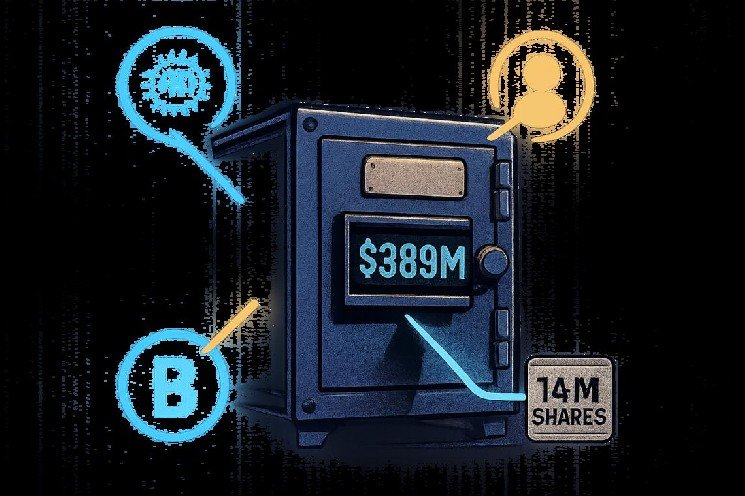
    Eightco Holdings has just given investors a detailed look at what’s sitting inside its treasury, and the numbers tell a story of a small-cap Nasdaq company betting big on three of the most talked-about trends in technology. According to a disclosure covering holdings as of August 19, 2026, Eightco Holdings investments now total approximately $389 million, spread across artificial intelligence, digital identity and the creator economy. The company, which trades under the ticker ORBS, also revealed it has been quietly buying back its own stock in large volumes over the past two weeks.

    Key takeaways

    • Eightco Holdings reports total assets of approximately $389 million as of August 19, 2026, at 6:00 p.m. ET.
    • The treasury includes a $90 million indirect stake in OpenAI, an $18 million investment in Beast Industries, and roughly 302 million Worldcoin ($WLD) tokens.
    • Eightco’s $WLD position equals about 8.4% of the token’s circulating supply, making it the largest publicly disclosed institutional holder globally.
    • The company repurchased about 14 million common shares in two weeks under its $125 million buyback program.
    • Eightco joined Pantera-led investors in a $52.5 million financing round for World Foundation.

    Eightco Holdings’ Asset Portfolio Overview

    Eightco’s balance sheet reads less like a typical Nasdaq small-cap filing and more like a venture portfolio wrapped in a public ticker. As of the August 19 snapshot, the company’s holdings totaled roughly $389 million across a mix of private-company stakes, digital tokens and cash.

    Treasury Composition and Valuation

    The breakdown includes a $90 million indirect stake in OpenAI held through special purpose vehicles, an $18 million investment in Beast Industries, and a smaller $1 million position in Mythical Games. On the crypto side, Eightco holds 301,971,219 Worldcoin tokens, valued at $0.37 per $WLD according to Coinbase pricing, plus 16,278 Ether. Rounding out the treasury is about $132 million in cash and cash equivalents. Together, these pieces make up the near-$389 million total that anchors the company’s strategy.

    Recent Share Repurchase Program

    Alongside the asset update, Eightco disclosed that it repurchased approximately 14 million shares of its common stock in the last two weeks. The buybacks fall under a previously announced $125 million share repurchase program, and the pace suggests management wanted to move quickly rather than spread the purchases out over months.

    Betting on AI, Digital Identity and the Creator Economy

    Eightco’s strategy is built around three megatrends the company expects to define the next decade: artificial intelligence, digital identity, and the creator economy. Rather than chasing all three broadly, Eightco has concentrated its capital into single, high-profile bets in each category — OpenAI, Worldcoin, and Beast Industries.

    OpenAI Stake Anchors AI Exposure

    The $90 million OpenAI stake represents about 23% of Eightco’s treasury assets, described as one of the highest disclosed concentrations of any publicly traded investment vehicle in a single private AI company. This OpenAI stake gives ORBS shareholders indirect exposure to a company whose consumer product, ChatGPT, ranks as the world’s top consumer AI app according to Sensor Tower. OpenAI has said its models now reach more than one billion active users and over two million businesses, with daily message volume climbing roughly 50% higher six months after users sign up.

    Why this matters: as OpenAI’s valuation and usage figures climb, Eightco’s treasury value becomes increasingly tied to a single private company’s trajectory — a concentration that amplifies both the upside and the risk tied to any liquidity event or roadmap shift at OpenAI.

    Worldcoin $WLD Holdings and Proof of Human

    On the digital identity side, Eightco’s Worldcoin $WLD holdings stand at nearly 302 million tokens, equal to about 8.4% of the circulating supply and roughly 29% of the company’s treasury. That makes Eightco the largest publicly disclosed institutional holder of $WLD anywhere in the world.

    Worldcoin is the native token of World, a Proof of Humanity network built by Tools for Humanity — co-founded by Sam Altman and Alex Blania — and overseen by the World Foundation. World’s Orb devices issue a privacy-preserving World ID meant to confirm that a user is a real, unique person rather than an AI agent. Under World’s business model, apps pay a fee per verification while individual users verify for free. Tools for Humanity has pointed to a combined $6.35 trillion revenue opportunity across 13 sectors, including banking, e-commerce, gaming, social media and agentic AI, as the addressable market for this kind of human-verification infrastructure.

    Beast Industries Investment

    The third leg of Eightco’s strategy is a $18 million creator economy investment in Beast Industries, representing about 5% of treasury assets. Beast Industries commands one of the largest direct-to-consumer audiences in the world, with combined platform followings topping 500 million, powered largely by MrBeast, the most-watched individual creator on YouTube. As AI tools make content production cheaper and more commoditized, distribution reach and audience trust — the exact assets Beast Industries has built at scale — become harder to replicate.

    World Foundation’s $52.5 Million Financing Round

    Beyond its own treasury holdings, Eightco has also stepped directly into the ecosystem it’s betting on. The company recently took part in a $52.5 million financing round for World Foundation, led by Pantera Capital with participation from Bain Capital Crypto, Selini Capital, Susquehanna Crypto and other investors. That move deepens Eightco’s ties to the infrastructure behind Worldcoin, rather than just holding the token itself, and signals the company sees value in supporting the network’s growth directly.

    CEO Confidence Amid Market Risks

    Kevin O’Donnell, Chairman and CEO of Eightco, framed the buybacks as a statement of conviction rather than a routine capital move. “We continue to believe ORBS’ common shares are undervalued to not only intrinsic value, but also the synergistic value of assets held,” O’Donnell said. “Our decision to repurchase 14 million shares in the past two weeks reflects the confidence we have in Eightco’s strategy, assets and future. We believe these share repurchases are an efficient and effective use of capital and increase shareholder value.”

    That confidence comes with real exposure to volatility. Eightco’s treasury value moves with the price of $WLD and ETH, both of which can swing sharply, and much of the portfolio’s worth depends on private companies — OpenAI and Beast Industries chief among them — where valuations aren’t set by public markets and liquidity events remain uncertain. Regulatory shifts around digital assets, AI applications and biometric verification technology could also affect how these holdings are treated going forward. For a company this concentrated in a handful of positions, the strategy’s payoff depends heavily on whether OpenAI, World’s Proof of Human network, and Beast Industries continue to grow roughly as expected.

    Still, the disclosure gives the market a rare, granular look at how one Nasdaq-listed company is translating three of tech’s biggest narratives — generative AI, human verification, and creator-driven media — into a single, tradable balance sheet.

    FAQ

    What is Eightco Holdings’ primary investment focus?

    Eightco Holdings focuses on three megatrends: artificial intelligence through its OpenAI stake, digital identity through Worldcoin, and the creator economy through Beast Industries.

    How much Worldcoin ($WLD) does Eightco hold?

    Eightco holds nearly 302 million $WLD tokens, representing about 8.4% of the circulating supply, making it the largest publicly disclosed institutional holder.

    What is the significance of Eightco’s share repurchase program?

    The repurchase of approximately 14 million shares under a $125 million program reflects management’s confidence in the company’s strategy and is aimed at enhancing shareholder value.

    Who is the CEO of Eightco Holdings and what is his view on the share repurchases?

    Kevin O’Donnell, Chairman and CEO, said the share repurchases demonstrate confidence in Eightco’s strategy and in the intrinsic and synergistic value of its assets.

    Article produced with the assistance of artificial intelligence and reviewed by the editorial team.

  • South Korea’s Budget Office Proposes 5-Year Crypto Loss Carryforward and Higher Tax Threshold Ahead of 2025 Rollout

    South Korea’s Budget Office Proposes 5-Year Crypto Loss Carryforward and Higher Tax Threshold Ahead of 2025 Rollout

    South Korea’s National Assembly Budget Office has recommended allowing virtual asset investors to carry forward trading losses for up to five years and raising the current tax exemption threshold of 2.5 million won (approximately $1,800), according to a report by Edaily. The proposals come as the country prepares to implement full-scale taxation on cryptocurrency gains starting January 2025.

    Key Proposals in the Tax Study

    The study, commissioned by the National Assembly Budget Office, outlines several measures aimed at addressing the practical challenges of taxing virtual assets. Among the most notable recommendations are:

    • Introducing a five-year carryforward for capital losses from virtual asset transfers, allowing investors to offset future gains against past losses.
    • Raising the minimum taxable threshold from the current 2.5 million won, which has been criticized as too low given the volatile nature of crypto markets.
    • Establishing more detailed tax standards for staking, lending, airdrops, and hard forks, which currently lack clear classification.
    • Introducing tax incentives to encourage trading on domestic South Korean exchanges, in an effort to prevent capital flight to overseas platforms.

    Background and Context

    South Korea has delayed its crypto tax regime multiple times, originally planned for 2022, due to market instability and industry pushback. The current framework, set to take effect in January 2025, would impose a 20% tax on annual gains exceeding 2.5 million won from virtual asset transactions. This threshold is significantly lower than the 5 million won exemption applied to stocks and other financial investments, a discrepancy that has drawn criticism from investors and lawmakers alike.

    The National Assembly Budget Office’s report acknowledges these concerns, noting that the low threshold could disproportionately affect smaller investors and discourage participation in the legitimate crypto market. The proposal to raise the exemption and introduce loss carryforwards aligns with international practices, such as those in the United States and Germany, where losses can be used to offset gains over multiple years.

    Implications for Investors and the Market

    If adopted, these recommendations would provide significant relief to South Korean crypto investors. The five-year loss carryforward would be particularly valuable in a market known for extreme price swings, allowing investors to recover losses against future profits. Raising the tax threshold would also reduce the compliance burden for casual traders, who may otherwise face taxes on relatively small gains.

    The proposed tax incentives for domestic exchanges are aimed at retaining trading volume within South Korea, where platforms like Upbit and Bithumb dominate. Without such measures, there is concern that traders might shift to overseas exchanges with more favorable tax treatment, reducing the effectiveness of the domestic tax regime and potentially undermining consumer protections.

    What’s Next

    The recommendations are not binding, but they carry weight as they come from the National Assembly Budget Office, which provides analysis to lawmakers. The final shape of the crypto tax rules will depend on legislative action in the coming months. With the January 2025 deadline approaching, stakeholders are closely watching whether the government will incorporate these proposals into the final framework.

    For now, investors and exchanges are advised to prepare for the upcoming tax regime while monitoring potential adjustments. The outcome will likely influence not only South Korea’s crypto market but also serve as a reference for other countries grappling with how to tax digital assets fairly and effectively.

    FAQs

    Q1: When will South Korea’s crypto tax take effect?
    The tax is scheduled to begin in January 2025, after multiple delays. The National Assembly Budget Office’s proposals, if adopted, could modify the rules before implementation.

    Q2: What is the current tax exemption threshold for crypto gains in South Korea?
    The current threshold is 2.5 million won (about $1,800) in annual gains. The Budget Office has recommended raising this threshold, though no new figure has been specified.

    Q3: How would a five-year loss carryforward work?
    Investors could deduct losses from virtual asset transfers against gains in the same year, and any unused losses could be carried forward to offset gains for up to five years, reducing overall tax liability over time.

    Related Reading

    • Upbit Adds NEXO to USDT Trading Pairs: What Traders Should Know
    • Nomura’s Laser Digital Registers as Crypto Business Operator in Japan
    • Upbit, Bithumb, and Coinone Place MANTRA (OM) on Delisting Watchlist: What Investors Should Know
    • Upbit and Bithumb Extend ZIL Delisting Review: What Traders Should Know
    • South Korea Moves to Empower FIU to Crack Down on Unregistered Crypto Firms
  • Bitcoin, Stocks and Gold Rip Higher While Bond Market Fear Festers

    Bitcoin, Stocks and Gold Rip Higher While Bond Market Fear Festers

    The session offered some breathing room after a bruising stretch in which rising long-term Treasury yields repeatedly hammered stocks lower. The Nasdaq Composite climbed 104.12 points, the NYSE Composite gained 194.68 points, the Dow Jones Industrial Average ripped 517.84 points higher, and the S&P 500 tacked on 32.83 points during Friday’s trading session.

    Even with that bounce, the real pressure point remained the bond market. Long-term Treasury yields had climbed toward multi-year highs as investors wrestled with sticky inflation, relentless government borrowing, and the swelling interest bill attached to federal debt. Higher yields bite because they raise financing costs for households and companies, while simultaneously making future corporate profits worth less in today’s dollars.

    Treasury Relief Fails to Kill the Fear

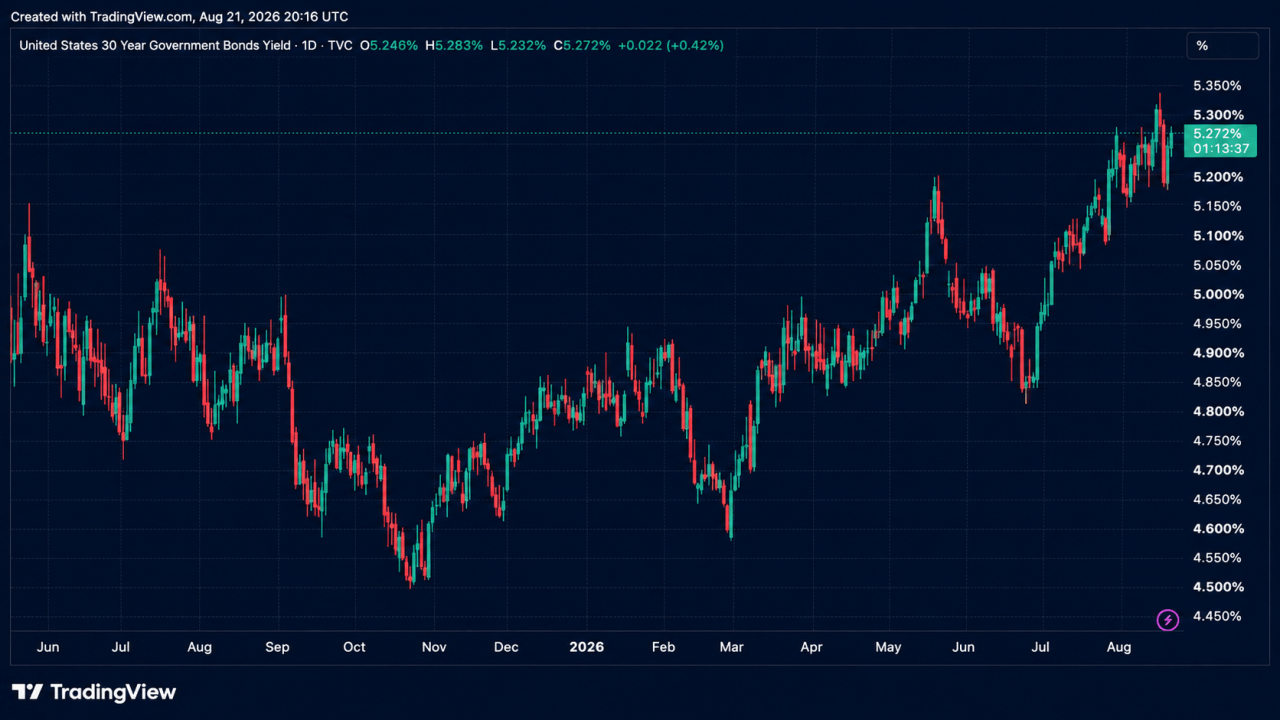
    Treasury Secretary Scott Bessent’s plan to expand purchases of outstanding longer-dated government bonds initially took some heat out of markets during the week. Those buybacks can lift bond prices and, in turn, push yields lower. But the relief proved thin because investors stayed locked on the forces driving yields higher, including massive deficits and oil-driven inflation risks tied to tensions involving Iran and the Strait of Hormuz. The U.S. 30-year Treasury bond yield stands at 5.273%.

    United States 30-Year Government Bond Yield via Tradingview on Aug. 21, 2026.

    That pressure explains why Friday’s gains hardly erased the week’s nerves. Financial stocks powered parts of the advance, while Ross Stores climbed after delivering stronger-than-expected quarterly results. Crypto-linked shares, including Coinbase, also caught a bid from bitcoin’s explosive move higher. Technology stocks, however, remained hostage to the bond market because high-growth companies get hit particularly hard when long-term yields climb.

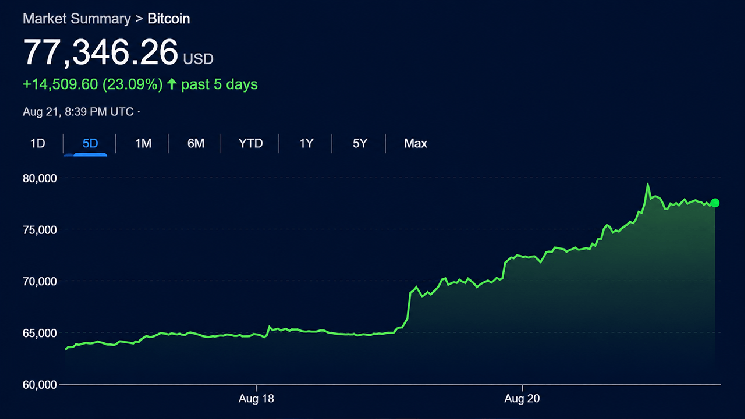
    Bitcoin delivered the sharpest contrast with the guarded mood in equities. Bitstamp $BTC/USD data over a four-hour timeframe shows the cryptocurrency ripping from a marked low near $62,653 to an intraday high near $79,461 before settling around $77,000. The run marked one of bitcoin’s strongest weeks since March 2023 and put the market’s swelling derivatives activity squarely under the microscope.

    Bitcoin Rally Lights Up the Derivatives Market

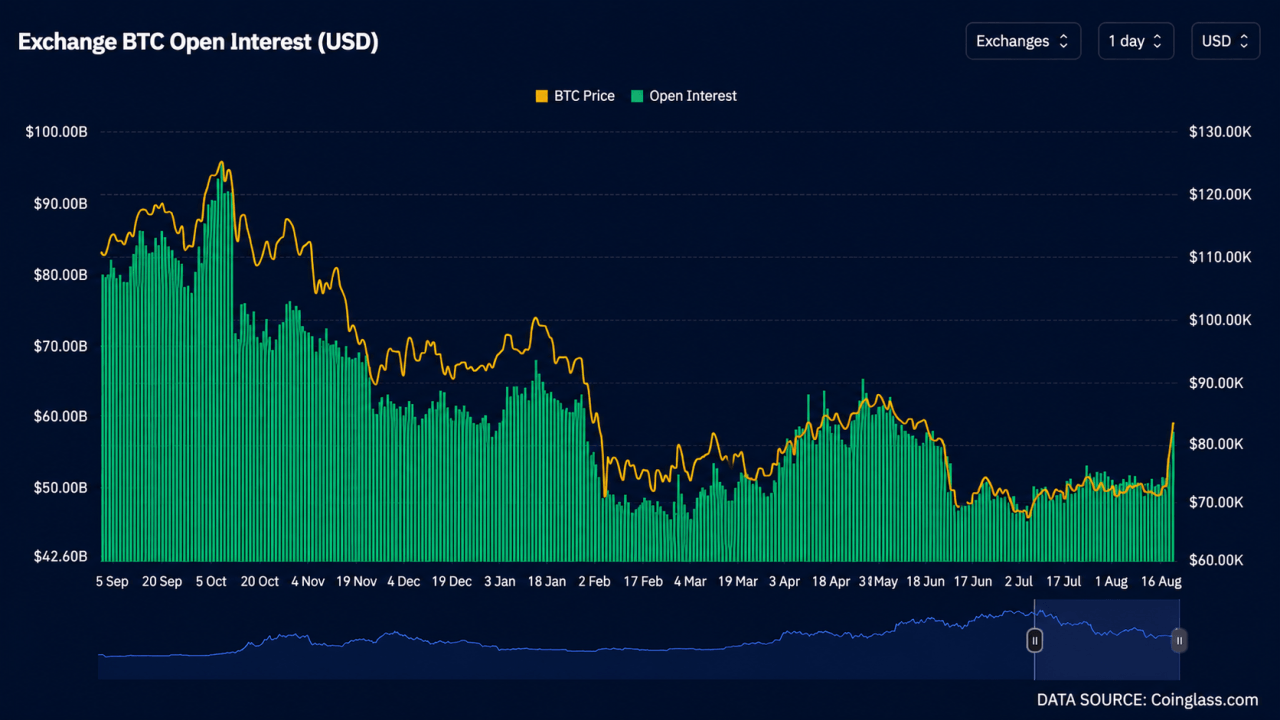
    Bitcoin futures open interest, the value of outstanding futures contracts, climbed sharply alongside the price. Exchange stats collected from coinglass.com show Binance carrying about $10.92 billion in bitcoin open interest and CME with $9.45 billion. CME’s open interest jumped 11.34% over 24 hours, while Binance’s rose 4.64%, showing that activity accelerated across both major venues.

    Bitcoin futures open interest (OI), according to stats collected from Coinglass.com on Aug. 21, 2026.

    Open interest is not automatically a bullish or bearish signal. While it reveals how much money is tied up in open positions, it cannot tell whether traders are positioned for gains or declines. Here, the increase followed a blistering price advance that triggered massive liquidations of leveraged short positions, or bets that bitcoin would fall. That kind of short squeeze can turbocharge a rally.

    The broader futures picture looked messier beneath the headline increase. Bybit, Gate, Kucoin, and Hyperliquid each recorded declines in open interest over the last 24 hours, while BingX logged a large percentage increase from a smaller base. That split shows the rally was not simply a leverage stampede across every venue. Instead, participation appeared concentrated in the biggest markets and in specific corners of the derivatives complex.

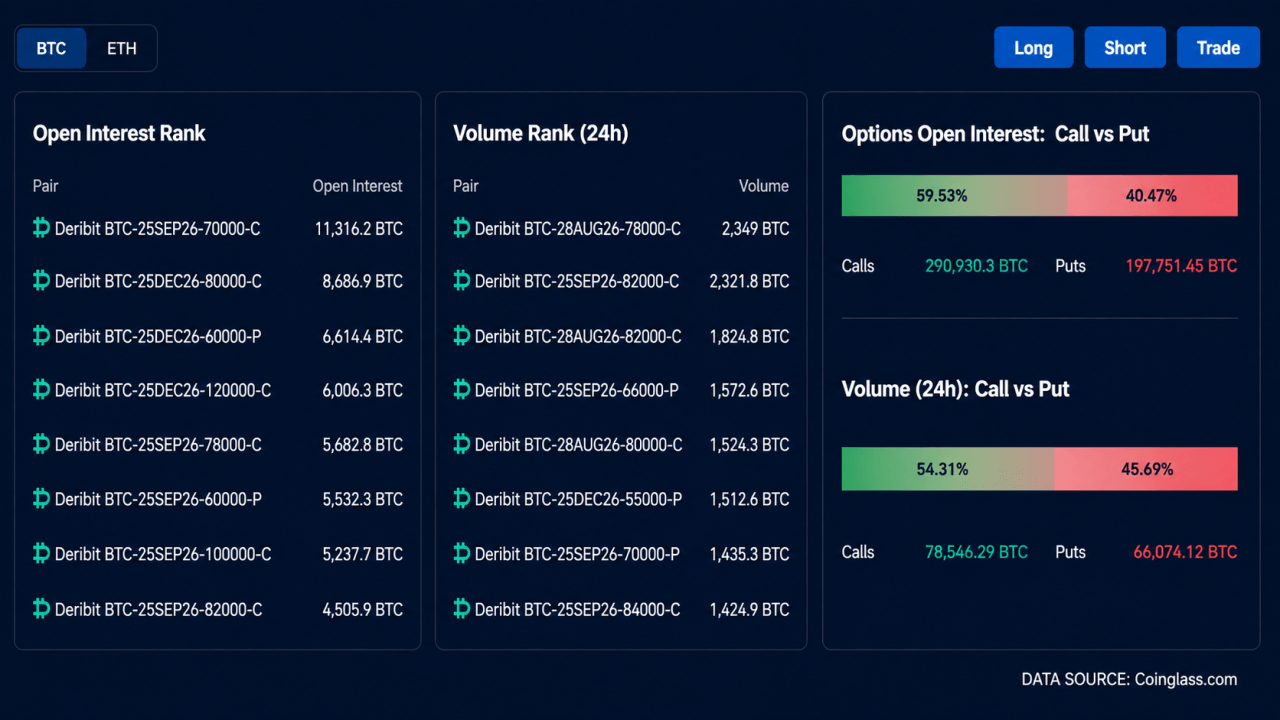
    Bitcoin options calls and puts on Deribit, according to stats collected from Coinglass.com on Aug. 21, 2026.

    On the other side of the derivatives map, options data showed a moderately bullish positioning tilt. Calls, which generally benefit when bitcoin climbs, represented 59.53% of bitcoin options open interest heading into the weekend, compared with 40.47% for puts. Calls also accounted for 54.31% of 24-hour options volume. The largest listed open-interest positions included December 2026 calls at $80,000 and $120,000, along with September calls at $70,000, $78,000, $82,000 and $100,000. Six figures is still firmly on the radar.

    Options Traders Chase Upside but Keep Protection

    Those positions should not be mistaken for clean-cut price targets. Investors routinely buy calls for upside exposure while buying puts to protect a portfolio against a reversal. The appearance of large put positions at $60,000 and $66,000 shows that downside insurance remains important right now, even while traders loaded up on upside exposure.

    The options market’s “max pain” measure, specifically from Deribit, also highlighted the gulf between bitcoin’s Friday price and several near-term strike concentrations. Max pain is the price where outstanding options would, theoretically, inflict the greatest aggregate losses on option buyers at expiration. Deribit’s data puts the Aug. 22 level near $74,000, followed by roughly $69,000 on Aug. 23 and $66,000 around Aug. 28.

    Institutional demand supplied another major piece of the advance. U.S. spot bitcoin exchange-traded funds (ETFs) are on track for more than $1 billion in weekly inflows, their strongest pace since January. These funds give investors $BTC exposure through a traditional brokerage account, making it easier for institutions and individuals to participate without directly holding or managing the cryptocurrency.

    Gold and Silver Catch the Same Bid

    Bitcoin was hardly the only asset reacting to the shift in yields and the dollar. The precious metal gold traded at $4,617.50 per ounce on Friday at Wall Street’s close, up 2.15% on the day, while silver traded at $69.52, gaining 1.92%. Platinum climbed 2.85%, and palladium added 1.29%, according to spot-price data.

    Gold and silver pay no interest, so they become relatively more attractive when yields retreat or when investors fear inflation and currency risks will eat into fixed-income returns. A weaker dollar also makes dollar-priced metals cheaper for buyers holding other currencies. The metals rally, therefore, captured both the temporary cooling in bond-market stress and the deeper anxiety surrounding debt, inflation, and geopolitical risk.

    The next test is whether yields stay contained after the Treasury’s intervention and whether Federal Reserve boss Kevin Warsh delivers clearer signals at the Jackson Hole symposium. Investors will also track oil prices, developments around Iran and the Strait of Hormuz, bitcoin ETF flows, and whether the leading crypto asset can defend its gains without another aggressive build-up in leveraged futures positions.

  • Solana is undergoing a four-phase update to double block production speed! Here are the details

    Solana is undergoing a four-phase update to double block production speed! Here are the details

    The Solana network is preparing to roll out a comprehensive upgrade plan aimed at increasing block production speed. According to information reported by BeInCrypto, the network aims to reduce its current 400-millisecond block production interval to 200 milliseconds. Following the completion of the four-phase upgrade, Solana is planned to produce a new block approximately every 0.2 seconds.

    This change is considered a significant step towards increasing Solana’s transaction capacity and overall network performance. Shortening block production time can lead to faster transaction processing and an improved user experience on the network. Faster block production, especially during periods of high transaction volume, can help the network meet demand.

    The first phase of the upgrade is planned to be activated with epoch number 1020. In the Solana network, epochs represent periods covering a specific number of slots, playing a crucial role in protocol updates and changes to network parameters.

    All four planned changes have already been integrated into the Agave validator software developed by Anza, the client for the Solana network. Instead of being rolled out all at once, the updates will be implemented gradually. This will allow developers to monitor the impact of each phase on the network before moving on to the next change.

    Following the successful implementation of all stages, Solana’s block production time will be reduced from 400 milliseconds to 200 milliseconds. This means the network’s current speed will be approximately doubled.

    The update, implemented in line with Solana’s scalability and high processing capacity goals, aims to improve the network’s performance while enhancing its decentralization and security features. Developers are opting for a phased approach to the upgrade, allowing for controlled handling of potential technical issues.

    *This is not investment advice.

  • DOJ Charges Five Iran-Based Hackers in HBO Breach Involving $6M Bitcoin Demand

    DOJ Charges Five Iran-Based Hackers in HBO Breach Involving $6M Bitcoin Demand

    The U.S. Department of Justice has expanded its case against members of the Iran-based Mabna Institute, adding charges against eight individuals and linking five of them to the 2017 hack of HBO that included a ransom demand of roughly $6 million in Bitcoin. The new indictments bring the total number of defendants in the broader cyber-espionage case to 17.

    Details of the HBO Hack and Indictment

    According to the DOJ, Behzad Mesri was previously indicted separately for allegedly hacking HBO’s systems, stealing internal data, and demanding a Bitcoin ransom of about $6 million. The latest charges allege that five of the newly charged defendants directly participated in that operation alongside Mesri. The Mabna Institute is accused of conducting cyberattacks against U.S. and international universities, companies, and government agencies on behalf of Iran’s Islamic Revolutionary Guard Corps (IRGC) and other entities.

    Broader Context of Iranian Cyber Operations

    The Mabna Institute has been linked to a series of intrusions dating back to at least 2013, targeting over 300 universities in the U.S. and abroad. The group’s activities have been characterized by U.S. officials as systematic theft of intellectual property and sensitive data. The new charges underscore the ongoing threat posed by state-sponsored hacking groups and the increasing use of cryptocurrency in ransom demands.

    Implications for Cybersecurity and Crypto Regulation

    This case highlights the intersection of cybercrime and digital currencies, as Bitcoin’s pseudonymous nature has made it a preferred payment method for ransomware attacks. The DOJ’s actions signal a continued effort to hold state-sponsored hackers accountable, even when they operate from jurisdictions with limited extradition treaties. For businesses and institutions, the case serves as a reminder of the persistent risks of cyber intrusion and the importance of robust security measures.

    Conclusion

    The expanded indictments against the Mabna Institute members mark a significant step in U.S. efforts to combat state-sponsored cybercrime. By linking the HBO hack to a broader campaign of intrusions, the DOJ is reinforcing its commitment to pursuing justice across borders. As the legal proceedings unfold, the case is likely to draw further attention to the challenges of prosecuting international cybercriminals and the role of cryptocurrency in modern extortion schemes.

    FAQs

    Q1: What is the Mabna Institute?
    The Mabna Institute is an Iran-based group accused by U.S. authorities of conducting cyberattacks on behalf of Iran’s Islamic Revolutionary Guard Corps (IRGC). It has been linked to intrusions targeting universities, companies, and government agencies worldwide.

    Q2: What was the HBO hack about?
    In 2017, hackers breached HBO’s systems, stole internal data, and demanded a ransom of approximately $6 million in Bitcoin. The DOJ alleges that Behzad Mesri and five other newly charged defendants were involved in this operation.

    Q3: How many people have been charged in connection with the Mabna Institute?
    With the latest charges, a total of 17 individuals have been indicted in connection with the Mabna Institute’s alleged hacking activities. The new charges add eight defendants, five of whom are linked to the HBO hack.

  • Ripple backs an RLUSD credit fund amid XRP’s best week in months

    Ripple backs an RLUSD credit fund amid XRP’s best week in months

    Ripple is backing a new institutional credit fund that will lend its $RLUSD stablecoin to fintech and payments companies on the $XRP Ledger, alongside lending platform Clearpool and credit manager Cicada Partners.

    The fund will provide working-capital loans denominated in $RLUSD, per a release shared with CoinDesk, with Cicada sourcing borrowers, setting loan terms and monitoring credit risk. Clearpool is building the infrastructure used to create and manage the lending pools, while Ripple provides capital as an investor alongside other institutions.

    Neither the size of the fund nor Ripple’s commitment was disclosed.

    None of it is live on the $XRP Ledger’s main network yet, however. Clearpool is testing the integration on a development network, and the two ledger features underpinning the product, a lending protocol known as XLS-66 and single asset vaults under XLS-65, are still going through the network’s amendment voting process, as CoinDesk earlier reported.

    Those two do the work the fund needs. The lending protocol handles issuing and repaying loans directly on the ledger. The vault system pools money from several lenders under a manager who decides where it goes, which in this case is Cicada.

  • MANTRA token plunges 18% to record low as blockchain halts after exploit

    MANTRA token plunges 18% to record low as blockchain halts after exploit

    “We have identified the vulnerability and are proceeding to prepare a patched release,” the team said.

    MANTRA’s network operators, known as validators, remain offline while developers prepare and test the fix. Restarting the blockchain will require coordination with the wider group of operators that verify transactions and keep the network running.

    The project is also tracing fund movements and working with exchanges while it assesses the damage. It has not disclosed which software was exploited, how the attack worked or whether any assets were lost.

    “Our assessment of the full impact is ongoing and we are not yet in a position to confirm the complete scope,” MANTRA said.

    The outage affects the chain’s public endpoints, validators, bridge operations and MANTRA-managed links used to communicate with other blockchains.

    The incident follows a difficult period for the project. MANTRA’s former OM token collapsed more than 90% in April 2025 in a bizarre sell-off, wiping out more than $5 billion in market value.

    Inveniam Capital Partners, which invested $20 million in MANTRA last year, said in June it planned to acquire the project. The deal is expected to close in the third quarter.

  • Binance launches Agent OS and MCP trading server

    Binance launches Agent OS and MCP trading server

    Binance launched Binance Agent OS and its Model Context Protocol Server on Aug. 20, giving compatible artificial intelligence applications controlled access to market data and trading functions.

    The developer platform combines Binance APIs, Wallet Agentic Hub, x402, Skill Hub and MCP support. Binance said the broader system is intended to reduce the need for developers to build separate connections for each crypto function.

    Its Binance MCP Server acts as the connection layer between supported AI clients and the exchange. Users can authorize compatible applications without storing Binance API keys locally, according to the company’s announcement.

    Availability depends on the user’s location, account status and access to individual Binance products. The launch does not make every Binance function available through every AI application.

    Binance Agent OS combines five developer components

    Agent OS brings several existing and new developer services into one platform. Binance APIs provide access to trading, market, wallet and blockchain functions, while Wallet Agentic Hub supports wallet interactions controlled through user permissions.

    Meet Agent OS – a new way to build, deploy and use AI agents on Binance.

    Bring Binance market intelligence, payment, on-chain, data and trading capabilities directly into your AI workflow.

    Build. Analyze. Trade. With AI. 🫡

    Experience it ↠ https://t.co/O4E5Dmg42K pic.twitter.com/1JIkcaP4Ot

    — Binance (@binance) August 20, 2026

    Binance x402 provides payment and settlement tools for transactions initiated by software agents. Skill Hub gives developers a directory of modular functions covering trading, wallets, market information and blockchain activity.

    The MCP Server provides a standardized method for compatible AI clients to discover and call those functions. MCP is an open protocol for connecting AI models with external services, data sources and software tools.

    Binance lists Claude, Claude Code, Codex, ChatGPT and VS Code as compatible applications. This means those clients can connect to the server when they support the required MCP setup. It does not mean that Binance controls or operates those applications.

    As previously reported, Coinbase also gave AI agents the ability to spend and trade crypto through wallets equipped with programmable controls. The launches show exchanges competing to become the execution layer for AI applications.

    The MCP Server supports trading but blocks withdrawals

    Public market information does not require authentication. An AI client can retrieve tickers, order books, candlestick data and funding rates without receiving access to a Binance account.

    Authorized account functions include balance checks and internal transfers. Users can also grant access to supported spot, margin and Convert products. The system covers USDⓈ M and COIN M futures where the account and region are eligible.

    Binance said agents cannot withdraw crypto to external addresses through the MCP Server. They also cannot move assets from a main Binance account into the dedicated Agentic subaccount.

    Users must fund that subaccount themselves. The separation limits the assets available to an authorized agent, although it does not remove trading losses, faulty instructions or the risks associated with granting software transactional permissions.

    The company advises users to review order and transfer details before confirming them. Scopes should also be limited to functions required for the intended task.

    In related coverage, Base introduced a similar architecture that keeps transaction approval under the user’s control while allowing AI applications to prepare wallet actions.

    Developers can connect through one MCP endpoint

    Developers and users can connect a compatible client to Binance through its published MCP endpoint. They must then create and fund an Agentic subaccount before authorizing account related actions.

    The subaccount can receive an optional read only view of the main account. Trading and transfers remain confined to the funds and permissions assigned to the Agentic environment.

    Binance has not announced a deadline for adding more applications or functions. The company said Agent OS provides a foundation for expanding wallet capabilities, developer tools and agent skills over time. Such additions remain forward looking until Binance publishes product details.

    The platform also includes Binance x402 as agent payment infrastructure. The protocol uses the HTTP 402 payment status to support automated payments between applications. As crypto.news reported, the standard has gained support from major cloud and payment companies.

    Binance has published technical setup instructions through its developer documentation. Users must still check regional product restrictions and review every permission before making funds available.

  • Bitcoin news: BTC reclaims $74,000 as ETFs see $5.3B volume

    Bitcoin news: BTC reclaims $74,000 as ETFs see $5.3B volume

    Bitcoin’s latest rally has been backed by a sharp increase in institutional activity. U.S. spot Bitcoin ETFs recorded more than $5.3 billion in trading volume as BTC reclaimed $74,000 for the first time in 86 days.

    BlackRock’s IBIT dominated activity with $4.44 billion in volume. Fidelity’s FBTC came next at $438 million and Grayscale at $208.8 million. Meanwhile, Bitwise, ARK Invest, VanEck, Morgan Stanley, Franklin Templeton, Invesco, Valkyrie, WisdomTree and Hashdex accounted for the remaining volume as per data.

    $517M Flows as Bitcoin Jumps 17%

    U.S. spot Bitcoin ETFs also attracted $517.19 million in net inflows, their strongest inflow day since May 4. Eight of the 12 funds recorded positive flows. BlackRock’s IBIT led with $284.7 million, followed by ARK and 21Shares’ ARKB at $77.7 million. Fidelity’s FBTC came next at $62.4 million.

    The ETF activity came as Bitcoin surged roughly 17% in two days. It added around $11,000 and more than $220 billion to its market capitalization.

    The rally has also triggered a major short squeeze. More than $3.6 billion in short positions have been liquidated over the past 72 hours, including $2.75 billion in Bitcoin shorts on Wednesday. Over the following 24 hours, another $783.2 million in Bitcoin positions were liquidated. Of this, $747.7 million came from shorts, according to CoinGlass data.

    What Fueled this Rally?

    • The rally followed the U.S. Treasury Department’s decision to at least double liquidity-support buyback operations for longer-dated nominal coupon securities. This applies in the 10- to 30-year segment.
    • Additional catalysts included the SEC’s latest crypto proposal. There was also a White House meeting between President Donald Trump and prominent crypto executives, helping trigger the unexpected move higher.

    McGlone Warns Rally Could Fade

    Despite the surge, Bloomberg’s Mike McGlone remains bearish. He described the move as “a bounce within the purge”, arguing that August can produce short squeezes even during a broader bear market.

    McGlone criticized Bitcoin’s volatility and correlation with stocks, saying institutional investors face unfavorable risk-reward characteristics. He also argued that the rapid expansion of the wider crypto market has created excessive supply. Consequently, he expects Bitcoin to potentially roll over by year-end.

    While he supports blockchain technology, McGlone argues Bitcoin’s original peer-to-peer cash use case has weakened. This comes with the emergence of crypto-dollar alternatives.