Solana has reached a significant milestone by surpassing the 1 million mark in the number of tokenized stock holders. This achievement is considered a science fiction feat just two years ago. Solana holds approximately 95% market share in on-chain tokenized stock trading and continues to outperform its competitors in this area.
Solana’s Rise in Numbers
The supply of tokenized shares on Solana reached a record high of $684 million in mid-September, representing a 47% increase in just three weeks. During the same period, the 30-day real-world asset trading volume reached $3.3 billion. Among Solana’s tokenized shares, NVDAx, a tokenized representation of NVIDIA shares, leads in holder numbers. New listings like Nike have accelerated this trend, moving beyond technology-heavy portfolios. Furthermore, integration with platforms like Pump.fun has attracted users who previously lacked access to tokenized shares.
The Meaning of Tokenized Shares
Tokenized shares, as blockchain-based tokens, represent ownership or exposure to traditional shares. These tokens are traded on-chain, exchanged almost instantly, and are accessible 24/7. On Solana, primary issuers like xStocks distribute them through networks like Backpack Securities.
Points to Consider
While the figure of 1 million seems impressive, this number measures wallet addresses, not verified unique individuals. A person may have multiple wallets, and incentive programs can inflate these numbers. As of the end of September, the verified number was recorded as 900,000. Furthermore, the composition of these wallets is also important.
If the majority of growth is driven by users holding almost insignificant positions, the headline figure might appear more impressive than the underlying economic activity warrants. However, supply and volume figures tell a more solid story; a total supply of $684 million and a monthly volume of $3.3 billion reflect the true flows of capital.
European financial authorities warned that an advanced quantum computer could undermine cryptography used to secure blockchains, saying the threat could emerge before the technology has a viable commercial application.
The warning from the Joint Committee of the European Supervisory Authorities (ESAs), which includes the European Banking Authority (EBA), European Securities and Markets Authority (ESMA) and European Insurance and Occupational Pensions Authority (EIOPA), brings fresh urgency to a long-running question for bitcoin of whether to freeze or not freeze the BTC in legacy wallets. In the event that quantum computers one day do become capable of breaking bitcoin’s cryptography, roughly 6.9 million bitcoin, worth roughly $586 billion, are currently vulnerable, according to Cryptoquant.
“Threats could materialize earlier than any viable commercial application,” the authorities said in their Autumn 2026 Risk and Vulnerabilities report released Wednesday. An advanced quantum computer “could undermine some cryptography systems widely used to secure communications, transactions, databases and blockchains,” according to the report..
Although the report does not mention timelines for quantum computing becoming commercially viable, a recent IBM report says it will be in use in four years or less.
As global bond yields rise, the usual narrative frames it as bearish for bitcoin
$BTC$83,262.77
. Yet over most of $BTC’s history, the asset has shown little to no consistent correlation with bonds.
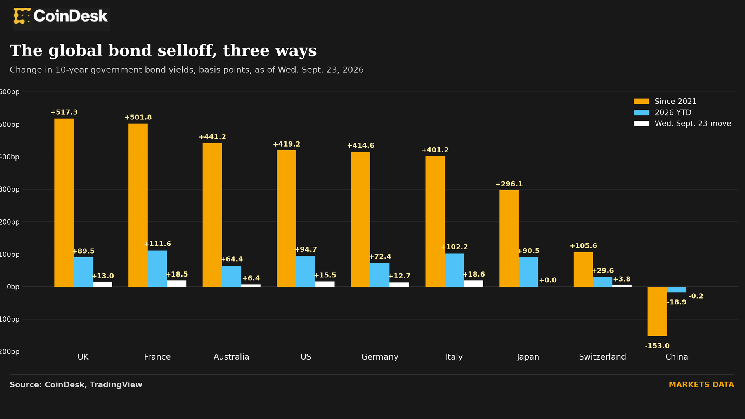
Yields snapped back into focus Wednesday. The U.S. 10-year jumped 15 basis points to its highest level since 2007, topping 5.13%, and pulled yields higher across the globe, as the feature image shows.
The standard interpretation is that as yields climb, the opportunity cost of holding non-yielding assets like bitcoin and gold rises, potentially pulling money toward bonds instead. In short, it’s a headwind, not a tailwind, for crypto.
That logic makes sense on paper. But correlations don’t back it up.
The 90-day correlation between bitcoin’s daily returns and the U.S. 10-year yield’s daily moves is just −0.18, according to data analyzed by CoinDesk. That’s close to zero and almost indistinguishable from no relationship at all.
Longer windows show the same thing, with the 180-day correlation at −0.06 and the 1-year figure at −0.03. Bitcoin is equally uncorrelated to yields of other nations.
U.S. Treasury yields across the entire curve are pushing to new highs as traders prepare for a longer stretch of tighter monetary policy. CME FedWatch puts the 4.75% to 5% federal funds range as the likely outcome for June 2027.
That would mean four quarter-point hikes from today’s 3.75% to 4% range. Meanwhile, the Federal Reserve has already raised the fed funds rate by 25 bps this month.
The pressure is across the entire Treasury market. The 20-year yield is approaching 5.5%, which has sent the long-bond ETF (TLT), to all-time lows below $80. While the 10-year yield is above 5.1%, levels last seen in 2007. Borrowing costs are rising beyond the U.S. too, with government bond yields under pressure in France, Germany, the U.K. and Japan.
Higher yields and a stronger dollar are weighing on risk assets. The dollar index has climbed above 101, up 3% this year. While, bitcoin has fallen below $83,000, from its local high of $87,500 and gold remains just above $4,200, down 25% from its January all-time high.
Polygon permanently removed 100 million $POL tokens with an estimated valuation of $10.12 million.
The liquidated volume equates to approximately 1% of the asset’s total issued supply.
The transaction utilized funds accumulated within the network’s fee-collector contract, which held nearly 121 million $POL.
Polygon burned 100M $POL tokens this Wednesday via a direct transaction on its blockchain. The Executive Director of the Polygon Foundation, Sandeep Nailwal, confirmed the execution in a post on his X account.
BURN COMPLETE: 100 MILLION $POL (~1% of $POL total supply) IS OFFICIALLY BURNED PERMANENTLY.https://t.co/3MOAw9eD8o pic.twitter.com/incm4389Df
— Sandeep | CEO, Polygon Foundation (※,※) (@sandeepnailwal) September 23, 2026
The transfer originated from an address marked with the contractual suffix «0xDEAD» and was routed to the core $POL token contract. Through this technical procedure, the assets were rendered entirely irrecoverable for any future secondary market circulation.
The source of the funds did not involve the foundation’s operational budget or institutional treasury reserves. Instead, the capital stemmed from the steady accumulation of gas generated by network users over recent months.
According to a technical report from crypto exchange KuCoin, processing fees on Polygon split into two specific components upon transaction validation: a priority fee and a mandatory base fee.
Validators responsible for block production receive priority fees as an incentive for their computational work. Conversely, base fees are automatically redirected to a collector smart contract designed to aggregate network surpluses.
Prior to this operation, the collection module held approximately 121 million units of $POL. With the transaction executed on September 23, 2026, the system consumed the vast majority of that accumulated reserve.
Technical mechanics of the EIP-1559 framework and community execution
Polygon’s technical infrastructure has operated under a model similar to the EIP-1559 improvement proposal since January 2022. Official protocol documentation notes that this mechanism aims to establish a direct, predictable correlation between actual network activity and the systematic reduction of tokens in circulation.
The key innovation within this deployment lies in the functional decentralization of future burns. Contract parameters allow any community participant to trigger the burn function once contract balances reach protocol-approved thresholds.
Under this framework, supply reductions are expected to occur on a roughly quarterly cadence. According to details shared by Polygon developers, the actual pace of these burns will depend strictly on the volume of transactions paying base fees across the ecosystem.
The secondary market did not immediately reflect the supply contraction. As of 7:34 a.m. UTC on September 23, 2026, the $POL token traded at $0.1014 following a 6.46% decline over a 24-hour window, according to data from CoinMarketCap.
Over the seven-day period preceding the transaction, the asset maintained a 10% gain. Total market capitalization stood at $1.07 billion, while 24-hour trading volume surged 77% to reach $228.83 million on the day.
Market commentary suggests that price absorption following supply reduction events tends to unfold gradually due to broader market liquidity dynamics.
The next evaluation cycle for automated $POL token burns will depend on the balance reported by the network’s collector contract at the close of the fourth quarter of 2026.
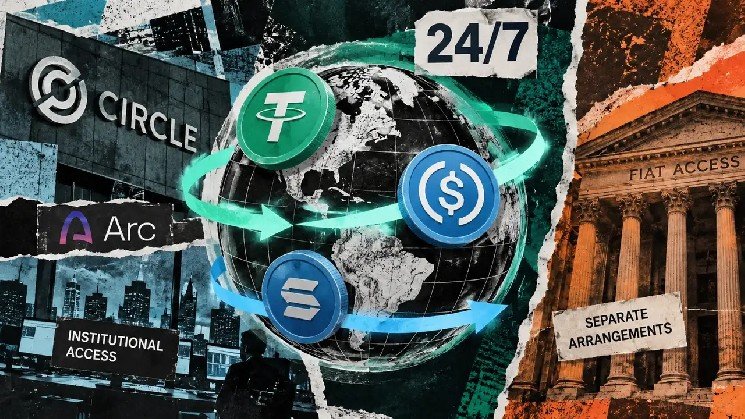
Circle has switched on 24-hour stablecoin foreign-exchange settlement on Arc, targeting a global FX market that moves nearly $10 trillion daily.
The service, called StableFX, allows screened businesses to request competing quotes from multiple liquidity providers and settle both sides of a stablecoin currency trade simultaneously on Circle’s newly launched blockchain. Users can choose near-instant settlement or defer completion to an agreed window, extending institutional FX activity beyond conventional banking hours.
Circle said much of the global currency market still relies on infrastructure designed around banking schedules even as payments, crypto trading and digital commerce increasingly operate continuously. StableFX is its attempt to move part of that market onto programmable settlement rails.
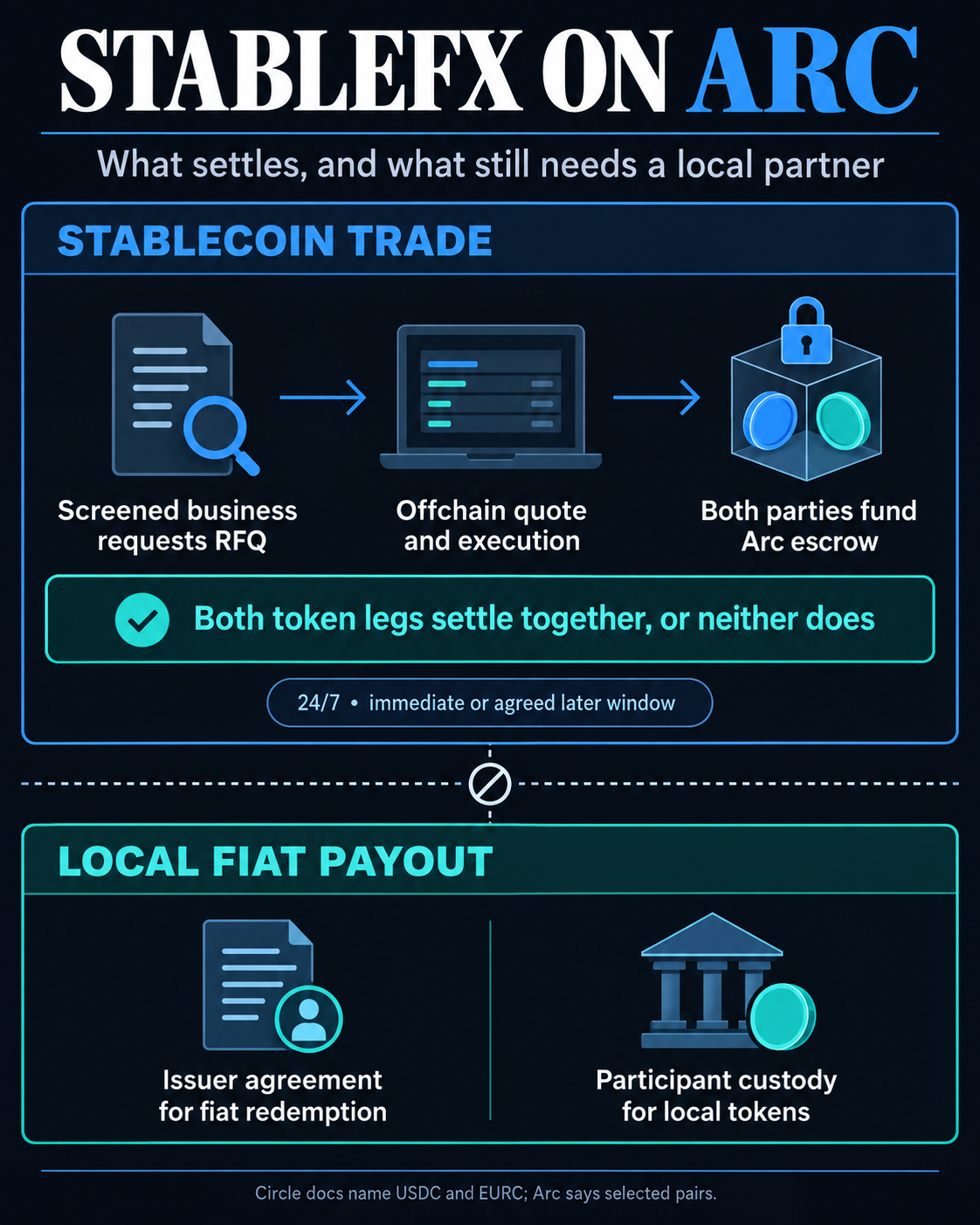
The system separates trade execution from settlement. Businesses submit a currency pair, amount, and preferred settlement window through a request-for-quote process, allowing approved liquidity providers to compete for the order. Execution happens off-chain before counterparties fund a smart-contract escrow on Arc.
Settlement then occurs on a payment-versus-payment basis: both stablecoin legs transfer together, or neither does. That structure is designed to reduce settlement risk while allowing businesses to contract with Circle once and access multiple vetted counterparties through the same venue.
Circle Chief Executive Jeremy Allaire described StableFX as a “strong emerging primitive” for atomically settled, real-time onchain foreign exchange, pointing to the stablecoin issuers and market participants being assembled around the service.
Arc pushes beyond payments into institutional FX infrastructure
The launch gives Arc an immediate institutional use case less than a week after Circle brought the blockchain to mainnet on Sept. 16.
Circle’s developer documentation currently names $USDC and euro-denominated $EURC, including an example of an exchange between the two tokens. Circle has said it will add additional local stablecoin pairs, though it has not published a complete list of pairs already available for live StableFX trading.
That distinction could determine how quickly the service expands beyond dollar-euro transactions. Circle listed a wider group of stablecoins as active or onboarding to Arc at mainnet launch, but blockchain participation does not automatically make each token available through StableFX.
Access is also restricted. Circle screens counterparties and limits StableFX to eligible incorporated businesses, positioning the service for payment companies, financial institutions and corporate treasury desks rather than retail traders.
For those firms, the attraction is partly operational. A payments company needing to rebalance stablecoin liquidity across currencies could execute the trade overnight or during a weekend rather than wait for traditional banking rails to reopen. Deferred settlement also gives treasury teams flexibility to match execution with their funding schedules.
The harder part begins after settlement.
StableFX exchanges digital currencies but does not automatically turn a local-currency stablecoin into cash in a recipient’s bank account. Firms using partner-issued stablecoins still need arrangements with their issuers for deposits and redemptions, suitable custody, and local payout infrastructure.
Circle Mint can provide $USDC and $EURC liquidity and fiat conversion in supported markets, but that access does not extend automatically to tokens issued by other companies.
Polygon Foundation CEO Sandeep Nailwal announced a significant supply development for $POL, the native token of the Polygon ecosystem. According to Nailwal’s statement dated September 24th, a total of 100 million $POL tokens have been permanently withdrawn from circulation.
Nailwal stated in a social media post that 100 million POLs were “permanently incinerated.” This amount reportedly represents approximately 1% of the total $POL supply.
Token burning means permanently removing a certain amount of cryptocurrency from circulation by sending it to an inaccessible address. After this process, the burned tokens cannot be reused or reintroduced into the market. This change in the $POL supply directly impacts the total number of tokens in the Polygon ecosystem.
The announcement by the Polygon Foundation is being closely watched, particularly in terms of the token economy and circulating supply. Burning 100 million $POL tokens means that approximately 1% of the total supply has been permanently removed from the system.
Sandeep Nailwal did not provide additional details in his post regarding the reasons for the token burn or the potential impact of the operation on Polygon’s future token economy. The statement also did not include any information about a new supply arrangement for $POL following the burn.
$POL stands out as the native token used for network activities and various transactions within the Polygon ecosystem. Supply changes in Polygon’s token structure are significant for the ecosystem’s economic model.
With the permanent burning of 100 million $POL tokens, approximately 1% of the token supply has been removed from circulation. However, Nailwal’s statement did not include any assessment of the impact of this development on $POL’s market price or investor behavior.
SEC Commissioner Mark Uyeda said the agency dropped some crypto lawsuits partly to protect its credibility, arguing that regulators should not defend legal positions they expect to abandon.
Speaking on Sept. 23, Uyeda said continuing to defend those positions in court could weaken confidence in the agency if its legal interpretation later changes. His comments were reported by Eleanor Terrett, host of the U.S. podcast Crypto in America.
🚨NEW: SEC Commissioner @MarkUyedaUS says the agency dropped several crypto cases inherited from the prior administration because continuing to defend legal interpretations it was preparing to reverse would have “hurt the SEC’s credibility.”
“I’m not about to have our… pic.twitter.com/FjsYE1ICbE
— Eleanor Terrett (@EleanorTerrett) September 23, 2026
SEC Moves Toward Rulemaking
Uyeda described the change as a “180-degree shift” in how the SEC handles crypto-related legal questions. He has previously criticized the agency’s reliance on enforcement actions, arguing that clearer rules should address issues affecting the industry.
Related: Ripple’s David Schwartz Links SEC Experience to Glock’s Connecticut Lawsuit
The SEC has recently moved toward rulemaking and temporary regulatory relief for parts of the crypto market.
Innovation Exemption Tests Tokenized Stocks
Uyeda described the SEC’s Innovation Exemption as “a kind of pilot.” The temporary framework allows certain onchain venues to trade tokenized U.S. stocks under specific conditions.
The SEC said the exemption will allow the agency to observe how these markets operate while considering longer-term rules. The commission has also requested public feedback on the framework.
Related: Russia to Let Market Shape Crypto Rules as Licensing Deadline Nears
Uniswap’s [$UNI] price rallied 15.17% at press time, after CME revealed plans for regulated Futures, as the surging spot activity strengthened the catalyst-driven advance.
On the 22nd of September, CME Group announced the planned Futures activity, which will launch on the 19th of October, subject to regulatory approvals.
This announcement gave $UNI exposure to another regulated derivatives venue as market participants reacted ahead of the scheduled launch. Trading activity around the token also expanded rapidly following the catalyst, with the spot volume jumping 72.33% to $2.14 billion.
Spot buyers keep control of the rally
After the announcement triggered huge market participation, the spot positioning also offered stronger support for $UNI.
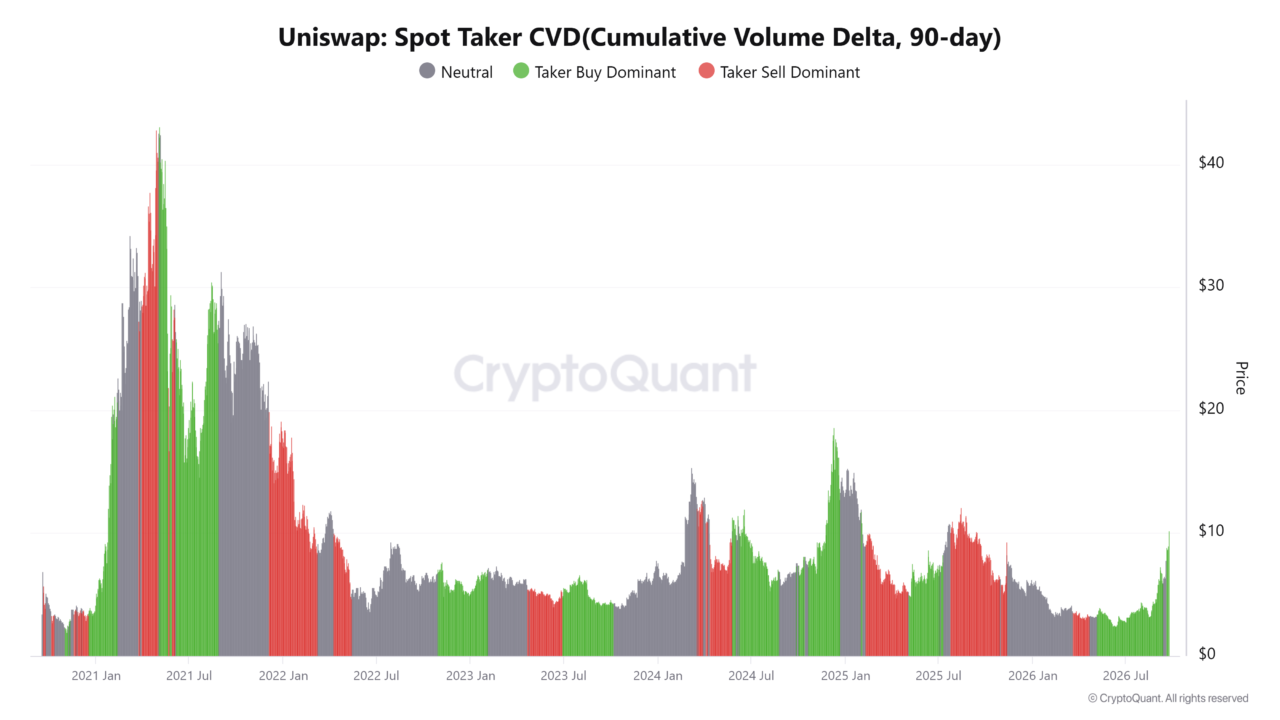
In particular, the Spot Taker CVD metric preserved buyer dominance, implying the aggressive bulls continued taking available liquidity from bears.
The Futures traders, meanwhile, became less resistant to the advance. The Futures Taker CVD shifted from seller dominance to neutral positioning as derivatives selling eased.
More importantly, the Futures buyers had not taken control yet, but rather sellers simply lost their earlier dominance. Therefore, the spot buyers remained the clearer driving element behind $UNI’s price expansion.
Eventually, in case the futures positioning shifts towards buyers, the derivatives demand could provide another layer of support. The persistent neutrality, however, would leave spot traders carrying more responsibility for extending the price recovery.
Uniswap Spot Taker CVD on CryptoQuant
Whales remain active near the barrier
Notably, larger market participants also maintained a significant edge over the retail traders as the $UNI price pushed towards its key weekly resistance.
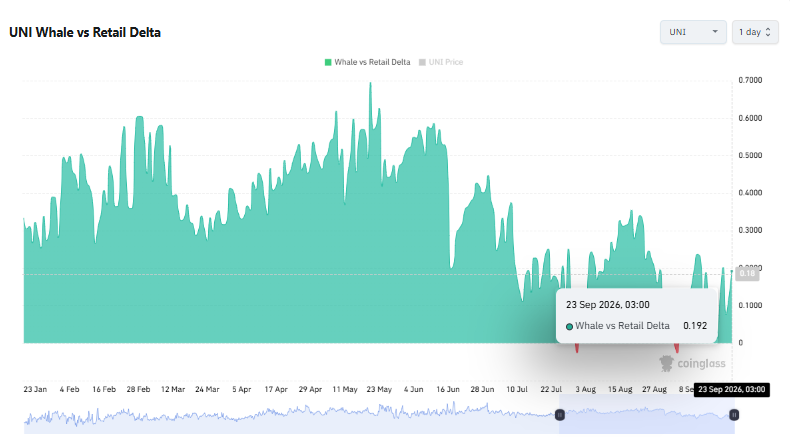
Specifically, the Whale versus Retail Delta had registered 0.192 at press time, keeping the reading in positive territory. The positive delta implied that whale activity remained stronger relative to the retail activity during the recent price increase.
Also notably, the on-chain activity strengthened this whale trend, as two wallets accumulated substantial $UNI positions during the rally.
According to Lookonchain, one newly created wallet bought 269,477 $UNI valued around $2.84 million, while another acquired 138,442 $UNI worth of $1.23 million. The wallets accumulated a total of roughly 407,919 $UNI worth $4.07 million.
However, the reading remained below several stronger peaks visible earlier in the year. The prevailing whale participation, therefore, did not match the most aggressive periods shown across the indicator’s recent history.
The combination remained supportive since the spot takers also favored buyers during the latest price advance.
Uniswap now faces a different challenge as the price approaches a historically important supply area.
$UNI Whale vs. Retail Delta on CoinGlass
Can $UNI turn $11-resistance into support?
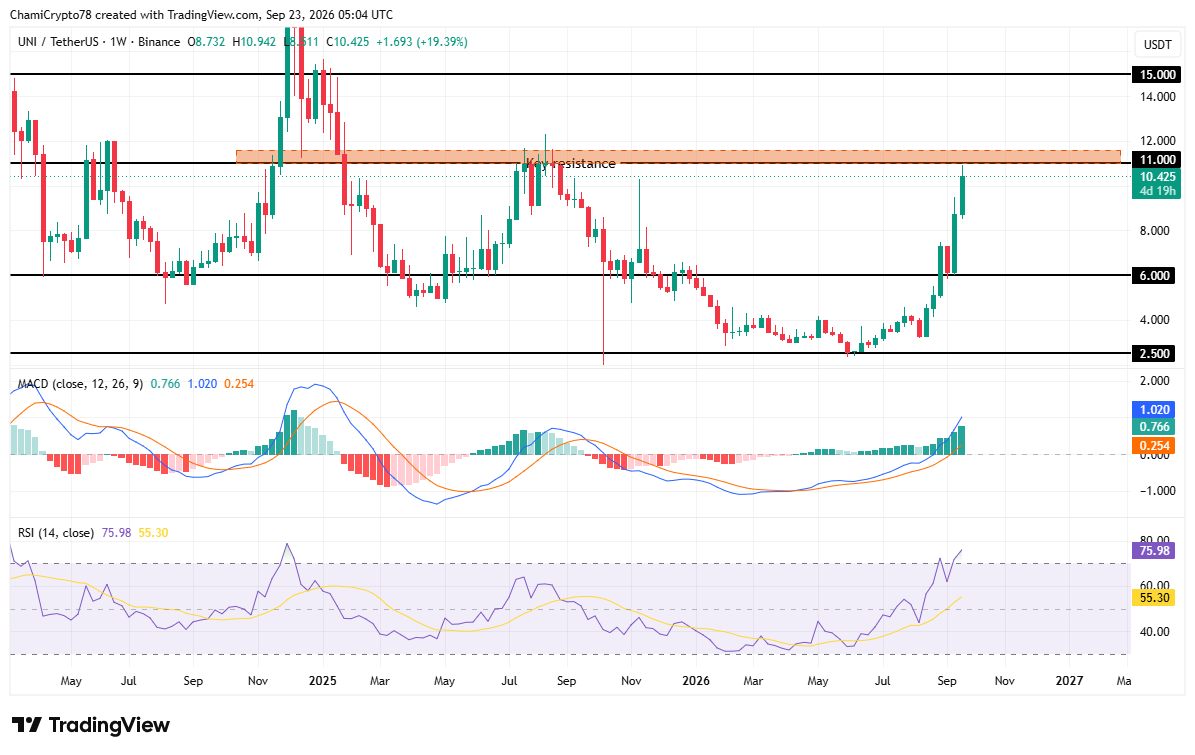
During its price uptrend,$UNIreached approximately $10.43 after its impulse from its lower range, reclaiming the major $6 price level.
Notably, this price rally placed $UNI directly below the weekly $11 area, where previous rallies encountered substantial rejection.
Also noteworthy, the Uniswap price had last tested this region during the late-2025 period before sellers forced the price sharply lower.
However, the current price structure carried a strong technical pressure as the weekly RSI climbed to 75.98 as of writing, pushing firmly into the overbought territory. Even so, an overbought reading alone would not confirm an immediate price rejection while buyers remained aggressive.
The expanding MACD structure instead supported the strength behind $UNI’s push towards its major resistance. In particular, the MACD line at 1.020 sat comfortably above its signal line at 0.254.
$UNI/USDT Weekly Chart on TradingView
Overall, a sustained weekly breakout above the $11-resistance could shift attention toward the next major resistance around $15. Another rejection, however, could expose $UNI‘s rally to a broader retracement after its sharp price advance.
Final Summary
CME futures plans strengthened $UNI’s rally as spot buyers maintained control of market activity.
Fading futures selling and positive whale activity strengthened $UNI’s attempt to clear $11.
Mark Uyeda, who served as acting chair of the US Securities and Exchange Commission (SEC) before Paul Atkins’s confirmation, said the agency dropped civil cases against cryptocurrency companies filed under the previous administration because it was preparing a “180-degree change” in rulemaking.
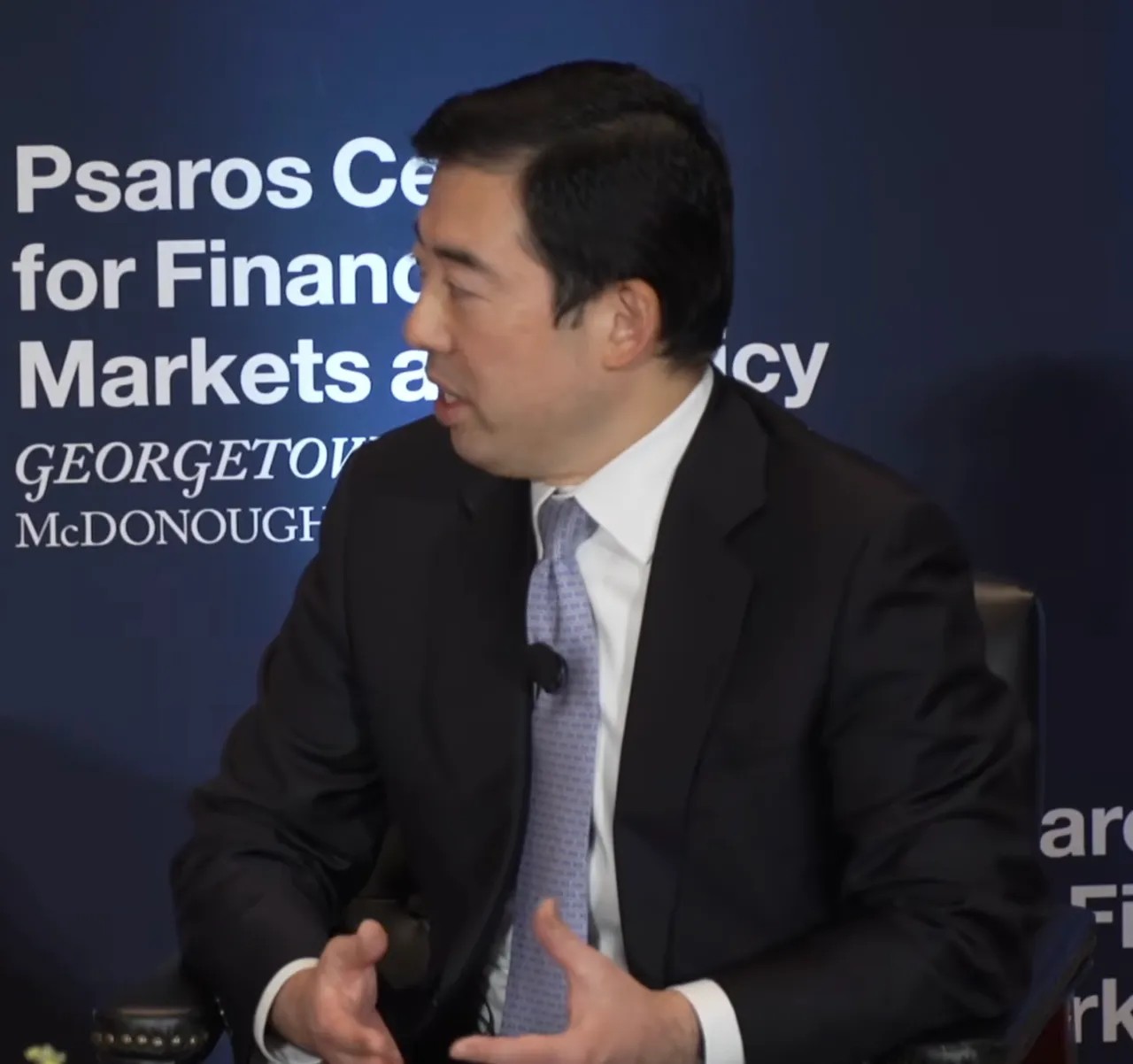
In a Wednesday panel at the Psaros Center for Financial Markets and Policy’s Financial Markets Quality Conference, Uyeda said the SEC dropped cases involving crypto companies in early 2025 as it could have hurt the agency’s credibility in arguing positions in court contrary to its planned policy changes. Uyeda argued that there had been “significant concerns” that the cases against crypto companies were “justifiable under law.”
“I’m not about to have our litigators, even though they’re having cases that were authorized under the prior administration, stand up in court and have a commission interpretation be issued that is a 180-degree change from what they’d been arguing for that court,” said the commissioner. “I think that hurts [our] credibility as an agency.”
SEC Commissioner Mark Uyeda. Source: Psaros Center for Financial Markets and Policy
Under Uyeda, who was acting SEC chair from January to April 2025, the commission dropped cases filed against Kraken, Ripple Labs, Coinbase and others in what many critics characterized as payback for the industry’s support of President Donald Trump’s 2024 campaign. Trump had promised to fire former SEC Chair Gary Gensler, under whom many of the cases were filed, “on day one” if elected. Gensler resigned the day Trump took office.
Uyeda has been a commissioner at the SEC since 2022 and currently serves at the agency’s leadership alongside Atkins and Commissioner Hester Peirce. With Peirce’s departure expected in November, the agency will have only two of its five members on its leadership panel, and Trump has not announced any nominations for potential replacements.