Category: Business

  • Pakistan steps in as intermediary in US-Iran crisis

    Pakistan steps in as intermediary in US-Iran crisis

    Pakistan is acting as a mediator in the US-Iran conflict, with a 10-day ceasefire extension now in place. The odds of a US-Iran ceasefire by April 30 have risen to 38.5% YES, up from 36% yesterday.

    The April 30 market saw a 4-point increase at 10:56 AM, indicating traders view mid-April as a potential turning point. The April 7 market dropped to 8.5% YES from 10% — suggesting no immediate breakthroughs are expected.

    With $1,365,780 in USDC traded over 24 hours, these markets are liquid but still volatile. It takes $15,138 to move the April 7 price by 5 points, showing a decent order book. The largest move was a 2-point drop at 8:13 AM, highlighting the impact of modest trades.

    Pakistan’s role as a mediator adds complexity, but without tangible progress like scheduled talks, markets stay cautious. At 38.5¢, a YES share for April 30 pays $1 if resolved. This bet hinges on a significant diplomatic breakthrough in the next 28 days.

    Watch for US or Iranian statements acknowledging Pakistan’s efforts or more mediation from Oman. Trump’s language in upcoming addresses could also signal changes — terms like ‘deal’ or ‘productive’ would influence these markets.

    Markets Impacted

    • US x Iran ceasefire by April 7? — currently 8.5% YES
    • US x Iran ceasefire by April 15? — currently 18.5% YES
    • US x Iran ceasefire by April 30? — currently 38.5% YES
    • US x Iran ceasefire by May 31? — currently 55.5% YES
    • US x Iran ceasefire by June 30? — currently 62.5% YES
    • US x Iran ceasefire by December 31? — currently 73.5% YES

    Get prediction market intelligence as a structured API feed. Early access waitlist.

  • U.S. Treasury Seeks Public Comment on GENIUS Stablecoin Rules

    U.S. Treasury Seeks Public Comment on GENIUS Stablecoin Rules

    On April 1, 2026, The U.S. Department of the Treasury issued its first notice of proposed rulemaking under the GENIUS Act, opening a 60-day public comment period. The proposal outlines how states can regulate smaller stablecoin issuers under frameworks aligned with federal standards.

    U.S. Treasury Issues Its First GENIUS Act NPRM

    The U.S. Department of the Treasury issued an NPRM seeking public comment on its implementation of the Guiding and Establishing National Innovation for U.S. Stablecoins (GENIUS) Act. The NPRM is the first regulation the Treasury has proposed to implement the GENIUS Act.

    Enacted on July 18, 2025, the Guiding and Establishing National Innovation for U.S. Stablecoins Act establishes a framework mandating 1:1 reserve backing with liquid assets, monthly disclosures, and compliance with AML and sanctions requirements, while allowing smaller issuers to opt into qualifying state oversight.

    Therefore, the GENIUS Act requires the Treasury to use notice-and-comment rulemaking to develop overarching principles for evaluating whether a state regulatory system aligns closely with the federal framework established under the GENIUS Act.

    GENIUS Act Allows State Oversight for Small Issuers

    The GENIUS Act establishes a federal regulatory framework for payment stablecoin issuers while allowing smaller issuers to opt into state oversight.

    Under Section 4(c)(1), issuers with total outstanding issuance of $10 billion or less may choose to operate under a state regulatory regime, provided the state framework is certified as substantially similar to the federal framework.

    Once a state regime is certified, including approval by the relevant interagency body that it meets or exceeds Section 4(a) standards, qualifying issuers may operate under state oversight. They remain subject to core federal requirements, including 100% reserves in high-quality liquid assets, on-demand par redemption, Bank Secrecy Act registration, AML CFT and sanctions compliance, and public disclosures.

    What’s Next For U.S. Stablecoin Regulation?

    The NPRM invites public comments within 60 days of Federal Register publication, following a September 2025 advance notice, with input viewable at regulations.gov to shape final implementation rules.

    As of April 1, 2026, the stablecoin market totals $310 billion, with 391 coins and 24-hour trading volume above $97 billion, according to CoinGecko. Tether (USDT) and USDC dominate at $184 billion and $77 billion, respectively, exceeding the $10 billion threshold and leaving the NPRM focused on smaller issuers under state-level oversight.

    By providing regulatory certainty in the $310 billion stablecoin market, the GENIUS Act and NPRM protect consumers and stability while allowing smaller issuers to grow and major players to meet federal standards.

    The OCC, FDIC, and NCUA continue rulemakings to build the GENIUS Act framework. Full implementation in late 2026 or early 2027 could support broader adoption and new digital-asset use cases.

    Related: US Stablecoin Market Surges as GENIUS Act Implementation Begins

  • Luffa Partners with Delphi AI to Bring Crowd Forecasts to Web3 Agents

    Luffa, a Web3 social wallet, has announced its partnership with Delphi AI, a renowned platform to transform crowd prediction into robust insights. The partnership aims to merge the AI agent infrastructure of Luffa with the prediction market mechanism of Delphi AI. As Luffa disclosed in its official social media announcement, the development focuses on improving>

    Excited to announce our partnership with @delphiai_lab ! 🤝

    Delphi AI is building a prediction-market platform that aggregates crowd forecasts—turning market sentiment into actionable probabilistic signals across crypto, stocks, and policy.

    As a Web3 x AI SuperConnector, Luffa… pic.twitter.com/gMXimarVkf

    — Luffa (@LuffaApp) April 1, 2026

    Luffa and Delphi Partner to Leverage Blockchain and AI for Market Insights

    The partnership between Luffa and Delphi AI is poised to integrate the Web3 intelligence layer and the cutting-edge prediction market technology. So, the move underscores a rising trend where AI and blockchain technologies converge and reshape the way consumers interpret as well as take action on the market data. In this respect, Delphi AI is creating a prediction market entity to aggregate forecasts coming from a broad range of members, bringing probabilistic signals from collective opinions.

    Particularly, these signals can span different areas such as crypto markets, policy-related developments, and conventional stocks. With the respective integration, Luffa endeavors to expand the framework for its upcoming AI agents beyond just data processing. Rather than analyzing information, the agents will then be capable of interpreting market sentiment in real time.

    Advancing AI-driven Prediction to Redefine Crypto Strategies and Decision-Making

    According to Luffa, this approach could assist consumers in navigating highly volatile markets of digital assets more efficiently while utilizing the crowd wisdom. With the merger of AI functionalities, these systems can provide faster insights, enhance strategic forecasting, and automate decision procedures for analysts and traders alike. Overall, the partnership places both platforms as leading players driving the convergence of Web3 infrastructure and AI innovation across blockchain sector.

  • Agencies Must Create Clear Prediction Market Rules to Avoid FTX-Style ‘Implosions’: CFTC Chair

    Agencies Must Create Clear Prediction Market Rules to Avoid FTX-Style ‘Implosions’: CFTC Chair

    In brief

    • CFTC Chairman Michael Selig is concerned that driving prediction markets offshore into unregulated space could cause FTX-style “implosions.”
    • Prediction markets are facing scrutiny over insider trading on their platforms.
    • Selig warned against states “regulating by litigation and enforcement actions.”

    If regulators fail to set up clear policies and rules around prediction markets, there could be another FTX-like implosion, according to Commodity Futures Trading Commission Chairman Michael Selig.

    “The failure of agencies to actually regulate, to do their job and set policy, is such a disservice to the builders and innovators and everyday Americans who want to access these products,” Selig said in an interview with Dastan President and Co-Founder Farokh Sarmad.

    The CFTC, which claims complete jurisdiction over prediction markets and derivatives contracts, wants to make sure that’s not the case moving forward.

    “We saw FTX and we saw all these implosions of crypto firms, I’m concerned we’ll see the same with prediction markets if we keep pushing it offshore into the unregulated space,” he said.

    “We’ve got to make sure these exchanges come and register here in the United States and that our rules are set up to facilitate fair markets, markets that have investor protections, customer protections, and have real guardrails and rules,” Selig added.

    Prediction markets like Kalshi and Polymarket have exploded in popularity over the last year, moving from niche homes to political markets to massive platforms facilitating event contracts for nearly anything you could imagine—sports, weather, geopolitical issues, and more.

    (Disclaimer: Decrypt’s parent company, Dastan, operates Myriad, a prediction market).

    The surge in volumes, which now stretches above $20 billion monthly, has led to rapidly rising valuations as well, with Kalshi reportedly doubling its valuation earlier this month when it raised $1 billion at a $22 billion valuation.

    Prediction markets under the microscope

    Those surging values have not come without scrutiny. Kalshi and Polymarket have recently faced accusations of insider trading on their platforms, as public officials like California Governor Gavin Newsom allege that individuals close to the Trump administration have profited from insider knowledge using prediction markets.

    More specific examples have led to a fine and suspension against a video editor for MrBeast, who profited from inside information related to the YouTube personality’s videos. In February, two Israelis were arrested and charged with misusing classified information, having allegedly used military secrets to profit on Polymarket.

    Recently, both offered new policies and procedures to try and address the insider trading concerns.

    The platforms are also running into issues in the courts, where states are now pushing back on their offerings. For example, Arizona attorney general Kris Mayes filed 20 criminal charges against Kalshi, alleging the site is running an “illegal gambling operation.” 

    Earlier this month, Nevada earned a victory in court over the platform, landing a temporary restraining order that banned it from offering its event contracts in the state. Other states, like Massachusetts, may not be far behind from doing the same.

    Selig, who has previously condemned the behavior from states, didn’t expect it.

    “I am surprised about it,” he told Sarmad about the state’s lawsuits against prediction markets, adding that, “I think the jurisdiction of the agency is very clear.”

    The jurisdiction and regulation of prediction markets, as well as crypto and artificial intelligence and their relationship to derivative markets, is something that Selig said the agency is committed to getting right.

    States “regulating by litigation”

    “We’ve got to get the policy right, and we’re committed to working with every stakeholder who wants to work with us,” he said. “What we don’t want is states and others suing our registrants to assert their authority in the same way that the last administration did with crypto, where they’re regulating by litigation and enforcement actions.”

    “We’d like to work together to get the policy right,” he added.

    To do so, his agency has recently put out an Advanced Notice of Proposed Rulemaking to invite public comments and feedback about the rules necessary to properly regulate prediction markets.

    Last week, the CFTC launched an Innovation Task Force to help create a clear regulatory framework for AI, crypto, and prediction markets as well, indicating it would coordinate with other federal agencies like the SEC and its Crypto Task Force on initiatives.

    Daily Debrief Newsletter

    Start every day with the top news stories right now, plus original features, a podcast, videos and more.

  • Franklin Templeton to Buy CoinFund Spinoff, Build Out Crypto Investment Offering

    Franklin Templeton to Buy CoinFund Spinoff, Build Out Crypto Investment Offering

    In brief

    • Franklin Templeton is acquiring 250 Digital, a CoinFund spinoff, as it builds out its own crypto wing, Franklin Crypto.
    • The firm is bringing the 250 Digital team on board as well as its crypto investment strategies, which it will invest in as part of the deal.
    • It is using BENJI tokens, its on-chain money market fund, as payment considerations in the deal.

    Global asset manager Franklin Templeton announced Wednesday it is forming a crypto unit—Frankling Crypto—following its acquisition of 250 Digital, a crypto investment firm and spinoff from CoinFund.

    The acquisition, expected to close during Q2, brings the 250 Digital team and all its crypto strategies to Franklin Templeton, which will invest in those strategies as part of the deal. 

    “Crypto’s institutional moment has arrived, and Franklin Crypto will help our global clients navigate this complex and rapidly evolving asset class by delivering the expertise, knowledge and digital asset products that meet their sophisticated investment needs,” Head of Franklin Crypto Christopher Perkins said in a statement.

    Perkins, who will join the firm and serve as the division leader of Franklin Crypto, previously led 250 Digital alongside Seth Ginns, who will come on board and serve as the Chief Investment Officer of Franklin Crypto.

    “This is an exciting addition for Franklin Templeton, and we’re pleased to welcome Chris, Seth and the 250 Digital team to our firm,” Franklin Templeton CEO Jenny Johnson in a statement.

    “Together, their investment talent and differentiated strategies strengthen our capabilities in digital assets and position us among a small group of global asset managers with a dedicated, institutional-grade crypto investment management team, enhancing our ability to serve clients worldwide,” she added. 

    While financial details of the acquisition were not disclosed, the firm noted that BENJI tokens—those representing its on-chain money market fund—will be used as payment considerations, “marking an important and innovative step toward conducting M&A transactions on chain.”

    The firm first debuted the tokenized fund in 2021, before expanding its access to Ethereum in 2024. Since that time, it has also expanded to other popular blockchain networks like Solana, and Ethereum scaling networks like Base and Arbitrum

    Its latest crypto initiative comes just one week after it announced a deal with Ondo Finance to launch tokenized versions of five of its exchange-traded funds (ETFs). 

    A representative for Franklin Templeton did not immediately respond to Decrypt’s request for comment.

    Daily Debrief Newsletter

    Start every day with the top news stories right now, plus original features, a podcast, videos and more.

  • Japanese Giant Company, Attracting Attention with Ripple (XRP) Moves, Will Start Using a Surprise Altcoin Network!

    Japanese Giant Company, Attracting Attention with Ripple (XRP) Moves, Will Start Using a Surprise Altcoin Network!

    Japanese banking giant SBI Holdings continues to make significant strides in the cryptocurrency sector.

    At this point, SBI’s subsidiary B2C2 chose Solana (SOL) for its institutional stablecoin payments.

    B2C2, the cryptocurrency market maker acquired by Japanese financial giant SBI Holdings in 2020, will now primarily route and finalize large-scale stablecoin transactions for its institutional clients through Solana.

    B2C2 stated that they will support Solana-based $USDC, USDT, PYUSD, USDG, USD1, EURC, and FDUSD, and “also support other stablecoins mined on Solana and occasionally backed by B2C2.”

    B2C2 Group CEO Thomas Restout stated, “Solana has solidified its position as a fundamental financial infrastructure. We support real-world flow here because it delivers what matters to our customers – speed, reliability, and scale. The future of payment processing is moving in this direction.”

    Although Solana lags behind Ethereum (ETH) and Tron (TRX) in terms of stablecoin market capitalization, its usage is steadily increasing.

    Indeed, many large institutions have begun using Solana for their stablecoin needs. Late last year, Visa started using Solana for $USDC payments for US banks, while Mastercard, PayPal, SoFi, Western Union, and Worldpay also have Solana integration.

    B2C2, a key marketplace provider for companies like Robinhood, recently announced partnerships with firms such as Anchorage Digital, Bitget, and Standard Chartered.

    *This is not investment advice.

  • Zcash Vulnerability That Put Millions of Dollars of ZEC at Risk Has Been Fixed

    Zcash Vulnerability That Put Millions of Dollars of ZEC at Risk Has Been Fixed

    In brief

    • A security researcher discovered a critical vulnerability in Zcash nodes that bypassed proof verification for the deprecated Sprout shielded pool.
    • Major mining pools deployed the patch within three days, with Zcash developers releasing v6.12.0 on Tuesday.
    • Zcash’s “turnstile” mechanism would have prevented broader supply inflation even if the pool had been compromised.

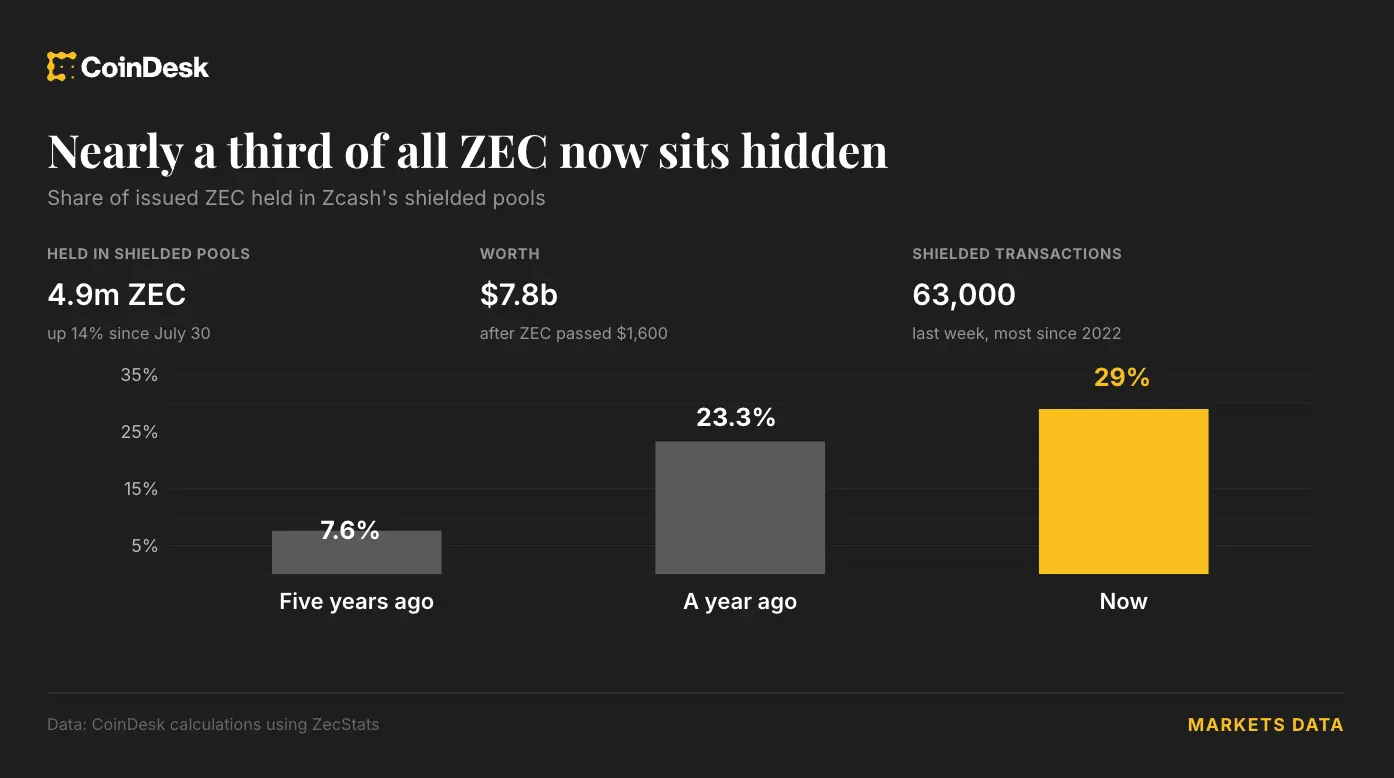
    A security researcher discovered a critical vulnerability in Zcash nodes that could have allowed malicious miners to drain more than 25,000 ZEC from the network’s deprecated Sprout shielded pool—a sum worth about $6.5 million at writing.

    Alex “Scalar” Sol disclosed the flaw on March 23, according to a disclosure report released Tuesday, revealing that zcashd nodes were skipping proof verification for transactions involving the legacy Sprout pool. The bug was not exploited and all users’ funds remain safe, according to the disclosure.

    The vulnerability spanned releases from July 2020 through the present, with Zcash developers releasing v6.12.0 on Tuesday to contain the fix. Major mining pools moved quickly to patch their systems—Luxor mining pool confirmed deployment on March 25, while F2Pool, ViaBTC, and AntPool all deployed the fix by March 26, according to the same report.

    The Zebra full node implementation was not affected by the vulnerability, the report said, and would have triggered a chain fork if exploitation had been attempted, providing an additional layer of network protection.

    Sol, who discovered the vulnerability using AI assistance, reported it to Shielded Labs on March 23. The organization coordinated with the Zcash Open Development Lab (ZODL), whose engineer Jack “str4d” Grigg authored the patch.

    For his disclosure, Sol will receive a 200 ZEC total bounty—valued above $51,000—with Shielded Labs, ZODL, the Zcash Foundation, and Bootstrap each contributing 50 ZEC.

    The Sprout pool was closed to new deposits in November 2020, making it a deprecated but still-active component holding approximately 25,424 ZEC that users have not yet migrated to newer shielded pool versions.

    While the vulnerability could have allowed draining these funds, the Zcash Open Development Team (ZODL) said that Zcash’s “turnstile” mechanism would have prevented broader supply inflation. The turnstile requires that any coins leaving the Sprout pool must have verifiably entered it, creating a safeguard against the creation of new tokens beyond the network’s total circulation of around 16.63 million ZEC.

    This isn’t the first big vulnerability that the network has faced. Back in 2019, the network patched a bug described as an “infinite counterfeit” crypto generator, though it was patched out before becoming a major issue for the privacy coin network.

    Zcash is the biggest gainer over the last 24 hours among the top 100 coins by market cap, per CoinGecko data, rising more than 14% to a recent price above $255. The price of the privacy coin skyrocketed last fall from a price of about $50 to a multi-year peak near $700, but has fallen alongside Bitcoin and other cryptocurrencies in recent months.

    Daily Debrief Newsletter

    Start every day with the top news stories right now, plus original features, a podcast, videos and more.

  • Latin America’s Mercado Libre Pulls the Plug on Its Crypto Coin

    Latin America’s Mercado Libre Pulls the Plug on Its Crypto Coin

    In brief

    • Mercado Libre killed Mercado Coin after a failed four-year experiment.
    • The company’s stablecoin is replacing the Mercado Coin loyalty token.
    • Nubank’s Nucoin collapse shows industry-wide failure of reward tokens.

    Latin America’s e-commerce giant quietly killed its ERC-20 loyalty token four years in—while Nubank’s Nucoin already died the same death.

    Mercado Libre is shutting down Mercado Coin. The company—which is bigger than Amazon in Latin America—announced through its Mercado Pago wallet that the token will stop functioning on April 17.

    Users holding the coin have three options: Sell it through the app, spend it as purchase credit on the platform, or do nothing and wait for it to be auto-converted to local fiat. Mercado Libre didn’t explain the decision in its customer notice. The company did not respond to Decrypt‘s request for comment.

    Mercado Coin launched in August 2022 in Brazil as an ERC-20 token on Ethereum, built along with crypto exchange Ripio. The idea was simple: buy selected products on the marketplace, earn tokens, use them on future purchases, or cash out. It never really caught on.

    The token expanded to other markets after its Brazilian debut, but it never built a meaningful base. It lived and died as a curiosity—a loyalty points system with extra steps and a dose of volatility.

    That last part is likely why Mercado Libre isn’t abandoning crypto altogether—it’s just changing what kind of crypto it bets on.

    In August 2024, the company launched MeliDolar (MUSD), a stablecoin pegged to the U.S. dollar. It’s also built with Ripio, and also accessible through Mercado Pago. The key difference is, of course, the price of MeliDolar doesn’t move. It’s backed by U.S. Treasury securities and dollar deposits, and its value sits exactly where users expect it to.

    MeliDolar is also the backbone of the company’s Meli Plus loyalty program. Members get it as cashback on purchases. They can spend it back on the platform, sell it in the app with no fees, or just hold it as a dollar hedge—a genuinely useful feature for Brazilian and Mexican consumers watching their local currencies lose ground. This was the logical step after a brief experiment allowing users to experiment with Paxos’ Stablecoin.

    Mercado Libre isn’t alone in learning this lesson the hard way. Nubank—Brazil’s largest bank, a fully digital neobank with over 100 million customers in Brazil alone—ran the same experiment at the same time. Nucoin launched in 2023 on Polygon, airdropped to its massive user base as a loyalty and rewards token.

    It subsequently collapsed 97% in value. Nubank suspended trading in September 2024, gave holders 90 days to convert their coins to Bitcoin or USDC, and shut the whole thing down by December. Sixteen million users were left holding the bag, sweetened only by a prize campaign the bank ran to take the edge off.

    Mercado Libre still holds more than $38 million in Bitcoin on its balance sheet and continues to offer crypto trading and stablecoin transfers through Mercado Pago. The infrastructure is staying—but not the coin nobody was really using anyway.

    Daily Debrief Newsletter

    Start every day with the top news stories right now, plus original features, a podcast, videos and more.

  • Grayscale’s research head says tokenization will happen in waves and explains how to play it

    Grayscale’s research head says tokenization will happen in waves and explains how to play it

    Tokenization has become one of crypto’s favorite buzzwords, but Grayscale head of research Zach Pandl said investors should think about it less as a single trade and more as a long roadmap with different winners at different stages.

    Speaking at EthCC conference in Cannes, France, Pandl said that the trend is still in its infancy. Tokenized assets — the process of using blockchain rails to settle, transfer and record ownership of all kinds of financial assets such as bonds, funds and equities — is rapidly growing. However, currently at $27 billion, it still represents roughly 0.01%, a tiny fraction, of global capital markets. That’s projected to swell to near $19 trillion by 2033, according to BCG and Ripple.

    Big banks and asset managers already understand the opportunity. “The two things that institutions are aware of are stablecoins and tokenization,” Pandl said. But they are still trying to figure out where to allocate capital to actually benefit from these innovations.

    From here, Pandl expects tokenization to unfold in phases, with different types of networks and models capturing value at each stage.

    The first winners, he said, may be projects that look more like traditional finance, not less.

    “In the early stages of the tokenization process, you will see things that have success that look more similar to how the financial system works today,” he said.

    That means institution-centric, permissioned systems that solve practical issues like privacy, identity and control.

    Pandl pointed to the Canton Network (CC), backed by Wall Street giants like DRW, TradeWeb, Goldman Sachs and Nasdaq, as a potential winner in this early phase of tokenization.

    He said it is “a perfectly reasonable investment” for investors who want nearer-term traction, even if Canton’s approach represents only “a slightly different, slightly upgraded version” of today’s financial system.

    The second phase

    The second phase of tokenization could be a hybrid model where we have both institution-owned blockchains and a global shared state, with those networks interconnected and speaking to each other. One example for that is Avalanche (AVAX), with hundreds of sovereign, corporate-owned chains (called subnets) live but connected to a primary, layer-1 network.

    Ethereum’s ether ($ETH), in his view, is the bigger but slower bet. Pandl said he believes the market will eventually move toward “global decentralized finance,” but added that “the tech is not fully ready” and that institutions are not ready either.

    That makes $ETH the more ambitious investment for those willing to wait for the longer-term shift away from financial intermediaries.

    There are also picks-and-shovels plays. Pandl highlighted chain-agnostic service providers such as Chainlink as another way to get exposure, saying they may be “even more compelling” than some blockchains.

    Read more: How tokenized assets could become a $400 billion market in 2026

  • Fidelity, Managing $5 Trillion, Analyzes Bitcoin (BTC) Bull and Bear Cycles! “Nothing Is the Same Anymore!”

    Bitcoin ($BTC) has fallen by approximately 50% since October. However, this decline remains more limited compared to other cycles.

    At this point, Fidelity, one of the world’s largest asset management companies, analyzed that the declines in $BTC have been milder compared to past cycles.

    According to Fidelity’s analysis, the decline in Bitcoin in the current cycle is milder compared to the past. And Bitcoin is entering a phase of maturity with a combination of decreasing price volatility and institutional fund inflows.

    Zack Wainwright, a research analyst at Fidelity Digital Assets, noted that $BTC has historically experienced sharp drops of 80% to 90% after its all-time highs in previous cycles.

    In contrast, the decline in this cycle was limited to approximately 50%.

    “Bitcoin has only fallen by about 50% in this market cycle. The current decline is significantly narrower compared to previous cycles where it fell by 80-90% from its peaks.”

    At this point, Wainwright added that when Bitcoin’s price performance is viewed relative to the peaks of previous cycles, a “diminishing returns” pattern emerges between cycles.

    “As cycles repeat, the phenomenon of diminishing returns emerges as volatility decreases in both upward and downward movements.”

    While analyzing the changing cyclical structure of Fidelity, Joao Wedson, founder of the cryptocurrency analytics firm Alphractal, pointed out that based on historical patterns, the bottom occurs 912-922 days after the halving, predicting that the market bottom will likely occur in late September or early October.

    *This is not investment advice.