Supporters of BIP-110 split off into a minority Bitcoin chain on Saturday at block 961,632, but it mined only two blocks in about eight hours before stalling, falling dozens of blocks behind the main network.
The fork inherited Bitcoin’s difficulty setting with barely any hashpower—about 2.53% of recent blocks signaled support, far below the 55% activation threshold,
BIP-110 sought to temporarily block non-financial data like Ordinals inscriptions from transactions, a move critics including Michael Saylor call a dangerous precedent.
The long-simmering fight over a controversial Bitcoin network proposal finally produced a chain split over the weekend, but the breakaway Bitcoin fork sputtered almost immediately, grinding out just two blocks in roughly eight hours before stalling out.
The fork came as a result of a Bitcoin Improvement Proposal known as BIP-110, whose supporters claimed would protect the network from unwanted spam and the legal liability that comes from hosting non-financial data on the network. Its detractors, the majority of the Bitcoin community, viewed it as an attempt at censorship.
The fork triggered Saturday at block 961,632, when Bitcoin nodes running BIP-110 software began rejecting any block that failed to signal support for the proposal. A block mined by AntPool without that signal was accepted by the main network and rejected by BIP-110 nodes, while a miner on the Ocean pool produced the alternative the minority chain followed.
Hours later, the splinter chain sat far behind, trailing the main network by dozens of blocks as Bitcoin kept churning out one roughly every ten minutes.
The stall stems from a problem the fork can’t easily escape. Bitcoin only recalibrates its mining difficulty every 2,016 blocks, and the breakaway chain inherited the network’s current setting while commanding a sliver of its computing power—about 2.53% of recent blocks signaled for the proposal, far short of the 55% needed to activate without splitting. At that pace, the chain would need roughly 350 days to reach its next difficulty adjustment, versus about two weeks for Bitcoin, leaving blocks hours apart.
BIP-110, as Decrypt has previously reported, is a soft-fork proposal to temporarily bar people from stuffing images, text, and other non-financial data into Bitcoin transactions. Backers argue the practice, popularized by Ordinals inscriptions, clogs the network and drives up fees for ordinary payments.
Opponents counter that anyone paying for block space has earned the right to use it as they see fit, and that letting miners and node operators police transactions erodes Bitcoin’s censorship resistance. Strategy’s Michael Saylor has been among the critics, warning that turning a spam dispute into a consensus change sets a dangerous precedent.
On early Sunday morning, Saylor posted on X: “Bitcoin worked exactly as designed. BIP-110 was free to fork, and the network was free not to follow. The result was decisive: about 99.85% of Bitcoin’s hash power stayed with Bitcoin. The BIP-110 branch mined only two blocks and is already more than 80 blocks behind.”
Bitcoin worked exactly as designed. BIP-110 was free to fork, and the network was free not to follow. The result was decisive: about 99.85% of Bitcoin’s hashpower stayed with Bitcoin. The BIP-110 branch mined only two blocks and is already more than 80 blocks behind.
Jameson Lopp, a long-time Bitcoin advocate and the co-founder of Bitcoin security company Casa, echoed the sentiment and took it a step further: I won’t be ‘welcoming back’ or unblocking any BIP-110 supporters,” he posted on X. “They proved themselves to be susceptible to delusional propaganda from folks emanating reality distortion fields. In many cases they spewed vitriol and harassed the very people who have devoted their lives to supporting and improving Bitcoin.”
I won’t be “welcoming back” or unblocking any BIP-110 supporters.
They proved themselves to be susceptible to delusional propaganda from folks emanating reality distortion fields. In many cases they spewed vitriol and harassed the very people who have devoted their lives to…
There’s a further catch for anyone holding the fork’s coins: because both chains accept identical transactions, a sale on the minority chain can be replayed on Bitcoin, potentially handing a buyer real BTC from the same seller. The mandatory signaling window closes at block 963,647—a mark the chain won’t come close to reaching.
Daily Debrief Newsletter
Start every day with the top news stories right now, plus original features, a podcast, videos and more.
Payments-focused cryptocurrency $XRP dropped about 5% to $1.03 last week, even as bitcoin BTC$64,992.63, ether ETH$1,918.56, and solana (SOL) each climbed 1% to 4%. The broader crypto market added 1.4%, pushing total market capitalization to $2.19 trillion. $XRP is currently hovering near $1.03.
The underperformance is puzzling because $XRP exchange-traded funds still attracted net investor capital for a fourth consecutive week. The inflows, however, have slowed sharply, collapsing roughly 93% week-over-week to around $1 million, according to data source SoSoValue. Meanwhile, bitcoin and ether funds pulled in hundreds of millions.
Traders and analysts on X and elsewhere point to several overlapping explanations for the price apathy. Regulatory uncertainty tops the list: the Senate has delayed consideration of the CLARITY Act, the legislation many view as key to clarifying $XRP’s status and unlocking broader institutional participation. That vote is not expected until mid-September at the earliest.
On the flow side, the setup currently looks balanced.
“$XRP’s positioning looks patient in its own right, with order flow staying large even as volume metrics turn neutral — quiet absorption rather than capitulation or a confirmed breakout,” Iliya Kalchev,, analyst at Nexo, said in an email.
New York Stock Exchange President Lynn Martin said on Aug. 10 that the exchange is continuing to develop infrastructure for onchain settlement of tokenized securities, months after outlining plans for a dedicated digital trading platform.
Speaking at a National Assembly seminar in Seoul, Martin also confirmed NYSE participated in The Depository Trust Company’s July tokenization initiative.
The remarks provide a fresh update on a project that has moved from an early development announcement into live industry testing. NYSE first disclosed the platform in January, while regulatory filings and its participation in DTC’s July production transactions have since provided clearer details about how tokenized securities could fit into existing U.S. market infrastructure.
NYSE Developing Onchain Settlement Platform for Tokenized Securities
NYSE President Lynn Martin said the exchange is developing an onchain settlement platform for tokenized securities and participated in DTC’s tokenization pilot in July.
Martin said NYSE will continue exploring… pic.twitter.com/XlF5ptE9We
— Wu Blockchain (@WuBlockchain) August 10, 2026
NYSE tokenized securities plan moves beyond January announcement
NYSE parent Intercontinental Exchange first announced the platform on Jan. 19. The planned venue is designed to combine NYSE’s Pillar matching engine with blockchain based post trade infrastructure. ICE said it would support 24/7 trading, immediate settlement, fractional shares, dollar denominated orders and stablecoin funding.
Subject to regulatory approvals, the separate digital venue would support both tokenized versions of traditional securities and securities issued natively in tokenized form. Holders would retain conventional dividend and governance rights. The system is also being designed to support multiple blockchain networks for settlement and custody.
As previously reported in the exchange’s January plans, the project represents a broader attempt to bring blockchain settlement into regulated U.S. equities rather than creating an offshore tokenized stock product. Martin said in Seoul that NYSE views the industry as being at a “critical turning point between traditional finance and DeFi.”
DTC pilot gave NYSE a live production test
Martin said NYSE participated in DTC’s tokenization pilot in July. DTCC independently confirmed NYSE among more than 30 financial and digital asset companies involved in live production transactions completed on July 15. Participants also included BlackRock, Goldman Sachs, JPMorgan, Nasdaq, Circle, Ondo Finance, Citadel Securities and Vanguard.
The DTCC release said the exercise converted securities held at DTC into tokenized representations and used them in real transactions. Tests covered equity delivery versus payment, Treasury and repo transactions, securities lending, collateral pledges, equity transfers and central counterparty margin processes. The transactions ran across DTCC’s private Besu network and the public Canton network.
The July work was therefore more than a technical sandbox. It used DTC’s production environment and followed a December 2025 SEC staff no action letter permitting DTC to operate a three year tokenization program under specified conditions. DTCC plans to launch its broader Tokenization Service in October. As crypto.news reported in recent pilot coverage, the effort brings major traditional and crypto firms onto common settlement infrastructure.
NYSE has also taken a separate regulatory step. An April SEC filing established rules allowing eligible securities to trade in tokenized form on NYSE during DTC’s pilot program. The filing became effective upon submission under the applicable SEC rule process.
Under that framework, tokenized shares can trade alongside traditional shares on the same order book when they have the same ticker, CUSIP, rights and privileges. Eligible securities include Russell 1000 components and exchange traded funds tracking major indexes. The tokenization choice does not alter order priority. In related regulatory coverage, crypto.news previously reported how the proposal keeps the assets inside existing national market rules.
There is an important distinction between that framework and NYSE’s planned dedicated digital venue. Trades handled through the current DTC pilot continue settling on a T+1 basis, according to the SEC filing. By contrast, NYSE’s separately announced digital platform is intended to support immediate settlement and 24/7 trading and remains subject to regulatory approvals described by ICE.
What happens next for NYSE’s onchain platform
NYSE has also been building the infrastructure around the proposed venue. In March, it signed an agreement with Securitize, naming the company as the first digital transfer agent eligible to mint blockchain native securities for issuers on the upcoming platform. Securitize Markets is also expected to participate as a broker dealer, subject to applicable requirements.
The next concrete milestone is DTCC’s planned October launch of its Tokenization Service following July’s production transactions. NYSE’s April rules also state that the exchange will provide members at least 30 calendar days of notice before beginning tokenized trading under the DTC pilot framework.
For the separate 24/7 digital platform, ICE has not replaced its original qualification that the venue is subject to regulatory approvals. Martin’s Seoul remarks instead show that NYSE continues pursuing the project while testing tokenized market infrastructure through DTC. Her comments frame onchain settlement as a potential part of global financial infrastructure, but its broader rollout still depends on regulatory and operational steps.
This week brings a heavy mix of inflation, consumer and energy data that could influence risk assets and crypto prices. Bitcoin is approaching a key resistance zone, while $XRP and Ethereum analysts are watching different technical setups. Here’s what could matter most for the market.
Crypto This Week
The week is packed with economic releases, with inflation data likely to be the biggest catalyst:
Key Events This Week:
1. July Existing Home Sales data – Tuesday
2. OPEC Monthly Report – Wednesday
3. July CPI Inflation data – Wednesday
4. July PPI Inflation data – Thursday
5. July Retail Sales data – Friday
6. August MI Consumer Sentiment data – Friday
It’s a big week…
— The Kobeissi Letter (@KobeissiLetter) August 9, 2026
July Existing Home Sales — Tuesday: Strong figures could show economic resilience but weaken rate-cut bets. Softer results may lift expectations for easier policy and support risk assets.
OPEC Monthly Report — Wednesday: Production and demand forecasts will shape oil-market expectations. Higher crude prices could fuel inflation, while weaker demand may ease price pressures.
July CPI Inflation — Wednesday: The week’s biggest catalyst. Cooler inflation could boost Bitcoin and other risk assets, while a hotter reading may trigger selling.
July PPI Inflation — Thursday: Shows price pressure at the producer level. An unexpected jump could revive inflation fears and keep borrowing costs elevated.
July Retail Sales — Friday: Strong spending would signal a resilient consumer but could limit expectations for aggressive cuts. Weak figures may raise slowdown fears while strengthening easing bets.
August Michigan Consumer Sentiment — Friday: Offers a snapshot of household confidence and inflation expectations. A sharp decline could point to weaker economic activity ahead.
The CPI and PPI figures will be especially important because they could influence expectations around interest rates and broader risk appetite.
Bitcoin Position Right Now: Will it hit $68K?
Bitcoin has pushed toward $64,000, with the $68,000-$70,000 area now seen as the next major zone to watch.
One analyst pointed out that the current move may not be the start of a fresh bull run. Instead, he expects Bitcoin could make one more push toward $69,000 before a deeper correction begins. His projected path is $64K, $69K, $61K, followed by potential moves toward $57K, $53K, $49K and eventually $44K.
🚨 THIS SETUP IS GETTING UGLY
$BTC has already pushed into $64K, with $68K-$70K FVG now in sight
But this move doesn’t look like start of a new bull run$BTC looks like it’s building one final squeeze before real flush begins
Bearish signal: Rejection near $69,000 and break below $61,000
He further expects around 60 days of accumulation before a possible recovery toward $55,000. He also points to previous calls involving Bitcoin’s $126K cycle top in 2025, the $96K, $60K and $83K, $59K sell-offs, and the latest roughly 10% S&P 500 correction.
Will $XRP Revive?
Some $XRP analysts Julia Liberte and Dandelion said the token is following a structure similar to its 2017 cycle. Their roadmap starts with a move from $1.10 toward $0.97, followed by $1.80, then $2.70-$3.20. If the pattern continues, they see a possible move toward $6.50 and eventually $13.
$XRP is repeating the exact same trendline from 2017.
History is repeating itself.
Right before the 70,000% explosion.
The path to the next bull run:
Scenario 1: (AUG-SEP) $1.10 → $0.97 → $1.80
Scenario 2: (NOV-DEC) $1.80 → $2.70 → $3.20
Scenario 3: (JAN-FEB)… pic.twitter.com/e4JhRDAykp
— Julia (@Julia_Liberte) August 9, 2026
Hence another successful support retest could trigger a larger expansion, although these remain technical projections rather than guaranteed price targets.
Ethereum Gets Two Monthly Buy Signs
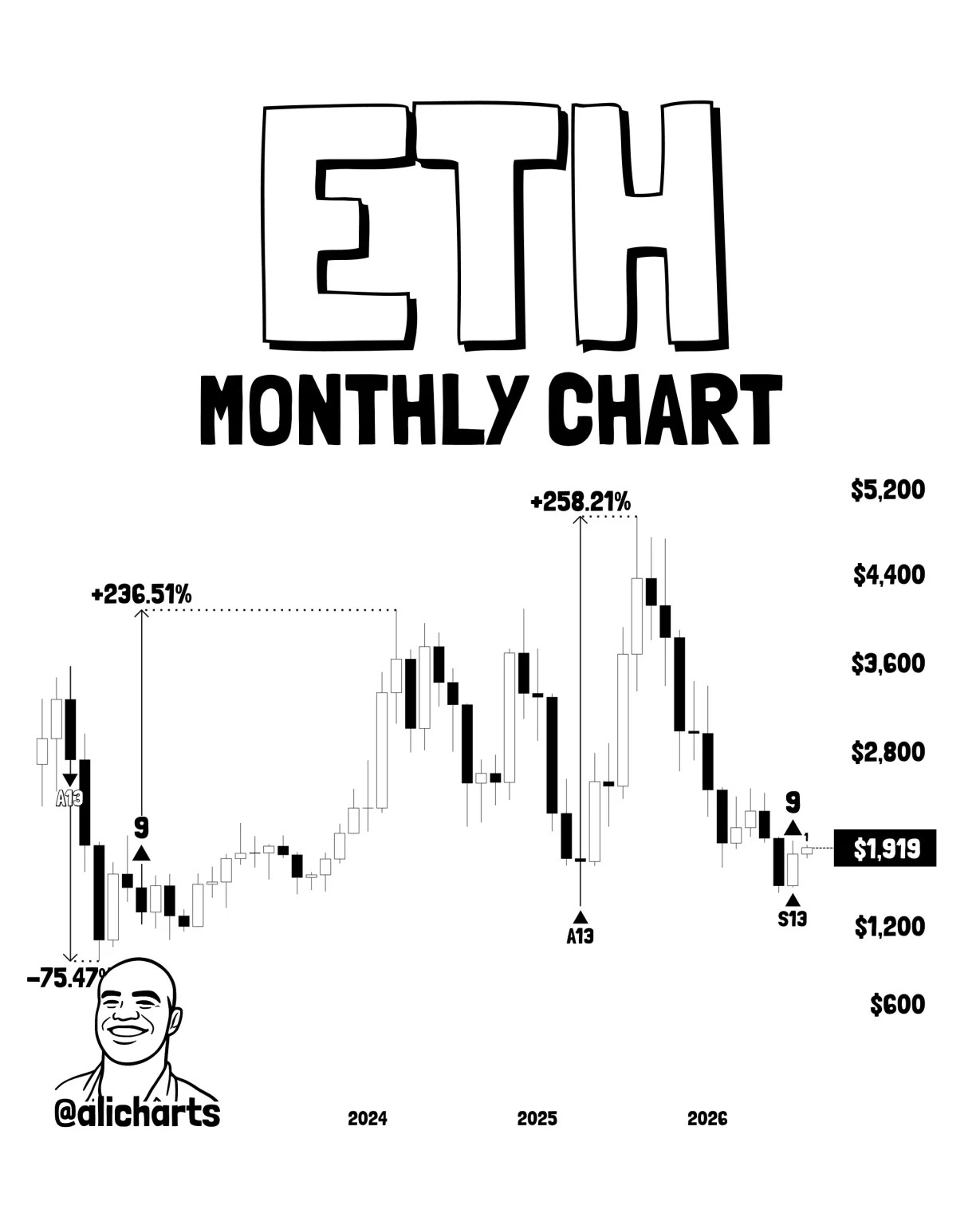
Ethereum is also attracting attention after On-chain analyst Ali Martinez revealed two TD Sequential buy Indicators on its monthly chart, a black 9 and an S13.
He pointed to previous Cues, including a 236% rise after the September 2022 buy trigger and a 258% gain following the April 2025. If the latest signs are validated, he sees Ethereum potentially moving toward $3,000.
Other Events
Markets are also waiting for the Iran deal that the US said was coming last week. The agreement has still not been announced, leaving geopolitics as another factor traders will monitor alongside this week’s economic data.
Senate Majority Leader John Thune introduced a cloture motion for the Clarity Act, which includes comprehensive regulations for the cryptocurrency market. This move paves the way for a critical procedural vote on the bill after Congress members return from their August recess.
According to an agreement reached in the Senate, the cloture vote on the motion to proceed with the consideration of the Clarity Act is scheduled for Tuesday, September 15.
Passing the Cloture amendment will not automatically enact the Clarity Act. The vote will only limit the debate on the amendment to proceed with the bill’s consideration, allowing the legislation to move forward on the Senate’s agenda.
Related NewsMajor Updates Coming to Ethereum and Solana: What Will Change?
The motion requires the support of 60 senators to pass. Given that Republicans hold 53 seats in the Senate, even with the support of all Republican senators, at least 7 Democrats or independent senators would still need to vote for it.
The Clarity Act aims to clarify the regulatory framework for the cryptocurrency market in the US and more clearly define which institutions will oversee digital assets. However, negotiations are ongoing in the Senate regarding the final version of the bill.
Politicians are reportedly trying to resolve their disagreements, particularly regarding ethical provisions, rules on combating illicit financing, and how to incorporate regulations drafted by the Senate Agriculture Committee into the bill.
The introduction of the Cloture motion is seen as a significant procedural step indicating that the Republican leadership plans to make the Clarity Act a top priority item on the Senate’s agenda in September.
CoinGecko, a cryptocurrency data and tracking platform, has announced the cryptocurrencies that have attracted the most investor interest in the last few hours. Based on search data from the last three hours on the platform, Tutorial ($TUT) topped the list of trending cryptocurrencies.
According to CoinGecko data, Tutorial ($TUT) attracted attention by rising 325.8% in the last 24 hours. Pudgy Penguins ($PENGU) and IoTeX ($IOTX) followed closely behind, with IoTeX gaining 49.3% and Pudgy Penguins 1.7% in the same period.
Related NewsMajor Development for the Clarity Act After a Long Wait—Affects All Cryptocurrencies
Here is a list of the most searched cryptocurrencies and their total market capitalization on CoinGecko in the last 3 hours:
Grayscale Research Director Zach Pandl said that the CLARITY Act, which aims to create a comprehensive regulatory framework for the cryptocurrency market in the US, now seems unlikely to pass Congress this year. Pandl noted that the Senate’s busy schedule and election year politics make it difficult to reach a bipartisan agreement on the bill.
According to Pandl, the failure of the Clarity Act to become law will not directly impact the demand for Bitcoin as a store of value, the functioning of major blockchains, or the growth in stablecoin payments in the short term. The cryptocurrency sector has been developing in the US for nearly 17 years without comprehensive market structure legislation.
However, a Grayscale executive noted that the lack of comprehensive regulation could slow new investment activity and capital formation in the U.S. The CLARITY Act aimed to open new avenues for capital formation through blockchain technology, support the development of tokenized securities markets, and create a comprehensive oversight framework for digital asset intermediaries. The bill also included various protections for consumers, investors, and software developers.
Related NewsMajor Development for the Clarity Act After a Long Wait—Affects All Cryptocurrencies
Pandl believes that federal regulators will continue to fill regulatory gaps in the crypto sector even without new legislation. In particular, the SEC and other agencies are expected to develop new rules and regulations in various areas, especially tokenized securities, in the coming months.
According to Grayscale, significant progress has been made in favor of the sector in the regulatory approach to institutional custody services, banking access, staking, and crypto exchange investment products under the current administration. However, Pandl warned that in the absence of comprehensive market structure legislation, a larger portion of new investments and developer activity could shift to countries outside the US.
The delay of the US CLARITY Act announced at the end of the business week harmed several altcoins, but $XRP’s price dipped the most among the larger caps.
$BTC and ETH managed to hold support on Friday, remaining above or at key milestones at $64,000 and $1,900. $XRP, on the other hand, slipped to just over $1. That’s why we decided to ask ChatGPT for its analysis of the matter and whether Ripple’s token will continue to face adverse consequences.
Why Such a Reaction, $XRP?
The answer to whether the token will inevitably crash below $1, according to the popular AI solution, was “not necessarily, but the risk has increased.” It explained that the cross-border altcoin has become uniquely tied to US regulatory developments, dating back to the beginning of the lawsuit against the SEC nearly six years ago.
Unlike bitcoin, which has institutional and ETF demand, or Ethereum, which benefits from tokenization, stablecoins, and treasury accumulation from companies like Bitmine, much of $XRP’s bullish narrative over the past few years has centered on regulatory clarity.
Passage of the CLARITY Act would likely cement its commodity status in federal law and provide greater certainty for banks, institutions, and ETF issuers. In contrast, delaying the process postpones those potential inflows rather than eliminating them.
OpenAI’s solution pointed out that $XRP had historically rallied aggressively on regulatory optimism earlier in the cycle, making it more vulnerable to disappointment when the catalyst faded. Certain analysts agree with the thesis that $XRP could indeed slip below $1 soon, but they believe this would open the door for a more profound rally.
Is Sub-$1 Inevitable?
Again, ChatGPT doesn’t believe this is the most probable scenario; instead, it thinks $XRP has several catalysts that could prevent such a move. Perhaps the most significant support comes from the company behind the token and its substantial expansion experienced over the past few years, which included major partnerships, acquisitions, and regulatory wins, albeit in other jurisdictions.
The AI also noted that markets tend to overreact to legislative delays – after all, it doesn’t necessarily mean the bill will fail. If investors begin pricing in eventual approval rather than focusing solely on timing, Ripple’s token could stabilize before Washington returns in September.
Nevertheless, it didn’t completely rule out a dip below $1.00, especially if the broader crypto sentiment deteriorates and $BTC loses key support. In addition, macroeconomic news or war escalation can trigger another leg down, and both of those factors are outside the scope of the regulatory delay.
The initiative says it has scanned about 150 Bitcoin repositories and made more than a dozen vulnerability disclosures.
The team is developing an open-source AI platform for auditing Bitcoin software.
Developers say the effort is uncovering critical vulnerabilities across wallets, cryptographic libraries, and infrastructure.
A volunteer security initiative says it used frontier AI models to scan 150 Bitcoin repositories and found more than a dozen vulnerabilities as developers increasingly use artificial intelligence to audit blockchains.
In a post on X earlier this week, AnchorWatch CEO Rob Hamilton said the group has spent about $20,000 on AI services while building a “Bitcoin red team” platform.
“We have been working around the clock, with ~$20,000 of spend up to this point across different services,” he wrote. “Funding is secured, I appreciate all the gestures for donations but it is not necessary. The bill is taken care of.”
A red team refers to cybersecurity professionals who test software from an attacker’s perspective, probing for vulnerabilities before they can be exploited.
“We also have been connected with OpenAI for some help so I could manage getting the Cyber Harness running as well,” he wrote. “It’s a much more expensive scan, but well worth it for load-bearing portions of the Bitcoin ecosystem and has already yielded good results.”
Pseudonymous Bitcoin developer Calle said the initiative has built multiple AI-powered review systems targeting wallets, cryptographic libraries, infrastructure, and other Bitcoin projects.
“We’re averaging on the order of one critical exploit per hour per person,” Calle wrote on X. “We’ve reported critical vulnerabilities to several projects in the last 12 hours. Thankfully, this is a very expensive exercise. We’re burning through $10,000 per day.”
The team did not disclose which projects were affected or provide details of the vulnerabilities.
The announcement comes as AI is playing a growing role in finding security flaws across the crypto industry. Earlier this year, researchers using Anthropic’s Claude Opus 4.8 uncovered a four-year-old flaw in Zcash that could have allowed attackers to create unlimited counterfeit ZEC. In August, Coinkite said it believes attackers used AI to identify the Coldcard wallet vulnerability, while Bitcoin bridge Boltz suspended its swap service after saying attackers were using AI to identify vulnerabilities faster than its team could patch them.
Daily Debrief Newsletter
Start every day with the top news stories right now, plus original features, a podcast, videos and more.
$OKB showed renewed bullish momentum as network activity and trading volume strengthened its breakout setup.
The token traded near $93.17 after gaining 5.9% in 24 hours. Daily trading volume surged 63% to $45.14 million.
The volume increase suggested stronger market participation as $OKB approached a major resistance level.
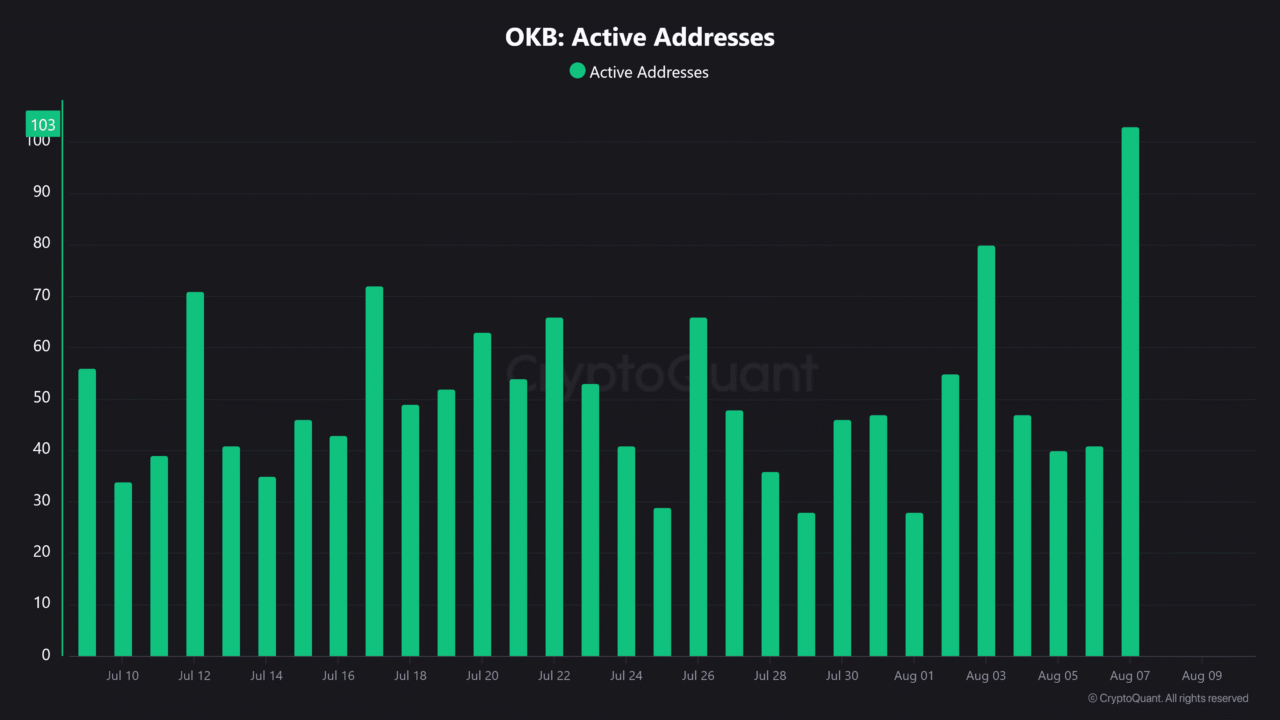
Network activity also supported the bullish outlook. Active Addresses climbed to 103, their highest level this month. That signaled increased on-chain participation alongside $OKB’s latest price move.
Source: CryptoQuant
Can $OKB break above $100?
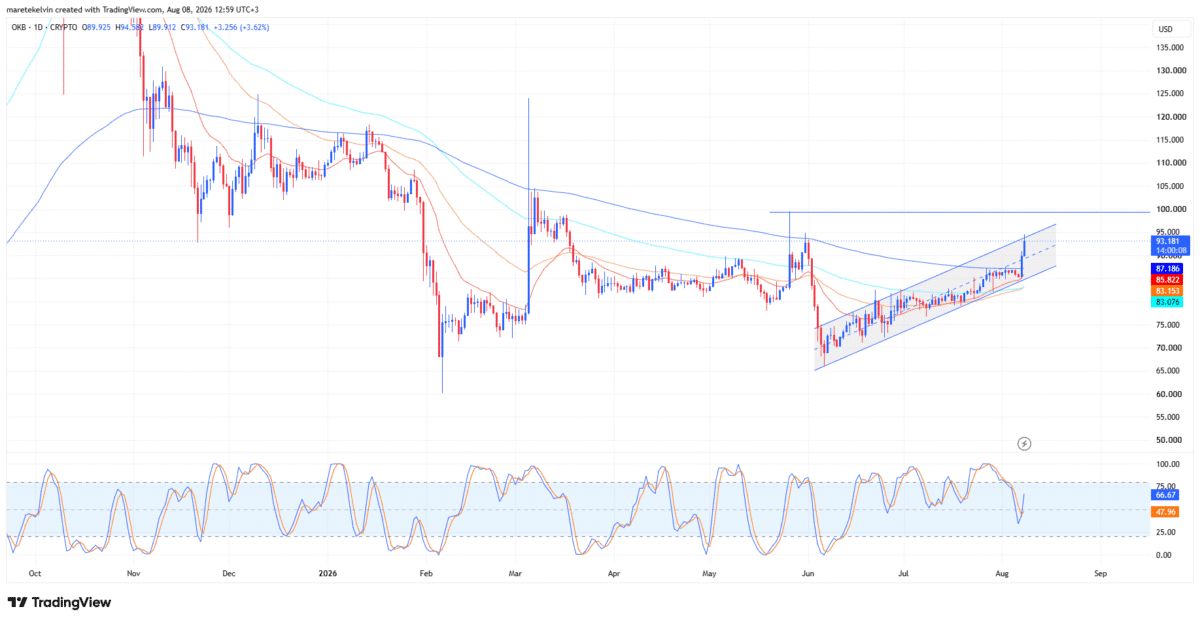
On the daily chart, $OKB traded within a bullish flag after recovering from its June lows. The token approached $100, a psychological level that aligned with the pattern’s upper resistance.
A decisive breakout above $100 could confirm the broader recovery’s continuation.
$OKB also traded above its 20-day, 50-day, 100-day, and 200-day EMAs. Holding above those Moving Averages kept the medium-term structure tilted toward the bulls.
However, Stochastic RSI rose toward elevated levels and stood near 66.67. The reading showed that buyers had control. It also raised the chance of short-term consolidation.
Source: TradingView
Is volume supporting $OKB’s rally?
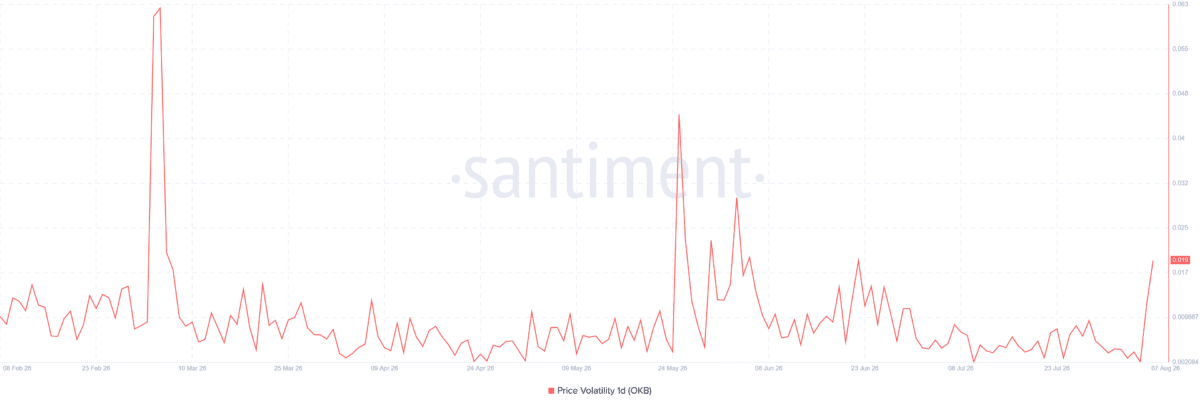
$OKB’s latest move came with a sharp increase in volatility.
The Daily Volatility metric climbed to roughly 1.9%, its highest level since late June.
Historically, higher volatility coincided with larger $OKB price swings. That made the $100 test particularly important.
Source: Santiment
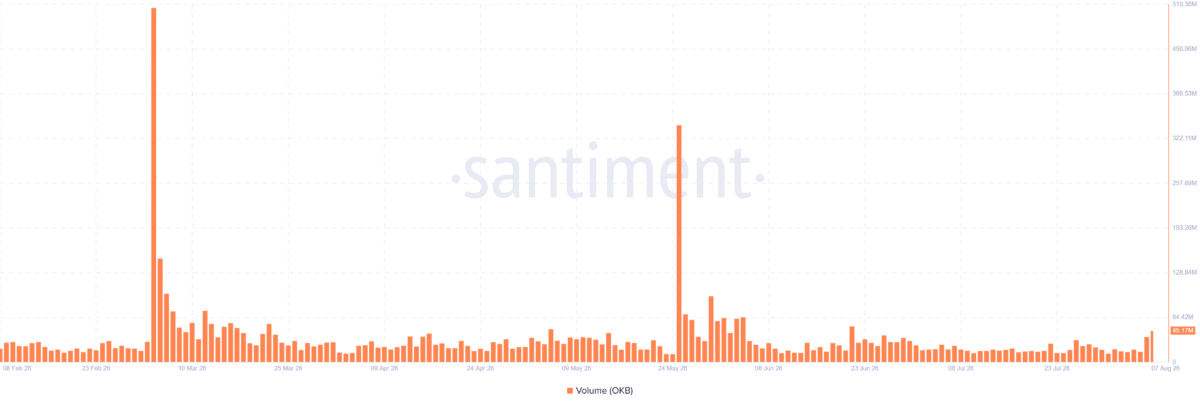
Meanwhile, daily trading volume reached $45.14 million after a 63% increase. A sustained volume increase during a breakout would strengthen the case that buyers absorbed available selling pressure.
A daily close above $100 could confirm the bullish flag breakout. Rejection could send $OKB toward its EMA support cluster near $85 to $87.
Source: Santiment
Final Summary
$OKB Active Addresses reached 103, their highest reading this month, supporting the token’s bullish setup.
A daily close above $100 could confirm an $OKB bullish flag breakout, while $85 to $87 remains key support.