Category: Business

  • HYPE whale exits $22.9m position as Hyperliquid token hovers near highs

    HYPE whale exits $22.9m position as Hyperliquid token hovers near highs

    High Stakes Capital has fully exited a 602,421 $HYPE position for $22.9m around $38, extending a broader wave of profit‑taking among Hyperliquid whales near record highs.

    Summary

    • $HYPE is trading around $38.86 after whale High Stakes Capital fully exited a position worth nearly $22.94 million over 24 hours.
    • The address offloaded 602,421 $HYPE at an average price of $38.08, following earlier sales of 300,000 $HYPE for $11.45 million at $38.17 each.
    • The unwind extends a broader pattern of profit-taking among large Hyperliquid whales after the derivatives-focused token hit record highs near $40.

    A major Hyperliquid ($HYPE) whale known as High Stakes Capital has liquidated more than 600,000 $HYPE in the past 24 hours, cashing out close to $22.94 million and putting short-term pressure on the flagship Hyperliquid token. ChainCatcher, citing Onchain Lens data, reported that the address sold a total of 602,421 $HYPE for approximately 22.938 million $USDC, at an average price of $38.08, with the final tranche of 152,421 $HYPE netting around $5.82 million and completing the exit. The sell-off comes as $HYPE, the native token of Hyperliquid’s decentralized perpetuals and derivatives ecosystem, trades just below recent peaks at about $38.86, up 2.72% on the day.

    PANews, also quoting Onchain Lens, noted that in the previous 12 hours the same whale had already sold 450,000 $HYPE for $17.12 million $USDC, at an average price of $38.05, while still holding 152,421 $HYPE worth $5.68 million before the final leg. Earlier, Phemex News reported that High Stakes Capital offloaded 300,000 $HYPE for $11.45 million at an average of $38.17, while still sitting on 302,421 $HYPE valued at about $11.54 million and a cumulative profit exceeding $33.2 million. This staggered exit pattern shows the whale systematically selling into strength around the $38–$39 range rather than dumping in a single transaction, a strategy that tends to limit slippage but can cap upside while the orders clear.

    $HYPE is part of the derivatives and DeFi sector, functioning as the core token of the Hyperliquid network, where traders use the platform for decentralized perpetual futures and leveraged speculation. Hyperliquid’s token previously touched an all-time high near $39.93 as 24‑hour trading volume surged to roughly $496 million and open interest climbed to $10.1 billion, according to DailyCoin’s earlier reporting on $HYPE’s breakout. At the same time, total value locked in the protocol jumped more than 369% in a matter of weeks, from about $311.55 million to $1.462 billion, underscoring the scale of capital rotating into derivatives-focused DeFi.

    You might also like: 6 popular AI tools for Bitcoin mining in 2026: Traditional miners face new challenges

    Recent data suggests that large $HYPE holders are actively managing exposure around the $35–$40 band. KuCoin Flash reported that another genesis whale, linked to the address known as tummy.hl, began selling 498,000 $HYPE via TWAP orders for more than $20 million, with the sale expected to complete within 21 hours. Coingabbar’s price analysis noted that $HYPE was trading near $34.73 in early February, up 30.53% over the preceding month, with open interest at $1.65 billion even as trading volumes fell 18% to about $805.7 million, suggesting a structurally bullish but increasingly crowded trade. Against that backdrop, High Stakes Capital’s exit looks less like capitulation and more like a textbook profit realization into a stretched market, as derivatives tokens and exchange-linked assets continue to outperform much of the broader crypto complex.

    Read more: Circle’s 16‑wallet $USDC freeze revives centralization and blacklist debate

  • Early Uber Investor Jason Calacanis Predicts 200x TAO Rally

    Early Uber Investor Jason Calacanis Predicts 200x TAO Rally

    Jason Calacanis is making a much bigger bet on decentralized AI than a casual market call. In an episode of This Week In Startups, the veteran angel investor appears to frame Bittensor’s $TAO token as the kind of asymmetric opportunity that venture investors spend years hunting for, and one that, in his view, could still be dramatically underpriced.

    Calacanis’s $TAO Comments Land as Bittensor Gains a More Explicit Venture-Style Bull Case

    In the segment posted by TWiSTartups, Calacanis argues that $TAO may have the kind of upside that could produce a 200x (from a $2.5 billion market cap), effectively labeling Bittensor as a long-duration, high-conviction AI infrastructure bet rather than a simple crypto trade.

    Calcanis is widely known as an early Uber backer and longtime startup investor, and has increasingly attached his name to the Bittensor narrative.

    A Stillcore Capital fund overview from late 2025 lists Calacanis as a consulting partner and describes the vehicle as a U.S. fund focused on Bittensor and $TAO, presenting the token as institutional-grade exposure to decentralized AI. The same materials describe Bittensor as an “intelligence infrastructure” play and repeatedly position $TAO as a reserve asset within that ecosystem.

    Calacanis’ call fits with a larger thesis now circulating around Bittensor, which is that if Bitcoin was the money layer of crypto and Ethereum became the application layer, $TAO bulls believe Bittensor could become the intelligence layer for an AI-native internet.

    Stillcore’s own materials go as far as to describe Bittensor as the potential “ Bitcoin of AI.”

    $TAO appears to be outshining an otherwise stagnant altcoin market, currently trading at $326, currently up 87% in the last 30 days.

    FAQ 🔎

    • Who is Jason Calacanis? J
      ason Calacanis is a longtime angel investor and podcaster best known for early bets including Uber and for hosting This Week in Startups.
    • What is $TAO?
      $TAO is the native token of Bittensor, a decentralized AI network that supporters describe as an intelligence infrastructure for the internet.
    • Why did Calacanis’s $TAO comment get attention?
      It got attention because he appears to frame $TAO as a potential 200x-style opportunity, and he has also been publicly linked to a Bittensor-focused fund.
    • Is Calacanis formally involved with Bittensor-related investing?
      Yes. A Stillcore Capital fund overview lists him as a consulting partner on a fund focused on Bittensor and $TAO.
  • Bitget Blends Crypto Trading With MotoGP Brazil Fan Experience Push

    Bitget Blends Crypto Trading With MotoGP Brazil Fan Experience Push

    Bitget brought crypto trading to the MotoGP Brazil Grand Prix, held March 20–22 at Autódromo Internacional Ayrton Senna in Goiânia. The exchange launched an on-site activation and expanded its Smarter Speed Challenge game. The initiative involved MotoGP attendees and global users, aiming to connect crypto trading concepts with motorsport experiences through interactive formats.

  • ZachXBT Reports Russian OTC Broker Allegedly Laundered $4.7M+ in Crypto

    ZachXBT Reports Russian OTC Broker Allegedly Laundered $4.7M+ in Crypto

    Blockchain investigator ZachXBT reported today that Russian OTC broker Aleksandr Khinkis allegedly laundered over $4.7 million in crypto. The activity reportedly occurred between July 2025 and March 2026 across a single exchange account. According to the findings, three suspected ransomware payments totaling 796 $BTC drove the transactions through Bitcoin, Avalanche, and Tron networks.

  • Tether Says It Will Be Audited By Big Four Accounting Firm—But Won’t Say Which One

    Tether Says It Will Be Audited By Big Four Accounting Firm—But Won’t Say Which One

    In brief

    • Tether says it will undergo its first full audit by a Big Four firm, but hasn’t disclosed which one.
    • The audit would verify reserves backing USDT, which the company claims total around $192 billion.
    • Completing the audit could help Tether comply with U.S. rules under the GENIUS Act.

    Tether, the world’s top stablecoin issuer, announced Tuesday it will soon make good on a yearslong promise to audit its sprawling stablecoin reserves—but won’t yet disclose which firm will actually do the job.

    Tether claims to hold some $192 billion in assets in reserve around the world to back the value of its dollar-pegged stablecoin, USDT. The majority of those reserves are purported to be held in U.S. Treasuries.

    But, ever since its founding in 2014, the company has refrained from undergoing an audit from a Big Four accounting firm to confirm the accuracy of its reserve claims. It has instead relied on attestations reviewed by an Italian accounting firm that has never directly examined Tether’s accounts and holdings.

    Today, the company announced it has signed a deal with a Big Four accounting firm to “complete its first full independent financial statement audit.” But Tether did not state which firm, and a Tether representative declined comment when reached by Decrypt.

    The Big Four accounting firms—Deloitte, PriceWaterhouseCoopers, Ernst & Young, and KPMG—are the world’s largest auditors, and are widely regarded as providing a certain standard of rigor and transparency when engaged by major corporations.

    Tether’s CEO, Paolo Ardoino, told Decrypt last year he planned on putting Tether through a Big Four audit, but that the process was taking time given the company’s size.

    The GENIUS Act, signed into law by President Donald Trump last summer, requires all foreign stablecoin issuers—theoretically including Tether, which is based in El Salvador—to undergo rigorous audits of its stablecoin reserves. Ardoino said last year he intends for USDT to comply with the law. A Big Four audit would go a long way to achieving that goal.

    Last fall, Tether launched an American offshoot with its own, U.S.-specific stablecoin, USAT. The token launched in January, and currently boasts a far smaller market capitalization than Tether’s flagship token: just $27 million, compared to USDT’s $184 billion.

    USAT’s far smaller reserves were successfully audited by Deloitte a month later.

    Editor’s note: This story was updated after publication to note that Tether declined comment.

    Daily Debrief Newsletter

    Start every day with the top news stories right now, plus original features, a podcast, videos and more.

  • Robinhood approves $1.5B buyback as stock nears 55% drop since October high

    Robinhood approves $1.5B buyback as stock nears 55% drop since October high

    Robinhood has approved a new $1.5 billion share repurchase program, giving the company more than $1.1 billion of additional capacity as management signals confidence in its strategy and financial strength.

    The company said it expects to execute the refreshed authorization over about three years, while keeping flexibility to move faster if market conditions allow.

    The new plan builds on Robinhood’s earlier buyback efforts. The company first launched a $1 billion repurchase program in May 2024, then raised the total authorization by another $500 million in April 2025.

    By February 2026, Robinhood had already spent about $910 million buying back roughly 22 million shares at an average price of $40.64, and its March 2026 investor presentation highlighted a $1.5 billion repurchase authorization as part of a broader capital allocation strategy.

    The buyback arrives as crypto markets remain under pressure, a key driver of weakness for Robinhood given its reliance on digital asset trading. Bitcoin hit a record high near $126,000 in early October 2025 and was last trading near $70,000 today, reflecting a sharp decline as risk appetite unwound.

    Robinhood stock has followed a similar path, hitting a record high near $154 in early October 2025 and last trading near $69 today, down about 55% from that peak.

    The company reported fourth quarter 2025 crypto trading revenue of $221 million, missing analyst expectations, while its digital asset segment has faced sustained pressure since the October market downturn.

    Disclosure: This article was edited by Estefano Gomez. For more information on how we create and review content, see our Editorial Policy.

  • Circle stock drops nearly 20% as CLARITY Act draft targets stablecoin yield

    Circle stock drops nearly 20% as CLARITY Act draft targets stablecoin yield

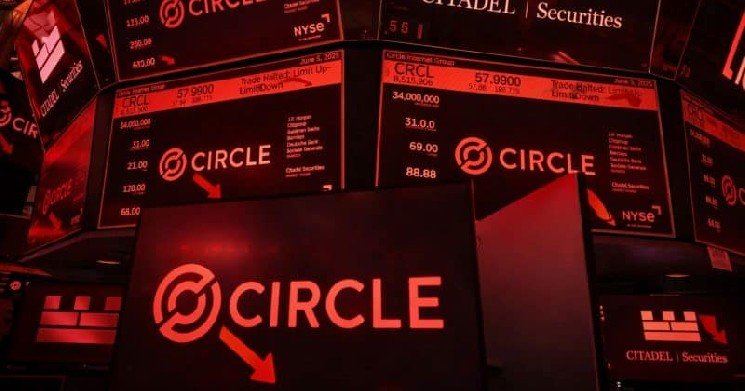
    Circle shares dropped nearly 20% Tuesday, falling toward the $100 level after a CoinDesk report revealed new draft language in the CLARITY Act that would ban yield on stablecoin balances.

    The proposed rules would prohibit issuers from offering passive rewards for simply holding a stablecoin and restrict structures that resemble interest-bearing deposits. While activity-based rewards may still be allowed, the framework remains unclear, according to people familiar with the draft reviewed by industry participants on Capitol Hill.

    The update directly affects stablecoin issuers such as Circle. Although $USDC does not currently offer yield to holders, the restriction removes a potential future pathway for the product to evolve beyond payments into a store of value. That shift weakens the broader bull case around $USDC as a more competitive financial instrument.

    Circle stock had been on a strong run before the pullback. Shares surged more than 175% from an early February low near $50 to a recent high around $135 last week. The stock was trading near $102.85 at press time following the selloff.

    The draft language represents a compromise after pushback from the banking sector, which argued that yield-bearing stablecoins could function too similarly to deposits and disrupt traditional lending markets. The current proposal allows rewards tied to user activity but not balances, though details on how those programs would be structured remain unresolved.

    The CLARITY Act is part of a broader effort to establish a comprehensive market structure framework for digital assets in the US. A prior version passed the House, and lawmakers are now working to align competing proposals before advancing the bill through the Senate Banking Committee.

    The outcome of the legislation remains a key overhang for stablecoin issuers. If passed with the yield restriction intact, it could limit how products like $USDC compete with newer yield-bearing alternatives and shape how capital flows across the digital asset ecosystem.

    Disclosure: This article was edited by Estefano Gomez. For more information on how we create and review content, see our Editorial Policy.

  • White House Correspondent Debunks Today’s News That Caused Bitcoin to Drop: “The Clarity Act Currently Allows Stablecoin Yields”

    White House Correspondent Debunks Today’s News That Caused Bitcoin to Drop: “The Clarity Act Currently Allows Stablecoin Yields”

    As discussions continue in the US regarding the draft Clarity Act, which is expected to shape the cryptocurrency market, the issue of yield on stablecoins has become one of the most critical topics in the regulatory process. A new draft text that emerged today allegedly suggests that, under pressure from the banking sector, direct earnings from stablecoin balances will be prohibited. This has sparked significant concern in the cryptocurrency market.

    However, according to new information reported by White House correspondent Sander Lutz, significant flexibility in favor of the crypto sector may have emerged during negotiations on the draft text. According to information from two sources, the new regulatory language could allow earning returns on staked stablecoins. If this approach is adopted, users would be able to continue earning passive income by staking their stablecoin assets.

    While this potential regulation is seen as a significant gain for the crypto sector, the focus of the debate has quickly shifted to the banking sector. The critical question is whether banks will view returns generated through staking as a direct threat to their business models. Indeed, another source close to the matter stated that it would be “illogical” for the banking sector to accept such a compromise, highlighting the depth of the disagreement between the parties.

    On the other hand, it is reported that the aforementioned compromise text is being reviewed today by banking sector representatives on Capitol Hill. Following this review process, the stablecoin regulations are expected to take their final form and the fate of the Clarity Act draft is expected to become clear.

    *This is not investment advice.

  • Monero (XMR) Price Falls by 5% Amid Surging Demand

    Monero (XMR) Price Falls by 5% Amid Surging Demand

    • On Tuesday, Monero ($XMR) witnessed a drop of 5% following the downward momentum in Bitcoin, dropping its value from $362 to $339 in 24 hours
    • The drop in the cryptocurrency amid the growing demand of $XMR as cross-chain swap activities for Monero are growing in the first quarter of 2026
    • $BTC-to-$XMR swaps have become the major trading pair on various platforms, accounting for over 3.6% of all swaps

    Amid the chaotic situation in the financial world, Monero ($XMR), the popular privacy coin, plunged by over 5% on Tuesday, declining its value from $362 to $339 on a daily chart.

    At the moment, the cryptocurrency’s price is revolving around $339.67 with a market capitalisation of $6.28 billion, according to CoinMarketCap. The shocking part of this drop is that it comes when the demand for Monero ($XMR) cryptocurrency reached an all-time high.

    Monero ($XMR) Privacy Demand Hits New Peaks in 2026

    According to fresh data on non-custodial swap platforms and reports, cross-chain swap activities for Monero are growing in the first quarter of 2026. $BTC-to-$XMR swaps have become the top trading pair on many instant-exchange sites, which sometimes accounts for over 3.6% of all swaps.

    Monero itself is now among the most-swapped cryptocurrencies, which accounted for around 16% of activity across platforms. According to the official data, privacy-based swaps, including $XMR pairs, have reached their highest share ever at 5.55% of total crypto swaps.

    Apart from this, daily Monero transactions on its own network are holding steady above 40,000, which is near all-time highs. The network’s hash rate is also increasing, which is showing strong user and miner support.

    Amid the rise in fear of privacy-based assets, many people are worried about privacy. Governments around the world are establishing strict regulations for the crypto sector. Recent developments in laws in the EU, U.S., and other countries are asking for the sharing of details of transfers, and tracking tools can easily follow Bitcoin transactions.

    Not just this, data breaches on big exchanges have also exposed user info. These kinds of cases have raised safety concerns. As a result, many are adopting Monero for real financial privacy.

    Platforms like GhostSwap are playing a crucial role in this to meet the growing demand by providing no-KYC swaps between Bitcoin and Monero using atomic swap technology and decentralised liquidity pools.

    Technically speaking, the current outlook for Monero is looking neutral to slightly bearish in the short term. Major platforms like TradingView are showing a strong sell signal based on moving averages despite the growth in their demand. The Monero price is now trading below major short-term lines such as the 10-day, 20-day, and 50-day exponential moving averages.

    The Relative Strength Index (RSI) is revolving around 45 to 51, which is in neutral territory and suggests there is still room for movement without being overbought or oversold. The MACD indicator is showing less selling pressure in recent readings, while oscillators are still in a neutral state.

    For Monero, there are major support levels seen around $320 to $340, where the price may find buying interest if the decline continues. There are strong support levels that revolve around $300. On the upside, resistance is noted at $370, which is a level that has rejected the price multiple times recently. This is a level that has rejected the price multiple times recently, followed by tougher hurdles at $380 to $400. The chart is showing consolidation after a pullback with good network performance, like steady transactions.

    The overall crypto market is struggling to break the consolidation zone. After soaring above $70,000 in the past week many times, the Bitcoin ($BTC) price failed to sustain a rally and quickly plunged below this support level.

    Also Read: Pi Token Price Slides Amid Thin Volume and Market Caution