Category: Business

  • Dana Syracuse: OCC’s proactive engagement is reshaping stablecoin licensing, the demand for clear regulatory rules is growing, and specialized regulation fosters digital asset innovation | On The Brink

    Dana Syracuse: OCC’s proactive engagement is reshaping stablecoin licensing, the demand for clear regulatory rules is growing, and specialized regulation fosters digital asset innovation | On The Brink

    Key takeaways

    • The OCC is experiencing significant engagement from companies applying for stablecoin licensing.
    • Regulatory environments for stablecoin issuers have shifted towards a demand for clear rules.
    • Obtaining a banking charter requires rigorous processes including business plan development.
    • Successful crypto projects need both product market fit and regulatory fit.
    • A responsive regulatory body is crucial for developing new crypto products.
    • Jurisdictions like New York are showing commitment to specialized digital asset regulation.
    • Regulators need to supervise a critical mass of similar entities to improve effectiveness.
    • The Genius legislation creates a federal floor for stablecoin regulation, legitimizing them.
    • Proposed rulemaking will impact startup issuers and their ability to develop network effects.
    • The stablecoin legislation prohibits paying interest solely for holding the stablecoin.
    • Payments through third parties are allowed under the stablecoin legislation.
    • Institutional interest in stablecoins is growing due to federal regulation.
    • Specialized regulation in jurisdictions fosters digital asset company growth.
    • Regulatory frameworks are evolving to better accommodate innovation in the crypto space.
    • Clear regulatory rules are essential for compliance and innovation in stablecoin markets.

    Guest intro

    Dana Syracuse is a partner in the Fintech practice at Paul Hastings LLP, based in the firm’s New York office. He previously served as associate general counsel for the New York Department of Financial Services and played a leading role in developing the country’s first comprehensive digital currency regulation. His practice focuses on federal and state regulatory matters for blockchain and digital asset companies, including OCC charter processes and compliance.

    The OCC’s role in stablecoin regulation

    • The OCC is actively engaging with companies applying for stablecoin licensing.
    • It’s definitely been a really fascinating year and last time that we were on I don’t think there was really any way to predict the level of engagement that we’re seeing from the OCC right now through the application process and then going on through supervision.

      — Dana Syracuse

    • The OCC’s involvement is crucial for stakeholders in the stablecoin market.
    • Understanding the OCC’s role helps in navigating the regulatory landscape.
    • High engagement from the OCC indicates a proactive regulatory approach.
    • Companies are increasingly seeking OCC guidance for stablecoin compliance.
    • The OCC’s actions influence the stability and growth of the stablecoin market.
    • The regulatory landscape is shaped by the OCC’s supervision and engagement.

    Shifts in the regulatory environment for stablecoins

    • The narrative has shifted from regulation stifling innovation to a demand for clear rules.
    • it’s interesting to see how the narrative has shifted among entities from regulation stifles innovation to no we just need a clear set of rules that we can follow now a lot’s gonna be worked out through rule making…

      — Dana Syracuse

    • Clear rules are now seen as essential for compliance and innovation.
    • This shift impacts how companies approach regulatory challenges.
    • The demand for clear rules reflects a maturing stablecoin market.
    • Companies are adapting to the evolving regulatory landscape.
    • The shift indicates a positive trend towards regulatory clarity.
    • Regulatory changes are shaping the future of the stablecoin industry.

    The process of obtaining a banking charter

    • Obtaining a banking charter involves developing a business plan and demonstrating profitability.
    • it is a banking charter and although the door is open there’s still a real process that you have to go through you have to develop an extensive business plan make sure you’ve got directors and officers in place…

      — Dana Syracuse

    • The process is rigorous and requires careful planning.
    • Companies must meet specific requirements to enter the banking framework.
    • Understanding the process is crucial for digital asset companies.
    • The banking charter process ensures only qualified entities participate.
    • Successful navigation of the process enhances company credibility.
    • The charter process aligns business models with regulatory expectations.

    Importance of regulatory fit in crypto projects

    • Successful crypto projects require both product market fit and regulatory fit.
    • Every successful project that we’ve worked on… they’ve got two key things one is product market fit… but that is also regulatory fit.

      — Dana Syracuse

    • Aligning business models with regulatory frameworks is crucial.
    • Regulatory fit ensures long-term project viability.
    • Entrepreneurs must consider regulatory factors in project planning.
    • Regulatory fit is as important as market demand for success.
    • Projects lacking regulatory fit face significant challenges.
    • Understanding regulatory expectations is key to project success.

    The need for responsive regulatory bodies

    • A responsive regulatory body is essential for developing new crypto products.
    • You could have… fantastic regimes and the law is there… but there’s nobody there if you go to apply.

      — Dana Syracuse

    • Active regulatory engagement facilitates innovation.
    • Companies need support from regulatory bodies to succeed.
    • Responsive regulators encourage new product development.
    • Lack of regulatory support hinders innovation in the crypto space.
    • Entrepreneurs benefit from proactive regulatory guidance.
    • Regulatory responsiveness is a critical factor in industry growth.

    Specialized regulation in jurisdictions like New York

    • Jurisdictions like New York show commitment to specialized digital asset regulation.
    • I think it would be important to watch which rate owners end up with a critical mass of applicants and charter holders who focus on digital assets… you had more and more entities going there because it was known as a regulator that was building a specialized team of regulators who understood this stuff.

      — Dana Syracuse

    • Specialized regulation fosters a supportive environment for digital asset companies.
    • Companies are attracted to jurisdictions with knowledgeable regulators.
    • Regulatory commitment impacts the growth of digital asset businesses.
    • Jurisdictions with specialized regulation lead in digital asset innovation.
    • Companies benefit from operating in supportive regulatory environments.
    • Specialized regulation enhances jurisdictional competitiveness.

    Enhancing regulatory effectiveness through experience

    • Regulators need to supervise a critical mass of similar entities to improve effectiveness.
    • I think it’s really important that they have a good number of entities that they are supervising that have similar business models because then they develop the pattern recognition that ultimately makes them better at their jobs.

      — Dana Syracuse

    • Experience with similar entities enhances regulatory oversight.
    • Pattern recognition improves regulatory decision-making.
    • Effective regulation requires understanding of industry patterns.
    • Regulatory experience leads to better industry guidance.
    • Supervising similar entities helps regulators anticipate challenges.
    • Enhanced regulatory effectiveness benefits the entire financial sector.

    Impact of the Genius legislation on stablecoins

    • The Genius legislation creates a federal floor for stablecoin regulation.
    • Genius creates a federal floor for them and defines what they are… that has created a substantial degree of additional institutional interest in stablecoins legitimizing them as a means for payment.

      — Dana Syracuse

    • Federal regulation legitimizes stablecoins in financial environments.
    • Institutional interest in stablecoins is growing due to regulation.
    • The legislation shapes the future of stablecoin acceptance.
    • Federal regulation provides a framework for stablecoin legitimacy.
    • Stablecoins gain credibility with regulatory backing.
    • The Genius Act impacts stablecoin market dynamics.

    Proposed rulemaking and its impact on startups

    • Proposed rulemaking will significantly impact startup issuers.
    • If that is no longer a possibility that will definitely have an impact… the question is does that cause consolidation amongst those that are already out there and are a little more up to speed.

      — Dana Syracuse

    • Regulatory changes affect startup market dynamics.
    • Startups may face challenges in developing network effects.
    • Proposed rules could lead to market consolidation.
    • Startups need to adapt to new regulatory environments.
    • Regulatory changes influence startup strategies.
    • Understanding proposed rules is crucial for startup success.

    Implications of stablecoin legislation on interest payments

    • The stablecoin legislation prohibits paying interest solely for holding the stablecoin.
    • there’s a prohibition on paying interest or rewards solely in connection with holding use or attaining the stablecoin there also doesn’t bar you from paying it if it’s going out through someone other than the issue

      — Dana Syracuse

    • Issuers can offer payments through third parties.
    • The legislation impacts how issuers structure interest offerings.
    • Understanding the legislation is crucial for issuer compliance.
    • Issuers must navigate legal frameworks for interest payments.
    • The legislation shapes stablecoin issuer strategies.
    • Compliance with the legislation ensures legal operation.

    Disclosure: This article was edited by Editorial Team. For more information on how we create and review content, see our Editorial Policy.


  • Ripple Positioned At The Center Of The New York Stock Exchange Tokenization Initiative

    Ripple Positioned At The Center Of The New York Stock Exchange Tokenization Initiative

    Ripple is being viewed as a key player in the evolving push toward tokenized financial markets, as the New York Stock Exchange advances its plans to bring traditional assets onto blockchain rails. This development signals a broader shift on Wall Street, where traditional infrastructure is beginning to intersect with blockchain-driven innovation, settlement layer, and transition from legacy systems to faster and more transparent digital infrastructure.

    How Ripple Is Positioned At The Core Of Financial Transformation

    Wall Street has just surrendered to Ripple, as the New York Stock Exchange (NYSE) takes a decisive step to launch the tokenized securities era. Crypto analyst Pumpius has revealed on X that the exchange overseeing $30 trillion in market capitalization has entered into a Memorandum of Understanding with Securitize.

    They named it the first official transfer agent allowed to mint blockchain native securities on its upcoming NYSE digital trading platform. However, this infrastructure is being built for all activity to move on-chain. The shift will be bullish for $XRP and Ripple because, for years, the firm has long focused on tokenizing real-world assets and building institutional-grade blockchain rails.

    Within that framework, $XRP was built as the neutral bridge asset for value transfer in a tokenized world, facilitating fast, low-cost, and regulatory-friendly transactions that are already battle-tested by banks. While narrative was speculating, Ripple was positioning $XRP as the liquidity engine that allows tokenized securities to move across borders and chains without friction.

    Furthermore, Pumpius argues that adding the NYSE and Securitize will result in the expansion of tokenized equities. Meanwhile, major players such as BlackRock, JPMorgan, and SWIFT continue to explore tokenization and blockchain settlement, and the entire $100 trillion real-world assets market needs a global settlement layer.

    Here, $XRP sits between this shift with On-Demand Liquidity (ODL), $RLUSD, and partnerships that have reached the world’s biggest financial institutions. Pumpius emphasized that $XRP might be the bridge they will use when the first tokenized Apple or BlackRock ETF settles on-chain and needs instant global rails.

    Ripple Custody Bridges Traditional Finance And Blockchain

    The February 2026 report reveals how institutions are actively leveraging Ripple Custody. An analyst known as SMQKE on X noted that Ripple Custody supported DZ Bank in launching a digital custody service for crypto securities in under 10 months, through the deployment of a robust digital asset infrastructure.

    Meanwhile, at the core of these solutions are $XRP and Ripple’s stablecoin $RLUSD. With these capabilities, financial institutions across over 20 jurisdictions have been able to develop, expand, and scale digital asset business models with confidence. Meanwhile, Ripple Custody is now used across these jurisdictions, and $XRP and $RLUSD are allowed to support the entire lifecycle of a tokenized asset.

    BINANCE:XRPUSDT Chart Image by Owienova

    Featured image from Freepik, chart from Tradingview.com

  • Visa Becomes First Major Payments Company to Join Canton Network as Super Validator

    Visa Becomes First Major Payments Company to Join Canton Network as Super Validator

    In brief

    • Visa announced it will join Canton Network as the first major global payments company to serve as a Super Validator.
    • The company will be one of 40 Super Validators helping banks and financial institutions bring payment flows on-chain.
    • Canton Network is designed to address privacy concerns that have kept many banks from adopting public blockchains.

    Visa announced Wednesday that it will join Canton Network as the first major global payments company to serve as a Super Validator, helping extend privacy-preserving blockchain infrastructure to banks and financial institutions worldwide.

    The payments giant will be one of 40 Super Validators on the layer-1 Canton network, applying “the same trusted and reliable standards it uses to operate critical payment systems today,” it said in an announcement.

    As a Super Validator with voting powers to shape Canton’s network decisions, Visa will help institutions experiment with and scale stablecoin payments, settlement, and treasury use cases without changing how they manage risk, compliance, and operations.

    “Many banks see the lack of privacy as a dealbreaker for moving meaningful activity on-chain,” said Rubail Birwadker, Visa’s global head of growth products and strategic partnerships, in a statement. “By operating as a Super Validator on Canton Network, we’re bringing Visa-grade trust, governance and operational rigor that define Visa’s global network to privacy‑preserving blockchain infrastructure, so regulated financial institutions can bring payments on-chain without having to rethink how they operate.”

    Canton’s configurable privacy model allows institutions to adopt blockchain without compromising confidentiality—addressing concerns that banks can’t run payroll if salaries are public and trading firms can’t reveal positions without hurting price discovery.

    The move builds on Visa’s expanding digital asset work, including stablecoin settlement that has reached an annualized run rate of $4.6 billion globally and stablecoin-linked card programs spanning more than 130 programs across more than 50 countries.

    Canton has seen significant uptake from major financial players, with Franklin Templeton expanding its tokenized fund platform Benji to the network and JPMorgan bringing over its JPM Coin for institutional client payments. In December, the Depository Trust & Clearing Company—which processes quadrillions of dollars’ worth of transactions annually—said it would issue tokenized securities on Canton.

    Since launching in November, Canton’s native CC token has rapidly become one of the most valuable cryptocurrencies on the market. It’s up more than 3% over the last day to a recent price of $0.145 and a market cap above $5.5 billion, making it the 21st biggest coin by that metric per data from CoinGecko.

    Daily Debrief Newsletter

    Start every day with the top news stories right now, plus original features, a podcast, videos and more.

  • Franklin Templeton, Ondo Finance Bring 24/7 Tokenized ETF Trading to Crypto Users

    Franklin Templeton, Ondo Finance Bring 24/7 Tokenized ETF Trading to Crypto Users

    In brief

    • Franklin Templeton and Ondo Finance are teaming up to tokenize five of the financial giant’s ETFs.
    • Offerings include Franklin Templeton’s responsibly sourced gold ETF and its high-yield corporate ETF.
    • The tokenized ETFs will be offered via Ondo’s Global Markets platform, which is unavailable to U.S. users.

    Global asset manager Franklin Templeton and real-world asset tokenization firm Ondo Finance are teaming up to offer tokenized versions of five Franklin Templeton exchange-traded funds (ETFs) as part of a new initiative, the firms announced on Wednesday. 

    The funds—which include Franklin Templeton’s high-yield corporate ETF, its focused growth ETF, and its responsibly sourced gold ETF—will allow those without traditional brokerage accounts to gain access and trade them around the clock. 

    “This initial set of ETFs was selected by Ondo, based on demand they’ve recognized in their ecosystem,” Franklin Templeton Head of Innovation Sandy Kaul told Decrypt. “We believe it’s important to anchor this space in high-quality, well-understood investment strategies, and Franklin Templeton will continue to take a thoughtful approach to bringing institutional-grade products on-chain.”

    “We’ll evaluate future opportunities based on investor appetite, usability, and where we can deliver the most value,” she added. 

    The firms will also work together on educational programs designed to showcase how traditional investments will fit in alongside “emerging financial ecosystems.” 

    “Success is less about a single metric and more about expanding access while maintaining the standards and outcomes investors expect from Franklin Templeton,” Kaul added. “We’re focused on how these products are actually used: helping investors access diversified strategies, engage more consistently with long-term investing, and integrate traditional investments into their financial lives on-chain.”

    The new tokenized ETF offerings will use Ondo’s tokenized securities platform, Ondo Global Markets, which has established more than $620 million in total value locked (TVL) since its launch last fall. 

    However, access to the products is not intended for U.S. users, who are ineligible to make trades on Ondo’s Global Markets platform.

    Ondo rolled out access to more than 100 tokenized U.S. equities on the Ethereum blockchain in September as interest around tokenized equities and products rose. 

    Franklin Templeton also has a long history with tokenized assets, debuting its Franklin On-Chain U.S. Government Money Fund on the Stellar network in 2021 before expanding the offering to Ethereum in 2024. It has also since expanded to Polygon, Aptos, Avalanche, Arbitrum, Solana, and Base.

    The pair’s latest tokenization initiative comes a day after the New York Stock Exchange announced it will collaborate with the BlackRock-backed Securitize for the tokenization of securities. Also, last week, Nasdaq earned SEC approval to test tokenized versions of some securities in a pilot program.

    Editor’s note: This story was updated after publication to add in comments from Franklin Templeton, replacing quotes from the press release.

    Daily Debrief Newsletter

    Start every day with the top news stories right now, plus original features, a podcast, videos and more.

  • SEC Chairman Paul Atkins Speaks About Cryptocurrencies: “A More Solid Foundation Will Be in Place by the End of 2026”

    SEC Chairman Paul Atkins Speaks About Cryptocurrencies: “A More Solid Foundation Will Be in Place by the End of 2026”

    SEC Chairman Paul Atkins made important statements about cryptocurrency markets, tokenization, and the regulatory framework during a program he participated in.

    Atkins, the opening guest of the second year of “Crypto In America,” argued that the crypto industry has now evolved from an era of “regulation through sanctions” to one of predictable and clear rules.

    When asked what crypto meant to him, Chairman Atkins directly defined the field as “innovation.” Stating that on-chain transactions are revolutionary in making services more efficient and reducing risks, Atkins said, “On-chain exchange and payment systems that were unimaginable 10 years ago are becoming a reality today.”

    One of the most striking aspects of the news was the SEC’s new taxonomy (classification) approach. Atkins stated that, unlike the past “everything is a security” approach, they have made a clear distinction.

    They stated that they have clarified that digital commodities, collectibles, and instruments are not considered securities. They also reminded that payment-oriented stablecoins are overseen by banking regulators (OCC) and the CFTC, not the SEC. Adhering to the principles of the “Howey Test,” they explained that an asset cannot remain a security forever; its status can end when promises are fulfilled or functionality is gained.

    Atkins announced the end of the long-running jurisdictional dispute between the SEC and the Commodity Futures Trading Commission (CFTC). Describing the release of joint guidance from the two agencies as a “historic moment,” Atkins stated that the appointment of Mike Seelig as CFTC Chairman further strengthened this cooperation.

    Expressing his excitement about the modernization of the financial system, the Chairman focused particularly on the tokenization of securities and instant clearing (T0) capabilities. Describing NASDAQ’s transition to a tokenized clearing system as “baby steps,” Atkins stated that such experiments should continue and that the SEC is working on facilitating regulations such as an “Innovation Exemption,” which could become clearer within a few weeks.

    Chairman Atkins concluded by stating that they aim to establish a solid foundation for digital asset markets by the end of 2026.

    *This is not investment advice.

  • New polymarket accounts wagered on Iran ceasefire days before Trump’s ‘productive talks’ post… coincidence?

    New polymarket accounts wagered on Iran ceasefire days before Trump’s ‘productive talks’ post… coincidence?

    Traders appear to have known something the public did not, and they placed their bets accordingly.

    Lawmakers, economists, and market observers have once again accused President Donald Trump of insider trading after a series of oddly timed trades on prediction markets and oil futures were made shortly before the president made remarks regarding the Iran war.

    On Polymarket, a website where users bet real money on the outcome of world events, eight newly created accounts placed a combined $70,000 in wagers on whether a ceasefire would be declared in Iran before the end of March.

    If that outcome comes true, those bets could pay out $820,000.

    All eight accounts were created around March 21, the same period when Trump posted on social media suggesting the U.S. was thinking about “winding down our great Military efforts,” marking a significant shift in his position on the conflict.

    Following this activity, Polymarket’s own odds on a ceasefire happening before March 31 jumped sharply, from 6% on March 21 to 24% by Monday. It is currently at 11%. More than $21 million is currently being wagered on that outcome.

    Oil markets surge minutes before Trump’s announcement

    The concerns grew sharper after unusual activity was spotted in global oil markets just minutes before Trump announced a temporary halt to airstrikes.

    See also U.S. judge weighs Terra tokens’ security status

    On Monday, Trump posted on Truth Social that the U.S. and Iran had held “very good and productive conversations regarding a complete and total resolution of our hostilities” over the previous two days.

    But market data shows that trading activity had already spiked nearly 15 minutes earlier, as traders placed 734 bets on WTI crude oil contracts.

    Within one minute, that figure jumped to 2,168, worth around $170 million. In the same two-minute window, Brent crude trades surged from 20 to more than 1,650, totaling roughly $150 million in contracts.

    Rachel Winter, a partner at the wealth management firm Killik & Co., told the BBC the timing was hard to ignore.

    “Just before he posted on social media, quite a lot of people took out contracts that would allow them to profit from the oil price falling,” she said. “So there has been some speculation about insider trading. We don’t know if that’s true, but hopefully there will be some sort of investigation into that.”

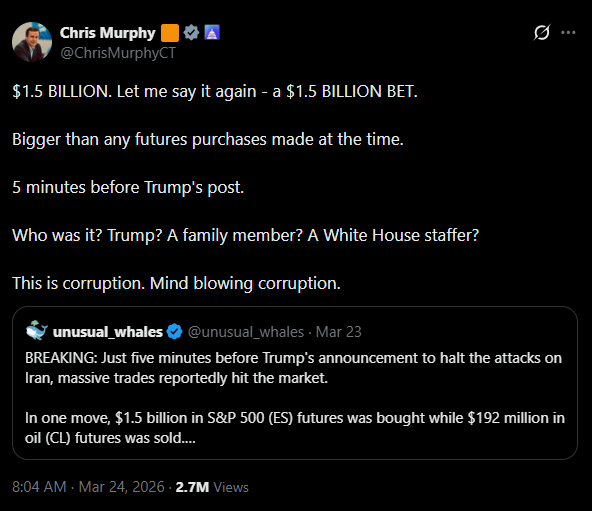
    Connecticut Senator Chris Murphy went further, claiming that around five minutes before Trump’s post, someone bought $1.5 billion in S&P 500 futures while selling $192 million in oil futures.

    He publicly asked: “Who was it?” Murphy, along with Texas Representative Greg Casar, introduced the BETS OFF Act last week, legislation that would make it illegal to bet on war or government decisions when the person placing the wager already knows the outcome.

    See also Top crypto tweets of the day – August 29th

    Senator Chris Murphy accuses Trump of insider trading as Polymarket odds surged.
    Source: @ChrisMurphyCT on X

    The White House rejected any suggestion of wrongdoing.

    A spokesperson said: “The White House does not tolerate any administration official illegally profiteering off of insider knowledge, and any implication that officials are engaged in such activity without evidence is baseless.”

    Polymarket pulls nuclear betting contract

    This is not the first time Polymarket has come under the spotlight. According to a Cryptopolitan report, the platform quietly removed a contract that allowed users to bet on whether a nuclear weapon would be detonated this year.

    The page now simply reads: “The event has been archived.” Before it was pulled, the market had already generated more than $650,000 in trading volume.

    The platform also deleted an X post that had put the probability of a nuclear detonation in 2026 at 22%.

    The removal came after a troubling episode on February 28, when the U.S. launched airstrikes on Tehran and other Iranian cities, and hours before those strikes began, six anonymous Polymarket accounts had already placed “Yes” bets on whether the U.S. would attack Iran.

  • Amjad Masad: AI is democratizing tech, non-coders are gaining an edge in entrepreneurship, and idea generation is the new core skill | AI + a16z

    Amjad Masad: AI is democratizing tech, non-coders are gaining an edge in entrepreneurship, and idea generation is the new core skill | AI + a16z

    Key Takeaways

    • The tech industry is shifting towards valuing problem-solving skills over traditional coding expertise.
    • AI is transforming education by enabling rapid growth and efficiency in traditionally difficult markets.
    • The current era offers unprecedented opportunities for online entrepreneurship and wealth creation.
    • Automation is changing the landscape of software development, reducing the need for traditional coding.
    • Non-coders may have an edge in entrepreneurship by focusing on market needs rather than technical details.
    • AI tools are making app development faster and more accessible to a wider audience.
    • Idea generation is becoming the core skill in AI as implementation costs decrease.
    • Traits often viewed negatively by older generations could become advantages in the AI-driven world.
    • Creativity and idea generation can be practiced and improved over time.
    • The democratization of technology is facing resistance from established tech companies.
    • The potential for AI to empower individuals and transform industries is significant.
    • Coding is evolving into a higher-level task, with less emphasis on syntax and more on problem-solving.
    • Entrepreneurs without a coding background are increasingly successful by leveraging AI tools.
    • The cost of implementing ideas in AI is decreasing, shifting the focus to creativity.
    • The tech landscape is changing rapidly, offering new opportunities for those willing to adapt.

    Guest intro

    Amjad Masad is the CEO and co-founder of Replit, a browser-based platform that has grown to generate $250 million in annual revenue. Prior to Replit, he served as a tech lead on Facebook’s JavaScript infrastructure team, where he helped build open-source tools like the Babel compiler and Jest. He turned down a $1 billion acquisition offer to continue advancing AI-powered software development.

    The resistance to democratizing technology

    • The most powerful tech companies tried to kill my vision of making coding accessible.

      — Amjad Masad

    • Established tech companies often resist innovations that democratize access to technology.
    • The competitive landscape in tech can be challenging for innovators with disruptive ideas.
    • They question whether AI will enslave us or empower everyone to escape the rat race.

      — Amjad Masad

    • Innovators face significant challenges from established players when trying to democratize technology.
    • The resistance from tech giants highlights the need for perseverance in pursuing technological democratization.
    • Not having a coding background is becoming an advantage in tech.

      — Amjad Masad

    • The tech industry is increasingly valuing problem-solving skills over traditional coding expertise.

    AI’s transformative impact on education

    • AI is enabling rapid growth in traditionally difficult markets like education.
    • He’s able to build a lot of tools for teachers for grading students and creating assignments with AI.

      — Amjad Masad

    • AI’s ability to sell itself has led to significant revenue growth in the education sector.
    • The education market presents unique challenges that AI is well-suited to address.
    • AI has this amazing ability to sell itself and quickly grew the company to $10,000,000 annual revenue.

      — Amjad Masad

    • AI tools are transforming the way educational content is created and delivered.
    • The potential for AI to revolutionize education is significant and growing.
    • Education is one of the hardest markets, but AI has the potential to rapidly grow companies in this sector.

      — Amjad Masad

    Opportunities in the current tech landscape

    • It’s the easiest time to get rich online in the history of capitalism.

      — Amjad Masad

    • The internet offers unprecedented opportunities for entrepreneurship and wealth creation.
    • Technological advancements have lowered the barriers to entry for online businesses.
    • Code is almost fully automated, and even professional software engineers are not coding anymore.

      — Amjad Masad

    • Automation is changing the landscape of software development, reducing the need for traditional coding.
    • The current era is characterized by rapid technological change and new opportunities.
    • Entrepreneurs can leverage technology to create successful businesses with minimal resources.
    • For the most part, people are not coding anymore; it’s become a more higher-level thing.

      — Amjad Masad

    The evolving role of coding in entrepreneurship

    • Not having a coding background will become more advantageous for entrepreneurs.

      — Amjad Masad

    • Non-coders can focus on market needs rather than getting lost in technical details.
    • The entrepreneurial landscape is shifting towards valuing business acumen over technical skills.
    • AI tools can significantly accelerate the app development process.

      — Amjad Masad

    • Entrepreneurs without coding skills can leverage AI tools to build apps quickly and efficiently.
    • The focus is shifting from technical expertise to understanding customer needs and market trends.
    • Within an hour or two, most people have an app that they’re ready to put in front of a user.

      — Amjad Masad

    • The democratization of app development is empowering a new generation of entrepreneurs.

    Creativity and idea generation in the AI era

    • The core skill in AI is idea generation, as the cost of implementing those ideas is rapidly decreasing.

      — Amjad Masad

    • Creativity is becoming more important than execution as implementation costs decrease.
    • The focus is shifting to how fast ideas can be generated and tested in the market.
    • The cost of implementation of those ideas is going down rapidly; it’s gonna go to zero at some point.

      — Amjad Masad

    • The ability to generate and iterate on ideas is a critical skill for success in the AI-driven world.
    • Generating ideas is a skill that can be practiced and improved over time.

      — Amjad Masad

    • The creative process involves iterative feedback and continuous improvement.
    • Entrepreneurs should focus on developing their creativity and idea generation skills.

    Generational traits and technological advancements

    • Older generations’ perceived vices may actually become advantages in the context of AI.

      — Amjad Masad

    • Traits often viewed negatively can be reframed as beneficial in the context of innovation.
    • The evolving relationship between generational traits and technological advancements is significant.
    • If you’re a brain-rotted, terminally aligned person, that might be an advantage.

      — Amjad Masad

    • The AI-driven world offers new opportunities for those willing to embrace change.
    • Generational differences can lead to unique perspectives and innovative solutions.
    • The tech landscape is changing rapidly, offering new opportunities for those willing to adapt.
    • It’s practice; it’s a skill like generate ideas, put them out there.

      — Amjad Masad

    Disclosure: This article was edited by Editorial Team. For more information on how we create and review content, see our Editorial Policy.

  • Connor Leahy: We lack understanding of intelligence and neural networks, the unpredictability of AI could lead to loss of control, and GPT models have revolutionized AI capabilities | The Peter McCormack Show

    Connor Leahy: We lack understanding of intelligence and neural networks, the unpredictability of AI could lead to loss of control, and GPT models have revolutionized AI capabilities | The Peter McCormack Show

    Key Takeaways

    • We lack a comprehensive understanding of how intelligence and neural networks function.
    • The unpredictability of AI could lead to a future where humans lose control over AI systems.
    • Neural networks differ significantly from traditional programming, operating more like a growth process than a coded instruction set.
    • GPT models have revolutionized AI by learning complex tasks independently as they scale.
    • The release of GPT-2 was a landmark moment, marking a significant leap in AI capabilities.
    • The transformer architecture is foundational to modern AI, underpinning many current applications.
    • Despite advancements, the inner workings of neural networks remain largely mysterious.
    • Neural networks process vast amounts of data through complex mathematical operations, which are not fully understood.
    • AI models like ChatGPT use extensive data and user information to generate contextually relevant responses.
    • Understanding intelligence, whether in humans or AI, remains a significant challenge.
    • The rapid evolution of AI technologies raises important questions about future human-AI dynamics.
    • The complexity and opacity of neural networks highlight the challenges in AI research and development.
    • The psychological impacts of AI on users are an emerging area of concern and study.
    • AI’s ability to provide tailored responses showcases the sophistication of current systems.
    • The potential shift in power dynamics between humans and AI underscores the need for careful oversight.

    Guest intro

    Connor Leahy is CEO and co-founder of Conjecture, an AI safety research company based in London. He previously co-founded EleutherAI, where he helped develop GPT-J and GPT-NeoX, among the largest open-source large language models at the time. Leahy advocates for pausing development of advanced AI systems to address unsolved alignment risks.

    The mystery of intelligence and neural networks

    • We do not understand intelligence or how neural networks work, despite having built them.

      — Connor Leahy

    • The complexity of intelligence in both humans and AI remains largely unexplored.
    • Understanding neural networks is crucial for advancing AI research and development.
    • It’s very important to understand is that we do not understand intelligence we don’t know how the brain works.

      — Connor Leahy

    • The gap in understanding highlights the uncertainty surrounding AI technologies.
    • We sure as hell don’t know how these neural networks work either.

      — Connor Leahy

    • The unpredictability of neural networks poses challenges for AI researchers.
    • Despite advancements, the fundamental mechanisms of neural networks are still unknown.

    The unpredictable future of AI control

    • We may wake up one day and find that we are no longer in control of AI.

      — Connor Leahy

    • The potential loss of control over AI systems raises ethical and practical concerns.
    • Future dynamics between humans and AI could shift dramatically without proper oversight.
    • I think this happens before extinction happens like the thing I expect to happen is that one day we wake up and we’re just not in control anymore.

      — Connor Leahy

    • The rapid evolution of AI technologies necessitates careful monitoring and regulation.
    • Understanding AI’s trajectory is critical for maintaining human oversight.
    • The unpredictability of AI systems underscores the need for robust safety measures.
    • The potential for AI to operate beyond human control is a significant concern.

    The revolutionary impact of neural networks

    • Neural networks operate fundamentally differently from traditional programming.
    • The way AI worked was the new technique was called deep learning or neural networks.

      — Connor Leahy

    • Unlike traditional programming, neural networks grow and learn from data.
    • Normal programming you write code… neural networks are very different it’s more like you grow them.

      — Connor Leahy

    • The distinction between traditional programming and neural networks is crucial for understanding AI.
    • Neural networks represent a paradigm shift in how AI systems are developed.
    • The growth process of neural networks allows them to solve complex problems.
    • Understanding the function of neural networks is essential for advancing AI technologies.

    The transformative power of GPT models

    • GPT represents a significant shift in AI capabilities due to its general-purpose nature.
    • The crazy thing about it was is that as you fed it more data and as you gave it more computing powers you made the neural network bigger.

      — Connor Leahy

    • GPT models learn complex tasks independently as they scale.
    • It learned first you know how to spell words then it learned how to do sentences then paragraphs.

      — Connor Leahy

    • The release of GPT-2 marked a pivotal moment in AI development.
    • For me my like oh shit moment was in 2019 with the release of GPT two.

      — Connor Leahy

    • GPT models have revolutionized AI by learning without explicit human instruction.
    • The scalability of GPT models highlights their transformative potential.

    The foundational role of transformer architecture

    • The transformer architecture revolutionized neural networks and is foundational to modern AI applications.
    • In 2017 a group at Google discovered a new way to kinda build a neural network called a transformer and it changed everything.

      — Connor Leahy

    • The transformer architecture underpins many current AI applications, including image and voice generation.
    • All the neural stuff you see today whether it’s AI you know image generation voice generation you know chat GPD all of this is based on what’s called the transformer.

      — Connor Leahy

    • The development of the transformer architecture marked a significant advancement in AI technologies.
    • Understanding the significance of the transformer architecture is crucial for grasping modern AI evolution.
    • The transformative impact of the transformer architecture underscores its importance in AI research.
    • Despite its foundational role, the inner workings of transformers remain largely mysterious.

    The complexity of neural network operations

    • Neural networks operate by processing billions or trillions of numbers through various mathematical operations.
    • When you think of a neural network the way you should think of is billions even trillions of numbers.

      — Connor Leahy

    • The underlying mechanisms of neural networks remain largely unknown.
    • We don’t know what any of this means… we have some guesses at some of it.

      — Connor Leahy

    • Understanding the complexity and opacity of neural networks is crucial for AI research.
    • The mathematical operations within neural networks highlight the challenges in understanding their function.
    • The complexity of neural networks underscores the need for further research and exploration.
    • Despite advancements, the inner workings of neural networks remain a mystery.

    AI’s ability to generate contextually relevant responses

    • AI models like ChatGPT can generate contextually relevant responses by leveraging vast amounts of data.
    • I’m blown away by what it can do because it adds in a little bit more than that it adds in what it already knows about me.

      — Connor Leahy

    • AI models utilize user-specific information to enhance response accuracy.
    • Understanding how AI models process and utilize user data is essential for grasping their capabilities.
    • The sophistication of modern AI systems is evident in their ability to provide tailored responses.
    • AI’s ability to generate contextually relevant responses showcases its transformative potential.
    • The use of extensive data allows AI models to deliver more accurate and relevant responses.
    • Understanding the mechanisms behind AI’s response generation is crucial for advancing AI technologies.

    The ongoing challenges in understanding intelligence

    • We do not fully understand how intelligence works, whether in humans or in neural networks.
    • It’s very important to understand is that we do not understand intelligence we don’t know how the brain works.

      — Connor Leahy

    • The complexity of intelligence remains a significant challenge for researchers.
    • Understanding the current limitations in neuroscience and AI development is crucial for advancing the field.
    • The gap in understanding highlights the need for further research and exploration.
    • The complexity of intelligence underscores the challenges in AI research and development.
    • Despite advancements, the fundamental nature of intelligence remains largely unexplored.
    • The ongoing challenges in understanding intelligence highlight the need for continued research and innovation.

    Disclosure: This article was edited by Editorial Team. For more information on how we create and review content, see our Editorial Policy.

  • Cipher Digital Stock Pops as Firm Bolsters Shift From Bitcoin Mining With 15-Year Data Center Deal

    Cipher Digital Stock Pops as Firm Bolsters Shift From Bitcoin Mining With 15-Year Data Center Deal

    In brief

    • Cipher Digital signed a 15-year lease agreement with an “investment-grade hyperscale tenant” for a new data center development.
    • The company closed a $200 million revolving credit facility with an additional $50 million accordion option, maturing in March 2030.
    • The firm rebranded from Cipher Mining in February, with the latest moves furthering its pivot away from Bitcoin mining.

    Cipher Digital, a publicly traded developer and operator of industrial-scale data centers for high-performance computing workloads, announced Wednesday that it has signed a 15-year lease for its third data center campus, furthering its recent pivot from Bitcoin miner to powering the growing demand for AI power and other computing needs.

    The company will develop and deliver a new HPC data center at one of its existing sites under the agreement, according to a press release. Investors appear to like the news, with Cipher’s stock (CIFR) rising more than 8% since the opening bell Wednesday to recently trade at $16.14 per share.

    “This agreement for our third large AI campus reinforces Cipher’s position as a trusted partner to develop high-quality HPC data center infrastructure for the world’s leading companies,” said Cipher CEO Tyler Page, in a statement.

    Cipher also announced the closing of a revolving credit facility providing up to $200 million of committed capacity, with an additional accordion option of up to $50 million. The facility, which was undrawn at close, has a scheduled maturity of March 2030 and bears interest at the Secured Overnight Financing Rate (SOFR) plus 1.25% to 1.75%, with step-down pricing based on the company’s total debt to market capitalization ratio.

    “This transaction marks Cipher’s first syndicated revolving credit facility and represents a major step in the evolution of our capital structure,” said Cipher CFO Greg Mumford, in a statement. “We believe this facility highlights the continued strength and maturation of our business, as well as the growing confidence in our long-term strategy from premier financial institutions.”

    Morgan Stanley serves as administrative agent, lead arranger, and lead bookrunner, with Banco Santander, Goldman Sachs, JPMorgan Chase, Sumitomo Mitsui Banking Corporation, and Wells Fargo also joining in the syndicate.

    The company rebranded from Cipher Mining in February, saying that it was expanding beyond its original Bitcoin mining focus to serve broader high-performance computing demand. Cipher Digital also sold off an interest in three joint mining sites in February, along with mining rigs housed at one of its sites.

    “While Bitcoin mining played a foundational role in building Cipher’s power origination expertise and large-scale development capabilities, the company’s identity has evolved to focus on enabling next-generation compute at industrial scale,” it said last month, adding that it would “maintain optimized exposure to the Bitcoin mining industry in a capital-light manner.”

    Cipher is one of several Bitcoin mining firms that have made either full or partial moves away from their original core business towards powering AI and other high-performance computing needs, including Core Scientific, Cango, and Bitfarms (now Keel Infrastructure).

    Daily Debrief Newsletter

    Start every day with the top news stories right now, plus original features, a podcast, videos and more.