Category: Business

  • Critical Claim from the XRP Treasury: “The Recent Ruling in the U.S. Is a Perfect Fit for XRP”

    Critical Claim from the XRP Treasury: “The Recent Ruling in the U.S. Is a Perfect Fit for XRP”

    As new developments regarding cryptocurrency regulations in the US continue unabated, Evernorth, a treasury firm focused on $XRP, drew attention to the recent decision of the Commodity Futures Commission (CFTC).

    The company stated that this development could be a significant milestone, particularly for self-custody solutions.

    Evernorth’s statement highlighted a significant step taken last week, overshadowed by the Securities and Exchange Commission’s (SEC) commodity classification decision. According to the statement, the CFTC issued a “letter of inaction” for the first time to a self-custody crypto wallet software provider. The company summarized the fundamental principle behind this decision as, “If you don’t hold client funds, you’re not a financial intermediary.” This approach, it was stated, clarifies the distinction between crypto infrastructure providers and traditional intermediaries.

    Evernorth also argued that this framework aligns with $XRP’s design philosophy. The statement noted that transactions in the $XRP ecosystem occur directly on the chain, rather than through a central counterparty, suggesting that this structure could provide regulatory advantages.

    The company argued that $XRP was “perfectly suited” for this development.

    *This is not investment advice.

  • Morning Minute: Saylor Gains Access to Another $44B to Buy Bitcoin

    Morning Minute: Saylor Gains Access to Another $44B to Buy Bitcoin

    Morning Minute is a daily newsletter written by Tyler Warner. The analysis and opinions expressed are his own and do not necessarily reflect those of Decrypt. And check out our new daily news show covering all of the top stories in 5 minutes or less, downloadable on Apple Pod or Spotify.

    GM!

    Today’s top news:

    • Crypto majors grind higher, SOL leads; BTC +1% at $71k
    • Saylor gets access to another $42B+ in MSTR and STRC ATM programs
    • Congressmen introduce bipartisan bill banning sports betting in pred markets
    • Polymarket introduces referral program and new fee structure
    • Elizabeth Warren comes after Mr. Beast’s new banking app and potential crypto tie in

    ₿ Strategy Unveils a $44B Equity Plan to Buy More Bitcoin

    Strategy said it can now issue $44 billion in additional equity to fund future Bitcoin purchases, split across $21 billion of common stock (MSTR), $21 billion of STRC, and $2.1 billion of STRK.

    The move is designed to keep feeding Strategy’s Bitcoin-buying machine, even as the pace of purchases briefly slowed.

    Notably, STRC accounts for nearly half of the total authorization. The company recently boosted STRC’s monthly dividend to 11.5%, leading to a spike in demand that helped fuel Saylor’s large buys earlier this month.

    Bitcoin did not react to the news, holding at $70,500 on the day.

    Key Details

    • Strategy can issue $44B in fresh equity.
    • The authorization includes $21B MSTR, $21B STRC, and $2.1B STRK.
    • STRC has enabled Strategy to raise more than $1.5B this month.

    🏛 Congress Moves to Ban Sports Bets on Prediction Markets

    The Wall Street Journal reported that lawmakers are preparing a bipartisan bill to ban sports betting on prediction market platforms.

    That would directly target one of the fastest-growing use cases for firms like Kalshi and Polymarket, both of which have pushed aggressively into sports-related markets.

    For context of how big this is, Kalshi’s weekly sports volume makes up 70-85% of its total handle and Polymarket’s sports volume is 35-40% of its total.

    And the timing is notable, with Kalshi fresh off the news of its latest $22B fundraise.

    State gaming regulators argue these products are sports betting and should be treated like gambling. The platforms argue they are federally regulated event contracts and belong under derivatives oversight instead.

    Congress now appears ready to test that question directly with legislation.

    Key Details

    • WSJ reported the bill would be bipartisan and would target sports bets on prediction markets, not the entire category.
    • Kalshi’s sports volume makes up 70-85% of its total volume across platforms.
    • The timing is notable because prediction markets have just had a major momentum streak, with large new partnerships, rising volumes, and fresh private-market funding.

    🕵️ Polymarket and Kalshi Make Series of Announcements

    It was a busy day for prediction markets, beyond the WSJ report of the new bipartisan bill.

    Polymarket previously hyped a big announcement coming Monday, and it delivered…a new referral program. They also bundled in a new fee structure, varying by market sector and probability with a peak fee of 1.8% (for crypto markets).

    Polymarket also updated its insider-trading rules and emphasized a “multi-layered monitoring system” for suspicious activity, while Kalshi has also been tightening controls as the sector faces more political and regulatory attention.

    Kalshi is banning athletes, coaches and politicians from betting on their own markets in an effort to prevent insider trading.

    And Polymarket recently said it is working with Palantir to build surveillance systems for sports-focused prediction markets.

    Key Details

    • Polymarket’s new referral program includes traders >$10k in volume and will include up to 30% rewards
    • Polymarket’s new fee structure varies by market type and peaks at 1.8%
    • Kalshi banned athletes, coaches and politicians from trading

    🏀 Coinbase Users Blast March Madness Push Notifications

    Coinbase users complained after receiving repeated March Madness push notifications encouraging them to make sports-related predictions. The backlash on X got large enough to become a trending topic, with multiple users arguing the notifications felt more like sports-gambling ads than a normal crypto exchange experience.

    Coinbase’s app homepage was prominently featuring March Madness promotion at the top of the screen, while some users said they were getting several notifications a day.

    Coinbase CEO Brian Armstrong replied that the criticism was “a fair point” and said more customization options would be added.

    Key Details

    • Users complained about receiving multiple push notifications per day.
    • Coinbase’s app homepage was also featuring a March Madness ad prominently.
    • Armstrong responded publicly and promised more customization options.

    🧒 Elizabeth Warren Presses MrBeast Over Crypto in a Teen Banking App

    Senator Elizabeth Warren is pressing Beast Industries over whether crypto could be pushed through Step, the teen-focused banking app tied to MrBeast.

    Warren sent a 12-page letter focused on Step’s previous crypto activity and raised concerns about how a large youth audience could be exposed if crypto features returned.

    Step had previously marketed itself as the first U.S. platform to let teens, with parental consent, buy digital assets such as Bitcoin, and later expanded that access to dozens of crypto assets and NFTs.

    Key Details

    • Warren’s letter is 12 pages long and focuses heavily on Step’s prior crypto activity.
    • Step previously let teens buy crypto with parental consent.
    • Beast Industries recently received a $200M investment from BitMine.

    🌎 Macro Crypto and Markets

    • Crypto majors are slightly green after yesterday’s major bounce; BTC +1% at $71k; ETH +2% at $2,165; SOL +3% at $92
    • APT (+12%), TAO (+11%), and ZRO (+8%) led top movers
    • Oil held steady at $90; Gold also flat at $4,410
    • Nasdaq partnered with institutional crypto infra firm Talos to connect crypto trading and risk tools with its Calypso platform, the same system banks and funds use to manage collateral and surveillance across stocks and bonds
    • Former Kalshi employees are raising $35M for a new prediction market venture fund, backed by both the Kalshi and Polymarket CEOs
    • ParaFi Capital raised $125M for a new venture fund focused on stablecoins, tokenization, and institutional on-chain finance

    Corporate Treasuries & ETFs

    Meme Coin Tracker

    • Meme majors were mixed; DOGE +2%, SHIB +1%, PEPE +1%, TRUMP flat, PENGU flat, SPX -1%, FARTCOIN -3%
    • 7 Wanderers (+75x), Punch (+50%), LOL (+40%) and testicle (+33%) led top movers

    💰 Token, Airdrop & Protocol Tracker

    • Polymarket introduced a new referral program with 30% rewards for direct referrals and 10% for indirect and hinted at eligibility for “all future rewards” along with a new fee structure for its markets
    • MoonPay released its OpenWallet Standard as open source, a unified protocol that lets AI agents handle keys, wallets, and transaction signing across all major blockchains
    • The Backpack Exchange token launched yesterday, opening at $400M FDV before falling to $200M; Mad Lads received a BP token airdrop
    • Balancer Labs is winding down six months after a November exploit drained $128M across six blockchains in 30 minutes from its V2 Vault contract

    🚚 What is happening in NFTs?

    • NFT leaders were mostly mixed; Punks -3% at 28.5 ETH, Pudgy +1% at 4.15 ETH, BAYC +4% at 5.35 ETH; Hypurr’s +1% at 405 HYPE
    • Normies (+60%) led notable movers
    • Pudgy World officially lau

    Daily Debrief Newsletter

    Start every day with the top news stories right now, plus original features, a podcast, videos and more.

  • Bittensor Leads AI Altcoin Surge as Short Squeeze, Conflicting Iran Talks Claims Fuel Volatility

    Bittensor Leads AI Altcoin Surge as Short Squeeze, Conflicting Iran Talks Claims Fuel Volatility

    In brief

    • Bittensor’s TAO led an AI altcoin surge as geopolitical tensions briefly eased following Trump’s announcement of a pause in planned strikes against Iran’s energy infrastructure.
    • Iran subsequently denied that talks had taken place, triggering a whipsaw in prices and liquidating roughly $670 million in leveraged crypto positions over 24 hours.
    • Conflicting Iran signals fuel risk aversion, testing Bitcoin’s store-of-value narrative, Decrypt was told.

    AI-focused altcoins led a market-wide rally Tuesday after U.S. President Donald Trump announced that he would “postpone” planned strikes on Iran’s energy infrastructure, triggering a cascade of short liquidations.

    Bittensor’s TAO token jumped 10.2%, while Artificial Superintelligence Alliance (FET) and Render (RENDER) gained 6.2% and 4.8%, respectively, over 24 hours. Aptos (APT), LayerZero (ZRO), and World Liberty Financial (WLFI) also posted significant moves as the total crypto market cap topped $2.5 trillion, according to CoinGecko data.

    The immediate catalyst was President Donald Trump’s announcement of a five-day pause on strikes against Iran’s power plants, along with claims of “productive conversations” between the U.S. and Iran. Trump’s statement sent oil prices tumbling over 13%, sparking a relief rally across risk assets.

    However, Iran’s foreign ministry said there was “no dialogue” between Tehran and Washington, a statement subsequently echoed by Iran parliament speaker Mohammad Bagher Ghalibaf. The remarks sparked a volatile environment that sent oil back over $100 a barrel and led to over $670 million in liquidations across the crypto market over a 24 hour period. Short positions accounted for $370 million—more than half of the total.

    That short squeeze propagated “hardest into higher-beta names where positioning was already most compressed,” Derek Lim, head of research at crypto market-making firm Caladan, told Decrypt.

    He also pointed to Nvidia CEO Jensen Huang’s GTC conference last week as a second catalyst. The convergence of the two events added tailwinds to the AI sector, he said.

    Despite the sharp gains, a broad-based altcoin rally remains unlikely, Decrypt previously reported. Instead, any “alt season” is expected to mature and be limited to a narrow sector of narrative- and fundamental-driven tokens.

    Looking ahead

    “Conflicting statements around the Iran war are increasing uncertainty, which fuels risk aversion,” Illia Otychenko, lead analyst at cryptocurrency exchange CEX.IO, told Decrypt. “That uncertainty is keeping oil prices elevated and lowering expectations for rate cuts.”

    For now, with both oil prices and Treasury yields rising, inflation remains a key concern, he said. That dynamic is “not that bad for Bitcoin due to its store-of-value narrative.”

    Still, Bitcoin continues to hold steady around $71,000 and is up 0.3% over the past 24 hours, according to CoinGecko data.

    Otychenko warned that the bigger risk would be if oil prices and Treasury yields start moving in different directions. “That would create a more complex macro backdrop that could test Bitcoin’s store-of-value narrative as it would put significant pressure on most assets except bonds and the U.S. dollar.”

    Users on prediction market Myriad, owned by Decrypt’s parent company Dastan, reflected the growing uncertainty, assigning only a 44% chance to a spring crypto rally.

    Daily Debrief Newsletter

    Start every day with the top news stories right now, plus original features, a podcast, videos and more.

  • Balaji’s viral post says Singapore-style order makes libertarianism work

    Balaji’s viral post says Singapore-style order makes libertarianism work

    Balaji Srinivasan’s viral X post argues libertarianism only works with Lee Kuan Yew‑style order, using Singapore to link his crypto, network‑state and U.S. debt theses.

    Summary

    • Balaji Srinivasan, former CTO of Coinbase and general partner at Andreessen Horowitz, posted a four-line political thesis on March 24 arguing that functional libertarianism requires a pragmatic, order-driven state to underpin it — drawing the largest engagement of any crypto-adjacent post on X in the past 12 hours.
    • The tweet — which accumulated 60.6K views, 185 reposts, 1.3K likes, and 89 replies within hours — invoked Singapore’s founding prime minister Lee Kuan Yew as the embodiment of a governance model that makes free markets and open trade sustainable in the real world.
    • In a follow-up reply, Srinivasan cited Singapore’s Housing Development Board flats, Health Savings Accounts, and ethnic-resentment restrictions as proof that the optimal political model occupies multiple ideological quadrants simultaneously — a framework he compared to combining programming paradigms rather than choosing one.

    Balaji Srinivasan (@balajis), former chief technology officer of Coinbase and former general partner at Andreessen Horowitz, posted a terse but widely discussed political and philosophical argument on X on March 24, contending that libertarianism as an ideology can only function when paired with the kind of disciplined, order-driven governance associated with Singapore’s late founding prime minister Lee Kuan Yew — a post that generated 60.6K views and 185 reposts within hours of publication.

    Read more: BMO brings tokenized cash and deposits to CME’s 24/7 settlement rails

    “Libertarianism in theory requires Lee Kuan Yew in practice,” Srinivasan wrote. “Order and borders are prerequisites for liberty and prosperity. Tolerance and internationalism enables trade and capitalism. Pragmatism about the scope of the state minimizes the scope of the state.” The four-sentence formulation is a deliberate compression of a political philosophy Srinivasan has developed across years of writing and public speaking, and one that sits at the intersection of his views on crypto, network states, and sovereign city models.​

    Who Was Lee Kuan Yew — and Why Does It Matter to Crypto?

    Lee Kuan Yew served as Singapore’s prime minister from 1959 to 1990, transforming a former British colony with no natural resources into one of the world’s wealthiest and most stable economies. His model combined strict rule of law, low corporate taxes (17%), no capital gains tax, rigorous anti-corruption enforcement, and open trade — while maintaining firm social controls on speech and behavior that Western libertarians would typically reject. By 2020, foreign investment in Singapore had grown to $92 billion, up from $1.2 billion in 1980.

    For Srinivasan, Lee Kuan Yew has long represented a practical answer to the central failure of libertarian political theory: that without the preconditions of order, property rights, and enforceable contracts, free markets cannot function. It is an argument with direct resonance in the crypto world, where stateless financial infrastructure and decentralized governance have repeatedly collided with the practical need for regulatory clarity, institutional trust, and enforceable rules.

    You might also like: Omnes and Apex tokenize Bitcoin mining note on base

    The Follow-Up: Singapore as a Multi-Paradigm Model

    In a reply to the thread, Srinivasan elaborated, pointing to Singapore as a state that operates across all four quadrants of conventional political mapping. “Singapore does things like HSAs and HDB flats (top left) and also restricts behavior likely to cause ethnic resentment (bottom left),” he wrote. “I think of political paradigms as akin to programming paradigms. Often you use” — with the remainder visible only upon expanding the post — the implication being that pragmatic governance, like good code, selects the best tool for each problem rather than adhering dogmatically to a single ideology.​

    The framing echoes ideas Srinivasan has been developing publicly for several years. In December 2025, the Financial Times reported on Srinivasan’s efforts to build self-governing network states and experimental cities — initiatives backed by venture capital and cryptocurrency funding — describing him as a central figure in a movement to create new governance structures outside the traditional nation-state framework.

    A Philosopher-Investor With Stakes in the Crypto Future

    Srinivasan is not merely a commentator. He has repeatedly argued that the U.S. faces an unfixable $175 trillion in fiscal obligations when future entitlement promises are included, calling it “a national bankruptcy” to be resolved through money printing — a thesis that directly underpins his conviction in Bitcoin and hard-capped digital assets as exit vehicles from fiat debasement. He has also argued that crypto is the foundational currency of AI economies, positioning decentralized financial infrastructure as the rails on which autonomous agents will eventually transact.

    That the post garnered more than 60,000 views and drew responses ranging from memes to academic political theory charts suggests Srinivasan has touched a live nerve — not only in crypto circles, but among a broader audience wrestling with the gap between libertarian ideals and the institutions required to make them work.

    Read more: BMO brings tokenized cash and deposits to CME’s 24/7 settlement rails

  • Thursday Has Been Designated as a Critical Day in the Peace Talks Between the U.S. and Iran

    Thursday Has Been Designated as a Critical Day in the Peace Talks Between the U.S. and Iran

    While diplomatic contacts intensify between the US and Iran regarding a possible peace process, it has been reported that the parties have not yet reached a concrete agreement and uncertainty persists.

    According to two sources close to the matter, the US and regional mediators are considering the possibility of holding a high-level peace summit as early as Thursday. However, the Washington administration remains awaiting an official response from Tehran.

    While the process is shaped by US President Donald Trump’s desire to end the war, Iran’s influence over the Strait of Hormuz and the military balance in the region are complicating a possible exit strategy. Although it is claimed that the US shared a 15-point plan to end the war with Israel and that Iran accepted some critical points of this plan, there is no concrete evidence to support this. Iranian officials, while denying claims of behind-the-scenes negotiations, confirm that they have received various messages and proposals from the US.

    On the Israeli front, developments are being watched cautiously. Prime Minister Benjamin Netanyahu is reportedly concerned that the Trump administration may reach an agreement that falls short of Israel’s goals and that significant concessions may be made to Iran. Israeli sources, while skeptical of the US claims that Iran has made concessions, indicate that the difference in positions between the two countries remains significant.

    It is reported that Pakistan, Egypt, and Turkey have assumed mediating roles in the diplomatic process, with Pakistan specifically stating its readiness to host talks if the parties agree. Trump’s public sharing of this message reveals his interest in a possible summit. While it is stated that the US Vice President may also be involved in the process if the talks take place, sources say that it is not even clear yet whether there is a concrete basis for negotiations.

    *This is not investment advice.

  • MNT price prediction as Mantle DeFi TVL surpasses that of Sui

    MNT price prediction as Mantle DeFi TVL surpasses that of Sui

    • Mantle’s DeFi TVL surges, surpassing major rival networks.
    • Mantle ($MNT) price lags despite strong ecosystem growth.
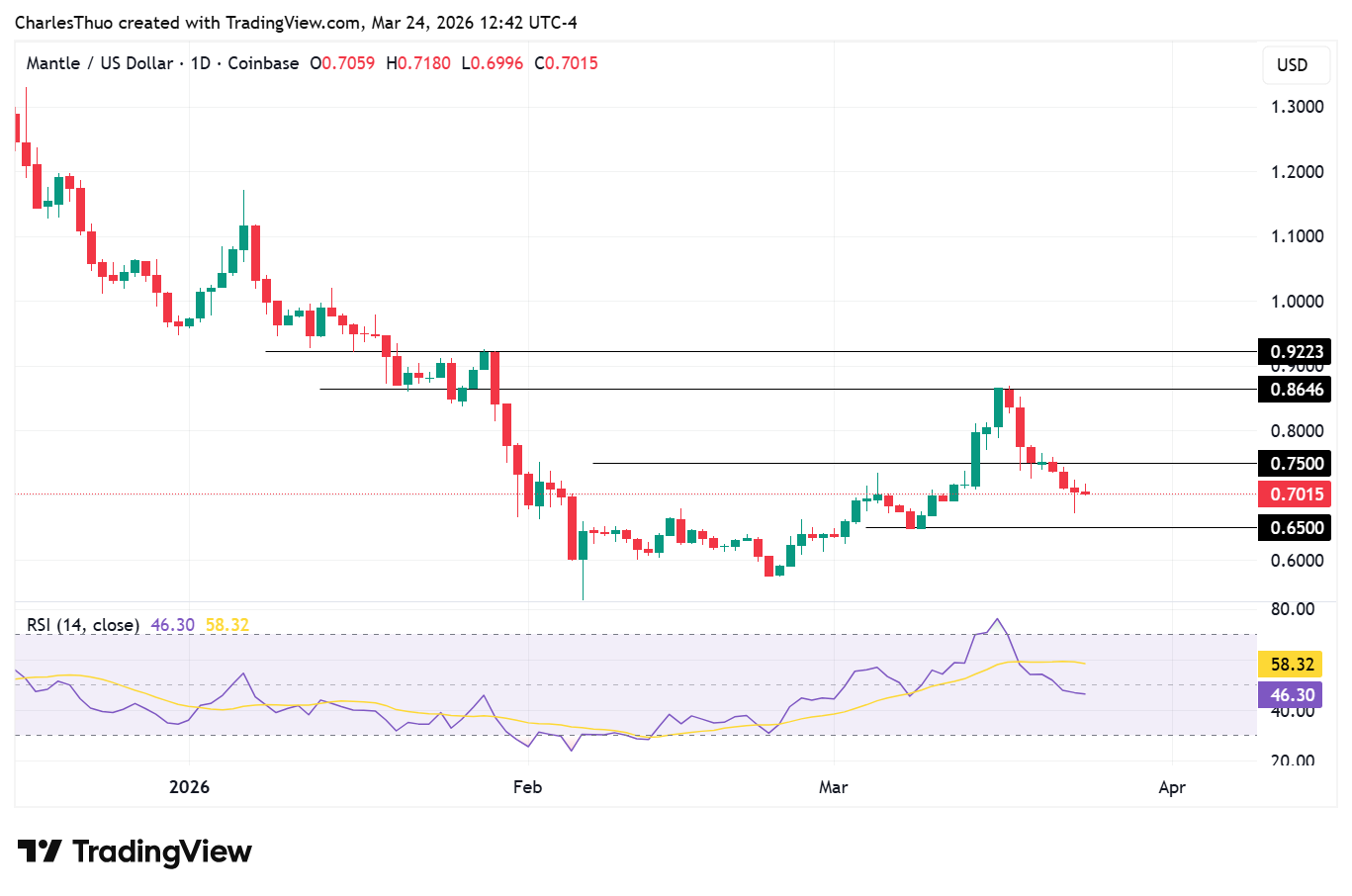
    • The key $MNT price levels to watch are the $0.75 resistance and the $0.65 support.

    Mantle ($MNT) network’s DeFi ecosystem has expanded rapidly and overtaken Sui in total value locked (TVL).

    The milestone reflects a sharp increase in capital flowing into Mantle, even as broader market conditions remain uncertain.

    In just one month, Mantle’s ecosystem has recorded a significant surge in locked assets, signalling rising confidence from both users and developers.

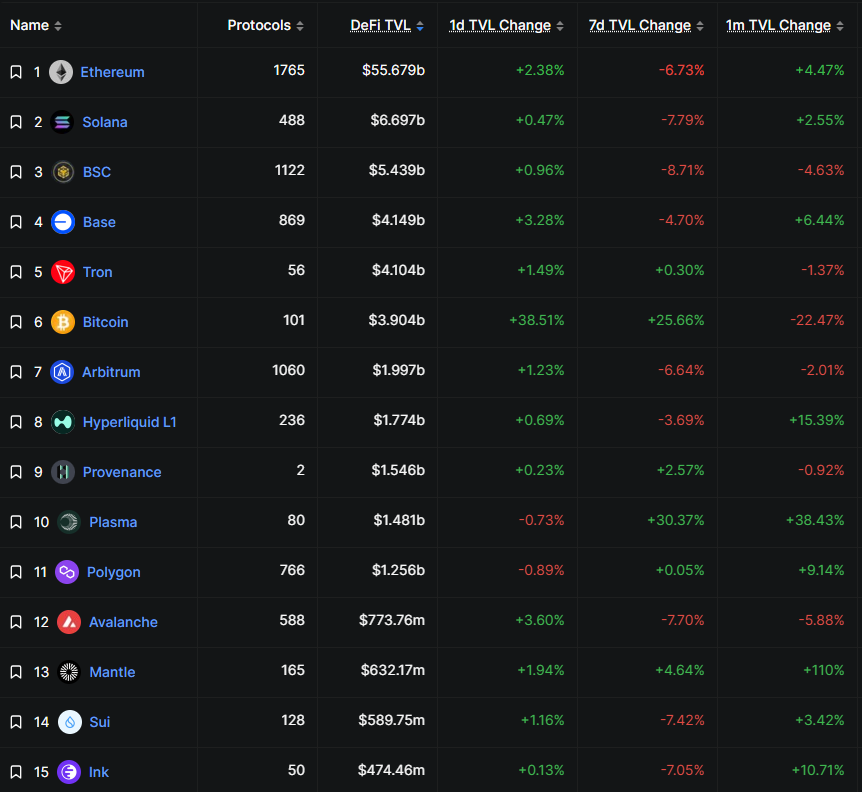
    According to data obtained from DeFiLlama, Mantle’s total value locked in DeFi is currently valued at around $632.17 million, while that of Sui stands at $589.5 million.

    Blockchain ranking in terms of their DeFi TVL

    This kind of growth is rarely accidental and often points to deeper structural strength within a network.

    Mantle’s DeFi expansion

    The surge in Mantle’s DeFi activity has been driven by a combination of strategic positioning and ecosystem development.

    One major factor behind the growth is its focus on real-world assets, which continues to attract institutional interest.

    By integrating traditional financial instruments into blockchain systems, Mantle is positioning itself for long-term adoption rather than short-term speculation.

    Another key driver is its connection to centralised exchange infrastructure, which helps onboard liquidity more efficiently.

    This hybrid model allows users to move seamlessly between centralised and decentralised finance, reducing friction that often limits adoption.

    At the same time, integrations with major DeFi protocols have boosted activity across lending and borrowing markets.

    These developments have helped create a steady inflow of capital rather than relying on temporary incentives.

    Such consistency is often a sign of a maturing ecosystem rather than a hype-driven spike.

    Despite this strong growth, the price of $MNT has not followed the same upward trajectory.

    This divergence between fundamentals and price action is becoming increasingly noticeable.

    $MNT price struggles to reflect strong fundamentals

    While the network’s DeFi metrics continue to improve, $MNT remains significantly below its previous highs.

    The token is still trading far from its peak, reflecting broader weakness across the altcoin market.

    Short-term price action has also been mixed, with recent declines interrupting what appeared to be a recovery phase.

    This suggests that traders are still cautious, even in the face of improving fundamentals.

    Market sentiment continues to play a dominant role, especially with altcoins reacting closely to movements in Bitcoin.

    Without a strong catalyst, $MNT has struggled to build sustained upward momentum.

    This creates a situation where the asset shows promise on paper but remains technically fragile.

    Such conditions often lead to periods of consolidation before a clearer trend emerges.

    Mantle price forecast

    The near-term outlook for $MNT is defined by a tight range that is likely to determine the next major move.

    The $0.75 level stands out as the most important resistance zone, acting as a barrier that bulls have yet to overcome.

    Mantle (<span class=$MNT) price”>

    A confirmed move above this level would signal a shift in short-term momentum and could open the door for further upside towards $0.8642 and even $0.9223 as projected by CoinLore.

    On the downside, the $0.65 level is providing immediate support and remains critical for maintaining stability.

    A break below this support would reinforce the current bearish structure and increase the risk of further declines.

    For now, the price remains trapped between these two levels, creating a clear decision zone for traders.

    Until a breakout or breakdown occurs, the current bounce should be treated with caution.

    If buyers manage to push the price above resistance, it could mark the beginning of a recovery phase supported by strong fundamentals.

    However, failure to hold support would likely confirm that bearish pressure is still dominant in the short term.

  • Shiba Inu Exchange Outflows Spike: Is Accumulation Enough to Offset Bearish Signals?

    Shiba Inu Exchange Outflows Spike: Is Accumulation Enough to Offset Bearish Signals?

    As Shiba Inu gradually recovers from recent bearish pressure, on-chain data now signals the potential emergence of a fresh downside risk.

    Despite Shiba Inu’s recent price rebound, underlying metrics point to a fragile technical structure. These developments suggest that $SHIB may soon experience selling pressure.

    Key Points

    • On-chain data signals the potential emergence of fresh downside risk.
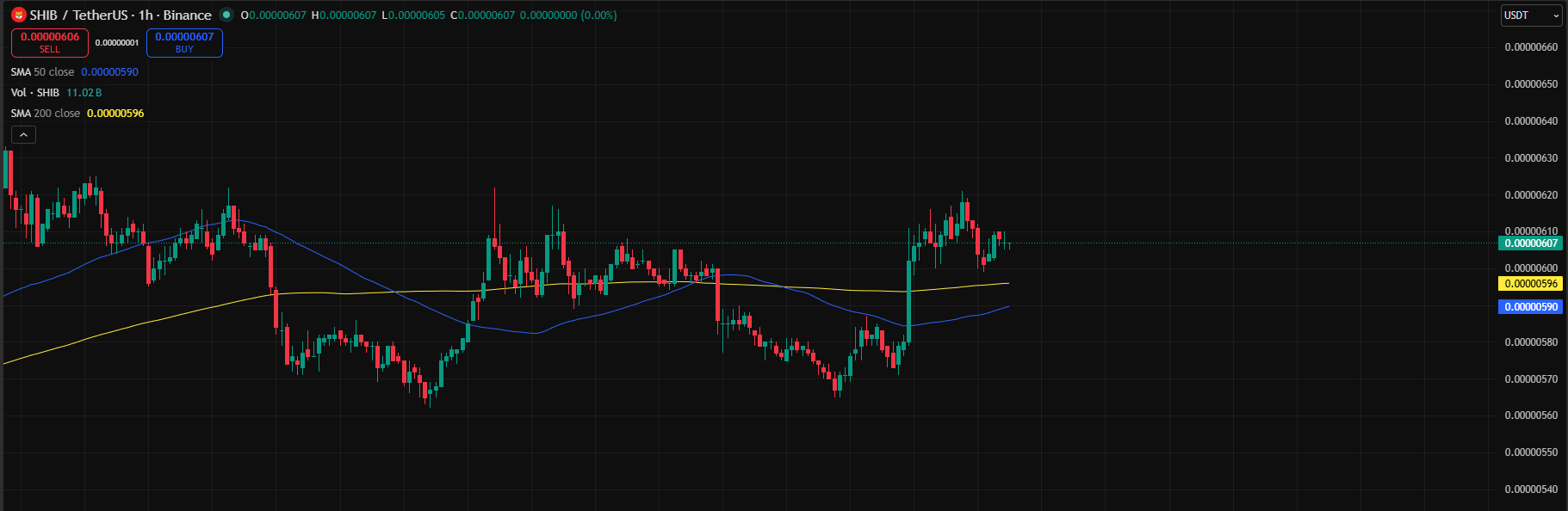
    • A death cross has formed on the one-hour chart.
    • Despite these bearish signals, $SHIB has climbed over 5% in the past day, supported by a strong rebound in trading volume and rising exchange outflows.
    • A golden cross on the 4-hour chart, formed on March 19, remains intact, offering some technical optimism.

    Weak Technicals

    $SHIB’s technical outlook remains bearish. The asset remains below key resistance levels, particularly around $0.0000065. Adding to the concern, $SHIB recently formed a death cross on the 1-hour chart after failing to establish a golden cross on the same timeframe.

    In this case, the 200-period simple moving average crossed above the 50-period SMA, reinforcing short-term bearish momentum.

    Shiba Inu Death Cross on 1H Chart

    Shiba Inu Soars 5%, Maintains Golden Cross on 4-Hour Timeframe

    Despite these negative indicators, $SHIB has posted a notable short-term recovery. The token has surged by more than 5% over the past day and is currently trading above $0.0000060.

    Currently trading at $0.000006116, $SHIB is up 5.81% in the last 24 hours and 0.43% over the past week, although it remains down 1.72% on the 30-day timeframe. In the meantime, the broader picture presents a mixed outlook.

    Shiba Inu previously formed a golden cross on the 4-hour chart on March 19 and has maintained it since then. In addition, trading activity has rebounded sharply after an earlier dip, with volume surging 69.35% in the past 24 hours to $188.21 million.

    Rising Exchange Outflows

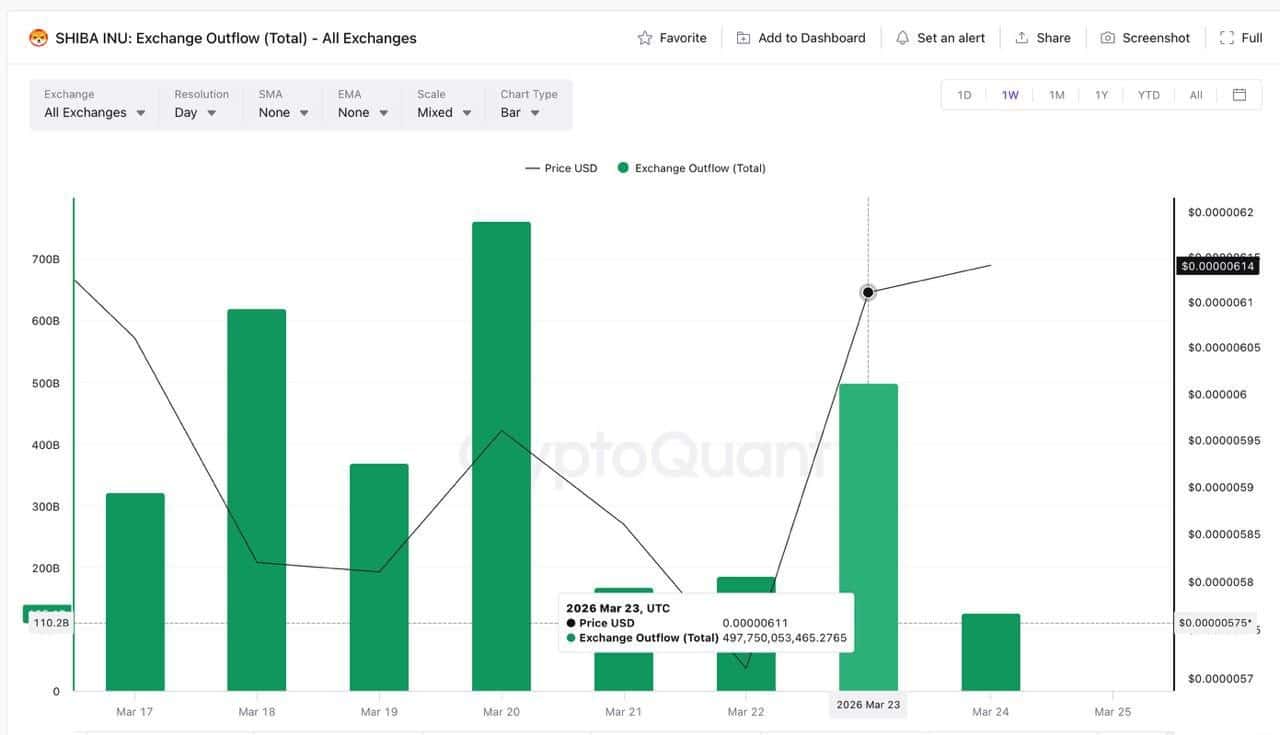
    Meanwhile, Shiba Inu exchange outflows have trended upward in recent days, according to data from CryptoQuant. The metric shows that outflows rose from 163 billion tokens on March 21 to 185 billion on March 22. Subsequently, the figure surged sharply to approximately 497.75 billion tokens yesterday, March 23.

    Shiba Inu Exchange Outflows

    Shiba Inu Exchange Outflows

    Notably, rising outflows typically signal strong accumulation, as investors move $SHIB from exchanges into private wallets for long-term holding, thereby reducing immediate selling pressure.

    Conversely, declining outflows, such as the dip observed between March 21 and 22, indicate weaker accumulation. In such cases, more tokens remain on exchanges, where they remain liquid and readily available for potential selling.

    While short-term momentum appears to be improving, the underlying technical signal suggests that caution remains warranted as bearish pressure could re-emerge.

  • Ripple CTO Emeritus Says Bitcoin’s Decentralization Doesn’t Come From PoW

    Ripple CTO Emeritus Says Bitcoin’s Decentralization Doesn’t Come From PoW

    David Schwartz, former CTO of Ripple, recently argued that Bitcoin’s decentralization does not come from its use of the PoW mechanism.

    Schwartz’s latest comments followed a recent event where a single mining entity showed significant control. This led to discussions about how secure and balanced Bitcoin’s network truly is with the Proof-of-Work consensus mechanism.

    Key Points

    • Foundry USA, the largest Bitcoin mining pool, recently mined 7 consecutive Bitcoin blocks, leading to a chain reorganization and raising concerns about mining concentration.
    • Vet, an XRPL validator, noted that Foundry USA’s hashrate is near the profitability threshold for selfish mining, suggesting large miners could exploit the system.
    • David Schwartz argued that Proof-of-Work is itself a centralizing force, and Bitcoin must continuously work to maintain decentralization.
    • Schwartz explained that changing the mining algorithm could weaken trust in Bitcoin’s immutability, but leaving it unchanged could rely too much on miner behavior.
    • He stressed that the Bitcoin community may choose to live with the issue for now, as fixing it prematurely could lead to even bigger problems.

    Schwartz Speaks on Growing Concerns in Bitcoin Mining

    Schwartz’s recent comments came in response to concerns raised by Vet, an XRPL validator. Notably, Bitcoin proponents still see PoW as a force of decentralization, but recent events show that mining power may be becoming more concentrated.

    Specifically, Vet pointed out in a recent post that Foundry USA, the largest Bitcoin mining pool in the world, mined 7 Bitcoin blocks in a row, which raised concerns about how much control one mining group could have.

    This led to a quick blockchain reorganization involving Antpool and ViaBTC, something that can happen when competing chains briefly exist. Some network participants suggested this dominance could result in a possible case of selfish mining, where a miner tries to gain an advantage by holding back blocks.

    Responding to these concerns, Schwartz argued that Bitcoin’s decentralization does not come directly from PoW. Instead, he said PoW can actually push the system toward centralization, meaning the network must keep working to stay decentralized.

    It really demonstrates a point that I’ve made several times which is that bitcoin’s decentralization doesn’t come from its use of PoW, rather PoW is a centralizing force bitcoin has to keep fighting against.

    — David ‘JoelKatz’ Schwartz (@JoelKatz) March 23, 2026

    “Bitcoin’s decentralization doesn’t come from its use of PoW,” the former Ripple CTO said, “rather, PoW is a centralizing force bitcoin has to keep fighting against.”

    Concerns Around Selfish Mining

    Vet also showed concerns about how Bitcoin handles these situations. He explained that chain reorganizations are a major weakness, as they show that transactions do not have absolute finality. He said, in contrast, the $XRP Ledger does not face the same type of reorganization risks, boasting true final settlement.

    Further, the XRPL validator noted that Foundry USA’s hashrate is close to the level where selfish mining could become profitable, based on several academic studies. This raises the risk that large miners could take advantage of the system if it becomes beneficial for them. As a result, he stressed that the Bitcoin network needs to spread mining power more evenly.

    Notably, Schwartz suggested that the issue presented a conundrum for the community. He explained that changing the mining algorithm could show that Bitcoin’s rules are not as fixed as many believe. At the same time, leaving things unchanged could mean the network depends too much on large players acting in good faith.

    Bitcoin and XRPL Consensus Mechanisms

    For context, Bitcoin uses the PoW mechanism, where miners compete to solve complex problems, and the longest chain becomes the valid one. While this method is slow, costly, and energy-intensive, Bitcoin proponents insist that it remains secure and decentralized.

    On the other hand, the $XRP Ledger uses the Ripple Protocol Consensus Algorithm. In this system, trusted validators agree on transactions within seconds using a supermajority vote. This allows for faster and more efficient processing. However, the Bitcoin community argues that relying on a set of validators can also lead to centralization.

  • MoonPay Launches Open-Source Wallet Standard for AI Agents

    MoonPay Launches Open-Source Wallet Standard for AI Agents

    In brief

    • MoonPay has introduced the Open Wallet Standard (OWS), an open-source framework for AI agents to manage funds across blockchains.
    • Contributors include PayPal, Ethereum Foundation, Solana Foundation, Ripple, OKX, Tron, and TON Foundation, among others.
    • The standard addresses wallet and key management fragmentation challenges while enhancing security for AI developers.

    Crypto payments infrastructure company MoonPay has launched an open-source wallet standard designed for AI agents to manage funds and execute transactions across multiple blockchains, addressing key infrastructure challenges that have limited AI-crypto integration.

    The Open Wallet Standard (OWS), announced Monday, was developed with contributions from PayPal, the Ethereum Foundation, the Solana Foundation, Ripple, OKX, Tron, TON Foundation, and Base, among other companies.

    “The agent economy has payment rails. It didn’t have a wallet standard. We built one, open-sourced it, and now the full stack exists,” said MoonPay co-founder and CEO Ivan Soto-Wright in a statement.

    The framework aims to solve fragmentation issues in wallet and key management that have complicated financial operations for autonomous AI systems, according to MoonPay, which is an investor in Decrypt’s sister company Myriad.

    OWS supports the x402 open payment protocol developed by Coinbase, along with Stripe and Tempo’s Machine Payments Protocol (MPP) for session-based micropayments. It also builds on MoonPay’s earlier collaboration with Ledger that enables hardware wallet signing for MoonPay Agents transactions.

    “On-chain payments originate from wallet addresses, and every chain represents them a bit differently,” said Mysten Labs co-founder and CTO Sam Blackshear in a statement, explaining that a “unified representation” streamlines processes and enables agents to focus on high-level tasks instead of details.

    According to MoonPay, OWS is designed in such a way that a wallet’s private key is never exposed to agents, the LLM context or parent applications when transacting.

    The launch comes as AI agents increasingly require sophisticated financial capabilities to operate autonomously, and forms part of a “deliberate shift” at MoonPay towards AI-native infrastructure.

    Agentic payments are a growing concern for crypto infrastructure developers, with Coinbase launching a wallet specifically for AI agents with built-in guardrails, Stripe-backed Tempo Network focusing on enabling AI agent payment capabilities, and Sam Altman’s World tapping Coinbase’s protocol to verify humans behind AI agents.

    Daily Debrief Newsletter

    Start every day with the top news stories right now, plus original features, a podcast, videos and more.