
Ethics reportedly remains a threat to the CLARITY Act’s progress, despite the stablecoin yield clash currently taking center stage. This development comes as Democrats probe the $TRUMP Coin conference holding later this month, with U.S. President Donald Trump reportedly set to attend.
Category: Business
-
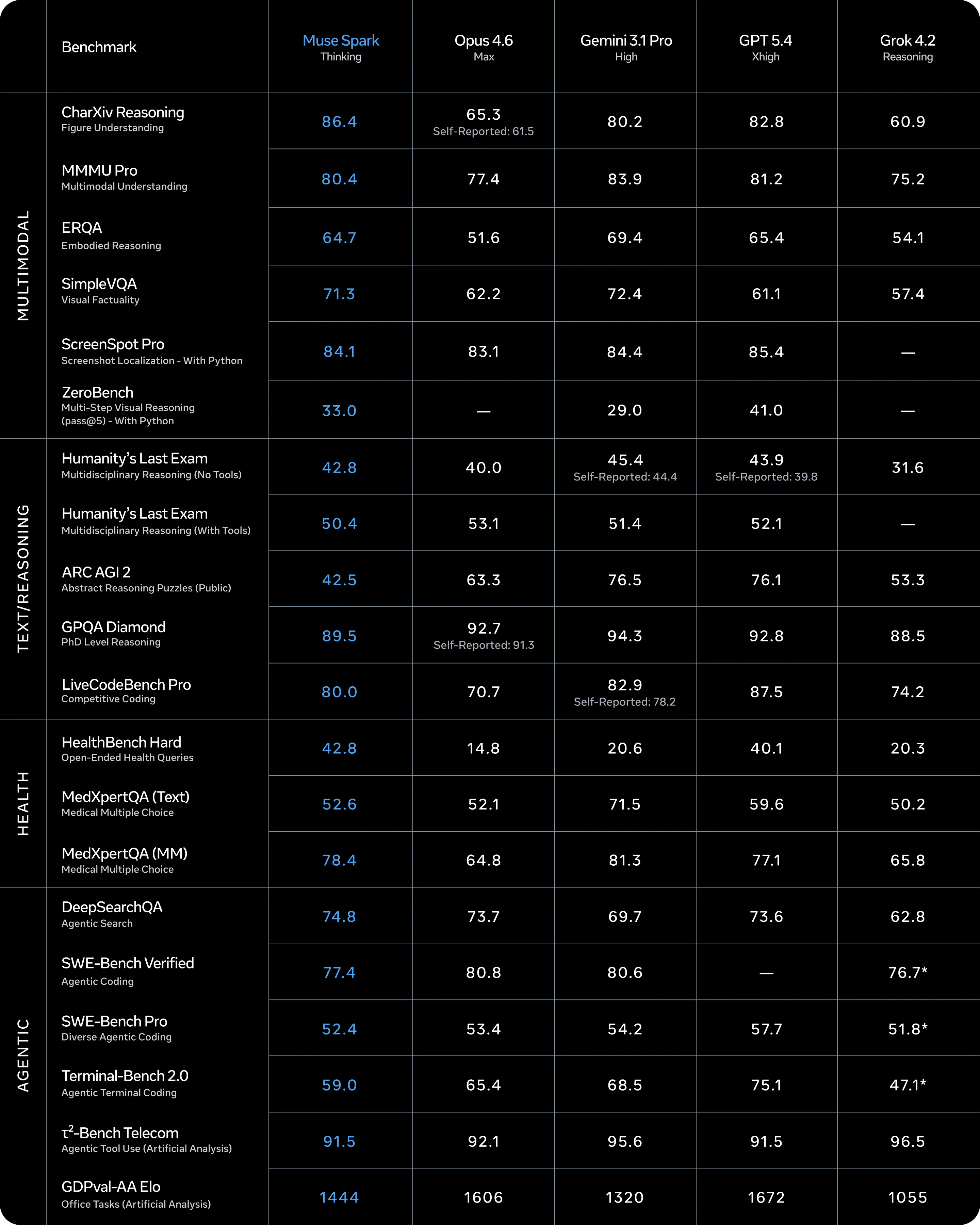
Meta Launches Muse Spark, Its Most Capable AI Yet—But Gemini 3.1 Pro Still Leads the Pack
In brief
🚰 SYSTEM PROMPT LEAK 🚰
Here’s the full Muse Spark system prompt from Meta!
I noticed @AIatMeta forgot to open source it, so I’ve done them the courtesy 😘
PROMPT:
“””
Who are you?You are a friendly, intelligent, and agentic AI assistant. You are warm and a bit playful.…
— Pliny the Liberator 🐉󠅫󠄼󠄿󠅆󠄵󠄐󠅀󠄼󠄹󠄾󠅉󠅭 (@elder_plinius) April 8, 2026
Daily Debrief Newsletter
Start every day with the top news stories right now, plus original features, a podcast, videos and more.
-
Bitcoin Miner Cango Sells $143 Million in BTC, Slashes Production Costs
In brief
Daily Debrief Newsletter
Start every day with the top news stories right now, plus original features, a podcast, videos and more.
-
Crypto exchanges chase TradFi commodities market as pricing gaps persist
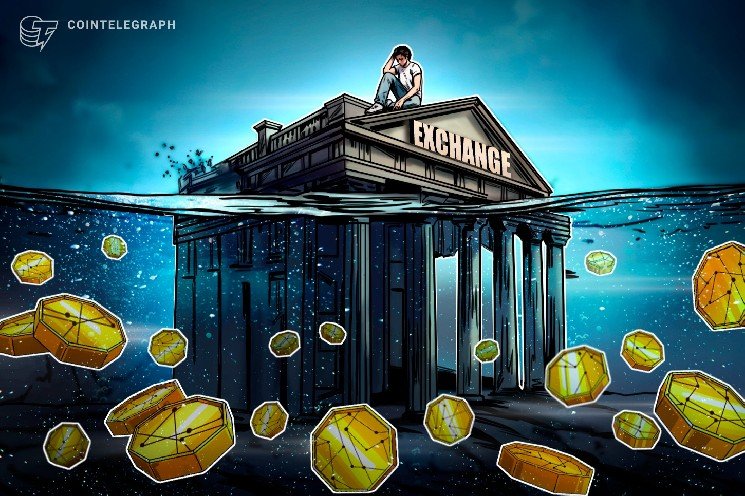
Cryptocurrency exchanges are taking a growing market share from traditional finance (TradFi) trading venues through tokenized commodities products, but the mainstream adoption of tokenized precious metals remains limited by pricing and liquidity issues.
Silver perpetuals have reached about 40% of the equivalent volume of the Comex Silver (SI) Contract at their peak, the world’s largest silver futures market, which accounts for over 70% of global exchange-traded silver futures volume, according to a Thursday report from Binance Research.
During March and April, tokenized silver accounted for 14.90% and 14.98% of the Comex’s volume, respectively, up from just 1.37% in January.
The growth suggests crypto exchanges are capturing more demand for round-the-clock exposure to traditional assets, particularly in metals-linked perpetuals, but analysts at Kaiko said liquidity depth and price formation still pose major obstacles to wider adoption among traditional investors.
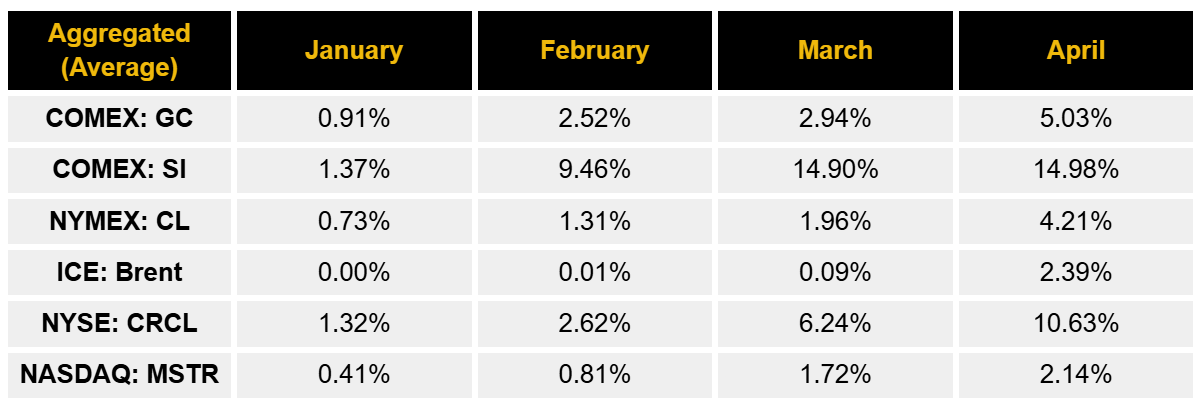
Average Aggregated TradFi-Perps Volume to The Primary Futures Equivalents on Traditional Exchanges. Source: Binance Research Crypto TradFi perps need reliable pricing, strong liquidity
Tokenized commodities offer 24/7 trading, which can create vulnerabilities compared to TradFi gold and silver futures, where the holiday and weekend close create “natural circuit breakers that actually protect market quality,” Kaiko research analyst Laurens Fraussen told Cointelegraph.
This exposes tokenized commodities to degraded order book debt, widened spreads and less reference pricing from closed traditional venues.
Legacy commodities offerings avoid these issues through centralized clearing, consolidated liquidity, standardized contracts and “coordinated operating hours that prevent liquidity deserts,” Fraussen said, adding that crypto needs “better chain abstraction and unified liquidity aggregation” to compete with TradFi.
Related: NYSE taps Securitize for 24/7 tokenized securities platform
Despite the infrastructure concerns, tokenized gold perps have surpassed the gold futures trading volumes of several regional commodity exchanges, a trend seeing monthly acceleration, according to Binance Research.
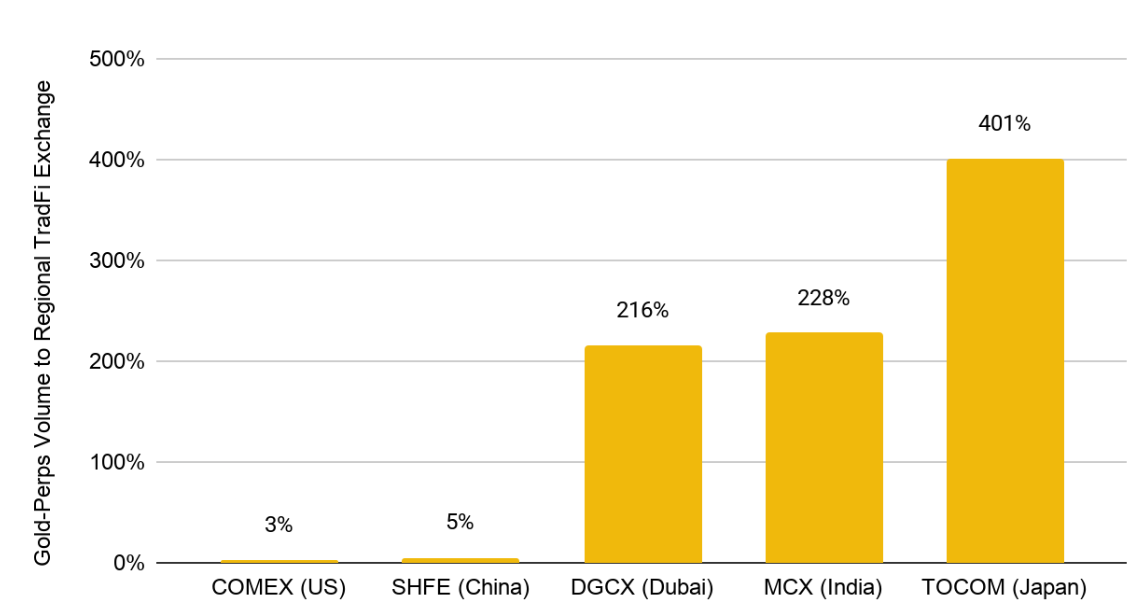
Figure 3: Average Aggregated Volume of Gold-Perps to Gold Futures in Regional Exchanges, in March Binance Research also said gold perpetuals outpaced several regional commodity exchanges in March, reaching 401% compared to gold futures trading on the Japanese energy commodities futures exchange TOCOM, 228% of India’s Multi Commodity Exchange (MCX) and 216% of the Dubai Gold & Commodities Exchange (DGCX).
Binance attributed part of this growth to “market-moving events” that routinely occur on weekends, which would leave investors exposed to gap risks through traditional venues operating under regular trading hours.
Magazine: Can Robinhood or Kraken’s tokenized stocks ever be truly decentralized?
-
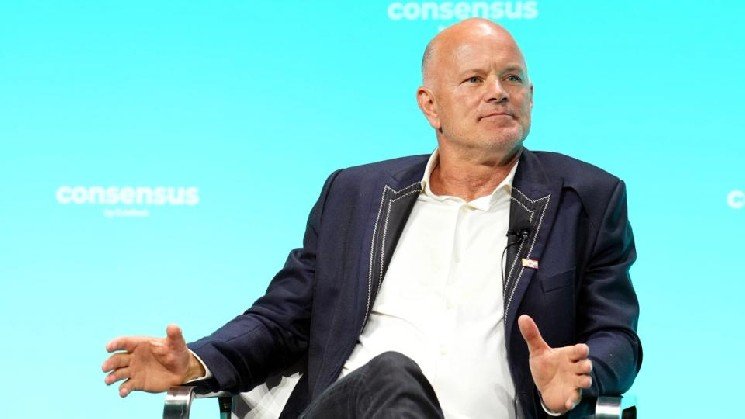
Mike Novogratz spotlights Helios as $15 billion powerhouse in Galaxy Digital annual report
Galaxy Digital (GLXY) founder and CEO Mike Novogratz highlighted the firm’s key milestones in its 2025 annual report, marking its first 10-K filing as a Nasdaq-listed company.
Novogratz described the listing as more than a milestone, calling it “a declaration that the digital economy is real, and that Galaxy is built to lead it.”
Over the years, Galaxy has evolved from a pure-play digital asset firm into a diversified platform that includes asset management, institutional trading and AI-driven high-performance computing data centers.
Novogratz noted that the digital asset economy has evolved from a speculative, niche market into a mainstream industry, with even the United States now holding bitcoin on its balance sheet, something that would have been inconceivable a decade ago.
The company’s biggest growth tailwind is its artificial intelligence and high-performance computing strategy and Helios, its AI data center campus in West Texas. The site has secured more than 1.6 gigawatts of approved power capacity through ERCOT.
The initial 800 megawatts is already leased to AI cloud provider CoreWeave (CRWV), representing over $7.5 billion in capital investment. With an additional 830 megawatts approved for expansion, Helios is now valued at well above $15 billion, according to the report.
Novogratz’s longer-term goal is to build a multi-billion-dollar portfolio of digital infrastructure assets diversified across regions, tenants, and technologies. “Demand for compute is not a cycle, it is a structural condition that will define the next decade.”
On the digital assets side, Galaxy manages roughly $12.3 billion in platform assets as of December 31, 2025. Its offerings include over-the-counter spot and derivatives trading, lending, staking across 11 blockchains, including Ethereum and Solana, ETFs, and institutional-grade custody.
In October 2025, the firm expanded into retail with GalaxyOne, a fintech platform offering FDIC-insured high-yield accounts, commission-free trading in equities and crypto, and the option to automatically reinvest interest into bitcoin.
Despite the industry downturn in the fourth quarter of 2025, the company saw a net loss of $241 million. Novogratz remains optimistic, saying the firm is “more clear-eyed about our opportunity than we have ever been.”
-
OpenAI Publishes Child Safety Blueprint to Address AI-Enabled Exploitation
In brief
Daily Debrief Newsletter
Start every day with the top news stories right now, plus original features, a podcast, videos and more.
-
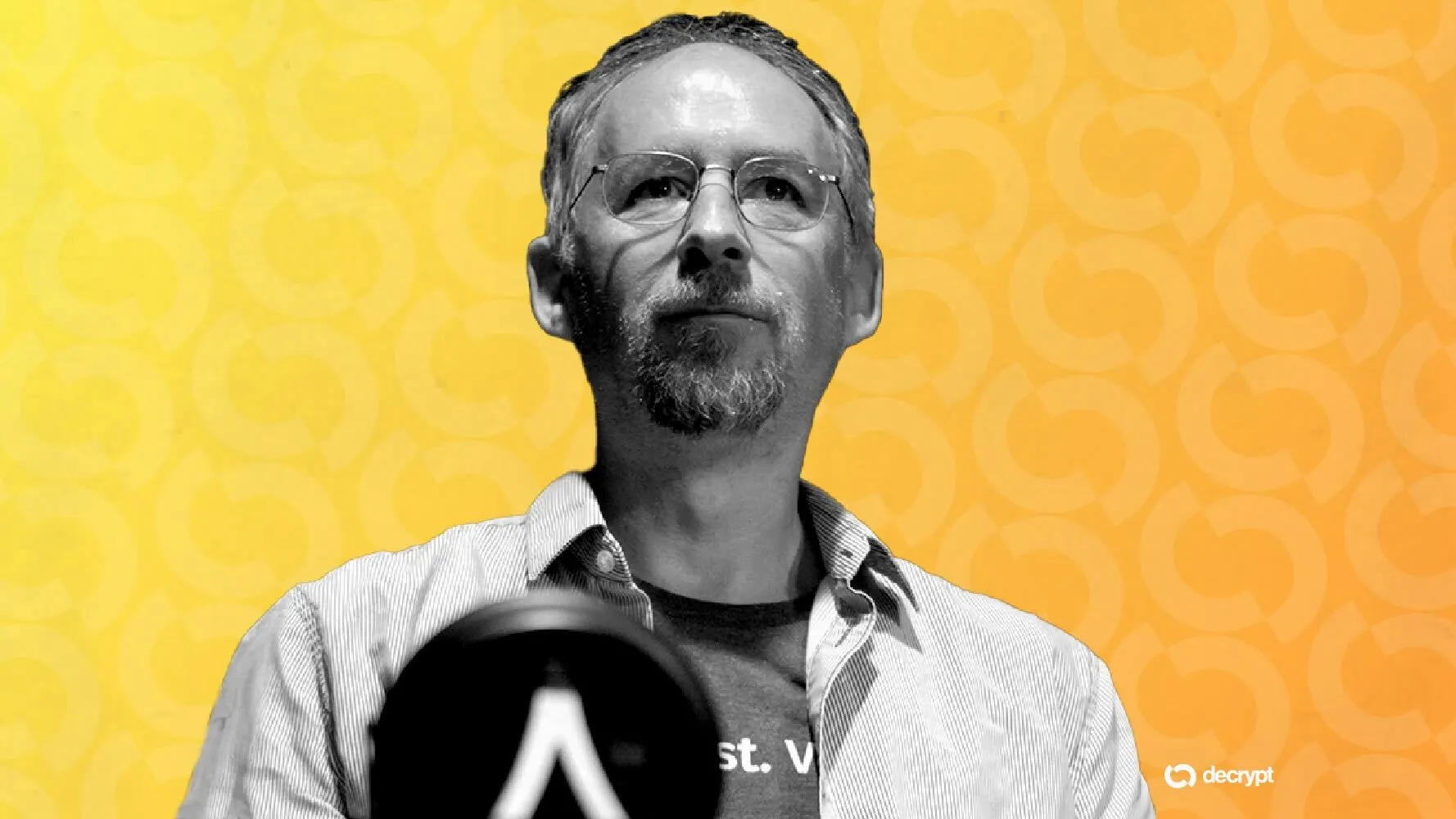
Bitcoin Pioneer Adam Back, Bernstein Say Quantum Threat to BTC Isn’t Existential
In brief
Daily Debrief Newsletter
Start every day with the top news stories right now, plus original features, a podcast, videos and more.
-

Aori Expands to Rootstock, Bridging Bitcoin DeFi With Cross Chain Liquidity
Aori has officially joined Rootstock in a major collaboration, which opens new avenues of cross-chain liquidity and enhances access to Bitcoin-native financial applications. The development of Bitcoin based decentralized finance is gaining traction, with new infrastructure being added to tie up isolated blockchain ecosystems.
A faster, simpler way to move assets across chains🔥@aori_io is now live on Rootstock.
Its intent settlement protocol brings cross-chain liquidity routing to Bitcoin DeFi, letting users move assets across networks without the usual multi-step bridging process.
✔️No manual… pic.twitter.com/2IHVVTcL3F
— Rootstock (@rootstock_io) April 8, 2026
This integration brings the intent based settlement model of Aori to the ecosystem of Rootstock enabling the users to transfer assets across blockchains with increased efficiency. Initial support will be USDT0, with other assets like rBTC becoming available soon.
Through the integration of the Bitcoin secured infrastructure of Rootstock and the liquidity routing system of Aori, the partnership will ease the process of user interaction with decentralized finance on networks.
Simplifying Cross-Chain Transactions With Intent Based Trading
The difficulty of transferring assets between blockchains has been one of the historical problems of decentralized finance. Conventional cross-chain operations may involve users manually bridging tokens, communicating with various platforms, and conducting various transactions, each of which may add cost and risks.
Aori is a solution to this problem by using an intent-based system. Rather than handling a step at a time, users can simply specify the desired outcome, say, the transfer of assets through one chain to another. The execution is then done behind the scenes by the protocol.
Solvets are a set of liquidity providers that power this process. These players are in competition of meeting the user intents by sourcing liquidity and identifying the most efficient path to execute it. After being matched, the transactions are settled on chain with the help of smart contracts that are created to provide atomic and secure settlement.
The outcome is a smooth process that lowers friction, minimizes charges and enhances the speed of transactions and keeps a trust minimized structure.
Why Rootstock Strengthens the Integration
Rootstock is a key player in this collaboration as it expands the functions of Bitcoin beyond mere value transfers. Being a smart contract platform that is secured by the Bitcoin network, it allows a wide variety of decentralized apps, such as lending markets, as well as trading platforms.
By adding Aori, the functionality of Rootstock is enriched with the powerful cross-chain liquidity layer. Rootstock users are now able to access the liquidity of networks like Ethereum and Layer 2 ecosystems without using the traditional bridging options.
Meanwhile, Aori users will have direct access to DeFi opportunities backed by Bitcoin. This forms a two-way value bridge, linking hitherto disaggregated liquidity pools and enabling the transfer of capital across ecosystems more freely.
Benefits for Users and Developers
The integration provides evident benefits to users and developers working in the decentralized finance environment.
Rootstock can be a bridge to DeFi strategies based on Bitcoin to users who are already on Aori. They can now engage in lending, trading, and yield opportunities based on Bitcoin-secured infrastructure without going out of the multi-chain environment they know well.
The advantages are also substantial to the users of Rootstock. Aori also offers an easier method to move assets across chains without requiring various manual processes. Transactions are quicker and less expensive and access to external liquidity enhances the overall capital efficiency.
The integration is also beneficial to developers. Through the infrastructure of Aori, they are able to add cross-chain trading and liquidity routing to their apps without necessarily developing complex bridging systems. This reduces the development barrier and innovations are rapid in the ecosystem.
Addressing Liquidity Fragmentation in DeFi
Liquidity fragmentation continues to be a significant challenge of decentralized finance, where assets are typically locked in different blockchain networks. This restricts the efficiency of trading and access to wider financial opportunities.
The solution to this problem proposed by Aori is to orchestrate liquidity among chains and allow atomic settlement via smart contracts. Its solver network is based on the idea of sending capital to the point of need, instead of the method of fragmented bridges.
In the case of Rootstock, it implies enhanced access to vibrant ecosystems, as well as deeper pools of liquidity. As a result, users can engage in more advanced financial strategies without compromising on security or efficiency.
-

What Would Happen to Bitcoin and Altcoins If a Permanent Ceasefire Were Reached Between Iran and the U.S.?
Cryptocurrency analyst Michaël van de Poppe, in his assessment of the overall market outlook, stated that despite short-term fluctuations, the upward trend could be maintained.
The analyst described current market conditions as “positive,” suggesting that a period of consolidation could be followed by a continued uptrend.
Van de Poppe argued that Bitcoin is experiencing a short-term correction, but that this is not alarming. According to the analyst, a rapid market recovery could be seen if geopolitical developments subside and a potential ceasefire becomes permanent. In this scenario, van de Poppe predicts that Bitcoin could make a strong move towards the $80,000 level in April, adding that maintaining the $69,500 level is critical for this to happen.
Related News New York Times Claims to Have Identified Bitcoin Founder Satoshi Nakamoto
The analyst also argued that the expected upward movement in Bitcoin would give momentum to the altcoin market as well. Van de Poppe noted that altcoins, which have recently experienced significant value losses, are currently at low levels, and that stronger increases could be seen in these assets if market conditions improve.
*This is not investment advice.
-
Partner of Trump-Backed World Liberty Linked to Sanctioned Cambodian Scam Company: Report
In brief
New huge investigation from me & partners @OCCRP and @GuardianAus.
This picture, which has never been seen before, shows Donald Trump Jr. and Zach Witkoff, the son of Trump’s “peace envoy” meeting in Singapore last October with Jacky Sui (in glasses), one of the main people… pic.twitter.com/vCeRAAiLrh
— Aubrey Belford (@AubreyBelford) April 7, 2026
Daily Debrief Newsletter
Start every day with the top news stories right now, plus original features, a podcast, videos and more.