Category: Business

  • ‘True Strength Is Holding’: Shiba Inu Message Reignites Ryoshi’s Legacy

    ‘True Strength Is Holding’: Shiba Inu Message Reignites Ryoshi’s Legacy

    In a tweet shared with the Shiba Inu community, $SHIB-focused X handle Shibizens highlights the legacy of Ryoshi, Shiba Inu’s pseudonymous founder, and the tenets that shaped $SHIB from its inception.

    The tweet takes a look back at Ryoshi’s original Woofpaper, which emphasized spontaneity, decentralization and community-driven development, while urging the Shiba Inu community to reflect on this history.

    The Shibizens X handle draws its inspiration from this particular chapter in Shiba Inu’s past. The real knowledge it says this brings is that true strength lies in holding through storms and contributing during calm.

    Good morning, $SHIB loyal pack!

    On this Friday, honor the history. Ryoshi’s woofpaper emphasized spontaneity and decentralization.

    The real knowledge? True strength lies in holding through storms and contributing during calm.

    SHIBARMY STRONG pic.twitter.com/e9vtDW0Ycv

    — Shibarium | $SHIB.IO (@Shibizens) April 10, 2026

    “The real knowledge? True strength lies in holding through storms and contributing during calm,” Shibizen wrote in a tweet.

    For many in the $SHIB community, this speaks to the cycles Shiba Inu has gone through since its inception, from significant price increases (increase in millions of percent) to extended quiet phases, contributed to by investor sentiment and broader crypto market conditions.

    As reported, Shiba Inu rose millions of percent shortly after its launch to reach an all time high of $0.000088 in October 2021. Since then, Shiba Inu has stayed in a quiet consolidation phase, which has weighed on its price. At current prices, Shiba Inu is down more than 93% from its ATH.

    Market catalysts awaited

    At the time of writing, $SHIB was unchanged in the last 24 hours, up 0.76% in the last 24 hours to $0.000005897 as the broader crypto market awaits a catalyst.

    One key catalyst on Friday will be the U.S. consumer price index (CPI) data, which is expected to show a jump in headline inflation. The U.S. consumer price index, which was up 0.3% in February, is expected to show an increase of 0.9% when the latest monthly print is released. Similarly, headline annual inflation, which stood at 2.4% year-over-year in February, is forecast to jump to 3.3% for March.

    On Thursday, the personal consumption expenditures price index, which is regarded as the Fed’s preferred inflation gauge, saw a monthly rise of 0.4% in February, in line with expectations and increasing 2.8% year-on-year.

  • Token Unlock Events for This Altcoin, Which Has Faced Heavy Criticism Due to Inflation, Will Decrease Significantly Starting This Summer

    Token Unlock Events for This Altcoin, Which Has Faced Heavy Criticism Due to Inflation, Will Decrease Significantly Starting This Summer

    Worldcoin ($WLD), one of the projects attracting attention in the cryptocurrency market, has received an important update regarding its token economy. According to a statement from the World Community, a significant reduction in the token unlock speed is planned.

    The announcement states that as of April 10, 2026, the total supply of $WLD is 10 billion, of which 4.9 billion (49%) have been unlocked and approximately 3.3 billion tokens are in circulation. At the project’s launch on July 24, 2023, 500 million $WLD were unlocked from the World Community allocation. The remaining 9.5 billion tokens are being gradually released through a daily linear mechanism, with the goal of completing this process 15 years after the launch.

    Related News Adam Back, Who Is Alleged to Be Satoshi Nakamoto, Speaks Out: “Satoshi Will Only Come Forward If These Two Conditions Are Met”

    According to the new regulation, an automatic slowdown in token unlocking speed will be implemented starting July 24, 2026. As part of this, the daily unlocking amount for community tokens will be reduced by 50%, from 3.2 million to 1.6 million. For investor and team tokens, the daily unlocking will decrease by 32%, from 1.9 million to 1.3 million.

    Taking all categories into account, the total daily number of lock-openings will decrease by approximately 43%, from 5.1 million $WLD to 2.9 million $WLD.

    *This is not investment advice.

  • ‘Operation Atlantic’: US and UK Team With Firms to Trace, Freeze Millions in Stolen Crypto

    ‘Operation Atlantic’: US and UK Team With Firms to Trace, Freeze Millions in Stolen Crypto

    In brief

    • Crypto firms and government agencies teamed up in “Operation Atlantic,” designed to stop crypto fraud schemes and approval phishing campaigns.
    • The sprint led to $12 million in frozen funds and $45 million in total traced funds believed to be related to crypto fraud.
    • Held at the U.K.’s NCA headquarters in London, the operation had involvement from Coinbase, Binance, the Secret Service, and more.

    Crypto firms like Coinbase and Binance, alongside government agencies like the United States Secret Service and the U.K.’s National Crime Agency (NCA), have flagged $45 million in stolen crypto funds as part of fraud schemes, the parties announced on Thursday. 

    In the probe, more than 20,000 victims of approval phishing fraud were identified, and $12 million in funds were frozen in the hopes of returning funds to victims.

    “To take on approval phishing at scale, our Global Intelligence team joined forces with multiple international law enforcement agencies and other partners for a focused operational sprint held at the National Crime Agency’s headquarters in London,” Coinbase wrote. 

    “The goal was straightforward: identify victims, trace stolen funds, and disrupt the infrastructure that makes approval phishing possible—as fast as we could,” it added. 

    The investigative sprint, dubbed “Operation Atlantic,” was first revealed last month and was hosted by the NCA at its headquarters in London. In a week of focused work there, the agencies disrupted “multiple fraud networks,” and will continue to analyze intelligence gathered moving forward. Other crypto firms, like on-chain security firm Chainalysis, crypto exchange Kraken, and stablecoin issuer Tether, were included as partners. 

    “Operation Atlantic is a powerful example of what is possible when international agencies and private industry work side by side,” said National Crime Agency Deputy Director of Investigations Miles Bronfield, in a statement. “This intensive action has led to the safeguarding of thousands of victims in the UK and overseas, stopped criminals in their tracks and helped save others from losing their funds.”

    The enforcement campaign was focused on crypto investors who may have been impacted by approval phishing, when malicious actors attempt to gain access to funds via fake pop-up notifications or alerts that unsuspecting victims believe come from trusted parties. 

    More than 120 web domains used for schemes were identified during the week, according to the Secret Service. 

    “With traditional financial crimes, this kind of cross-border, multi-agency coordination would take months,” Coinbase wrote in its recap on the week. “With blockchain technology, we moved from identification to action in a single week-long sprint.” 

    The engagement report comes just over a week after alleged North Korean hackers made off with around $285 million via an exploit of Solana protocol, Drift. The exploit would represent just a fraction of the funds lost to crypto scam last year, with a recent report from the FBI indicating that more than $11.4 billion was lost to crypto scams in 2025 alone.

    Daily Debrief Newsletter

    Start every day with the top news stories right now, plus original features, a podcast, videos and more.


  • Morning Minute: Bitcoin Breaks $73K as Strategy’s STRC Bid Grows

    Morning Minute: Bitcoin Breaks $73K as Strategy’s STRC Bid Grows

    Morning Minute is a daily newsletter written by Tyler Warner. The analysis and opinions expressed are his own and do not necessarily reflect those of Decrypt. And check out our new daily news show covering all of the top stories in 5 minutes or less, downloadable on Apple Pod or Spotify.

    GM!

    Today’s top news:

    • Crypto majors up 1%; BTC at $72K
    • ZEC and MON rally 20% leading top movers; HYPE +5%
    • CZ and OKX founder Star publicly dispute, CZ calls for $1B “divorce” bet
    • Bessent and Brian Armstrong both say it’s time to pass the Clarity Act
    • WLFI falls 10% after team reveals using 5B tokens to borrow $75M

    🌎 Bitcoin breaks $73K on ceasefire hopes, STRC

    Bitcoin topped $73,000 briefly on Thursday, per data from CoinMarketCap, reversing an early sell-off after Netanyahu signaled Lebanon negotiations. It bounced off that level and is holding just above $72K this morning.

    The Bitcoin options market is even more bullish. Data shows that the $80,000 level is seeing the most volume in June expiry contracts with over $1.6B in open interest, a full 10% move from current levels.

    As for why traders are bullish—well, it could be Saylor-driven. Strategy‘s STRC had another massive day Thursday with over 3M preferred shares moved, generating capital to purchase 2,000+ Bitcoin ($144M). Wednesday’s numbers were similar, and the totals historically rise into the dividend cutoff date (next Wednesday). So expect 3 more days of increasing STRC flows.

    It’s a strong setup for Bitcoin near-term.

    Key Details:

    • Bitcoin topped $73,000 Thursday, up ~9% over the past month as crypto decouples from software stocks, which are down 12% over the same stretch
    • June $80K Bitcoin options showing $1.6B in open interest, most concentrated target
    • Saylor’s STRC moved 3M shares, enough to buy $144M in Bitcoin; on pace for well over $300M in purchases this week

    📊 Galaxy profit rockets, stock jumps

    The headline number from Galaxy’s 2025 annual report, a $241M net loss, buried the more important one: The firm’s Digital Assets segment generated $505M in adjusted gross profit.

    GLXY closed up 11.3% Thursday, second-best crypto equity on the day.

    The thesis Mike Novogratz is selling isn’t a crypto trading story anymore. It’s AI infrastructure. Galaxy’s Helios campus, once one of North America’s largest Bitcoin mines, is an 800-megawatt facility fully leased to CoreWeave that’s beginning to generate compute revenue in 2026. “The most consequential shift right now is the move from narrative to infrastructure,” he wrote.

    That pivot from BTC mining to AI is clearly paying off…

    Key Details:

    • Galaxy posted a $241M 2025 net loss driven by unrealized losses and one-time costs; core Digital Assets segment generated $505M in adjusted gross profit
    • GLXY closed up 11.3% at $21.15; total assets on platform hit $12B with $2B in net inflows during 2025
    • The Helios play: 800MW Texas facility fully leased to CoreWeave; AI compute revenue begins 2026; Galaxy is pitching itself as half crypto financial firm, half AI infrastructure company

    🦅 Gemini is on sale, but nobody wants the whole thing

    Potential buyers are circling Gemini, but not in the way the Winklevoss twins might want.

    Per CoinDesk, interested parties are evaluating an acquisition of Gemini’s shuttered EU and UK operations specifically to obtain MiCA and FCA regulatory licenses. Nobody is pursuing a full takeover.

    The backdrop is stark. Gemini IPO’d at $28 in September 2025 and now trades around $4.70, down 83%. The company cut 25% of its workforce in February, exited the EU, UK, and Australia, lost three senior executives, and faces a shareholder class-action lawsuit filed in March.

    GEMI stock jumped 11% on the acquisition reports, but has already shed some of those gains.

    Key Details:

    • Potential buyers are circling Gemini’s shuttered EU and UK operations for MiCA and FCA licenses; no full takeover interest
    • The distress context: $28 IPO September 2025, now $4.70 (down 83%); 25% workforce cut; exited EU/UK/Australia; three executives departed; class-action lawsuit filed March 2026
    • MiCA wrinkle: license doesn’t transfer in an acquisition; change of control triggers full regulatory reassessment; buyers face scrutiny equivalent to a new applicant

    ⚖️ Bessent to the Senate: Pass the Clarity Act

    Treasury Secretary Bessent made his most direct push yet Thursday, urging the Senate to pass the Clarity Act and resolve the stablecoin yield dispute still stalling the bill.

    This comes just one day after the White House Council of Economic Advisors mathematically dismantled the banking lobby’s core argument, finding a yield ban would boost lending by just $2.1B, a 0.02% increase.

    The only remaining variable is whether Senate Democrats and holdout Republicans will accept a stablecoin yield framework that Coinbase can live with.

    And we may have gotten a signal from Brian Armstrong last night, who tweeted “It’s time to pass the Clarity Act” in union with Bessent.

    Key Details:

    • Bessent urged the Senate to pass the Clarity Act, calling for resolution on stablecoin yield provisions; follows the White House CEA report that undercut the banking lobby’s deposit-flight argument
    • What’s left: Senate Banking Committee markup; stablecoin yield language is the last unlock for the full US crypto regulatory stack
    • Odds of the Clarity Act passing in 2026 rose 3% to 59% on Thursday

    🤖 Florida goes after OpenAI

    Florida AG James Uthmeier launched a formal investigation into OpenAI and ChatGPT Thursday, citing the chatbot’s alleged role in the April 2025 FSU mass shooting that killed two people, child safety concerns, and the risk of OpenAI data reaching the Chinese government.

    The quote Uthmeier posted to announce it is the week’s most ironic AI headline: “AI should advance mankind, not destroy it.”

    The investigation arrives as AI infrastructure, specifically data centers, are coming under attack. Per Bloomberg and Sightline Climate, 30-50% of the data centers planned to come online this year are facing delays or outright cancellations. Of the 12 gigawatts of capacity announced for 2026, only a third is currently under construction. Bernie Sanders and AOC introduced the AI Data Center Moratorium Act in March to stop all new construction until federal safeguards are in place. It’s not going anywhere, but it signals the political mood around AI is shifting.

    Key Details:

    • Florida AG Uthmeier launched a formal OpenAI investigation, citing ChatGPT’s alleged role in the 2025 FSU shooting, child safety, and CCP data concerns; subpoenas forthcoming; arrives as OpenAI eyes a $1T IPO
    • 30-50% of US data centers planned for 2026 are facing delays or cancellations per Sightline Climate
    • The political pressure: Sanders and AOC introduced the AI Data Center Moratorium Act in March, calling for a full construction halt until federal safeguards are in place; fringe bill, real signal

    🌎 Macro crypto and markets

    • Crypto majors are slightly green; BTC +1% at $72.1k; ETH +1% at $2,210; SOL +2% at $84; HYPE +5% at $41
    • DEXE (+30%), ZEC (+20%), and MON (+20%) led top movers
    • Oil -3% at $94; Gold even at $4,764
    • The Bitcoin options market is showing concentration at the $80,000 price level for June expiry contracts with over $1.6B in open interest
    • Treasury Secretary Bessent urged the Senate to pass the Clarity Act, pushing for resolution on stablecoin yield provisions still stalling the bill
    • The Treasury will share cybersecurity intelligence with crypto firms, giving the industry access to the same threat data distributed to traditional financial institutions
    • Former SEC official Brett Redfearn joined Securitize as president ahead of the BlackRock-backed tokenization firm’s anticipated public listing
    • Binance founder CZ got into a public dispute with OKX founder Star, escalating to the point that CZ bet Star $1B that he is “officially divorced” from Binance

    Corporate Treasuries & ETFs

    Meme Coin Tracker

    • Meme leaders were slightly green; DOGE +1%, SHIB +1%, PEPE +1%, TRUMP -2%, PENGU +4%, SPX +5%, FARTCOIN +2%
    • SBTI (25x), triplet (+102%), chillguy (+32%), and hodl (+38%) led notable onchain movers

    💰 Token, airdrop & protocol Tracker

    • Tether released its QVAC SDK, a toolkit enabling AI apps to run locally on devices without cloud servers, extending Tether’s push into AI infrastructure
    • Nunchuk released open-source tools letting AI agents interact with Bitcoin wallets via multi-sig, without giving agents unilateral control over funds
    • DeFi lender Sky is restructuring its products to pursue a formal credit rating, targeting institutional capital as DeFi protocols push further into TradFi
    • Binance enabled prediction market trading in-app via Predict.fun, giving 240M+ users direct access to event contracts as the CFTC battles states over federal jurisdiction
    • WLFI fell 10% after the team revealed that it borrowed $75M against 5B tokens

    🚚 What is happening in NFTs?

    • NFT leaders were mostly flat again; Punks -1% at 28 ETH, Pudgy -1 at 4.2 ETH, BAYC even at 6.39 ETH; Hypurr’s +!% at 392 HYPE
    • Nouns (+69%) and Kodas (+13%) led notable movers

    Daily Debrief Newsletter

    Start every day with the top news stories right now, plus original features, a podcast, videos and more.
  • OpenAI Plans Advanced Cybersecurity Product—With ‘Trusted Access’ Only

    OpenAI Plans Advanced Cybersecurity Product—With ‘Trusted Access’ Only

    In brief

    • OpenAI is joining Anthropic in locking down its most powerful cyber AI, according to a new report.
    • Frontier models and products now appear to be too risky to release publicly.
    • Top-tier AI is shifting to invite-only, controlled access.

    OpenAI is currently building a cybersecurity product it plans to release exclusively through its “Trusted Access for Cyber” program, according to Axios. The program was previously announced in February, and it’s meant to be a controlled rollout that keeps certain products away from the general public and in the hands of defensive security operators only.

    OpenAI launched the program after releasing GPT-5.3-Codex, currently its most capable cybersecurity offering, and is backing participant access with $10 million in API credits.

    The news comes amid growing worry among cybersecurity experts over the potential for increasingly powerful AI products overwhelming existing systems. Just earlier this week, Anthropic spooked itself with its own creation, Claude Mythos.

    Anthropic said Mythos is the company’s most capable AI model, and turned out to be so effective at finding security vulnerabilities—zero-days in every major operating system and browser—that it decided only a handpicked group of organizations should have access to it.

    Now OpenAI is, reportedly, doing something similar.

    Anthropic is currently fighting a legal battle after the Pentagon designated it a supply chain risk after the company refused to lift usage restrictions on Claude for surveillance and autonomous weapons applications. Federal agencies have been scrutinizing AI companies’ safety protocols with increasing intensity since early April.

    As of now, OpenAI has not shared any public information officially confirming or denying the reports.

    The reason for the restrictions isn’t subtle. Anthropic’s Mythos Preview, which leaked before its official rollout, was found capable of identifying “tens of thousands of vulnerabilities” that even advanced human bug hunters would struggle to locate. The model is described as “extremely autonomous” and reasons with the sophistication of a senior security researcher. That kind of capability, available to anyone with an API key, is the kind of thing that keeps security teams up at night.

    Anthropic’s response was Project Glasswing—a controlled access initiative that gives Mythos Preview only to vetted organizations: Amazon Web Services, Apple, Broadcom, Cisco, CrowdStrike, Google, JPMorgan Chase, the Linux Foundation, Microsoft, Nvidia, Palo Alto Networks, and roughly 40 others involved in maintaining critical infrastructure.

    OpenAI’s decision to lock down products like this one looks like an attempt to get ahead of that regulatory pressure. By voluntarily restricting access before a government agency tells them to, OpenAI positions itself as the responsible actor in a space where Anthropic is getting hammered.

    The restrictions also reflect something deeper than caution about one specific model. Anthropic’s own safety report acknowledged that Cybench, the benchmark used to evaluate whether an AI poses serious cyber risk, “is no longer sufficiently informative of current frontier model capabilities”—because Mythos cleared it completely. The tool built to measure the danger is no longer adequate for what’s being built. Anthropic added that its overall safety determination “involves judgment calls” and that many evaluations leave “more fundamental uncertainty.”

    Anthropic committed up to $100 million in usage credits and $4 million in direct donations to open-source security organizations as part of its rollout. OpenAI has not announced a comparable commitment alongside its access program, though both companies are framing their restricted programs as a net benefit for defensive security—the idea being that giving better tools to defenders before attackers get them is worth the tradeoff of limiting general access.

    The pattern emerging across the frontier AI industry is that the most capable models will no longer arrive as broad product launches. They’ll be distributed more like classified research—selectively, under agreement, to organizations with the infrastructure and intent to use them responsibly.

    Daily Debrief Newsletter

    Start every day with the top news stories right now, plus original features, a podcast, videos and more.
  • Pepe May Follow Dogecoin to Wall Street—But ETF Investors Aren’t Buying Meme Hype

    Pepe May Follow Dogecoin to Wall Street—But ETF Investors Aren’t Buying Meme Hype

    In brief

    • Canary Capital filed an application Wednesday for a Pepe ETF, yet the meme coin’s price reaction was muted.
    • Dogecoin is ranked 17th out of all crypto ETFs that CoinShares tracks, generating $13 million worth of year-to-date inflows.
    • “They’re just not popular with investors,” CoinShares’ James Butterfill told Decrypt, in reference to crypto ETFs outside of Bitcoin, Ethereum, XRP, and Solana.

    Canary Capital thrust Pepe into the limelight on Wednesday with an application for an exchange-traded fund that tracks the meme coin’s price, but the token’s muted reaction may serve as the latest sign of Wall Street’s tepid appetite for assets that trade on vibes.

    On Thursday, Pepe changed hands around $0.00000359, up about 0.6% over the last day, according to CoinGecko. The day before, trading volume rose 10% to $432 million.

    Not long ago, meme coins served as key growth drivers for firms like Wintermute. Yet the crypto market maker acknowledged last year that its prediction of a core asset manager debuting a meme coin ETF, particularly Dogecoin, was intended to be tongue-in-cheek.

    Today, four crypto asset managers offer U.S.-listed Dogecoin ETFs. Still, it remains “very hard for institutional investors to construct a credible investment rationale around something like Doge, which is perhaps more geared towards the retail audience,” James Butterfill, head of research at crypto asset manager CoinShares, told Decrypt.

    Dogecoin is ranked 17th out of all crypto ETFs that CoinShares tracks, generating $13 million worth of year-to-date inflows. Outside of ETFs tracking Bitcoin, Ethereum, Solana, and XRP, Butterfill noted that ETFs tied to other altcoins represent 9% of total assets under management.

    “They’re just not popular with investors,” he said. “It’s the big four and not much else.”

    Decrypt has reached out to Canary for comment.

    SEC Chair Paul Atkins indicated last November that most cryptocurrencies, including meme coins, shouldn’t be treated as securities. That sentiment was bolstered by SEC guidance published last month, which categorized meme coins as a form of “digital collectibles.”

    Under generic listing standards for crypto ETFs established last year, exchanges are able to list commodity-based ETFs without requiring case-by-case approval. Among key factors, digital assets underlying them have to have a six-month history of regulated futures trading.

    Pepe futures currently trade on crypto exchange Kraken. Canary’s filing noted that contracts for the meme coin “are typically traded on regulated or registered trading venues.”

    Canary has filed applications for ETFs that track other meme coins, including Mog, Pudgy Penguins’ PENGU, and President Donald Trump’s meme coin, TRUMP. Bloomberg Senior ETF Analyst Eric Balchunas expressed skepticism that the Trump-related ETF would pass when Canary’s application landed on the SEC’s desk last year, citing a lack of futures trading.

    Balchunas once noted to Decrypt that the ETF industry is famous for “throwing spaghetti at the wall.” Meanwhile, Butterfill described a flurry of filings across ETFs from some issuers on Thursday as a “machine gun approach.”

    Tuttle Capital Management, in some ways, has taken further steps to appeal to degens. In January, the ETF issuer filed applications for leveraged TRUMP, BONK, and MELANIA ETFs. But the SEC hasn’t offered a final verdict on those applications yet.

    Daily Debrief Newsletter

    Start every day with the top news stories right now, plus original features, a podcast, videos and more.

  • Bitget Launches IPO Prime With Tokenized SpaceX Access Through Republic

    Bitget Launches IPO Prime With Tokenized SpaceX Access Through Republic

    Bitget has launched IPO Prime, a new product that gives eligible users access to tokenized pre-IPO offerings through a subscription model.

    • The first asset under the program is preSPAX, a digital instrument tied to the economic performance of SpaceX.

    Bitget is moving into tokenized private market access with a product that aims to bring pre-IPO exposure closer to retail users, not just institutions and private wealth circles.

    The exchange said Friday that its new offering, called IPO Prime, will begin with preSPAX, a digital asset linked to the economic performance of SpaceX. The private rocket company is currently valued at $1.54 trillion on secondary trading venue Nasdaq Private Market, according to the report.

    Bitget and Republic push pre-IPO access into tokenized form

    IPO Prime is powered by Republic and built around a subscription model. Eligible users apply for allocations in tokenized offerings, with allocation limits determined by user tier.

    Higher VIP levels receive access to larger thresholds, which gives the product a familiar exchange-style structure even though the underlying theme is private market investing.

    Once the subscription phase ends, the digital assets move into an over-the-counter market on Bitget, where they can continue trading. That is an important detail. The pitch here is not only early access, but also liquidity. Traditional pre-IPO exposure is usually defined by waiting. Bitget is trying to shorten that distance.

    The first use case, tied to SpaceX, gives the product immediate visibility. SpaceX is one of the most closely watched private companies in the world, and demand for indirect exposure has been strong for years.

    The bigger bet is on how private market investing gets distributed

    Bitget chief executive Gracy Chen said the product is meant to shift access to pre-IPO opportunities beyond institutional investors. That is the core argument behind IPO Prime. Let users participate earlier in a company’s growth cycle, then give them ongoing trading flexibility rather than locking them into a static private market position.

    There is a broader industry angle here too. Crypto exchanges have spent years trying to prove they can offer more than token speculation. Products like this suggest the next phase may involve using crypto infrastructure to repackage traditional private market access in a more liquid, app-based format.

  • Analytics Company Examines Critical Metric, Reveals Timeline for Bitcoin’s Bottom!

    The leading cryptocurrency, Bitcoin (BTC), surged above $70,000 following the ceasefire agreement between the US and Iran.

    With this rise fueling talk of Bitcoin reaching $80,000 and above, a CryptoQuant analysis revealed that the bear market in Bitcoin is far from over and outlined a timeline for Bitcoin’s next “bottom.”

    According to new CryptoQuant analysis, Bitcoin could find a bottom around $55,000 in the second half of 2026.

    In their latest analysis, CryptoQuant analysts examined the Bitcoin MVRV Z-score metric. According to their findings, the MVRV Z-score still needs to match previous bear market lows to signal a trend reversal in Bitcoin.

    Historically, for the MVRV Z-score to signal a bear market bottom, it needs to fall below zero into negative territory.

    “This metric is showing a decline, but it hasn’t yet entered the negative/below-value zone.”

    Because, at every low point in history, this value has fallen below zero. Right now, the market is just cooling down, it’s not in despair.”

    At this point, a CryptoQuant analyst stated that the last time the MVRV Z-score dropped below zero was the bottom of Bitcoin’s last bear market in 2022, adding that for 2026, this date aligns with October and December.

    “The target for Bitcoin is the $55,000-$60,000 range. This range aligns with a sub-zero MVRV Z-Score and historical data.”

    *This is not investment advice.

  • A Proposal Submitted That Would Bring Radical Changes to XRP-Based Altcoins! If Accepted, It Could Significantly Reduce Token Inflation!

    A Proposal Submitted That Would Bring Radical Changes to XRP-Based Altcoins! If Accepted, It Could Significantly Reduce Token Inflation!

    Flare ($FLR), an XRP-based DeFi ecosystem, has introduced a governance model that will reduce $FLR inflation by 40%.

    According to CoinDesk, Flare has proposed a governance reform.

    Accordingly, Flare proposed a governance change to define the Maximum Retrievable Value (MEV) at the protocol level and reduce the annual $FLR inflation from 5% to 3%.

    With this, Flare plans to reduce the annual token inflation rate from 5% to 3% and lower the cap on the token supply. This move aims to support value stability by reducing the number of tokens entering the market.

    If the proposal is accepted, the changes will take effect immediately. These include reducing the annual $FLR export limit from five billion to three billion and increasing the base gas fee twentyfold, from 60 gwei to 1,200 gwei.

    This fee increase is expected to raise the amount of $FLR burned annually from approximately 7.5 million to 300 million. Even after the increase, a standard Flare operation will still cost a fraction of a few cents.

    Flare ($FLR), which has increased by 2.3% in the last 24 hours, continues to trade at around $0.007.

    *This is not investment advice.

  • BREAKING! US Inflation Data Released! Here’s Bitcoin’s (BTC) Initial Reaction!

    BREAKING! US Inflation Data Released! Here’s Bitcoin’s (BTC) Initial Reaction!

    The leading cryptocurrency Bitcoin (BTC), after rising towards $73,000 following the ceasefire between the US and Iran, continues to remain above $70,000.

    Although news reports have pulled oil prices back, the ongoing war, which has lasted for over a month, has driven oil prices up above $100. This indirectly increases inflation concerns, and analysts worry that inflation, which the US Federal Reserve (FED) has long been trying to bring down to its 2 percent target, may come under renewed upward pressure with this increase in energy prices.

    While there is talk that the Fed might even raise interest rates in the face of inflation risk, the US March inflation data, which the Fed closely monitors when making its interest rate decisions, has been released.

    Here are the US inflation figures that have been released:

    Consumer Price Index Annual: Announced 3.3% – Expected 3.4% – Previous 2.4%

    Consumer Price Index Monthly: Announced 0.9% – Expectation 1.0% – Previous 0.3%

    Core Consumer Price Index Annual: Announced 2.6% – Expected 2.7% – Previous 2.5%

    Core Consumer Price Index Monthly: Announced 0.2% – Expectation 0.3% – Previous 0.2%

    The consumer price index is a key variable used to measure consumer purchasing trends and changes in US inflation.

    According to The Kobeissi Letter, CPI inflation reached its highest level since May 2024 amid the Iran-Iraq conflict. And Fed interest rate cuts for 2026 have been removed from pricing.

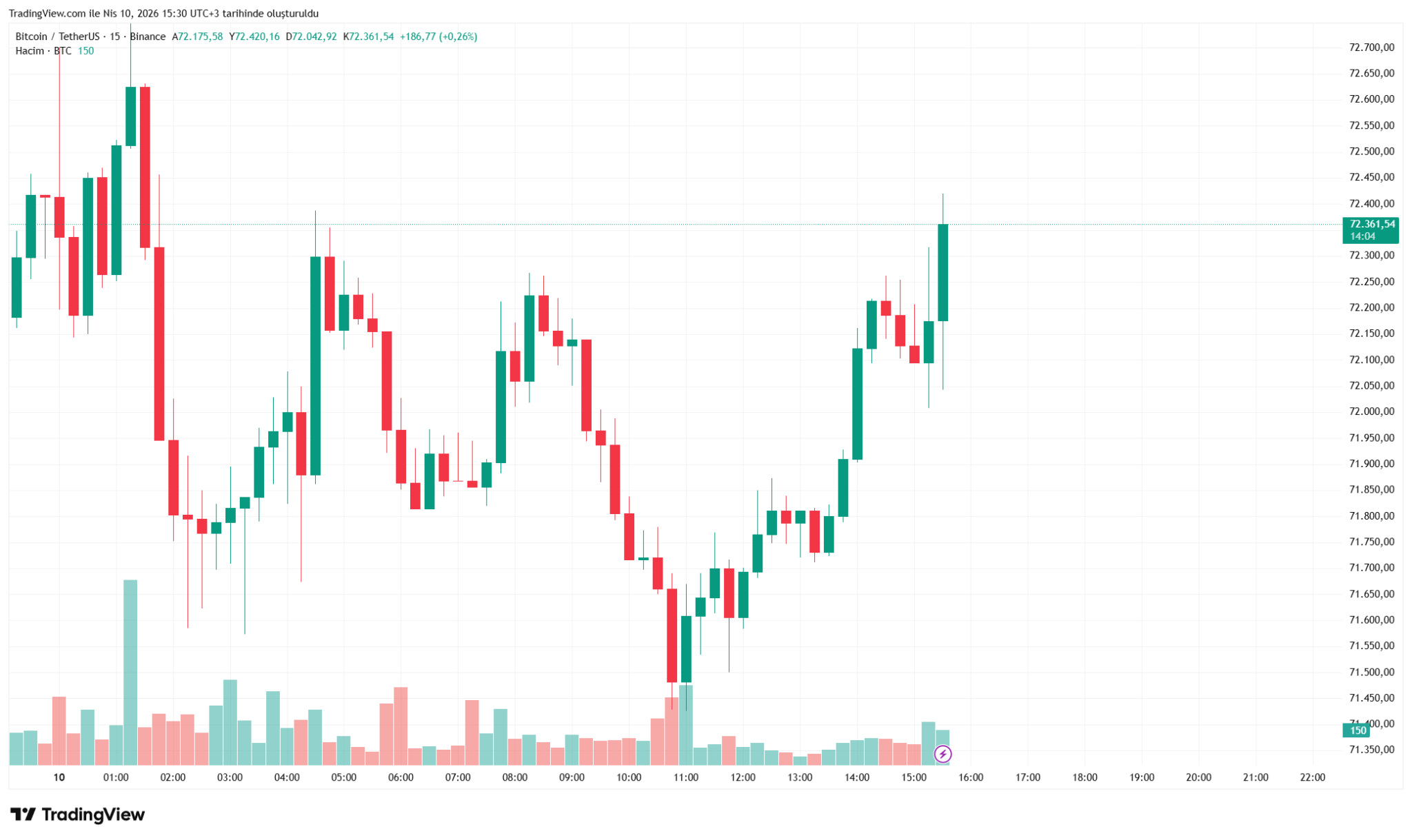
    Bitcoin’s Initial Reaction After the CPI Data!

    *This is not investment advice.