Category: Business

  • White House Supports Cryptocurrency Sector! Offers Solution to Stablecoin Debate!

    The Clarity Act, considered one of the most important cryptocurrency laws in the US, has been delayed for months due to disagreements over interest payments on stablecoins. CLARITY is stalled because of disputes between banks and the cryptocurrency sector regarding interest payments on stablecoins.

    While the banking sector advocates for a ban on interest payments on stablecoins, the cryptocurrency sector supports stablecoin yields.

    As the debate over stablecoin interest rates continues, a White House council has released a report on stablecoin interest rates.

    Accordingly, the US White House Council of Economic Advisors (CEA) stated that the impact of stablecoin interest payments on local banks would be minimal and limited.

    According to Bloomberg, the White House Council of Economic Advisors stated that cryptocurrency companies paying interest to customers holding stablecoins would not trigger a wave of deposit outflows from banks.

    White House economists believe banning stablecoin yields would only increase bank lending by 0.02%. This assessment suggests that the impact of stablecoin rewards on traditional financial institutions is minimal and alleviates concerns about potential disruptions.

    CEA economists also concluded that this measure would be largely ineffective in protecting banks and could deprive consumers of competitive returns.

    However, the CEA’s analysis contradicts that of the Independent Regional Banking Council (ICBC). In a recent analysis, the ICBC stated that allowing interest payments on stablecoins could lead to banks withdrawing up to $1.3 trillion in deposits and up to $850 billion in loans.

    The White House appears to have sided with the cryptocurrency sector regarding stablecoin returns with its latest report.

    *This is not investment advice.

  • CoinDesk 20 performance update: Internet Computer (ICP) rises 12.1%

    CoinDesk 20 performance update: Internet Computer (ICP) rises 12.1%

    CoinDesk Indices presents its daily market update, highlighting the performance of leaders and laggards in the CoinDesk 20 Index.

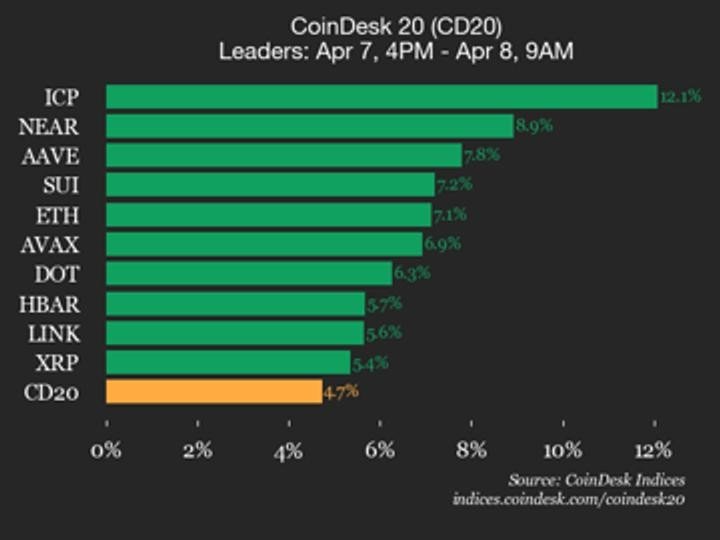
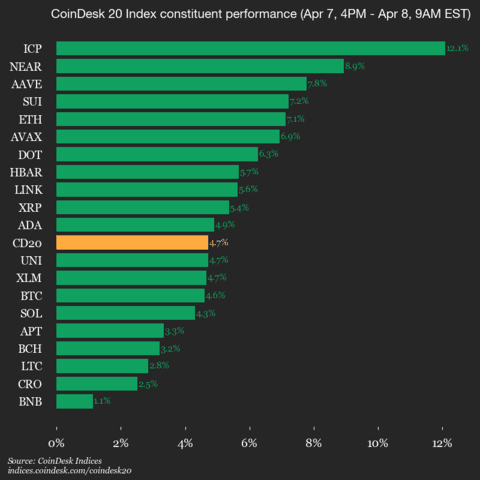
    The CoinDesk 20 is currently trading at 2027.7, up 4.7% (+91.47) since 4 p.m. ET on Tuesday.

    All 20 assets are trading higher.

    Leaders: ICP (+12.1%) and NEAR (+8.9%).

    Laggards: BNB (+1.1%) and CRO (+2.5%).

    The CoinDesk 20 is a broad-based index traded on multiple platforms in several regions globally.

  • Iran eyes crypto toll for oil tanker transits through Strait of Hormuz, according to FT

    Iran will collect crypto payments as transit fees from oil tankers passing through the Strait of Hormuz during the two‑week ceasefire with the U.S., an industry official told FT.

    Hamid Hosseini, spokesperson for Iran’s Oil, Gas and Petrochemical Products Exporters’ Union, said that crypto-denominated tolls will be charged for fully loaded vessels as the nation seeks to “monitor what goes in and out of the strait to ensure these two weeks aren’t used for transferring weapons.”

    Hosseini’s comments signal Tehran’s willingness to use cryptocurrency for toll payments, highlighting the expanding real‑world use cases of digital assets in high-stakes geopolitical developments.

    This isn’t new — nations at odds with the U.S. or its allies have long turned to crypto as a way to bypass traditional banking channels that leave a paper trail. Russia has indeed used cryptocurrency as part of broader efforts to evade Western sanctions, and in Iran’s case, Tehran is exploring digital payments as it looks to unlock funds for rebuilding the war-destroyed infrastructure.

    The proposed framework will require tankers to notify cargo details to Iranian authorities via email, and the toll will reportedly be calculated at $1 per barrel of oil. Authorities will then instruct on how to settle the fee in digital assets, with officials citing bitcoin as a potential payment method.

    Hosseini suggested that empty tankers would transit without charge, but fully laden vessels must comply with the reporting and crypto payment process before being cleared for passage.

    “Once the email arrives and Iran completes its assessment, vessels are given a few seconds to pay in Bitcoin, ensuring they can’t be traced or confiscated due to sanctions,” he said.

    The comments also indicated Tehran may direct traffic along the northern route of the Strait close to its coastline, a move that could raise questions about whether Western and Gulf‑linked shipping firms are prepared to navigate the risky Iranian waters.

  • ‘Captive Audience’ Could Drive Demand for Morgan Stanley’s Bitcoin ETF: Bloomberg Analyst

    ‘Captive Audience’ Could Drive Demand for Morgan Stanley’s Bitcoin ETF: Bloomberg Analyst

    In brief

    • Morgan Stanley’s Bitcoin Trust is expected to debut as early as Wednesday after the SEC flashed a regulatory green light for the exchange-traded fund.
    • The product faces an entrenched titan in BlackRock’s spot Bitcoin ETF, but Morgan Stanley is making things more competitive with the industry’s lowest fees.
    • Meanwhile, one of the largest investment banks has an “army of advisors” that could bolster the product’s adoption, Bloomberg’s Eric Balchunas said.

    Morgan Stanley’s Bitcoin Trust is expected to face stiff competition when it debuts as early as Wednesday, but the exchange-traded fund is poised to enter a crowded field with distinct advantages, according to Bloomberg Senior ETF Analyst Eric Balchunas.

    Through a combination of low fees and in-house distribution, Balchunas told Decrypt on Tuesday that the product being offered by the firm with $9.3 trillion in assets has a decent shot at pulling momentum away from BlackRock’s industry-leading alternative.

    “It’s not going to knock off BlackRock and become the biggest, but I believe it will do well,” he said in reference to Morgan Stanley’s spot Bitcoin ETF. “What Morgan Stanley has going for it is a captive audience. It’s got its own army of advisors.”

    With approximately 16,000 financial advisors on Morgan Stanley’s payroll, MSBT’s adoption will be bolstered by recommendations to clients, Balchunas said. He pointed out that Fidelity has some advisors—but “Morgan Stanley is on another level.”

    Last year, Morgan Stanley’s Global Investment Committee recommended allocating up to 4% of investors’ portfolios to crypto for “opportunistic growth.” Among clients, those allocations could soon become further legitimized, with the SEC’s approval of MSBT’s debut on Tuesday.

    Balchunas noted that Morgan Stanley’s “brand is huge,” standing in contrast with a handful of crypto asset managers that debuted their products alongside BlackRock.

    As various issuers refined filings ahead of spot Bitcoin ETFs’ U.S. debut in 2024, Balchunas began using the term “Terrordome” to describe an intensely competitive environment for emerging issuers’ fees. He said Morgan Stanley hasn’t failed to show up.

    ETFs charge what is known as an expense ratio, deducting fees from the fund’s assets to cover management, administrative, and operating costs. Morgan Stanley’s spot Bitcoin ETF is set to debut with a 0.14% expense ratio, undercutting BlackRock’s 0.25% fee for its iShares Bitcoin Trust ETF (IBIT).

    Balchunas said Morgan Stanley’s target is lower than most legacy firms are willing to go, but the move likely has strategic elements when it comes to optics for advisors.

    “You’ve got this product that’s cheap enough where [allocations] won’t look like a conflict of interest,” he said. “They’re literally picking the most fiduciary product if you go by fees alone.”

    For a firm that’s “late to the party,” Balchunas noted that differentiation is crucial. He wagered that Morgan Stanley has done enough to separate its product from BlackRock’s, which has taken in $63.3 billion since its debut, according to CoinGlass.

    Balchunas compared IBIT to basketball legend Michael Jordan. At this point, he said that BlackRock’s ETF has become entrenched as the undeniable leader in its field through robust liquidity and a massive options market.

    Historically, the Grayscale Bitcoin Trust ETF’s fees have been the highest at 1.5%. Still, the asset manager debuted a “Mini” counterpart last year that has a 0.15% expense ratio, lower than almost every other alternative on the market.

    The VanEck Bitcoin Trust currently charges no fees to investors. But that’s because the asset manager has implemented what is known as a fee waiver. Its expense ratio is set to remain at 0% until the end of July, unless it crosses $2.5 billion in assets beforehand. 

    Decrypt has reached out to Morgan Stanley for comment.

    Daily Debrief Newsletter

    Start every day with the top news stories right now, plus original features, a podcast, videos and more.

  • Bitcoin Threatens to Break Support as Trump Threatens to Destroy Iran

    Bitcoin Threatens to Break Support as Trump Threatens to Destroy Iran

    In brief

    • Trump set an 8 p.m. ET deadline for Iran to reopen the Strait of Hormuz or face destruction.
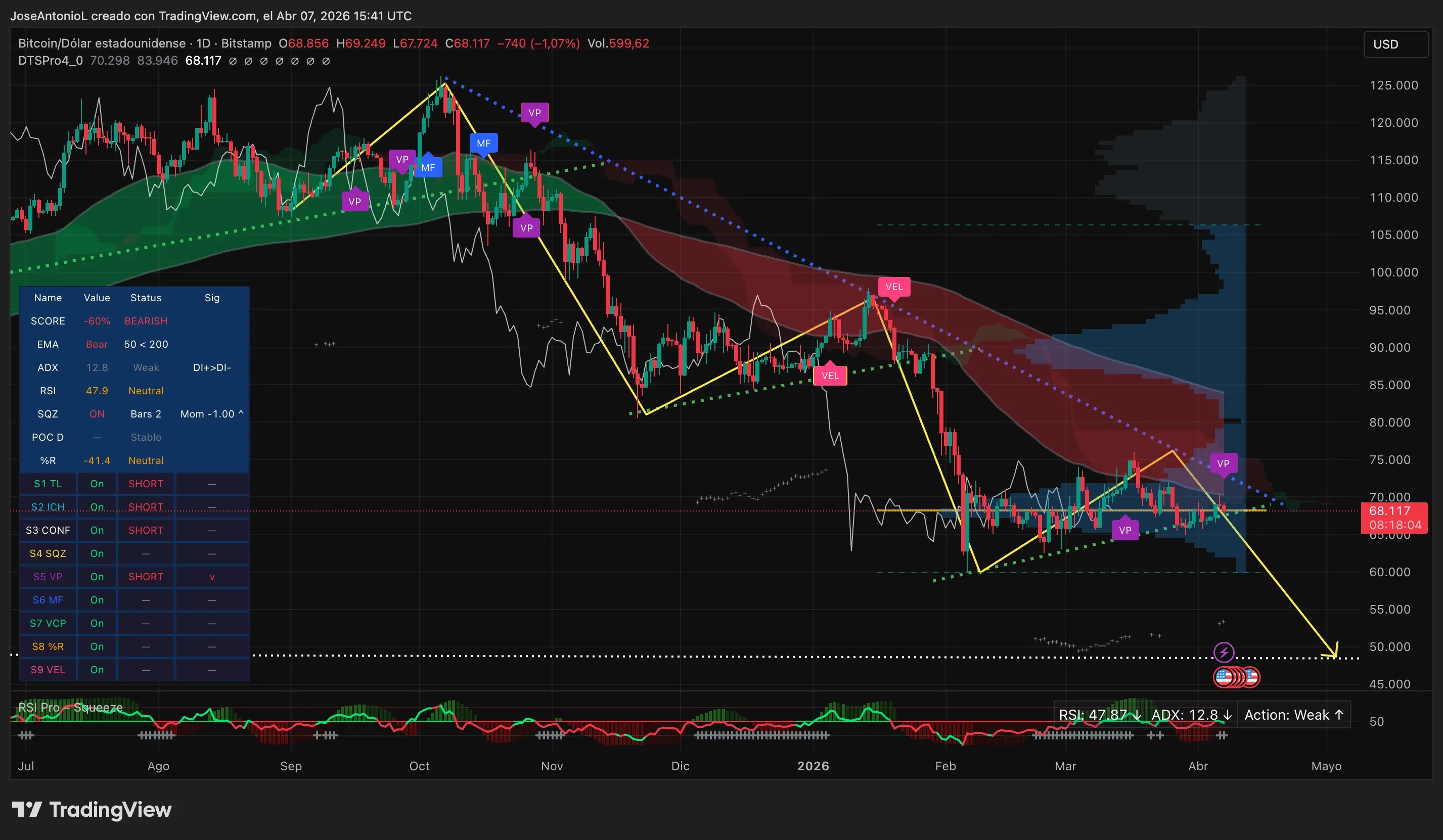
    • The move has rattled markets, with Bitcoin down 2% to $68,117 and a triple-pattern breakdown playing out on the daily chart.
    • Prediction market traders on Myriad give BTC a 57% chance of dumping to $55K.

    War is the macro today.

    President Donald Trump posted on Tuesday morning on Truth Social that “a whole civilization will die tonight, never to be brought back again” unless Iran gives in to U.S. demands. He set 8 p.m. ET as the hard deadline for Iran to reopen the Strait of Hormuz or face destruction.

    S&P 500 futures fell 0.4%, Nasdaq 100 futures dropped 0.6%, and Dow futures sank 142 points before the opening bell. Oil went the other direction: WTI crude is trading above $115 a barrel, Brent above $110—a more than 70% rise over the last 30 days—the direct result of a Strait of Hormuz closure that has been choking off roughly a fifth of the world’s oil supply since late February.

    Iran rejected a previous ceasefire proposal from the United States, and international groups such as the International Committee of the Red Cross have said Trump’s threats, if fulfilled, could amount to “war crimes.”

    The escalation in rhetoric has markets on edge, and crypto is no different. Bitcoin slipped to $68,557, dropping 2% on the day, and Ethereum slipped 2.7% as traders apparently brace for further turmoil. The logic appears to be that if bombs start falling on civilian infrastructure tonight, investors will flee to safety—and Bitcoin has increasingly shown to not function as a safe haven asset during a war panic.

    On Myriad, a prediction market built by Decrypt‘s parent company Dastan, traders are pricing in only a 24.1% chance that the Iranian regime falls before October. It suggests traders either expect yet another TACO move from Trump or believe the conflict will drag deep into the second half of the year, with no clean resolution in sight.

    The Bitcoin chart has seen this movie before

    With Bitcoin down around 2% today, the short-term movement doesn’t look catastrophic—but the long-term picture isn’t pretty.

    Price of Bitcoin over time. Image: Tradingview
    Image: Tradingview

    The daily charts show three separate attempts by buyers to recover losses after a major top, and three separate failures, since October of last year. Each recovery set a lower high. Each breakdown found a lower bottom. Bitcoin closed Q1 2026 with its worst quarter since 2018, down 22% as war, tariffs, and a hawkish Fed crushed risk appetite. The coin is now at the bottom of the third pattern, hovering above support near $65,000. If this plays out the way the previous two did, the next stop is $55,000 or worse.

    The overall indicators show a bearish mood among Bitcoin traders.

    The Exponential Moving Averages, or EMAs, show that the 50-day average is trading below the 200-day, which is the quintessential bearish indicator. It means the longer-term trend is still pointed down, and there’s no structural reversal in the moving averages yet. When EMAs are in this configuration, traders refer to it as a “death cross,” and rallies tend to get sold into.

    The 50-day EMA has marked a solid resistance since the death cross appeared late last year.

    The Average Directional Index, or ADX, is at 12.8—well below the 25 threshold that signals a real trend is forming. ADX measures trend strength regardless of direction. Below 20 means the market is choppy and directionless. The bears are in control on paper, but the trend hasn’t gone full force yet as can be seen by the sideways movement after the big drop in February.

    For Bitcoin bulls, the good news is that a low ADX could point to a trend reversal. The bad news is it needs confirmation from other indicators, and that’s not happening right now.

    The Relative Strength Index, or RSI, sits at 47.9—firmly neutral but slightly oversold. RSI measures buying and selling momentum; at this level, neither camp has the edge. Meanwhile, the Squeeze Momentum Indicator shows that compressed energy is building, and the current lean is negative. A squeeze release with downward momentum is a bearish setup.

    Moon or doom?

    The charts show Bitcoin is more likely to go down. Three identical yellow patterns. Three failed recoveries. BTC formed a lower high every single time, then broke through support and found a new floor. The descending blue trendline connecting the highs is still intact. The Ichimoku cloud above is deep red—a ceiling, not a floor.

    Close below $65,000, and it’s a major confirmation for this pattern. The path to $55,000 then opens with little structural support in between.

    On Myriad, traders are leaning that way too: traders say there’s a 57% chance BTC’s next major move is a dump to $55,000, compared to 43% odds on a pump to $84,000. A separate market asks whether there’s still a chance crypto will bloom this spring: 66% say no, with the market closing May 31.

    There’s a real argument for the other side. Bitcoin is down more than 45% from the $126K all-time high set last October. Some analysts—including Main Management’s Kim Arthur—have called this the “bottoming phase” of a classic four-year crypto winter.

    But bulls need to see real confirmation first: Bitcoin breaking past the $75,000 mark with conviction, ADX climbing above 20 to signal a genuine trend forming, and the 50-day EMA starting to curl back toward the 200-day. None of that is happening yet. Without it, any bounce seems like just another lower high in the making.

    Disclaimer

    The views and opinions expressed by the author are for informational purposes only and do not constitute financial, investment, or other advice.

    Daily Debrief Newsletter

    Start every day with the top news stories right now, plus original features, a podcast, videos and more.

  • Bloomberg Analyst McGlone, Who Forecasts Bitcoin Will Reach $10,000: “It Could Stabilize Under Certain Conditions”

    Bloomberg Analyst McGlone, Who Forecasts Bitcoin Will Reach $10,000: “It Could Stabilize Under Certain Conditions”

    Bloomberg senior commodities strategist Mike McGlone shared a noteworthy assessment of Bitcoin and the cryptocurrency market in general.

    McGlone stated that current macroeconomic conditions are putting pressure on risky assets, and that the scenario in which the Bitcoin price could fall to the $10,000 level in the long term is becoming increasingly discussed.

    “Bitcoin Will Only Stabilize If US Stocks Remain Strong”

    According to McGlone, the resilience of US stock markets, in particular, plays a critical role in this scenario. The strategist argued that Bitcoin, among millions of crypto assets, could stabilize under certain conditions, but this depends on the stock markets remaining strong. However, he noted that the low volatility in US stock markets despite rising risk indicators in commodities like gold and oil is “a rare occurrence in history.”

    Related News Developers of a Project Issued an Urgent Call for Their Own Cryptocurrency Platform: “Everyone Should Withdraw Their Liquidity Immediately”

    On the other hand, McGlone compared the current market dynamics to the process leading up to the 2008 global financial crisis. Recalling that rising oil prices had historically paved the way for recessions, the strategist stated that a similar pattern could re-emerge. In this context, he added that movements in energy markets are critical for the global economic outlook.

    McGlone also shared his “normalization” expectations for 2026. According to the analyst, possible scenarios include WTI oil prices heading towards $40, copper towards $4, US Treasury yields towards 4%, gold towards $4,000, and silver towards $50.

    In his assessment of the crypto market, McGlone also referenced Michael Saylor’s past statement, “We buy Bitcoin with money we can’t afford to lose,” noting that such approaches reflect periods of excessive risk appetite. McGlone added that MicroStrategy is a pioneer in this field with its Bitcoin investments.

    *This is not investment advice.

  • Bitcoin Exchange Biinance Announces It Will Support This Altcoin’s Network Upgrade and Hard Fork! Here Are the Details

    Bitcoin Exchange Biinance Announces It Will Support This Altcoin’s Network Upgrade and Hard Fork! Here Are the Details

    Cryptocurrency exchange Binance has announced it will support the network upgrade and hard fork process on the Polygon network.

    According to a statement from the exchange, certain transactions will be temporarily suspended to protect user experience.

    Binance announced that it will cease deposit and withdrawal operations for tokens on the Polygon network as of April 8, 2026, at 4:00 PM. This step was taken to prevent potential technical disruptions during the network upgrade.

    The network update and hard fork are expected to take place around 5:00 PM on the same day, at a block height of 85,268,500.

    The exchange stated that only deposit and withdrawal transactions would be affected by this process, while trading would continue uninterrupted. Users will be able to continue trading their Polygon network assets on Binance.

    Binance also stated that all technical requirements for the upgrade process will be met by the platform and users will not need to take any additional action. Deposit and withdrawal operations will be reopened once the network upgrade is complete and the system is stable, although no further announcements may be made regarding this.

    Experts emphasize that while these types of network updates generally provide performance improvements and security enhancements, temporary transaction restrictions should be carefully monitored by investors.

    *This is not investment advice.

  • Bitcoin Price Jumps Amid Peace Talks, Risk Appetite Ignites Rally

    Bitcoin Price Jumps Amid Peace Talks, Risk Appetite Ignites Rally

    Bitcoin price started a strong increase above the $70,000 zone. $BTC is consolidating gains and might aim for more gains above the $71,500 zone.

    • Bitcoin gained pace for a move above the $69,500 and $70,500 levels.
    • The price is trading above $70,000 and the 100 hourly simple moving average.
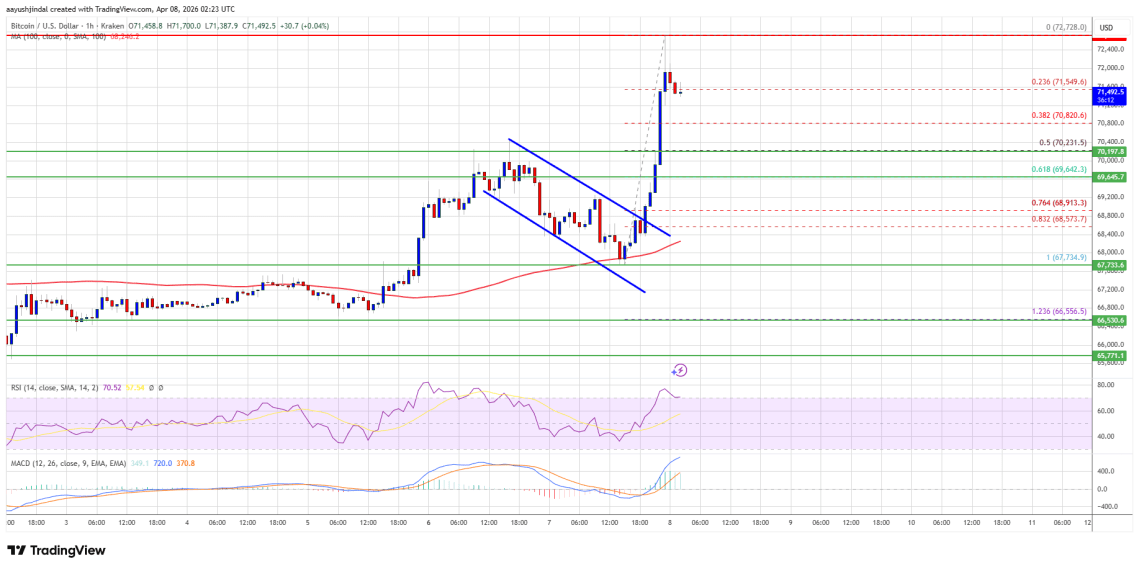
    • There was a break above a key declining channel with resistance at $68,800 on the hourly chart of the $BTC/USD pair (data feed from Kraken).
    • The pair might extend gains if it stays above the $70,250 and $69,500 levels.

    Bitcoin Price Rallies 5%

    Bitcoin price managed to climb higher above the $68,800 resistance zone. $BTC gained pace for a move above the $69,500 and $70,000 levels.

    Besides, there was a break above a key declining channel with resistance at $68,800 on the hourly chart of the $BTC/USD pair. The pair even rallied above the $72,000 level. A high was formed at $72,728, and the price started a downside correction. There was a move below the 23.6% Fib retracement level of the upward move from the $67,734 swing low to the $72,728 high.

    Source: BTCUSD on TradingView.com

    Bitcoin is now trading above $70,500 and the 100 hourly simple moving average. If the price remains stable above $70,500, it could attempt a fresh increase. Immediate resistance is near the $72,000 level. The first key resistance is near the $72,750 level. A close above the $72,750 resistance might send the price further higher. In the stated case, the price could rise and test the $73,500 resistance. Any more gains might send the price toward the $74,000 level. The next barrier for the bulls could be $75,000.

    Another Decline In $BTC?

    If Bitcoin fails to rise above the $72,750 resistance zone, it could start another decline. Immediate support is near the $70,800 level. The first major support is near the $70,250 level or the 50% Fib retracement level of the upward move from the $67,734 swing low to the $72,728 high.

    The next support is now near the $69,500 zone. Any more losses might send the price toward the $68,800 support in the near term. The main support now sits at $67,500, below which $BTC might struggle to recover in the near term.

    Technical indicators:

    Hourly MACD – The MACD is now losing pace in the bullish zone.

    Hourly RSI (Relative Strength Index) – The RSI for $BTC/USD is now above the 60 level.

    Major Support Levels – $70,800, followed by $70,250.

    Major Resistance Levels – $72,000 and $72,750.

  • SEC admits certain crypto enforcement cases delivered no investor benefit

    SEC admits certain crypto enforcement cases delivered no investor benefit

    Some past enforcement actions against cryptocurrency companies lacked clear investor benefit and misinterpreted federal securities laws, the US Securities and Exchange Commission (SEC) said on Tuesday.

    Since the 2022 fiscal year, the SEC brought 95 actions and $2.3 billion in penalties for “book-and-record violations,” it said in a statement about its enforcement results for 2025.

    “Together with seven crypto firm registration-related and six ‘definition of a dealer’ cases, these cases identified no direct investor harm from those violations, produced no investor benefit or protection.”

    It also reflected a “bias for volume of cases brought versus matters of investor protection,” a misallocation of resources and a misinterpretation of federal securities laws, the SEC said.

    It is the latest example of the regulator’s shift in approach towards enforcement since it came under new leadership under SEC Chair Paul Atkins in April 2025.

    His predecessor, former SEC Chair Gary Gensler, has been accused of pursuing a regulation-by-enforcement approach toward crypto. Since his departure, the SEC has adopted a friendlier stance toward digital assets.

    SEC said it is shifting its focus to quality over quantity

    In the lead-up to Donald Trump’s 2025 inauguration, the SEC enforcement division engaged in an “unprecedented rush” to bring cases and moved ahead with an “aggressive pursuit of novel legal theories,” the agency said.

    Atkins said the agency has since shifted away from this approach, ending regulation by enforcement and refocusing on the commission’s core mission by prioritizing cases that provide meaningful investor protection and strengthen market integrity.

    “We have redirected resources toward the types of misconduct that inflict the greatest harm—particularly fraud, market manipulation, and abuses of trust—and away from approaches that prioritized volume and record-setting penalties over true investor protection,” he added.

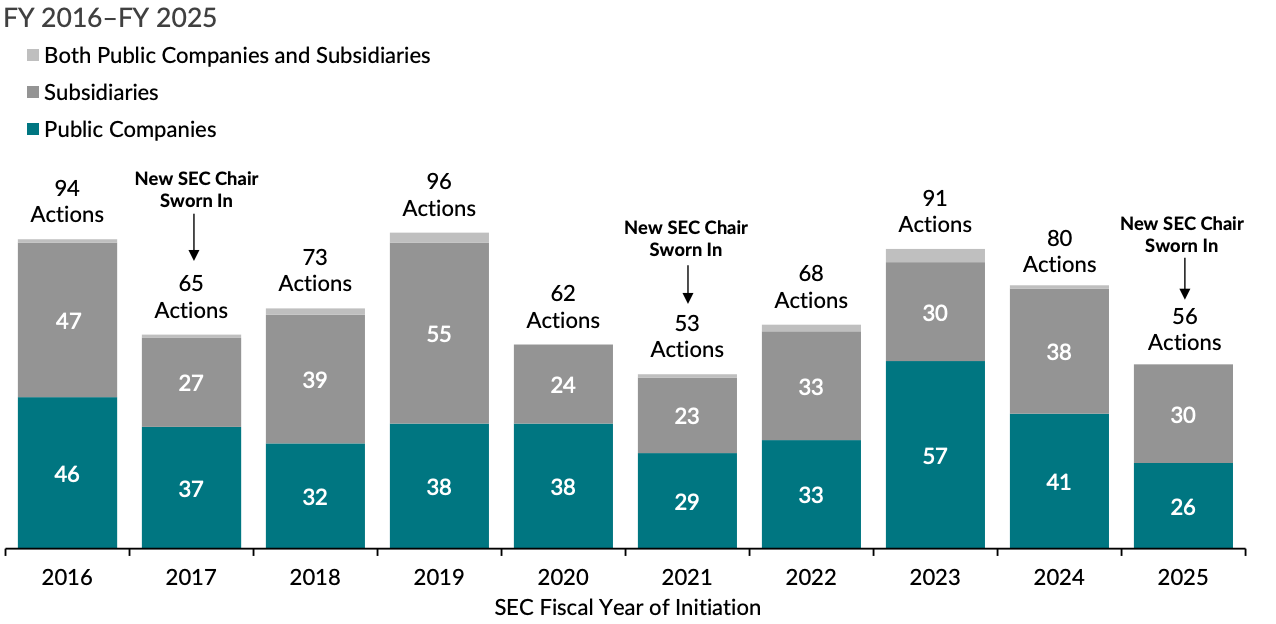
    Consulting firm Cornerstone Research reported in November that under Atkins, the number of enforcement actions against public companies, including those involving crypto, decreased by about 30% in fiscal 2025 compared with fiscal 2024.

    Under Paul Atkins, the number of SEC enforcement actions has dropped. Source: Cornerstone Research

    In connection with 2025 enforcement actions, the SEC said it obtained orders for monetary relief totaling $17.9 billion, comprising $7.2 billion in civil penalties and the remainder in disgorgement and prejudgment interest.

    “This year’s enforcement results clarify the flaws of these actions and their respective penalties and re-establish the definition and measure of enforcement effectiveness, grounded in Congress’ original intent and focused on bringing actions that actually prevent investor harm instead of headlines and inflated numbers,” the SEC said.

    Some crypto companies are still in the firing line

    Despite the SEC’s enforcement shift, several crypto companies were still hit with enforcement actions in 2025.

    In May 2025, Unicoin and four of its current and former executives were sued by the SEC for allegedly raising $100 million by misleading investors about certificates that purported to convey rights to receive Unicoin tokens and stock. However, the platform has accused the agency of distorting its regulatory statements to build a case.

    The SEC also filed a civil complaint against Ramil Ventura Palafox in April 2025, CEO of Praetorian Group International, for allegedly orchestrating a $200 million Ponzi scheme. A parallel criminal case brought by the US Department of Justice resulted in Palafox’s February sentence of 20 years in prison.

  • DeFiChain Adds New dTokens: What They Are, How They Work, and Why It Matters

    DeFiChain Adds New dTokens: What They Are, How They Work, and Why It Matters

    Can you trade a token that tracks the Goldman Sachs stock price — without a brokerage account, without KYC, and without waiting for Wall Street’s trading hours?

    That’s the specific thing DeFiChain built.

    When DeFiChain announced the addition of four new dTokens — dJNJ (Johnson & Johnson), dDAX (DAX ETF), dADS (Adidas), and dGS (Goldman Sachs) — it was adding to a system already offering tokenized versions of Tesla, Apple, Amazon, Google, and dozens of other traditional financial assets. All of it running on a blockchain built as a fork of Bitcoin, anchored to the Bitcoin network every few minutes for security.

    The concept sounds simple. The mechanics are not. This article explains both.

    What DeFiChain Is, and Why Bitcoin Matters Here

    DeFiChain was founded in 2019 by Dr. Julian Hosp and U-Zyn Chua (Chua is also chief engineer at Zynesis and a blockchain advisor to the Singapore government). The mainnet launched on May 11, 2020. Its stated purpose: bring decentralized financial services to the Bitcoin ecosystem.

    This positioning matters because most DeFi runs on Ethereum. DeFiChain took a different path: build a dedicated blockchain as a software fork of Bitcoin’s codebase, then anchor it to the Bitcoin blockchain via a Merkle root every few blocks. The practical result is that DeFiChain inherits Bitcoin’s security model — one of the most battle-tested in crypto — while adding DeFi functionality that Bitcoin itself can never natively support.

    The trade-off is intentional. DeFiChain uses a non-Turing complete transaction scripting language. That means it can’t run arbitrary smart contracts the way Ethereum can. It’s deliberately limited to DeFi-specific operations: lending, exchanges, asset tokenization, liquidity mining, staking. Less surface area for exploits. Faster, cheaper transactions. More predictable behaviour. Not the right design for every use case — but arguably the right design for a platform dedicated to financial services on the Bitcoin security layer.

    The native token is DFI, capped at 1.2 billion. It functions as payment for transaction fees, governance (masternode holders vote on DeFiChain Improvement Proposals, or DFIPs), and collateral for minting dTokens. Running a staking node requires 20,000 DFI locked as collateral. Over 10,000 masternodes distributed globally secure the network.

    What Are dTokens?

    dTokens are decentralised asset tokens on DeFiChain that track the price of real-world assets: US stocks, ETFs, commodities, indices. The key word is track. Holding a dToken does not give you equity ownership in the underlying company. No shareholder rights, no dividends, no vote at the annual meeting. What you get is price exposure — if Apple’s stock goes up 15%, dAAPL goes up approximately 15%.

    That distinction matters, and most tokenized stocks across all platforms work the same way — they’re price-linked digital contracts, not legal ownership of shares.

    What makes dTokens different from a derivatives contract at a broker:

    • No intermediary. You mint and trade directly on-chain through DeFiChain’s decentralised exchange.
    • No trading hours. dTokens trade 24 hours a day, seven days a week. dTSLA doesn’t close when the NASDAQ does.
    • Fractional access. You don’t need to buy a full share of Goldman Sachs at $500+. You can hold $5 worth of dGS.
    • No geographic restrictions. A user in Indonesia or Nigeria can get price exposure to the S&P 500 or Adidas stock without a US brokerage account.
    • Yield opportunity. Providing liquidity to dToken pools on DeFiChain’s DEX generates liquidity mining rewards, paid in DFI.

    The asset list DeFiChain built out over 2021–2022 included not just the four new additions (JNJ, DAX, Adidas, Goldman Sachs) but also dTSLA, dAAPL, dGOOGL, dAMZN, dMSFT, dNFLX, dMETA, dSPY (S&P 500 ETF), dQQQ, precious metals, and more.

    The Four New dTokens: JNJ, DAX, Adidas, Goldman Sachs

    dJNJ — Johnson & Johnson J&J is one of the most traded healthcare stocks globally, consistent dividend payer, component of the Dow Jones. Adding dJNJ extended DeFiChain’s healthcare sector exposure and gave non-US investors a path to pharmaceutical/consumer health price exposure without opening a US brokerage account.

    dDAX — DAX ETF The DAX is Germany’s benchmark stock index — 40 major German companies including SAP, Siemens, BASF, and Deutsche Bank. Adding the DAX ETF made DeFiChain genuinely international: rather than a list of primarily US tech stocks, users could now access European market exposure on a Bitcoin-anchored blockchain. This was a meaningful differentiation from Ethereum-based competitors at the time.

    dADS — Adidas Adidas stock (listed on the Frankfurt Stock Exchange) brought more European equity exposure. Adidas shares tend to be volatile around product launches and partnership news — a product that appeals to traders looking for short-term momentum alongside longer-term holders.

    dGS — Goldman Sachs Goldman Sachs is one of the flagship financial institutions in global markets. Adding a tokenized Goldman Sachs exposure on a DeFi platform built on Bitcoin had a certain symbolic weight — a Wall Street titan available to trade on a decentralised exchange at 3am on a Sunday.

    Together, these four additions moved DeFiChain’s dToken offering from US-tech-centric to a more internationally diversified pool of traditional financial assets.

    How dTokens Are Minted: The Collateral Mechanics

    Creating a new dToken requires collateral. The collateralisation system works as follows:

    Option A: DFI + other assets. A user locks a minimum 150% collateral ratio — typically a combination of 50% DFI and 50% other supported assets — and mints dTokens against that collateral. If the underlying stock price rises and the collateral ratio falls below the minimum, the position faces liquidation.

    Option B: dUSD. DeFiChain’s decentralised stablecoin (dUSD) can also be used as the minting collateral. The dUSD itself is a decentralised stablecoin backed by the vault system — not issued by any central entity.

    Oracle price feeds. The accuracy of dTokens depends on oracle price data — external price feeds that tell the blockchain what Apple or Goldman Sachs is actually trading at in the real world. DeFiChain uses a decentralised oracle system where multiple trusted sources submit price data and the median is used. Price accuracy during after-hours or weekend trading (when markets are closed) relies on the last available price.

    Loan vaults. The infrastructure for dToken minting runs through DeFiChain’s loan vault system. Each vault tracks the collateral-to-loan ratio in real time. The vault owner earns yield from providing collateral (through liquidity mining rewards), while taking on the risk of liquidation if the collateral value drops relative to the minted asset.

    The Broader dToken Ecosystem in 2025–2026

    The tokenized real-world assets market has grown substantially since DeFiChain’s early dToken launches. On-chain RWAs rose from approximately $5.5 billion in early 2025 to $18.6 billion by year-end, according to RWA.xyz data. Analysts project the market reaching $2 trillion by 2030 under base scenarios. Tokenized US Treasury products alone exceeded $9 billion by late 2025.

    DeFiChain was among the earliest movers in this space, building out a tokenized stock system in 2021–2022 when most DeFi protocols were focused on crypto-native yield farming. The DeFi Meta Chain (DMC) — DeFiChain’s EVM-compatible layer — expanded the ecosystem further in 2023–2024, making DeFiChain assets accessible to Ethereum-native wallets and developers.

    In late 2024, DeFiChain launched cUSDC — a cross-chain stablecoin that moves between DeFiChain and Polygon, providing portable stability rather than locking value within DeFiChain’s native environment. The DTL (DeFiChain Technical Lab) team was also developing native dUSDC — a decentralised version not backed by any single entity — as of early 2026, though the bridge from cUSDC to native dUSDC remained in development due to resource constraints.

    A significant community governance vote in early 2026 (95.26% approval) redirected approximately 58,200 DFI per day from block rewards to the Community Fund, strengthening the treasury’s capacity to fund development, grants, and ecosystem growth.

    DeFiChain also ranked third globally among DeFi projects by development activity in February 2025, according to Santiment data — ahead of Synthetix and Liquity, behind only Chainlink and DeepBook on Sui. For a project with a sub-$10M market cap at the time, that development velocity was notable.

    The Competitive Context: Tokenized Stocks in 2025

    DeFiChain pioneered decentralised tokenized stocks on a Bitcoin-anchored blockchain, but the broader market has evolved. By December 2025, tokenized public equities reached approximately $683 million in total on-chain value across all platforms, generating around $1.74 billion in monthly transfer volume. Ethereum holds the largest share with roughly $329 million, followed by Solana ($158 million) and Algorand ($130 million).

    The dominant players in tokenized stocks are now Backed Finance and Ondo Finance, together accounting for roughly 95% of the tokenized stock market. These platforms operate on Ethereum primarily, and their growth reflects the broader institutional adoption of on-chain real-world assets following BlackRock’s $1.8 billion BUIDL fund launch in 2024.

    DeFiChain’s dToken approach differs from these in one significant way: dTokens are synthetic, created through a collateralised vault system on a decentralised blockchain, with no custodian holding actual shares. Backed Finance, by contrast, holds real shares in custody. Both approaches have trade-offs — DeFiChain’s is more decentralised but requires active collateral management; Backed Finance’s is more capital-efficient but introduces custody risk and regulatory exposure.

    The competition hasn’t made DeFiChain’s system obsolete. It has positioned dTokens as the most decentralised version of tokenized stock exposure available — particularly valuable for users in jurisdictions where regulated tokenized stocks aren’t accessible.

    DeFiChain’s Current State (April 2026)

    The DFI token’s price trajectory has been difficult. CoinGecko shows DFI trading at approximately $0.0009–$0.003 in early 2026, down dramatically from its December 2021 ATH of $5.61. The market cap sits below $3 million — a significant decline from the $2 billion+ peak. The dUSD peg has also experienced strain, with 1 dUSD trading around 5.08 DFI rather than the intended 1:1 ratio, which the community fund proposal was specifically designed to address.

    That said, DeFiChain’s technical development has continued. The DFI ERC-20 format on Uniswap opened the ecosystem to Ethereum users. The Huobi listing in 2022 expanded exchange availability. The interchain development (version 1.0 tested on devnet) is positioning DeFiChain for cross-chain connectivity beyond Polygon.

    The gap between the technical work happening in the ecosystem and the DFI token price reflects a common pattern in DeFi infrastructure: development continues, but market sentiment has not yet rewarded it. The community governance structure — masternodes voting on DFIPs — has maintained active participation. The 2026 community fund vote with 95.26% approval on a governance mechanism affecting daily block rewards is a healthy sign of engaged governance even at current price levels.

    Why the dToken Concept Still Matters

    The idea DeFiChain proved out in 2021–2022 has become mainstream infrastructure in 2025–2026 — just not primarily through DeFiChain. BlackRock tokenizing a $1.8 billion fund, Franklin Templeton running a money market fund on Stellar, Ondo Finance creating compliant tokenized Treasuries: these are the direct descendants of the same thesis DeFiChain was building when adding dJNJ and dGS.

    The specific addition of four new dTokens isn’t just a product announcement. It’s a data point in a longer story: the first attempts to bring real-world financial assets on-chain in a decentralised way, running on infrastructure secured by Bitcoin’s proof-of-work through cryptographic anchoring, governed by community masternodes rather than any corporation.

    Whether DeFiChain itself becomes part of the next wave of RWA adoption — or whether it serves primarily as an early proof of concept that inspired more capitalised successors — depends on the interchain development and whether the Community Fund can attract enough developer activity to rebuild momentum.

    The dToken system works. The collateral mechanics are sound. The oracle infrastructure functions. The missing piece is the user adoption that turns a working technical system into a growing financial platform.