Category: Business

  • Meta, CoreWeave Shares Rise After Expanding $21 Billion AI Cloud Deal

    Meta, CoreWeave Shares Rise After Expanding $21 Billion AI Cloud Deal

    In brief

    • Meta expanded its AI cloud agreement with CoreWeave, now valued at $21 billion.
    • The deal runs through December 2032 and supports Meta’s AI inference workloads.
    • The infrastructure rollout will include early deployments of Nvidia’s Vera Rubin platform.

    Meta and CoreWeave have expanded a long-term artificial intelligence infrastructure agreement worth about $21 billion, extending their partnership through December 2032. Both companies have seen their shares rise Thursday following the announcement.

    CoreWeave announced the expanded deal Thursday, describing it as an extension of the companies’ existing relationship and an increase in infrastructure supporting Meta’s AI operations.

    “This is another example that leading companies are choosing CoreWeave’s AI cloud to run their most demanding workloads,” CoreWeave co-founder, CEO, and Chairman Michael Intrator said in a statement.

    The agreement gives Meta access to AI cloud capacity from CoreWeave to support the development and deployment of its AI systems, including inference workloads that run trained models at scale.

    The infrastructure will be deployed across multiple locations and will include some of the first deployments of Nvidia’s Vera Rubin platform. CoreWeave said the distributed deployment is intended to optimize performance, resilience, and scalability for Meta’s AI systems, and reflects rising demand for infrastructure capable of supporting large-scale AI workloads.

    Meta and CoreWeave previously struck a $14 billion AI infrastructure deal in 2025, under which the cloud provider agreed to supply computing power to Meta through 2031.

    The news comes as Meta accelerates its push into advanced AI systems. On Wednesday, the company introduced Muse Spark, a natively multimodal model capable of processing text, images, and voice and designed to tackle complex reasoning tasks using multiple AI agents.

    Meta has also outlined a new Advanced AI Scaling Framework that expands how it evaluates risks and tests its most capable models before deployment.

    “As we build more capable and more personalized AI, reliability, security, and user protections are more important than ever,” Meta said in a statement. “Advanced models require an advanced approach to safety—one that scales with the technology.”

    Shares of Meta and CoreWeave rose after the companies announced their expanded AI infrastructure deal. Currently, Meta (META) is trading above $630 per share, up about 3% on the day, while CoreWeave (CRWV) has jumped 5.5% to a recent price of $93.70.

    Daily Debrief Newsletter

    Start every day with the top news stories right now, plus original features, a podcast, videos and more.


  • Analyst Ali Martinez Takes a Closer Look at the Future of Bitcoin, Ethereum, XRP, Solana, and Dogecoin Prices

    Analyst Ali Martinez Takes a Closer Look at the Future of Bitcoin, Ethereum, XRP, Solana, and Dogecoin Prices

    Analyst Ali Martinez, known for his assessments of cryptocurrency markets, made noteworthy statements about the overall market outlook in his latest analysis.

    According to Martinez, the crypto market is beginning to form a “structural bottom” after a downtrend that has lasted for about seven months. The analyst claims that the current volatility presents a significant buying opportunity for long-term investors.

    Martinez specifically highlighted a critical indicator for Bitcoin. According to the Cumulative Value Days Destroyed (CVDD) channel, Bitcoin’s “golden zone” is around $49,330. The analyst notes that this zone historically marks the beginning of bull markets, and during such periods, the price can rise to levels as high as $178,478 or even $273,158.

    Martinez noted that a parallel channel structure is prominent on the Ethereum side, stating that the area between current levels and $1,070 offers a strong buying opportunity. In the long term, he suggested that Ethereum has the potential for a macro uptrend extending up to $8,670.

    Related News One of the People Closest to Satoshi Nakamoto: “Adam Back Is Not Satoshi”

    The analyst also pointed to a significant support level for $XRP. He stated that if $XRP holds around $0.80, the price could retest its $3.30 peak and further increases beyond that are possible.

    Martinez described the $50 to $74 range for Solana as a “deep bottom,” stating that these levels are critical for clearing speculative movements and could create a strong foundation for a new uptrend.

    On the other hand, the analyst, also commenting on Dogecoin, described the $0.060–$0.090 range as a “whale accumulation zone.” According to Martinez, such periods of consolidation have historically been observed before sharp and parabolic rises.

    *This is not investment advice.

  • Bitcoin On-Chain Technical Data Released: Here’s What It Tells Us

    Bitcoin On-Chain Technical Data Released: Here’s What It Tells Us

    Current on-chain data in the cryptocurrency market continues to generate important signals regarding investor behavior and market psychology. In particular, both derivative data and on-chain indicators present a noteworthy picture for Bitcoin.

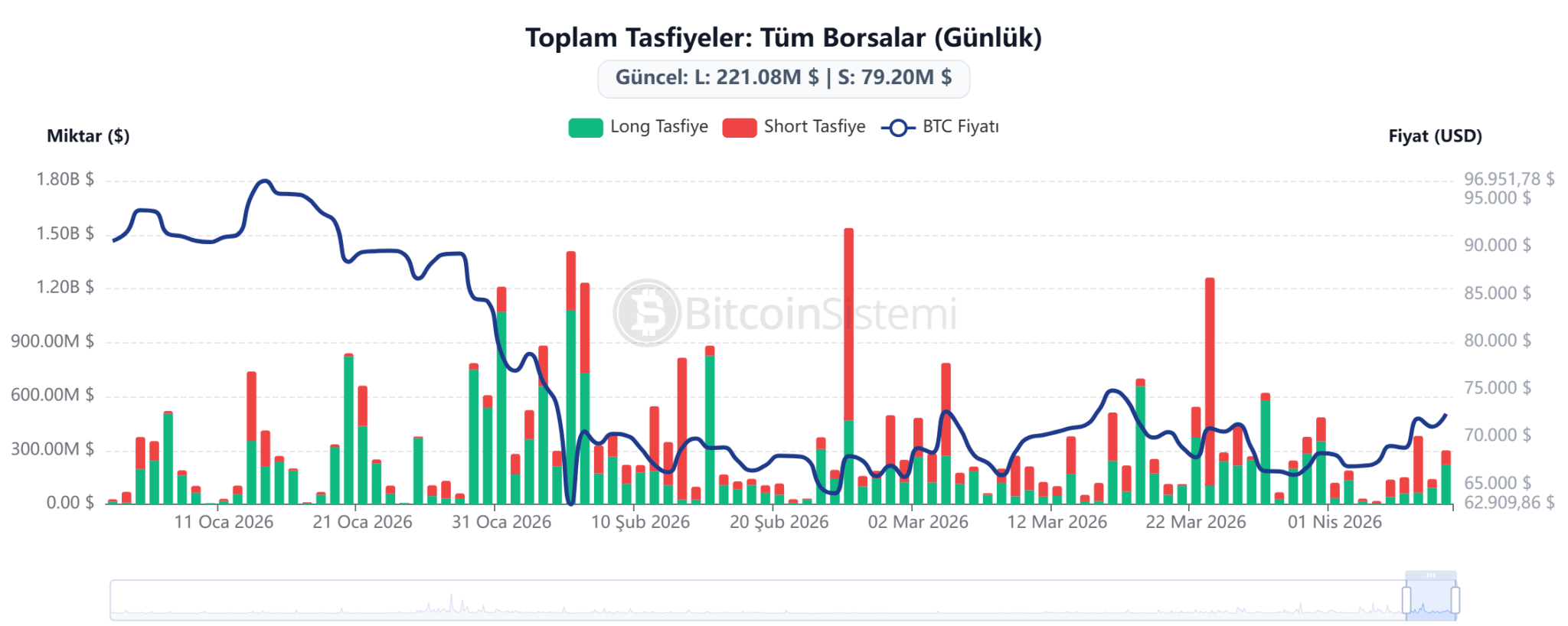
    According to data from the last 24 hours, while the Bitcoin price was trading around $72,280, a total of $327.18 million in liquidations occurred in the market. Of these liquidations, $237.64 million consisted of long positions, while short (bearish) positions accounted for $89.54 million. The data indicates that approximately 72.6% of the liquidations were long positions, suggesting a sharp cleanup in the market following overly optimistic short-term positioning.

    A graph comparing Bitcoin price and liquidations.

    On the other hand, the fear and greed index, which measures market sentiment, continues to remain in the “Extreme Fear” zone. The current score is at 14, while it was measured at 17 yesterday, 12 last week, and 13 last month.

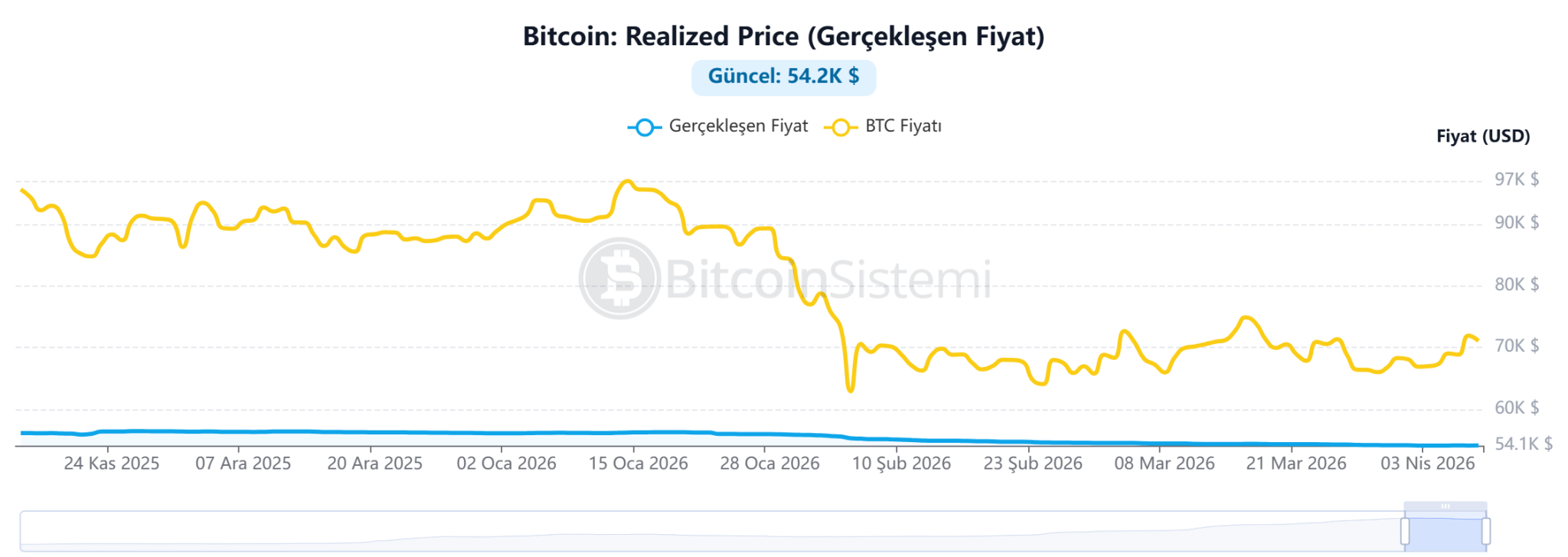
    Another important metric that stands out on the on-chain side is the “actual price.” For Bitcoin, this level is around $54,200, and the fact that the current price is well above this level indicates that the market as a whole is in profit. This suggests that this level could act as a strong support zone in uptrends. In past cycles, the price approaching this level has been seen as points where selling pressure weakened and buyers stepped in.

    A graph showing the price data for Bitcoin.

    Related News One of the People Closest to Satoshi Nakamoto: “Adam Back Is Not Satoshi”

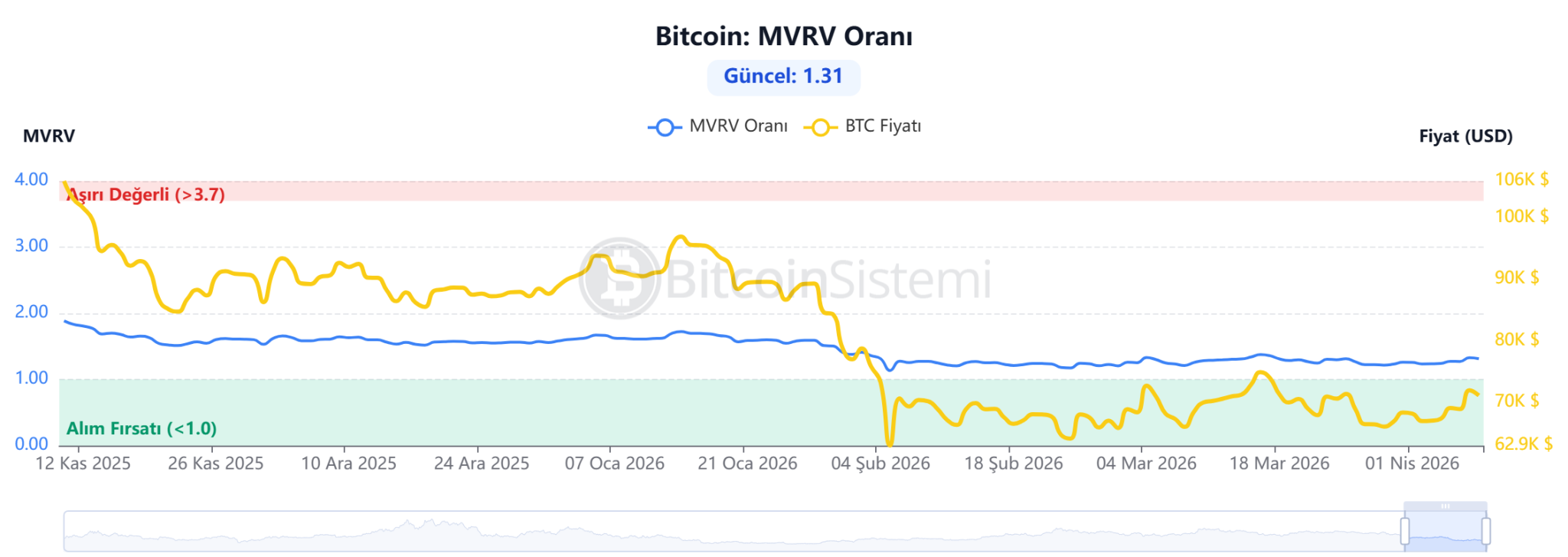
    However, the MVRV ratio is also measured at 1.31. This value indicates that the market is neither excessively cheap nor excessively expensive, but rather “close to equilibrium but in a slightly profit-taking zone.” Historically, an MVRV below 1 is considered a bottoming-out signal, while levels above 3.7 are seen as a bubble and peak warning. The current outlook suggests that the market has not yet overheated, but investors are in profit.

    A graph comparing MVRV value with Bitcoin price.

    *This is not investment advice.

  • OpenAI Pauses UK AI Tech Team-Up With Nvidia Over Energy Costs, Regulation

    OpenAI Pauses UK AI Tech Team-Up With Nvidia Over Energy Costs, Regulation

    In brief

    • OpenAI has halted its planned Stargate AI infrastructure project in the United Kingdom.
    • The initiative with Nvidia and Nscale planned to deploy up to 8,000 GPUs, with potential expansion to 31,000 in total.
    • The company said it may move forward if energy costs and regulatory conditions become more favorable.

    OpenAI has paused its planned Stargate artificial intelligence infrastructure project in the United Kingdom, citing high energy costs and regulatory uncertainty, according to a report by CNBC that was confirmed by a company spokesperson.

    The ChatGPT giant first announced the Stargate UK infrastructure project in mid-September 2025, in partnership with chipmaker Nvidia and infrastructure provider Nscale. The plan called for deploying up to 8,000 GPUs beginning in the first quarter of 2026, with the potential to scale to about 31,000 GPUs over time.

    “Everything starts with compute,” OpenAI CEO Sam Altman said in a statement at the time. “Compute infrastructure will be the basis for the economy of the future, and we will utilize what we’re building with Nvidia to both create new AI breakthroughs and empower people and businesses with them at scale.”

    The Stargate project had been expected to support local computing infrastructure for AI systems in the country. Proposed locations included sites such as Cobalt Park in northeast England, part of a designated “AI Growth Zone.”

    A critical factor in the decision to halt the project stems from industrial electricity cost in the U.K., which averages about 24 pence per kilowatt-hour for medium-sized businesses—and AI data centers require far more power than typical industrial sites. Often, data centers run at 50–100 megawatts continuously, and more than 140 projects are already waiting for grid connections totaling over 50 gigawatts.

    At current prices, operating a 100-megawatt data center could cost roughly $125 million to $250 million a year, highlighting the growing energy demands of AI infrastructure.

    The Stargate U.K. project followed OpenAI’s July 2025 memorandum of understanding with the U.K. government, focused on adopting frontier AI systems in public services. It also comes months after the Trump administration announced a Stargate AI infrastructure initiative in January 2025.

    While Altman and OpenAI have not made a public statement regarding the status of Stargate UK, OpenAI told CNBC it continues to evaluate the project and may proceed if conditions improve.

    “We continue to explore Stargate U.K. and will move forward when the right conditions such as regulation and the cost of energy enable long-term infrastructure investment,” OpenAI said in a statement.

    OpenAI did not immediately respond to a request for comment by Decrypt.

    Daily Debrief Newsletter

    Start every day with the top news stories right now, plus original features, a podcast, videos and more.
  • Tom Lee’s BitMine Uplisted to NYSE as Ethereum Firm Expands Buyback Program to $4 Billion

    Tom Lee’s BitMine Uplisted to NYSE as Ethereum Firm Expands Buyback Program to $4 Billion

    In brief

    • BitMine Immersion Technologies was unlisted from the smaller NYSE American exchange to the primary NYSE.
    • The firm’s board of directors also approved a major increase to its share buyback program, bumping its authorization from $1 billion to $4 billion.
    • Shares in the firm are up around 1% while ETH remains roughly flat over the last 24 hours.

    Publicly traded Ethereum treasury firm BitMine Immersion Technologies (BMNR) was uplisted to the New York Stock Exchange (NYSE) on Thursday, with shares of BMNR concluding trading on the smaller NYSE American exchange with Wednesday’s market close. 

    Shares in the firm are up nearly 1% since opening on the new trading venue, recently changing hands around $21.75. 

    “Today, BitMine achieved a major milestone by being uplisted to the ‘Big Board’ NYSE,” BitMine Chairman Tom Lee said in a statement. “The NYSE is the envy of capital markets around the world, and BitMine is proud to be the newest company traded on this exchange.”

    Alongside its uplisting, the firm also announced its board of directors approved an increase in its previously established share buyback program, raising its limits from $1 billion to $4 billion. 

    “BitMine’s expanded $4 billion buyback reflects our commitment to shareholders,” said Lee. “There may be a time in the future when BitMine shares are trading below intrinsic value, and the Company wants to be in a position to accretively retire common shares.”

    It doesn’t appear that BitMine has actually used funds to repurchase shares to date. Decrypt reached out to the company for confirmation and clarification, but did not immediately receive a response.

    Other publicly traded digital asset treasuries have similarly approved share buyback programs to repurchase outstanding shares when their mNAV—the ratio of their market cap compared to the value of the net assets they hold—trades below 1, or at a discount. 

    For example, competing Ethereum treasury firm Sharplink (SBET) has remained committed to only acquiring ETH when its mNAV is above 1. At all other times, the firm repurchases shares of SBET in a move that is deemed more beneficial for shareholders.

    While Lee indicates the firm may repurchase shares in the future when they are trading below “intrinsic value,” publicly available data shows that the firm is currently trading below an mNAV of 1. 

    Nevertheless, it has sought to consistently purchase Ethereum, not shares of BMNR, adding around $150 million worth of ETH last week.  

    At the time of writing, its intraday market cap is around $9.81 billion, according to data from Yahoo Finance. Meanwhile, its Ethereum tokens alone—of which it has more than 4.8 million—account for more than $10.6 billion in net assets as ETH changes hands at $2,216. 

    The firm also maintains around $14 million in BTC and total cash holdings of $864 million, giving it around $11.4 billion in total holdings, according to a Monday press release.

    Shares of BMNR have fallen around 63% in the last six months of trading as Ethereum itself has slid 55% from its August all-time high of $4,946.

    Daily Debrief Newsletter

    Start every day with the top news stories right now, plus original features, a podcast, videos and more.
  • Kalshi now controls 89% of the U.S. prediction market as regulated trading takes over

    Kalshi now controls 89% of the U.S. prediction market as regulated trading takes over

    Prediction markets are seeing steady growth in the U.S., but a wave of legal disputes and shifting competition is beginning to reshape the sector, a new report from Bank of America said.

    Total weekly volume rose 4% week-over-week, according to the report, with Kalshi — a federally regulated exchange — leading gains at 6%. Crypto.com posted a smaller increase, while Polymarket, a crypto-native platform that had surged in prior weeks, saw overall volumes fall 16%.

    Kalshi now controls roughly 89% of measured U.S. prediction market volume, far ahead of Polymarket at 7% and Crypto.com at 4%, according to BofA estimates. The shift points to a market consolidating around platforms with clearer regulatory standing.

    That divide reflects a deeper tension. At the center is whether prediction markets should be treated as financial instruments or as gambling. Kalshi operates under oversight from the Commodity Futures Trading Commission (CFTC), framing its contracts — including those tied to political or sports outcomes — as derivatives.

    Polymarket runs on blockchain rails and has historically operated outside U.S. regulatory boundaries. It allows users to trade on event outcomes using crypto, often attracting global liquidity but facing restrictions domestically.

    The gap is becoming more visible as regulators step in. Nevada and Massachusetts have both secured preliminary injunctions against Kalshi at the state level, while New Jersey lost an appeal that limits its ability to enforce gambling laws against the firm.

    At the same time, the CFTC has taken an aggressive stance in support of prediction markets.

    The agency has sued multiple states, arguing that federal law preempts state-level gambling rules. CFTC leadership has also drawn a distinction between sports betting, which it views as entertainment, and event contracts, which it classifies as financial tools for hedging risk.

    The outcome of that fight could define the industry. A federal win would allow platforms like Kalshi to scale nationally under a single framework. A loss could push the market into a state-by-state model similar to online sports betting, slowing growth.

    Crypto firms are still trying to carve out a role. Polymarket remains one of the largest global platforms and has drawn attention during major events like elections, where trading volumes can spike sharply. Meanwhile, companies like Crypto.com and Coinbase (COIN) are experimenting with prediction market-style products, signaling broader interest from centralized exchanges. The largest crypto exchange in the world, Binance, announced Thursday that it added a prediction markets feature to Binance Wallet.

    Even traditional gaming firms are adjusting. FanDuel recently shut down parts of its fantasy sports offerings, a move Bank of America links in part to the rise of prediction markets. The shift suggests users may be moving toward products that resemble trading more than betting.

  • The Altcoins with the Highest Inflows and Outflows Over the Past Week Have Been Revealed

    The Altcoins with the Highest Inflows and Outflows Over the Past Week Have Been Revealed

    Over the past week, on-chain data in the cryptocurrency market has indicated significant divergences in investor capital flows.

    While some networks recorded strong net inflows, notable fund outflows were observed, particularly in large ecosystems. The data reveals that market participants are allocating liquidity more selectively and directing it towards specific networks.

    According to weekly data, the highest net fund inflows were concentrated particularly in Layer-2 and alternative blockchain ecosystems. The prominent projects and their net inflow amounts are ranked as follows:

    Altcoin networks experiencing net fund inflows:

    1. Polygon PoS – $117.33 million
    2. Hyperliquid – $112.11 million
    3. Base – $23.70 million
    4. Ink – $15.62 million
    5. Injective (INJ) – $8.62 million
    6. BNB Chain – $2.57 million
    7. Sui – $106,000

    Related News Bitcoin Surpasses $72,000: There Are Signs of a Ceasefire Between Israel and Lebanon

    The top 10 altcoin networks experiencing the largest net fund outflows:

    1. Arbitrum – -$115.49 million
    2. Ethereum (ETH) – -$62.72 million
    3. OP Mainnet – -$36.31 million
    4. Solana (SOL) – -$34.26 million
    5. Sei Network – -$14.51 million
    6. Berachin – -$5.02 million
    7. Avalanche C-Chain – -$3.30 million
    8. Starknet – -$3.28 million
    9. Unichain – -$2.27 million
    10. WorldChain – -$763,000

    *This is not investment advice.

  • Morgan Stanley Bitcoin ETF Draws In $31M on First Trading Day

    Morgan Stanley Bitcoin ETF Draws In $31M on First Trading Day

    In brief

    • Morgan Stanley has become the first major U.S. commercial bank to launch a spot Bitcoin ETF.
    • MSBT drew $30.6 million in inflows on its debut Wednesday, with spot Bitcoin ETFs posting net outflows for a second straight day.
    • At 0.14%, the fund charges the lowest expense ratio among Bitcoin ETFs.

    Morgan Stanley became the first major U.S. commercial bank to launch a spot Bitcoin ETF on Wednesday, with its MSBT product posting inflows of $30.6 million in its first trading day according to data from Farside Investors.

    Despite the newcomer’s first-day performance, Wednesday marked a second day of net outflows from spot Bitcoin ETFs, with the funds shedding $124.5 million. Nevertheless, the investment products remain in the black for the week, thanks to Monday’s $471 million one-day haul, their biggest since February.

    MSBT’s 0.14% expense ratio makes it the cheapest Bitcoin ETF available, undercutting category leader BlackRock’s IBIT by 11 basis points. The launch intensifies competition with BlackRock’s IBIT, which holds $56 billion in assets while charging 0.25% annually; on Wednesday, IBIT drew in $40.4 million.

    Bloomberg Intelligence analyst James Seyffart suggested that the product “might be a loss leader,” arguing that “this is their way of, potentially trying to get some crypto millionaires—a lot of people with a lot of money—to join their wealth management product.”

    In a tweet, Seyffart’s colleague Eric Balchunas called MSBT’s debut “arguably biggest btc launch since they began” and projected first-year assets under management of $5 billion.

    Earlier this week, Balchunas told Decrypt earlier this week that Morgan Stanley’s offering is “not going to knock off BlackRock and become the biggest, but I believe it will do well,” adding that. “What Morgan Stanley has going for it is a captive audience. It’s got its own army of advisors.”

    Bitcoin is currently trading at $71,260, down 0.6% on the day and up 6.6% on the week, per CoinGecko data. On prediction market Myriad, owed by Decrypt‘s parent company Dastan, users are evenly split on the cryptocurrency’s prospects, putting an even chance on its next move taking it to $84,000 or $55,000.

    Daily Debrief Newsletter

    Start every day with the top news stories right now, plus original features, a podcast, videos and more.
  • BitMEX Co-Founder Ben Delo Reveals $5.4M Donation to Farage’s Reform UK

    BitMEX Co-Founder Ben Delo Reveals $5.4M Donation to Farage’s Reform UK

    In brief

    • Ben Delo’s £4m donation was made prior to a new cap on overseas contributions.
    • Reform UK has positioned itself as the most crypto-aligned party in Britain.
    • The BitMEX co-founder was previously convicted in the U.S. over the exchange’s AML failures.

    BitMEX co-founder Ben Delo has revealed that he donated $5.4 million (£4 million) to Nigel Farage’s Reform UK party, saying he was motivated to become politically active for the first time by what he described as a failing UK political system.

    Delo, who is based in Hong Kong, wrote in a Daily Telegraph op-ed that he made the contribution earlier this year before the introduction of a £100,000 cap on donations from British citizens living abroad. He said the funding would help build Reform into “a genuine alternative party of government”.

    In the article, Delo said the UK faced a “grave threat” driven by “self-deception” among political elites and argued that Reform was gaining support by recognising the scale of the country’s problems.

    Delo co-founded BitMEX, one of the crypto industry’s earliest derivatives exchanges. In 2022, he pleaded guilty in the U.S. to breaching the Bank Secrecy Act after failing to implement adequate anti-money-laundering controls, paying a $10 million criminal fine. He later received a presidential pardon from Donald Trump, describing the case in his op-ed as “a regulatory failing that isn’t even a crime in the UK.”

    His donation adds to significant backing for Reform from internationally based donors, including £11.4m from Thailand-based Tether investor Christopher Harborne.

    Reform UK and crypto

    The funding comes as Reform positions itself as the UK’s most crypto-aligned political party. It has accepted cryptocurrency donations, promoted pro-crypto policies and built ties with industry figures, distinguishing it from more cautious approaches taken by Labour and the Conservatives.

    That stance has placed Reform at the centre of a broader debate over crypto and political finance. Government ministers have moved to tighten rules on overseas donations and imposed a moratorium on cryptocurrency contributions following a government-commissioned review into foreign financial influence. The review recommended capping donations from expatriates and highlighted risks around transparency and enforcement in crypto-based funding.

    Reform has branded these recommendations an attack on its party specifically and has pushed back, arguing existing rules can accommodate crypto and that tighter restrictions risk disadvantaging newer parties. Critics, including transparency campaigners, argue that crypto donations could create new channels for opaque or foreign-linked funding.

    Reform leader Nigel Farage, who last month invested in a Bitcoin treasury firm and has made tens of thousands of dollars from speaking engagements at crypto conferences, retweeted Delo’s op-ed, stating that “the scheming and dishonest Keir Starmer will not stop us.”

    “In fact, his actions have only made brave people like Ben Delo even more determined to beat Labour at the next election,” he added.

    Farage has also advocated crypto-friendly policies, including lower taxes on digital assets and the creation of a national Bitcoin reserve.

    Reform described Delo as “a true patriot”.

    Delo said he intends to relocate to the UK, which would allow him to continue donating without restriction. He said the move reflected both personal reasons and a desire to play a more direct role in the country’s future.

    Daily Debrief Newsletter

    Start every day with the top news stories right now, plus original features, a podcast, videos and more.

  • AlphaTON raises $43 million to build sovereign AI and privacy infrastructure

    AlphaTON raises $43 million to build sovereign AI and privacy infrastructure

    AlphaTON secures about $43 million from Vertical Data to build sovereign AI and privacy computing infrastructure for $TON, Telegram and Animoca‑linked applications.

    AlphaTON Capital has entered a strategic financing agreement worth approximately $43 million with Vertical Data to accelerate its AI and privacy computing infrastructure build‑out. The $TON‑focused financial firm said the collaboration centers on AI hardware deployment to speed up its “privacy computing” roadmap and sovereign AI infrastructure stack. According to AlphaTON, the goal is to support integrated development across AI, digital assets, and confidential computing on top of the $TON ecosystem.

    The company added that its planned AI and privacy computing infrastructure will provide base‑layer computing power for applications built by partners such as Telegram and Animoca Brands, positioning the stack as shared infrastructure rather than a siloed product play. In its announcement, AlphaTON framed the project as a way to align high‑performance AI hardware with end‑to‑end encrypted and privacy‑preserving computation, arguing this is necessary to reconcile regulatory demands with scalable AI and Web3 services. Vertical Data’s role, as outlined in the deal, is to bring capital and hardware deployment expertise to the partnership as demand for AI compute continues to outstrip traditional data‑center capacity.

    By explicitly branding the stack as “sovereign AI infrastructure,” AlphaTON is tapping into a growing narrative that AI models and data pipelines should run on infrastructure that is both jurisdictionally aligned and privacy‑preserving. This overlaps with the rise of confidential computing, which uses hardware‑based enclaves and cryptographic techniques to process sensitive data without exposing it in the clear. In the context of digital assets, such infrastructure could underpin use cases like private on‑chain recommendation engines, encrypted identity scoring, or AI agents that can transact while shielding user‑level data.

    The participation of partners like Telegram and Animoca Brands signals that AlphaTON is targeting high‑volume consumer and gaming applications rather than purely institutional workloads. Telegram brings a massive messaging and social graph, while Animoca Brands sits at the intersection of gaming, NFTs, and metaverse‑style experiences. Their involvement suggests AlphaTON’s infrastructure is expected to support not only generic AI workloads but also on‑chain gaming, social, and digital asset applications that need both throughput and privacy guarantees.

    For internal linking, you can connect this piece to three relevant Crypto.news articles, for example: a feature on confidential computing and crypto vouchers, a report on AI‑driven Web3 infrastructure raises, and an article on Telegram‑linked $TON ecosystem development (all linked on single keywords like “confidential,” “AI infrastructure,” and “$TON”). Additionally, for any tokens mentioned (for instance, Toncoin or others used in the final edit), link their names to the corresponding Crypto.news price pages from the market‑cap section, ensuring each token name in the body is a single‑word link to its price page.