Category: Business

  • 8 African Nations Advance Crypto Regulation as Adoption Accelerates Across Emerging Markets

    8 African Nations Advance Crypto Regulation as Adoption Accelerates Across Emerging Markets

    Africa’s crypto regulation is accelerating as Ripple highlights eight nations advancing formal oversight, driving adoption and investment while positioning the region for deeper integration into global digital asset markets.

    Key Takeaways:

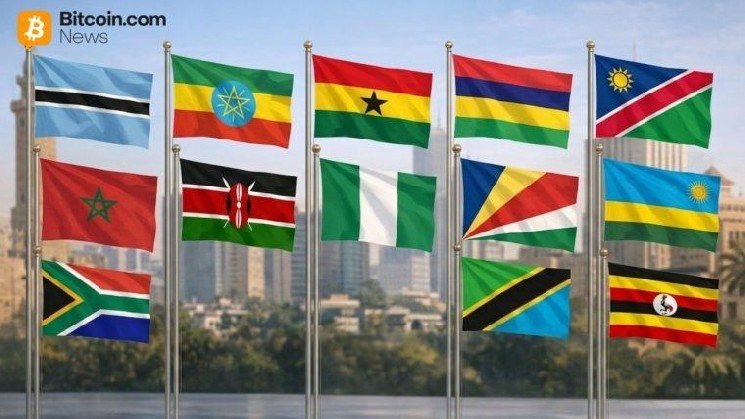
    • Ripple highlights 8 African nations advancing crypto regulation, led by South Africa licensing rules.
    • Nigeria, Kenya, and Mauritius frameworks boost adoption, with stablecoins rising in trade flows.
    • Ghana, Botswana, and Ethiopia signal next wave, targeting broader compliance rollout through 2026.

    Africa Crypto Regulations Expand Across Key Markets

    Evolving policy approaches worldwide are beginning to redefine how digital asset ecosystems develop in emerging markets. Ripple, a company focused on blockchain-based payment solutions, released findings on April 6 that examine how African nations are approaching crypto regulation at different stages of maturity. The insight underscores a combination of rising usage, gradual policy coordination, and ongoing investment in financial infrastructure, with emphasis on how regulatory paths differ across jurisdictions rather than follow a single model.

    Ripple stated:

    “As activity grows across the continent, regulators in several key jurisdictions are moving quickly to set the stage for the next phase of Africa’s digital asset ecosystem.”

    South Africa has positioned itself as one of the most advanced regulatory environments on the continent, formally treating crypto assets as financial instruments and requiring service providers to register and comply with oversight bodies such as the FSCA and FIC. In Kenya, authorities have moved forward with a legal framework for virtual asset providers, dividing supervisory responsibilities between monetary and capital markets regulators, while continuing to refine the framework through stakeholder consultation and iterative policy adjustments.

    Mauritius continues to expand its regulatory toolkit, building on earlier initiatives by broadening licensing categories and clarifying its stance on stablecoin-related activity, with ongoing work aimed at establishing clearer long-term rules for issuance and use. Nigeria, meanwhile, has shifted toward formal recognition of digital assets within its securities framework, while also relaxing earlier banking constraints and experimenting with supervised compliance environments, reflecting a more pragmatic and engagement-driven regulatory approach.

    Regulatory Activity Broadens Across the Region

    Beyond these key markets, the insight identifies a wider group of countries beginning to formalize their approach to digital assets, contributing to a more interconnected and steadily evolving regulatory landscape. Ghana has introduced initial compliance measures, including registration requirements, which serve as a foundation for more comprehensive oversight in the future.

    Botswana, Namibia, and Seychelles are at various stages of drafting or implementing crypto-focused regulations, with an emphasis on defining licensing processes and ensuring adherence to compliance standards. These developments highlight a gradual but intentional move toward regulatory consistency across the region, as policymakers seek to establish clearer entry conditions for market participants. Ripple noted:

    “Today, roughly eight African countries have implemented some form of crypto-specific regulation, with additional jurisdictions working toward formal frameworks.”

    Elsewhere, countries such as Ethiopia, Morocco, Rwanda, Tanzania, and Uganda are still in exploratory phases, assessing how digital asset policies can be adapted to local economic structures and financial system priorities. In many cases, regulators are carefully weighing the benefits of innovation against potential systemic risks, particularly those linked to capital mobility and rapid adoption.

    “Africa has long been a global leader in crypto adoption, driven by practical needs like remittances, cross-border trade and mobile-first financial services,” Ripple observed. This widespread adoption is closely linked to longstanding gaps in traditional financial systems, especially in areas such as cross-border payment efficiency and access to stable foreign currencies. As a result, digital assets are increasingly viewed as practical tools for addressing these limitations, particularly in markets where conventional banking infrastructure remains uneven or inaccessible.

    Market Demand and Infrastructure Continue to Drive Growth

    Underlying economic conditions continue to support both policy development and rising institutional involvement throughout the region. The success of mobile money platforms has already demonstrated the viability of digital-first financial solutions, creating a natural bridge for broader digital asset usage.

    Stablecoins, in particular, are seeing expanded use cases ranging from commercial settlements to liquidity management and remittance flows, offering efficiency gains compared to legacy financial rails. At the same time, financial institutions are exploring new service offerings, including secure custody and compliance-driven platforms, to meet increasing demand from both enterprises and individual users. As regulatory clarity improves, this trend is expected to further enable institutional participation and streamline cross-border financial activity. Ripple remarked:

    “Africa remains one of the world’s most compelling regions for digital asset adoption and momentum.”

    Looking ahead, continued progress in regulation and greater coordination between jurisdictions could accelerate the integration of digital assets into mainstream financial systems. Sustained alignment on policy standards may ultimately support a more cohesive, scalable, and resilient digital economy across Africa, positioning the region for long-term growth and deeper global financial connectivity.
  • Bitcoin Long-Term Holders Return to Accumulation Mode: Binance Sees Early Bull Market Signals

    Bitcoin Long-Term Holders Return to Accumulation Mode: Binance Sees Early Bull Market Signals

    Bitcoin accumulation by long-term holders is signaling a market transition, with Binance data pointing to tightening supply conditions that could support the early stages of a new bull cycle.

    Key Takeaways:

    • Binance shows $BTC accumulation since Feb. 2026 as long-term holders steadily stack positions.
    • Binance signals early bull cycle setup, with 2026 trends aligning with past breakout phases.
    • $BTC supply tightens as holders lock coins, reinforcing conditions for sustained upside.

    Binance Sees Bitcoin Long-Term Holders Return to Accumulation Mode, Pointing to Early Bull Market Phase

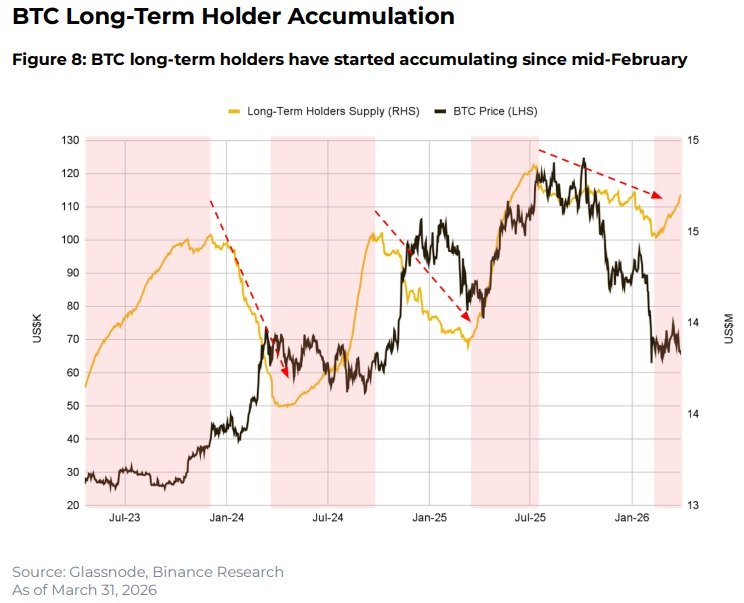
    The cryptocurrency market is showing early signs of a structural shift as long-term bitcoin holders return to accumulation, reinforcing a potential turning point in the current cycle. Binance detailed this transition in its April 6 market report, highlighting how investor behavior has evolved after a prolonged drawdown. The findings emphasize that sustained accumulation by experienced holders is reshaping market structure and influencing future price dynamics.

    Richard Teng, CEO of Binance, shared on social media platform X on April 7 a direct observation supporting this trend. The chief executive stated:

    “Since mid-February, $BTC long-term holders have been back in accumulation mode.”

    His comment highlights a phase where seasoned investors are steadily increasing exposure, a pattern that has historically emerged during early stages of market recovery before broader bullish momentum develops.

    Bitcoin Accumulation Trend Signals Supply Tightening Shift

    According to Binance, long-term holder behavior plays a central role in shaping bitcoin market cycles and overall supply conditions. Commenting on long-term holder (LTH) supply, the report notes:

    “Historically, LTH supply contraction following market peaks – as seen in December 2023 and October 2024 – signals early bull market dynamics driven by profit-taking.”

    In contrast, the current cycle shows long-term holders expanding their positions even after a significant correction, indicating that coins are increasingly held rather than redistributed across the market.

    This continued accumulation contributes to a gradual tightening of available supply while aligning with renewed institutional demand through spot bitcoin exchange-traded funds. Binance emphasized: “Together, these suggest a market reset which paves the foundation for a new accumulation cycle.”

    Teng’s observation reinforces this trajectory by pointing to the return of accumulation behavior, which historically precedes stronger price trends. As more supply becomes held by long-term participants, the market structure shifts toward conditions that can support a developing bull phase, particularly if demand continues to build alongside reduced selling pressure.

  • Bitcoin reclaims $72K after US, Iran agree to 2-week ceasefire

    Bitcoin reclaims $72K after US, Iran agree to 2-week ceasefire

    The price of Bitcoin pushed past $72,000 for the first time in 20 days after the US and Iran agreed to a two-week ceasefire.

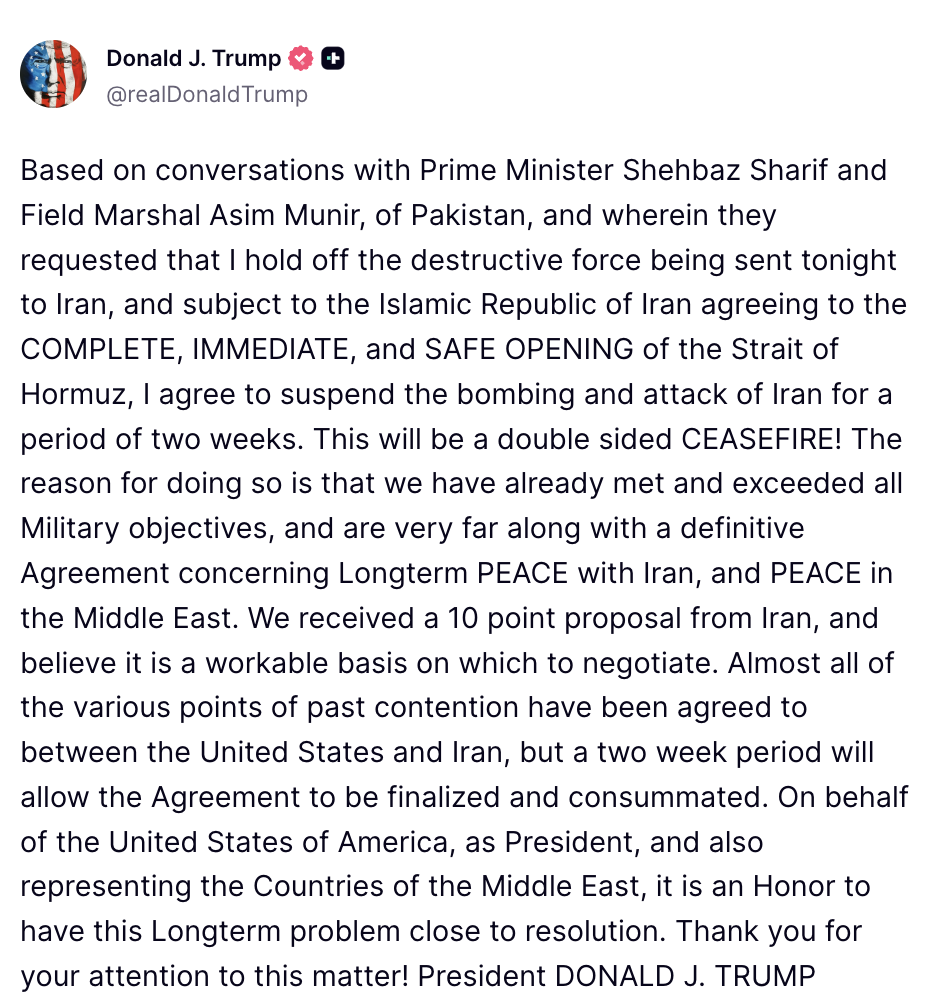
    “I agree to suspend the bombing and attack of Iran for a period of two weeks,” Trump said in a Truth Social post on Tuesday, hours before his deadline for Iran to reopen the Strait of Hormuz or face military attacks on key infrastructure.

    Iran’s Supreme National Security Council also said it accepted the ceasefire.

    Bitcoin (BTC) climbed 2.6% in the hour following the announcement, reaching $72,339 at the time of publication, according to CoinMarketCap.

    Crypto traders have historically seen geopolitical tensions as a headwind for prices, with any hints of easing often triggering quick relief rallies.

    Source: Donald Trump

    The deal also came hours after Trump renewed threats against Iran.

    “A whole civilization will die tonight, never to be brought back again. I don’t want that to happen, but it probably will,” Trump said in a post on Monday.

    The last time Bitcoin traded above $72,000 was March 18, as sentiment continues to drag in the crypto market.

    The Crypto Fear & Greed Index, which measures overall crypto market sentiment, posted an “Extreme Fear” score of 11 on Tuesday, signaling that investors are taking a cautious approach to the crypto market.

    On April 1, Trump said the US could wrap up its military campaign in Iran within weeks, claiming the goal of eliminating Iran’s nuclear capabilities had been achieved.

  • Phone Logs Show Seven Calls Between Milei and LIBRA Backer on Launch Night: Report

    Phone Logs Show Seven Calls Between Milei and LIBRA Backer on Launch Night: Report

    In brief

    • Phone logs show seven calls between Milei and a backer of the LIBRA meme coin on its launch night, according to a New York Times report.
    • WhatsApp messages reference regular payments to Milei from when he was still a congressman.
    • Argentina’s federal criminal probe into the scandal remains open.

    Argentine President Javier Milei’s ties to the collapsed LIBRA meme coin may run deeper than he has acknowledged, with newly surfaced phone logs showing seven calls between Milei and a key figure behind the token on the night of its launch.

    Milei promoted the Solana-based token on X in February 2025, sending its market cap above $4 billion before it crashed over 90% within hours as insiders drained roughly $87 million in liquidity.

    The collapse cost investors an estimated $250 million and triggered fraud charges, a congressional investigation, and a federal criminal probe that remains open.

    By June 2025, Argentina’s anti-corruption office cleared Milei, ruling he acted in a personal capacity when he posted about the token.

    According to a New York Times report citing initial coverage from local cable news channel C5N, the calls in question took place before and after Milei’s now-deleted post endorsing the Solana-based token at the time.

    “The launch and promotion of LIBRA was not at all improvised or accidental on the part of the president,” Maximiliano Ferraro, an opposition lawmaker, told the paper. “It was a planned, coordinated and deliberately executed operation.”

    Behind the scenes

    The phone logs, obtained from the federal prosecutor’s investigation, show the calls took place on the night of February 14, 2025, between Milei and Mauricio Novelli, one of the entrepreneurs behind the token. Novelli also allegedly called two of Milei’s top advisers that evening, including the president’s sister Karina Milei, per the report.

    WhatsApp messages recovered from Novelli’s phone point to a financial relationship way before the token’s launch.

    In one 2023 audio message, Novelli told an assistant to budget “the usual 2,000 for Milei,” calling it a monthly salary, while in a separate April 2024 message he referenced “the 4,000 we need to give to Karina,” in an apparent reference to Milei’s sister, per the Times.

    Draft documents found on Novelli’s phone outlined a $1.5 million payment scheme tied to Milei publicly naming Hayden Davis as a presidential adviser, the report indicates.

    It’s worth noting, however, that no evidence has emerged showing Milei agreed to or received any of the payments. The Argentine president has not publicly commented on the phone logs or payment references, and has not been formally charged in relation to them.

    Novelli’s lawyer, meanwhile, told the Times his client “is entirely unconnected to any wrongdoing” and is seeking to have the phone evidence excluded, arguing the device may have been tampered with in custody.

    If Milei was already cleared, the new evidence could cause them to “go back and re-investigate,” Austin Campbell, founder of crypto risk and compliance advisory firm Zero Knowledge, told Decrypt, while pointing to the difficulties of doing so.

    “Crypto has a deep problem with undisclosed payments, promotions, and outright scams,” Campbell said. “What we badly need is a disclosure regime for such arrangements or payments, with significant civil and criminal penalties for failing to disclose.”

    Milei dissolved the government task force investigating the scandal in May last year. The federal criminal probe under prosecutor Eduardo Taiano remains open.

    Decrypt has reached out to Argentina’s presidential press office for comment and will update this piece should they respond.

    Daily Debrief Newsletter

    Start every day with the top news stories right now, plus original features, a podcast, videos and more.

  • Solana Foundation to Help Secure DeFi Protocols Following $285 Million Drift Hack

    Solana Foundation to Help Secure DeFi Protocols Following $285 Million Drift Hack

    In brief

    • The Solana Foundation launched the STRIDE security program with 24/7 threat monitoring for protocols exceeding $10M total value locked.
    • Protocols with over $100M TVL receive “formal verification” services funded by the Foundation.
    • On April 1, the Solana-based Drift Protocol saw $285 million swiped in an exploit that’s believed to have been planned for months by North Korean hackers.

    Nearly a week after a prominent Solana-based decentralized exchange was hit with a $285 million hack that’s been linked to North Korean hackers, the Solana Foundation has revealed plans to help secure the network’s largest DeFi protocols.

    The Solana Foundation and Asymmetric Research launched STRIDE, a tiered security program that provides 24/7 threat monitoring for DeFi protocols with over $10 million in total value locked (TVL). For protocols with over $100 million TVL, the Foundation will offer “formal verification”—described in a post as “a mathematical, proof-based method that guarantees smart contract correctness by exhaustively checking every possible state and execution path.”

    STRIDE—or Solana Trust, Resilience and Infrastructure for DeFi Enterprises—evaluates protocols against security standards before providing ongoing protection services. The initiative marks a significant escalation in blockchain security infrastructure as attackers target Solana’s growing billions in locked value with increasingly sophisticated methods.

    The program launched alongside the Solana Incident Response Network (SIRN), a membership-based collective of security firms dedicated to rapid ecosystem defense. Founding participants include Asymmetric Research along with OtterSec, Neodyme, Squads, and ZeroShadow. The framework will evolve based on real-world assessment feedback, with version 0.1 currently live.

    The timing underscores an urgent need—Drift Protocol suffered an exploit where attackers drained $285 million in under 12 minutes on April 1, demonstrating the speed and scale at which modern DeFi vulnerabilities can be exploited. Drift said on Sunday that it discovered that North Korean hackers had spent six months infiltrating its team and infrastructure before executing the attack.

    Such incidents highlight why major blockchain networks are taking more direct responsibility for ecosystem-wide security rather than leaving individual protocols to defend themselves.

    The tiered approach based on TVL thresholds reflects how layer-1 networks are institutionalizing security as decentralized finance matures. Rather than treating all protocols equally, STRIDE allocates resources proportionally to risk—acknowledging that protocols managing hundreds of millions of dollars’ worth of assets require different protection than smaller experiments.

    This shift recognizes that individual smart contract audits alone cannot match the innovation pace of adversaries targeting blockchain infrastructure. Rapidly advancing AI is also a key concern, as it can help attackers and developers alike find flaws.

    An upcoming Anthropic AI model codenamed Claude Mythos is being viewed as a particular threat to cybersecurity—so much so that top cybersecurity stock prices fell late last month when first details of the model were leaked. On the other hand, a recently fixed Zcash software exploit was discovered with the help of AI tooling.

    Daily Debrief Newsletter

    Start every day with the top news stories right now, plus original features, a podcast, videos and more.

  • Crypto billionaire to prison: CZ’s autobiography revisits turbulent Binance era

    Crypto billionaire to prison: CZ’s autobiography revisits turbulent Binance era

    Changpeng “CZ” Zhao became a household name in the cryptocurrency sector after founding Binance, the world’s largest crypto exchange. Following a series of legal and regulatory challenges that culminated in a prison sentence, Zhao has authored an autobiography recounting his rise — and subsequent fallout.

    The 364-page manuscript, titled Freedom of Money, presents a first-person account of Zhao’s life and career. The foreword is written by Yi He, a Binance co-founder who has worked with Zhao since 2014.

    Zhao writes that his story has been shaped by media coverage, court filings and public commentary. He describes the book as an account intended to provide additional context to those narratives.

    Throughout the memoir, Zhao emphasizes the human dimension behind Binance’s rapid ascent — and his personal and professional downfall — which he argues has been lost in soundbite-driven coverage.

    The memoir covers his early life and career in finance and technology, as well as the founding of Binance in 2017. It outlines the company’s rapid growth into one of the world’s largest cryptocurrency exchanges.

    Regulatory failures and accountability

    Zhao served a four-month prison sentence in the United States in 2024 after pleading guilty to violating US Anti-Money-Laundering laws, as part of a broader settlement with authorities that also required him to step down as Binance CEO.

    The case marked a major enforcement action by the US Department of Justice, which had initially sought a longer sentence to reflect the severity of the violations. Binance, for its part, agreed to pay billions of dollars in penalties and implement sweeping compliance reforms.

    US regulators had for years scrutinized Binance over alleged failures related to anti-money laundering controls, sanctions compliance and operating without proper licensing. The settlement effectively closed one of the most high-profile investigations in the crypto industry.

    In the memoir, Zhao reflects on the decisions and missteps that led to these outcomes. He recounts the events surrounding the settlement, his guilty plea and his resignation, describing the tradeoffs made during Binance’s rapid growth.

    The book also includes detailed descriptions of his time in federal prison, including the adjustment from leading a global company to living in a confined environment.

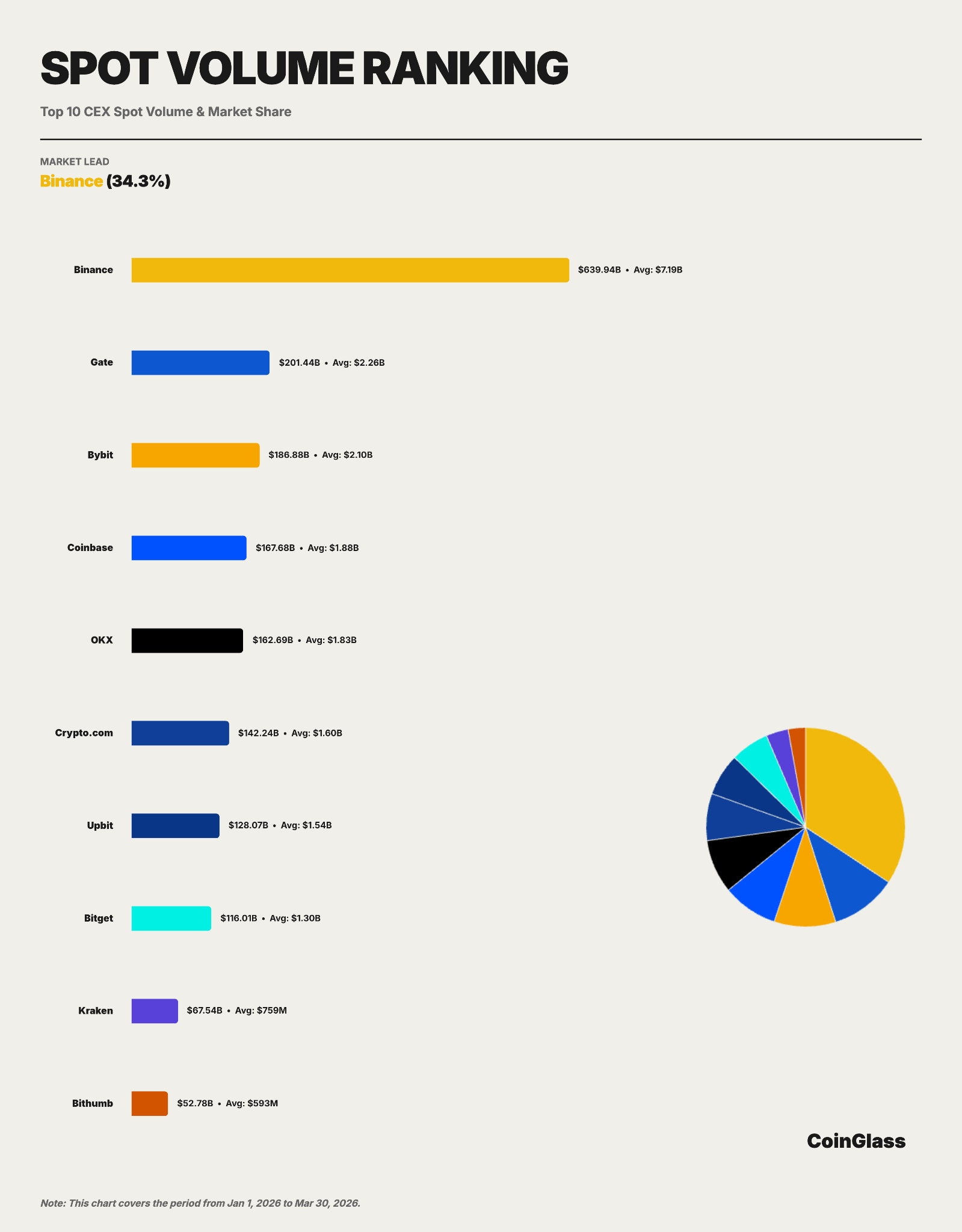
    Binance remains a top venue for crypto access, including derivatives trading, where it ranks first globally in trading volume. Source: CoinGlass

    “Freedom of money”

    The book’s title reflects a central theme of the memoir. Zhao describes the “freedom of money” as the idea that cryptocurrency can address barriers to financial access, particularly in countries with limited banking infrastructure or strict capital controls.

    He links part of Binance’s growth to users in emerging markets who used the platform to move funds across borders, hedge against local currency volatility and access global financial markets.

    Zhao also acknowledges that expanding access at scale introduced challenges. He writes that Binance’s rapid growth often outpaced regulatory frameworks, contributing to gaps in compliance and oversight that later drew scrutiny from authorities.

  • WLFI Price Falls 4% Following Link to Sanctioned Entity

    WLFI Price Falls 4% Following Link to Sanctioned Entity

    • On Tuesday, the World Liberty Financial ($WLFI) price plunged by approximately 4%, forcing its value to fall from $0.099 to $0.096.
    • The drop follows a long consolidation phase in the crypto market, which kept major cryptocurrencies like Bitcoin and Ethereum locked in a tight range,
    • World Liberty Financial has attracted a new controversy due to its partnership with AB DAO, an Asia-based blockchain project.

    On April 7, the World Liberty Financial ($WLFI) price, a DeFi project backed by U.S. President Donald Trump, plunged by over 4% following a downward trend in the overall crypto market.

    According to CoinMarketCap, $WLFI is currently trading at around $0.09590 with a market capitalization of $3.04 billion. The daily trading volume currently stands at around $51.39 million.

    World Liberty Financial ($WLFI) Drops Amid Fresh Controversy

    There are various factors behind the drop in the cryptocurrency, though the main reasons behind the drop in the cryptocurrency price are connected to ongoing investor caution around regulatory scrutiny and the latest reports of token sales linked to sanctioned regions.

    Congressional investigations have raised concerns over foreign stakes, including a reported $500 million with a UAE-affiliated firm and potential connections to high-risk wallets. These issues have created persistent sales pressure even as the project advances its core products.

    At the same time, some experts mentioned treasury asset rotations from wrapped Bitcoin to wrapped Ethereum earlier in the year, which added to short-term supply dynamics.

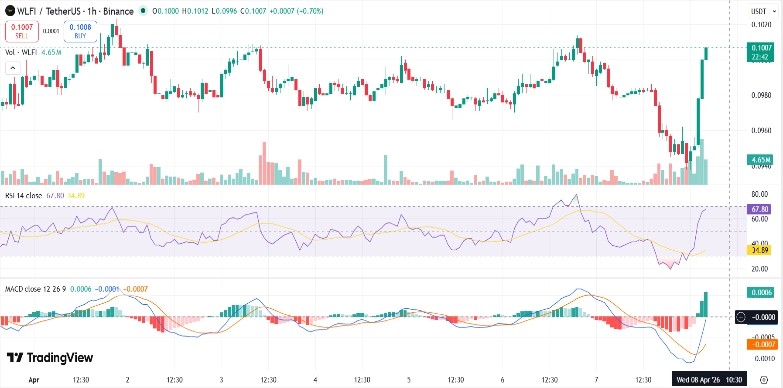
    (Source: TradingView)

    While the overall crypto sector is stuck in the consolidation phase, technical indicators are also suggesting a cautious setup with small bearish signals. The Relative Strength Index on the daily chart revolves around 61, which shows weakening momentum without reaching extreme oversold conditions.

    $WLFI price is well below the 50-day simple moving average, which is expected to act as resistance on any upside attempts. There is immediate support around $0.089 and resistance around $0.100 based on recent important levels. The token is stuck in a wide consolidation range after earlier declines, with lower highs visible on the daily timeframe.

    Bollinger Bands are showing reduced volatility, which generally influences the market through a market catalyst. This shows that $WLFI may test lower support before any sustained recovery if buying volume does not increase.

    There are many macroeconomic factors behind this drop, which is creating the selective pressure on tokens like $WLFI. The overall crypto market has shown mixed performance with many assets facing downward momentum from uncertainty around global interest rate ways and ongoing geopolitical developments. The ongoing war between the U.S. and Iran has created turbulence in the crypto market.

    While Bitcoin has displayed great resilience, many altcoins have witnessed a small drop in their price. This is a clear sign that investors are staying away from volatile assets like crypto.

    Despite the turmoil in the price of cryptocurrency, World Liberty Financial has witnessed steady growth. Recently, World Liberty Financial announced that its USD1 stablecoin now serves as the exclusive settlement asset for real-world asset perpetuals on Aster DEX, which covers commodities such as gold, silver, and crude oil.

    USD-1-denominated perpetual markets have also gone live on Binance Wallet with low fees and incentives designed to boost utility and trading activity.

    World Liberty Financial has come under fresh regulatory scrutiny following its partnership with AB DAO. This Asia-based blockchain project ran a flagship incentive that involved individuals who were later sanctioned by the United States and the United Kingdom over an alleged link to a major fraud network.

    In repose, World Liberty Financial stated that it conducted proper due diligence and has no direct relationship with the sanctioned entities.

  • Bitcoin ETFs Add $471M in Biggest One-Day Haul Since February

    Bitcoin ETFs Add $471M in Biggest One-Day Haul Since February

    In brief

    • Bitcoin ETFs recorded $471 million in inflows Monday, the largest since February.
    • Iran responded to America’s 15-point plan with its own 10-point plan including reopening the Strait of Hormuz with a $2 million per ship fee.
    • Prediction market users on Myriad have optimistically repriced a spike in traffic through the Strait before May, from 43% on April 3 to 68% today.

    Bitcoin ETFs posted their largest single-day inflow since late February as investors positioned ahead of President Trump’s Tuesday-night deadline on Iran.

    The funds added $471.3 million on Monday, led by BlackRock’s IBIT with $181.9 million, followed by Fidelity’s FBTC at $147.3 million and ARKB at $118.8 million, according to SoSoValue data. Every ETF recorded net inflows or held flat, with none seeing outflows.

    The inflows come as Bitcoin trades at around $69,200, down 1% over the past 24 hours and up 3.7% on the week, according to CoinGecko data.

    “Institutional positioning right now looks more like measured accumulation than a binary bet on geopolitics,” Wenny Cai, Founder and CEO of decentralized derivatives exchange SynFutures, told Decrypt.

    This move from institutional investors shows that they’re stepping back in, but through “structured allocation rather than chasing a near-term resolution of the Middle East conflict,” Cai explained.

    The flows follow a flurry of diplomatic activity in the U.S.-Iran conflict.

    Iran delivered a “10-point” response to the U.S. “15-point peace plan,” demanding a permanent end to the war, the lifting of all sanctions, and an end to Israeli strikes in Lebanon. In return, Iran would reopen the Strait of Hormuz but impose a $2 million fee per ship, splitting proceeds with Oman.

    However, negotiators are “pessimistic” Iran will bend to meet Trump’s demand to reopen the strait before his Tuesday-night deadline, The Wall Street Journal reported.

    A strategic adviser to Iran’s parliament speaker struck a defiant tone: “It is Trump who has about 20 hours to either surrender to Iran or his allies will return to the Stone Age,” according to The Kobeissi Letter’s post Tuesday.

    As a result, oil prices have extended gains to $115.50 per barrel, up 110% since December 2025 lows as the reopening of the Strait of Hormuz—a key variable—remains shrouded in uncertainty.

    Users on prediction market Myriad, owned by Decrypt’s parent company Dastan, see a 68% chance that average ships transiting the strait will rise above 15 before May—up from 43% on April 3, reflecting growing but cautious optimism. Nevertheless, Myriad users put an 84% chance on crude oil’s next move taking it to $120.

    For Bitcoin, the path forward hinges on whether diplomatic efforts succeed, Decrypt previously reported, with analysts suggesting a potential retest of $80,000 was possible if the ceasefire talks yield an end to hostilities.

    “If tensions ease, Bitcoin could be one of the first assets to reprice higher, but a sustained bull run will still depend more on global liquidity than geopolitics alone,” Cai said.

    However, Bitcoin’s resilience since the war began on February 29 underscores a shift in its narrative. That, combined with steady ETF demand and macro hedging, could keep Bitcoin supported near current levels, with $70,000 acting more as a test zone than a firm floor, Cai said, tempering optimistic expectations.

    Daily Debrief Newsletter

    Start every day with the top news stories right now, plus original features, a podcast, videos and more.

  • Bitcoin Whale Moves $20M to Binance Amid Broader Selling Pressure

    Bitcoin Whale Moves $20M to Binance Amid Broader Selling Pressure

    In brief

    • A Bitcoin whale moved 300 BTC worth more than $20 million to Binance Tuesday.
    • The transfer could represent a $15 million loss if sold at current prices, though alternative scenarios like OTC deals remain possible
    • Bitcoin currently trades at around $68,300, down 45% from its October 2025 all-time high of $126,080.

    A Bitcoin whale moved roughly 300 BTC worth more than $20 million to a Binance deposit address on Tuesday, according to on-chain data. The transfer marks the latest in a series of large holder movements as Bitcoin trades well below last year’s highs.

    Per Arkham data, the whale’s wallet accumulated just under 513.3 BTC between January and March 2025, during which time Bitcoin traded at an average purchase price of $97,500, according to CoinGecko historical data.

    With Bitcoin currently trading at around $68,300, the transfer represents a potential realized loss of around $15.02 million—though the movement could also indicate an over-the-counter deal, custody rebalancing, or other non-sale activity. The whale retains approximately 200 BTC worth around $13.65 million in their wallet.

    Tuesday’s transfer follows heightened whale activity in recent months. In November last year, a Bitcoin billionaire dumped their entire $1.3 billion stash after 14 years, while just two months later a Satoshi-era whale moved $180 million in BTC to Coinbase.

    Last month, a holder moved 2,100 BTC worth $147.7 million that had remained untouched for over 13 years, while another whale transferred $33 million worth of BTC to Binance during the same period, continuing an unwind of coins acquired in 2013. These movements have coincided with Bitcoin’s retreat from its all-time high of $126,080 recorded in October 2025.

    Bitcoin currently trades almost 46% below those record levels, facing sustained selling pressure as the cryptocurrency market navigates a broader downturn, with Q1 2026 marking the worst quarterly performance for the cryptocurrency since 2018. The accumulation period for Tuesday’s whale—between January and March 2025—coincided with Bitcoin trading around what was then an all-time high, making this holder representative of investors who entered positions during last year’s rally.

    Daily Debrief Newsletter

    Start every day with the top news stories right now, plus original features, a podcast, videos and more.

  • 1inch CEO: Institutions Should Partner with DeFi Infrastructure Instead of Rebuilding It

    1inch CEO: Institutions Should Partner with DeFi Infrastructure Instead of Rebuilding It

    Speaking in an interview at EthCC 2026 in Cannes, France, Kunz said many traditional finance firms are still approaching DeFi in silos, often attempting to rebuild technology that already works well.

    1inch is a DeFi aggregator that routes trades across multiple protocols to find the best possible execution. Its technology is integrated into major Web3 wallets and used by some institutional platforms, including Coinbase.

    Institutions working in silos

    Kunz described 1inch as a hybrid between a search engine for token swaps and a backend infrastructure provider for financial applications. The platform’s routing algorithms identify the most efficient paths for trading between assets, even when direct liquidity is unavailable, while its intent-based protocols enable compliant execution through professional market makers.

    “We are like a search engine for users who want the best execution when swapping assets, and at the same time like an infrastructure layer for developers, businesses and institutions,” he said.

    The model positions 1inch as a foundational layer for both retail and institutional participation in DeFi markets.

    However, Kunz said a lack of coordination continues to slow institutional adoption, with firms often building in isolation rather than collaborating with established protocols.

    “They are working in silos and trying to build what already exists without really discovering who has already done it,” he said. “I would encourage them to partner rather than reinvent the wheel because it is already working very well and is highly efficient.”

    His comments reflect a broader theme at EthCC, where DeFi founders are increasingly positioning their platforms as infrastructure for traditional finance rather than as direct alternatives to it.

    AI to improve integration, not execution

    On the topic of artificial intelligence, Kunz said its most immediate value for 1inch lies in improving developer productivity and integration, rather than enhancing core trading functions. He noted that the platform’s routing algorithms already operate with high efficiency, making AI unnecessary for execution itself.

    Instead, he sees AI playing a useful role in simplifying access to data and accelerating product integration.

    Kunz also expressed caution around deploying AI agents directly within financial products, citing concerns over accountability in a decentralized environment.

    “This reflects the decentralized finance culture. You are responsible for your actions,” he said. “I don’t want to be responsible for your actions. That’s why I’m not sure we will introduce something that decides for users. People need to understand and decide for themselves.”

    His remarks highlight a key tension in DeFi’s evolution: how to balance greater automation and improved user experience with the sector’s core principle of individual responsibility.