Category: Business

  • The crypto honeymoon is over for now as analysts warn of a major first-quarter profit squeeze

    The crypto honeymoon is over for now as analysts warn of a major first-quarter profit squeeze

    Crypto trading has cooled in early 2026, and Wall Street analysts are racing to adjust their forecasts before companies report first-quarter earnings.

    New research from Barclays and Oppenheimer shows multiple analysts are reaching similar conclusions, a few weeks into the second quarter. Expectations are coming down across the sector as trading volumes weaken and earlier projections look too optimistic.

    Barclays took the most direct step, downgrading Coinbase (COIN) and warning that “global crypto trading activity has declined to a level not seen since the end of 2023.” The bank added that “absent a resurgence in near-term crypto trading activity, we see profitability under pressure at Coinbase.”

    The slowdown is visible in the data. Coinbase’s March trading volume marked “the lowest volume month since September 2024,” Barclays wrote, with April showing “no signs of improvement.” For the first quarter, the bank estimates volumes fell roughly 30% from the prior quarter.

    Coinbase and other exchanges charge fees on each transaction they facilitate, meaning lower volumes will lead to less revenue.

    The mechanics are straightforward. When markets turn quiet, many traders step back. A retail user who once traded weekly during a rally may stop altogether when prices flatten. Multiply that behavior across millions of accounts, and exchange volumes drop quickly.

    That matters because transaction fees remain the main revenue driver for most crypto platforms. Barclays underscored this risk, saying its forecast for Coinbase’s adjusted EBITDA is about 24% below the Street, driven largely by weaker spot trading and retail activity.

    Crypto prices have pulled back in the first quarter, with the average price of major tokens falling sharply quarter-over-quarter. Bitcoin lost over 22% of its value in the first quarter of this year, while ether was down 29%.

    Oppenheimer struck a similar tone but kept a more upbeat stance on Coinbase. The firm said it is cutting its forecasts due to softer crypto prices and lower trading activity in the first quarter, driven in part by broader economic uncertainty. It also noted that current Wall Street estimates still do not fully reflect the drop in trading volumes during that period.

    That lag is now being corrected.

    Across the industry, analysts are revising models downward to reflect a quieter market.

    Oppenheimer cut its Coinbase volume estimate to $211 billion for the quarter, down from $244 billion previously, and now expects total revenue of $1.48 billion, below prior forecasts and consensus.

    The reset is not limited to Coinbase. Oppenheimer said that Circle (CRCL) continues to expand the $USDC stablecoin network, with stablecoin market cap and $USDC transfer volume rising about 1% and 12% quarter over quarter, respectively.

    Crypto platform Bullish (BLSH), the owner of CoinDesk, saw “strong on platform activity” tied to volatility in February, though spot volumes still missed expectations. As a result, Rosenblatt downgraded BLSH earlier this week while Compass Point downgraded CRCL — to “neutral” and “sell,” respectively.

    Even these pockets of strength highlight the broader issue: the core business of crypto trading is slowing.

    Efforts to diversify revenue streams are underway but may take time to offset the downturn. Coinbase’s push into becoming what it calls an “everything exchange” includes derivatives, tokenized assets and new markets. Barclays was skeptical, writing that the strategy is “likely to take a long time to pay off” and that it sees “little ‘right to win’ in new asset classes like equities.”

    Stablecoins, often seen as a steadier revenue stream, also face uncertainty. Barclays pointed to ongoing debate in Washington over regulation, noting that the status of stablecoin rewards “remains in question.” At the same time, Oppenheimer sees near-term support from new use cases, saying “increased prediction market activity could support $USDC growth.”

    Still, those areas remain secondary to trading.

    The broader takeaway is that analysts are moving preemptively. With earnings season approaching, firms are lowering estimates now rather than risk being caught off guard by weak results later.

    Coinbase reports second-quarter earnings on May 7 and Bullish reports on April 23. Circle has not yet announced a date.

  • Iran and the U.S. Have Begun Peace Talks in Pakistan: Here’s the Latest – Trump Also Spoke

    After a long period of indirect contacts between the US and Iran, the two sides sat down at the negotiating table for the first time.

    A US delegation led by JD Vance reportedly held face-to-face meetings with Iranian officials in Pakistan. According to sources, both sides also contacted the Pakistani Prime Minister separately prior to the meetings.

    The talks are described as a high-risk diplomatic process, and it was noted that previous contacts were largely conducted through intermediaries. In this respect, the shift to a direct negotiation format is interpreted as a significant turning point.

    US President Donald Trump made a noteworthy statement, saying that the process of “cleaning up” the Strait of Hormuz, which is critically important for global energy trade, has been initiated. However, it is not yet clear how this statement will be reflected on the ground.

    On the other hand, diplomatic activity in the region is not limited to the US-Iran axis. Lebanese and Israeli diplomats are scheduled to meet in Washington DC next week. Despite the US-Iran ceasefire, the ongoing clashes between Israel and Hezbollah indicate that tensions in the region persist.

    Related News Will Iran Really Accept Bitcoin for Passages Through the Strait of Hormuz?

    Intelligence sources claim that China is preparing to send new air defense systems to Iran. However, the Chinese Embassy in Washington has denied these claims. This development could create a new source of tension in the fragile ceasefire environment.

    According to reports in Iranian media, the talks in Islamabad have progressed to the technical details stage. Tasnim News Agency reported that the parties are conducting in-depth negotiations on specific topics at the expert level. While initially planned to last one day, the talks may be extended due to the scope of the technical issues being discussed.

    Pakistani sources stated that the first round of talks lasted approximately two hours before the parties took a break. US officials added that they have not yet received any threats from Iran against the ships.

    President Trump, in his statement regarding the day’s developments, avoided making a clear assessment of the progress of the negotiations. Confirming that the talks had officially begun, Trump said that regarding Iran’s sincerity, “we will understand very soon.” Trump also stated that the US was “ready to restart” negotiations if the process took a negative turn.

    *This is not investment advice.

  • VVV eyes ATH with 17% surge – What’s driving this rally?

    VVV eyes ATH with 17% surge – What’s driving this rally?

    Vince Token [$VVV] has delivered one of its strongest performances in recent sessions, surging 17% in the early hours of trading.

    This sharp upswing reflects building momentum, with market conditions aligning for a possible extension toward new highs.

    Capital inflows reinforce bullish conviction

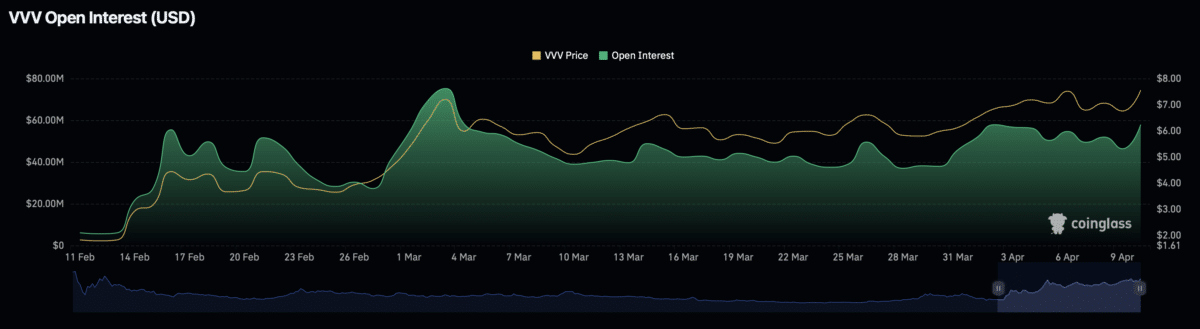
    The clearest driver behind this move is the surge in activity within the $VVV perpetual market.

    At the time of writing, capital inflows have climbed significantly. Data from CoinGlass showed inflows reaching $59.84 million, while Funding Rates remained firmly tilted toward long positions.

    Funding Rates have risen to 0.0085%, indicating that traders were increasingly willing to pay a premium to maintain long exposure. This reflected growing confidence in continued upside.

    Source: CoinGlass

    At the same time, short traders have faced mounting pressure. Liquidation data revealed a clear imbalance, with bearish positions absorbing the bulk of losses.

    Over the past 24 hours, long liquidations have remained minimal at $28,000, while short liquidations have surged to $215,000. This disparity highlighted aggressive short squeezes, further fueling upward price movement.

    Momentum indicators favor continued upside

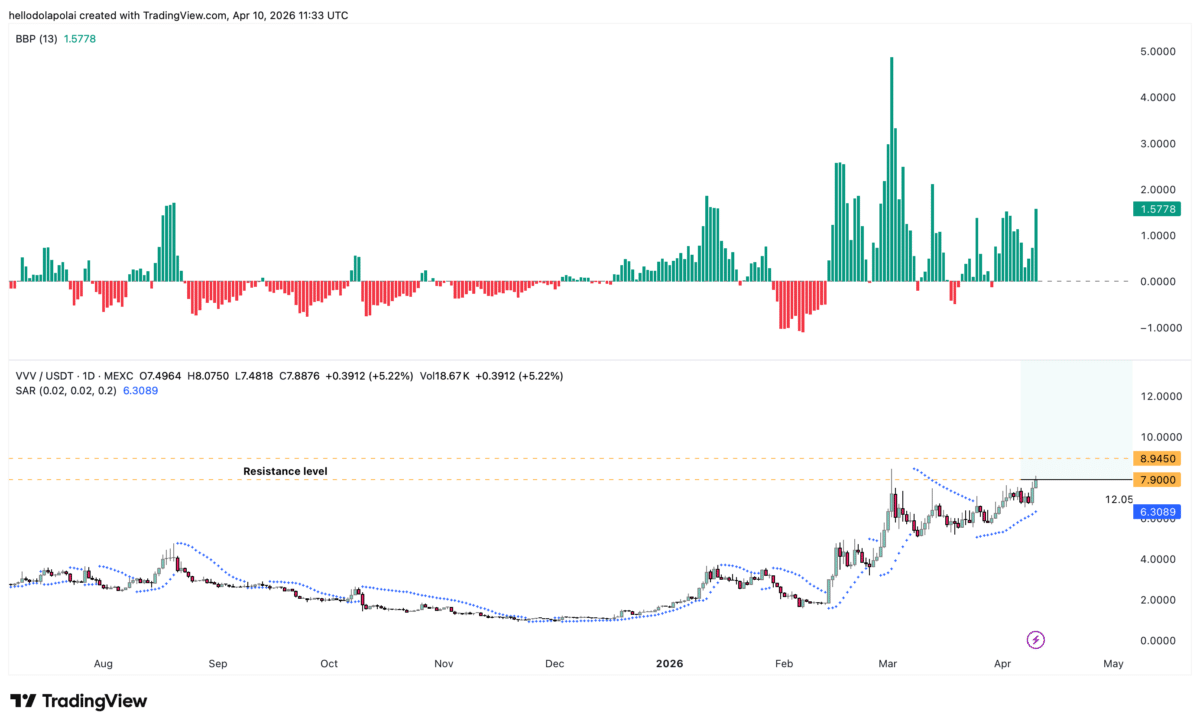
    Technical indicators have continued to align with $VVV’s bullish structure. The Bull Bear Power (BBP) confirmed that buyers remained in control of the market.

    The indicator, which tracks the dominance of bulls versus bears over a set period, showed a sustained green histogram on the daily timeframe at press time, signaling consistent buying pressure.

    Notably, BBP has returned to levels last seen on the 13th of March, reinforcing the view that demand has strengthened meaningfully. The persistence of this trend suggests that buyers remain active and committed.

    Source: CoinGlass

    The Parabolic SAR (Stop and Reverse) further supports this outlook. Its dots remain positioned below the current price, a classic indication of an active uptrend and strengthening momentum.

    With no visible signs of exhaustion among buyers, the structure remains firmly bullish, leaving room for further expansion.

    All-time high back in focus for $VVV

    Given the current trajectory, a move toward a new all-time high is increasingly within reach.

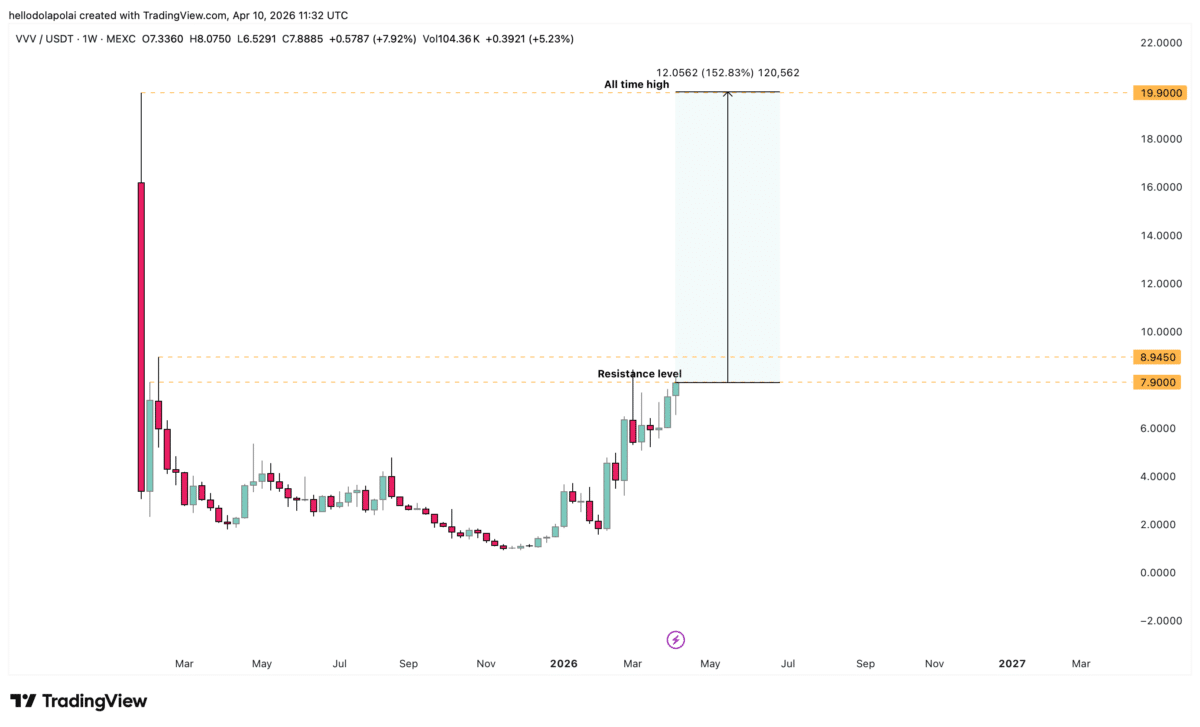
    Price action shows little resistance between current levels and a broader breakout zone, suggesting that $VVV could transition into price discovery if momentum holds.

    Source: TradingView

    If the asset maintains its pattern of higher highs and higher lows, a 152% upside move appears achievable, bringing it back to its previous all-time high of $19.9.

    A sustained push beyond that level would confirm a full breakout, placing $VVV in a position to establish a new all-time high.

    Final Summary

    • $VVV’s move is strongly supported by perpetual traders, with rising capital inflows and positive funding rates reinforcing a bullish long-term outlook.
    • Technical indicators point to sustained upside, with $VVV showing a clear structure that favors a continued rally and a potential breakout.
  • Crypto Expert Predicts A New XRP All-Time High Is In Sight As These 3 Technicals Align

    Crypto Expert Predicts A New XRP All-Time High Is In Sight As These 3 Technicals Align

    A crypto market expert has just projected that the $XRP price could explode to a new all-time high this cycle. Lately, the cryptocurrency has shown significant weakness amid a prolonged downtrend that began when it broke above $3.5 last year. Despite crashing more than 60% from that high today, the analyst argues that $XRP’s corrective phase may have ended, citing three technical indicators that support his bullish thesis.

    Aligned Technical Indicators Confirm $XRP Price Bottom

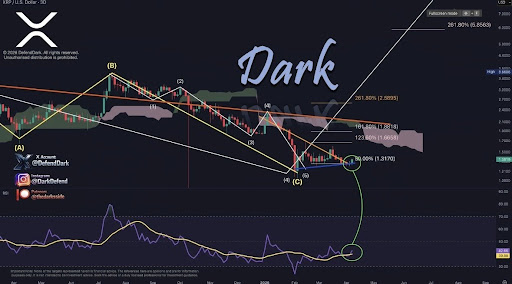
    Crypto analyst Dark Defender has released a new analysis suggesting that $XRP may have found a bottom and is poised to reverse its downtrend toward a new all-time high. He points to three technical signals, including a confirmed completion of $XRP’s corrective wave C structure, a triangle breakout, and a Relative Strength Index (RSI) bullish cross.

    In his analysis, Dark Defender presented an Elliott Wave chart of $XRP on a three-day timeframe, covering roughly April 2025 through a projected target period extending into mid-to-late 2026. The chart maps out a completed ABC corrective pattern, beginning with wave A, which marked an initial high for $XRP before a sharp sell-off followed. Wave B then unfolded as a strong recovery rally, pushing $XRP’s price up to its $3.6 peak in 2025 before reversing once again and setting the stage for wave C.

    Source: Chart from Dark Defender on X

    According to the chart, wave C represents the final and most significant phase of the $XRP correction. It is shown as a classic five-subwave impulse decline that has now fully played out. Within this structure, the fifth sub-wave recently completed near $1.31, marking $XRP’s potential bottom and the end of the five-wave sequence. As a result, the completion of wave C is a key turning point, suggesting that $XRP’s prolonged bearish move from the wave B peak may be over, potentially giving way to a new bullish impulse.

    In addition, the chart shows that the ABC corrective wave formed between two converging trendlines, creating what Dark Defender called a “resistance-support triangle.” Apparently, the $XRP price had compressed inside this bearish triangle throughout its corrective phase. The upper resistance trendline of this triangle, shown in orange, served as a strong barrier for a long time. However, Dark Defender notes that $XRP has now broken above this resistance line, signaling the end of its compression phase and the potential beginning of a new uptrend.

    Next Move Points To Strong Rally Toward New ATH

    While the orange resistance trendline capped price action before $XRP’s recent breakout, the yellow support line on Dark Defender’s chart served as a strong base, repeatedly preventing the price from breaking lower. Each successful defense of this support helped establish a firmer bottom, a move that coincided with the RSI forming a bullish crossover at deeply oversold levels.

    Looking ahead, Dark Defender outlines four potential upside targets for $XRP’s next bullish impulse wave. The first target sits at the 123.6% extension near $1.66, representing a roughly 27% gain from current levels above $1.30. The next level lies at the 161.8% extension around $1.88 before the final resistance at $2.58.

    For his all-time high target, Dark Defender projects a move toward the 261.08% extension at $5.85. A price rally to this level could represent a staggering surge of more than 350% from $XRP’s present market value.

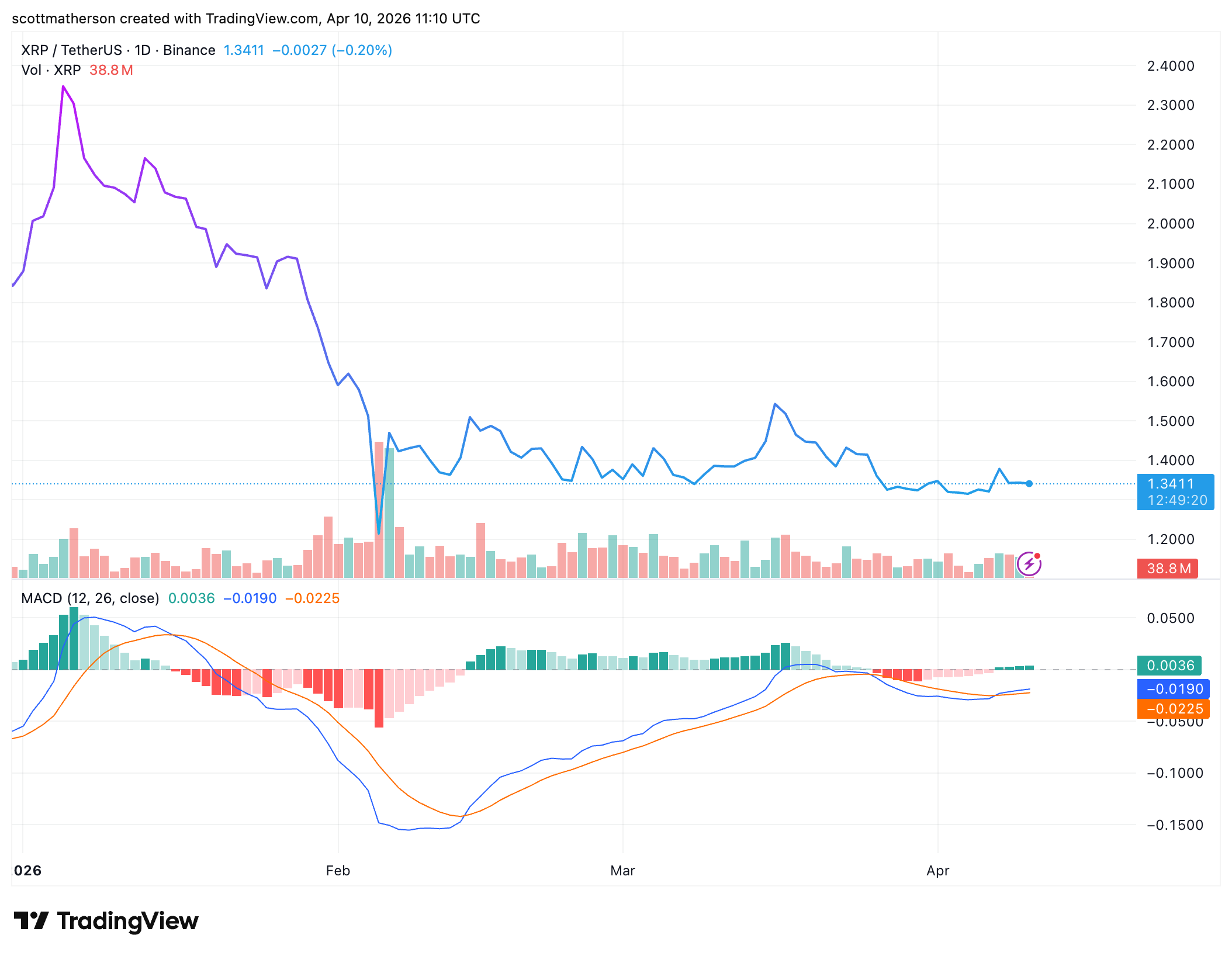
    $XRP trading at $1.34 on the 1D chart | Source: XRPUSDT on Tradingview.com
  • SIREN price prediction – After 300% rally, is a 150% price hike up next?

    SIREN price prediction – After 300% rally, is a 150% price hike up next?

    Siren [$SIREN] rallied by 17% in 24 hours and was up nearly 300% over the past week. This extraordinary performance in the short term has captured the attention of traders and investors once again.

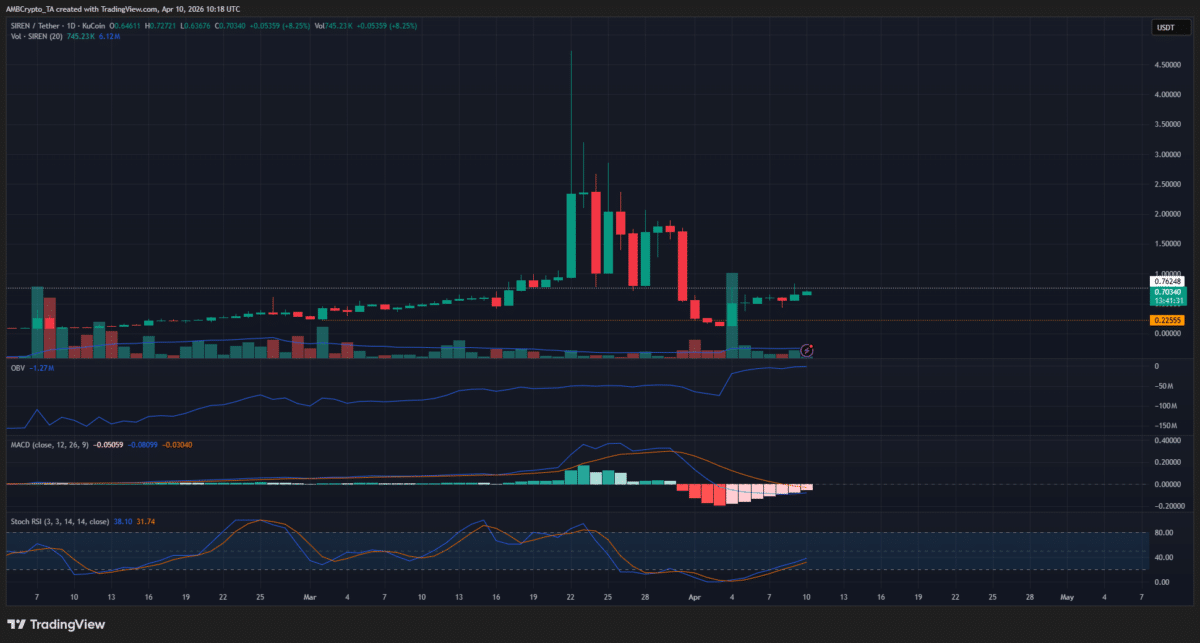
    In the second half of March, the memecoin burst past the $0.76 resistance and briefly ascended past the $4-level. However, it has retraced this rally since then.

    Source: $SIREN/$USDT on TradingView

    The major rally and the deep retracement since then must have rocked investor confidence. Based on the 1-day chart’s price action, it can be argued that the move below the swing low at $0.225 earlier this month has shifted the structure bearishly.

    On the other hand, the volume on 4 April was the highest daily volume since 7 February. It was a statement of intent from the buyers as they rescued $SIREN’s price from falling even further below the $0.225 swing low.

    The OBV made new highs following this spike in demand, with the Stochastic RSI climbing back from the bearish extreme and heading higher. The MACD also seemed to be laboring to climb back above the zero line.

    Which way should $SIREN traders form their bias?

    The recent momentum and buying volume were a fantastic recovery from the extremely deep retracement. At the same time, the retracement in question might have been a structural shift.

    Based on the evidence at hand, the latter scenario appeared more likely. Given the market sentiment and potential for a Bitcoin [BTC] sell-off, traders should be prepared to take profits at key resistance levels.

    Source: $SIREN/$USDT on TradingView

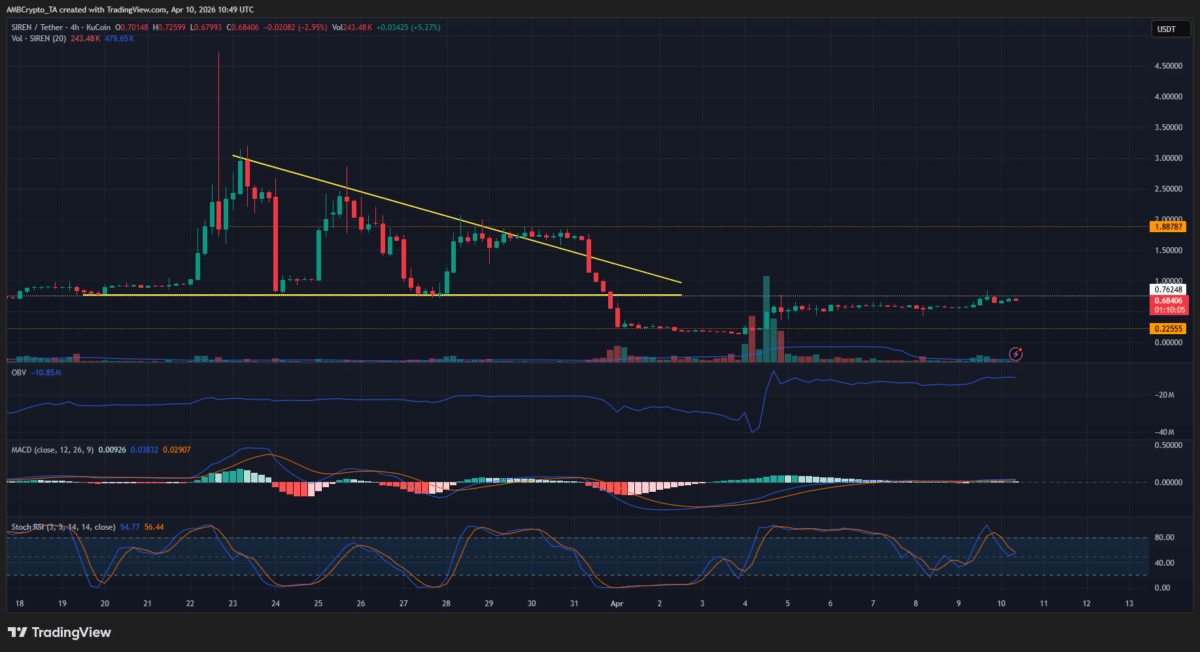
    The triangle formation in March saw a bearish breakdown, but the consolidation around $1.88 affected the pattern’s reliability. Some analysts would see the pattern is broken and invalidated too.

    What matters is the sentiment the pattern is trying to capture. The willingness among sellers to force prices lower after increasingly shallow bounces after 23 March is the highlight.

    Now, the $0.762-level is under siege once more. A breakout beyond this level will likely see $SIREN rally to $1.88. These are the two levels that holders and traders can use to take profits.

    Final Summary

    • $SIREN has rallied by nearly 300% in a week, recovering from the drop below the $0.2255 swing low.
    • Current move would likely see a breakout to $1.88, but traders and holders should remember to take profits.
  • Cardano In Danger Zone? Trader Drops ‘Time Bomb’ Claim

    Cardano In Danger Zone? Trader Drops ‘Time Bomb’ Claim

    Cardano’s short sellers are taking a beating. Over the past 24 hours, over $500,000 worth of short positions were liquidated as $ADA hovered near $0.25 — a price point that one unnamed trader is calling a powder keg ready to blow.

    Whale Activity Signals Quiet Accumulation

    Exchange data tells a quiet story of confidence beneath the surface. More $ADA has been flowing out of exchanges than flowing in, a pattern that often shows up when large holders are pulling coins into private wallets rather than preparing to sell.

    Whale accumulation has picked up as well. Reports indicate the number of wallets holding 10 million or more $ADA recently climbed to a four-month high, even as the price continued sliding.

    The liquidation data reflects the same tension. Of the $637,500 in total $ADA positions wiped out in the past day, shorts accounted for nearly 80% of the damage. Long positions absorbed the rest — about $135,200 — as buyers got caught on the wrong side of brief downward swings.

    BREAKING:

    CARDANO ( $ADA ) IS A TICKING TIME BOMB SAYS EXPERT TRADER 🤯🤯🤯

    The target is 1.20$ end of this week.

    In his words “there’s nowhere left for it to go this week it will either go up or go down.” pic.twitter.com/Sg8yef818a

    — 🪏Mintern (@MinswapIntern) April 9, 2026

    A Chart Four Years In The Making

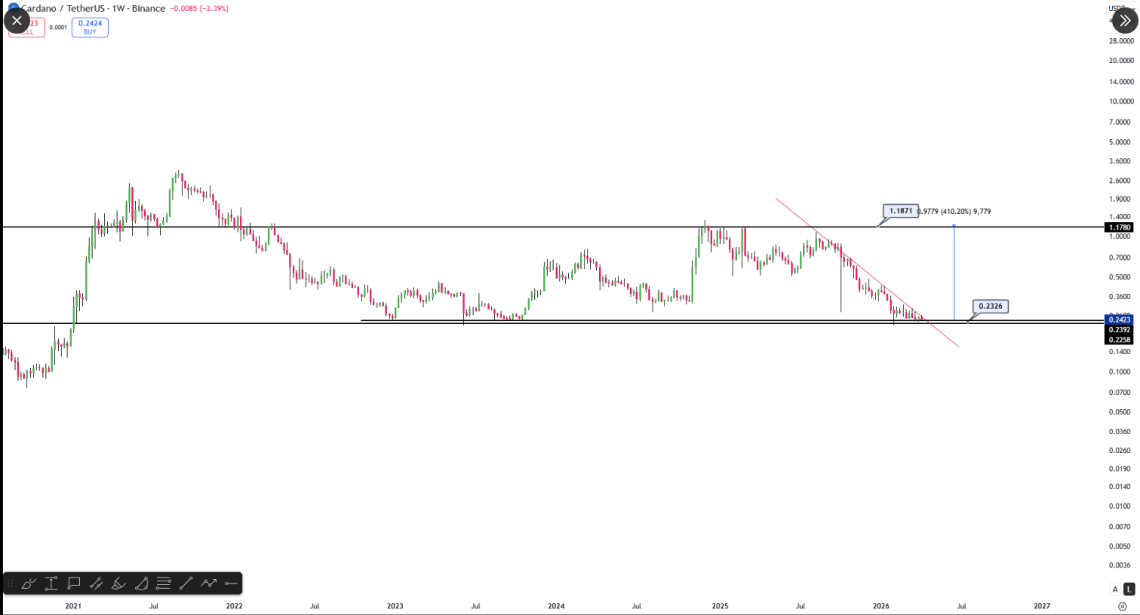
    The technical case for a breakout rests on a structure that has been building since early 2022. Based on a chart shared by Minswap DEX’s self-described chief meme officer Mintern on X, $ADA has been trading inside a horizontal price channel for roughly four years, bouncing between a ceiling and a floor without breaking decisively in either direction.

    $ADA’s all-time high of $3.10 came in 2021. After that peak, the coin dropped sharply. By the week of January 17, 2022, it had fallen from $1.60 to below $0.91, before eventually settling near the top of the channel around $1.18.

    That range — from roughly $0.23 on the low end to $1.18 on the high end — has contained price action ever since.

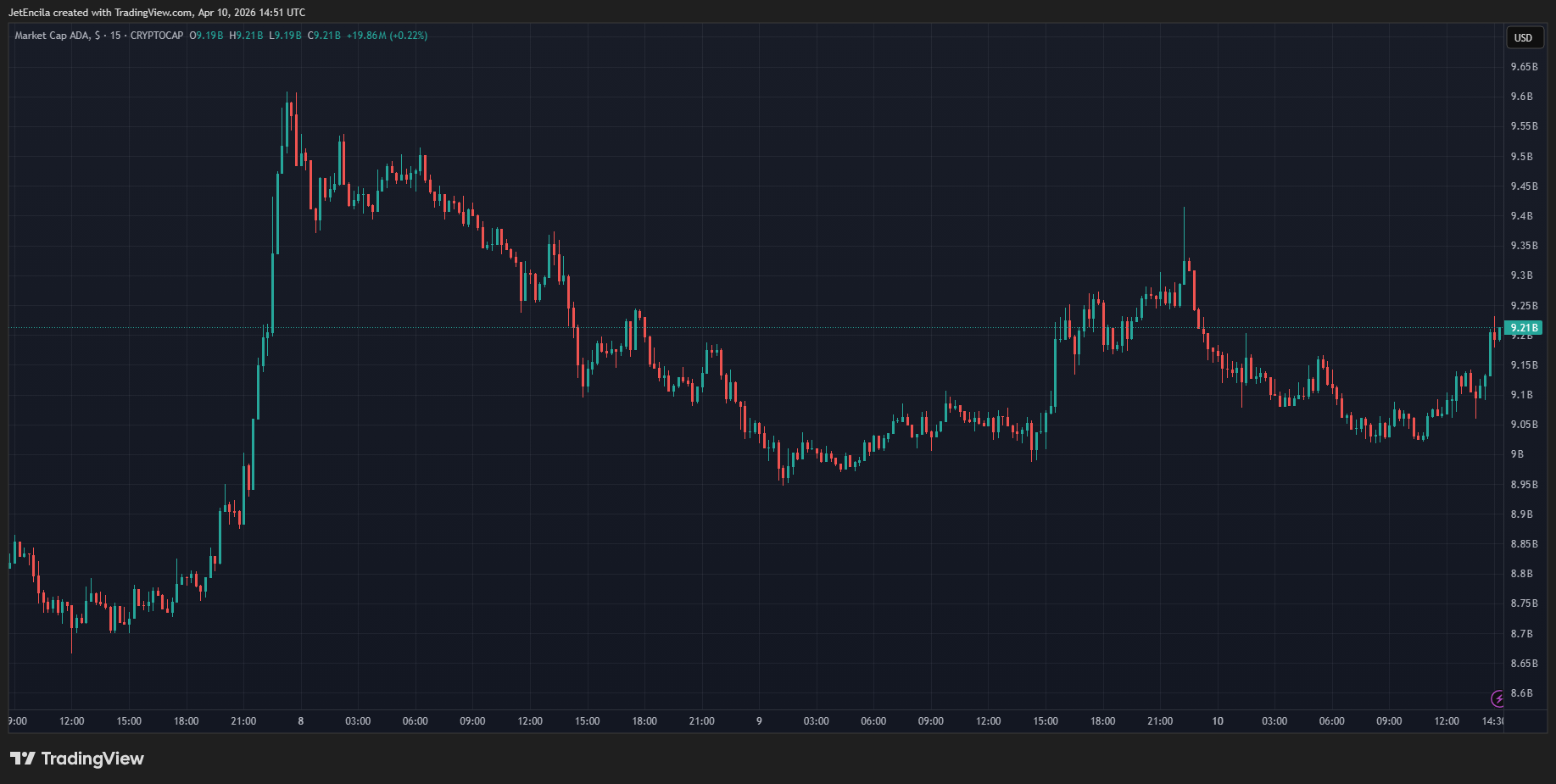
    $ADA market cap currently at $9.21 billion. Chart: TradingView

    A descending trendline developed inside the channel starting around August 2025, when $ADA peaked near $1.02 and then began forming a series of lower highs.

    Today, the price sits where that trendline meets the channel’s lower boundary — a compression point that typically forces a decisive move.

    The unnamed trader’s analysis calls for a breakout to the upside with a price target near $1.20 before the week ends. That would represent a roughly 380% gain from current levels in less than two days.

    A Bold Call From An Unknown Voice

    Still, the prediction carries real weight only if its source does — and that source remains unknown. The trader behind the “ticking time bomb” call was never identified in the analysis Mintern shared, which raises obvious questions about credibility, track record, and motive.

    A 380% rally in under 48 hours is an extraordinary claim. Extraordinary claims demand more than an anonymous chart.

    Featured image from Meta, chart from TradingView

  • Powell, Bessent Warn Banks About Security Risks From Anthropic’s Mythos AI: Bloomberg

    Powell, Bessent Warn Banks About Security Risks From Anthropic’s Mythos AI: Bloomberg

    In brief

    • U.S. officials warned major banks about cybersecurity risks tied to Anthropic’s Mythos AI model, Bloomberg reports.
    • The system can reportedly identify and exploit vulnerabilities in operating systems and browsers.
    • Anthropic has limited access to the model while it evaluates potential security risks.

    U.S. Treasury Secretary Scott Bessent and Federal Reserve Chair Jerome Powell reportedly convened a meeting with Wall Street bank CEOs earlier this week to warn about cybersecurity risks tied to a new artificial intelligence model from Anthropic.

    According to a report by Bloomberg, the meeting included executives from Citigroup, Bank of America, Wells Fargo, Morgan Stanley, and Goldman Sachs. Officials discussed Anthropic’s new AI model Mythos, which has recently drawn broad concern over its apparent advanced cybersecurity capabilities.

    Officials convened the meeting to ensure banks understand the risks posed by systems capable of identifying and exploiting software vulnerabilities across operating systems and web browsers, and to encourage institutions to strengthen defenses against potential AI-assisted cyberattacks targeting financial infrastructure.

    Security researchers have warned that tools capable of automatically discovering vulnerabilities could accelerate both defensive security work and malicious hacking if misused.

    Anthropic’s Mythos model first surfaced online in March after draft materials about the system leaked online, revealing what the company described as its most capable AI model yet. In testing, the system reportedly found thousands of previously unknown software vulnerabilities, including zero-day flaws across major operating systems and web browsers.

    Anthropic researchers said in a report earlier this week that Mythos Preview’s vulnerability-discovery capabilities were not intentionally trained, but instead emerged from broader improvements in the model’s coding, reasoning, and autonomy.

    “The same improvements that make the model substantially more effective at patching vulnerabilities also make it substantially more effective at exploiting them,” the firm wrote.

    Because of those capabilities, Anthropic has restricted access to a small group of cybersecurity organizations.

    “Given the strength of its capabilities, we’re being deliberate about how we release it,” Anthropic said in a statement. “As is standard practice across the industry, we’re working with a small group of early access customers to test the model. We consider this model a step change and the most capable we’ve built to date.”

    To address that risk, Anthropic is testing Mythos through Project Glasswing, a collaboration with major technology and cybersecurity companies that uses the model to identify and patch vulnerabilities in critical software before attackers can exploit them.

    “Project Glasswing is a starting point. No one organization can solve these cybersecurity problems alone,” the company said in a statement. “Frontier AI developers, other software companies, security researchers, open-source maintainers, and governments across the world all have essential roles to play.”

    Anthropic did not immediately respond to Decrypt’s request for comment.

    Daily Debrief Newsletter

    Start every day with the top news stories right now, plus original features, a podcast, videos and more.

  • Exodus Rolls Out ‘Exodus Pay’ to Turn Bitcoin Wallet Into Spending App

    Exodus Rolls Out ‘Exodus Pay’ to Turn Bitcoin Wallet Into Spending App

    In brief

    • Exodus launches Exodus Pay, a feature that lets users spend crypto directly from its wallet app.
    • The rollout is limited to five U.S. states, including New York and California.
    • The company says the feature aims to reduce reliance on third-party payment platforms.

    Exodus, the publicly traded crypto wallet provider, began rolling out a new “Exodus Pay” feature on Wednesday, aiming to turn its self-custodial storage app into a tool for everyday payments. The launch is currently limited to users in five states, including New York and California.

    The Omaha-based firm listed its stock on the New York Stock Exchange in 2024 and says the new feature expands the role of its wallet beyond storage into payments. The company positions the service as an alternative to centralized payment apps.

    “Most payment apps are third parties that hold your funds for you,” Exodus co-founder and CEO JP Richardson told Decrypt. “That means they can freeze your account, reverse transactions, and decide what you’re allowed to buy.” Exodus, by contrast, can’t do that, because users remain in control of their funds at all times.

    The company says Exodus Pay works within the existing wallet app and allows users to spend USD-backed stablecoins, such as USDC, or Bitcoin at merchants that accept Visa or Apple Pay.

    “The problem with self-custody until now has been the friction. Seed phrases, complicated networks—most self-custody consumer experiences aren’t built for someone who just wants to pay for groceries or send friends money,” Richardson said.

    To encourage adoption, Exodus says it will subsidize network fees and allow transfers using phone numbers. The service remains geographically limited due to regulatory requirements. It is currently available only in Nebraska, Texas, Florida, New York, and California.

    Richardson said the company has focused on simplifying the user experience, claiming that “someone with zero crypto experience should be able to use an app intuitively.”

    Exodus joins a growing list of crypto wallet developers that let customers pay for purchases using crypto or stablecoins, including Coinbase, BitPay, and PayPal.

    After the initial launch, Richardson said the company plans to expand the service nationwide over the next several weeks.

    “By mid-April, everyone in America will have Exodus Pay in their app,” Richardson said. For existing users, the feature will appear as an automatic update rather than a new download. “If you already have Exodus, you’ll have Exodus Pay,” he added.

    Daily Debrief Newsletter

    Start every day with the top news stories right now, plus original features, a podcast, videos and more.

  • Lummis on Major Crypto Bill: ‘This Is Our Last Chance’

    Lummis on Major Crypto Bill: ‘This Is Our Last Chance’

    The high-stakes legislative battle over the future of cryptocurrency regulation in the United States has reached a critical inflection point.

    Senator Cynthia Lummis has issued a stark warning to Congress: act now, or risk a multi-year regulatory freeze.

    “This is our last chance to pass the Clarity Act until at least 2030,” Senator Lummis stressed on X (formerly Twitter). “We can’t afford to surrender America’s financial future.”

    A major push

    Treasury Secretary Scott Bessent recently urged the Senate Banking Committee to immediately hold a markup and send the legislation to the President’s desk. Bessent emphasized that Congress has spent half a decade trying to establish a framework to onshore the future of finance, noting that “Senate time is precious, and now is the time to act.”

    Bessent’s plea has received the backing of Coinbase CEO Brian Armstrong. This indicates that the bitter legislative standoff holding up the bill may finally be resolved.

    “We agree. Thank you @SecScottBessent for saying it,” Armstrong posted in response to the Treasury Secretary. “It’s time to pass the Clarity Act. Grateful for all the bipartisan work among Senators and staff over the past several months to make this a strong bill.”

    White House warnings pay off

    As reported by U.Today, top White House crypto advisor Patrick Witt recently issued a severe warning to those attempting to block the bill over regulatory concessions like stablecoin rewards.

    Witt cautioned that obstructing the current bipartisan compromise could leave the entire digital asset sector vulnerable to a much harsher regulatory crackdown if a future administration were to take a hostile stance against decentralized finance (DeFi), developer protections, and the classification of digital commodities.

  • Bitcoin Price Above $73,000: What’s the Next Target Level? German Analysis Firm Explains

    Bitcoin Price Above $73,000: What’s the Next Target Level? German Analysis Firm Explains

    Cryptocurrency analysis company MakroVision has shared its latest assessment of Bitcoin’s technical outlook. According to the company’s analysis, $BTC has reached a high-liquidity zone concentrated around the $73,000 level, bringing back the attempt to break above its current sideways movement.

    This development is said to signal the beginning of a more critical and exciting period for the market in the short term.

    MakroVision pointed out that the $73,000 to $75,000 range is a key resistance zone for Bitcoin. This level is not only a strong technical barrier but also crucial for price movements due to its high liquidity. According to the analysis, a strong and clear breakout above this zone could significantly turn the short-term outlook positive and pave the way for the price to move to higher levels.

    Related News Bitcoin Billionaire Arthur Hayes Reveals His Two Favorite Altcoins and Shares the Only Condition for a $BTC Rally

    On the other hand, in downward scenarios, the $69,000 level was noted as a significant short-term support point. If this level is lost, the $64,000 to $61,000 range emerges as a stronger and more critical support zone. It is particularly considered that in the event of a failed breakout attempt, the price could be drawn back to this broad support band.

    Looking at the overall market structure, it was noted that Bitcoin is still trading within a wide horizontal band, but is approaching the upper limit of this band again. The fact that the current upward move is occurring towards the liquidity zone indicates that the market is approaching a decision point. According to the analysis, if an upward breakout occurs this time, the recovery could gain momentum. However, in the event of a possible rejection, Bitcoin is expected to continue its current horizontal movement for some time.

    *This is not investment advice.