Category: Business

  • UK Raids Addresses Involved in Unregistered Cryptocurrency Activity! Here Are the Details

    UK Raids Addresses Involved in Unregistered Cryptocurrency Activity! Here Are the Details

    As oversight of the cryptocurrency market in the UK tightens, the Financial Transactions Authority (FCA) has carried out its first comprehensive operation against illicit peer-to-peer (P2P) crypto transactions. The agency announced that it conducted joint raids targeting eight different locations across London.

    The FCA conducted the operation in conjunction with HM Revenue & Customs and the South West Regional Organized Crime Unit. Inspections at suspected addresses uncovered evidence of illegal activity, and official warnings were issued to the individuals and businesses involved to cease their operations. The collected evidence reportedly supports several ongoing criminal investigations.

    Peer-to-peer crypto trading involves users trading directly with each other instead of through a centralized exchange. However, according to the FCA, registration is required for such activities to be legally conducted. The agency emphasized that there are currently no registered P2P crypto trading platforms or individual providers in the United Kingdom.

    Steve Smart, an FCA official, stated that individuals operating off the books are engaging in illegal activities and increasing the risk of financial crime. Similarly, law enforcement officials have pointed out that such operations can be used for money laundering and illicit fund transfers.

    Experts say this step is part of the FCA’s strategy to expand cryptocurrency oversight. While comprehensive crypto regulations are expected to come into effect in the country by 2027, existing rules, particularly anti-money laundering obligations, are already in place.

    *This is not investment advice.

  • Anthropic’s Claude Mythos AI Finds 271 Vulnerabilities in Firefox—Yes, It’s Seriously Powerful

    Anthropic’s Claude Mythos AI Finds 271 Vulnerabilities in Firefox—Yes, It’s Seriously Powerful

    In brief

    • Mozilla says Anthropic’s Claude Mythos identified 271 vulnerabilities in Firefox during testing.
    • Anthropic is restricting the model to vetted partners through Project Glasswing because of cybersecurity risks.
    • Researchers warn that the same capability could accelerate automated cyberattacks.

    For decades, attackers have had the advantage in cybersecurity. Artificial intelligence may be about to change that.

    In a blog post published on Tuesday, Firefox browser developer Mozilla said an early version of Anthropic’s Claude Mythos AI—which has drawn attention in recent weeks for its purported cybersecurity prowess—model helped identify 271 vulnerabilities in the browser during internal testing. Those bugs were patched this week.

    The results highlight how advanced AI systems can analyze large codebases and locate weaknesses that previously required extensive manual review by human cybersecurity researchers.

    “As these capabilities reach the hands of more defenders, many other teams are now experiencing the same vertigo we did when the findings first came into focus,” Mozilla wrote. “For a hardened target, just one such bug would have been red-alert in 2025, and so many at once makes you stop to wonder whether it’s even possible to keep up.”

    Mozilla had earlier tested another Anthropic model that identified 22 security-sensitive bugs in a previous Firefox release. Despite these successes, Mozilla acknowledged that the cybersecurity industry has long treated the complete elimination of software exploits as an “unrealistic goal.”

    “Until now, the industry has largely fought security to a draw,” the company wrote. “Vendors of critical internet-exposed software like Firefox take security extremely seriously and have teams of people who get out of bed every morning thinking about how to keep users safe.”

    Mozilla said the new AI system can analyze source code and identify vulnerabilities in ways that previously depended on scarce human expertise. However, Mozilla said the company was encouraged to see that no bugs were found that couldn’t have been discovered by “an elite human researcher.”

    “Some commentators predict that future AI models will unearth entirely new forms of vulnerabilities that defy our current comprehension, but we don’t think so,” they said. “Software like Firefox is designed in a modular way for humans to be able to reason about its correctness. It is complex, but not arbitrarily complex.”

    The results, however, suggest AI tools could allow developers to uncover large numbers of vulnerabilities before attackers exploit them—though conversely, in the wrong hands, it could spell big trouble for software firms and users alike.

    Launched in March, Mythos is Anthropic’s most advanced model for reasoning, coding, and cybersecurity tasks. Internal company materials describe the system as part of a new model tier beyond the company’s earlier Opus series.

    Testing conducted before the model’s release showed it could identify thousands of previously unknown vulnerabilities across major operating systems and web browsers.

    Anthropic has limited access to the system through a restricted program called Project Glasswing, which gives select technology companies—including Amazon, Apple, and Microsoft—the ability to use the model to scan software for weaknesses. It reflects a growing effort within the cybersecurity industry to use AI systems to identify and patch vulnerabilities before attackers can exploit them.

    However, the same technology could also enable new forms of cyberattacks. Security researchers say AI systems capable of analyzing code at scale could automate the discovery of exploitable vulnerabilities across widely used software.

    After the launch of Mythos, testing by the U.K.’s AI Security Institute found that the AI could autonomously execute complex cyber operations, including completing a multi-stage corporate network attack simulation without human assistance. Those capabilities have drawn attention from governments and intelligence agencies alike.

    Despite a call from President Donald Trump’s administration to stop using Anthropic’s technology due to a clash over its use in war and surveillance matters, on Monday, the National Security Agency was revealed to be running Claude Mythos Preview on classified networks, according to sources familiar with the deployment. The use of Mythos underscores the growing interest among U.S. security agencies in the model’s ability to identify critical software vulnerabilities.

    The model’s performance has also exposed limits in existing AI evaluation systems. Earlier this month, Anthropic acknowledged that several cybersecurity benchmarks are no longer sufficient to measure the capabilities of its newest models.

    Mozilla said the results point to a potential shift in cybersecurity, where defenders may begin to close the long-standing advantage attackers have held.

    “We are extremely proud of how our team rose to meet this challenge, and others will too,” Mozilla wrote. “Our work isn’t finished, but we’ve turned the corner and can glimpse a future much better than just keeping up. Defenders finally have a chance to win, decisively.”

    Mozilla did not immediately respond to a request for comment by Decrypt.

    Daily Debrief Newsletter

    Start every day with the top news stories right now, plus original features, a podcast, videos and more.


  • A Whale Waited Patiently, Found the Peak! Turned $575 into $1.7 Million! Here’s the Altcoin It Bought!

    A Whale Waited Patiently, Found the Peak! Turned $575 into $1.7 Million! Here’s the Altcoin It Bought!

    Memecoins are known for their sudden rises and falls, with some investors making millions of dollars during these surges.

    Recently, there have been two examples of this. According to a post by the cryptocurrency platform Lookonchain, a lucky investor turned $575 into $1.7 million in a memecoin.

    Accordingly, this investor made headlines in the market by multiplying his fortune thanks to Asteroid (ASTEROID), one of the most popular memecoins of recent days.

    According to Lookonchain’s report, this investor acquired 2.79 billion ASTEROID tokens and then sold them for 503 Ethereum (worth $1.17 million $ETH), making a profit of $1.17 million.

    Thus, in just 5 days, this investor turned $575 into $1.17 million. This represents a return of over 2,000 times the initial investment.

    This lucky investor didn’t even sell when the total value of their ASTEROID tokens exceeded $1 million. Waiting two more days for the rise to continue, the patient investor seems to have managed to sell at the peak.

    Besides this investor, another investor made a huge profit from memecoins. This investor’s success came from forgetfulness. According to Lookonchain’s report, an investor forgot about the memecoin called FLORK, which they bought in 2023. During this time, the FLORK memecoin experienced a significant increase in value.

    According to the data, this investor purchased a total of 44.03 billion FLORK approximately three years ago, spending 1.9 Ethereum. This investor paid approximately $3,941 for these FLORK at the time and has not made any further transactions since. With the subsequent rise in value, the FLORK is now worth approximately $352,000.

    However, Lookonchain notes that this address has been inactive for 976 days, with no transactions recorded. This raises the possibility that the investor may have forgotten about their FLORK holdings and profits.

    This guy spent 1.9 $ETH ($3,941) on Apr 18, 2023 to buy 44.03B $FLORK.

    After holding for over 3 years, it is now worth $352K. 🤯

    But this wallet has had no activity for 976 days.

    Does he even remember the $FLORK sitting in it?

    Check the tokens you bought before and still… pic.twitter.com/e70ZxSxqJY

    — Lookonchain (@lookonchain) April 22, 2026

    *This is not investment advice.

  • Crypto giant GSR launches its first ETF to give investors an easy way to bet on the big 3 tokens

    Crypto giant GSR launches its first ETF to give investors an easy way to bet on the big 3 tokens

    Crypto trading firm GSR has launched its first exchange-traded fund (ETF), entering a fast-growing segment of the digital asset market as investor demand for regulated crypto exposure continues to rise.

    The GSR Crypto Core3 ETF, trading under the ticker BESO on Nasdaq, offers exposure to three major cryptocurrencies, including bitcoin , ether (ETH) and solana (SOL). The fund carries a 1% management fee and includes both active portfolio management and the ability to earn staking rewards on eligible assets.

    The launch comes as crypto ETFs have gained traction with both retail and institutional investors seeking easier access to digital assets through traditional brokerage accounts. While most U.S.-listed crypto ETFs to date have focused on single assets, particularly bitcoin, some have moved to basket funds, similar to Core3, which bundles multiple tokens into a single product and adjusts allocations on a weekly basis.

    GSR said the fund aims to reflect two main themes in crypto markets: bitcoin’s role as a macro asset and the growth of blockchain platforms such as Ethereum and Solana, which support applications like stablecoins and tokenized assets.

    “The fund allocates actively across the three assets and rebalances weekly based on research-driven signals designed to pursue additional returns,” GSR said in a press release.

    Framework Digital Advisors will serve as the fund’s investment adviser.

    The move expands GSR’s business beyond trading and market making into asset management.

    The firm has spent more than a decade providing liquidity and over-the-counter trading services in crypto markets and is now looking to package that expertise into investment products.

    The ETF also introduces staking rewards, a feature not commonly available in traditional investment vehicles but one that has been added to some existing crypto ETFs, including the largest, BlackRock’s iShares Bitcoin Trust (IBIT). This feature the fund to generate yield from certain blockchain networks while holding assets.

    “GSR has spent over a decade building efficient crypto markets, and with Core3, we are extending that expertise into a product accessible to a broader range of investors,” GSR CEO Xin Song said.

  • Coinbase Flags Proof-of-Stake Chains Like Ethereum, Solana as Potential Quantum Risks

    Coinbase Flags Proof-of-Stake Chains Like Ethereum, Solana as Potential Quantum Risks

    In brief

    • A Coinbase advisory report says proof-of-stake blockchains may face additional exposure to quantum attacks because validator signatures secure the network.
    • Wallet cryptography used to prove ownership of crypto is another long-term vulnerability.
    • The report says current quantum computers cannot break modern cryptography, but urges the industry to begin preparing.

    Proof-of-stake blockchains could face greater exposure to future quantum computing attacks because the validator signatures used to secure those networks rely on cryptography that a powerful enough quantum computer could eventually break, according to a report released by cryptocurrency exchange Coinbase.

    Released Tuesday by Coinbase’s Independent Advisory Board on Quantum Computing and Blockchain, the report examines how advances in quantum computing could affect digital asset security.

    “The right time to prepare for a cryptographic transition is before it becomes urgent,” a Coinbase Advisory Board spokesperson told Decrypt. “Our view is that customer assets are safe today, but the industry should not confuse ‘not imminent’ with ‘not important.’”

    Proof-of-stake networks like Ethereum and Solana rely on cryptographic signatures—BLS signatures for Ethereum validators and Ed25519 signatures for Solana validators and users—to help the network agree on blocks and maintain consensus.

    “Proof-of-stake chains have exposure in the signature schemes that validators use to secure the network,” the advisory board said. “That means the challenge for proof-of-stake isn’t just upgrading wallets; parts of the core consensus mechanism itself may need to be redesigned.”

    The report pointed to recent work by Ethereum developers, including a proposal by co-founder Vitalik Buterin in February to replace BLS validator signatures, KZG commitments, and ECDSA wallet signatures with quantum-resistant alternatives.

    Launched in January, Coinbase’s Independent Advisory Board on Quantum Computing and Blockchain brings together academic and industry experts to study how advances in quantum computing could affect blockchain security and to outline long-term solutions. The council includes researchers from Stanford University, the University of Texas at Austin, the Ethereum Foundation, Eigen Labs, Bar-Ilan University, and the University of California, Santa Barbara.

    The council also identified digital signatures used by crypto wallets as another major long-term vulnerability. These signatures prove ownership of cryptocurrency and authorize transactions. If broken, attackers could impersonate wallet owners and move their funds. Wallets where public keys are visible on-chain are considered the most exposed. The report estimates that about 6.9 million Bitcoin fall into that category.

    The report says current cryptocurrency systems remain secure because quantum computers capable of breaking modern cryptographic signatures do not yet exist. Machines capable of doing so would need to be far more powerful than today’s quantum systems.

    While much of the quantum threat discussion has focused on Bitcoin, the council said the network’s core infrastructure—including its mining process, hash functions, and historical ledger—is not considered meaningfully vulnerable under current understanding.

    “A quantum computer running Grover’s algorithm could, in theory, solve the proof-of-work challenge faster than a classical computer,” the advisory board said. “However, at the scale of current proof-of-work puzzles, the overhead required to run Grover’s algorithm on a quantum computer outweighs its theoretical advantage.”

    Experts warn that moving blockchains to quantum-resistant cryptography presents technical challenges due to quantum-safe signatures being significantly larger than current ones, which could affect transaction speed, storage, and costs.

    “The prudent thing to do is to prepare Bitcoin and give people the option to migrate their keys to a quantum-ready format,” Blockstream CEO Adam Back told Bloomberg in a recent interview. “The longer time that Bitcoin users have in order to migrate their keys for custodians and exchanges to move their coins to a quantum-ready format, the safer it will be.”

    The report also raises the question of how networks should handle wallets that never upgrade. Lost keys, inactive accounts, and abandoned wallets mean some assets could remain exposed if quantum attacks become possible.

    “A cryptographically relevant quantum computer would still require a major leap from today’s systems, but upgrading wallets, exchanges, custodians, and decentralized networks is a multi-year effort,” the advisory board said. “That’s why we wanted to publish now: to ground the conversation in science rather than hype, outline what is actually at risk, and help the industry start making practical migration decisions early.”

    Daily Debrief Newsletter

    Start every day with the top news stories right now, plus original features, a podcast, videos and more.

  • Tax-free bitcoin is back: How UK investors can avoid paying duty on crypto investments once more

    Tax-free bitcoin is back: How UK investors can avoid paying duty on crypto investments once more

    Investors in the U.K. can once again hold cryptocurrency exchange-traded notes (ETNs) in a tax-free vehicle after fintech startup Stratiphy received approval to offer them in a special class of individual savings account (ISA), according to a report by the Financial Times on Wednesday.

    Stratiphy, a fintech platform that allows users to personalize their investment strategies, is offering both crypto ETNs and Innovative Finance ISAs (IFISAs), the wrapper authorized to invest in them, the FT reported.

    ISAs allow users to save up to 20,000 pounds ($27,000) a year without paying income tax or capital gains tax on the returns. The two most common types are cash ISAs, which pay interest, and stocks and shares ISAs, which invest in equities and exchange-traded instruments.

    At the end of February, the U.K.’s tax authority, His Majesty’s Revenue and Customs (HMRC), classified crypto ETNs as instruments only available in IFISAs from the start of the current tax year on April 6.

    This essentially made last year’s decision to lift the ban on retail users accessing crypto ETNs redundant because no mainstream investment platform offered IFISAs. The few that did had no plans to offer crypto products.

    The decision drew criticism from some commentators, who said it risked making the U.K. an outlier among markets where exchange-traded products (ETPs) have made crypto investment available to a far broader base of retail investors.

    Stratiphy will offer access to three ETNs provided by 21Shares: those covering bitcoin , ether (ETH) and one combining BTC and gold.

    The London-based investment platform, which opened for business in August last year, manages 4 million pounds ($5.4 million) for 2,000 retail and corporate clients.

    “We see a disproportionate level of interest in these [crypto] products,” CEO Daniel Gold said, according to the newspaper.

    “It’s a really interesting way to diversify your portfolio. It’s a new asset class with low correlation to other asset classes.”

    Stratiphy did not immediately respond to CoinDesk’s request for comment.

  • HIVE, Keel push deeper into AI data centers with capital raise, asset sale

    Mining firms HIVE Digital (HIVE) and Keel Infrastructure (KEEL) are doubling down on artificial intelligence (AI) infrastructure, which continues the theme of a broader shift across the sector away from bitcoin mining exclusively.

    HIVE raised $115 million through a zero interest convertible note offering, with proceeds earmarked for expanding its global data center footprint and GPU capacity, according to an announcement on Wednesday.

    The company has increasingly leaned into Tier III data centers across Canada, Sweden and Paraguay, positioning them for both bitcoin mining, AI and high-performance computing (HPC) workloads. The capital raise, paired with capped call protection to limit dilution, is aimed at accelerating that buildout.

    Keel, meanwhile, is funding its transition by shrinking. The company completed the sale of its 70 MW Paraguay site for roughly $13 million, below initial expectations, citing deteriorating bitcoin mining economics. The move finalizes its exit from Latin America and follows its recent rebrand from Bitfarms to Keel Infrastructure.

    “This is a clean exit from Latin America,” CEO Ben Gagnon said. “We are focused and committed to building the infrastructure backbone to support the AI economy in North America.”

    Gagnon added that the proceeds effectively bring forward “two to three years” of expected cash flow, which will now be redeployed into Keel’s HPC and AI pipeline.

    Shares of both companies have risen roughly 7%, following the announcements.

  • CoinDesk 20 performance update: Aptos (APT) rises 5.5%, leading index higher

    CoinDesk 20 performance update: Aptos (APT) rises 5.5%, leading index higher

    CoinDesk Indices presents its daily market update, highlighting the performance of leaders and laggards in the CoinDesk 20 Index.

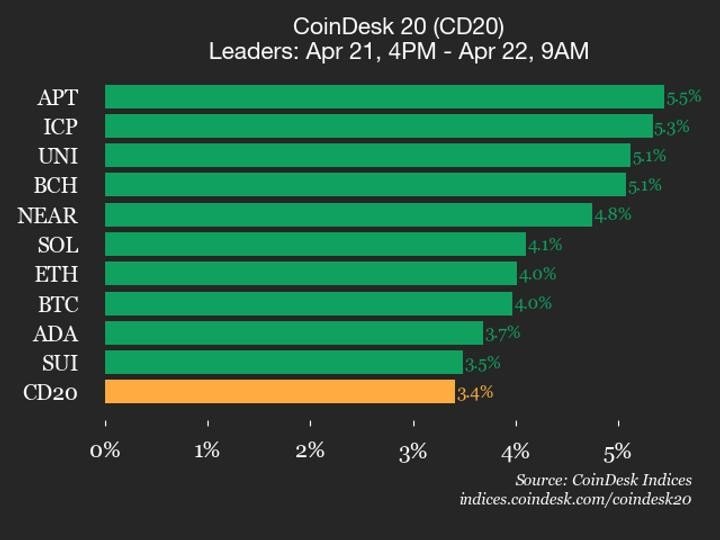
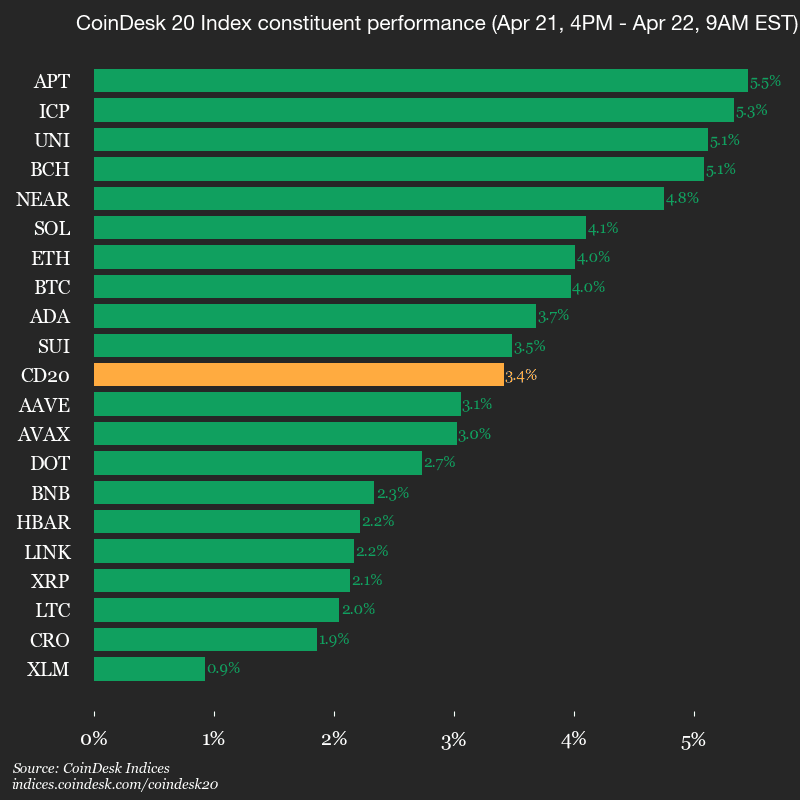
    The CoinDesk 20 is currently trading at 2157.12, up 3.4% (+71.19) since 4 p.m. ET on Tuesday.

    All 20 assets are trading higher.

    Leaders: APT (+5.5%) and ICP (+5.3%).

    Laggards: XLM (+0.9%) and CRO (+1.9%).

    The CoinDesk 20 is a broad-based index traded on multiple platforms in several regions globally.

  • Uzbekistan launches tax-free crypto mining hub to attract foreign investment

    Uzbekistan launches tax-free crypto mining hub to attract foreign investment

    Uzbekistan is launching a special area in Karakalpakstan called “Besqala Mining Valley” where crypto mining is officially regulated and allowed under government rules, with income from mining operations exempt from taxes until January 1, 2035, according to a new decree signed by President Shavkat Mirziyoyev.

    The initiative aims to attract investment, expand renewable energy use, and boost employment through regulated mining activities.

    Mining is restricted to registered legal entities and is mainly intended to use renewable energy sources such as solar power, with additional provisions allowing the use of other controlled energy systems.

    Licensing and supervision will be handled by a state-backed administrative, while operational approvals will be managed by a national agency. Companies can legally mine, trade, and convert crypto assets, provided all earnings are routed through domestic banking channels.

    While mining income in the zone is exempt from taxes until 2035, operators must pay a monthly fee based on revenue and higher electricity tariffs when using the national grid.

    The rules also include strict controls to prevent illegal activity, requiring companies and owners to pass background checks and follow financial transparency laws.

    How Uzbekistan got here

    Uzbekistan’s relationship with crypto has been a slow burn.

    A 2018 presidential decree first acknowledged digital assets and established a basic regulatory framework, but it came with heavy guardrails. Mining was initially limited to legal entities using solar photovoltaic energy, and the regulatory posture was one of extreme caution.

    The country spent several years watching from the sidelines while Kazakhstan next door became a global hashrate magnet, only to see Kazakh authorities forced into crackdowns on unregistered “gray” miners and a battle with grid stability.

    Uzbekistan studied that playbook and opted for a deterrent strategy, requiring grid-connected miners to pay double the standard commercial electricity rate.

    The stance has shifted with the introduction of a 15% electricity discount for registered miners and data centers, alongside the launch of Besqala Mining Valley.

  • Core Scientific Reveals $3.3 Billion Junk-Bond Sale to Pivot Further from Bitcoin Mining to AI

    Core Scientific Reveals $3.3 Billion Junk-Bond Sale to Pivot Further from Bitcoin Mining to AI

    In brief

    • Core Scientific, which mines Bitcoin, said it would offer $3.3 billion worth of speculative-grade debt to capitalize on the AI boom.
    • The firm is currently developing six data center facilities under a deal with cloud-computing firm CoreWeave, per Bloomberg.
    • The company said last month that it is willing to sell the entirety of its Bitcoin holdings in order to fund its ongoing pivot.

    Core Scientific, a Bitcoin miner turned data center operator, said on Tuesday that it plans to offer $3.3 billion worth of speculative-grade debt to fund its massive pivot into AI infrastructure.

    In an announcement, the company valued around $6.55 billion said that it would use a portion of proceeds from the raise to refinance debt. The firm did not say what the notes due in 2031 would pay in terms of an interest, nor when they would be offered to investors.

    Under a 12-year agreement with cloud-computing firm CoreWeave, which could generate roughly $10 billion in revenue, Core Scientific is currently building six data center facilities, Bloomberg reported on Tuesday, citing a person with direct knowledge of the matter.

    Core Scientific shares rose 4.5% on Tuesday to $20.77, according to Yahoo Finance. As the AI boom has continued to drive demand for high-density data centers across the U.S., the company’s shares have surged 42% year-to-date.

    The junk-bond sale would capitalize the firm with additional funding after it secured up to $1 billion in financing from Morgan Stanley. Core Scientific CEO Adam Sullivan said the firm would be deploying capital to accelerate service timelines associated with its projects.

    Days before, the Austin, Texas-based firm indicated that it would continue offloading Bitcoin in order to finance its pivot. At the time, CFO Jim Nygaard estimated that the company currently owns less than 1,000 Bitcoin after selling 1,900 Bitcoin for $175 million in January.

    Billing itself now as a leader in digital infrastructure and high-density colocation, the company concluded 2025 with 2,537 Bitcoin on its balance sheet that would be worth $192 million today, with Bitcoin recently changing hands around $75,800, according CoinGecko.

    Although the company is distancing itself from the leading digital asset, Bitcoin mining has remained the firm’s biggest money-maker. In the fourth quarter, Core Scientific earned $41.1 million from mining Bitcoin for itself compared to $31.3 million from colocation.

    The firm is among several that have historically mined Bitcoin but are now prioritizing AI, including Hut 8, TeraWulf, Riot Platforms, MARA Holdings, and Bitfarms.

    When Core Scientific emerged from Chapter 11 bankruptcy in 2024, the company described itself as one of the largest Bitcoin miners in North America. And the previous year, its fleet of miners produced 13,762 Bitcoin, a sum valued at roughly $1 billion today.

    Daily Debrief Newsletter

    Start every day with the top news stories right now, plus original features, a podcast, videos and more.