Over $10 billion has exited Aave after the Kelp DAO exploit, but the capital hasn’t all gone to one place.
After the roughly $292 million exploit broke the cross-chain backing of rsETH, users have spread capital across safer, simpler venues rather than rotating into a direct replacement. Aave’s total value locked has fallen about 40%, according to DeFiLlama data, as impaired collateral triggered market freezes, stalled liquidations, and forced deleveraging, pushing users to withdraw or close positions.
Some of that capital has moved into Maker-linked Spark, which has emerged as the clearest relative winner. Its TVL has risen around 10% as users rotate toward infrastructure backed by Sky’s $6.5 Billion stablecoin reserves, favoring tighter risk controls over open-ended lending markets exposed to complex collateral.
Elsewhere, large liquid staking providers like Lido have held relatively steady. That stability suggests users are not abandoning ETH exposure, but stripping out layers of risk tied to restaking, rehypothecation and cross-chain bridges.
A third pocket of inflows is showing up in real-world asset protocols such as Centrifuge and Spiko, which both offer exposure to tokenized assets like T-bills and bonds.
At the same time, a significant share of funds has moved into stablecoins, particularly USDC, as users step out of risk and wait on the sidelines rather than immediately redeploying capital.
Not all of Aave’s decline reflects capital rotation. Part of the drop comes from loans being repaid and positions unwound, mechanically shrinking TVL without a new destination.
The result is a fragmented market response. Capital is flowing toward simplicity, controlled risk and even cash, suggesting that after Kelp, confidence in shared collateral layers has weakened rather than shifted elsewhere.
While Bitcoin broke record after record in 2025, Ethereum only managed to surpass its 2021 all-time high once and couldn’t even break above $5,000.
Ethereum has been underperforming compared to Bitcoin, and is currently 50% below its all-time high.
However, according to a new report, Ethereum ($ETH) could also reach triple digits. A new report from Etherealize suggests that $ETH could reach $250,000, catching up with the monetary premium of gold and Bitcoin (BTC).
A new report from Etherealize, a startup that received investment from Ethereum founder Vitalik Buterin, suggests that Ethereum could surpass $250,000 per $ETH if it catches up to the approximately $31 trillion monetary premium currently held by gold and Bitcoin. However, the report does not provide a target date for the price prediction.
The report argues that $ETH is unique in the history of money because it is both a store of value and a productive asset.
The latest price forecast is significantly lower than Etherealize’s previous target of $740,000 per $ETH, which was set in its initial public announcement last year.
Etherealize co-founder Vivek Raman said, “Ethereum will be the cornerstone of the global financial system. One or two digital assets will prove themselves as a store of value. If one of them is Bitcoin, Ethereum will be another competing asset.”
The report focuses on maintaining the value of gold and Bitcoin, while acknowledging that $ETH also has the potential to reach that value.
Furthermore, unlike purely monetary assets such as Ethereum, gold, and Bitcoin, it also possesses real economic activity, such as a burgeoning DeFi, staking, and stablecoin economy.
This makes Ethereum not only a value asset but also a more attractive investment option.
“$ETH is the first monetary asset to deliver returns without counterparty risk. Throughout human history, you’ve had to choose between holding onto money (stable, inefficient) or investing it in productive assets (risky, wealth-generating). These two categories were mutually exclusive. Ethereum eliminates that divide.”
A Polymarket contract on whether Kelp DAO will spread the losses from the weekend’s $292 million exploit beyond those directly affected is pointing to a clear answer: probably not.
Bettors are giving a 14% chance that Kelp will “socialize the losses,” or implement a mechanism forcing rsETH holders on Ethereum, which wasn’t hit, to share the pain of users on other chains.
The attackers drained roughly 116,500 rsETH from a LayerZero-powered bridge that held the reserves backing the token across more than 20 blockchains. That left parts of the system undercollateralized, with some holders effectively owning tokens no longer fully backed by ether (ETH).
“Socializing the losses” would mean Kelp redistributes the shortfall across all rsETH holders, including those on the Ethereum mainnet, rather than leaving losses concentrated among users and protocols tied to the compromised bridge.
The most widely cited precedent of this approach came in 2016, when Bitfinex imposed losses on all users after a $60 million hack, effectively mutualizing the hit to avoid shutting down.
More recently, derivatives exchanges have used variations of the concept through auto-deleveraging (ADL), in which profitable positions are forcibly reduced to cover losses when insurance funds are exhausted.
During the October flash crash, ADL mechanisms were triggered across some venues, closing out even market-neutral positions and leaving traders exposed. These moves are rare and controversial, but they have been used as a last resort to stabilize systems under stress.
Kelp’s situation is more complex. The exploit drained the reserve backing rsETH across more than 20 chains, leaving losses fragmented across different user groups and platforms.
Holders on affected networks face impaired backing, while others remain relatively insulated. Any attempt to equalize losses would require coordination across chains, clear accounting of liabilities, and a willingness to impose losses on users who may not see themselves as affected.
That makes a clean, system-wide redistribution both technically and politically difficult, which may explain why Polymarket traders are approaching the question with skepticism.
The Coinbase Premium Index, a key indicator of institutional demand in the cryptocurrency market, is exhibiting a remarkable upward trend. This index, calculated for Bitcoin, has remained in positive territory for 14 consecutive days since April 9th, marking its longest run since its all-time high in October 2025.
According to the data, this indicator measures the price difference between US-based Coinbase and globally operating Binance. A higher Bitcoin price on Coinbase compared to Binance generally indicates strong buying activity by US-based institutional investors. Therefore, a sustained positive trend in the index is considered a significant signal of strong institutional demand in the market.
Analysts suggest that institutional buying, rather than individual investor activity, may be the driving force behind the recent recovery in Bitcoin prices. The increased interest in US spot ETFs and the re-entry of large funds into the market, in particular, aligns with Coinbase Premium data.
On the other hand, experts emphasize that this indicator alone should not be considered a definitive bullish signal. They state that market dynamics are multifaceted and that macroeconomic developments also play a decisive role in price movements.
However, the current trajectory of the Coinbase Premium Index stands out as a strong indicator of the growing influence of institutional investors in the Bitcoin market.
A peace agreement has yet to be signed between the US and Iran. Just before the two-week temporary ceasefire was due to expire, the mediating state Pakistan intervened, and Trump extended the ceasefire between the US and Iran.
Donald Trump’s extension of the ceasefire with Iran caused Bitcoin ($BTC) to rise again, climbing above $78,000 in the morning hours.
While bullish expectations for Bitcoin continue, the first hurdle expected to be breaking above $80,000 is anticipated.
While there is no clear direction for $BTC due to the uncertainty surrounding the outcome of a US-Iran war, analysis firm Tiger Research has announced a Bitcoin price target of $143,000.
Asia-based analytics and consulting firm Tiger Research has set a Bitcoin price target of $143,000 for the second quarter of 2026 in its new report.
The analysis firm noted that the macroeconomic environment was positive (global M2 reaching a record high of $134.4 trillion and ETF funds turning into net inflows).
Conversely, analysts argue that despite the Iran-related oil price shock pushing CPI up to 3.3% and the Fed slowing its pace of interest rate cuts, global liquidity will outpace short-term inflationary pressures.
It is stated at this point that a decrease in inflationary pressure will support Bitcoin’s long-term upward trend.
Analysts also added that on-chain indicators are moving out of the fear zone and towards a balance between undervaluation and equilibrium. This is seen as a classic signal of market bottom formation and early accumulation.
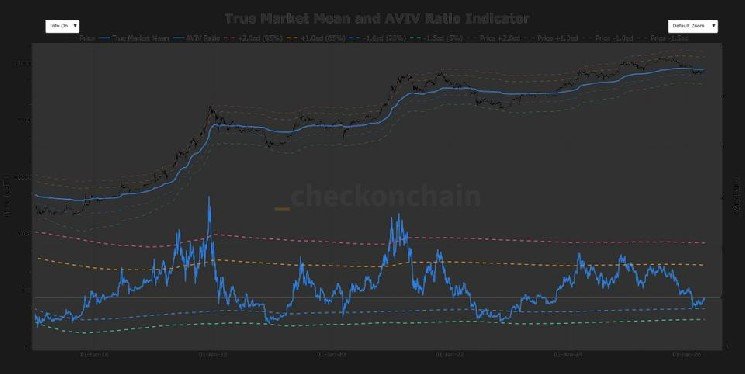
Bitcoin is nearing a decisive moment as it tests two closely aligned on-chain resistance levels, following roughly 75 days of sideways consolidation since its Feb. 6 local bottom at $60,000 as bitcoin climbs above $78,000.
The first metric is the True Market Mean, currently at $78,200. This metric, tracked by Checkonchain, reflects the average acquisition price of actively circulating supply, excluding lost or dormant coins. It effectively captures the aggregate cost basis of engaged market participants.
The True Market Mean filters out lost, dormant, and economically inactive coins, leaving only the cost basis of participants who are actually present in the market, making it a more precise gauge of where real selling pressure resides.
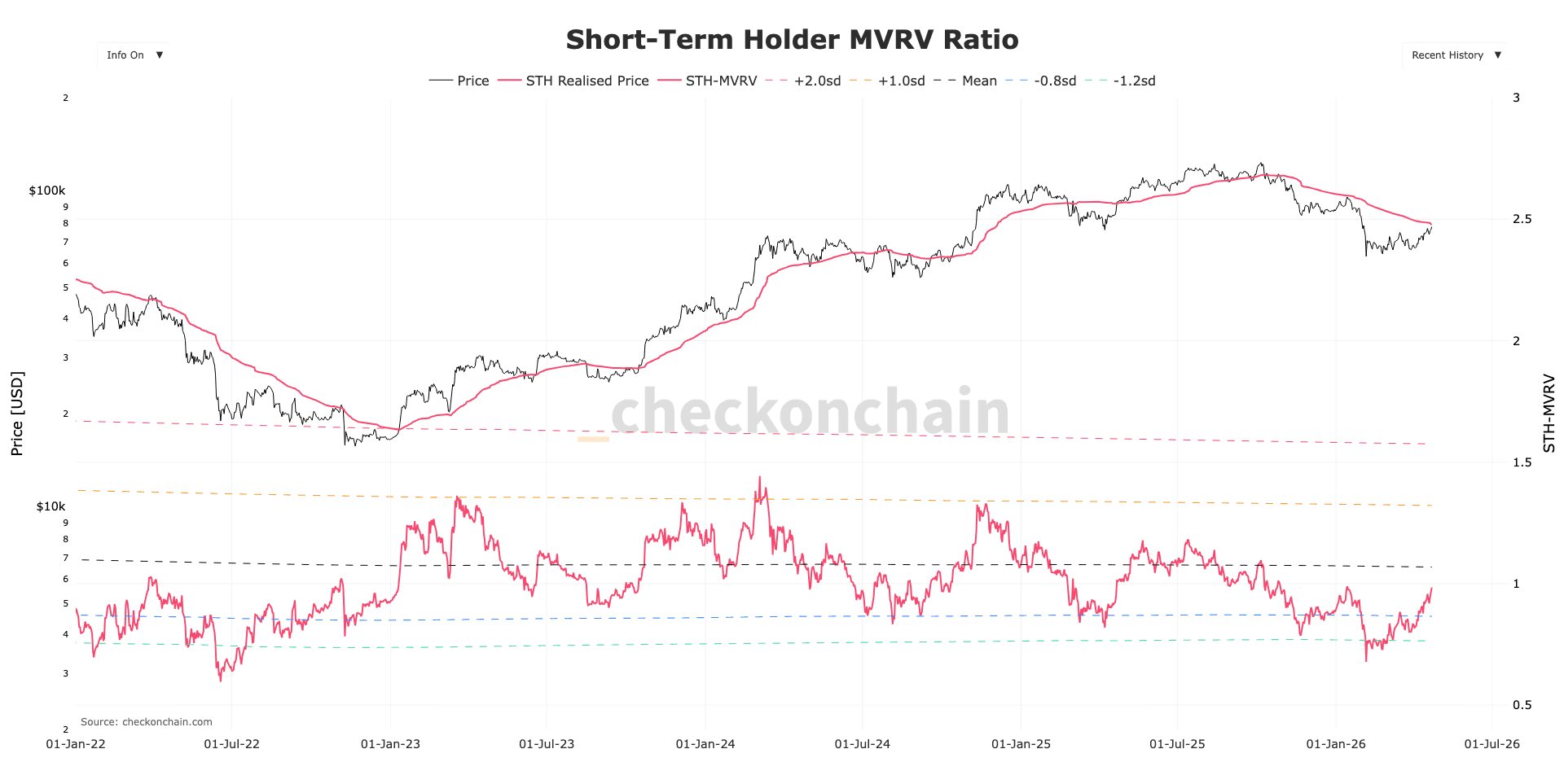
Just above sits the Short-Term Holder realized price (STHRP) at $79,200, according to checkonchain. This cohort, defined as investors holding coins for fewer than 155 days, tends to be more reactive to price swings. With spot prices below their average entry, these participants remain at a slight loss. Bitcoin tested the STHRP in mid-January around $98,000 and got rejected.
A sustained move above this zone could shift both levels into support, strengthening bullish momentum. Conversely, failure to reclaim them may prolong bitcoin’s consolidation phase, with potential downside.
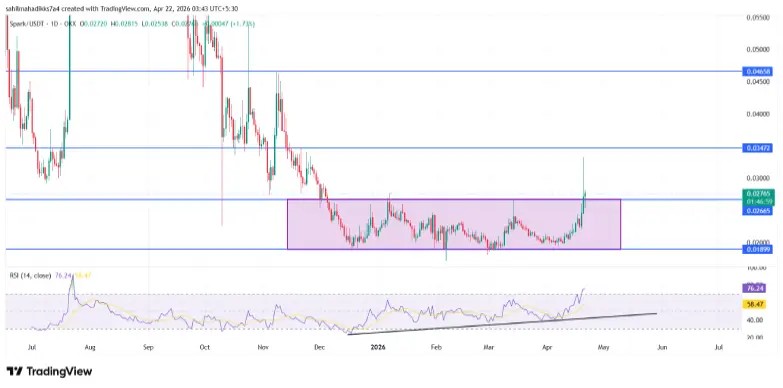
$SPK, the native governance asset of the Spark protocol, is up 1.21% during Tuesday’s U.S. market hours to currently trade at $0.027. The buying pressure followed a capital rotation to leading protocol Sparklend as its major competitor AAVE got caught in the recent Kelp DAO rsETH exploit. The price jumps offer a major breakout from key resistance level, signalling an opportunity for potential recovery in near-term.
Sparklend Gains $1.4B as Kelp DAO Hack Shakes DeFi Markets
On April 18, 2026, Kelp DAO was exploited in a devastating $293 million attack, the biggest DeFi hack of the year. The attacker manipulated a vulnerability in the protocol’s LayerZero-powered bridge, which relied on a flawed single-verifier configuration. The hacker created 116,500 unbacked rsETH (18 percent of the total supply) by forging cross-chain messages and shared these fake coins with over 20 different networks.
The collapse instantly froze Aave. Though its core contracts were protected, the acceptance of rsETH as collateral by the protocol was a crucial flaw. The attacker leveraged the useless rsETH to borrow around $236 million of high-quality assets such as WETH, placing Aave in almost the same position with almost 196 million in bad debt. This sparked a massive liquidity crisis; panicked users withdrew over $5.4 billion, pushing ETH utilization to 100% and effectively trapping remaining funds in a “liquidity crunch.”
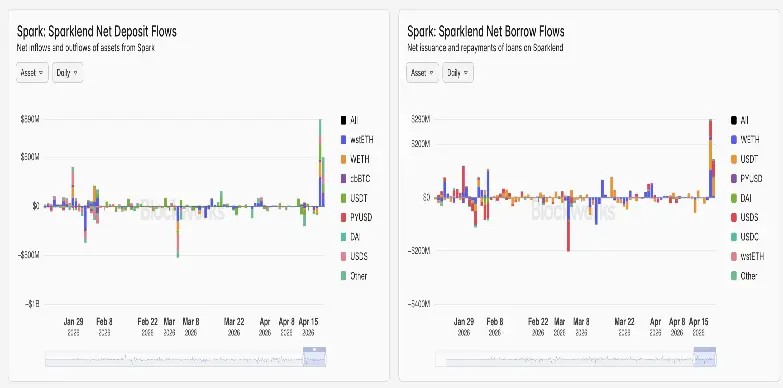
This volatility led to a great exodus of capital to protocols seen as more robust, a flight to quality. The main beneficiary of this shift was Sparklend. Whilst Aave had to freeze its markets to test its Umbrella safety module, Sparklend had registered an unprecedented net deposits and loan growth of $1.4 billion and $350 million, respectively, in a span of 48 hours. According to the data, the inflows of April 18th and 20th are by far the largest in all of 2026.
The success of Sparklend was based on its proactive risk management. Spark already halted the rsETH and other low-liquidity assets in January 2026, and had no exposure to the forged tokens. This enabled it to keep on operating fully as competitors were hampered by contagion. The enormous rush of USDS and DAI testifies to the fact that the investors perceived Sparklend as a safe haven, effectively seizing a large portion of liquidity leaving the market in the panic.
Spark Price Gives a Decisive Breakout From 4-Months Consolidation
Following a significant correction in 2025, the Spark price shifted its trajectory to sideways above the $0.019 support. For over four months, the $SPK price remains in a confined range between the horizontal level of $0.026 and $0.018.
This consolidation acted as an accumulation zone for $SPK buyers, evidenced by a rising slope in momentum indicator RSI. The building bullish momentum bolstered price to rebound from the aforementioned despite the geopolitical tension in the middle east.
Furthermore, the Kelp DAO rsETH exploit acted as triggered for capital rotation to Spark price, giving a decisive breakout from the range resistance on April 20th. If the breakout holds, the Spark price could drive a 25% rally to $0.034, followed by a leap to $0.046.
ZetaChain has onboarded Kimi K2.6 from Moonshot AI and Alibaba’s Qwen 3.6 Max, moving toward a vision where AI models operate natively across blockchain ecosystems. The platform positions itself as a universal layer where applications can run across chains and models simultaneously while maintaining private, persistent user memory that belongs to the user rather than the platform.
. @Kimi_Moonshot K2.6 and @Alibaba_Qwen 3.6 Max are now onboarded on ZetaChain.
The model layer is moving fast. The memory layer is just getting started.
ZetaChain enables: – Model-agnostic memory – Persistent user context – Private, user-owned data
The model layer is moving fast. The memory layer is just getting started, and that’s where the real infrastructure gap exists.
About ZetaChain & How It is Different
ZetaChain isn’t building another blockchain to chase transactions. It’s building the infrastructure so apps can work across chains and AI models without developers having to wire up each one separately.
An app on ZetaChain picks Kimi, Qwen, or whoever else is onboarded, routes the request to whichever model makes sense for the job, and does it all from one interface.
The cross-chain stuff works the same way. An app executes transactions and accesses liquidity across multiple blockchains without anyone managing bridges, wrapped tokens, or chain-specific integrations. ZetaChain handles those details. You don’t see them.
That abstraction is powerful because it removes the fragmentation that currently makes Web3 applications unnecessarily complex. Users shouldn’t need to understand which chain a liquidity pool lives on to swap assets. Developers shouldn’t need to deploy the same application separately to every blockchain. ZetaChain removes those requirements.
The Memory Layer Is the Real Feature
The model layer with Kimi and Qwen is impressive, but the memory layer is where ZetaChain is making its actual bet on what comes next. Current AI interactions are stateless. You ask a question, you get an answer, and the next conversation starts fresh with no context from what came before. That limitation creates friction for any application that depends on understanding who the user is and what they’ve done previously.
ZetaChain’s memory layer changes that by giving users persistent, private, user-owned context that AI models can access across interactions. An AI agent helping manage a crypto portfolio needs to know what positions the user currently holds, what their risk tolerance is, and what trades they’ve already executed.
Without persistent memory, the agent starts from zero with every interaction and can’t provide intelligent, contextual help.
The private, user-owned part matters as much as the persistence. Current AI services store interaction history on company servers and use that data to train models or sell insights. The memory layer is different from how every other AI service works.
The memory stays with the user. It’s encrypted. It’s theirs. The AI model can read what it needs to give smart responses, but the user owns the data. They can revoke access anytime. They can switch to a different model and their history moves with them.
How This Changes the Pricing Model
The economics are completely different from cloud AI services. Instead of paying a subscription for access to a model, users own their memory and can choose which models to interact with.
A developer building on ZetaChain doesn’t need to host infrastructure. They build the application logic, and ZetaChain handles the model routing, memory management, and cross-chain execution.
That shift moves the economic incentive from locking users into a single platform to providing the best tools and infrastructure for applications that users actually want to use. It’s the difference between renting compute and building applications that control their own infrastructure and data.
Conclusion
ZetaChain onboarding Kimi and Qwen demonstrates the model layer working. The memory layer is where the platform’s actual innovation lives. Users getting persistent, private memory across AI interactions while developers build without managing their own infrastructure represents a genuinely different approach to how AI and Web3 combine. The model layer is moving fast. The memory layer is where the real value starts to compound.
Another day, another exploit. The security crisis in blockchain-based decentralized finance (DeFi), once touted as a challenger to legacy infrastructure, is only getting worse.
The latest victim is Volo Protocol, a platform built on the Sui blockchain, where users deposit assets into yield-generating “vaults,” which function as pooled investments. Deposited tokens such as bitcoin, stablecoins and tokenized assets are deployed using various onchain strategies to generate returns.
Early Wednesday, the protocol confirmed a security breach that drained a total of roughly $3.5 million in digital assets from three of the vaults. Assets locked in other vaults were not affected, it said in a post on X.
“The ~$28M in TVL across all other Volo vaults is safe. The exploit was isolated to 3 specific vaults, and we have confirmed no shared attack vector exists with the remaining vaults,” the protocol said, adding that it is “prepared to absorb” the financial loss rather than pass it on to users.
The attack hit vaults holding wrapped bitcoin (WBTC), Matridock’s tokenized gold token, XAUm, and the dollar-pegged stablecoin USDC. In response, the protocol froze all vaults and began working with the Sui Foundation and onchain investigators to contain the damage and trace funds.
Since the incident, Volo has “frozen” $500,000 in assets through coordination with ecosystem partners, meaning those funds have been immobilized onchain to prevent any movement or withdrawal. Still, the majority of the stolen funds remain under investigation.
Growing unease
The breach adds to growing unease across decentralized finance, where a string of exploits has raised questions about smart contract security and protocol oversight. The timing is particularly sensitive, coming just days after the weekend’s KelpDAO exploit, in which an attacker drained millions by artificially minting unbacked liquid restaking tokens, rsETH.
The aftermath has rippled across the DeFi, triggering collateral damage in multiple protocols, including leading lending platform Aave, where users rushed to withdraw funds because of the heightened uncertainty.
To date, decentralized finance has suffered roughly $7.78 billion in hacks, according to data from DeFiLlama. Bridge protocols — which enable the transfer of assets across blockchains — account for another $2.90 billion in losses. Combined, the figure exceeds $10 billion, roughly equivalent to the market capitalization of cryptocurrencies ranked between 10th and 15th globally.
Volo says it will publish a full post-mortem once its investigation is complete and remediation steps are finalized.
But for DeFi users and investors, a broader pattern is becoming harder to ignore: while institutional adoption is accelerating, relatively little of that capital appears to be flowing into improving security, with exploits continuing to arrive in clusters.
Read more: The $13 billion DeFi wipeout in two days, and it started with KelpDAO attack
The long-standing feud between Justin Sun and $WLFI is escalating.
At this point, the final move came from Tron (TRX) founder Justin Sun.
Justin Sun has filed a lawsuit against World Liberty Finance ($WLFI), a cryptocurrency project supported by US President Donald Trump.
The Sun announced in a post from its X account that it has filed a lawsuit against World Liberty Finance ($WLFI) in a California federal court.
Sun stated in the lawsuit that the $WLFI project team froze their tokens without valid reason, stripped them of their voting rights in governance proposals, and threatened to permanently burn their tokens.
Sun also explained that he tried to negotiate to resolve the issue, but initiated legal action after the project refused to lift the token freeze and restore governance voting rights.
“…I tried to resolve this situation in good faith with the World Liberty project team without resorting to legal action.”
However, the project team rejected my requests to dissolve my tokens and restore my rights as a token holder. They left me no choice but to take legal action. My goal is to be treated the same way as other early investors.”
Sun stated that she still supports President Trump and his administration, emphasizing that her lawsuit targets specific individuals on the project team, not the president himself.
“…Unfortunately, some individuals on the World Liberty project team are running the project in a way that is contrary to President Trump’s values…”
Sun also strongly opposed a new governance proposal announced by World Liberty Finance on April 15, stating that it was disadvantageous to the community because it would require the tokens of those who voted against it to be locked indefinitely or partially burned.