Category: Business

  • Lazarus Group has become especially dangerous with new Mach-O Man attack: CertiK

    Lazarus Group has become especially dangerous with new Mach-O Man attack: CertiK

    The North Korean state-run Lazarus Group is running a new campaign known as “Mach-O Man” that turns routine business communication into a direct path to credential theft and data loss, security experts warned Wednesday.

    The collective, with cumulative loot estimated at $6.7 billion since 2017, is targeting fintech, cryptocurrency and other high-value executives and firms, Natalie Newson, a senior blockchain security researcher at CertiK, told CoinDesk on Wednesday.

    In the past two weeks alone, the North Korean hackers have siphoned more than $500 million from the Drift and KelpDAO exploits in what appears to be a sustained campaign. The crypto industry needs to start viewing Lazarus the same way banks view nation-state cyber actors: “as a constant and well-funded threat, not just another news headline,” she said.

    “What makes Lazarus especially dangerous right now is their activity level,” Newson said. “KelpDAO, Drift, and now a new macOS malware kit, all within the same month. This isn’t random hacking; it’s a state-directed financial operation running at a scale and speed typical of institutions.”

    North Korea has turned crypto theft into a lucrative national industry, and Mach-O Man is just the latest product from that process, she said. While Lazarus created it, other cybercrime groups are also using it.

    “It is a modular macOS malware kit created by Lazarus Group’s infamous Chollima division. It uses native Mach-O binaries tailored for Apple environments where crypto and fintech operate,” she said.

    Newson said Mach-O Man uses a delivery method known as ClickFix. “It’s important to be clear because a lot of coverage is mixing up two separate things,” she noted. ClickFix is a social engineering technique where the victim is asked to paste a command into their terminal to fix a simulated connection issue.

    It works by Lazarus sending executives an “urgent” meeting invite over Telegram for a Zoom, Microsoft Teams or Google Meet call, according to Mauro Eldritch, a security expert and founder of threat intelligence firm BCA Ltd.

    The link leads to a fake, but convincing, website that instructs them to copy and paste one simple command into their Mac’s terminal to “fix a connection issue.” In doing so, the victims provide immediate access to corporate systems, SaaS platforms and financial resources. By the time they find out they were exploited, it is usually too late.

    There are several variations of this attack, security threat researcher Vladimir S. said on X. There are already cases where Lazarus attackers have hijacked decentralized finance (DeFI) projects’ domains with this new malware by replacing their websites with a fake message from Cloudflare, asking them to enter a command to grant access.

    “These fake ‘verification steps’ guide victims through keyboard shortcuts that run a harmful command,” said Certik’s Newson. “The page looks real, the instructions seem normal, and the victim initiates the action themselves — which is why traditional security controls often miss it.”

    Most victims of this hack will not realize their security has been breached until the damage has been done, at which time, the malware will have already erased itself as well.

    “They likely don’t know it yet,” she said. “If they do, they probably can’t identify which variant affected them.”

  • A $575 bet on a Shiba-themed token became $1.17 million in 5 days

    A $575 bet on a Shiba-themed token became $1.17 million in 5 days

    Memecoin season keeps printing life-changing trades for people willing to take a shot.
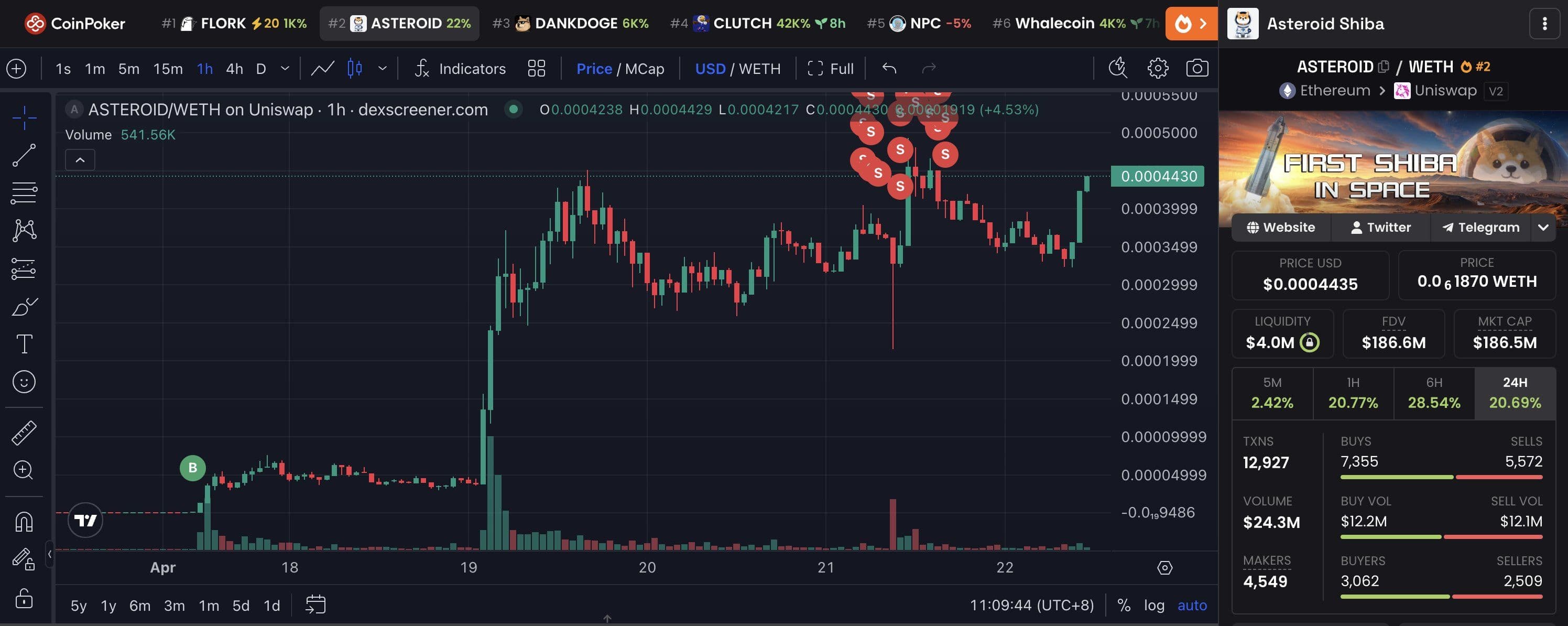
    An anonymous wallet bought 2.79 billion ASTEROID tokens for $575 on April 17 and sold the entire position for 503 ETH on Tuesday, worth roughly $1.17 million, according to on-chain tracker Lookonchain. The round trip took five days and produced a return of more than 2,000x.

    ASTEROID is an Ethereum-based memecoin branded as “First Shiba In Space.” It is themed after a Shiba Inu drawing by Liv Perrotto, a teenage cancer patient who died in January 2026 after a five-year battle with the disease.

    Two years before her death, Perrotto sketched the dog while serving as a volunteer on SpaceX’s Polaris Dawn ground support team. The design, inspired by Musk’s own Shiba Inu named Floki, flew on the Polaris Dawn mission in September 2024 as the crew’s zero-gravity indicator.

    Liv’s Asteroid drawing that went to space with the @polarisprogram came today! They also took a special letter she got at Camp Cadet to space for her too. What an incredible gift! ❤️🚀🌎 @spacex @rookisaacman @kiddpoteet @annawmenon @gillis_sarahe pic.twitter.com/Vv0jbRN0oZ

    — Rebecca Perrotto (@rebeccaperrotto) March 17, 2025

    Before she passed, Perrotto had written down eight questions she hoped to ask Musk. The final one asked whether Asteroid could become SpaceX’s official mascot. Her mother shared the list publicly after her death, and media personality Glenn Beck amplified it on April 16. The post went viral, reached Musk, and he said “ok” in response to making Asteroid the official SpaceX mascot.

    That response ignited the token. ASTEROID’s market cap ran from roughly $50,000 to more than $20 million within hours of Musk’s reply, then pushed past $100 million over the following days on more than $100 million in 24-hour trading volume.

    At its peak the token briefly entered the top 200 cryptocurrencies by market cap. As of European morning hours on Wednesday, it trades at $0.0004435 with a $186.5 million market cap and $24 million in 24-hour volume.

    The token has no formal SpaceX endorsement, no licensing arrangement, and no confirmed Musk involvement beyond the social media replies.

    It trades on Uniswap against wrapped ether with a market cap of $186.5 million and 24-hour trading volume of $24.3 million. Price is up 20.69% over 24 hours, 28.54% over six hours, and has climbed about 10x from the wallet’s entry point on April 17, according to DEX Screener data.

  • Brian Armstrong: New Satoshi Doc is the Best Yet

    Brian Armstrong: New Satoshi Doc is the Best Yet

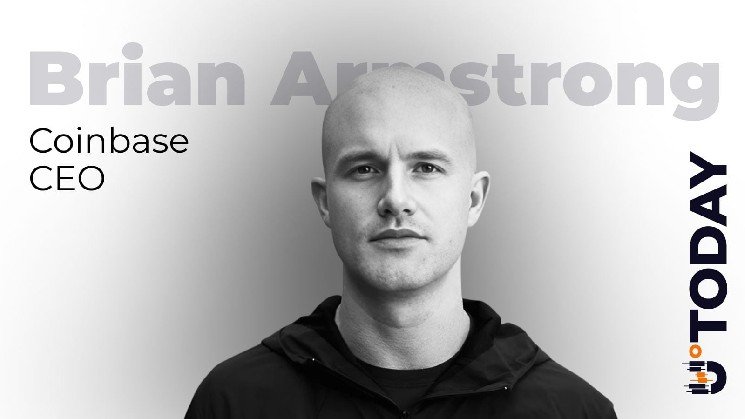
    Brian Armstrong, the head of the leading US exchange, has endorsed a new documentary about Satoshi, claiming that it is the most “thoughtful take” yet on the identity of Bitcoin’s anonymous creator.

    The 101-minute film, which is debuting this Wednesday, is the culmination of a four-year investigation led by New York Times bestselling investigative journalist William D. Cohan and private investigator Tyler Maroney.

    The new documentary is being billed as part investigative thriller and part human portrait.

    The documentary features interviews with industry heavyweights of the likes of Michael Saylor (MicroStrategy), Joseph Lubin (Ethereum), Fred Ehrsam (Coinbase), and Brian Brooks. It also includes former SEC Chair Gary Gensler, journalist Kara Swisher, Haun Ventures CEO Katie Haun, and Bitcoin security engineer Jameson Lopp.

    The Coinbase CEO praised the film’s conclusion and announced that Coinbase users were granted exclusive early access to the documentary via the exchange’s mobile app.

    Investment manager Ross Gerber also lauded the release, calling it a “very well done” and “in-depth look” for crypto fans.

    A crowded field

    The media has had a long-time obsession with unmasking the Bitcoin creator.

    A recent HBO documentary controversially pointed the finger at early core developer Peter Todd.

    Journalist John Carreyrou recently stated with “99% confidence” that cryptography pioneer Adam Back is Satoshi. Back has vehemently denied the claim while arguing that Satoshi might indeed be British.

    However, some believe that Satoshi’s identity should remain hidden, and the cryptocurrency community should protect it.

  • Revolut Targeting $200 Billion Valuation in IPO—But Not Until 2028: FT

    Revolut Targeting $200 Billion Valuation in IPO—But Not Until 2028: FT

    In brief

    • Revolut is seeking a $200 billion valuation via an IPO, according to the Financial Times.
    • The report cited investors briefed on the firm’s plans, though it doesn’t intend to IPO until 2028 according to its CEO.
    • The firm last raised funding in November at a $75 billion valuation.

    Fintech firm Revolut aims to command a $200 billion valuation when it goes public, according to a new report from the Financial Times, citing investors briefed on the firm’s plans. 

    At that mark, the firm’s valuation would have jumped more than 160% since its November fundraise, when it completed a share sale that valued it around $75 billion. People at the firm told Financial Times that executives had discussed a target range of $150-200 billion when it goes public.

    Earlier this week, though, the firm’s CEO and co-founder Nik Storonsky told Bloomberg’s David Rubenstein that the event won’t take place for another “two years time.”

    A source close to the firm told Decrypt no formal valuation target has been made. Revolut declined to comment.

    Revenues for the global firm surged to a record $6 billion last year, representing a 46% jump year-over-year as it netted pre-tax profits of $2.3 billion, buoyed by its global market expansion. 

    As it stands, the firm now operates a licensed bank in 30 of its 40 geographies, including its home country, the United Kingdom. In March, it cleared the regulatory hurdles necessary to become a bank in the UK, earning approval from the Prudential Regulation Authority (PRA) amid its $4 billion commitment to invest in the country. 

    Prior to that, it launched full banking operations in Mexico and later applied for a U.S. bank charter, with Storonsky calling the U.S. “a key pillar of our global growth strategy.”

    At this time, though, the firm does not offer any crypto services to its U.S. customers, but users in eligible jurisdictions can make use of its crypto exchange and custody solutions. In February, it was selected as one of four UK firms to participate in an exploratory stablecoin sandbox ahead of the nation’s launch of stablecoin regulations later this year.

    Last year, sources told Decrypt that the firm was actively exploring the launch of its own stablecoin product. It has not yet done so, and predictors on Myriad—the prediction market platform operated by Decrypt’s parent company, Dastan—place odds of the firm launching a stablecoin before July at just 16%

    Daily Debrief Newsletter

    Start every day with the top news stories right now, plus original features, a podcast, videos and more.

  • Wall Street turns to ‘always-on’ RWA trading platforms as global conflicts escalate

    Wall Street turns to ‘always-on’ RWA trading platforms as global conflicts escalate

    The ongoing conflict between the U.S. and Iran is accelerating Wall Street’s transition into tokenized real-world assets (RWAs) to allay the risk of geopolitical volatility. The crisis has solidified RWAs as essential “always-on” infrastructure for Wall Street, exposing the limitations of traditional financial markets that close during weekends.

    As of April 2026, financial institutions are increasingly adopting blockchain-based tokenized trading to reduce the risks posed by 24/7 geopolitical tensions that traditional markets are ill-equipped to handle.

    Closing on weekends when many geopolitical escalations occur has emerged as a critical vulnerability in traditional financial markets. Major attacks, such as the U.S. strikes on Iran in February 2026, have frequently happened during off-market hours.

    Accordingly, Wall Street desks now use tokenized assets and perpetual futures on platforms like Hyperliquid as the only open window for pricing gold, oil, and war risk when legacy exchanges are offline. The disruption of physical trade routes, particularly in the Strait of Hormuz, has accelerated the shift toward instant “atomic” settlement.

    Tokenized U.S. Treasuries market surges to over $12B in April

    The tokenized U.S. Treasuries market has surged to $12.78 billion as of April 2026, as investors seek liquid collateral that can be moved instantly across borders. Tokenized commodities like gold and oil have also seen surging volumes as traders seek around-the-clock hedges against energy supply shocks.

    Meanwhile, institutional players are also transitioning from pilot programs to full-scale deployment of tokenized assets. Major firms like BlackRock and Franklin Templeton have integrated tokenized funds into their core offerings to avoid the bottlenecks of the traditional banking system during crises.

    These firms provide a digital-native structure that remains operational even as physical infrastructure, like in the Gulf, faces drone threats. As of April 2026, BlackRock has accumulated approximately $1.9 billion in tokenized U.S. Treasuries within its BUIDL fund.

    On the other hand, some nations, including Iran, are experimenting with blockchain to exchange value outside the U.S.-dollar-denominated system to bypass sanctions and naval blockades. Crypto-native platforms effectively became “the market” during critical moments, such as the February 2026 airstrikes. Legacy exchanges are now under intense pressure to adopt 24/7 trading models to compete with these digital-native structures, according to media reports.

    Consequently, on-chain perpetual futures for commodities like gold and oil now account for more than 67% of builder-deployed contracts on decentralized exchanges, with weekend volumes increasing ninefold since the beginning of 2026. The need for blockchain-based instant settlement has become a structural necessity, providing products that remain liquid even when physical trade routes are disrupted.

    IMF chief economist says U.S.-Iran war creates bigger risk than Trump’s tariffs

    IMF chief economist Pierre-Olivier Gourinchas has emphasized that the U.S.-Iran conflict creates a far bigger risk to the global economy than President Donald Trump’s initial wave of steep tariffs a year ago.

    He further notes that several countries are likely to undergo outright recessions under this scenario, with oil prices averaging $110 per barrel in 2026 and $125 in 2027.

    “What’s happening in the Gulf is potentially much, much larger, and that’s what our scenarios are kind of documenting.”

    Pierre-Olivier Gourinchas, Chief Economist at the IMF

    Based on these claims, the U.S.-Iran war is prompting investors to turn to tokenized oil and decentralized finance (DeFi) platforms for hedging, with major financial players fast-tracking the launch of tokenized securities platforms. Traders are using 24/7 crypto-native markets to hedge against oil price volatility stemming from the conflict.

    The IMF also predicts that global GDP growth could fall to 2.5% under an adverse scenario of a longer conflict that would keep oil prices around $100 per barrel this year. The fund’s worst-case scenario assumes a deepening, prolonged conflict that could drive oil prices higher, prompting major financial market dislocations and tighter financial conditions, slashing global growth to 2%.

  • Bill Regarding Bitcoin (BTC) Cryptocurrencies in Russia Receives First Official Approval!

    Bill Regarding Bitcoin (BTC) Cryptocurrencies in Russia Receives First Official Approval!

    Russia, where the use of Bitcoin (BTC) and cryptocurrencies is very high, continues to take regulatory steps.

    According to the Russian local news agency TASS, the Russian State Duma has approved a bill on cryptocurrencies in its first reading.

    At this point, the Duma approved a bill titled “On Digital Currency and Digital Rights”.

    The essence of the bill is to appoint the Central Bank of Russia as the regulatory authority for cryptocurrencies and to allow the use of cryptocurrencies in foreign trade payments.

    According to the draft law, the Central Bank of Russia will be designated as the key institution overseeing the cryptocurrency market, granting broad powers to issue licenses, approve or prohibit transactions, and determine legality.

    The bill also defines the procedures for banks and brokerage firms to enter the cryptocurrency market. Accordingly, regulations regarding cryptocurrency investment will be applied differently depending on the eligibility criteria.

    Specifically, the limit for purchasing cryptocurrency is capped at 300,000 rubles per person for unqualified investors. However, this limitation will not apply to qualified investors.

    The bill also recognizes cryptocurrencies as property under the Russian legal system.

    Finally, the bill needs to pass second and third readings in the State Duma before being submitted to the Federal Council and ultimately to the President for approval. According to the report, if officially approved, the bill is expected to come into effect on July 1, 2026.

    *This is not investment advice.

  • Google Fixes AI Coding Tool Flaw That Let Attackers Execute Malicious Code: Report

    Google Fixes AI Coding Tool Flaw That Let Attackers Execute Malicious Code: Report

    In brief

    • Researchers found a prompt injection vulnerability in Google’s Antigravity AI coding platform.
    • The flaw could allow attackers to execute commands even with the platform’s Secure Mode enabled.
    • Google fixed the issue Feb. 28 after researchers disclosed it in January, Pillar Security said.

    Google has patched a vulnerability in its Antigravity AI coding platform that researchers say could allow attackers to run commands on a developer’s machine through a prompt injection attack.

    According to a report by Cybersecurity firm Pillar Security, the flaw involved Antigravity’s find_by_name file search tool, which passed user input directly to an underlying command-line utility without validation. That allowed malicious input to convert a file search into a command execution task, enabling remote code execution.

    “Combined with Antigravity’s ability to create files as a permitted action, this enables a full attack chain: stage a malicious script, then trigger it through a seemingly legitimate search, all without additional user interaction once the prompt injection lands,” Pillar Security researchers wrote.

    Launched last November, Antigravity is Google’s AI-powered development environment designed to help programmers write, test, and manage code with the assistance of autonomous software agents. Pillar Security disclosed the issue to Google on January 7, and Google acknowledged the report the same day, marking the issue as fixed on February 28.

    Google did not immediately respond to a request for comment by Decrypt.

    Prompt injection attacks occur when hidden instructions embedded in content cause an AI system to perform unintended actions. Because AI tools often process external files or text as part of normal workflows, the system may interpret those instructions as legitimate commands, allowing an attacker to trigger actions on a user’s machine without direct access or additional interaction.

    The threat of prompt injection attacks for large language models came into renewed focus last summer when ChatGPT developer OpenAI warned that its new ChatGPT agent could be compromised.

    “When you sign ChatGPT agent into websites or enable connectors, it will be able to access sensitive data from those sources, such as emails, files, or account information,” OpenAI wrote in a blog post.

    To demonstrate the Antigravity issue, the researchers created a test script inside a project workspace and triggered it through the search tool. When executed, the script opened the computer’s calculator application, showing that the search function could be turned into a command execution mechanism.

    “Critically, this vulnerability bypasses Antigravity’s Secure Mode, the product’s most restrictive security configuration,” the report said.

    The findings highlight a broader security challenge facing AI-powered development tools as they begin to execute tasks autonomously.

    “The industry must move beyond sanitization-based controls toward execution isolation. Every native tool parameter that reaches a shell command is a potential injection point,” Pillar Security said. “Auditing for this class of vulnerability is no longer optional, and it is a prerequisite for shipping agentic features safely.”

    Daily Debrief Newsletter

    Start every day with the top news stories right now, plus original features, a podcast, videos and more.

  • US Giant Bank SoFi Makes New Bullish Announcement Regarding XRP!

    US Giant Bank SoFi Makes New Bullish Announcement Regarding XRP!

    As $XRP continues to expand globally, it has received positive news from the US.

    According to The Block, US-based fintech platform SoFi has announced that it has enabled $XRP investment.

    However, SoFi has enabled $XRP deposits and portfolio tracking support in its application, allowing users to manage their $XRP directly in their accounts.

    “We are excited to now support $XRP deposits, alongside some of the most popular coins like Bitcoin (BTC), Ethereum (ETH), and Solana (SOL).”

    This has expanded access to regulated cryptocurrencies for individual users in the US.

    Furthermore, SoFi’s move has brought $XRP onto a nationally licensed banking platform.

    In contrast, while SoFi announced support for $XRP deposits, it faced user complaints for not enabling withdrawals to external wallets. Users criticized SoFi for not allowing its customers to withdraw their cryptocurrencies to external wallets.

    One user, X, stated that the service offered by SoFi is essentially no different from spot ETFs.

    The user commented, “SoFi doesn’t allow $XRP withdrawals. It’s basically just a spot ETF. It doesn’t benefit the $XRP ecosystem at all.”

    In response to these criticisms, the company stated that they also plan to support withdrawal functionality in the future.

    Ripple celebrated this move with the following statement:

    “With SoFi, increased access to $XRP means more people can participate, and that’s exactly how the benefit increases.”

    More access to $XRP with @SoFi means more people can participate, and that’s exactly how utility grows. 📶 https://t.co/IqxZGvM4cJ

    — Ripple (@Ripple) April 21, 2026

    *This is not investment advice.

  • Bitcoin tests $78,000 resistance as short-squeeze risks mount, altcoins rally

    Bitcoin tests $78,000 resistance as short-squeeze risks mount, altcoins rally

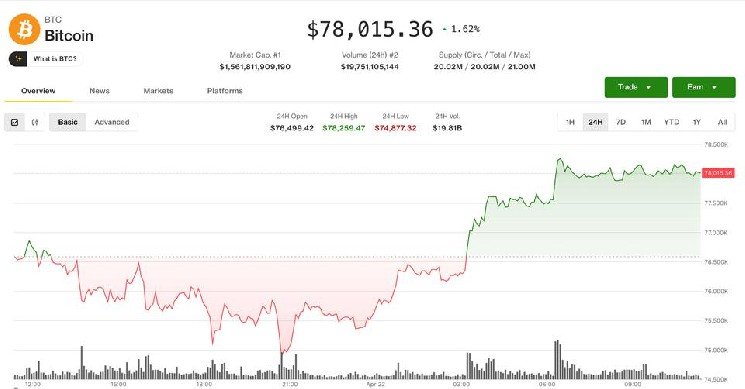
    The crypto market is on the brink of a major breakout with bitcoin trading at $78,000, the level it failed to breach on Friday and a price it has not topped since January.

    A break above this level would trigger upside momentum to $80,000 as $180 million worth of futures positions are due to be liquidated between $77,000 and $78,000, according to CoinGlass’ liquidation heatmap.

    However, there is also a $71 million long position that will be liquidated if the price fails to gain and descends back below $77,300, creating a defensive trading environment on both sides.

    The market is higher after U.S. President Donald Trump extended the ceasefire in Iran, saying that country’s government was “seriously fractured.”

    Nasdaq 100 futures and S&P 500 futures rose by 0.77% and 0.6%, respectively, since midnight UTC following the announcement, suggesting improving broader market sentiment.

    Derivatives positioning

    • $BTC‘s breakout to $78,000 caught the bears off guard, leading to $286 million in marketwide short liquidations on derivative exchanges. Longs, or bullish plays, suffered liquidations of just $132 million.
    • Still, overall crypto futures open interest (OI) has increased by over 4% to $126 billion in 24 hours. Notably, OI grew across the major tokens, including bitcoin and ether (ETH), outpacing spot price gains, indicating renewed capital inflows and rising demand for leverage.
    • Funding rates have flipped positive for most tokens, including $BTC, indicating a renewed bias for bullish bets. The 24-hour cumulative volume delta also paints the same picture.
    • M token stands out with annualized funding rates above 200%, signaling an overheated market crowded with bullish bets. Meanwhile, the HYPE and XML markets show a bias toward bearish short plays.
    • Broadly speaking, crypto futures activity suggests scope for further market gains. Also supporting the bull case are bitcoin and ether’s 30-day implied volatility indices, which remain under pressure, pointing to market calm.
    • On Deribit, bitcoin and ether risk reversals continue to print negative values across all time frames. That’s a sign of the richness of protective put options relative to calls.
    • Block flows featured investor bias for call ratio spreads, a strategy used by traders to profit from a moderately bullish, sideways or slightly rising market. Traders also chased bitcoin and ether straddles, a volatility strategy.

    Token talk

    • The altcoin market was also in a buoyant mood on Wednesday, with all major CoinDesk indexes posting gains of at least 1.5% since midnight UTC.
    • The CoinDesk MemeCoin Index (CDMEME) was the top performer, rising 3.4%, with one person turning $575 into more than $1 million on recently released token ASTEROID.
    • Popular memecoins TRUMP and DOGE added 6% and 3.8%, respectively, reflecting broader optimism across the sector.
    • There was also a boost in privacy coins DASH and XMR, both of which gained 6%-7% over the past 24 hours before tailing off slightly since midnight.
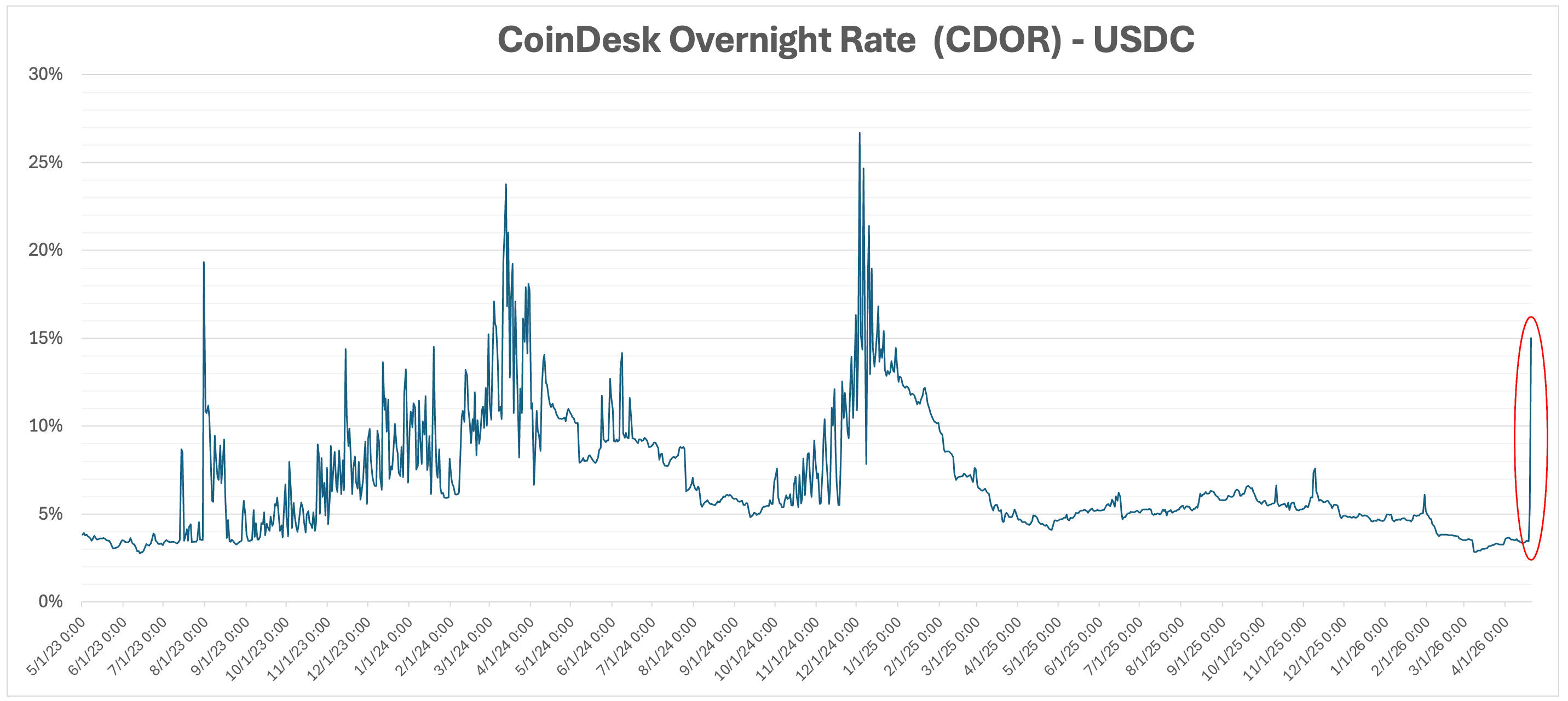
    • CoinDesk’s overnight rate (CDOR) for USDC rose to the highest level since 2024, hitting 15%. CDOR measures stablecoin lending & borrowing activity on the Aave platform, which spiked following the weekend’s $290 million exploit on KelpDAO. A high interest rate reflects high demand.
  • Prediction Market Giants Kalshi, Polymarket Eye Perpetual Futures Push: Report

    Prediction Market Giants Kalshi, Polymarket Eye Perpetual Futures Push: Report

    In brief

    • Kalshi plans to roll out crypto trading to users, a move expected to provide traders with access to perpetual futures, per a report.
    • Meanwhile, Polymarket announced that perpetual futures trading is coming to its platform, enabling users to speculate using leverage.
    • Polymarket and Kalshi can provide access to futures and options under the CFTC’s framework for Designated Contract Markets.

    Polymarket announced on Tuesday that users will soon be able to trade perpetual futures on its platform, while chief rival Kalshi reportedly eyes a similar push into the derivatives space.

    In an X post, Polymarket published a video indicating that users will be able to speculate on the price of various assets with at least 10x leverage, including real-world assets like gold and silver, stocks of companies like Nvidia and Coinbase, and digital assets like Bitcoin. 

    Not long before, The Information reported that Kalshi plans to support perpetual futures on its platform, a move that would give U.S. customers access to derivative contracts that don’t feature an expiration date and use a so-called funding rate to trade around the clock.

    For the prediction-market realm’s leading firms, an entry into the perpetual futures space would extend the platforms’ functionality beyond relatively basic bets on topics such as politics, finance, and sports—underscoring their respective efforts to expand their business models.

    Polymarket and Kalshi are already able to provide access to futures and options under the CFTC’s framework for so-called Designated Contract Markets. It is unclear whether Polymarket plans to introduce perpetual futures on its U.S.-facing platform, its international counterpart, or both.

    Decrypt has reached out to Kalshi and Polymarket for comment.

    The development comes as CME Group, the world’s leading derivatives marketplace, aligns itself with other players soliciting bets. Earlier this year, CME Group indicated that it would debut event contracts in collaboration with FanDuel, America’s leading online sportsbook.

    Recent interest in perpetual futures has been fueled by Hyperliquid, a decentralized exchange that facilitated $148 billion in derivatives volume last month, according to a Dune dashboard.

    In February, Hyperliquid said in an X post that it planned to support “outcome trading,” which would allow for the creation of prediction markets and option-like instruments on its platform. “There has been extensive user demand in both of these areas,” Hyperliquid said.

    Among crypto-native firms, dueling derivatives announcements have happened before. A week after crypto exchange Kraken debuted CME-based futures contracts for Bitcoin and Ethereum in the U.S. last July, Coinbase began offering similar contracts with five-year durations.

    On Tuesday, Coinbase found itself on the defensive amid its own prediction-market push alongside Gemini. The state of New York filed a pair of lawsuits against both firms, arguing that sports- and entertainment-related wagers were allowed in violation of local gambling laws.

    Daily Debrief Newsletter

    Start every day with the top news stories right now, plus original features, a podcast, videos and more.