Category: Business

  • Anthony Pompliano Claims the Bitcoin Bull Market Has Begun – “The Sling Shot Effect Is Coming”

    Anthony Pompliano Claims the Bitcoin Bull Market Has Begun – “The Sling Shot Effect Is Coming”

    Renowned financial analyst Anthony Pompliano, in his latest analysis, claims that the Bitcoin bull market has already begun and issued an important warning to his followers.

    Noting that Bitcoin has experienced a pullback of approximately 40% from its peak of $126,000, Pompliano predicts that this decline will create a “slingshot effect” leading to new highs.

    Pompliano argues that Bitcoin has proven its worth to institutional investors. In seven consecutive financial crises since 2020, Bitcoin has outperformed stocks, gold, and cash, becoming the most profitable asset.

    From pandemics to wars, banking crises to high inflation, he argues that Bitcoin has become the “king of safe havens” in all kinds of chaos.

    Related News BREAKING: Cryptocurrency Exchange Coinbase Lists a Surprise Altcoin

    Citing a new report published by Bitwise, Pompliano argued that an investor who holds Bitcoin for at least three years has less than a 1% chance of losing money.

    The analyst argues that a historic period is underway not only for cryptocurrencies but also for stock markets. He added that the signal he calls the “3-3-3 rule” (the stock market rising by 3% or more for three consecutive weeks) has only occurred three times in the last 76 years.

    Referring to the impact of the upcoming US elections on the markets, Pompliano predicts that the current administration will do everything in its power to keep the economy afloat and boost asset prices before the election.

    *This is not investment advice.

  • The question isn’t whether privacy. It’s what sort of privacy

    Blockchains were built as public networks in the best tradition of open-source technology. But their future is private. And that future is arriving faster than most people realize.

    This month, Tempo — the Stripe-backed payment blockchain that raised $500 million at a $5 billion valuation, with Visa, Mastercard, Paradigm, and UBS among its backers — published a detailed architectural proposal for private enterprise stablecoin transactions. Tempo is not a scrappy privacy-native project. It is arguably the most institutionally credentialed blockchain launch in years, built by people who deeply understand what banks, payment processors, and enterprises actually need. When a network with that pedigree makes privacy a launch-week priority, it isn’t a signal. It’s a verdict.

    The question of whether or not institutional chains will be private has been settled. What remains is the harder one: what kind of privacy are we actually building?

    The problem with public chains

    Bitcoin solved a problem that had stumped computer scientists and bankers for decades: how to transfer value between strangers without a trusted intermediary. Ethereum took blockchains further, offering programmable value alongside value transfer — smart contracts that could encode agreements, automate settlement, and eliminate entire categories of middlemen. Then came stablecoins, which married programmability to the stability of the dollar, and from there, the migration of real-world assets to onchain protocols began.

    Each wave has brought added institutional interest, capital, and ambition. And now, as regulatory clarity emerges, institutions are ready to deploy resources onchain.

    But there’s one thing holding them back — a fundamental flaw that becomes more consequential the larger the numbers get.

    Everything is visible. Every wallet. Every balance. Every transaction, in real time, is readable by anyone with a browser. In financial markets, this is not a feature. It is an existential problem. Imagine if every hedge fund’s positions, every corporate treasury’s holdings, every pension fund’s rebalancing trade appeared on a public screen the moment it was executed. Sophisticated counterparties would front-run. Competitors would map your strategy. Criminals would identify targets. The financial system as it exists today would seize up overnight.

    Blockchains have been asking institutions to accept exactly that. Tempo’s announcement on April 16 is the clearest possible signal that institutions have finally said: no.

    Architecture is destiny

    Here is where the conversation gets more consequential — and more nuanced.

    Tempo’s solution is Zones: private parallel blockchains connected to the main network. Within a Zone, participants transact privately. The public sees only cryptographic proofs of validity, not underlying data. Compliance controls travel with the token automatically. Assets remain interoperable with Tempo Mainnet. For enterprises running payroll, treasury operations, or settlement workflows, it is a thoughtful and practical design.

    But Tempo’s privacy model is operator-visible. The Zone operator — an enterprise or infrastructure provider — sees all transactions within its Zone. The public sees nothing. The operator sees everything. For many regulated institutions, this is acceptable, and may even be required. But it means privacy is contingent on trusting an intermediary. You have moved the visibility problem; you have not eliminated it.

    This is not a criticism of Tempo. It is a description of a genuine architectural choice — one with real consequences for anyone thinking carefully about risk.

    Zero-knowledge cryptography offers a different path. ZK proofs allow a party to prove that a transaction is valid without revealing the underlying data. A new generation of ZK-native blockchains builds this privacy-preserving functionality into the execution layer itself. Accounts execute transactions locally, with the chain storing only a cryptographic commitment. Nothing sensitive ever touches a public ledger. Transaction history is not browsable. And crucially, no operator has a god’s-eye view — privacy is enforced at the base layer, not delegated to an intermediary.

    If Bitcoin gave us trustless transfer and Ethereum gave us programmable trust, ZK-native blockchains offer verifiable privacy: the ability to prove that everything happened correctly without revealing what actually happened.

    Compliance without full transparency

    The obvious objection is regulatory. Privacy and compliance have long been framed as incompatible — oil and water. That framing is becoming obsolete.

    Regulatory compliance does not require that everyone can see your transactions. It requires that the right parties, under the right conditions, can verify that your transactions were legitimate. That is a meaningful distinction, and it is one that ZK cryptography is uniquely positioned to enforce. Selective, programmable disclosure — revealing what regulators need to see, nothing more — is not a workaround. It is a more precise implementation of what compliance actually demands.

    Tempo’s model handles this at the operator level. ZK-native approaches handle it at the cryptographic level. Both satisfy the compliance requirement. But they distribute trust very differently.

    The question that matters

    The financial industry knows it needs to move onchain. It now knows — Tempo’s announcement makes this undeniable — that it cannot do so on fully public infrastructure. The era of public-by-default blockchains as the assumed standard for institutional finance is ending.

    What comes next depends on a choice the industry is only beginning to make clearly: privacy through trusted operators, or privacy through cryptographic guarantees that require no trust at all.

    Both are legitimate answers. But they are not equivalent. The privacy model you choose determines your risk surface, your compliance posture, and your exposure to the failure modes of the intermediaries you depend on. Architecture is not a technical detail to be resolved later. It is the decision that determines everything else.

    The question for the industry is not whether privacy. That debate is over.

    The question is what sort of privacy — and who, if anyone, you are willing to trust with the view.

  • New Binance US CEO Assesses Bitcoin’s Future: “It Will Be a Golden Age”

    New Binance US CEO Assesses Bitcoin’s Future: “It Will Be a Golden Age”

    Stephen Gregory, the experienced legal and compliance professional who took over the leadership of Binance US, gave optimistic messages about the future of the US cryptocurrency market.

    Gregory stated that Binance US has moved beyond past regulatory pressures and entered a fully growth-focused phase.

    Gregory acknowledged that the past few years have been challenging for crypto companies in the US, but said the current situation is rapidly changing. According to the CEO, the US is no longer just a market; it’s a hub for liquidity, innovation, and the developments that will trigger the next bull cycle.

    Related News BREAKING: Cryptocurrency Exchange Coinbase Lists a Surprise Altcoin

    In the interview, Gregory addressed one of the most frequently asked questions regarding his relationship with Binance Global, stating clearly that the two companies have completely separate operational processes and control mechanisms. Gregory said, “Although we share a common end-benefactor (UBO), Binance US and Global parted ways years ago and operate under different regulations.”

    Gregory predicts that while the recent rally was largely driven by institutional Bitcoin purchases, the next wave will be driven by genuine individual investor influx. According to the CEO, this period will be a “golden age” for crypto, where real-world use cases will emerge, translating it from mere speculation.

    *This is not investment advice.

  • Bitwise CIO makes the case for new AVAX ETF launch

    Bitwise CIO makes the case for new AVAX ETF launch

    Bitwise says Avalanche deserves a place alongside larger blockchain networks, arguing that its model offers differentiated exposure to the long term growth of tokenized assets, stablecoins, and onchain finance just after launching its Avalanche fund on April 15.

    In his latest CIO memo, Matt Hougan said Avalanche is attractive not because it already dominates the Layer 1 market, but because it approaches blockchain design differently from Ethereum and Solana. Rather than operating as a single shared chain, Avalanche lets firms and institutions launch their own customizable blockchains with their own rules, validators, and access controls.

    Hougan framed that model as especially relevant for banks, governments, gaming firms, and other regulated entities that may want blockchain infrastructure without fully adopting the operating model of a public chain.

    He tied that thesis to growing institutional activity on Avalanche, noting that tokenized real world assets on the network have climbed sharply and that the ecosystem has drawn partners including BlackRock, Apollo, Toyota, the State of Wyoming, and FIFA. Hougan argued that this gives Avalanche a credible shot at capturing part of a much larger market if hundreds of trillions of dollars in assets eventually move onchain.

    Hougan also used the memo to make a broader portfolio point. In an early and fast moving Layer 1 market, he said the most sensible approach is not pretending to know the final winner, but focusing on the networks with the clearest structural differences and the most realistic path to long term relevance. In his view, that group starts with Ethereum, Solana, and XRP, and extends to Avalanche.

  • American Bitcoin Shares Spike After Trump-Backed Firm Activates 11K BTC Miners

    American Bitcoin Shares Spike After Trump-Backed Firm Activates 11K BTC Miners

    In brief

    • American Bitcoin Corp. completed activation of approximately 11,298 Bitcoin miners at its Drumheller facility in Alberta, Canada.
    • The deployment added 3.05 EH/s of hash rate, bringing total owned capacity to 28.1 EH/s.
    • American Bitcoin shares soared Wednesday morning following the announcement.

    American Bitcoin Corp. (ABTC) said Wednesday that it activated 11,298 Bitcoin miners at its Drumheller facility in Alberta, Canada, expanding the company’s total owned hashrate to 28.1 EH/s across 89,242 machines. And the Trump-backed firm’s shares are soaring following the announcement.

    The deployment fulfills expansion plans the company first announced on March 3. With the Drumheller activation complete, American Bitcoin’s owned fleet operates at an average efficiency of 16.0 J/TH.

    “Scaling hash rate is one of the ways we strengthen our position in Bitcoin,” said Eric Trump, co-founder and Chief Strategy Officer at American Bitcoin, in a statement. “Bringing these miners online at Drumheller reflects exactly how we intend to lead: moving quickly, allocating capital with discipline, and growing our Bitcoin exposure efficiently at institutional scale.”

    ABTC shares have jumped more than 13% since markets opened Wednesday, recently trading at $1.41. Shares have surged 49% over the last month, rising after hitting a low of $0.77 on March 30.

    The Drumheller expansion advances American Bitcoin’s core strategy of accumulating Bitcoin through self-mining at below-market costs. The company said it mined Bitcoin at a 53% discount to spot prices in the fourth quarter of 2025. This mining-focused approach has built American Bitcoin’s treasury to over 7,000 BTC, valued at approximately $552 million.

    “This deployment reflects our operating model in practice, turning execution and efficiency gains into lower-cost Bitcoin accumulation for shareholders,” said American Bitcoin President Matt Prusak, in a statement.

    American Bitcoin Corp., a majority-owned subsidiary of Hut 8 Corp., operates as a Bitcoin accumulation platform building what it calls America’s Bitcoin infrastructure through scaled self-mining.

    The deployment coincides with renewed legislative support for domestic Bitcoin mining. Senators recently unveiled a “Mined in America” bill aimed at boosting the sector.

    Daily Debrief Newsletter

    Start every day with the top news stories right now, plus original features, a podcast, videos and more.


  • Crypto trading firm GSR launches U.S. listed ETF tied to Bitcoin, Ether, and Solana

    Crypto trading firm GSR launches U.S. listed ETF tied to Bitcoin, Ether, and Solana

    Crypto trading firm and market maker GSR has launched its first exchange traded fund, the GSR Crypto Core3 ETF, giving investors exposure to Bitcoin, Ether, and Solana.

    The fund, which trades on Nasdaq under the ticker BESO, uses an actively managed structure, includes staking rewards, and carries a 1.00% management fee, marking GSR’s expansion into the fast growing U.S. digital asset fund market.

    The new product marks a notable step for GSR, which has spent years operating as a crypto market maker and liquidity provider and is now pushing further into asset management.

    Framework Digital Advisors is serving as the fund’s investment adviser, while GSR is positioning the ETF as a bridge between traditional finance demand and crypto native market expertise.

    Core3 allocates across Bitcoin, Ether, and Solana and rebalances weekly using research driven signals aimed at improving returns over time. GSR said the strategy is built around two of the market’s biggest themes, Bitcoin’s role as a macro asset and the continued growth of blockchain networks such as Ethereum and Solana, which support use cases including stablecoins and tokenization.

    The launch also reflects how quickly the U.S. crypto ETF market is broadening. GSR’s filing for Core3 had already been part of a wider pipeline of crypto fund proposals that moved beyond single token exposure and into baskets, staking, and active strategies. That expansion accelerated after rule changes in 2025 opened a faster path for plain vanilla crypto exchange traded products, helping fuel a wave of new listings and copycat filings.

    Earlier U.S. listed products tied to Solana introduced regulated fund structures that pass through staking rewards, and later market commentary pointed to regulatory clarification around protocol staking as a major catalyst for ETF innovation. BESO now takes that trend a step further by combining staking with a multi asset portfolio and active allocation inside a single listed vehicle.

  • ‘Finding Satoshi’ Makes the Case for Hal Finney, Len Sassaman as Bitcoin Co-Creators

    ‘Finding Satoshi’ Makes the Case for Hal Finney, Len Sassaman as Bitcoin Co-Creators

    In brief

    • A new documentary argues that Bitcoin creator Satoshi Nakamoto was two people: late cryptographers Hal Finney and Len Sassaman.
    • The documentary’s investigation relied on a process of elimination that tapped a Unabomber investigator and cross-referenced suspects’ online activity.
    • The directors told Decrypt that a 90-minute interview with disgraced crypto mogul Sam Bankman-Fried didn’t make the final cut.

    A documentary released on Wednesday asserts that Satoshi Nakamoto was never an individual, but rather a pseudonym shared by two expert cryptographers who combined forces to create Bitcoin before their respective deaths: Hal Finney and Len Sassaman.

    Directed by Tucker Tooley and Matthew Miele, “Finding Satoshi” showcases a four-year investigation guided by American business writer William D. Cohan and private investigator Tyler Maroney, delving deep into one of the 21st century’s greatest unsolved mysteries.

    The film features well over a dozen interviews, ranging from the wealthiest people in the world to computer scientists who helped uncover Satoshi’s identity, sometimes unintentionally. 

    Investigations into Satoshi’s identity can bring unwanted legal or personal scrutiny to the individuals—longtime Bitcoin Core developer Peter Todd, for example—yet the conclusion of “Finding Satoshi” provokes little consternation because its suspects are no longer alive.

    In some ways, the documentary appears to break new ground, featuring an interview with Fran Finney, the late cryptographer’s widow. In the film, she concedes that her husband probably played a role in Bitcoin’s creation. Cohan told Decrypt, “I think [that] was very, very powerful.”

    Sassaman’s widow, Meredith L. Patterson, is also included in the documentary, assessing whether her husband could’ve been Satoshi as well. But that’s not before other suspects are identified first: Adam Back, Nick Szabo, David Chaum, Paul Le Roux, and Wei Dai.

    In many ways, the film comes across as a love letter to the digital underground where Satoshi found fertile ground, namely privacy-fighting cypherpunks. Phil Zimmermann is among the most notable featured in the film, a privacy pioneer who armed the public with “military-grade” email encryption in the early ‘90s by creating Pretty Good Privacy (PGP). 

    Sassaman, who took his own life in 2011 after Satoshi’s final public post, and Finney, who passed away due to complications from ALS in 2014, both worked on PGP’s encryption. The documentary theorizes that Finney composed Bitcoin’s code, while Sassaman handled written matters, including Bitcoin’s foundational nine-page white paper.

    Before Cohan and Maroney land on their suspects, Finding Satoshi’s directors devote ample time to mapping out the cultures that Bitcoin was likely born from—such as the Extropians, a group of techno-optimist transhumanists—and various Bitcoin forerunners that Satoshi combined elements of, including Adam Back’s Hashcash.

    Back, the co-founder and CEO of Bitcoin infrastructure firm Blockstream who established the concept of proof-of-work, was recently fingered as Satoshi in a New York Times investigation, which leaned heavily on linguistic analysis. Following the article’s publication, Back denied that he was Satoshi, as he has done many times.

    “If you had a $100 billion fortune, you’re not just going to sit there and live a life of frugality,” Cohan said, referring to the estimated 1.1 million Bitcoin that Satoshi holds. “We just used our analysis and deductive reasoning to get to a different conclusion.”

    The film’s investigators enlisted the help of Kathleen Puckett, a former FBI agent who helped bust Unabomber Theodore John Kaczynski, to assess the motivations of whoever wrote Bitcoin’s white paper. Her analysis: Bitcoin’s creator didn’t seem to care about money.

    Back is eventually eliminated alongside several Satoshi candidates following a conversation with Alyssa Blackburn, a data scientist who previously worked at Rice University and Baylor College of Medicine in Houston. She provides Cohan and Maroney with data that allows them to measure suspects’ online history against Satoshi’s. The profile fits Finney and Sassaman.

    The flick also presents a fact flagged by Jameson Lopp, CTO of security firm Casa, as a potential counterpoint: Satoshi emailed back and forth with a developer at the same time that Finney, an avid runner, participated in a race in Santa Barbara, California.

    That discrepancy ultimately backs investigators’ theory that Finney composed code, while Sassaman composed sentences. Still, Cohan and Maroney said that they conducted plenty of interviews across the cryptosphere that didn’t move the needle much.

    Conducted at the height of his powers in 2021, a 90-minute interview with FTX founder and former CEO Sam Bankman-Fried didn’t make the final cut, Cohan said. The disgraced crypto mogul was later sentenced to 25 years in prison for orchestrating a multibillion-dollar fraud scheme.

    The documentary features interviews from other figures in finance, including Strategy’s Michael Saylor and Microsoft’s Bill Gates. Cohan noted that those individuals appeared to downplay the importance of Satoshi’s identity, effectively giving investigators a stiff-arm.

    “We spent a year and a half interviewing all these people,” Cohan said. “They’re fascinating, and they should be their own separate documentary, but we weren’t getting anywhere.”

    Daily Debrief Newsletter

    Start every day with the top news stories right now, plus original features, a podcast, videos and more.
  • Robinhood Ventures Invests $75 Million in OpenAI, Offering Retail Traders Exposure

    Robinhood Ventures Invests $75 Million in OpenAI, Offering Retail Traders Exposure

    In brief

    • Robinhood Ventures Fund I purchased approximately $75 million of OpenAI common stock.
    • The publicly-traded closed-end fund is intended to democratize access to private markets without accreditation requirements or investment minimums.
    • The fund’s portfolio includes Stripe, Databricks, ElevenLabs, Ramp, and Revolut alongside its new OpenAI position.

    Robinhood Ventures Fund I purchased approximately $75 million of OpenAI common stock, the fund announced Wednesday, letting retail investors who buy shares in Robinhood’s publicly traded fund get exposure to the AI giant.

    The investment represents a significant addition to RVI’s concentrated portfolio of high-growth private companies, which includes Airwallex, Boom, Databricks, ElevenLabs, Mercor, Oura, Ramp, Revolut, and Stripe. OpenAI, the maker of ChatGPT recently valued at $852 billion, marks one of the fund’s largest single investments since launch.

    “OpenAI is one of the frontier artificial intelligence companies, and we are incredibly proud to add them to the Fund,” said Sarah Pinto, president of Robinhood Ventures Fund I, in a statement. “As one of RVI’s largest investments to date, this underscores our core mission to provide everyday investors with access to what we believe are transformative companies shaping the future.”

    RVI’s structure as a closed-end fund enables retail investors to access private company valuations through standard brokerage accounts. The fund eliminates barriers that typically restrict private market investments to wealthy accredited investors, including high minimum thresholds and complex investment structures.

    The timing aligns with growing retail interest in AI investments across crypto-adjacent platforms. Robinhood’s push into AI exposure comes as traditional finance and crypto platforms increasingly compete for retail investment dollars in emerging technology sectors. The fund’s public listing allows investors to trade shares like any stock, providing liquidity that direct private investments lack.

    The investment highlights a significant shift in market composition, with the number of publicly traded companies in the U.S. falling from 7,000 in 2000 to 4,000 last year. Meanwhile, private companies have grown to outnumber public companies by more than 6.5 times as of April 2024, with the estimated value of private firms surpassing $10 trillion in the first quarter of 2025.

    Led by Sam Altman, OpenAI is one of the largest players in the frontier AI space, competing with fellow startup Anthropic—the maker of Claude—and tech giant Google with its Gemini series of models.

    Both OpenAI and Anthropic are believed to be laying the groundwork for public offerings, perhaps as soon as later this year. Users on Myriad—a prediction market platform operated by Decrypt‘s parent company, Dastan—currently believe that Anthropic will be the first of the AI giants to go public, penciling in nearly 64% odds as of this writing.

    Daily Debrief Newsletter

    Start every day with the top news stories right now, plus original features, a podcast, videos and more.

  • Bitcoin (BTC) Is Gaining Momentum Again – Is the Recent Rally a Bull Trap or a Sign of New Rallies to Come?

    Bitcoin (BTC) Is Gaining Momentum Again – Is the Recent Rally a Bull Trap or a Sign of New Rallies to Come?

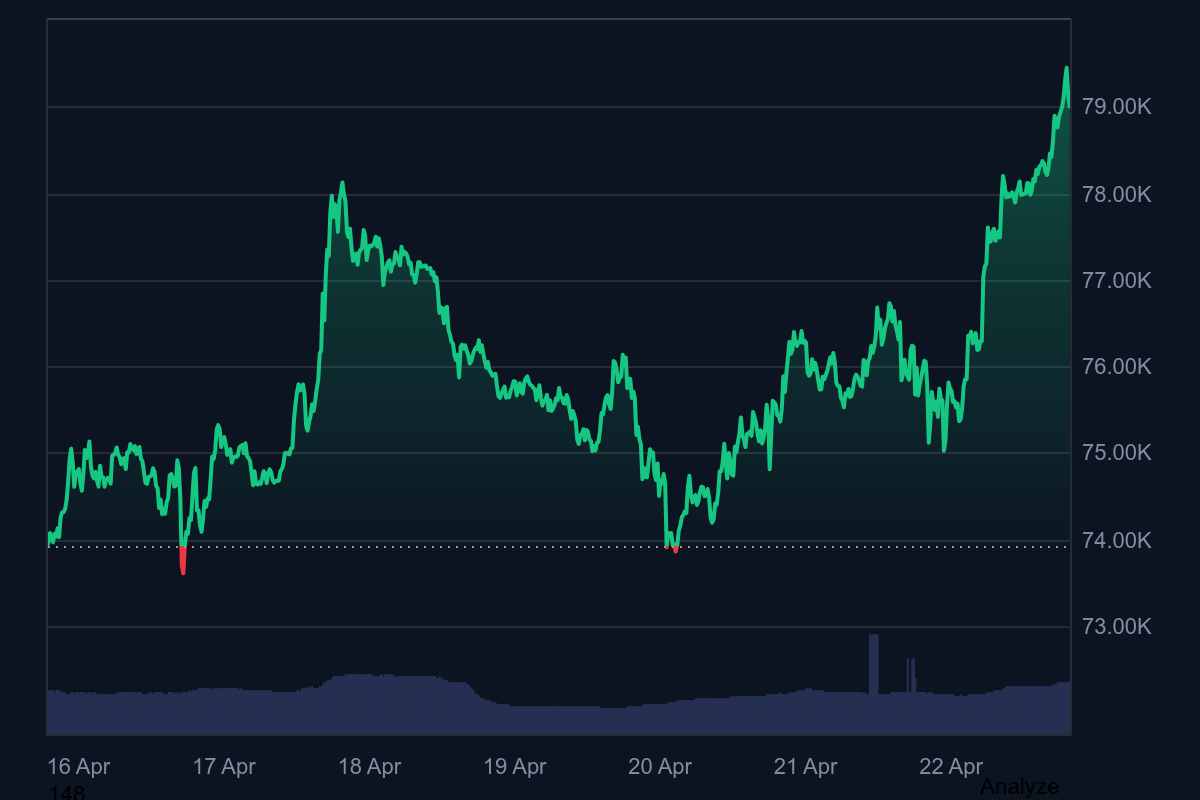
    The cryptocurrency markets have been energized again as Bitcoin ($BTC) surpassed the $78,000 mark, reaching its highest level in 11 weeks.

    With investor risk appetite increasing, Scott Melker and macro strategist Noelle Acheson discussed the current state of the market and the dynamics behind Bitcoin’s rise on “The Wolf Of All Streets” channel.

    Noelle Acheson stated that although Bitcoin is still viewed as a “risk asset” in the traditional financial world, its performance during times of crisis has shattered this perception.

    Weekly chart showing the recent rise in $BTC price.

    Experts, noting that Bitcoin has always gained value 60 days after seven major crises since 2020 (including the collapse of Silicon Valley Bank), argued that $BTC actually serves as a “protection against chaos.”

    Related News New Pro-Crypto Legislation on the Horizon in the U.S. – Here’s What the PACE Act Entails

    One of the most critical points that stood out was the “worrying” signals from the bond market while stock markets were hitting record highs. The rise in 10-year Treasury yields to 4.2% – 4.3% indicates that markets have not yet found the relief they expected from the Fed’s interest rate cuts.

    The broadcast stated that the hacking incidents in DeFi (Decentralized Finance) protocols last week and the vulnerabilities in platforms like “Kelp DAO” have created significant distrust in the market. This situation has driven institutional investors away from DeFi and towards Bitcoin, resulting in Bitcoin dominance reaching its highest level in the past year.

    Analysts believe that data from derivative markets has not yet signaled “overheating” (frothy), leaving the door open for a new rally towards the $82,000-$84,000 levels. However, experts emphasize that investors should exercise caution due to speculation surrounding the Trump administration and global geopolitical risks.

    *This is not investment advice.

  • The Protocol: Kelp DAO exploited for $292 million

    The Protocol: Kelp DAO exploited for $292 million

    Network News

    KELP DAO EXPLOIT: A cross-chain bridge holding nearly a fifth of a restaked ether token’s circulating supply just got drained, and the fallout is moving through DeFi faster than Kelp DAO can pause contracts. An attacker drained 116,500 rsETH (restaked ether) from Kelp DAO’s LayerZero-powered bridge at 17:35 UTC over the weekend, worth roughly $292 million at current prices and representing about 18% of rsETH’s 630,000 token circulating supply tracked by CoinGecko. LayerZero is a cross-chain messaging layer, or the infrastructure that lets different blockchains send verified instructions to each other. Kelp DAO is a liquid restaking protocol, which takes user-deposited $ETH, routes it through EigenLayer to earn additional yield on top of standard Ethereum staking rewards, and issues rsETH as a tradeable receipt. The bridge that was drained held the rsETH reserve backing wrapped versions of the token deployed on more than 20 other blockchains. The attacker tricked LayerZero’s cross-chain messaging layer into believing a valid instruction had arrived from another network, which triggered Kelp’s bridge to release 116,500 rsETH to an attacker-controlled address. Kelp’s emergency pauser multisig froze the protocol’s core contracts 46 minutes after the successful drain, at 18:21 UTC. Two follow-up attempts at 18:26 UTC and 18:28 UTC both reverted, each carrying the same LayerZero packet attempting another 40,000 rsETH drain worth roughly $100 million. — Shaurya Malwa Read more.

    NORTH KOREA CRYPTO HEIST PLAYBOOK: Less than three weeks after North Korea-linked hackers used social engineering to hit crypto trading firm Drift, hackers tied to the nation appear to have pulled off another major exploit with Kelp. The attack on Kelp, a restaking protocol tied into LayerZero’s cross-chain infrastructure, suggests an evolution in how North Korea-linked hackers operate, not just looking for bugs or stolen credentials, but exploiting the basic assumptions built into decentralized systems. Taken together, the two incidents point to something more organized than a string of one-off hacks, as North Korea continues to escalate its efforts to hijack funds from the crypto sector. “This is not a series of incidents; it is a cadence,” said Alexander Urbelis, chief information security officer and general counsel at ENS Labs. “You cannot patch your way out of a procurement schedule.” More than $500 million was siphoned across the Drift and Kelp exploits in just over two weeks. At its core, the Kelp exploit did not involve breaking encryption or cracking keys. The system actually worked the way it was designed to. Rather, attackers manipulated the data feeding into the system and forced it to rely on those compromised inputs, causing it to approve transactions that never actually occurred. — Margaux Nijkerk Read more.

    AAVE AFFECTED BY KELP DAO HACK: An attacker exploited that setup by forging a transfer message that appeared valid. The system approved the transfer even though the tokens were never taken out of the sending chain, meaning new tokens were effectively created without backing, releasing 116,500 rsETH from the Ethereum-side bridge. Rather than selling the assets on the open market, the attacker deposited 89,567 rsETH into Aave as collateral and borrowed roughly $190 million in $ETH and related assets across Ethereum and Arbitrum, according to the report. This left Aave exposed to collateral whose backing may be significantly impaired. Aave Labs said it moved quickly to contain the risk. Within hours, the protocol froze rsETH markets across its deployments, set loan-to-value ratios to zero, and halted new borrowing against the asset. The outcome now depends largely on how Kelp handles the shortfall. If losses are spread across all rsETH holders, the token would face an estimated 15% depegging (meaning the value of the staked tokens would not match the value of actual $ETH), resulting in about $124 million in bad debt for Aave. If losses are instead isolated to Layer 2 networks, the impact would be far more severe, with bad debt rising to roughly $230 million and concentrated on networks such as Arbitrum and Mantle.— Margaux Nijkerk Read more.

    COINBASE COMMISSIONS PAPER ON QUANTUM COMPUTING RISKS: A new report commissioned by Coinbase sounds a cautious, but urgent, alarm: Quantum computing won’t break crypto tomorrow, but the industry can’t afford to wait. The 50-page paper, authored by an independent advisory board that includes prominent cryptographers and academics like Dan Boneh of Stanford University, Justin Drake of the Ethereum Foundation and Sreeram Kannan of Eigen Labs, concludes that while today’s blockchains remain secure, a future “fault-tolerant quantum computer” capable of breaking widely used encryption is increasingly plausible, and preparation must begin now. In recent months, concerns around quantum risk have moved further into the mainstream. Google researchers have published estimates suggesting that a sufficiently advanced quantum computer could one day break Bitcoin’s cryptography. Major crypto ecosystems have already started mapping out their responses. The Ethereum Foundation has proposed new types of digital signatures that are designed to be safe against quantum computers, while Solana and others are experimenting with quantum-resistant wallet designs. The report stresses that current quantum machines are far from powerful enough to crack the cryptography underpinning Bitcoin, Ethereum and other networks. Breaking standard encryption would require vast computational overhead, a milestone still considered a major engineering challenge. — Margaux Nijkerk Read more.


    In Other News

    • A chunk of the Kelp DAO haul is no longer going anywhere. Arbitrum’s Security Council froze 30,766 $ETH worth roughly $71 million on Monday night, moving funds linked to Saturday’s $292 million rsETH exploit into an intermediary wallet that can only be accessed through further Arbitrum governance action. The council said it acted on law enforcement’s input regarding the exploiter’s identity and executed the freeze “without impacting any Arbitrum users or applications.” The transfer completed at 11:26 p.m. ET on April 20, according to Arbitrum’s statement on X. The stolen funds are no longer under the control of the address that originally held them. — Shaurya Malwa Read more.
    • A Polymarket contract on whether Kelp DAO will spread the losses from the weekend’s $292 million exploit beyond those directly affected is pointing to a clear answer: probably not. Bettors are giving a 14% chance that Kelp will “socialize the losses,” or implement a mechanism forcing rsETH holders on Ethereum, which wasn’t hit, to share the pain of users on other chains. The attackers drained roughly 116,500 rsETH from a LayerZero-powered bridge that held the reserves backing the token across more than 20 blockchains. That left parts of the system undercollateralized, with some holders effectively owning tokens no longer fully backed by ether ($ETH). “Socializing the losses” would mean Kelp redistributes the shortfall across all rsETH holders, including those on the Ethereum mainnet, rather than leaving losses concentrated among users and protocols tied to the compromised bridge. The most widely cited precedent of this approach came in 2016, when Bitfinex imposed losses on all users after a $60 million hack, effectively mutualizing the hit to avoid shutting down. — Sam Reynolds Read more.

    Regulatory and Policy

    • April appears to be a lost cause for the crypto Clarity Act, but a U.S. Senate committee hearing sometime in May could keep the critical market structure legislation alive, as long as it can reach a final vote of the overall Senate by July, according to lobbyists and a lawmaker aide focusing on the market structure bill’s sluggish progress. The legislative calendar is running out of room for this year, but a Senate aide told CoinDesk that a potential new delay of a couple of weeks — allowing Republican Senator Thom Tillis to finish discussions with bankers over stablecoin-yield concerns — is not yet pushing this work past the point of no return. The aide also said that earlier negotiations over decentralized finance (DeFi) protections are effectively settled, leaving few other impediments in the way of a committee approval.One of the chief problems the crypto industry faces (if it can leap the stubborn hurdle of the banking sector’s objections about stablecoin rewards) is that the Senate Banking Committee hearing that the bill needs to clear would be only a first step of many. — Jesse Hamilton Read more.
    • Tron creator Justin Sun sued World Liberty Financial, the stablecoin and crypto firm backed by members of U.S. President Donald Trump’s family, on Tuesday, alleging that the project had unfairly locked up his $WLFI holdings, made fraudulent misrepresentations, and threatened and defamed Sun. The lawsuit filed, which includes a line about Sun’s support for Trump himself, alleged that World Liberty’s leadership had engaged “in an illegal scheme to seize property” in the form of Sun’s tokens, which Sun alleged he had purchased after being solicited by the World Liberty team in 2024. “At that pivotal time for World Liberty, Mr. Sun invested $45 million to purchase $WLFI tokens from World Liberty not only because of the project’s claims that it would promote adoption of decentralized finance — an issue Mr. Sun cares deeply about and to which he has devoted much of his life’s work — but also because of the Trump family’s association with the project,” the suit said.— Nikhilesh De & Sam Reynolds Read more.

    Calendar

    • May 5-7, 2026: Consensus, Miami
    • June 2-3, 2026: Proof of Talk, Paris
    • June 8-10, 2026: ETHConf, New York
    • Sept. 29-Oct.1, 2026: Korea Blockchain Week, Seoul
    • Oct. 7-8, 2026: Token2049, Singapore
    • Nov. 3-6, 2026: Devcon, Mumbai
    • Nov. 15-17, 2026: Solana Breakpoint, London