Category: Business

  • Bitcoin’s Relative Strength Index (RSI) Approaches Its Strongest Overbought Zone in Two Years! What Does It Mean? Here Are the Details

    Bitcoin’s Relative Strength Index (RSI) Approaches Its Strongest Overbought Zone in Two Years! What Does It Mean? Here Are the Details

    A notable development has occurred in Bitcoin’s technical outlook. The cryptocurrency’s Relative Strength Index (RSI) rose to the 84-86 range, pushing Bitcoin into its strongest overbought zone since November 2024. This rise in the technical indicator has attracted investor attention following Bitcoin’s recent sharp gains.

    Bitcoin recently broke above its trading range of $62,000 to $71,000. Following this breakout, the cryptocurrency surged by up to 12% in just one to two days, coming very close to the $80,000 level at one point. This sharp price movement also led to a significant liquidation of short positions in the market.

    According to the data, over $3 billion in short positions were liquidated within 24 hours during Bitcoin’s surge. These forced position closures caused investors who had taken short positions to exit the market, and the resulting liquidations contributed to a further acceleration of the upward movement.

    In the short term, the $77,000 level stands out as an important support point for Bitcoin. Analysts believe that the price remaining above this level is critical for maintaining the uptrend. Conversely, it is noted that a loss of the $77,000 support level could strengthen short-term selling pressure.

    In Bitcoin, the RSI approaching its highest overbought region in two years indicates that strong momentum coexists with the risk of a potential correction.

    *This is not investment advice.

  • PI holds key support despite 15% decline – But $0.085 breakdown risk looms

    PI holds key support despite 15% decline – But $0.085 breakdown risk looms

    PI Network [PI] has declined by a double-digit percentage, showing that the asset is on the downside and has lost 15%.

    Market sentiment shows that while bears may be dominating, there hasn’t been sufficient data to suggest that a massive decline may be coming. If anything, it’s the other way around.

    PI’s real test is below

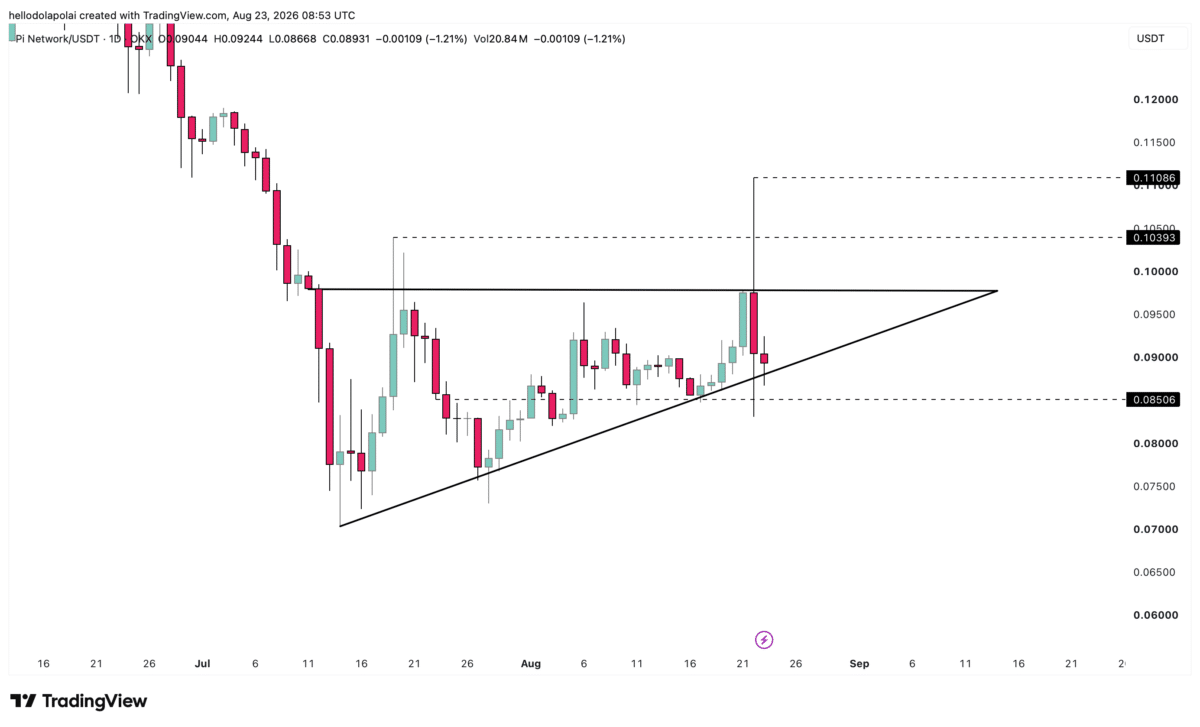
    The market structure data shows that PI has been trading within a bullish triangle pattern, and the recent drop is a decline toward the support line of the chart.

    The support line is the diagonal trendline, and this level has prevented a market decline on three different occasions, pushing the asset higher.

    This is the second attempt price has made to trade lower toward the support level, although there hasn’t been a breakdown below this level yet. If a breakdown occurs, then the price could find support at the horizontal support level of $0.085.

    Source: TradingView

    Ideally, the price could consolidate within the channel before a breakout to the upside, above the resistance, which could lead to a new high on the chart. If this happens, possible near-term targets for price would be $0.103 and $0.110, as marked on the chart.

    Still, there’s a possibility that the price will continue to consolidate along this line before a breakout to the upside.

    Capital flow isn’t favorable

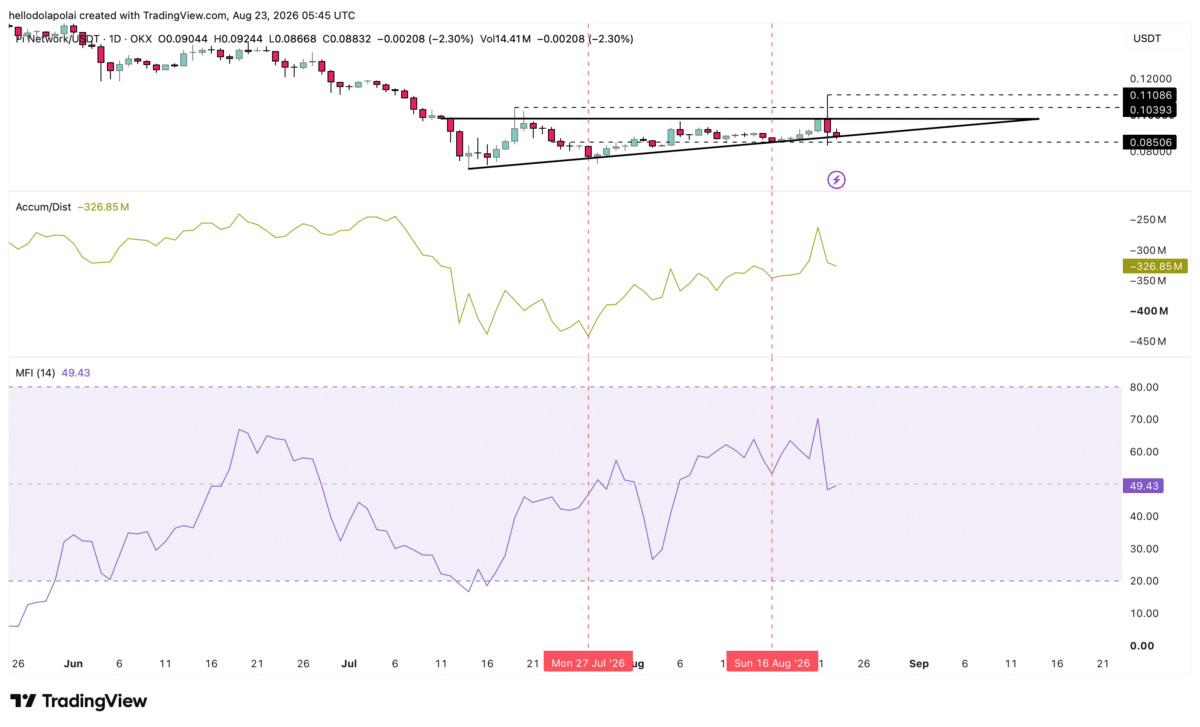
    Investors aren’t particularly bullish on price, and this could restrict capital flow into the market. At the time of this report, the Accumulation/Distribution indicator, as well as the Money Flow Index (MFI), has moved lower on the chart.

    The A/D indicator has been on the downside and remains on the sidelines, while the MFI is in the bearish zone, below 50.

    Source: TradingView

    The Accumulation/Distribution indicator is a volume-weighted tracker used to determine whether there is buying or selling pressure, while the Money Flow Index tracks overall buying and selling in the market.

    On the last two occasions when price traded into the support level on the chart, marked by the red line, the A/D indicator and MFI were both trending higher. This isn’t the case at present.

    Notably, the MFI needs to rally above 50 before the market can be considered bullish. A cross above this zone would imply that investors are likely to continue rotating capital into the market. Likewise, the A/D would need to move further higher for the bulls to establish dominance.

    Funding and market are still good

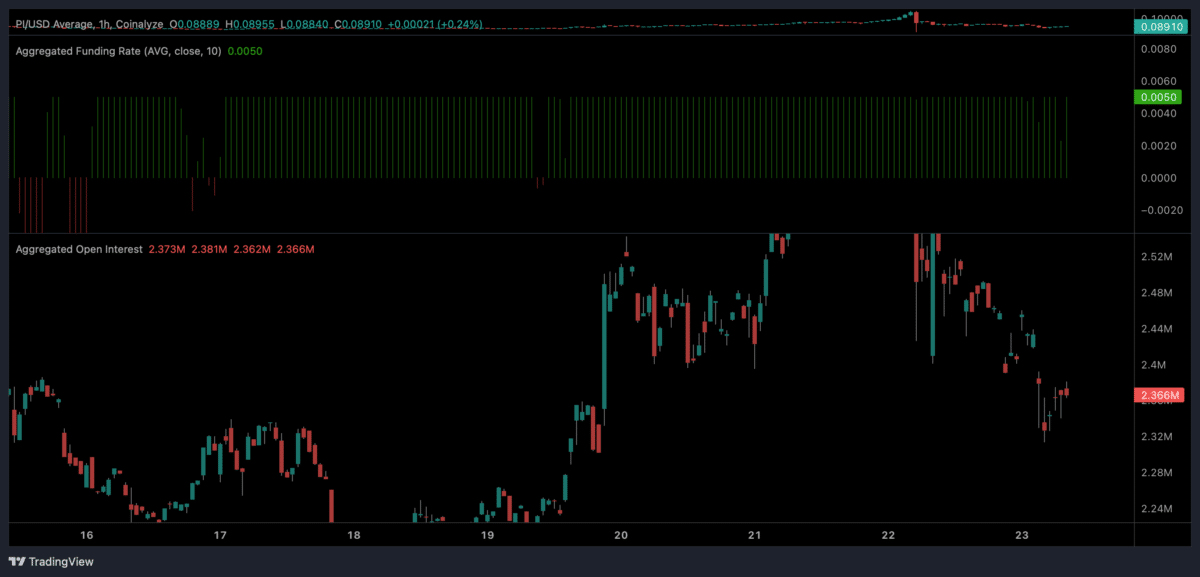
    There has been clear bullish sentiment across exchange activity. The Funding Rate and Open Interest in the market have remained bullish.

    The Funding Rate is at 0.0050 on the chart, implying that there are more long positions in the market and showing that traders are still buying the asset. At the same time, Open Interest has a reading of $2.3 million in the market.

    Source: Coinalyze

    The Funding Rate would play a key role in helping the asset maintain its bullish outlook, especially in the near term.


    Funding Rate

    • PI is testing a key triangle support level after its 15% decline, with a breakdown potentially exposing the $0.085 support.
    • Bulls need stronger capital inflows and a move above $0.103 to strengthen the case for a rally toward $0.11.
  • Ray Dalio Backs Bitcoin as US Debt Could Spiral to $60 Trillion

    Ray Dalio Backs Bitcoin as US Debt Could Spiral to $60 Trillion

    Dalio Backs Bitcoin as Debt Risks Intensify

    Bridgewater Associates founder Ray Dalio said growing debt, weakening demand for government bonds, and monetary expansion could erode currencies while supporting scarce assets. In an Aug. 21 LinkedIn analysis, he stated:

    “I expect non-government-produced monies like gold and bitcoin to do relatively well.”

    Bitcoin’s potential role rests partly on its predetermined issuance and maximum supply of 21 million coins. Its store-of-value characteristics include scarcity, portability, self-custody, and resistance to monetary debasement, although substantial volatility prevents it from providing consistent short-term stability.

    Dalio’s support remains measured rather than unconditional, reflecting his continued preference for gold as the more established monetary asset. In May, he argued that bitcoin’s correlation with technology stocks weakens its safe-haven appeal when investors sell volatile holdings to cover losses elsewhere.

    US Debt Could Reach $60 Trillion

    Federal finances already reflect several pressures highlighted in Dalio’s debt-cycle framework, including persistent deficits and rising interest costs. The Congressional Budget Office projected a $1.9 trillion fiscal 2026 deficit, with federal outlays of $7.4 trillion, revenue of $5.6 trillion, and debt held by the public reaching 120% of gross domestic product by 2036.

    America’s debt accumulation has continued at a rapid pace, strengthening arguments that scarce assets could provide protection against long-term currency depreciation. Total public debt outstanding reached $40.05 trillion as of the close of business Aug. 18, passing $40 trillion for the first time, Treasury figures released Aug. 19 showed.

    Debt growth had already been running fast ahead of that milestone, adding nearly $1 trillion within five months. Dalio said current projections imply another substantial increase over the coming decade as deficits require continued borrowing and interest expenses consume more federal revenue. The investor wrote:

    “After taking the recently passed budget reconciliation bill into account, most of the independent assessors of the situation project that the debt in 10 years will be $55-60 trillion.”

    A full debt crisis could arrive in three years, give or take two, if the country’s fiscal course does not change, Dalio guessed. He set out that timing alongside the debt projection in a summary of his book, “How Countries Go Broke: The Big Cycle.”

    Treasury Buybacks Reinforce Debt-Cycle Concerns

    The U.S. Department of the Treasury added another signal when it expanded long-term liquidity-support buybacks on Aug. 19. The department increased the maximum purchase size for certain 10- to 30-year securities from $2 billion to at least $4 billion per operation, effective Sept. 9 through Nov. 4.

    The expansion revived discussion of the debasement trade, under which investors reduce exposure to currencies and bonds while favoring scarce assets. Bitcoin advanced as the Treasury buyback announcement drew attention to dollar weakness, although Treasury repurchases do not constitute Federal Reserve quantitative easing and do not create money by themselves.

    Where Dalio Sees Bitcoin Falling Short of Gold

    Dalio also recognizes risks that could limit bitcoin’s monetary role despite its fixed supply and borderless network. He has identified potential vulnerabilities in bitcoin’s code, government controls, transaction transparency, and the possibility that central banks may remain unwilling to treat it as a reserve asset.

    His current position represents a shift from 2020, when he questioned bitcoin’s usefulness as money and warned that governments could restrict it if it became threatening to sovereign currencies. Dalio nevertheless acknowledged that he could be wrong about bitcoin and invited proponents to address his concerns.

    The Bridgewater Associates founder ultimately favors broad diversification while reducing exposure to debt assets and allocating some capital to non-government money. He advised:

    “As general advice, I suggest diversifying well in asset classes and countries that have strong income statements and balance sheets and are not having great internal political and external geopolitical conflicts, underweighting debt assets like bonds, and overweighting gold and a bit of bitcoin.”

    “Having a small percentage—maybe 10-15%—of one’s money in gold can reduce a portfolio’s risk, and I think it would also raise its return,” he concluded.

  • Zondacrypto vanishes with executives missing and customer funds frozen

    Zondacrypto vanishes with executives missing and customer funds frozen

    Zondagrypto, which used to be the leading cryptocurrency platform in Eastern and Central Europe, has vanished after both its top managers have disappeared and hundreds of thousands of users are blocked from accessing their funds.

    The incident serves as a reminder to the crypto industry, which is still struggling for recognition, about how swiftly people’s trust can disappear if they do not know what happens to their investments.

    The damage is not limited to Poland and Estonia, where the exchange has its roots. Cryptocurrencies have gained political and institutional acceptance in part due to President Donald Trump, whose family-owned cryptocurrency venture reportedly made $1.4 billion, as noted by the New York Times (Times).

    Nevertheless, Zondacrypto demonstrates that the old fraud problem in the business still matters. Its ZND token has lost 99.9% of its value, CoinMarketCap data shows, while the platform where it keeps customer deposits has been offline since April.

    Two bosses gone in four years

    The platform started as BitBay in 2014 in Katowice, which was founded by Sylwester Suszek, who was a miner’s son and was called a “crypto king” by the media in Poland. As per earlier reports by Cryptopolitan, Suszek vanished in March 2022 at the age of 34 after going to a fuel depot close to Katowice to meet his associate, Marian Wszolek.

    His family believes he was kidnapped and killed. Polish prosecutors later charged Wszolek with organized-crime membership, large-scale VAT fraud, money laundering, and unlawful deprivation of liberty tied to Suszek’s disappearance. Wszolek later vanished as well, the Times reported.

    The attorney representing Suszek, Przemyslaw Kral, has now taken control of affairs. The last communication from him was via social media on April 16, 2026, in which he told all clients to keep calm. It has been four months since then, although the Times alleged several sightings of him in places such as Israel, Botswana, and Dubai.

    Robert Nogacki, a lawyer from Warsaw acting on behalf of those clients who are unable to access their property, stated that:

    “It was a fraud from the first day.”

    The wallet only a missing man could open

    Kral assured anxious clients that Zondacrypto possessed 4,500 Bitcoins, which had a value of about $336 million at that time, with only Suszek in possession of the keys.

    However, this was not true according to blockchain forensics company Recoveris. Their investigation indicated that Zondacrypto’s major Bitcoin hot wallet has shown a 99.7% drop in holdings from the recorded maximum monthly average of 55.7 $BTC in August 2024 to 0.18 $BTC in March 2026. As of April 1, Zondacrypto had 0.086 $BTC remaining, worth around $9,700.

    According to Recoveris, similar European exchanges had an average of 308 $BTC in their primary hot wallets. Recoveris pointed out that the company had initiated the transfer of 511 transactions from Zondacrypto wallets to a deposit address at Kraken between mid-December 2025 and the beginning of April, worth approximately $21 million.

    The exchange refused to disclose wallet addresses as proof of its cold reserves and cited the MiCA and DORA rules of the European Union. Both regulations do not prohibit the disclosure of the information.

    Estonia pulls the license, Brussels’ clock runs out

    On June 29, 2026, the license of BB Trade Estonia OÜ, the parent company of Zondacrypto, was cancelled by Estonia’s Financial Intelligence Unit (FIU). Earlier, on May 18, the FIU had already temporarily suspended some of the company’s licenses, preventing it from accepting new clients.

    The agency added that its capacity is limited since its purpose is to supervise compliance of anti-money laundering laws, but not to check whether customers’ funds actually exist and are safely kept.

    The collapse’s timing added to its drama. Article 143 of MiCA mandates that providers operating according to pre-existing national regimes can continue to operate only up to July 1, 2026, or till their application gets approved or denied by the European Securities and Markets Authority (ESMA). Zondacrypto’s Estonian license disappeared just two days before the deadline.

    Prosecutors fold it into an organized-crime case

    According to a statement issued on August 3, the Zondacrypto investigation by the Regional Prosecutor’s Office in Katowice has been integrated with the investigation by the National Prosecutor’s Office run by the organized crime and corruption department in Silesia region.

    Prosecutors have a number of inquiries into the creation and functioning of BitBay and Zondacrypto, including the investigation related to the disappearance of Suszek.

    Prime Minister Donald Tusk of Poland has accused Zondacrypto of being connected to Russian crime syndicates and intelligence agencies, pointing out the company’s financial connections to right-wing politicians and events in Poland.

    Speaking at the Sejm on April 17 he stated that Zondacrypto’s rise to success had begun “with the money of the Russian mafia.”

    For now, its customers are only concerned about two issues: the fate of their deposits and the future of the two missing executives.


  • Cathie Wood Keeps Buying Circle Stock Despite 42% Price Slide

    Cathie Wood Keeps Buying Circle Stock Despite 42% Price Slide

    ARK Invest’s founder says Wall Street analysts do not understand the stablecoin issuer’s business model.

    Cathie Wood has kept buying Circle shares through a steep decline, according to reports from BeInCrypto and Yahoo Finance. The stock has dropped 42% from earlier levels this year. Wood, founder of ARK Invest, said Wall Street analysts covering Circle cannot fathom the company’s true worth.

    Circle is the issuer of $USDC, one of the largest dollar-pegged stablecoins in circulation. The company went public earlier this year, drawing significant attention from both traditional finance and crypto-native investors. Its stock performance since listing has been volatile, reflecting broader uncertainty about how markets should value stablecoin issuers.

    ARK Invest has built a reputation for taking concentrated, high-conviction positions in companies it believes are misunderstood by mainstream analysts. Wood has previously made similar bets on names in electric vehicles, genomics, and other disruptive technology sectors. Her continued accumulation of Circle shares during a sharp price decline fits that established pattern.

    Stablecoins occupy a unique position in financial markets. They function as digital dollar substitutes, used heavily in crypto trading, cross-border payments, and increasingly in traditional settlement systems. Circle’s revenue model depends partly on interest earned from reserves backing $USDC, making the company sensitive to interest rate movements and regulatory treatment of stablecoin reserves.

    Analyst skepticism toward Circle likely stems from several factors. These include competition from other stablecoin issuers, regulatory uncertainty around stablecoin legislation, and questions about how sustainable reserve-based revenue will be if interest rates decline. Wood’s public comments suggest she views these concerns as overstated or already priced into a lower valuation.

    The timing of Wood’s remarks comes as stablecoin regulation remains a live policy topic in the United States and elsewhere. Legislative efforts to establish clearer rules for stablecoin issuers have progressed at various paces across jurisdictions. Any regulatory clarity, positive or negative, could materially affect how investors value Circle relative to peers.

    Wood’s willingness to buy through a substantial drawdown signals confidence that current pricing does not reflect Circle’s long-term prospects. Whether that conviction proves correct will depend on factors including $USDC‘s market share, interest rate trends, and the pace of stablecoin regulatory frameworks taking shape.

    Market Impact

    ARK Invest’s continued buying could draw additional investor attention to Circle at a moment when its share price is under pressure. Institutional investors sometimes watch high-profile fund managers for signals about undervalued assets, though such buying does not guarantee a price recovery.

    The episode also highlights a broader disconnect between how traditional equity analysts and crypto-focused investors value stablecoin issuers. Divergent views on Circle’s business model may persist until stablecoin regulation and interest rate trends become clearer, which could keep volatility elevated in the stock.

    Cathie Wood’s continued purchases of Circle stock underscore her long-standing strategy of backing companies she believes the market has mispriced. The outcome will hinge on how stablecoin regulation and interest rate conditions evolve in the months ahead.

    Frequently Asked Questions

    What does Circle do?

    Circle is a financial technology company that issues $USDC, a stablecoin pegged to the U.S. dollar and widely used in crypto trading and payments.

    Why has Circle’s stock fallen 42%?

    The reports do not specify a single cause, but stablecoin issuers face pressure from regulatory uncertainty, interest rate sensitivity, and competition from other stablecoin providers.

    Why is Cathie Wood buying Circle shares during the decline?

    Wood has said analysts do not understand Circle’s long-term value, reflecting ARK Invest’s typical strategy of accumulating positions in companies it views as misunderstood.

    How could stablecoin regulation affect Circle’s stock?

    Clearer rules on stablecoin reserves and issuance could reduce uncertainty, while unfavorable regulation could pressure the company’s revenue model further.

  • Peter Schiff Says AI Could Turn Into Bitcoin’s Biggest Threat

    Peter Schiff Says AI Could Turn Into Bitcoin’s Biggest Threat

    The gold advocate and longtime $BTC critic made the argument Sunday afternoon, saying bitcoin supporters are attempting to connect the cryptocurrency with the booming AI investment trade when the technologies may actually be competitors.

    “Bitcoin pumpers are trying to hitch Bitcoin to the AI wagon, hoping investors will see it as part of the AI trade. They have it backwards. AI isn’t bullish for Bitcoin; it’s a threat to it,” Schiff wrote on the social media platform X.

    “AI competes with Bitcoin for speculative capital, electricity, and>Bitcoin miners have already felt that pressure. Some mining companies have begun converting portions of their infrastructure to support AI and high-performance computing (HPC) because those businesses can offer another source of revenue.

    That development, however, does not necessarily threaten the Bitcoin network itself. It creates competition for bitcoin mining companies, which must decide whether using available electricity for mining or AI computing produces better returns.

    Bitcoin was designed to adjust when mining participation changes. Roughly every 2,016 blocks, the network changes its mining difficulty to keep blocks arriving around once every ten minutes. If substantial computing power leaves Bitcoin, mining eventually becomes easier for the remaining participants.

    $BTC supporters and Schiff critics quickly piled into the economist’s X thread. “AI is a threat to gold more than it is to Bitcoin, Peter,” one account fired back. Schiff, apparently unconvinced, responded, “How so?” The user then laid out the counterargument:

    “You could ask AI yourself … But here you go … 1. AI finds huge new gold deposits. 2. Robots make mining far cheaper. 3. AI unlocks low-grade/deep-sea gold. 4. Better tech dramatically improves gold recycling. 5. Eventually, asteroid mining could flood supply. 6. More supply + less scarcity → gold prices fall.”

    AI Security Warning Faces a Higher Bar

    Schiff’s second argument goes further. He says increasingly powerful AI could discover vulnerabilities in Bitcoin’s code, cryptography, wallets or network that human researchers have overlooked. Software vulnerabilities are possible, and Bitcoin is not magically immune to programming mistakes. Wallet applications, exchanges, and Bitcoin implementations can contain bugs, which is why developers continually review and test software.

    Finding a bug, however, is not the same as changing Bitcoin’s monetary rules. Bitcoin’s 21 million supply limit is enforced by independently operated worker nodes, computers that verify whether transactions and blocks follow the network’s rules. Software attempting to create bitcoin outside those rules would be rejected by nodes still enforcing them.

    A fundamental break in Bitcoin’s cryptography would represent a much larger problem. Modern banking, secure websites, corporate systems, and government communications also depend heavily on cryptographic security. An AI system capable of defeating widely used cryptography could therefore threaten far more than Bitcoin.

    AI Could Strengthen the Defenses

    There is another problem with treating AI solely as an attacker. Developers and security researchers can use the same technology to examine code, discover bugs, automate testing, and identify weaknesses before criminals exploit them.

    That leaves Schiff’s strongest point centered on economics rather than Bitcoin’s ultimate survival. AI can compete with bitcoin miners for electricity, capital, and data centers, potentially squeezing mining margins and accelerating the industry’s search for cheaper power.

    What matters next is whether that competition pulls substantial computing power away from the Bitcoin network and whether AI produces meaningful advances in vulnerability discovery. For now, competition between AI and bitcoin mining is somewhat measurable, although muddy, while the prospect of AI breaking Bitcoin’s fundamental rules remains misguided.

  • Bitcoin’s True Purpose Revealed: Michael Saylor Explains Concept of Digital Energy

    Bitcoin’s True Purpose Revealed: Michael Saylor Explains Concept of Digital Energy

    Strategy (formerly MicroStrategy) Executive Chairman Michael Saylor laid out a new logic for cryptocurrency accumulation in a recent post. According to him, Bitcoin’s breakthrough lies in the ability to “convert economic energy into digital form and securely bind it to a person, family, company, machine, or state.”

    This statement immediately explains the changes taking place on Strategy’s own balance sheet, as the company is now shifting from passively holding coins to building a closed-loop corporate economy.

    Saylor’s logic meets market gravity

    The attempt to “securely bind energy to a company” is already reflected in record figures: according to its financial statements, Strategy holds 840,447 BTC on its balance sheet — exactly 4% of Bitcoin’s total supply — worth $64.9 billion.

    In practice, however, this “bound value” is now undergoing a severe crash test against market gravity. The company’s position remained under intense accounting pressure for a long time, and it managed to return to a net unrealized gain of $1.4 billion only because of Bitcoin’s price surge this week.

    Bitcoin’s most profound breakthrough is the ability to convert economic energy into digital form and bind it securely to a person, family, company, machine, or nation.

    — Michael Saylor (@saylor) August 23, 2026

    The practical bridge for “binding energy to machines and commercial entities” has become Strategy’s own $13.37 billion Digital Credit sector. Strategy channels Bitcoin’s digital energy into a collateral base, issuing tokenized obligations with fixed yields against it.

    The viability of Saylor’s theory about the strength of this bond is being tested under stress. When the flagship STRC token fell below par over the summer, management did not liquidate the Bitcoin collateral.

    Instead, Strategy used fiat reserves to repurchase the obligations, bringing STRC back to $96.22. Strategy’s current figures show that the company is attempting to turn Bitcoin into a working foundation for corporate debt.

    Nevertheless, this attempt to permanently “lock economic energy” into digital code still depends on the cycles of the traditional financial market.

  • Monad is Trading 38.95% Above Our Price Prediction for Aug 28, 2026

    Monad is Trading 38.95% Above Our Price Prediction for Aug 28, 2026

    Disclaimer: This is not investment advice. The information provided is for general purposes only. No information, materials, services and other content provided on this page constitute a solicitation, recommendation, endorsement, or any financial, investment, or other advice. Seek independent professional consultation in the form of legal, financial, and fiscal advice before making any investment decision.

    • Monad is up 9.02% today against the US Dollar
    • $MON/$BTC increased by 9.45% today
    • $MON/ETH increased by 8.96% today
    • Monad is currently trading 38.95% above our prediction on Aug 28, 2026
    • Monad gained 30.89% in the last month and is up 5.50% since 1 year ago

    $MON price is expected to drop by -22.77% in the next 5 days according to our Monad price prediction

    is trading at $ 0.028832 after gaining 9.02% in the last 24 hours. The coin outperformed the cryptocurrency market, as the total crypto market cap increased by 3.19% in the same time period. $MON performed well against $BTC today and recorded a 9.45% gain against the world’s largest cryptocurrency.

    According to our Monad price prediction, $MON is expected to reach a price of $ 0.020751 by Aug 28, 2026. This would represent a -22.77% price decrease for $MON in the next 5 days.

    $MON Price Prediction Chart

    Buy/Sell Monad

    What has been going on with Monad in the last 30 days

    Monad has been displaying a positive trend recently, as the coin gained 30.89% in the last 30-days. The medium-term trend for Monad has been bullish, with $MON increasing by 9.81% in the last 3 months. The long-term picture for Monad has been positive, as $MON is currently displaying a 5.50% 1-year price change. On this day last year, $MON was trading at $ 0.027330.

    Monad reached its all-time high price on Nov 26, 2025, when the price of $MON peaked at $ 0.048888. The current $MON cycle high is $ 0.037435, while the cycle low is at $ 0.016189. $MON has been displaying low volatility recently – the 1-month volatility of the coin is at 8.34. Monad recorded 14 green days in the last 30 days.

    Monad technical analysis for today – Aug 23, 2026

    The sentiment in the Monad markets is currently Bullish, and the Fear & Greed index is reading Greed. The most important support levels to watch are $ 0.026240, $ 0.024346 and $ 0.022416, while $ 0.030064, $ 0.031994 and $ 0.033888 are the key resistance levels.

    Bullish sentiment for Monad

    23 indicators are currently signaling a bullish prediction for Monad, while 5 indicators are showing a bearish forecast. With 82% of indicators favoring a positive prediction. This results in an overall Bullish sentiment for Monad.

    Crypto market is currently experiencing Greed

    Currently, the Fear & Greed index is at 66 (Greed), which signals that investors have a positive outlook on the market. The Fear & Greed index is a measure of sentiment among cryptocurrency investors. A “Greed” reading suggests that investors are currently optimistic about the cryptocurrency market, but can also be an indication that the market is overvalued. A “Fear” reading, on the other hand, signals that investors are currently hesitant about the cryptocurrency market, which potentially represents a buying opportunity.

    Monad moving averages & oscillators

    Let’s take a look at what some of the most important technical indicators are signaling. We’ll be going through key moving averages and oscillators that will allow us to get a better idea of how Monad is positioned in the market right now.

    The Relative Strength Index (RSI 14) is a widely used indicator that helps inform investors whether an asset is currently overbought or oversold. The RSI 14 for Monad is at 72.66, suggesting that $MON is currently overbought.

    The 50-day Simple Moving Average (SMA 50) takes into account the closing price of Monad over the last 50 days. Currently, Monad is trading below the SMA 50 trendline, which is a bearish signal.

    Meanwhile, the 200-day Simple Moving Average (SMA 200) is a long-term trendline that’s calculated by taking an average of the $MON closing price for the last 200 days. $MON is now trading below the SMA 200, signaling that the market is currently bearish.

    The bottom line about this Monad prediction

    After considering the above factors, we can conclude that the current forecast for Monad price prediction is Bullish. $MON would have to decrease by -22.77% to hit our $ 0.020751 target within the next five days. Moving forward, it will be important to monitor the $MON market sentiment, the key support and resistance levels, and other metrics. However, we have to keep in mind that the cryptocurrency markets are unpredictable, and even the largest crypto assets display a lot of price volatility. For long-term Monad price predictions click here.

    Disclaimer: This is not investment advice. The information provided is for general purposes only. No information, materials, services and other content provided on this page constitute a solicitation, recommendation, endorsement, or any financial, investment, or other advice. Seek independent professional consultation in the form of legal, financial, and fiscal advice before making any investment decision.