Category: Business

  • Bitcoin Smashes $80K as $260M in Shorts Get Wiped Out: Here Are the Next Targets

    Bitcoin Smashes $80K as $260M in Shorts Get Wiped Out: Here Are the Next Targets

    Bitcoin’s price revival that began last Wednesday culminated, at least for now, a few hours ago when the asset soared past $80,000 for the first time since mid-May and tapped a multi-month peak above $81,000.

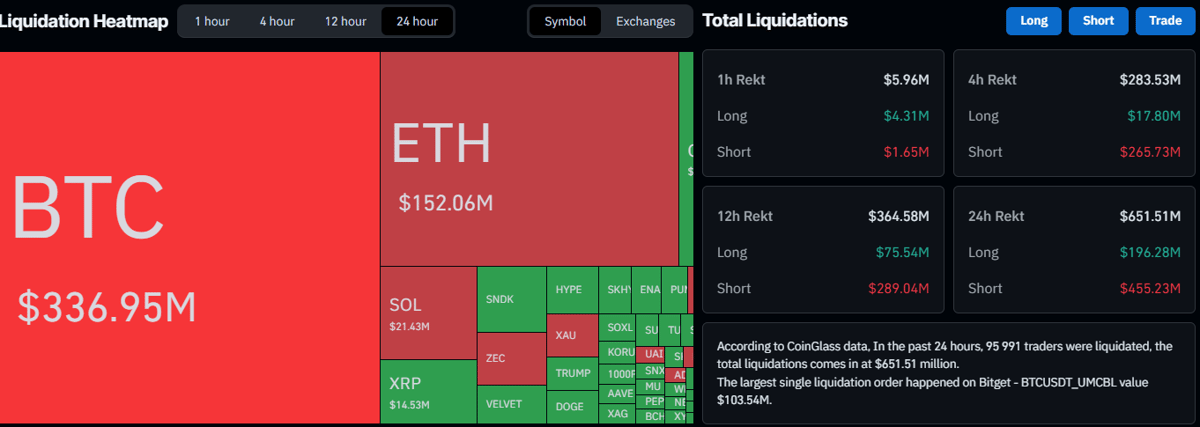
    Analysts were quick to pick up the move and outline the next short-term targets of up to $88,000. $BTC’s surge also led to an increase in liquidated short positions as the total value exceeded $260 million in the past 4 hours.

    On a daily scale, the liquidations are up to $650 million, with the lion’s share coming from shorts again. Bitcoin is responsible for half of that amount, according to data from CoinGlass.

    Liquidation Data on CoinGlass

    Thus, the primary cryptocurrency gained over $16,000 from its starting point of under $65,000 last Wednesday to just over $81,000 earlier today.

    Some of the reasons behind this major resurgence include the US Treasury Department’s announcement from last week, the Crypto Summit in the White House, renewed ETF appetite, and Jim Cramer. Oh, wait, the last one might be a joke.

    Some altcoins have followed $BTC on the way up today, including ETH, which has neared $2,500 once again. Although the asset has soared by 32% in the past week, the $2,500 barrier appears too strong at the moment. XRP, on the other hand, fights for the $1.50 resistance.

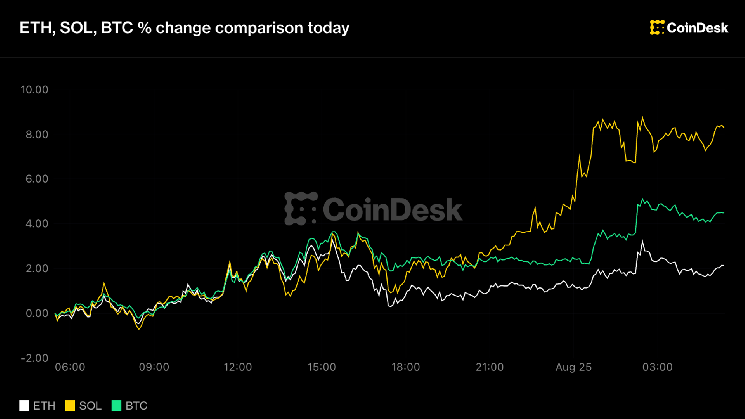
    SOL has surged the most from the larger-cap alts today, pumping by over 7.5%. It now trades above $100 for the first time in months as well.

  • Bitcoin tops $80,000, solana jumps 8% but rally now runs into overbought warning

    Bitcoin tops $80,000, solana jumps 8% but rally now runs into overbought warning

    Solana’s gains come as validators vote on two proposals that would cut SOL’s supply, as CoinDesk reported, one slowing new issuance and one raising daily burns to as much as $800,000. Voting closes Thursday.

    Zcash extended its run, up over 1% to $846 and 66% on the week, the strongest weekly performance among the top dozen tokens. Dogecoin edged up to 9 cents for a 32% weekly gain, and tron rose half a percent to just under 35 cents, the only major without a double-digit week at 4%.

    Hyperliquid’s HYPE was the sole decliner, off marginally at $81, though it holds a 36% weekly gain.

    The rally traces to Treasury Secretary Scott Bessent’s plan to step up bond repurchases, which revived talk of the debasement trade, the idea that holding assets outside government control protects against a currency losing value.

    Bessent added nothing further on Monday, saying the department will continue its regular programme of sales and signalling no changes before the next quarterly refunding announcement in November.

    Morgan Stanley estimated the Treasury has between $80 billion and $200 billion of spare cash it could put toward larger buybacks, according to interest-rate strategist Martin Tobias.

    Federal Reserve Chair Kevin Warsh speaks at Jackson Hole on Wednesday, his first appearance there since taking the job. Central bankers gather at the Wyoming resort each August, and the chair’s speech is where policy shifts have historically been signalled before they arrive, which is why traders treat it as a rate event in itself.

  • Bitcoin traders place $2.9 million bet on a rapid price jump above $82,000

    Bitcoin traders place $2.9 million bet on a rapid price jump above $82,000

    Bitcoin’s $BTC$80,733.47 recent staggering price rise has some traders paying millions for upside exposure.

    On Monday, one or more traders bought 2,000 bitcoin call-option contracts with an $82,000 strike price expiring on Sept. 4, according to data tracking platform Laevitas. The trade effectively bets that bitcoin’s spot price, currently near $80,000, will rise above $82,000 on or before Sept. 4.

    Think of it like buying a lottery ticket – the buyer pays a relatively small upfront amount for the chance of a much larger payout if the bet pays off. In this case, the call buyers spent $2.9 million in premium, the maximum they stand to lose if bitcoin remains below $82,000 through the Sept. 4 expiry.

    This bullish options flow comes amid a renewed upswing in Bitcoin. $BTC is currently trading around $80,000, up from roughly $64,000 a week ago, a 25% gain over seven days, according to CoinDesk data.

    The rally appears to have been driven by the U.S. Treasury’s bond-buyback announcement, continued inflows into spot Bitcoin ETFs, and short liquidations that likely accelerated the move higher.

    Caution persists

    Broadly speaking, the multi-billion dollar options market listed on Deribit continues to showcase caution.

  • Crypto Weekly Volume Doubles to $37B in Five Days, But August Momentum Slows

    Crypto Weekly Volume Doubles to $37B in Five Days, But August Momentum Slows

    Weekly cryptocurrency trading volume surged to $37 billion last week, doubling within five days, according to data from The Block. The sharp rebound follows a period of subdued activity, yet the figure remains far below the 12-month high of $105 billion recorded in mid-October, just after the market-wide selloff began.

    August Volume Lags July

    On a monthly basis, August has so far generated $490 billion in trading volume, a significant drop from July’s $670 billion. This slowdown suggests that while short-term momentum can spike, sustained participation has yet to return to earlier levels. The Block’s data highlights that the current cycle is notably different from past ones: the emergence of spot exchange-traded funds (ETFs) has redirected a portion of investment demand away from centralized exchanges (CEXs).

    However, analysts note that the majority of altcoin demand is still funneling through CEXs, indicating that decentralized venues or direct ETF exposure have not fully replaced traditional exchange activity for smaller tokens. This dynamic could shape liquidity patterns and fee revenues for major platforms in the coming months.

    Why This Matters for Traders

    The volume recovery, while modest, offers a glimpse into market sentiment. A doubling in five days often signals renewed interest, possibly driven by macroeconomic news or specific token catalysts. Yet the persistent gap from October’s peak suggests caution among institutional players, who may prefer regulated products like spot ETFs over direct exchange trading.

    Impact on Exchange Revenue and Liquidity

    For exchanges, lower monthly volume translates into reduced trading fee income. The shift toward ETFs also means that some trading activity that would have occurred on CEXs now happens off-exchange, potentially thinning order books for certain assets. Altcoins, however, remain a bright spot for CEXs, as their higher volatility and broader retail appeal continue to drive activity.

    Conclusion

    Last week’s volume spike is a positive sign for crypto markets, but it does not yet signal a full recovery. With August tracking below July and the shadow of October’s high still looming, traders and platforms should watch whether ETF adoption continues to reshape demand patterns. The data underscores a market in transition, where centralized exchanges retain their grip on altcoin trading while spot products capture a growing share of mainstream investment.

    FAQs

    Q1: Why did weekly crypto volume double in five days?
    Short-term catalysts, such as favorable regulatory news or a sudden price rally, often trigger a burst of trading activity. The exact driver isn’t specified, but volume spikes typically reflect increased participation from both retail and institutional traders.

    Q2: How do spot ETFs affect centralized exchange volume?
    Spot ETFs allow investors to gain exposure to cryptocurrencies without holding the assets directly, reducing the need to trade on centralized exchanges. This shifts some volume away from CEXs, particularly for major coins like Bitcoin and Ethereum.

    Q3: Will altcoin trading remain on centralized exchanges?
    Yes, for now. Most altcoins lack ETF products and have thinner liquidity on decentralized platforms, so traders continue to rely on CEXs for these assets. This trend is likely to persist unless regulatory changes or new financial products emerge.

    Related Reading

    • Multicoin Capital Moves $8.4M in HYPE to Coinbase Prime, Sparking Sell-Off Speculation
    • U.S. Treasury Weighs $1 Trillion TGA Drawdown for Bond Purchases, Boosting Liquidity
    • Nasdaq-Listed MicroCloud Hologram Buys $15.8M in Strategy Shares, Deepens Bitcoin Exposure
    • BTC Spot CVD Chart: Volume Heatmap and Order Flow Analysis at Aug. 24 Midnight UTC
    • Pantera Capital flags shift in Bitcoin positioning as price breaks key moving average
  • While Bitcoin Rises, Strategy Still on Hold! Founder Michael Saylor Makes Big Claims About BTC!

    While Bitcoin Rises, Strategy Still on Hold! Founder Michael Saylor Makes Big Claims About BTC!

    Strategy, the world’s largest publicly traded Bitcoin holder, did not make any purchases this week, as has been the case for some time.

    The company, which has been making headlines in recent weeks with its $BTC sales, currently holds 840,447 $BTC.

    The Week of Rise Was Wasted!

    According to a statement by Strategy founder Michael Saylor, Strategy neither bought nor sold Bitcoin last week.

    “…As of 23/08/2026, Strategy owns approximately 4% of the total $BTC supply and uses 0% net leverage.”

    Instead, the company announced it had increased its USD reserves to $5.10 billion and created an additional $1.59 billion in USD cash reserves.

    According to information shared by Strategy, MSTR generated $2 billion in capital through its sales.

    “…USD Cash strengthens our Digital Credit Capital Framework and is separately reserved for general Bitcoin Treasury Corporation purposes; these purposes include $BTC purchases, preferred dividends and interest payments, MSTR/preferred stock buybacks, convertible bond redemption, and increasing the USD Reserve.”

    According to the announcement, the company also repurchased STRC shares worth $136 million. The statement said, “These transactions further strengthen STRC,” and noted that the period for making dividend payments using dollar reserves has been extended by 414 days, bringing the total to 3.9 years.

    Saylor Sends a Message of Confidence in Bitcoin for the Next Ten Years!

    While Strategy also spent the past week without making any $BTC purchases, the company’s founder, Michael Saylor, made a noteworthy assessment regarding Bitcoin’s long-term investment potential.

    In his post, Saylor stated that investors should think like billionaires, and that to measure the value of an asset, they should consider “whether someone richer than them would want to buy that asset 10 years from now.”

    Saylor argued that Bitcoin meets this standard, which he described as the “Bernard Arnault test.” According to him, this measure shows that Bitcoin is an asset that wealthy individuals will want to buy not only today, but even a decade from now.

    *This is not investment advice.

  • ‘Think Like a Billionaire,’ Michael Saylor Issues New Bitcoin Advice

    ‘Think Like a Billionaire,’ Michael Saylor Issues New Bitcoin Advice

    Bitcoin’s vocal advocate and founder of the world’s largest Bitcoin treasury firm, Strategy, has sparked fresh debate on Bitcoin amid the persisting buzz surrounding the asset’s recent breakout.

    In a recent post shared by Saylor, the Bitcoin veteran shared a video that addresses the popular Bernard Arnault test, with claims that Bitcoin perfectly fits the criteria.

    Saylor Explains How to Think Like a Billionaire

    Saylor highlighted the Bernard Arnault test, describing it as how wealthy investors should make their investment decisions when in a dilemma about what asset to buy.

    According to Saylor, Bitcoin passes the Bernard Arnault test, which was formed and named after the CEO of LVMH, one of the world’s wealthiest individuals.

    While the test only categorizes assets that would still be considered desirable and in demand many years in the future for wealthy investors, Michael Saylor believes that Bitcoin fits into the category.

    In essence, Saylor recommends Bitcoin for anyone who thinks they have a lot of money and wants to invest it, suggesting that it is a way to think like a billionaire.

    Saylor Retains “Buy Bitcoin” Theory

    Following his statement, Michael Saylor extended his longstanding position that investors should not only ask whether an asset can make them richer, but whether there will still be a strong market of buyers willing to acquire it from them years later.

    This explains his relentless acquisition of the world’s largest crypto asset by market capitalization, regardless of whether the market is bullish or bearish.

    The founder continues to recommend Bitcoin as a preferred asset for long-term investment, emphasizing its scarcity and price potential in years to come.

  • EVM network halts block production after supply exploit as TON connection remains dark

    EVM network halts block production after supply exploit as TON connection remains dark

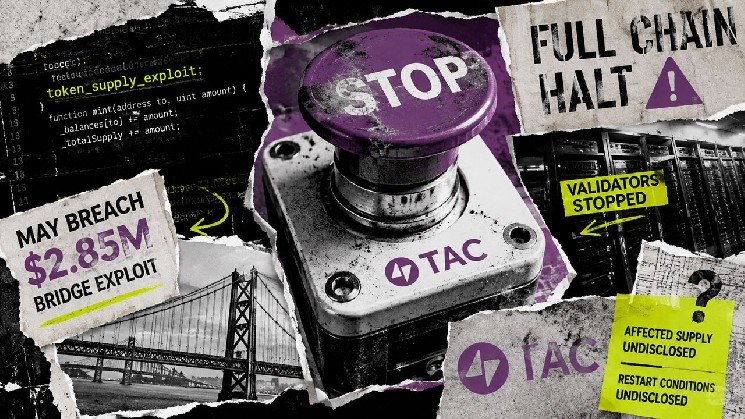
    TAC, an EVM network connected to TON, halted validator block production after the project said an exploited vulnerability affected the Cosmos-based EVM side of its network and, according to TAC, only the TAC token supply.

    In an Aug. 22 notice, the team said it was working with validators on a temporary halt that would take effect within minutes. TAC’s official Telegram announcement channel subsequently described the halt as implemented and promised further findings and steps toward resuming the chain.

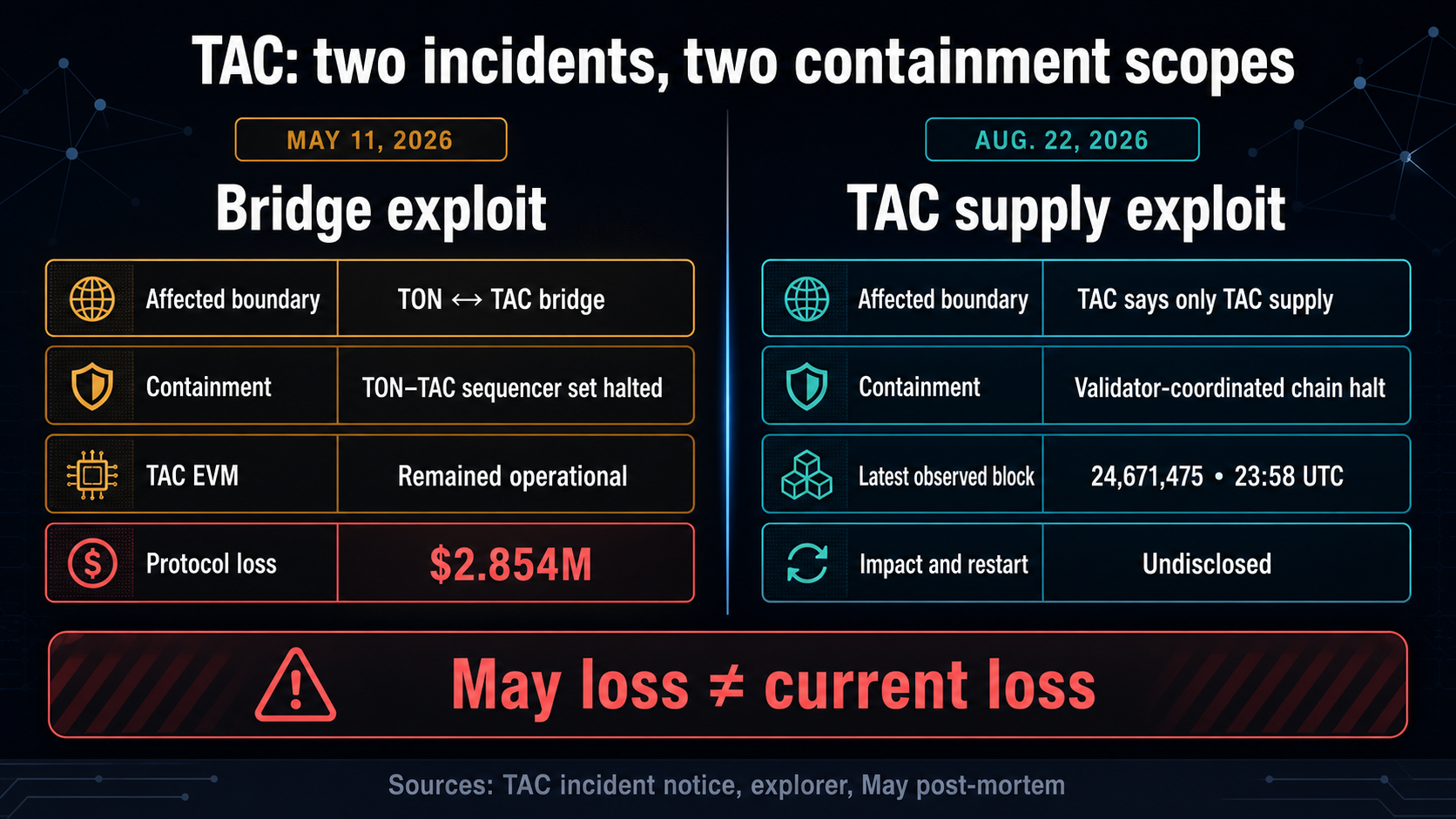
    A check of the TAC explorer API at about 1:03 p.m. UTC on Aug. 23 returned block 24,671,475, timestamped 11:58:11 p.m. UTC on Aug. 22, as the latest block. A fresh check of the TAC explorer at about 7:58 a.m. UTC on Aug. 24 still showed block 24,671,475.

    TAC’s notices did not identify an unauthorized TAC amount, a dollar loss, the exploit transaction or block height, the vulnerable component, affected wallets, user losses or a restart timetable. The team also did not explain why the problem could not be isolated below the full-chain level.

    The halt raises a state-reconciliation question that TAC has not yet answered. The project has not said whether native, wrapped, bridged, staked, exchange-held or protocol-controlled TAC balances must be checked before validators agree on a canonical state, and the available evidence does not establish that every one of those categories was affected.

    The scope differs from TAC’s separate May 11 bridge breach. In its May 20 post-mortem, TAC said its sequencer software failed to verify both the code hash of a TON jetton, or token, wallet and the expected minter behind it. Counterfeit deposit messages were accepted, unbacked equivalents were issued on TAC, and genuine assets locked on TON were released through the normal return path.

    TAC put the May incident’s total protocol loss at approximately $2,854,486.22 as of May 12 at 10 p.m. UTC. During that response, it halted the sequencer set connecting TAC to TON while saying the TAC EVM layer remained fully operational.

    The latest validator-coordinated chain halt is therefore a broader operational response, but it does not establish a new loss figure or show that the two incidents share a root cause. Until TAC publishes technical details of the Aug. 22 supply incident and a reconciled supply figure, the defensible conclusion is limited: block production was stopped, TAC says the issue concerns only its token supply, and the conditions for resuming remain undisclosed.

  • $400M AI crypto treasury firm seeks second reverse split while restoring capacity for 3 billion shares

    $400M AI crypto treasury firm seeks second reverse split while restoring capacity for 3 billion shares

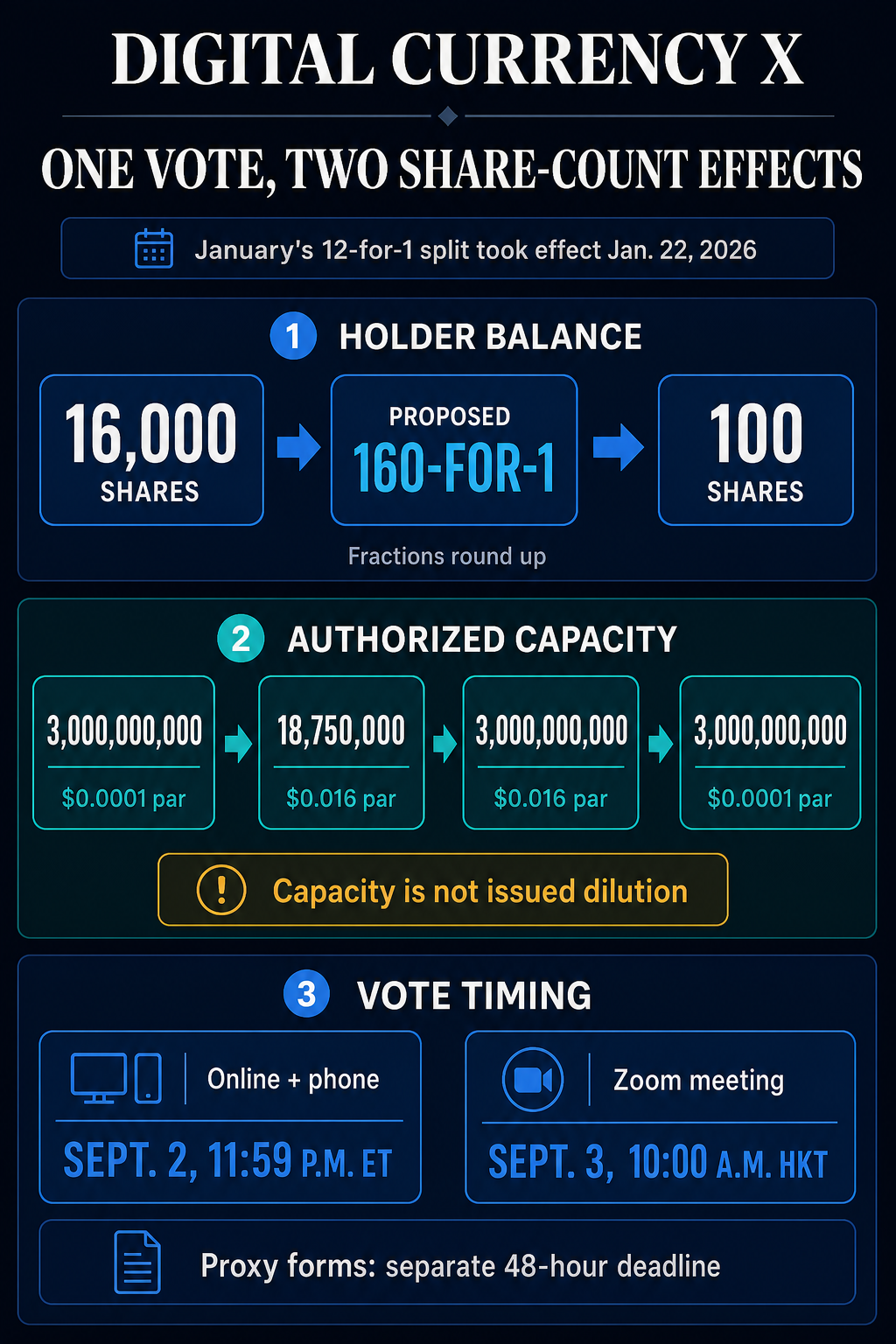
    Nasdaq-listed Digital Currency X Technology Inc. is asking shareholders to approve a 160-for-1 reverse stock split, also known as a share consolidation, on September 3. It would be the company’s second consolidation of 2026 after a 12-for-1 action took effect on January 22.

    Digital Currency X recently shifted from electric-vehicle manufacturing into the digital asset sector. In its latest annual report, the company said its treasury held 157.45 million EDGEAI tokens. It valued them at about $402 million as of December 31, 2025. It later locked all of those tokens in a 12-month staking agreement. The agreement carried a floating annualized yield of 3.5% to 8%.

    For a holder whose balance is divisible by 160, every 160 Class A or Class B shares would become one share. A holder of 16,000 shares, for example, would receive 100. The filing says the company would round fractional results up to the nearest whole share, so smaller or nondivisible positions would not follow that arithmetic exactly. The consolidation would cover both issued and unissued shares. It would take effect on a date confirmed by Nasdaq or one on which the exchange raises no objection.

    Related Reading

    Eric Trump’s American Bitcoin forces 1:15 reverse split to avoid Nasdaq delisting amid 8k BTC holding

    A reverse stock split, then an authorization reset

    The first resolution would reduce authorized shares from 3 billion, each with a par value of $0.0001, to 18.75 million, each with a $0.016 par value. A second resolution would immediately increase the authorization back to 3 billion shares at the higher par value. A third would reorganize the authorized share capital back to $0.0001 per share. Shareholders had approved the 3 billion-share authorization on May 13, according to a May filing.

    Authorized shares are capacity, rather than stock already issued. The resolutions would not themselves issue shares or prove immediate dilution, but they would leave the company able to issue far more shares after the consolidation than the 18.75 million-share ceiling created by the first step alone.

    Related Reading

    Zero mining revenue, 98% cash collapse, 2 million mysterious shares sets up miner’s 7 billion share survival play

    Share base and voting timeline

    The disclosed issued-share figures come from two earlier dates and establish only a floor. Digital Currency X’s annual report listed 19,823,627 Class A shares and 1,334 Class B shares outstanding as of April 20. A July 7 filing then said the company issued 331,753,557 units, each including one Class A share and warrants, at a July 3 private-placement closing. Together, those disclosures establish at least 351,577,184 Class A shares plus 1,334 Class B shares before any later warrant exercise or other issuance.

    Class A shares carry one vote each on general-meeting matters, while Class B shares carry 20. On the April counts, the Class B class represented 26,680 votes against more than 19.8 million Class A votes. The July issuance added Class A shares, but the materials do not establish current holder-by-holder control for the September vote.

    The company said it intended January’s consolidation to help regain Nasdaq minimum bid-price compliance. By contrast, the August meeting notice does not identify a compliance, financing, or offering rationale for the proposed 160-for-1 reverse stock split and capital reorganization. Intervening issuance also changed the share base, so the two ratios do not describe one continuous holder-level reduction.

    The Zoom-only meeting is scheduled for 10:00 a.m. Hong Kong time on September 3. Internet and phone voting closes at 11:59 p.m. Eastern time on September 2, while proxy forms have a separate deadline no later than 48 hours before the meeting.

  • Crypto Firm Shut Down After Nine Investors Lose Over £300,000

    Crypto Firm Shut Down After Nine Investors Lose Over £300,000

    UK Court Winds Up Key Coin Assets

    The U.K. government announced on Aug. 18 that a London court had wound up Key Coin Assets Ltd. a week earlier. An investigation by the Insolvency Service, the U.K. government agency that investigates corporate misconduct and insolvency, found no evidence that the company carried out any of the crypto trading it advertised.

    Nine people who took their complaints to Action Fraud, the U.K.’s national fraud and cybercrime reporting center, paid the company more than £300,000 between them.

    Unauthorized investment schemes remain a live risk for U.K. savers, with Britain’s full crypto authorization regime still more than a year away. The company told investors it could guarantee returns ranging from 40% to 100%, while one online promotion claimed “0 Fees, 0 Risks.”

    Insolvency Service Chief Investigator Mark George said:

    “Key Coin Assets Ltd promised guaranteed returns but delivered nothing. Their behavior displayed all the hallmarks of a Ponzi-style scheme.”

    Money from newer investors appeared to have gone toward paying off earlier ones rather than into any investment, the Insolvency Service noted.

    Funds Moved Into Director’s Personal Account

    Bank records examined by investigators showed customer funds were often transferred into the company director’s personal account within hours or on the same day they arrived. The money then became difficult to trace, while accounting records requested by the Insolvency Service were not provided during the investigation.

    The company repeatedly changed its official address, at one point listing a flat whose occupants had never heard of the firm. Filings at Companies House claimed assets reaching £42 million, a figure investigators found far above the level suggested by the company’s actual banking activity.

    Fake customer testimonials went up online without the permission of the people named in them. Moreover, investors were instructed to avoid terms such as “crypto” and “investment” in bank payment references.

    Fraud against individuals and businesses cost the U.K. economy £14.4 billion in 2023-24 and ranks as the country’s largest crime type, according to the government’s 2026-2029 Fraud Strategy. The strategy commits more than £250 million between 2026 and 2029 to combating it.

    FCA Had Previously Flagged the Firm

    The Financial Conduct Authority (FCA) added Key Coin Assets to its list of unauthorized firms on Sept. 12, 2024, nearly two years before the court order. The FCA warning on Key Coin Assets states that the firm was not authorized and could be targeting U.K. consumers.

    Anyone dealing with an unauthorized firm is not protected by the Financial Ombudsman Service, which handles complaints against financial firms, or the Financial Services Compensation Scheme, which can compensate customers if an authorized firm fails.

    The regulator has also stepped up enforcement elsewhere in the sector, including raids on eight premises linked to suspected illegal peer-to-peer crypto trading. That April operation marked its first coordinated enforcement action of that type and resulted in cease-and-desist letters as authorities examined potential unlawful activity.

    What Investors Should Check Before Paying

    The Insolvency Service and the FCA urge anyone weighing a crypto investment to look up the firm on the FCA’s Firm Checker and its list of unauthorized firms. Guaranteed high returns, a request to leave normal payment references off a transfer, and pressure to recruit other investors are the warning signs both bodies name.

    A common crypto scam warning sign is an unusually high return advertised alongside little or no apparent risk. Investigators found that exact combination in the material Key Coin Assets put in front of its customers.

    Wider UK Crypto Rules Take Effect in 2027

    Crypto firms carrying on regulated crypto asset activities in the U.K. will answer to the FCA the way banks and brokers already do, under the Financial Services and Markets Act 2000 (Cryptoassets) Regulations 2026. The regulations were finalized in February 2026, according to an HM Treasury policy note on the cryptoasset regulations.

    The final framework covers businesses including exchanges, custodians, staking providers, and lenders, with an Oct. 25, 2027 effective date outlined in the U.K.’s final crypto rulebook. Firms can begin applying for authorization from Sept. 30, 2026, creating a transition period before the broader rules take effect.

    Separately, U.K. lawmakers opened a July inquiry into crypto banking access, asking whether banks are cutting off legitimate crypto companies. The Crypto and Digital Assets All-Party Parliamentary Group wrote to major bank executives on Aug. 11 and is gathering evidence through Aug. 31.

    The Official Receiver, a government official who handles the affairs of companies wound up by the court, has been appointed liquidator of Key Coin Assets following the High Court order.