POSCO International, South Korea’s largest trading company, is pushing deeper into tokenized trade finance, completing a transaction that turned real-world receivables into digital assets on an Avalanche-based ($AVAX) blockchain network just one month after a similar pilot on Injective.
The firm’s U.S. arm worked with trade finance platform Olea and asset-backed finance technology firm Intain on the transaction, the companies said Tuesday. Intain used artificial intelligence to reconcile invoices, purchase orders, credit notes and shipping documents before verifying and recording the receivables on its Layer-1 network built on Avalanche ($AVAX).
Trade receivables are money owed to a company after it delivers goods but before the customer pays. Companies can borrow against those invoices, but financing often involves reconciling records held separately by buyers, sellers and banks.
Putting the receivable on a shared blockchain ledger creates a common record of ownership and the asset’s status, potentially cutting that paperwork and giving companies quicker access to financing.
The move followed POSCO International’s pilot with LG CNS announced last month to issue, transfer and settle tokenized receivables on Injective. That project also used receivables generated from live trade between POSCO’s overseas subsidiaries and their counterparties.
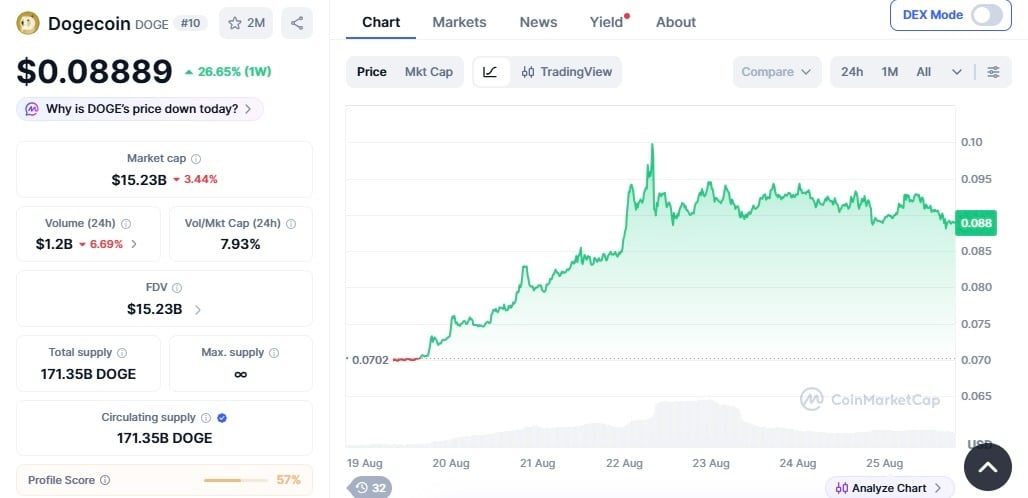
As Dogecoin ($DOGE) price surged by more than 26% over the past seven days, reaching a market capitalization of $15.27 billion on Tuesday, it retested a major year-to-date (YTD) resistance level.
After its impressive rally last week, $DOGE price has been trapped in a consolidation over the past three days. This large-cap dog-themed memecoin has fallen 2.87% over the last 24 hours, trading at $0.0888 on August 25.
Dogecoin performance. Source: CoinMarketCap
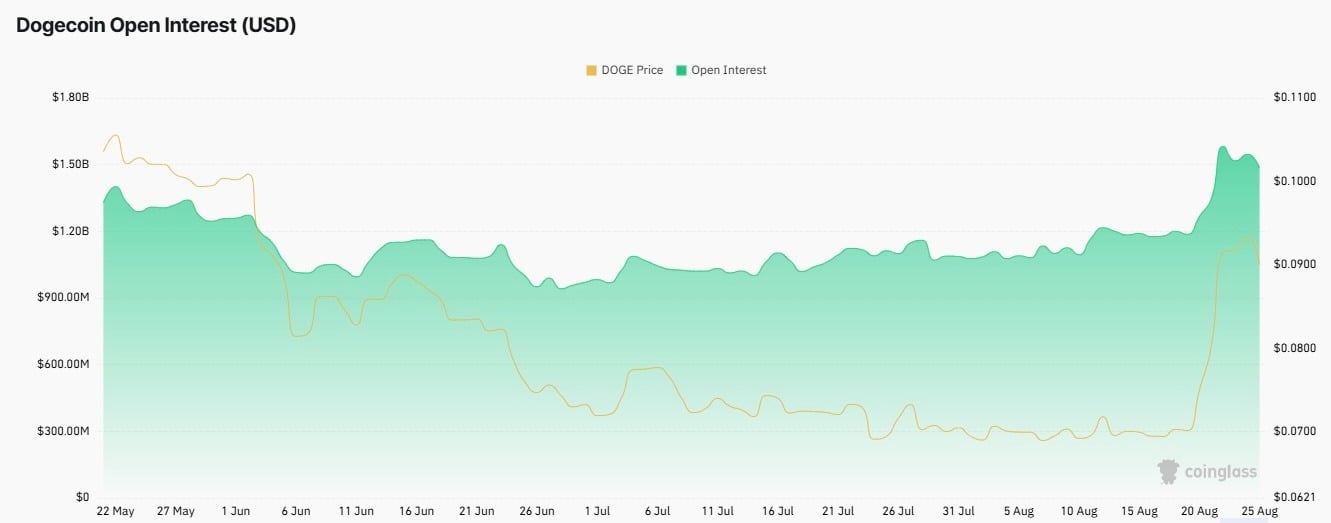
At the time of publication, $DOGE had a reported trading volume for the past 24 hours of nearly $1.2 billion. The token’s 24-hour futures volume was $2.09 billion while its Open Interest (OI), the total unsettled futures in the derivatives market, was at $1.45 billion, according to data from CoinGlass.
Worth noting that Dogecoin’s OI has surged to its highest level since May 16, thus signaling a heating up of its derivatives market.
Dogecoin’s OI. Source: CoinGlass
What’s next for the $DOGE price?
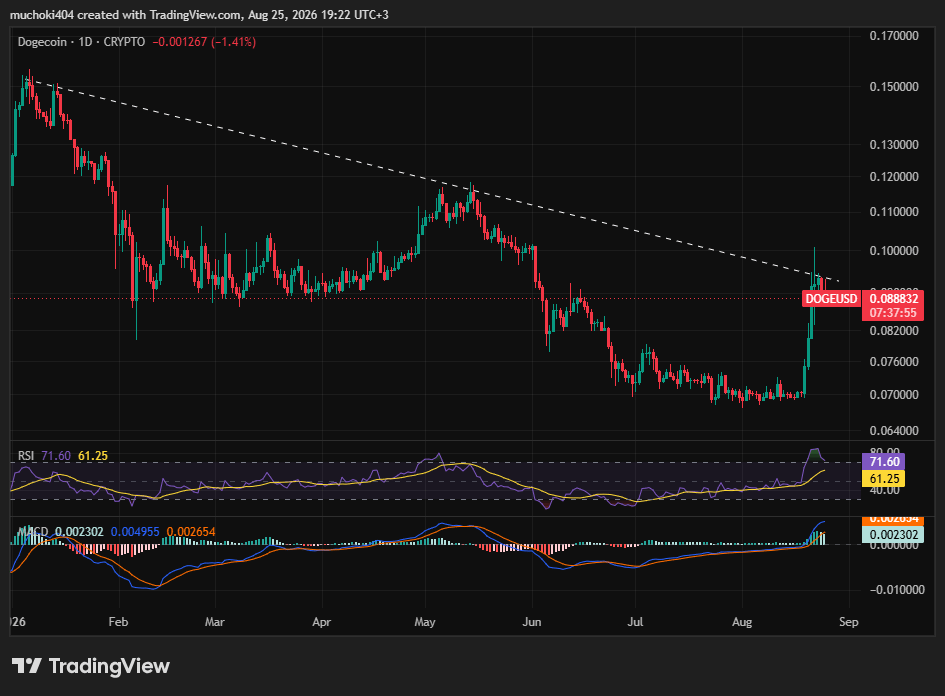
The recent Dogecoin price rally has pushed it to a major YTD resistance logarithmic trend line. The last two times that $DOGE price retested this YTD resistance trend lined resulted in a 40% selloff in the subsequent days.
$DOGE’s YTD chart. Source: TradingView
Dogecoin’s daily Relative Strength Index (RSI) recently surged to its YTD’s peak, currently at 71.60, which signals an overbought condition. On the other hand, the daily Moving Average Convergence Divergence (MACD) line and Signal line have all crossed above the Zero line, suggesting a strong bullish uptrend for the first time since early May, 2026.
From a technical analysis standpoint, if Dogecoin price consistently breaks above its YTD resistance trend, its recent bullish momentum could strengthen. However, if the recent FOMO (fear of missing out) fails to push $DOGE price above its YTD resistance trend line, a potential selloff could be inevitable.
The cryptocurrency projects that generated the most revenue in the last 30 days have been identified. The data reveals the revenue performance of projects operating in different sectors, from stablecoin issuers and blockchain networks to decentralized exchanges and prediction markets.
Stablecoin giant Tether topped the list with $438.9 million in revenue. While Tether’s revenue decreased by 0.1 percent compared to the previous 30-day period, Tron came in second with $224.6 million. Stablecoin issuer Circle was third with $181.5 million.
A significant difference in revenue emerged after the first three projects. The decentralized derivatives exchange Hyperliquid generated $48.6 million in revenue, registering a 25.3% increase over the past 30 days. The memecoin-focused trading platform pump.fun, on the other hand, stood out with $30.7 million in revenue and a 62.3% increase.
The income data for the last 30 days is as follows:
Tether – $438.9 million (-0.1%)
Tron (TRX) – $224.6 million (-0.7%)
Circle – $181.5 million (-1.3%)
Hyperliquid (HYPE) – $48.6 million (+25.3%)
pump.fun (PUMP) – $30.7 million (+62.3%)
Sky (SKY) – $30.5 million (-11.7%)
Polymarket – $25.6 million (-29.7%)
GMGN – $17.1 million (+159.0%)
Axiom Trade – $15.4 million (+59.5%)
Ethereum (ENA) – $14.7 million (-1.8%)
PancakeSwap (CAKE) – $10.5 million (+18.0%)
Grove (GROVE) – $7.2 million (+9.7%)
Uniswap (UNI) – $6.1 million (+74.7%)
Phantom – $6.0 million (-2.4%)
Lido Finance (LDO) – $4.7 million (+15.0%)
GMGN was the most remarkable project in terms of revenue growth. The platform’s revenue trend over the last 30 days increased by 159%, while Uniswap saw a 74.7% increase, pump.fun a 62.3% increase, and Axiom Trade a 59.5% increase.
The strong rally in the cryptocurrency market in recent weeks has led to a sharp shift in investor sentiment. The Crypto Fear and Greed Index rose to 81 points, reaching its highest level of the year, pushing market sentiment into the “Extreme Greed” zone. Just a month ago, the index was in the “Fear” zone, highlighting the rapid reversal in investor risk appetite. Last week, the index was at 41 points, in the “Neutral” level.
Bitcoin ($BTC) continues its upward trend, trading at $79,252 and gaining approximately 0.67% in the last hour.
However, the Fear and Greed Index in the BitcoinSystem On-Chain Terminal data currently shows a “Greed” level with 74 points.
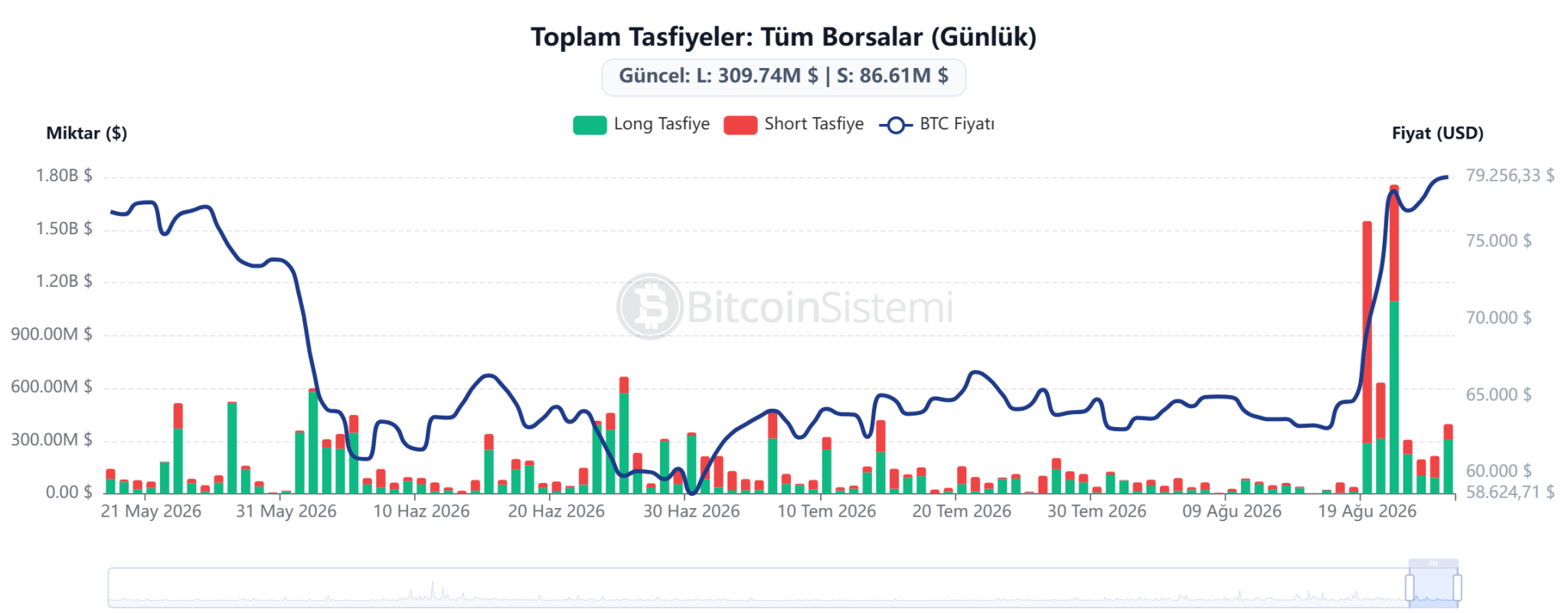
In derivatives markets, high volatility is noteworthy. According to liquidation data from the last 24 hours, a total of $424.5 million in leveraged positions were liquidated. Of this, $334.2 million consisted of long positions and $90.3 million consisted of short positions.
A graph showing liquidations in the cryptocurrency market.
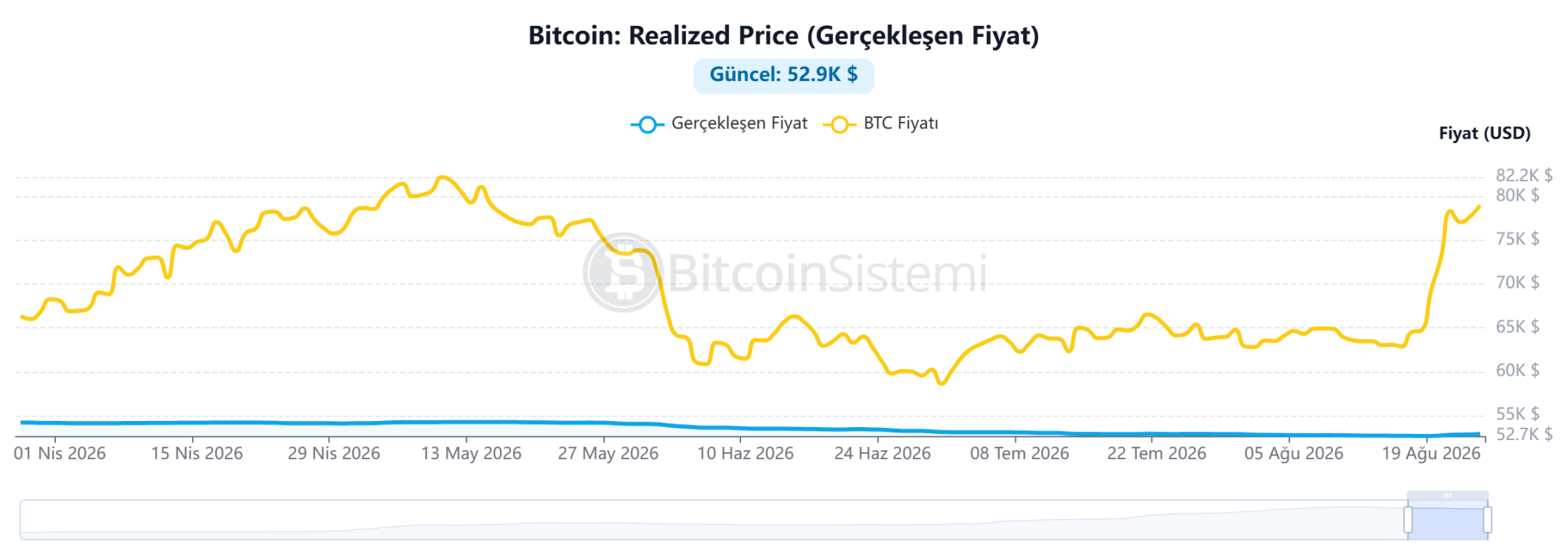
Bitcoin’s on-chain indicators also provide important signals regarding the current structure of the market. While Bitcoin’s current price is around $53,000, the fact that the market price is significantly above this level suggests that a large portion of investors are in profit-taking.
A chart showing the realized price information for $BTC.
The MVRV ratio is at 1.49. This value indicates that Bitcoin’s market capitalization is approximately 49 percent above its realized value, but remains below the much higher levels seen during overheated periods of past bull markets.
The Net Unrealized Profit/Loss (NUPL) indicator being at 0.33 also suggests that Bitcoin investors are holding unrealized profits overall. The SOPR indicator being at 1.0193 indicates that, on average, Bitcoins moved on the chain are being spent at a profit. SOPR remaining above 1 is considered a signal that profit-taking by investors is continuing.
The Puell Multiple indicator, which compares miners’ earnings to the Bitcoin price, is at 0.93. The indicator being close to 1 suggests that miner earnings have not yet reached excessively high levels compared to historical averages.
Blockchain analytics firm Chainalysis said a global operation it led identified more than 7,700 suspect accounts linked to child sexual abuse material (CSAM).
According to a Tuesday press release shared with Cointelegraph, Operation Lighthouse investigated 29,120 crypto addresses and digital identifiers connected to over 100 CSAM platforms, forums and distribution networks across the surface and dark web.
The operation also generated 14,300 investigative leads across 11 crypto exchanges and payment services and flagged suspects across 125 countries. Among the suspects identified were 16 registered sex offenders.
Tom McLouth, senior intelligence analyst at Chainalysis, said the suspect pool also included military personnel, law enforcement officers, medical professionals and educators, including individuals with direct access to children.
“Behind every lead is a real child at risk,” he told Cointelegraph.
The multi-day sprint was hosted at the National Cyber-Forensics and Training Alliance in New York after months of data enrichment. It brought together law enforcement agencies, private-sector partners and specialized nonprofits, including Europol, the UK National Crime Agency, Binance, Coinbase, Block and the Internet Watch Foundation.
Participants used onchain intelligence to develop leads for follow-on legal processes and case development. Chainalysis said the results were expected to lead to arrests, prosecutions and account-level disruption.
Crypto firms expand efforts against child exploitation
Operation Lighthouse follows other efforts by crypto firms and child-protection organizations to expand intelligence sharing around crypto activity linked to exploitation. Europol said joint action was essential because perpetrators exploit financial services, payment systems and internet platforms.
Binance, one of the exchanges participating in Lighthouse, announced a partnership with nonprofit Stop The Traffik in July. The exchange said the organization would provide intelligence, training and insights intended to improve its detection and investigation of crypto activity linked to human trafficking and child exploitation.
Blockchain tracing has previously contributed to enforcement actions in CSAM investigations. In 2019, the US Justice Department announced the takedown of Welcome to Video, described at the time as the largest darknet child sexual exploitation market by volume of content.
Authorities traced Bitcoin payments to locate the website server in South Korea and identify its administrator. The investigation led to 337 users being arrested and charged, the rescue of at least 23 victims and the seizure of about eight terabytes of material.
Chainalysis said its software was used to analyze the transactions and map the site’s users and contributors.
Arthur Hayes, closely followed for his statements and predictions in the cryptocurrency market, made noteworthy assessments for Bitcoin and Ethereum, as well as Ethereum ($ENA) and Ether.fi ($ETHFI). Hayes argued that a new bull market has begun and stated that Maelstrom is taking maximum risk on all four assets.
Arthur Hayes, who stated that he expects a major rise in cryptocurrencies, argues that Bitcoin is poised for a parabolic increase.
In a recent interview on the Altcoin Daily YouTube channel, Hayes claimed that Bitcoin is likely to soon experience a full parabolic rise, and therefore now is the right time to hold the asset.
Hayes added that Bitcoin would quickly reach “hundreds of thousands of dollars” and that anyone worried about the Fed’s control over bond yields should own Bitcoin now.
Highlighting $ENA!
Hayes, who stated that he is optimistic about altcoins as well as Bitcoin, noted that base trading, which profits from the price difference between spot and futures markets, is beginning to revive, and said that this is a positive signal for the crypto market.
However, Hayes noted that interest rates are still too low.
Hayes stated that the reactivation of base trading could be particularly positive for Ethereum ($ENA) and that $ENA still holds significant upside potential.
In his latest blog post, Hayes stated that the Maelstrom fund is also in maximum risk mode and shared the altcoins in their portfolio.
“Bitcoin, Ethereum, Ethena and Ether.fi”
FLOP is an Important Part of a Blog Post!
Hayes also dedicates a significant portion of his latest blog post to his new project, Flop Network.
They state that there is no pre-sale for FLOP, the token cannot be purchased, and useful activities on the testnet are required for the airdrop.
“…I repeat: there is no pre-sale. You cannot buy FLOP. Only those who participate in beneficial ways are eligible. Stay tuned for more information about the airdrop…”
Therefore, FLOP should not yet be considered an existing market position like $ENA or $ETHFI. Hayes positions it more as a new project to be established at the beginning of a new bull market.
“For over a century, getting a professional model meant handing your assets to a fund,” Bitwise Chief Investment Officer Matt Hougan said. “ATPs mean you can keep the assets in your own wallet, and the model comes to you.”
The announcement comes a day after Coinbase debuted tokenized versions of Apple, Nvidia, Meta and Alphabet on Base. Coinbase said more stocks are coming, and Bitwise’s portfolios offer a hint at potential additions: Microsoft, Amazon, Tesla, SpaceX and Sandisk are also included in its models. Coinbase hasn’t confirmed its next batch.
The products also expand Bitwise beyond the crypto ETFs for which the $9 billion asset manager is best known. It has recently moved into DeFi vault curation, another form of onchain asset management.
Glider, meanwhile, is a specialist of automated portfolios, and earlier this year teamed up with Ondo Finance to offer personalized portfolios using Ondo’s tokenized stock offerings.
Read more: Tokenization mirrors the $20 trillion ETF boom as blockchain and AI converge, Ondo exec says
A trio of former executives from Danish digital bank Lunar has decided that spreadsheets and human-only bookkeeping have run their course. Together with a professional auditor, they’ve raised €8.2 million to build Repodo, a startup betting that artificial intelligence can finally break into the notoriously conservative audit market, starting with small businesses in Denmark rather than the multinational giants that dominate the industry today.
Key takeaways
Repodo raised €8.2 million to launch an AI-powered audit firm, with the round led by Hedosophia and Seed Capital.
The company was founded by three former Lunar executives alongside professional auditor Anders Houmann.
The global audit market is worth roughly €80 billion, with Europe accounting for about €74 billion of that total.
Repodo is targeting small and medium-sized enterprises in Denmark first, with plans to expand across Europe.
The Big Four firms have poured billions into AI tools but remain focused on large corporate clients, leaving SMEs largely underserved.
Launch of Repodo and Its Founders
Repodo’s arrival answers a simple question: what happens when people who scaled a challenger bank turn their attention to auditing? The company launches with fresh capital and a founding team that blends fintech experience with formal audit credentials, an unusual pairing in a profession built on regulatory caution.
Funding and Investors
The €8.2 million funding round was led by Hedosophia and Seed Capital, two firms that also backed Lunar during its earlier fundraising rounds. That continuity matters. Investors who watched Lunar grow from a Danish challenger bank into a company that has raised more than €500 million since 2015, with over one million customers, are now placing a similar wager on the audit sector. It’s a signal that backers see repeatable playbooks between digital banking disruption and reshaping how audits get done.
Founding Team Composition
Three of Repodo’s founders previously held executive roles at Lunar. Joining them is Anders Houmann, a professional auditor whose presence addresses a structural reality of the industry: audit is heavily regulated, and no software, however advanced, can substitute for the legal requirement that a qualified human sign off on the final result. Repodo’s pitch rests on dividing labor sensibly, letting machines handle volume while licensed professionals retain accountability.
Repodo’s AI Approach to Auditing
Repodo describes itself as “AI-native,” a label meant to draw a sharp line between its technology and the bolt-on chatbots that legacy audit firms have added to existing workflows. The distinction is strategic as much as technical: it positions Repodo as built for automation from day one, rather than retrofitted for it.
AI Capabilities and Auditor Roles
The company’s AI is designed to handle the repetitive, time-consuming parts of an audit, data collection, transaction analysis, and pattern matching, tasks that traditionally eat up junior staff hours. Licensed auditors then step in for the parts of the job that genuinely require professional judgment, keeping the human sign-off intact while freeing up time that would otherwise go toward manual review.
Distinct AI-Native Strategy
This division of labor is central to why Repodo believes it can compete. Rather than promising to replace auditors outright, an approach that would run headlong into regulatory reality, the company frames AI as a way to compress the grunt work so human expertise can be applied more efficiently. That framing matters for a heavily regulated profession where trust and compliance carry as much weight as speed.
Market Context and Strategic Focus
Why does any of this matter beyond one startup’s funding round? Because the numbers behind the global audit market suggest a sizable gap between where big accounting firms have pointed their technology investment and where the actual demand for faster, cheaper audits sits.
Global and European Audit Market Size
The global audit market is valued at approximately €80 billion, and Europe alone accounts for around €74 billion of that figure. Those numbers put the European opportunity for SME audit Europe services in sharp relief: it’s a market nearly as large as the global total, concentrated on a continent with dense populations of small and mid-sized businesses that need audit services but often lack the budget or attention of top-tier firms.
Targeting SMEs and Expansion Plans
Small and medium-sized enterprises in Denmark represent Repodo’s initial focus, with expansion throughout Europe planned for later phases. That sequencing isn’t accidental. Building for smaller businesses first, then scaling into other markets, mirrors the approach Lunar’s founders used when they started as a Danish challenger bank before pushing into other Nordic markets. It’s the same playbook, applied to a different balance sheet problem.
Comparison with Big Four Firms’ Market Focus
The Big Four accounting firms, Deloitte, PwC, EY, and KPMG, have collectively invested billions in AI and automation tools over recent years. Yet their attention tends to skew toward large enterprise clients, the companies with the budgets and complexity that justify heavy technology spending. That focus leaves the SME segment relatively underserved by cutting-edge tools, even though small and mid-sized businesses make up the bulk of Europe’s economic activity.
This is where Repodo’s bet becomes strategically interesting rather than merely opportunistic. If the Big Four are optimizing for scale and complexity, a startup built around Lunar founders AI expertise and lean automation could carve out a segment that larger competitors have effectively priced themselves out of. Whether that gap stays open long enough for Repodo to establish itself, especially once larger firms notice the opening, is the question that will determine whether this funding round becomes a footnote or the start of a genuine shift in how SMEs get audited.
FAQ
Who founded Repodo and what is their background?
Repodo was founded by three former Lunar executives and professional auditor Anders Houmann.
What is Repodo’s approach to auditing with AI?
Repodo’s AI handles data collection, transaction analysis, and pattern matching while licensed auditors perform the expert judgment required for sign-off.
Which market segment does Repodo initially target?
Repodo initially targets small and medium-sized enterprises in Denmark, with plans to expand across Europe.
How does Repodo’s market focus differ from Big Four firms?
While the Big Four firms focus their AI investment on large enterprise clients, Repodo aims to serve SMEs with AI-driven audits, a segment it argues has been left behind by the industry’s biggest players.
Article produced with the assistance of artificial intelligence and reviewed by the editorial team.
The boundary between crypto-native trading venues and traditional brokerage desks is becoming harder to locate. Binance has spent months layering traditional finance assets onto a platform built for digital asset derivatives, and the latest read suggests the strategy is producing more than a product announcement cycle.
According to the original report, Binance’s effort to bring TradFi assets onto its crypto-native platform is showing clear signs of traction. The framing points to a multi-asset strategy, but the update does not provide granular volume figures or a detailed asset-by-asset breakdown. That leaves market participants reading the move through product structure rather than hard data.
What a TradFi Perpetual Changes for Traders
Perpetual contracts tied to traditional assets are not a new concept, but the way a major crypto exchange packages them matters. For a trader already using Binance’s perpetual infrastructure, the structural appeal is straightforward: a familiar order book, an established liquidation engine, and the ability to manage exposure without leaving the venue. That is different from opening a separate account with a broker or navigating fragmented TradFi execution.
The product design question is whether those contracts become genuine alternatives to traditional futures or function as synthetic exposure for crypto-native capital. Binance’s signal suggests it believes the demand is broad enough to support both. If that holds, the venue starts to look less like an exchange for digital assets and more like a cross-asset derivatives destination.
Liquidity, Collateral, and the Multi-Asset Push
Multi-asset strategy in derivatives usually means one collateral pool doing more work. That has benefits and complications. On the benefit side, capital efficiency improves when traders can post one type of margin against different exposures. On the risk side, the venue has to prove that its risk systems can handle the interaction between crypto volatility and more conventional asset prices.
The current push also lands at a moment when real-world asset tokenization is becoming a measurable flow rather than a narrative. As BlockchainReporter covered in its Weekly Tokenization Roundup, on-chain RWA activity has passed $20 billion, and live settlement arrangements are moving from test cases to operational infrastructure. Binance’s TradFi perpetuals are part of the same convergence, even if the contract structure is different from tokenized ownership.
Institutional demand for alternative exposure is not confined to tokenized Treasuries. Sui’s recent run-up on institutional staking demand showed how quickly product narratives can harden into capital flows, as noted in this Sui institutional staking update. The parallel matters because it indicates that allocators are willing to test non-native yield and exposure when the venue architecture is credible.
Why the Timing Matters
Exchange expansion into TradFi products is not happening in a regulatory vacuum. The US legislative picture remains unsettled, and major industry fights are still playing out in Washington. Banks were pressing for last-minute changes to a significant crypto bill just days before a Senate vote, a dynamic covered in this crypto bill update. That uncertainty makes offshore and global product rollouts more sensitive, because the same venue can face very different rules across jurisdictions.
What remains uncertain is whether the traction Binance reports translates into durable market share in TradFi-facing derivatives or simply reflects early experimentation by crypto-native traders. Without disclosed volumes, open interest, or product-level liquidity, the market cannot separate genuine adoption from promotional momentum. The next data points to watch are whether more traditional counterparties participate, whether margin efficiency improves, and whether the product attracts traders who were not already active in crypto perpetuals.
For now, the report offers a directional signal: Binance is treating TradFi perpetuals as core infrastructure, not as a side project. Whether that bet reshapes how traditional asset exposure is traded depends on execution details the market has not yet seen.
Ripple’s $RLUSD has crossed the $2 billion market-cap milestone this month, which now puts the stablecoin much closer to PayPal USD ($PYUSD), which has a market value of about $2.9 billion.
But market capitalization alone doesn’t show which stablecoin is used more. On-chain activity suggests $PYUSD still has the larger user base and generates more transfer volume. Meanwhile, $RLUSD shows a different pattern: fewer active addresses but high activity relative to its supply.
$RLUSD Is Smaller, But Its Supply Is Moving
As of August 24, RWA.xyz data puts $RLUSD’s market cap at about $2.02 billion, with 84,514 holders. Its monthly transfer volume stands at roughly $11.60 billion, generated through 1.28 million transfers and 7,982 active addresses.
That means $RLUSD’s monthly transfer volume is roughly 5.7 times its circulating supply. The figure is significant because it shows the $2 billion supply is not simply sitting in wallets.
$RLUSD also has a relatively high number of transfers per active address. Dividing its 1.28 million monthly transfers by 7,982 active addresses produces roughly 160 transfers per active address.
That points to a network with a relatively small active user base but frequent activity.
$PYUSD Has the Bigger User Base and More Volume
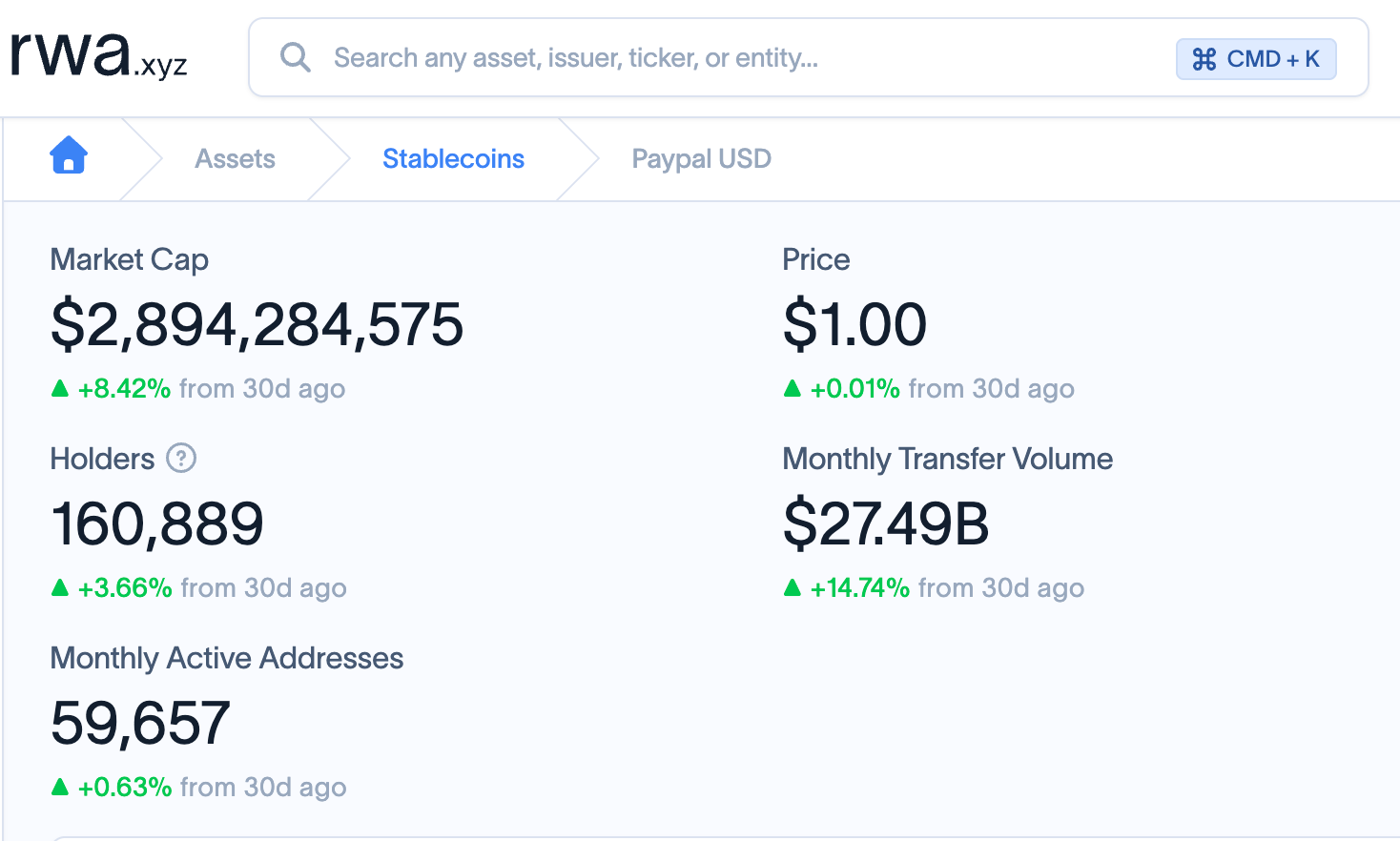
$PYUSD remains ahead on almost every broad usage metric. RWA.xyz currently puts $PYUSD’s market cap at about $2.89 billion, with 160,889 holders and 59,657 monthly active addresses. Its monthly transfer volume is approximately $27.5 billion across 957,693 transfers.
Source: RWA.xyz
On a supply-adjusted basis, $PYUSD moves about 9.7 times its circulating supply each month, considerably higher than $RLUSD’s roughly 5.7x turnover. $PYUSD also has more than seven times as many monthly active addresses as $RLUSD.
Interestingly, $RLUSD records more monthly transfers despite having far fewer active addresses. That gives $RLUSD a much higher transfer frequency per active address.
The difference is partly reflected in the average size of recorded transfers. $RLUSD’s monthly volume divided by its transfer count works out to roughly $9,100 per transfer, compared with about $29,300 for $PYUSD.
Chain Distribution Tells Another Story
$RLUSD’s supply is concentrated primarily on Ethereum and the $XRP Ledger. RWA.xyz shows approximately $1.03 billion of $RLUSD on Ethereum and about $988 million on XRPL, meaning the two networks account for virtually the entire current supply.
$PYUSD is more broadly distributed. Current RWA.xyz data shows roughly $1.96 billion on Ethereum, $708 million on Solana, $220 million on Arbitrum, and nearly $8 million on Stellar.
That wider distribution gives $PYUSD access to more ecosystems, particularly Solana, where cheap transactions have made the token attractive for payments and DeFi applications.
DeFi Gives $PYUSD a Broader Footprint
$PYUSD is used across DeFi venues including Aave, Curve, Morpho, and Kamino, with Solana playing an important role in its expansion.
$RLUSD also has a growing DeFi presence. On Ethereum, for example, Sentora operates an $RLUSD lending vault on Morpho, and FXRP was recently added as collateral, allowing users to borrow $RLUSD against an $XRP-linked asset without selling their $XRP.
A Curve USDC-$RLUSD pool has also reached tens of millions of dollars in liquidity, showing that $RLUSD is developing a meaningful secondary market inside DeFi.
Exchange Liquidity Favors Neither on Every Measure
CoinMarketCap currently shows $RLUSD trading volume at roughly $510 million over 24 hours, while $PYUSD is closer to $42 million. That snapshot suggests $RLUSD can see much heavier exchange activity during periods of increased demand or liquidity shifts.
Both tokens are also available through major trading venues including Kraken, ByBit, OKX, and Bitget.
The Real Difference Is the Use Case
The strongest distinction may not be raw transaction numbers but what each issuer is trying to make the stablecoin do.
$PYUSD has a natural distribution advantage through PayPal and is designed for payments, transfers, and conversions within the PayPal/Venmo ecosystem. PayPal also allows eligible users to earn rewards on $PYUSD balances.
Meanwhile, $RLUSD serves institutional settlement, cross-border payments, and financial-market infrastructure, while Ripple’s broader ecosystem includes institutional custody, trading, and lending applications.
The takeaway is that $PYUSD currently has the broader user and transaction footprint, while $RLUSD is concentrated around high-frequency and higher-value financial activity.
As both approach the same $2 billion-plus market-cap neighborhood, the more important battle will therefore be over how efficiently each dollar of stablecoin supply is actually put to work, rather than simply which token has the bigger supply.
Related:How $XRP Holders Can Borrow $RLUSD Without Selling—and the Risks of FXRP Lending