Study Suggests High EU Carbon Pricing Causes Mining Migration To Russia
The strict controls that the European Union (EU) exerts over carbon emissions might be a factor in the migration of these industries, at least operationally, to jurisdictions without carbon emissions taxes.
The “Does Carbon Pricing Displace Crypto-Mining Emissions? Quantile Evidence on Carbon Leakage from EU27, Russian and Rest-of-World Power Grids” study, published by Pham Ngoc Toan, Le Tran Trung Hieu, and Nguyen Vu Trung Nguyen, three Vietnamese investigators, examined whether carbon pricing in the EU could be a relevant cause behind bitcoin mining operations moving to Russia.
To this end, the study examined daily power sector emissions from the EU, the rest of the world, and Russia from 2019 to 2025 and linked them to bitcoin daily closing prices.
The results found a statistical correlation between carbon pricing in Europe and carbon emissions in Russia, concluding that bitcoin mining operations “migrate” to Russia at off-peak times when both bitcoin and EU carbon allowance prices grow higher.
The same statistical relationship was not present when examining the same relation between the EU and the rest of the world, making the finding more relevant.
Unlike the EU, Russia has no carbon pricing structure, meaning that mining operations can be more profitable there.
Nonetheless, as the study did not observe physical relocation of mining machinery to Russia, it stresses that the phenomenon might have an operational origin: companies with hardware in both jurisdictions shut down equipment in the EU and turn it on in Russia to maximize their profit margins.
Even so, the study also acknowledges several limitations, including the negative effect of May 2021’s Chinese bitcoin mining ban on the established link and disregard of other relevant factors.
Also, starting in 2025, the Russian government implemented a crypto mining ban in certain regions, with an expansion to Moscow approved this year, which could complicate the operational relocation of these activities to Russia, reducing the possibilities for mining companies.
Cryptocurrency tracking platform CoinGecko has announced the most searched cryptocurrencies by users in the last three hours. The Interfold (FOLD) topped the list, while Bitcoin ($BTC) and Pump.fun ($PUMP) were the next most popular assets.
According to CoinGecko data, The Interfold stood out with a 40.5% increase in value over the last 24 hours. Pump.fun rose 14.7% during the same period, while the change in Bitcoin price was limited to 0.1%. One of the most notable movements on the list was recorded by CyberLeek (CYBERLEEK), which increased by 1,973.7% in the last 24 hours.
The most searched cryptocurrencies and their total market capitalization on CoinGecko in the last few hours are listed below, in the given order:
“Stablecoin-funded cards are one example of how digital assets are becoming more deeply embedded in everyday life, giving users greater flexibility in how they spend, move and access their money.”
Crypto cards let users spend stablecoins and other assets through existing payment networks without requiring merchants to accept cryptocurrencies directly. Depending on the product, users deposit funds with the issuer or keep them in a self-custody wallet, and the balance is converted at checkout so the merchant receives it in their local currency.
This means stablecoins are not necessarily replacing Visa or Mastercard at checkout. Increasingly, they are becoming another way to fund the cards running over those networks.
Visa said in June that it had more than 160 stablecoin-linked card programs live or in development globally. StraitsX, a Visa partner that helps other crypto firms launch cards, said transaction volume on its card infrastructure increased 40-fold between the fourth quarters of 2024 and 2025.
However, that data comes with an important caveat.
The market the data tracked remains concentrated. RedotPay generated $395.1 million of July volume, followed by EtherFi at $100.3 million and KAST at $89.6 million. Together, the three platforms accounted for about 77% of the tracked total. Paymentscan’s RedotPay figures are self-reported rather than observed onchain.
Ether.fi CEO Mike Silagadze confirmed to CoinDesk that the platform’s $100.3 million represents card purchase volume, but excludes roughly $30 million of fiat transfers. Purchase volume was below $10 million in July 2025, two months after the product launched, he said.
Payments-focused cryptocurrency $XRP is on track for its best weekly performance since November 2024 after a U.S. Treasury announcement fueled market speculation that policymakers could ultimately resort to yield curve control (YCC), an aggressive monetary-easing tool.
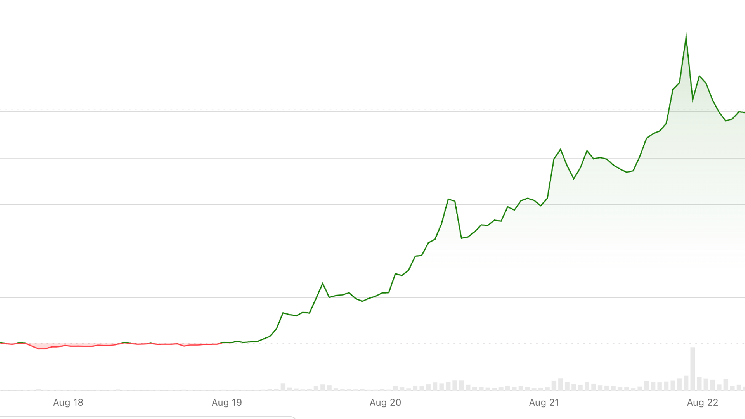
$XRP has surged 51% to $1.50 since Monday, beating its peers, bitcoin $BTC$77,176.83, ether $ETH$2,446.46, and Solana ($SOL), by a big margin, according to data from CoinDesk. $BTC and $ETH have gained 22% and 30%, respectively, while $SOL has rallied 28%.
$XRP‘s outperformance follows a period of lackluster price action, during which the cryptocurrency consistently lagged the broader market’s bounce. It has been characterized by a massive unwinding of short, or bearish, bets in futures. According to the data source Coinglass, shorts worth nearly $2 billion have been liquidated this week.
The surge in $XRP and other tokens began early this week after the U.S. Treasury said that, from Sept. 9 to Nov. 4, it will buy back $4 billion or more of its own long-duration (10- to 30-year) bonds on multiple occasions, double the previous $2 billion cap.
Eric Trump vehemently denied claims that US President Donald Trump is preparing to launch a new cryptocurrency. Responding to social media posts suggesting Trump would release a new coin, Eric Trump stated that there are no such plans and warned investors against potential scams.
A post that garnered nearly 2 million views on X, from an account called Whale Scan, claimed that Donald Trump was “about to officially launch his new coin.” Eric Trump, quoting the post, responded, “What a joke… This is absolutely not true. Nobody is launching any coin. If anyone says otherwise, it’s a scam.”
The rapid spread of the allegations on social media was also influenced by the Trump family’s previous token ventures in the cryptocurrency sector. Just days before his second presidential term in January 2025, Donald Trump launched the Official Trump ($TRUMP) memecoin on the Solana network. With a total supply of 1 billion units, $TRUMP attracted intense speculative interest after its launch and quickly became one of the most prominent assets in the crypto market.
Following Trump, Melania Trump also announced her own memecoin called MELANIA. Thus, the Trump family became two of the most important examples of the memecoin trend directly linked to political figures. While both tokens experienced significant price fluctuations in their early stages, they remained at the center of controversy, particularly due to token distribution, potential advantages for insider investors, and the intertwining of political influence and crypto assets.
Altcoin trading on South Korea’s largest cryptocurrency exchanges, Upbit and Bithumb, has seen significant activity in the last 24 hours. Combining data from the two exchanges reveals that $XRP and Official Trump ($TRUMP) stand out significantly in terms of trading volume compared to other altcoins.
$XRP topped the list with a total trading volume of $651.5 million, reaching approximately $411.9 million on Upbit and $239.6 million on Bithumb. $XRP transactions accounted for roughly a quarter of the total spot volume across both exchanges.
Official Trump came in second on the list. $TRUMP’s total trading volume across the two exchanges reached $298.7 million. Approximately $263.2 million of this volume occurred on Upbit.
According to Upbit and Bithumb data, the total trading volume of altcoins in the last 24 hours is as follows:
As the rise in Bitcoin price continues, lingering leveraged positions in the market have brought potential liquidation zones back into focus. According to Alphractal CEO and market analyst Joao Wedson, an examination of open positions over the past 30 days highlights levels particularly high at $61,000 and $57,000.
Wedson noted that numerous positions were opened when Bitcoin was trading between $65,000 and $68,000, around the $61,000 mark. It is assessed that a significant portion of leveraged positions could come under pressure if the price falls to this level.
The lower $57,000 level stands out as a stronger liquidation zone. According to Wedson, a significant portion of the positions at risk of liquidation at this level were opened when Bitcoin was trading between approximately $63,000 and $66,000.
The analyst pointed out that these areas are important not only in terms of liquidation levels but also because of investors’ stop-loss orders. Investors placing stop-loss orders around $61,000 and $57,000, believing the price is unlikely to reach these points, could further increase selling pressure in the event of a sharp decline.
On the other hand, there are also potential liquidation zones on the upside. Wedson stated that there is a significant amount of liquidation in the $85,000 to $86,000 range, but most of these stem from positions older than a month.
Jiang Zhuoer, one of China’s most prominent cryptocurrency miners and founder of $BTC.TOP, significantly strengthened his view that the market may have bottomed out, stating that his previous bear market prediction was largely wrong. Jiang said he is now 90% certain the bear market is over and that Ethereum ($ETH) could outperform Bitcoin ($BTC) in the current cycle.
Jiang Zhuoer explained that he repurchased the $ETH he had previously sold between $1,738 and $1,931, setting a stop-loss order at $2,100. He then stated that he sold 50% of his spot $ETH holdings at $2,525, attempting to predict the market peak, and set a stop-loss order at $2,550 for that trade.
The renowned miner stated that he plans to use approximately 20-30% of his reserve funds, which he has not yet released to the market, to buy Ethereum. According to Jiang, if the Bitcoin price falls to the $67,000-$72,000 range, the remaining funds will be used to purchase $ETH.
If Bitcoin does not fall to those levels, Jiang stated that he will buy Ethereum at the current market price by the end of October at the latest. This reveals his plan to allocate his remaining reserves entirely to $ETH.
Jiang Zhuoer also stated that the cryptocurrency market maintains a strong upward trend, and therefore the probability of accurately predicting the market peak is relatively low.
The launch comes from Layertwo Labs, founded and led by longtime Bitcoin developer Paul Sztorc, also known as Truthcoin. The play is not to rewrite Bitcoin itself. Instead, ECX will become a separate network that copies Bitcoin’s transaction ledger at designated snapshots and hands most bitcoin holders an equal number of coins on the new chain. Someone holding 1 $BTC in a wallet they control at the snapshot will receive 1 ECX on the new network, while the original $BTC stays exactly where it was.
That distinction is critical. A hard fork creates a separate version of a blockchain after sharing the same historical record. ECX will take Bitcoin’s existing ledger as its starting point, but it will run its own software settings, mining difficulty, nodes, and economic activity. Bitcoin users do not have to participate, and their $BTC is not converted, locked, or moved. The fork simply creates another asset attached to the same wallet addresses at the snapshot.
ECX Will Leverage a 3-Phase Launch
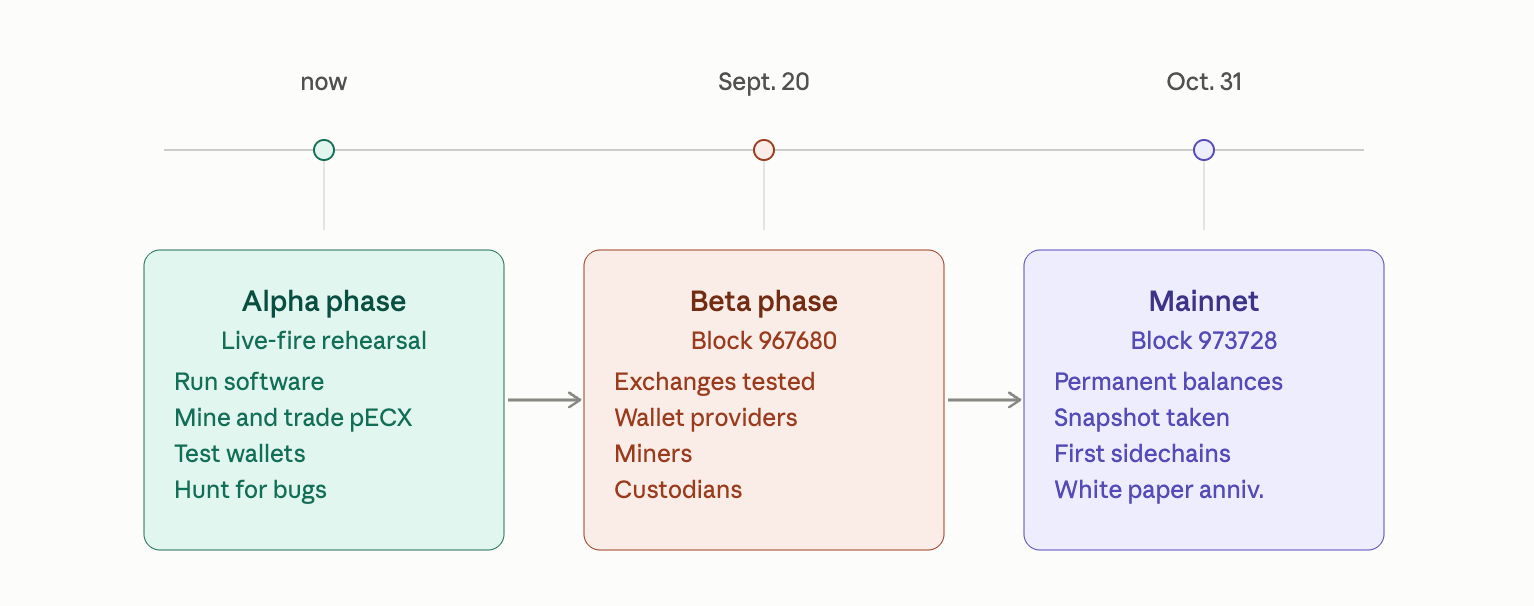
According to Sztorc, the alpha phase is designed as a live-fire rehearsal. Participants can run software, mine, trade practice coins, test wallets, and hunt for cracks in the system. The practice coins, called pECX or alpha ECX, are not permanent.
A beta phase is scheduled around Sept. 20 at Bitcoin block height 967680. That round is expected to lean harder on exchanges, wallet providers, miners, and custodians, the companies that safeguard assets for others.
A visual perspective of Paul Sztorc’s upcoming fork and its phases.
The permanent mainnet is scheduled for Oct. 31, near Bitcoin block 973728. That lands on the 18th anniversary of Satoshi’s Bitcoin white paper. At that snapshot, permanent ECX balances will be created, and the project expects its first batch of specialized sidechains to become available. The drawn-out rollout gives developers and infrastructure providers room to expose bugs, gauge mining conditions, and install safeguards before the permanent chain goes live.
Drivechains Are the Main Bet
Sztorc has spent more than a decade pushing Drivechains, a proposed way to let Bitcoin support optional sidechains without rewriting the rules for every user. A sidechain is a separate network with different features that can connect to a main blockchain. In practice, users could choose a sidechain for privacy, faster payments, or other functions while leaving the base network relatively conservative.
The proposed technology surfaced in BIP 300 and BIP 301, technical proposals Sztorc developed in 2017 and 2019. BIP 300 lays out a mechanism for moving assets between a main chain and sidechains. BIP 301 describes blind merged mining, which would let miners collect sidechain fees without running all of the software for every sidechain.
Those proposals never gathered enough support to activate on Bitcoin through a soft fork, a backward-compatible rules change. Bitcoin’s most recent major soft fork, Taproot, was activated in 2021. Layertwo Labs ultimately decided its Drivechain vision had a better shot as a separate hard fork than another campaign to win consensus from Bitcoin developers, miners, and node operators.
ECX plans to launch with seven specialized sidechains, including Thunder for high-throughput payments, Zside for shielded transactions, Bitnames for decentralized identity, Bitassets for token issuance, Photon for quantum-resistant signatures, Truthcoin for prediction markets, and Coinshift for cross-chain trading. The wager is that users can pick features without forcing every bitcoin user to swallow new base-layer rules.
Bitcoin Will Remain Unchanged
The project uses the same SHA-256d mining algorithm as Bitcoin and keeps its base layer close to Bitcoin Core, the dominant Bitcoin software. However, it will run its own network identifier and ports, keeping ECX nodes from mistakenly connecting to Bitcoin. The chain will reset mining difficulty to the minimum at launch before returning to normal adjustments, a setup likely to make early mining conditions fairly volatile.
One unique rule from the outset involves roughly 1.1 million early Bitcoin coins associated with Satoshi Nakamoto through the “Patoshi pattern,” a method researchers use to identify likely early-mined blocks. About 600,000 ECX will remain assigned to those addresses, while roughly 500,000 ECX will be redirected through special transactions to early investors and development funding. Supporters frame that as financing a new network without an initial coin offering. The move does not touch Satoshi’s $BTC on Bitcoin.
The project also stands far apart from the recent BIP-110 episode, an attempted temporary soft fork aimed at restricting some non-financial blockchain data. BIP-110 backers failed to attract meaningful miner support, node support, and infrastructure backing in any meaningful way, and the resulting minority chain stalled after a small handful of blocks. ECX is not trying to force rules onto Bitcoin. It is a separate experiment built to fight for users, miners, and capital while the Bitcoin network runs normally.
Self-Custody and Claiming Free Coins
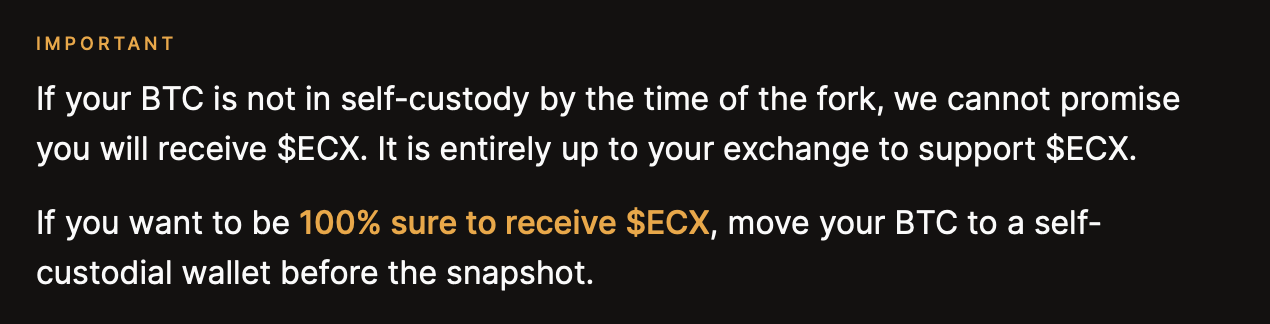
For individual holders, the crucial question is who controls the private keys at each snapshot. A private key is the secret credential proving control of a Bitcoin address. People holding $BTC in self-custody, meaning in a wallet where they control those keys, should be able to access their corresponding ECX directly. People keeping $BTC at exchanges or other custodians are stuck waiting to see whether those companies support the fork and distribute the new asset.
The ECX snapshot credits coins straight to bitcoin ($BTC) addresses, meaning whoever holds the private keys controls the matching ECX. If $BTC sits on an exchange, the exchange holds those keys and effectively controls the forked ECX, leaving customers at its mercy for distribution. Self-custody cuts out that middleman, putting the keys in the holder’s hands and giving them direct control over the corresponding ECX. Image source: ecash.com.
There is no established market price for permanent ECX because mainnet has not launched. During testing, some future-backed ECX trading could emerge, and even if exchanges list ECX, expect wildly speculative price discovery. The bigger question is whether ecash (ECX) gets warmer treatment than the recent BIP-110 fiasco. There is an ECX wallet for Apple (Testflight) and Android, while project docs also spotlight Bitwindow, an alternative Bitcoin Core frontend with native drivechain support.
The real fight starts after Oct. 31. ECX will need working sidechains, stable software, willing exchanges and enough miner participation to show that its combined fee model actually works. Bitcoin holders seeking direct access should track the snapshot heights, maintain control of their keys and stick with official guidance. They should also remember that ECX has nothing to do with XEC, the separate cryptocurrency that uses the same ecash name.
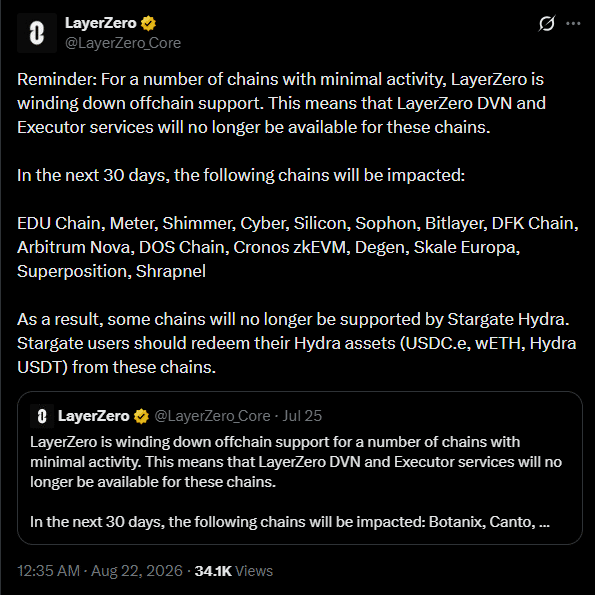
Cross-chain interoperability provider LayerZero will withdraw off-chain support for 14 low-activity chains, including Arbitrum Nova.
In its latest statement, the firm said that its DVN (decentralized verifier network) and Executors, collectively responsible for off-chain communication between different chains, will be deprecated for the 14 chains.
The affected networks include Cronos zkEVM, Degen, Skale Europa, Superposition, Shrapnel, and more. As a result, some assets, including stablecoins (USDT and USDC) across these chains, could be stranded if not moved before the full shutdown.
According to LayerZero, the off-chain support will be axed in 30 days (by September).
Source: X
Since July, LayerZero has flagged over 30 chains with low activity, including the recently shut BounceBit. Although the move is positioned as operational efficiency, security risk and competition seem to be key reasons behind the aggressive shift.
Chainlink CCIP traction threatens LayerZero
LayerZero has massive financial backing, including top-tier VC firms such as Sequoia Capital, a16z (Andreessen Horowitz), Binance Labs, and Coinbase Ventures.
And the bet was simple: bridge the fragmented liquidity across various blockchains. But the KelpDAO’s $292M hack, one of the largest DeFi exploits in 2026, triggered a massive fallout.
The exploit stemmed from LayerZero’s recommended “1-of-1” DVN setup, which doesn’t give enough verification before large minting or fund transfers are approved. Since the same loophole can be used with low-adopted reserve assets, Aave has stopped supporting most of them, including ghost chains.
In fact, several projects have since migrated from LayerZero to rival Chainlink CCIP (Cross-Chain Interoperability Protocol). Notably, the Wyoming state government, BitGo (WBTC), and Nethermind have migrated from LayerZero to CCIP.
Chainlink’s Zach Rynes estimated that a total of $15B has been migrated from LayerZero, underscoring the expensive lesson for LayerZero for the KelpDAO fallout.
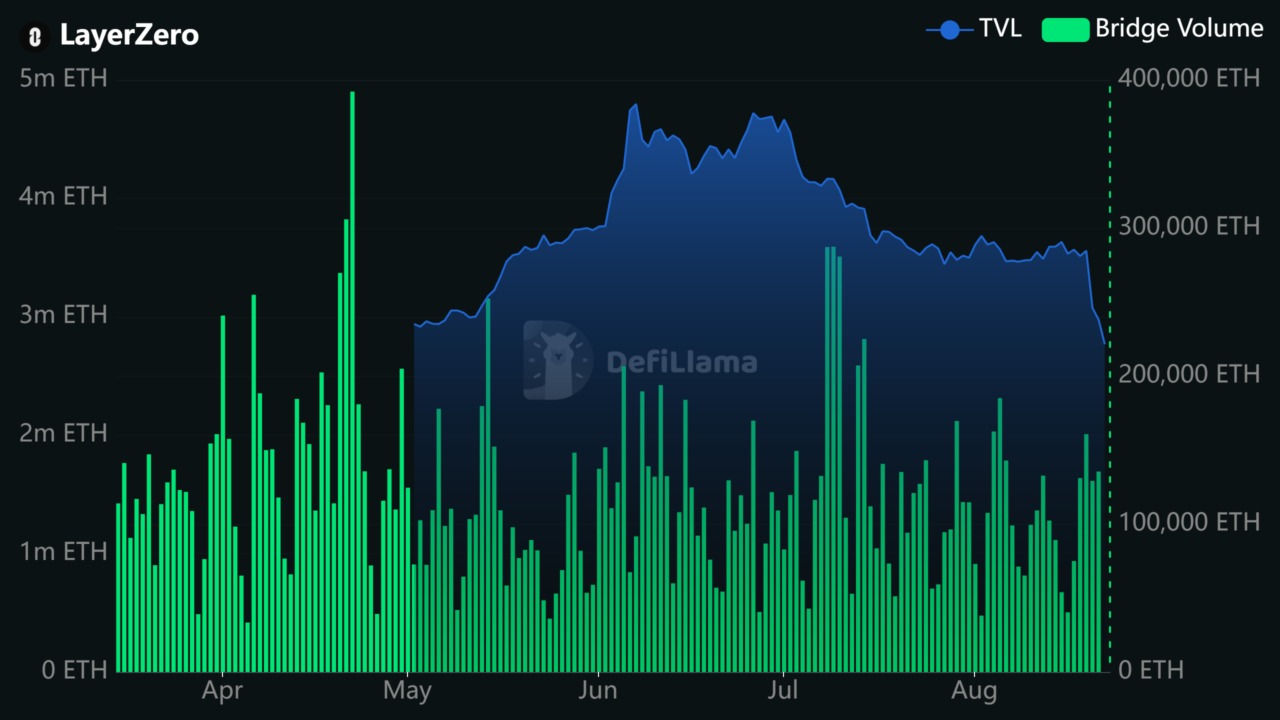
Notably, after the exploit, LayerZero bridged volume dropped 4x from nearly 400K $ETH to about 100K $ETH.
Source: DeFiLlama
As such, LayerZero’s aggressive move to wind down support for over 30 chains may be viewed as a strategic play to reduce its security risk exposure. By extension, it’s meant to counter Chainlink CCIP’s growing competition after the KelpDAO exploit.
But whether that’s enough to stop its top projects from migrating to Chainlink remains to be seen.
Final Summary
LayerZero to withdraw support for 14 chains by September.
Chainlink CCIP has attracted over $15B in assets migrating from LayerZero since the KelpDAO hack.