Category: Business

  • Centrifuge: Can CFG bulls break past $0.18 as TVL hits $1.6B? Examining…

    The past 24 hours have seen altcoins react differently, with the majority of them recording losses. Centrifuge [$CFG] was one of the standout performers with a 12% increase, ranking among the top ten daily gainers.

    Centrifuge’s announcement to expand to Base Chain, where it allowed the trading of tokenized S&P 500 as a new asset class, drove the rally. Is tokenization the main driver of $CFG? Can bulls keep up with the pace?

    $CFG price bounces off KEY retracement level

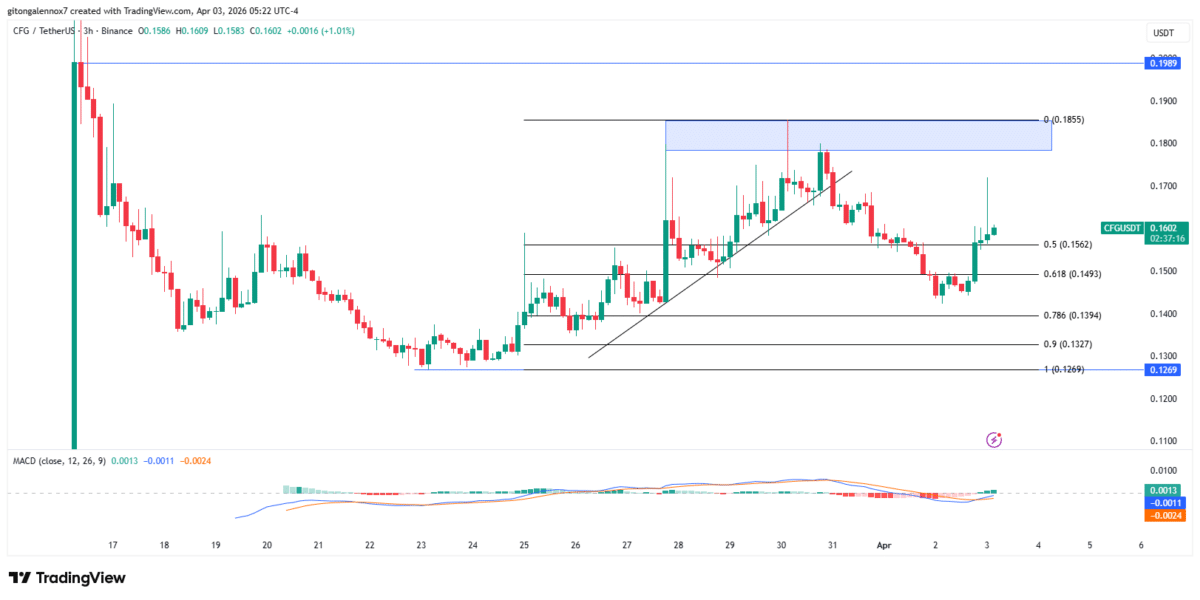
    The charts clearly showed the current bullish momentum, with $CFG rallying from a low of $0.14 to a daily high of $0.172. The altcoin lost its rising trendline support on the 31st of March but seemed to have ended the correction phase.

    $CFG bounced off the zone between 0.618 and 0.786 Fibonacci Retracement levels. To be specific, the altcoin respected the optimal zone at the 0.75 Fib level but seems to be seeing rejection around $0.17.

    Holding through the premium zone, which is above the 0.5 Fib level, the altcoin increases the potential to hit $0.1857. However, this zone has sparked bearish reversals three times as $CFG makes the fourth attempt.
    Source: $CFG/USDT on TradingView

    Interestingly, bulls are showing strength, though it’s weak. The MACD lines have had a crossover confirming a short-term trend shift in the altcoin’s price action.

    That puts $0.1857 as a potential reversal zone unless bulls can gather enough momentum past the resistance. This resistance zone was 18% away from $0.1561, which was a discount area considering the rally that started on the 23rd of March.

    Growth in Centrifuge’s TVL, revenue, and holders

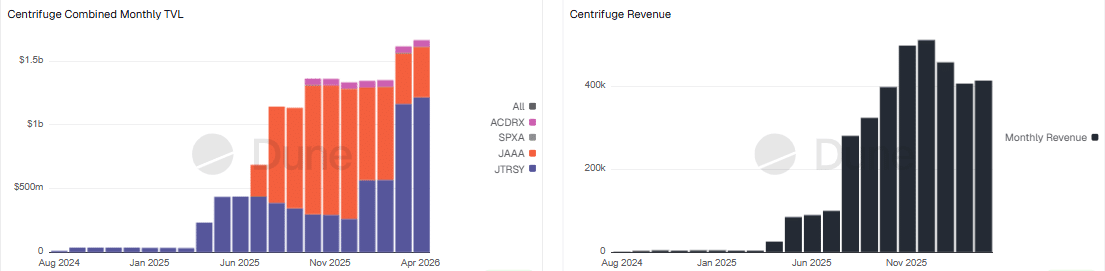
    As Centrifuge continued to expand its chain, its Total Value Locked (TVL), revenue, and number of holders followed suit.

    For instance, its TVL grew to $1.6 billion from $1.2 billion. This trend is continued as the asset classes have increased to four, which include treasuries, AAA CLOs, private credit, and now S&P 500. Treasuries accounted for the largest share of $1.2 billion.

    Its revenue showed steady growth even though there was a slight dip since the year started. March recorded higher revenue than February, indicating the growth was back to positive territory.
    Source: Dune Analytics

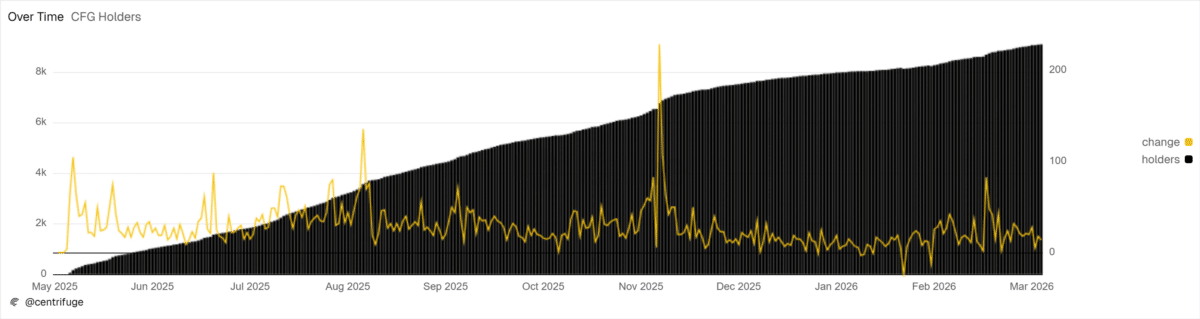
    Dune Analytics recorded a total of 19,699 unique addresses interacting with $CFG. Moreover, holders were growing steadily day by day since May 2025.

    Only 14 new holders had been added in the past 24 hours, taking the total over time to 9,111.
    Source: Dune Analytics

    In summary, $CFG prices were mainly driven by the network activity alongside a bullish technical setup.


    Final Summary

    • Centrifuge surges 12% amid Base Chain integration to trade tokenized S&P 500, but $CFG faces a key test at $0.18.
    • Centrifuge’s network activity was thriving, as seen in TVL, revenue, and number of holders.

  • Expert Analyst Reveals “Worst Bear Scenario” for Bitcoin! Predicts the Level the Price Could Fall To!

    Expert Analyst Reveals “Worst Bear Scenario” for Bitcoin! Predicts the Level the Price Could Fall To!

    US President Donald Trump’s harsh statements regarding a potential war with Iran caused the price of Bitcoin ($BTC) to fall below $67,000, wiping out gains made in previous days.

    With this decline expected to continue, one analyst has claimed that Bitcoin could fall to $10,000.

    An analyst at CryptoQuant, using the pseudonym XWIN Research, claimed that in a worst-case scenario, $BTC could fall to $10,000.

    The analyst said the current price structure is heavily reliant on derivatives rather than spot demand.

    It has been noted that open interest in CME Bitcoin futures is concentrated in short-term leveraged positions of 18,000 to 20,000 $BTC. Such a structure is fragile.

    According to the analyst, this situation could lead to a series of liquidations and selling pressures during periods of negative news, as investors would close their positions rather than roll them over.

    Given Bitcoin’s current fragile state and vulnerability to news, the analyst outlined several possible scenarios that could be anticipated.

    At this point, in the medium-term scenario, Bitcoin could fall to $50,000. This represents a 25% to 30% decrease.

    If spot ETF outflows and weak spot demand continue, $BTC could fall to the $20,000-$30,000 range (60% to 70%).

    In the worst-case scenario, for example, if the Strait of Hormuz is blockaded or a full-scale war breaks out with the participation of more countries, a sharp contraction in global liquidity and oil prices hovering between $150 and $200 could see $BTC fall to $10,000 (80%).

    *This is not investment advice.

  • U.S. March jobs smash expectations, with 178,000 added

    The U.S. employment market rebounded in a big way from February’s sizable losses.

    According to a Friday morning release from the Bureau of Labor Statistics, the country added 178,000 jobs in March, after losing 133,000 positions the previous month. Economist forecasts had been for 60,000 jobs to have been added.

    The unemployment rate fell to 4.3% versus 4.4% in February and expectations for 4.4%.

    At least part of the beat was due to a sizable downward revision in the February data from an originally reported decline of 92,000.

    Trading quietly near the $67,000 level in the hours ahead of the data, bitcoin remained there in the minutes just following the report.

    U.S stock index futures remained modestly lower, the Nasdaq 100 down 0.2%. The 10-year U.S. Treasury yield jumped four basis points to 4.36%.

    Expectations about the future course of interest rates, of late, have been far more influenced by events in the Middle East and the price of crude oil than by the outlook for domestic economic growth.

    As recently as last week, oil’s surging price had markets forecasting imminent rate hikes by the U.S. Federal Reserve. Speaking earlier this week, though, Fed Chairman Jerome Powell said the central bank recognized that oil price shocks — while initially making headline inflation numbers look worse — can depress economic activity. He indicated that the Fed would be in no hurry to raise rates in response to short-term moves in crude oil prices.

    This morning’s strong beat suggests growing momentum in the economy, perhaps putting 2026 rate hikes back on the table.

  • Ethereum Foundation stakes another $93 million ether, reaching its 70,000 ETH target

    Ethereum Foundation stakes another $93 million ether, reaching its 70,000 ETH target

    The Ethereum Foundation staked roughly $93 million in ether ($ETH) on Thursday in several batches, bringing its total staked position to approximately $143 million and nearly completing the 70,000 $ETH staking target it announced in February, according to Arkham data.

    The total deposit of 45,034 $ETH was split into uniform chunks of 2,047 $ETH, each worth roughly $4.23 million, sent from the foundation’s treasury multisig to the Eth2 Beacon Chain deposit contract.

    At roughly $2,059 per $ETH, the $143 million total staked position works out to approximately 69,500 $ETH, nearly the full 70,000 $ETH commitment.

    The foundation had been building toward the target incrementally since February, starting with an initial 2,016 $ETH deposit and adding roughly 20,470 $ETH on Monday. Thursday’s batch covered the remaining balance in one shot.

    The foundation’s Arkham-tracked portfolio shows approximately $270.9 million in total assets across 14 addresses, with $ETH as the dominant holding at roughly 102,400 $ETH ($210.9 million). Smaller positions include USDC, BNB, and a fraction of a bitcoin.

    Yield income

    Staking is the process of locking up cryptocurrency to help secure a blockchain and earn rewards. It’s analogous to buying bonds and lending money to the government in return for fixed income yields.

    At current staking rates, the position would generate roughly $3.9 million to $5.4 million annually at the 2.7% to 3.8% APY range typical for institutional stakers. With MEV-boost, returns could run higher.

    That is modest relative to the foundation’s annual operating expenses, which have historically run near $100 million, but it converts a dormant treasury into a productive one without selling $ETH.

    Why staking?

    The Ethereum Foundation is putting its $ETH to work through staking, earning rewards that help fund research, grants, and operations — all without needing to sell its coins, creating a long-term, self-sustaining treasury.

    This replaces the earlier model where the foundation resorted to $ETH sales that weighed over valuations. The foundation faced criticism for the same through 2024 and early 2025.

    With staking, the foundation earns yield. The shift, however, does not fully eliminate the need to sell entirely.

    At the same time, completing the 70,000 $ETH target does not mean staking is done. The foundation still holds over 100,000 unstaked $ETH. Whether it expands the program beyond the initial commitment or holds the rest as liquid reserves has not been announced.

    Ether traded at $2,059 at the time of the deposits, down roughly 4.3% over the past week.

  • Drift Protocol’s $285 Million Exploit on Solana Raises Questions Over DeFi Security

    Drift Protocol’s $285 Million Exploit on Solana Raises Questions Over DeFi Security

    In brief

    • Researchers and experts are poring over Drift’s design, questioning whether certain design features or procedures could’ve thwarted its $285 million exploit.
    • The incident shows how many DeFi projects prioritize technical security over cybersecurity hygiene, according to SVRN COO David Schwed.
    • Onlookers have argued that a “time lock” would’ve given Drift the opportunity to potentially step in and prevent the attacker from siphoning the funds.

    When millions of dollars in crypto are swiped from a decentralized finance protocol, tough questions often follow—and Drift Protocol’s $285 million exploit on Wednesday is no different.

    The Solana-based project has been thrust into the spotlight as researchers and experts pore over its design, raising questions about whether certain design features or procedures could’ve prevented someone from pulling off one of the most lucrative DeFi attacks in the recent past.

    In a post on X, Drift said a malicious actor gained unauthorized access to its platform through a “novel attack,” which granted administrative powers over Drift’s so-called security council. They added that the attack likely involved some degree of “sophisticated social engineering.”

    The heist, which is among DeFi’s largest in recent history, hinged on introducing a fake digital asset on the decentralized exchange and modifying the platform’s withdrawal limits. After inflating the malicious token’s value, the attacker gained the ability to swiftly drain real liquidity from Drift by abusing borrowing mechanics.

    There are indications that the exploit is linked to the Democratic People’s Republic of Korea, blockchain intelligence firm Elliptic said in a report on Thursday. They pointed to the attacker’s on-chain behavior, laundering methodologies, and network-level indicators.

    With user deposits affected—and the protocol frozen as a precautionary measure—onlookers are also focusing on a core element of Drift’s design: a multisignature wallet, where signatures produced by two private keys enabled the attacker to gain sweeping powers.

    Multisignature wallets represent a point of centralization for many DeFi projects, and the incident exposes the uncomfortable reality that smart contract audits can only prevent so much damage, according to SVRN COO and blockchain security expert David Schwed. 

    He told Decrypt that Drift has become the latest example of how services that seek to replace financial intermediaries with code are frequently reliant on small teams and points of centralization like multisignature wallets that present cybersecurity risks.

    “All of the engineers today focus on the technology side of security, they’re not focusing on the people in the process,” he said. “So yes, the protocol is decentralized, but the governance of it is centralized against five people.”

    ‘Yet again’

    Schwed compared Drift’s lapse in security to one of the most notorious DeFi hacks, where over $625 million worth of digital assets were stolen by hackers linked to North Korea in 2022. They targeted Ronin, an Ethereum sidechain developed for the hit NFT game Axie Infinity. The attack relied on gaining access to five private keys, per blockchain security firm Chainalysis.

    While blockchain analysts see the fingerprints of a nation-state, others argue the precision of the attack suggests a more intimate knowledge of the protocol. Schwed doubted that hackers linked to North Korea were involved in the hack against Drift because it feels like the attacker, possibly an insider, “knew who to target.” 

    Onlookers have speculated that a “time lock” could’ve prevented the exploit from taking place so quickly. The smart contract feature restricts the execution of transactions or access to funds until a specific future time is reached, potentially providing Drift’s team with a window to step in.

    “Time locks are helpful for gaining time to react to such an attack, and would have helped here—but that is not the root cause,” Stefan Byer, managing partner at Oak Security, told Decrypt. “The biggest issue was that—yet again—a privileged key was compromised.”

    Still, Dan Hongfei, founder and chair of Neo Blockchain, argued that protocols like Drift that house millions of dollars in funds should not be instantly drainable.

    In a post on X, he said time locks tied to critical actions like listing high-risk assets must be enforced to “prevent an attacker from completing the entire exploit chain within seconds.”

    The sentiment was echoed by Or Dadosh, founder of crypto security infrastructure provider Venn Network. He also pointed to automatic circuit breakers, which enable projects to instantly pause operations if abnormal outflow velocity or volume thresholds are breached.

    Several security experts wagered that Drift wouldn’t be the last DeFi project to suffer an exploit like the one that occurred on Wednesday. They noted that bad actors are increasingly turning to AI, using algorithms to gain a comprehensive understanding of their next target.

    “We’ve reached a level where a bad actor can spoof your mother’s voice on a phone call,” Dadosh told Decrypt. “We live in a new age where financial attacks can surface in places and formats we couldn’t have even imagined a year ago.”

    Daily Debrief Newsletter

    Start every day with the top news stories right now, plus original features, a podcast, videos and more.

  • Coinbase Links Up With Linux Foundation to Launch x402 Foundation

    Coinbase Links Up With Linux Foundation to Launch x402 Foundation

    In brief

    • Coinbase is joining with the Linux Foundation to launch the x402 Foundation.
    • The group will steward the x402 payments standard under an open governance model.
    • Companies including Google, Stripe, Visa, Mastercard, Shopify, and Cloudflare are participating.

    Coinbase is joining with the Linux Foundation to launch the x402 Foundation, an industry group created to oversee the development of a new internet payments standard.

    The foundation will steward the x402 protocol, which lets websites request and receive payments as part of normal web traffic, after Coinbase contributed the technology to the Linux Foundation to place it under neutral governance.

    “The internet was built on open protocols,” Linux Foundation Executive Director Jim Zemlin said in a statement. “The x402 Foundation will create an open, community-governed home to develop these capabilities in the open, ensuring they evolve with transparency, interoperability, and broad participation across the ecosystem.”

    Under Linux Foundation governance, the x402 protocol will remain vendor-neutral, the Linux Foundation said, allowing for “transparent, community-driven growth, ensuring accessibility, and supporting sustainability.”

    Erik Reppel, head of engineering for the Coinbase Developer Platform, said Coinbase will remain involved as a founding participant while the foundation manages development of the technology.

    “Coinbase is a founding member and the original creator of the protocol,” Reppel told Decrypt. “Both Coinbase and Base are part of the initial set of industry participants supporting the foundation’s migration to an open-source model. Members will help with governance to help guide the future of x402.”

    Launched in 2025 by Coinbase’s developer platform, x402 revived the long-unused HTTP 402 “Payment Required” status code to create a native payment layer for the web, allowing websites and APIs to request payment directly during normal HTTP interactions before granting access to content or services.

    Developers have begun experimenting with the protocol as AI agents increasingly perform tasks for users online. Projects, including Sam Altman’s World, are integrating x402 into tools that let agents prove they represent real people, and infrastructure efforts like MoonPay’s Open Wallet Standard are adding support for the protocol.

    Companies participating in the launch of the x402 foundation include Google, Stripe, Visa, Mastercard, Shopify, Cloudflare, and the Solana Foundation.

    “The shift toward agentic commerce requires cloud infrastructure that is as open as the protocols it supports,” Managing Director, Web3 and Digital Assets at Google Cloud, James Tromans, said in a statement. “By joining the x402 Foundation, Google is reinforcing its commitment to interoperable standards that enable secure, AI-driven transactions across platforms.”

    “Solana has been one of the earliest adopters of x402, driving nearly 65% of x402 transaction volume this year, and has a growing ecosystem building products with x402 payments,” Head of AI Growth, Solana Foundation, Rishin Sharma said in a statement. “We’re eager to support the x402 Foundation to build the future of agentic payments and onboard more developers, merchants, and agents to pay-per-request models with stablecoins.”

    The x402 Foundation will operate under Linux Foundation governance to support community-driven development of the standard. Organizations that contribute to or use the technology can join the foundation and help guide its development. Early priorities include maintaining interoperability across implementations and supporting developers and merchants building services around the standard.

    Shan Aggarwal, chief business officer at Coinbase, said the company views the project as an effort to create a more open infrastructure for the future of online payments.

    “Agents are going to buy, sell, and transact on our behalf. They will need a payment rail that’s open, interoperable, and doesn’t require a human clicking confirm purchase,” Aggarwal told Decrypt. “That’s x402, and now it’s governed by the community.”

    Daily Debrief Newsletter

    Start every day with the top news stories right now, plus original features, a podcast, videos and more.

  • Google Jumps Back Into the Open Source AI Race With Gemma 4

    Google Jumps Back Into the Open Source AI Race With Gemma 4

    In brief

    • Google dropped Gemma 4, a family of open models under the Apache 2.0 license.
    • The four-model lineup spans phones to data centers with the 31B model ranking #3 globally already.
    • U.S. open-source AI gets a needed boost, as Gemma 4—backed by DeepMind—positions itself as the strongest American contender against DeepSeek, Qwen, and other Chinese leaders.

    Google’s open AI ambitions got a lot more serious today. The company released Gemma 4, a family of four open-weight models built on the same research as Gemini 3, and licensed under Apache 2.0—a significant departure from the more restrictive terms on previous Gemma versions.

    Developers have downloaded past Gemma generations over 400 million times, spawning more than 100,000 community variants. This release is the most ambitious one yet.

    For the past year, the open-source AI leaderboard has been largely a Chinese affair. DeepSeek, Minimax, GLM and Qwen have dominated the top spots, leaving American alternatives scrambling for relevance. As Decrypt reported last year, Chinese open models went from barely 1.2% of global open-model usage in late 2024 to roughly 30% by the end of 2025, with Alibaba’s Qwen even overtaking Meta’s Llama as the most-used self-hosted model worldwide.

    Meta’s Llama used to be the default choice for developers who wanted a capable, locally runnable model. That reputation has eroded—Llama’s Meta-controlled license raised questions about its true open-source status, and its performance slipped behind the Chinese competition. The Allen Institute’s OLMo family tried to fill the gap but failed to gain meaningful traction. OpenAI released its gpt-oss models in August 2025, which gave the ecosystem a breath of fresh air, but they were never designed to be frontier competitors.

    And yesterday, a 30-person U.S. startup called Arcee AI released Trinity, a 400 billion parameter open model that made a compelling case that the American scene wasn’t completely dead. Gemma 4 follows that momentum, this time with the full weight of Google DeepMind behind it, turning it into arguably the best American model in the open-source AI scene.

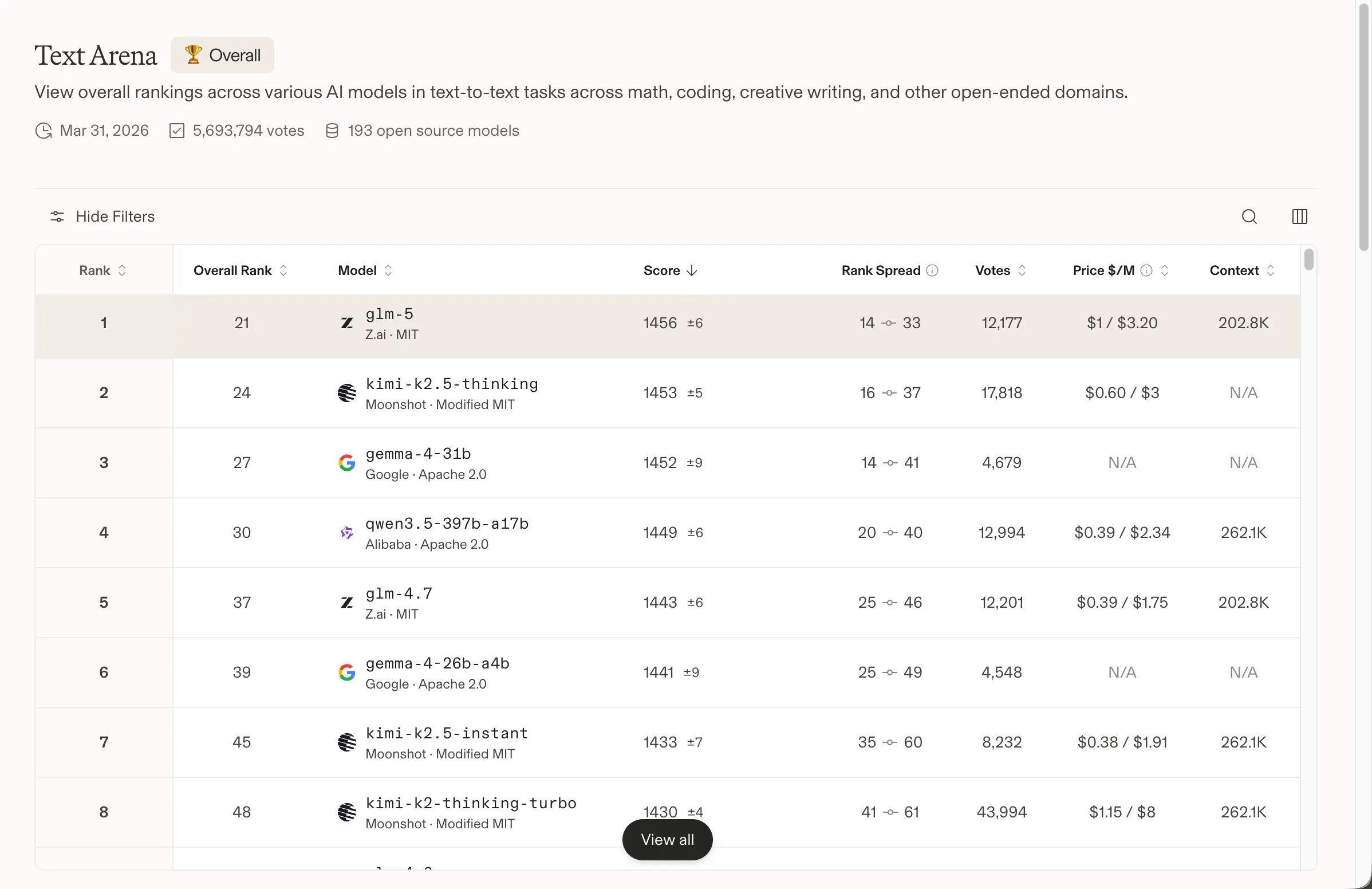
    The model is “built from the same world-class research and technology as Gemini 3,” Google said in its announcement. Gemma 4 ships in four sizes: Effective 2B and 4B for phones and edge devices, a 26B Mixture of Experts model focused on speed, and a 31B Dense model optimized for raw quality.

    The 31B Dense currently ranks third among all open models on Arena AI’s text leaderboard. The 26B MoE sits sixth. Google claims both outcompete models 20 times their size—a claim that holds up, at least against the Arena AI numbers, where Chinese models still hold the top two spots.

    We tested Gemma 4. It’s capable, with some caveats. The model applies reasoning even to tasks that don’t require it, which can make responses feel over-engineered for simple prompts. Creative writing is decent—serviceable, not inspired—and likely improves with more specific guidance and prompt engineering.

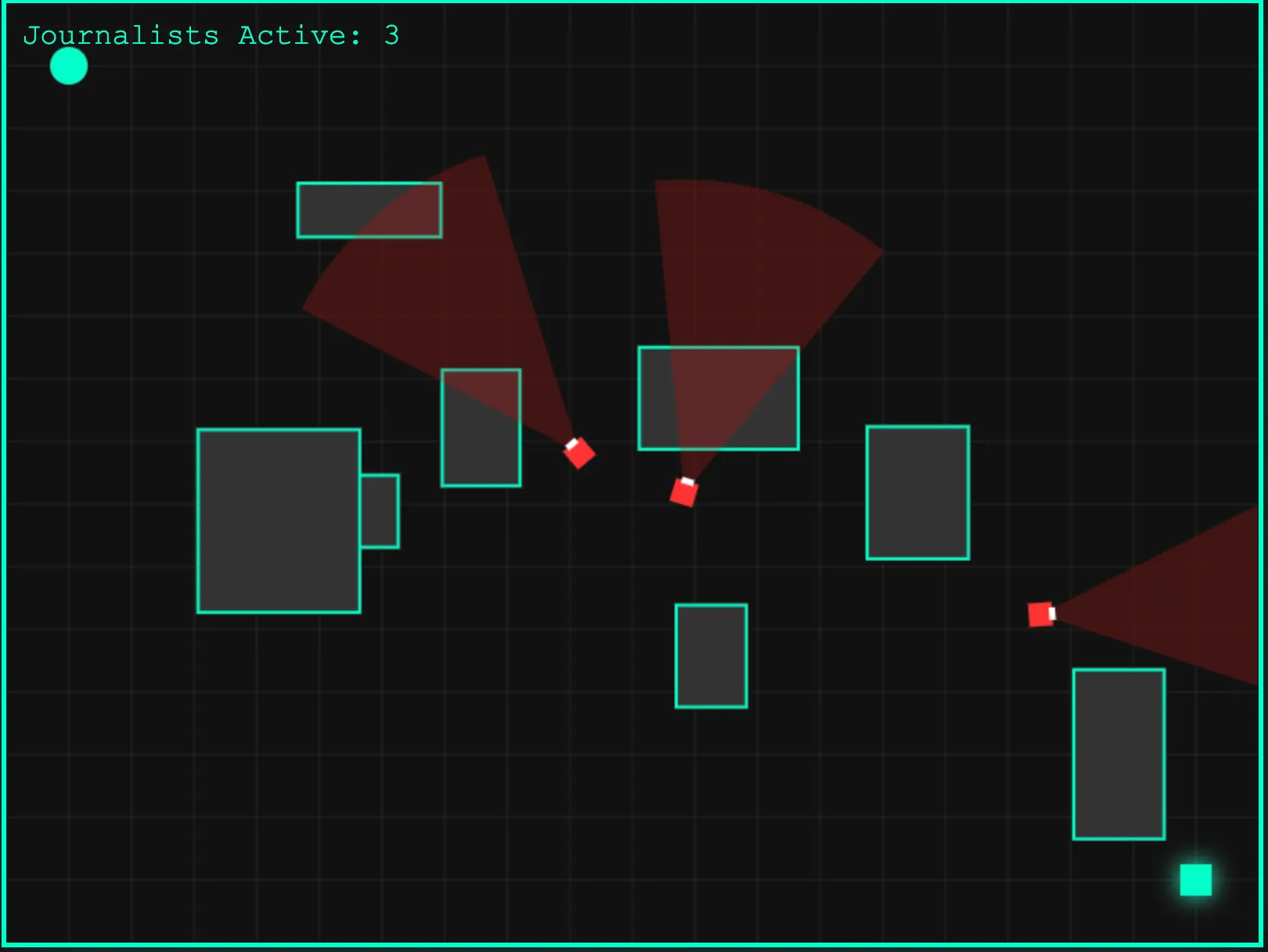
    Where it delivered most clearly was code. Asked to generate a game, the output wasn’t particularly flashy or elaborate, but it ran without errors on the first try. Not bad for a 41 billion parameter model. That zero-shot reliability is arguably more valuable than a prettier result that needs debugging.

    You can try the (basic, yet functional) game here.

    The four variants cover the full hardware spectrum. The E2B and E4B models are built for Android phones, Raspberry Pi, and edge devices, running completely offline with near-zero latency, native audio input, and a 128K context window. The 26B and 31B models target workstations and cloud deployments, extending context to 256K and adding native function-calling and structured JSON output for building autonomous agents. All four models process images and video natively. The larger models’ full-precision weights fit on a single 80GB NVIDIA H100 GPU; quantized versions run on consumer hardware.

    The Apache 2.0 license is the other headline. Google’s previous Gemma releases used a custom license that created legal ambiguity for commercial products. Apache 2.0 removes that friction entirely—developers can modify, redistribute, and commercialize without worrying about Google changing the terms later. Hugging Face co-founder Clement Delangue praised it, saying that “Local AI is having its moment,” and it is the future of the AI industry. Google DeepMind CEO Demis Hassabis went further, calling Gemma 4 “the best open models in the world for their respective sizes.”

    That’s a strong claim. Proprietary systems from Anthropic, OpenAI, and Google’s own Gemini still lead on the hardest benchmarks. But for open-weight models you can run locally, modify freely, and deploy on your own infrastructure? The competition just got significantly thinner. You can try Gemma 4 now in Google AI Studio (31B and 26B) or Google AI Edge Gallery (E2B and E4B). Model weights are also available on Hugging Face, Kaggle, and Ollama.

    Daily Debrief Newsletter

    Start every day with the top news stories right now, plus original features, a podcast, videos and more.

  • Crypto snoozes into Good Friday as oil and macro stir: Crypto Daybook Americas

    Crypto snoozes into Good Friday as oil and macro stir: Crypto Daybook Americas

    By Francisco Rodrigues (All times ET unless indicated otherwise)

    Bitcoin is stuck in a tight range near $66,600 ahead of the Good Friday holiday, as geopolitical tensions and shifting macro expectations keep prices contained.

    While the cryptocurrency saw a slight rise in the last 24 hour period it failed to break above $67,000. It’s struggling as U.S. President Donald Trump signaled a harsher stance on Iran, now threatening the country’s infrastructure.

    Brent crude hit $120 per barrel on spot markets, levels not seen since 2008, over the ongoing crisis and its effects on the Strait of Hormuz, a key artery for global oil shipping that has effectively been shut down.

    That surge in energy prices pushed up inflation expectations and undercut the case for rate cuts, a key support for bitcoin’s recent rally. Inflation in Europe has already risen to 2.5%, driven by energy costs.

    The pressure has revealed a divide in market structure. Institutional inflows into bitcoin ETFs remain consistent, with $22 million in net inflows this week. But data from CryptoQuant show total apparent demand has flipped negative, with large holders distributing more than they accumulate.

    Wallets holding 1,000 to 10,000 $BTC have shed nearly 188,000 $BTC since last year’s peak, the data shows. Nearly half of all bitcoin in circulation is, at current prices, trading at a loss.

    Heading into the long weekend, liquidity is set to remain thin. That leaves bitcoin exposed to potentially higher volatility based on developments in the Middle East or macro-linked statements. Stay alert!

    Read more: For analysis of today’s activity in altcoins and derivatives, see Crypto Markets Today

    What to Watch

    For a more comprehensive list of events this week, see CoinDesk’s “Crypto Week Ahead”.

    • Crypto
    • Macro
      • April 3, 8:30 a.m.: U.S. Nonfarm Payrolls for March est. 48K (Prev. -92K)
      • April 3, 8:30 a.m.: U.S. Unemployment Rate for March est. 4.5% (Prev. 4.4%)
      • April 3, 10:00 a.m.: U.S. ISM Services PMI for March (Prev. 56.1)
    • Earnings (Estimates based on FactSet data)

    Token Events

    For a more comprehensive list of events this week, see CoinDesk’s “Crypto Week Ahead”.

    • Governance votes & calls
      • SSV Network DAO is voting across two proposals to integrate ENS names for core protocol contracts to enhance security against phishing, and to establish a soft fee floor for public operators to ensure economic sustainability. Voting ends April 3.
    • Unlocks
    • Token Launches

    Conferences

    For a more comprehensive list of events this week, see CoinDesk’s “Crypto Week Ahead”.

    • Day 1 of 3: ETHGlobal Cannes 2026 (Cannes, France)

    Market Movements

    • $BTC is down 0.35% from 4 p.m. ET Thursday at $66,785.73 (24hrs: +0.65%)
    • $ETH is unchanged at $2,058.20 (24hrs: +0.94%)
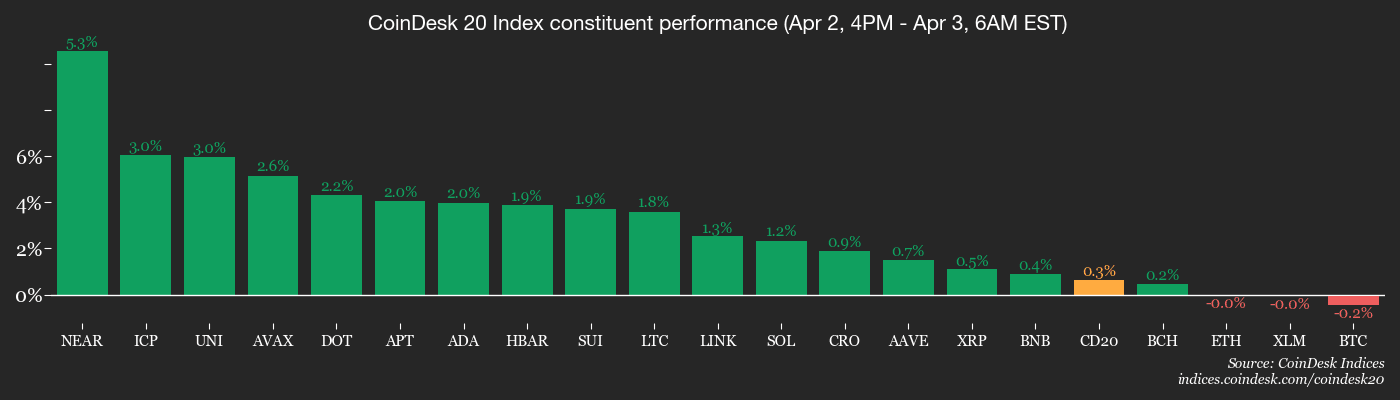
    • CoinDesk 20 is up 0.26% at 1,902.32 (24hrs: +0.80%)
    • Ether CESR Composite Staking Rate is up 1 bps at 2.77%
    • $BTC funding rate is at -0.0007% (-0.7731% annualized) on Binance
    • DXY is unchanged at 99.99
    • Gold futures are up 1.07% at $4,701.30
    • Silver futures are up 0.60% at $73.17
    • Nikkei 225 closed up 1.26% at 53,123.49
    • Hang Seng closed down 0.70% at 25,116.53
    • FTSE 100 is unchanged at 10,436.29
    • Euro Stoxx 50 is down 0.26% at 5,678.00
    • DJIA closed on Thursday down 0.13% at 46,504.67
    • S&P 500 closed up 0.11% at 6,582.69
    • Nasdaq Composite closed up 0.18% at 21,879.18
    • S&P/TSX Composite closed up 0.46% at 33,108.20
    • U.S. 10-Year Treasury rate is down 1 bps at 4.31%
    • E-mini S&P 500 futures are up 0.12% at 6,613.00
    • E-mini Nasdaq-100 futures are up 0.10% at 24,167.25
    • E-mini Dow Jones Industrial Average futures are up 0.10% at 46,678.00

    Bitcoin Stats

    • $BTC Dominance: 58.54% (-0.24%)
    • Ether to bitcoin ratio: 0.030821 (0.23%)
    • Hashrate (seven-day moving average): 997 EH/s
    • Hashprice (spot): $30.68
    • Total Fees: 2.54 $BTC / $170,134
    • CME Futures Open Interest: 106,230 $BTC
    • $BTC priced in gold: 15.9 oz
    • $BTC vs gold market cap: 4.46%

    Technical Analysis

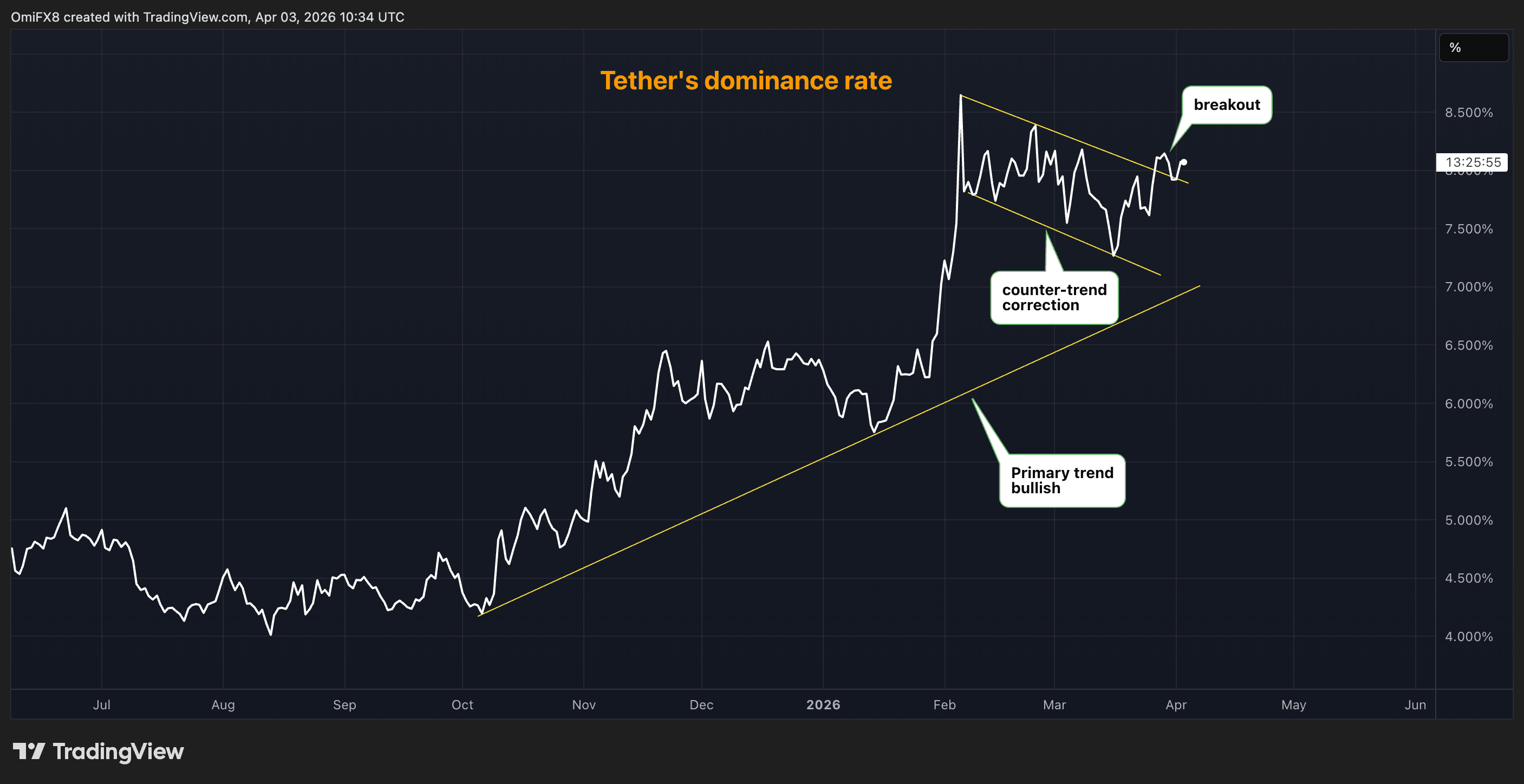
    • The chart shows daily swings in tether’s dominance rate in candlestick format. The dominance rate represents the share of stablecoin tether in the total crypto market.
    • The dominance rate is rising again after a temporary pullback, or counter-trend correction. This breakout suggests that the broader uptrend in dominance has likely resumed.
    • This has bearish implications for the broader market, as dollar-pegged assets like Tether typically gain dominance during market-wide sell-offs.

    Crypto Equities

    • Coinbase Global (COIN): closed on Thursday at $171.46 (–0.88%), unchanged in after-hours
    • Galaxy Digital (GLXY): closed at $17.64 (+1.55%), +0.28% at $17.69
    • MARA Holdings (MARA): closed at $8.71 (+8.33%), –1.03% at $8.62
    • Riot Platforms (RIOT): closed at $12.86 (+2.47%), unchanged at $12.86
    • Core Scientific (CORZ): closed at $16.23 (+6.08%), –0.62% at $16.13
    • CleanSpark (CLSK): closed at $8.79 (+1.97%), unchanged at $8.80
    • Exodus Movement (EXOD): closed at $6.10 (–8.68%), –0.80% at $6.05
    • CoinShares Bitcoin Miners ETF (WGMI): closed at $35.76 (+2.58%), –0.17% at $35.70
    • Circle Internet Group (CRCL): closed at $90.26 (–0.53%), +0.60% at $90.80
    • Bullish (BLSH): closed at $36.37 (+3.71%), –0.19% at $36.30

    Crypto Treasury Companies

    • Strategy (MSTR): closed at $119.83 (–2.40%), +0.34% at $120.24
    • Strive Asset Management (ASST): closed at $9.75 (–4.04%), +0.10% at $9.76
    • SharpLink Gaming (SBET): closed at $6.19 (–4.18%), +0.32% at $6.21
    • Upexi (UPXI): closed at $0.98 (–1.32%), –2.12% at $0.95
    • Lite Strategy (LITS): closed at $1.12 (–0.88%), unchanged at $1.12

    ETF Flows

    Spot $BTC ETFs

    • Daily net flow: $9 million
    • Cumulative net flows: $55.93 billion
    • Total $BTC holdings ~ 1.28 million

    Spot $ETH ETFs

    • Daily net flow: -$71.2 million
    • Cumulative net flows: $11.51 billion
    • Total $ETH holdings ~ 5.69 million

    Source: Farside Investors

    While You Were Sleeping

    French ship crosses Strait of Hormuz in first Western European transit during Iran war (euronews): The news could encourage other carriers to resume operations if the corridor proves reliable in the coming days and it follows Iran’s deputy foreign minister Kazem Gharibabadi announcement of a deal with Oman to secure traffic through the Strait of Hormuz.

    U.S. repatriates Chinese drug fugitive in a sign of stabilizing ties (The Wall Street Journal): This is the first case of its kind in recent years and is described as a rare move that points to cooperation ahead of the planned Trump-Xi summit next month.

    Iran strikes Gulf energy sites as Trump warns of further attacks (Bloomberg): Iran targeted more sites in Arab Gulf states, including in Kuwait Friday morning, hours after Trump issued fresh threats against Iranian infrastructure to pressure Tehran to start peace negotiations.

    Japan turns up FX heat as volatility rises, signals readiness to act (Reuters): The yen, trading near the psychologically key 160-per-dollar mark, lingered at levels that stoke concerns of market intervention, highlighting growing unease over the speed and scale of its decline.

  • Will the Bitcoin Tradition Continue Where It Left Off? How Much BTC Can Strategy Buy This Week? Here’s the Answer!

    Will the Bitcoin Tradition Continue Where It Left Off? How Much BTC Can Strategy Buy This Week? Here’s the Answer!

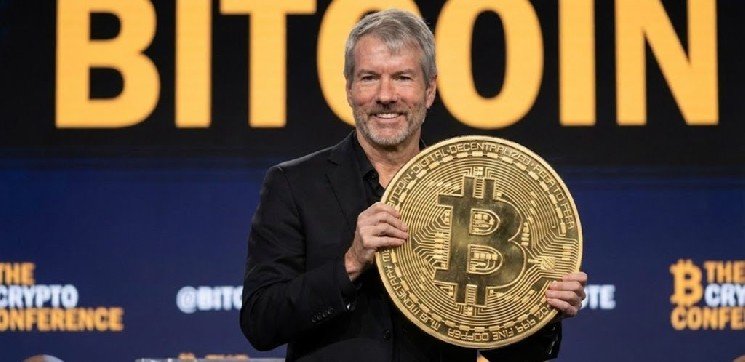
    Strategy, led by big bull Michael Saylor, did not make its long-standing weekly Bitcoin purchases this week.

    The company paused its weekly Bitcoin ($BTC) purchases, which it announces every Monday, and did not make any new purchases this week.

    The company maintained its total Bitcoin holdings at 762,099 $BTC.

    Looking at the company’s purchase history, it appears they have been accumulating Bitcoin regularly throughout March. Strategy purchased 1,031 $BTC on March 23rd, 22,337 $BTC on March 16th, and 17,994 $BTC on March 9th, with their last purchases made at an average price of approximately $74,326.

    Strategy has accumulated a total of 762,099 $BTC through 104 separate purchases, adding Bitcoin to its portfolio at an average cost of $75,694.

    While Saylor has not made any statement regarding the lack of $BTC purchases this week, Strategy is expected to resume its purchases this week.

    According to BitcoinTreasury.net, Strategy is expected to purchase approximately 4,535 Bitcoin next week.

    According to the platform, the proceeds from Strategy’s issued preferred shares (STRC) are expected to be approximately $300 million, and this fund is expected to finance the purchase of 4,535 $BTC this week.

    However, this figure is only an estimate, and whether Strategy will make the purchase, or how much it will purchase, will only be known with an official announcement.

    As it is known, Strategy recently raised investor funds through Stretch and continues to buy Bitcoin with these funds.

    *This is not investment advice.

  • Shiba Inu Price Prediction: SHIB Holds Steady as Burn Rate Drops 90%

    Shiba Inu Price Prediction: SHIB Holds Steady as Burn Rate Drops 90%

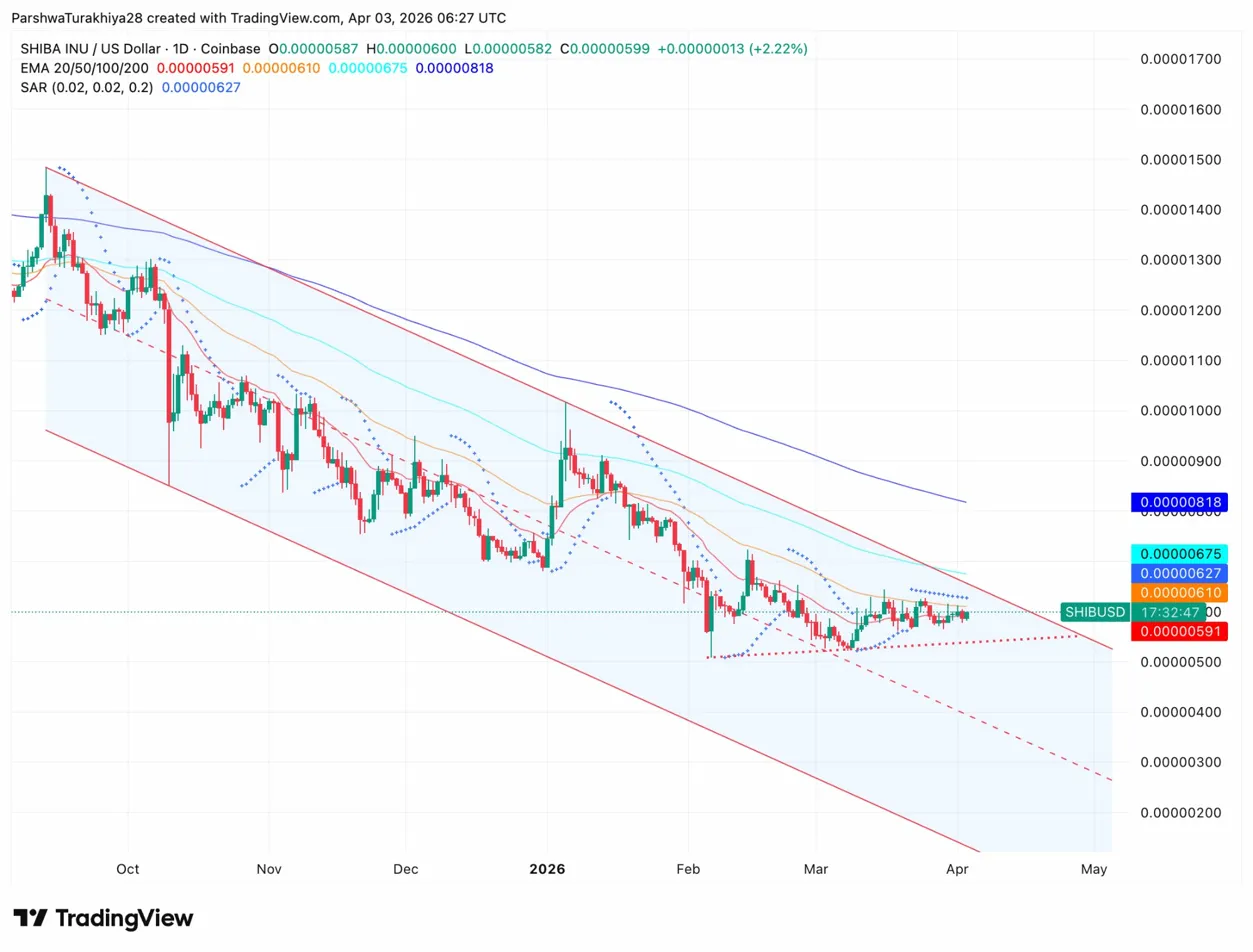
    $SHIB trades at $0.0000059 on April 3, holding near the lower half of a descending channel that has been intact since September 2025. The burn rate collapsed 90.21% in the last 24 hours, dropping to just 167,246 $SHIB after the elevated activity earlier in the week, and the SAR at $0.0000627 continues to cap every recovery attempt on the daily chart.

    Seven Months Inside A Descending Channel

    $SHIB Daily Price Action (Source: Coinbase)

    The descending channel from the September peak near $0.000015 is still intact, with the upper boundary now near $0.0000075 and the lower boundary approaching $0.0000040 through April. $SHIB has been trading in the lower third of the channel since February, with the four EMAs declining overhead: the 20-day at $0.0000591, the 50-day at $0.0000610, the 100-day at $0.0000675, and the 200-day at $0.0000818.

    Related: Cardano Price Prediction: ADA Tests $0.24 As Foundation Reports 45% Asset Drop

    The SAR at $0.0000627 has been bearish since October without flipping. Every rally in the past six months has stalled before reaching it. A daily close above $0.0000627 would be the first SAR flip since October and the clearest signal that the channel’s grip is weakening. Until then, $0.0000591 at the 20-day EMA is the immediate hurdle, with the channel’s lower boundary near $0.0000400 as the downside floor through April.

    Key Technical levels for $SHIB

    • 20-day EMA resistance: $0.0000591
    • SAR resistance: $0.0000627
    • Channel upper boundary: $0.0000750
    • Channel lower boundary: $0.0000400
    • 200-day EMA: $0.0000818

    Burn Rate Collapses 90% After Earlier Spike

    The 24h burn rate dropped 90.21% to 167,246 $SHIB on April 3, a steep reversal from the elevated burns earlier this week. With 41.08% of the initial one quadrillion supply permanently removed since launch, the long-term supply reduction story remains intact, but the day-to-day burn rate is too inconsistent to use as a reliable price catalyst.

    When burns are elevated, retail attention follows. When they collapse as sharply as today, that secondary tailwind disappears just as quickly.

    $SHIB Derivatives: Shorts Taking More Pain

    $SHIB Derivatives Data (Source: Coinglass)

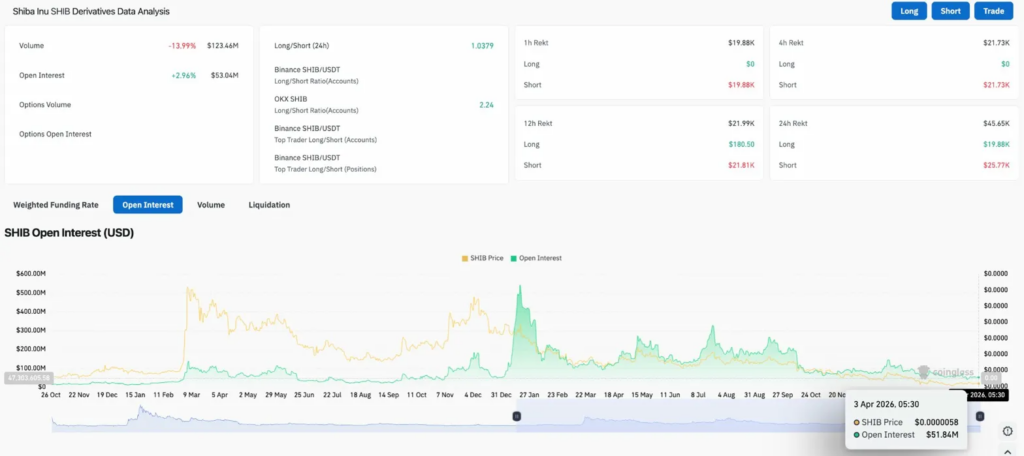
    Volume fell 13.99% to $123.46M while OI rose 2.96% to $53.04M. Declining volume with rising OI means new positions are being added quietly rather than through active trading, which typically reflects conviction rather than speculation. The long/short ratio sits at 1.0379, leaning slightly long, with OKX accounts at 2.24.

    Over 24 hours, shorts absorbed $25.77K in liquidations against just $19.88K for longs, a reversal from the pattern of recent sessions where bulls were taking more pain. That short liquidation bias, modest as it is, aligns with the morning’s 2.22% price move. OI at $51.84M remains far below the $500M peak from January, leaving room for leverage to build if a catalyst arrives.

    $SHIB Price Prediction: What Needs To Happen

    • Upside: A daily close above the 20-day EMA at $0.0000591 would be the first meaningful EMA reclaim in weeks. From there the SAR at $0.0000627 is the level that decides April’s direction. Clear it and the channel midline near $0.0000750 opens as the month’s target. A burn rate recovery alongside the move would add retail momentum to a chart that needs a catalyst to break the channel.
    • Downside: Fail to hold above $0.0000580 and the descending channel structure pulls price back toward the lower boundary near $0.0000400 through April. The burn rate dropping 90% removes one of the few positive narratives $SHIB has had this week, and with the channel six months old and unbroken, the default path without a catalyst remains lower.