Category: Business

  • Russia Takes Historic Step Regarding Bitcoin and Two Altcoins: A New Era Begins!

    Russia Takes Historic Step Regarding Bitcoin and Two Altcoins: A New Era Begins!

    According to the Russian news agency Interfax, the Central Bank of Russia has prepared a notable regulation for Bitcoin (BTC), Ethereum (ETH), and Tether ($USDT).

    The Central Bank of Russia has released a draft regulation that would include Bitcoin, Ethereum, and $USDT in the list of cryptocurrencies that can be publicly traded on exchanges. However, the regulation is still in draft form. Comments and suggestions on the draft will be accepted until August 24, 2026.

    300,000 Ruble Limit on Cryptocurrency Purchases!

    According to the draft regulation, unqualified investors will be able to purchase designated crypto assets through each brokerage firm up to a maximum of 300,000 rubles per year.

    The Central Bank stated that the aim of this restriction is to protect investors from sharp and unpredictable price movements that may occur in the cryptocurrency market.

    The bank stated that only the most liquid cryptocurrencies would be offered to unqualified investors, with Bitcoin, Ethereum, and Tether $USDT being among the prominent assets in this regard.

    No Limits for Qualified Investors!

    The statement noted that qualified investors would be able to purchase all cryptocurrencies traded on exchanges and over-the-counter markets without any quantity restrictions.

    However, the Russian Central Bank reminded investors that, regardless of their status, they should undergo necessary tests and be informed about the risks of investing in crypto assets before engaging in cryptocurrency transactions.

    “To protect unqualified investors from sharp and unpredictable fluctuations in cryptocurrency prices, they will only be offered the most liquid cryptocurrencies.”

    According to the law, when selecting cryptocurrencies, market capitalization, average daily trading volume, and price history on foreign exchanges (which must be at least five years for such an asset) are taken into account.

    Based on these criteria, the Central Bank of Russia has included Bitcoin, Ethereum, and Tether-$USDT in the list of cryptocurrencies that can be publicly traded on exchanges. Qualified investors will be able to purchase all cryptocurrencies traded on exchanges and over-the-counter markets without restriction.

    The bank has imposed limits on cryptocurrency purchases for unqualified investors. These investors will be able to purchase a maximum of 300,000 rubles worth of cryptocurrencies per year from each brokerage firm.

    The Editing is Still in Draft Stage!

    The regulation announced by the Central Bank is not yet final. Comments and suggestions regarding the draft will be accepted until August 24, 2026.

    Furthermore, Russia’s new comprehensive crypto regulation law was signed into law by Putin on August 4th and will generally come into effect on September 1st, 2026.

    *This is not investment advice.
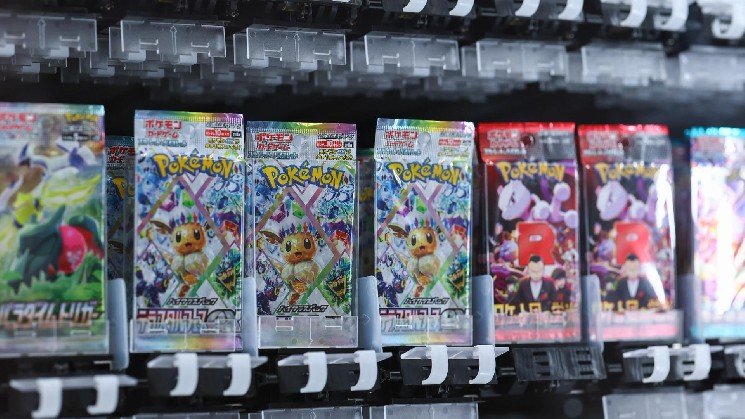
  • Pokémon cards are becoming multibillion dollar market. Crypto wants to fix how they trade

    Pokémon cards are becoming multibillion dollar market. Crypto wants to fix how they trade

    “Access to JTCC’s supply, one of the world’s largest liquidity streams in the trading card space, gives Deadstock an unfair advantage most platforms can never reach: deep, continuously replenished real-world inventory at scale,” said Jang.

    The eBay question

    However, there is an important caveat to this model: liquidity.

    eBay remains the industry’s dominant source of price discovery and liquidity in the trading card sector. More than $2.62 billion worth of individual trading cards changed hands on the marketplace in 2025, according to GemRate data, including about $837 million of trading-card-game and non-sports cards. The tally doesn’t include sealed boxes, packs, sets or lots, meaning the broader card business conducted on eBay is even larger.

    Liquidity begets liquidity. A seller is naturally drawn to the venue with the largest number of potential buyers, while buyers benefit from a deep history of completed sales that can help establish a particular card’s actual value. That network effect gives eBay an advantage that newer tokenized marketplaces have yet to replicate.

    And that creates a chicken-and-egg problem for platforms such as Deadstock.

    Transferring ownership on a blockchain may allow a trade to settle almost immediately, but it doesn’t guarantee that someone will be on the other side of the transaction. A tokenized card trading among a small number of users could be less liquid — and harder to price — than the same card listed on an established marketplace.

  • Vitalik Buterin Says Ethereum Is Betting Its Future on Quantum Security and AI

    Vitalik Buterin Says Ethereum Is Betting Its Future on Quantum Security and AI

    In brief

    • Vitalik Buterin says Ethereum has elevated quantum security and privacy since its 2023 roadmap.
    • Ethereum researchers are increasingly relying on STARKs and AI-assisted formal verification.
    • The roadmap also includes native rollups and explores a future beyond the EVM.

    Ethereum co-founder Vitalik Buterin says quantum resistance, privacy, and AI-assisted security have become greater priorities for Ethereum since he published his 2023 roadmap.

    In a post on X on Monday, Buterin said he updated his 2023 roadmap to compare its original goals with Ethereum’s current “Strawmap”—a working outline of the network’s long-term technical priorities.

    “What’s most striking, however, is that some completely new things are in the strawmap that are not in this diagram, because they were not in the 2023 roadmap at all,” Buterin wrote. “These reflect changing priorities.”

    Among those priorities are stronger privacy and scaling designed for a post-quantum world, alongside efforts to push the “lean-ification of the spec,” or simplify Ethereum’s technical specifications.

    “A common theme in scaling, found in both state types and zkzk frames (both new ideas), is that instead of trying to maximally scale all Ethereum activity,” Buterin wrote. “We try to create specialized mechanisms that have more restrictive properties that make them more scaling-friendly, while supporting the heaviest loads incurred by users and applications today (eg. token transfers, swaps) and tomorrow (eg. privacy protocols).”

    According to Buterin, advances in AI are making it practical to apply the technique more extensively to Ethereum.

    Buterin said Ethereum is increasingly relying on STARKs, a cryptographic technology used to verify computations, and AI-assisted verification, to check that the protocol works as intended.

    “This can only be safe with formal verification, which is itself only feasible with modern AI tools,” he wrote.

    Buterin’s post comes as Ethereum has accelerated preparations for “Q-Day” and the potential threat posed by quantum computers.

    In January, Buterin urged developers to adopt quantum-resistant cryptography before the threat becomes immediate, and the Ethereum Foundation formed a dedicated post-quantum team. In February, Buterin outlined a phased plan to replace four potentially vulnerable components of Ethereum’s cryptographic architecture.

    In July, Buterin put quantum safety and privacy at the center of his proposed “Lean Ethereum” overhaul, which calls for replacing quantum-vulnerable cryptography with quantum-safe alternatives.

    “Ethereum will be quantum-safe. Ethereum will put users’ privacy first. Ethereum will be secure,” Buterin wrote. “Ethereum will be censorship-resistant. Ethereum will be highly performant and scalable while satisfying the above. And Ethereum will be Lean.”

    Daily Debrief Newsletter

    Start every day with the top news stories right now, plus original features, a podcast, videos and more.

  • Worldcoin’s $1M liquidity cluster sets $0.40 target: What’s next as WLD surges 10%?

    Worldcoin’s $1M liquidity cluster sets $0.40 target: What’s next as WLD surges 10%?

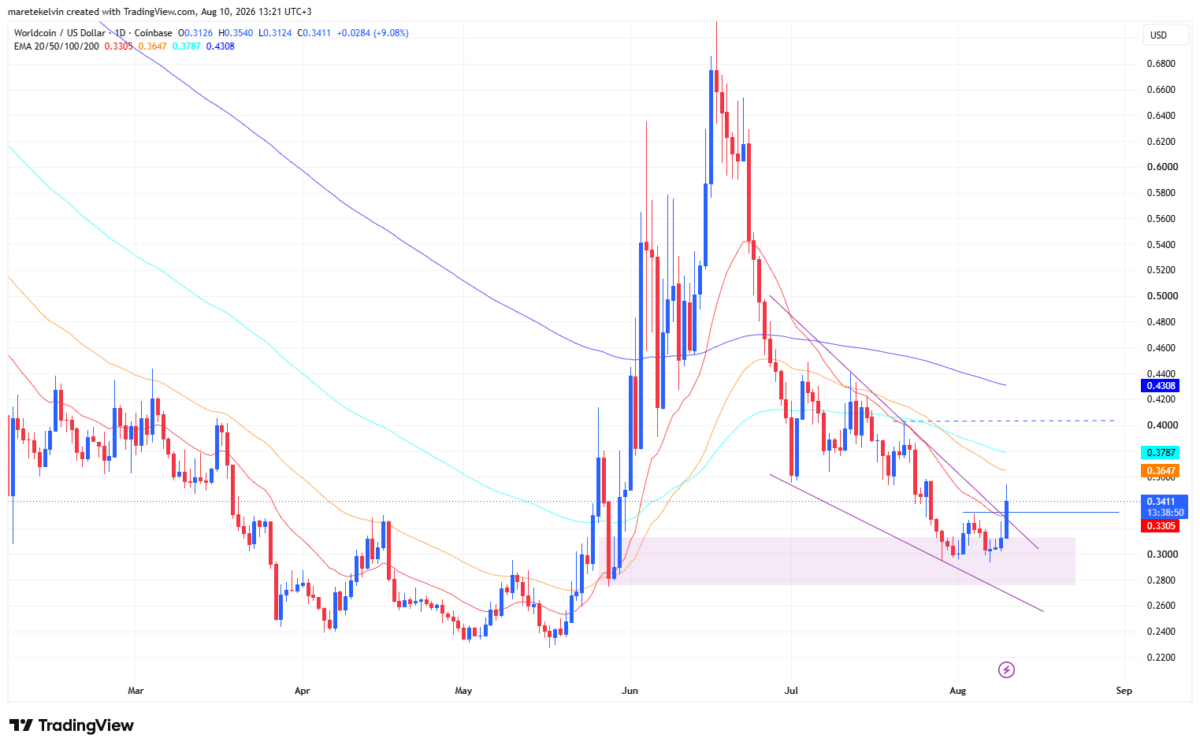
    Worldcoin [$WLD] surged by over 10% in the last 24 hours and sustained the upward momentum for the fourth day in a row to cross the $0.34 resistance.

    The price move places $WLD at a critical point as buyers attempt to invalidate the bearish structure that has dominated price action since June.

    Besides, the current rally helped $WLD break out above the upper boundary of the pennant consolidation pattern, indicating the potential formation of a trend reversal. A daily candle close above $0.34 will confirm the breakout.

    Source: TradingView

    Worldcoin’s trading activity is also supporting the recovery

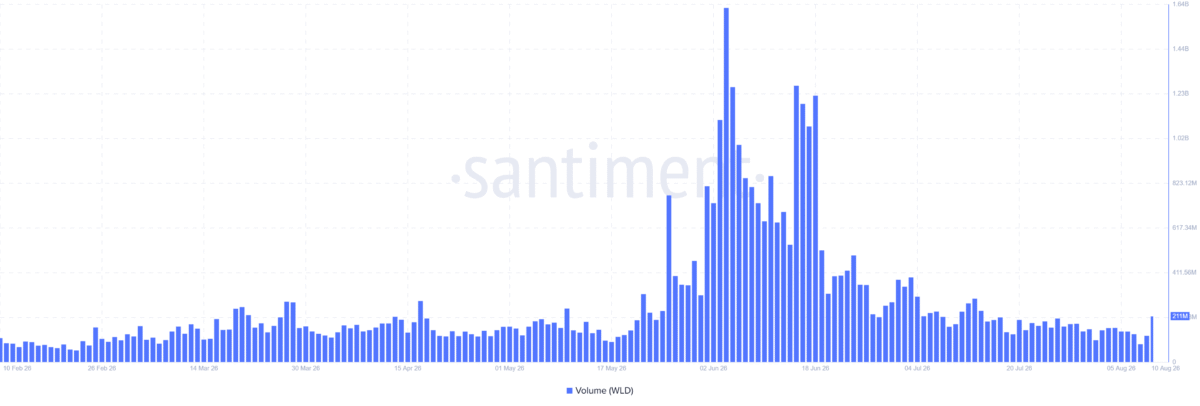
    That’s not all; Worldcoin’s trading volume has recorded a 150% increase to $211 million, suggesting a sharp increase in market participation as the token surges aggressively.

    The surge in volume provides stronger confirmation for the breakout because sustained buying activity can help prevent the move from becoming a short-lived price spike.

    Source: Santiment

    Derivative data is also sparking similar signals

    Worldcoin’s Open Interest gained by 10.44% to $169.4 million over the same period, indicating that traders are adding new positions as price momentum strengthens.

    The network’s rising Open Interest alongside a price rally suggests fresh capital is entering the market and could amplify $WLD’s upside if buyers maintain control.

    Source: Coinalyze

    Moreover, long positions currently account for approximately 60% of total $WLD market exposure, giving bulls a modest advantage. This positioning supports the bullish setup, although an excessively crowded long market could also increase liquidation risks if $WLD fails to sustain its breakout.

    Source: Coinalyze

    Is $0.40 next for the bulls?

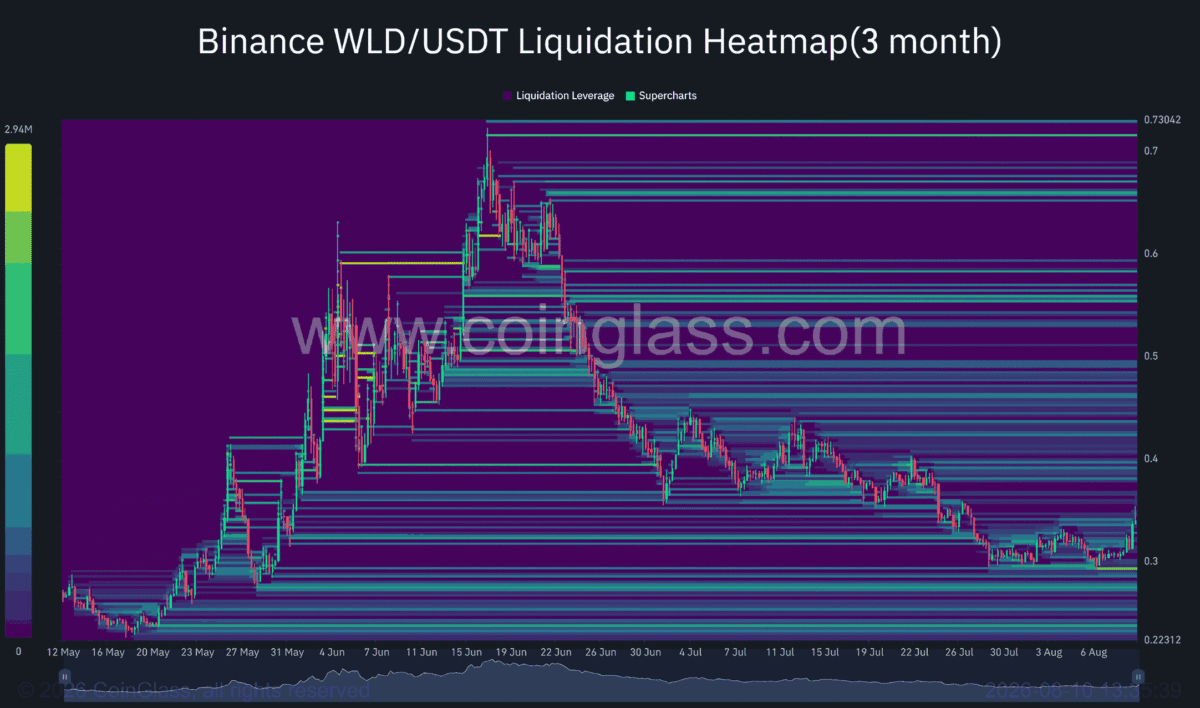
    More than $1 million in liquidity remains concentrated between $0.37 and $0.40, creating a significant liquidity pocket above the current price.

    If buyers sustain momentum, $WLD could be drawn toward this zone as its price action hunts for the unmitigated liquidation clusters.

    Source: CoinGlass

    Final Summary

    • $WLD gained by more than 10% in 24 hours, breaking above $0.34 as buyers challenge the token’s recent bearish structure.
    • Rising volume, Open Interest, and $1 million-plus liquidity between $0.37 and $0.40 could support a move toward $0.40.
  • U.S. SEC sets meeting to propose Reg Crypto to support certain digital assets offerings

    U.S. SEC sets meeting to propose Reg Crypto to support certain digital assets offerings

    “We view this as the first of several rulemakings the SEC will undertake to provide regulatory certainty for crypto assets after the Senate failed before the August recess to advance the Clarity Act on crypto market structure,” TD Cowen analyst Jaret Seiberg wrote in a client note sent after the SEC’s notice.

    The proposal is expected to give a path to crypto firms enabling them to raise capital for projects without triggering SEC registration requirements, and the businesses are also expected to be provided an exit path for getting clear of the agency’s jurisdiction when they’re not engaged in hands-on management of the projects anymore.

    Before this, Atkins and the agency had rolled through a lengthy series of crypto policy statements meant to clarify its regulatory position on digital assets, but the staff statements have little long-term durability. A formal rulemaking would be more difficult to reverse in the future.

    But the rule will likely take further months to develop and finalize. This first stage will come with a comment period — typically two or three months — and be followed by a potentially lengthy rewrite.

    Reg Crypto would join some of the other significant steps the agency has taken or is still working on to foster the U.S. crypto industry. One of the major moves was a joint stance with the Commodity Futures Trading Commission on a “taxonomy” to define how they view various crypto assets and which jurisdictions they belong in. The agency is also still working on its tokenized securities approach, which Atkins routinely mentions as one of the SEC’s marquee crypto maneuvers.

  • Solana (SOL) Shows 3 Bullish Signals: $100 Target Is Back in Sight

    Solana (SOL) Shows 3 Bullish Signals: $100 Target Is Back in Sight

    Solana is currently trading above $76, following a recovery of more than 6% over the past week, along with the rest of the top crypto market.

    With several bullish signals now aligning, one analyst believes $SOL could be headed toward a level not seen since February 2026 if the current setup confirms a breakout.

    Constructive Picture

    According to Ali Martinez, Solana appears to be trading within a parallel channel, and $78 has emerged as an important level. A break above the mid-range near this level could push $SOL toward the channel’s upper boundary around $100.

    The analyst also identified a buy signal from the TD Sequential on the crypto asset’s daily chart. The setup typically anticipates a 1-4 candle upswing or the start of a new “bullish countdown.” The resistance trendline at $78.7 is near the mid-range, which makes it a crucial level for confirmation.

    At the same time, the MACD has printed a golden cross, adding another sign that $SOL may be approaching an upside breakout. If these signals are confirmed, Martinez says that the altcoin could be on its way to $100.

    Trader Pepesso previously said that $SOL had one of the cleanest setups in crypto. At the time, he pointed to the $45-$60 range as the area to watch, while explaining that the same zone had triggered the asset’s 2023-2024 bull run. A move back into that range would still fit the accumulation view, as long as $45 held on a retest. A decisive break below it would invalidate the setup.

    On the upside, Pepesso identified $100 as the first major confirmation point. If $SOL reclaimed that level, the $150-$200 range would come into focus, followed by a potential move toward the previous cycle high.

    You may also like:

    • Jupiter Launches Lend v2 on Solana, Letting Borrowed Assets Earn Trading Fees
    • Ethereum Stays on Top of RWA Market as Solana Strengthens Its Position
    • Base Passes Solana in Curated Capital Milestone (Flash News)

    Big Moves

    Away from the price chart, the blockchain had a busy week on the network side. For example, BlackRock also brought another investment product to Solana with the launch of BRSRV, a money market fund designed to support stablecoin reserves.

    Meanwhile, Western Union’s launch of Stablecard also added another real-world use case for the blockchain. The digital wallet and Visa-secured credit card use USDPT, a US dollar-backed stablecoin issued by Anchorage Digital Bank on Solana.

    Take-Two Interactive also brought tokenized TTWO shares to the network through Backpack Securities, with each token backed 1:1 by the underlying stock.

    Additionally, Solana processed a record 1.01 billion non-vote transactions in a single week. Tokenized equities also recorded around $1.45 billion in volume in July, giving the network about 82% of the global market share.

  • Shibarium Transactions Surge 507% as Shiba Inu Layer-2 Network Hits One-Month High

    Shibarium Transactions Surge 507% as Shiba Inu Layer-2 Network Hits One-Month High

    Shibarium, the Layer-2 blockchain associated with Shiba Inu, has recorded a sharp rebound in daily transaction activity, with the network processing its highest number of transactions in a month.

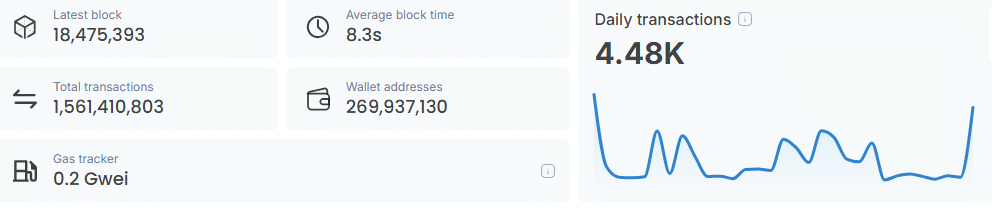
    According to data from Shibariumscan, the Shiba Inu L2 blockchain processed 4,480 transactions on August 9, marking a one-month high. The figure represents a dramatic recovery from the 738 transactions recorded on August 8. As a result, Shibarium’s daily transaction count jumped 507% within 24 hours.

    The latest increase interrupts a prolonged decline in network activity. For context, Shibarium processed 5,170 transactions on July 10. However, daily activity gradually weakened afterward, eventually falling below 1,000 transactions for several consecutive days by August 2.

    Therefore, the sharp increase recorded on August 9 represents a notable shift in network activity. Nevertheless, it remains unclear whether Shibarium can maintain this momentum over the coming days.

    Shibarium’s Impressive Long-Term Stats

    Meanwhile, Shibarium continues to post impressive long-term network statistics despite its recent weakness in daily activity.

    Data from Shibariumscan shows that the Layer-2 network has now processed 1.56 billion transactions since launching in August 2023. In addition, the blockchain has recorded roughly 269.93 million addresses, highlighting the scale of its cumulative network usage.

    Shibarium has also produced more than 18.47 million blocks, while its average block time currently stands at approximately 8.3 seconds.

    Shibarium Transaction Volume Spikes

    Shibarium DEX Activity Remains Extremely Weak

    Despite the latest surge, Shibarium has yet to see a corresponding increase in decentralized finance activity.

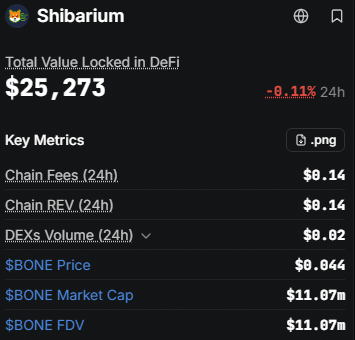
    At press time, decentralized exchanges on Shibarium had processed just $0.02 in trading volume over the previous 24 hours. This extremely low figure suggests that the increase in transaction activity has not yet translated into meaningful trading activity.

    Similarly, Shibarium’s total value locked (TVL) stood at $25,273, while the network generated only $0.14 in fees and $0.14 in revenue during the same period.

    Consequently, the latest transaction spike should not yet be interpreted as a broad recovery in Shibarium’s overall on-chain economic activity.

    Shibarium TVL

    Shiba Inu Burn Rate Declines 55%

    Meanwhile, Shiba Inu’s token-burning activity has also weakened.

    The $SHIB burn rate declined by 55% over the past 24 hours. During that period, the community permanently removed 4.72 million $SHIB tokens, worth around $22, from circulation.

    The sharp slowdown contrasts with periods of elevated burn activity in recent weeks. However, the latest burn figure remains relatively small compared with the broader $SHIB supply.

    $SHIB Slips to 29th in Crypto Rankings

    The latest Shibarium developments come as $SHIB struggles to maintain its position among the largest cryptocurrencies by market capitalization.

    After climbing to 25th place toward the end of July, Shiba Inu has since slipped to 29th. At press time, $SHIB had a market cap of $2.76 billion and traded at around $0.000004692.

    Nevertheless, the token recorded a modest short-term recovery, gaining 1.28% over the previous 24 hours. Despite that increase, $SHIB remained down approximately 2.7% over the past seven days.

  • Grayscale Withdraws ETF Application for Three Major Altcoins, SEC Approves in 190 Seconds! Here Are the Details

    Grayscale Withdraws ETF Application for Three Major Altcoins, SEC Approves in 190 Seconds! Here Are the Details

    Grayscale, one of the largest crypto asset managers based in the US, has withdrawn its ETF applications for three major altcoins.

    At this point, Grayscale withdrew its ETF applications for Cardano, Hedera, and Polkadot, three altcoins that have recently caused significant disappointment with their price drops.

    Grayscale has filed three Form RW withdrawal requests with the U.S. Securities and Exchange Commission (SEC), seeking the withdrawal of S-1 registration statements for the Grayscale Cardano Trust ETF, Grayscale Hedera Trust ETF, and Grayscale Polkadot Trust ETF.

    The SEC responded to this request in record time, with data showing that the ETF registrations were accepted just 190 seconds after the application was submitted.

    Why Did Grayscale Withdraw Its ADA, HBAR, and DOT Applications?

    The documents submitted to the SEC showed that all three applications contained standard and general justifications. Grayscale stated that it did not intend to proceed with the planned distribution of ETF shares under these registration statements. It was also noted that the registrations had not yet taken effect and no shares had been issued or sold.

    In this context, neither Grayscale nor the SEC has explained the actual and clear reason for the withdrawal.

    Finally, Grayscale currently has pending applications for Bittensor (TAO), Aave (AAVE), BNB, Near Protocol (NEAR), and Zcash (ZEC) ETFs. According to experts, this indicates that Grayscale is becoming more selective in its ETF applications.

    *This is not investment advice.

  • Standard Chartered Sees $4T Tokenization Driving Chainlink to $200 by 2030

    Standard Chartered Sees $4T Tokenization Driving Chainlink to $200 by 2030

    In brief

    • Standard Chartered initiated coverage of Chainlink on Monday with a price target of $200 by end-2030, up from around $8 today.
    • The bank expects tokenized assets on-chain to reach $4 trillion by end-2028 and assets deployed in DeFi to grow 37-fold to $2.7 trillion by 2030.
    • LINK was trading at around $8.25 Monday, down 0.8% on the day, according to CoinGecko.

    Standard Chartered has initiated coverage of Chainlink with a price target of $200 by the end of 2030, implying a roughly 25-fold gain from around $8 today and outperformance of both Bitcoin and Ethereum over the period.

    Geoff Kendrick, the bank’s global head of digital assets research, laid out staged targets in a note published Monday: $13 by the end of this year, then $41, $82 and $133 before reaching $200. The same note pencils in Bitcoin at $500,000 and Ethereum at $40,000 by end-2030.

    Kendrick expects the value of tokenized assets on-chain to climb roughly 12-fold to $4 trillion by end-2028 from about $340 billion now, and assets deployed in DeFi to grow 37-fold to $2.7 trillion by 2030. Because Chainlink charges for delivering data and moving assets between chains, the bank estimates its fees should rise about 25 times over that period, and assumes the token price follows fees.

    Chainlink’s incumbency is the other half of the argument. The note puts its total value secured above $110 billion, covering roughly 70% of oracle-dependent value in DeFi globally and more than 80% on Ethereum. Aave V3 alone accounts for 44% of that secured value.

    Wall Street on the client list

    Kendrick named Swift, DTCC, Euroclear, JP Morgan, Mastercard, UBS, Fidelity and S&P Global among institutions using Chainlink services, and expects off-chain customers to become a growing share of fees. Tokenized funds and bonds need net asset values, rates and reserve attestations, making them more data-hungry than crypto-native assets.

    On interoperability, Chainlink still trails LayerZero. The note says more than $7 billion in token value has moved from legacy bridges to Chainlink’s CCIP since a $292 million exploit in April, with quarterly CCIP volume reaching $4.9 billion in the second quarter, up 353% year on year. Decrypt reported in May that KelpDAO blamed LayerZero for that exploit and planned to rebuild on Chainlink, a characterization LayerZero disputes.

    The note is the latest in a run of DeFi initiations from Kendrick, all built on the same 37-fold forecast. He set targets of $100 for Uniswap and $3,500 for Aave in June, and $60 for Morpho in July. UNI jumped double digits after its note landed. Chainlink’s response has been more muted, with LINK currently trading at $8.25, down 0.8% on the day, per CoinGecko data.

    Risks flagged in the note include institutional tokenization scaling more slowly than expected, pilots failing to become recurring production workflows, specialist providers taking share, and technical failures denting confidence.

    Daily Debrief Newsletter

    Start every day with the top news stories right now, plus original features, a podcast, videos and more.

  • Bitcoin steadies above $65,000 as Iran-Oman deal talk eases Hormuz concerns, lifts risk assets

    Bitcoin steadies above $65,000 as Iran-Oman deal talk eases Hormuz concerns, lifts risk assets

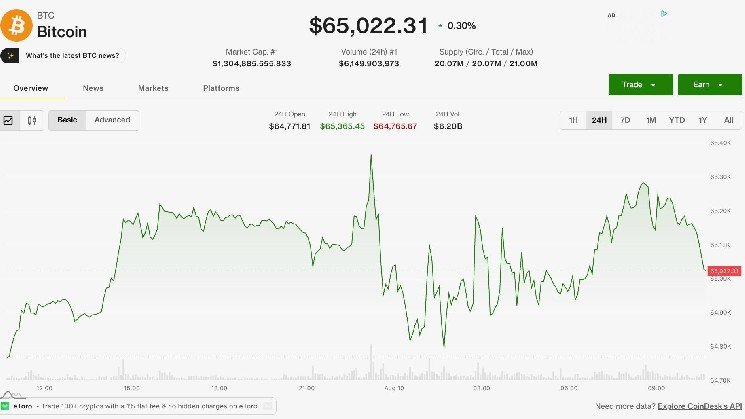
    The crypto market opened the week on a positive note, with bitcoin $BTC$64,978.83 up 0.54% since midnight UTC at $65,209 and ether $ETH$1,916.58 gaining 0.86% to $1,925 as sentiment stabilized following a turbulent July.

    The move was correlated with Nasdaq 100 index futures, which rose by 0.45% since midnight, buoyed by speculation from the Middle East that Iran is ready to strike a deal with Oman to open the Strait of Hormuz.

    The altcoin market is delicately poised, waiting to see if bitcoin can drive higher into the $68,000 to $72,000 range before benefiting from capital rotation.

    Derivatives positioning

    • Long-short ratio flips bullish: The long-short ratio for taker volume in crypto futures has flipped bullish, with longs accounting for 52% of the flow. A taker is an entity that removes liquidity from the order book by trading at available prices.
    • $BTC OI growth remains elusive: Bitcoin futures market activity remains subdued as $BTC attempts to hold above $65,000 amid cooling bets on Federal Reserve rate increases. Open interest (OI) slipped back below 750K $BTC. However, annualized funding rates and 24-hour OI-adjusted CVD remain positive, indicating that the limited interest present in the market is leaning bullish.
    • $ETH OI slides: De-risking continues in $ETH futures, with open interest falling to 13.35 million tokens, the lowest level since May 3, and a significant drop from the late-May peak of 15.98 million tokens.
    • Activity picks up in $SOL futures: Renewed activity is appearing in $SOL futures, as open interest rebounds to 64.60 million tokens from a recent low of around 60 million. This points to fresh capital inflows, coinciding with the token’s price recovery from nearly $70 to over $76 and a break above the widely tracked Ichimoku cloud, signaling a potential short-term bullish trend reversal.
    • Monero leads OI growth: Privacy-focused coin Monero (XMR) has surged 5% over the past 24 hours, briefly topping $400 for the first time since June 12. The rally appears to have staying power, with futures open interest jumping 6% alongside the price gains. The 24-hour CVD is the most positive among major cryptocurrencies, indicating that buyers are acting more aggressively through market orders rather than passive limit orders. In addition, annualized funding rates stand at the highest level among majors at 28%, underscoring growing demand for upside exposure.
    • BVIV hits 2026 lows: Bitcoin’s 30-day implied volatility index, BVIV, fell to a year-to-date low of 35.59% over the weekend. The drop shows expectations for market calm, although some traders warn that put options offering protection from price losses in $BTC are still trading at a premium to calls.
    • Calls dominate volume: The 24-hour volume ranking in options shows increased investor bias for bitcoin calls at strikes $68,000 and $70,000. Ether options show a similar profile.

    Token talk

    • Pump.fun PUMP$0.002740 led the altcoin market with a 5.39% gain since midnight UTC, extending a 24-hour run that has pushed its market cap above $1.1 billion.
    • Ethena (ENA) rose 4.84% to $0.0907, continuing a steady recovery that has seen it gain ground in most sessions over the past two weeks. Still, it remains more than 90% below its all-time high.
    • NEAR protocol gained 3.79% as AI tokens broadly recovered, with FET adding 2.10% after weeks of underperformance against the wider market.
    • Lighter (LIT) slipped 0.94%, one of the only notable altcoins in the red as its slide following July’s 200%-plus rally continues to grind lower.
    • Woldcoin WLD$0.3398 posted a 13% gain over the past 24 hours but remains in a deep downtrend, down 91% from its record high one year ago.
    • CoinMarketCap’s “altcoin season” indicator is at 37/100, down significantly from last week’s peak of 51/100 as investors focus on bitcoin’s potential move higher.