Category: Business

  • Cardano Founder Charles Hoskinson Discusses the Future of ADA: He Praised the Founder of the Controversial Altcoin

    Cardano Founder Charles Hoskinson Discusses the Future of ADA: He Praised the Founder of the Controversial Altcoin

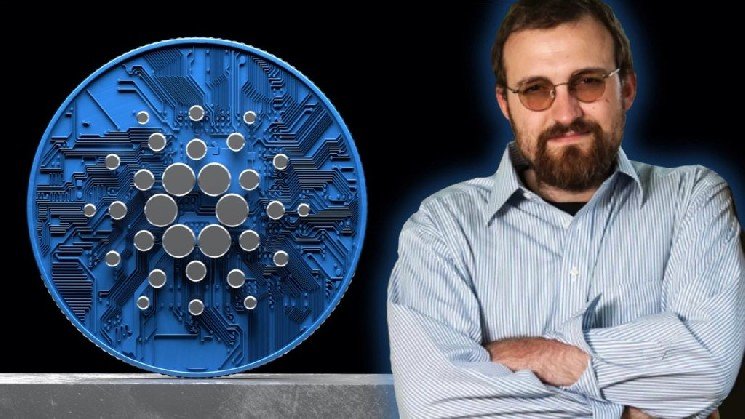
    Cardano founder Charles Hoskinson made statements about TRON founder Justin Sun, relations with the European Union, Monad, Midnight, and Cardano’s decentralized finance goals. Hoskinson also said he sees a low probability of the CLARITY Act, closely followed by the crypto sector in the US, becoming law.

    Hoskinson, stating that he has had a good relationship with Justin Sun for many years, said, “I love Justin Sun. He has been very kind to me over the years. We have a very nice and sincere relationship based on mutual respect. He has done incredible things. There is only one direction for him: upwards. You have to admire that.”

    Hoskinson also mentioned the contacts maintained with European Union institutions, stating that the work in this area is largely carried out by the Cardano Foundation. He said the foundation has established strong relationships across the EU and is regularly invited to events, adding that he finds the ongoing work successful.

    Hoskinson said he had no problems with Monad.

    Hoskinson highlighted RealFi, a product within the Cardano ecosystem, stating that it is one of the company’s most promising projects. He argued that RealFi has the highest potential to generate $1 billion in locked total value (TVL) for Cardano within the next 12 months.

    Hoskinson also spoke about Midnight’s NIGHT token not being listed on Coinbase, stating that Coinbase is the only major exchange that hasn’t listed the token. He attributed this to Coinbase’s investment in Aleo, which it considers a rival project, but expressed his belief that the exchange will change its decision in the future.

    Hoskinson also shared his expectations regarding the CLARITY Act, which aims to regulate the digital asset market in the US. When asked whether the bill would pass, he replied, “Probably not.”

  • Russia Approves Trading of Bitcoin, Ethereum and USDT—But No XRP

    Russia Approves Trading of Bitcoin, Ethereum and USDT—But No XRP

    In brief

    • The Bank of Russia published a draft directive letting non-qualified investors buy crypto through brokers, capped at 300,000 rubles a year.
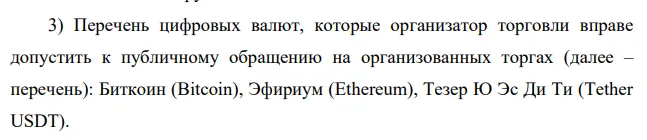
    • Only Bitcoin, Ethereum and Tether’s USDT made the approved list for public exchange trading.
    • Qualified investors face no such limits; all investors must pass a risk test first.

    Russia’s central bank has proposed its first framework for letting ordinary investors trade crypto on public markets.

    The Bank of Russia published a draft directive on Aug. 11 that would let non-qualified investors buy digital assets through brokers, crypto exchanges or managers—within a strict annual ceiling.

    “We’re setting a limit on the purchase of cryptocurrencies for non-qualified investors,” the central bank said in a separate notice. “Through each intermediary—a broker, crypto exchanger, or manager—they will be able to acquire such assets in the amount of 300 thousand rubles per year.”

    Which coins, and why only three

    The draft names exactly three tokens cleared for public exchange trading: Bitcoin, Ethereum, and Tether’s USDT. The central bank tied the short list to a law signed this month. “The list of digital currencies that the trading organizer is entitled to admit for public circulation on organized trading platforms (hereinafter referred to as the ‘List’): Bitcoin (Bitcoin), Ethereum (Ethereum), Tether USDT (Tether USDT).” the notice reads.

    The filter is liquidity and track record. Under the new federal law on digital currencies, a coin’s market cap, average daily volume and at least five years of pricing history on foreign platforms decide if it qualifies. “To protect non-qualified investors from sharp and unpredictable fluctuations in cryptocurrency rates, only the most liquid of them will be available to them,” the bank said.

    The cap itself is written into the directive’s operative text. “The maximum amount of the total value of digital currencies acquired through a broker during the calendar year amounts to 300 thousand rubles,” Article 2 states.

    XRP, the cryptocurrency created by the founders of payments company Ripple in 2012, has been left off the approved list for now. The token would seemingly qualify given the criteria, but XRP over the years has gone through regulatory troubles—stemming from a since-settled SEC lawsuit against Ripple—that caused the token to be delisted and then relisted on several exchanges, which could be playing a factor.

    Retail gets a door; whales get the market

    Qualified investors—Russia’s wealthier, accredited class—face none of these walls. “Qualified investors will be able to acquire all cryptocurrencies that will be traded on the exchange and over-the-counter markets, without restrictions,” the notice says. Before any trade, though, everyone takes a test. “All investors, regardless of their status, will need to pass testing and familiarize themselves with the risks of investing in cryptoassets.”

    The move follows the central bank’s earlier steps to open crypto to wealthy investors, and lands as Tether’s role draws scrutiny—the stablecoin issuer has frozen millions in USDT tied to sanctioned Russian exchanges.

    The Bank of Russia accepts comments until Aug. 24, and the directive takes effect 10 days after its official publication, signed by Governor Elvira Nabiullina.

    Daily Debrief Newsletter

    Start every day with the top news stories right now, plus original features, a podcast, videos and more.

  • DECTA taps OpenPayd to streamline treasury settlement

    DECTA taps OpenPayd to streamline treasury settlement

    Payments technology provider DECTA has partnered with OpenPayd to enhance its international treasury operations, integrating regulated stablecoin infrastructure to streamline operational settlement across its business.

    Through OpenPayd’s rails-agnostic platform, DECTA will gain access to fiat infrastructure, OTC conversion and hybrid payment capabilities through a single platform. The setup is expected to help DECTA manage liquidity and operational settlement more efficiently as it serves fintechs and merchants across multiple markets.

    “Stablecoins are becoming a practical treasury tool for businesses operating internationally. The opportunity extends well beyond digital asset companies. Organizations want faster, more consistent ways to manage liquidity and settle obligations without adding operational complexity,” OpenPayd CCO Lux Thiagarajah said in a statement.

    OpenPayd serves more than 1,200 businesses and processes over $280 billion in annual volumes, with customers including eToro, Kraken, OKX and B2C2. Its combination of regulated fiat infrastructure and digital asset capabilities can help businesses modernize treasury functions without compromising institutional governance and controls, Thiagarajah stated.

    DECTA UK CEO Scott Dawson said the company is focused on using technology to make its financial operations faster, simpler and more resilient. He said OpenPayd will provide a more efficient way for DECTA to move its own funds internationally, manage liquidity and support settlement while maintaining the regulatory discipline underpinning its operations.

    The partnership is part of DECTA’s ongoing investment in technology that can strengthen the efficiency and resilience of its operations, as institutions increasingly turn to stablecoins for liquidity management, settlement and cross-border transactions.

    The OpenPayd solution will be used solely for DECTA’s proprietary treasury activity and will not be offered for customer-facing crypto or foreign exchange services.

  • Watch Out: There Are Claims That a Cryptocurrency Exchange Is “Insolvent”

    Watch Out: There Are Claims That a Cryptocurrency Exchange Is “Insolvent”

    Matthew Wang, co-founder and CEO of OpenGradient, claimed that BitMart is experiencing payment difficulties, alleging that their market maker team is unable to withdraw funds held on the exchange.

    Wang stated on social media that his team was unable to access the balances in their BitMart accounts and could not process withdrawals. The OpenGradient executive argued that this raised serious questions about BitMart’s financial health.

    Wang stated that OpenGradient’s market maker team was unable to withdraw their balances held on BitMart.

    OpenGradient’s CEO stated that the exchange was “bankrupt” and that the company was unable to withdraw its funds from the platform.

    BitMart Allegedly Asked Token Holders to Lock Their Assets

    Wang also alleged that about a week before BitMart’s closure announcement, it had suggested campaigns to some token projects that would encourage token holders to lock their assets on the exchange.

    The screenshot shared by Wang shows an account that appears to be communicating on behalf of BitMart, offering a six-month locked savings campaign for token holders.

    The shared message suggests an annual return rate of approximately 15 percent for the campaign, stating that one of the goals is to encourage long-term token holding and reduce short-term selling pressure.

    The CEO of OpenGradient claimed that BitMart used these campaigns to encourage users to hold onto their assets on the platform.

    Wang described the decision to ask token holders to lock up their assets shortly before the exchange closed as “a move made for liquidity.”

    *This is not investment advice.

  • EToro reports second quarter crypto loss even as total profit beats estimates

    EToro reports second quarter crypto loss even as total profit beats estimates

    EToro’s (ETOR) crypto trading was $7.2 million in the red in the second quarter of 2026, a decline of nearly 120% from the $37.7 million it made a year earlier, according to its second-quarter earnings released Tuesday.

    The Tel Aviv, Israel-based trading platform reported $1.35 billion in cryptoasset revenue, around 29% lower than the $1.91 billion a year earlier. Its cost of revenue from cryptoassets was $1.35 billion, leaving a $7.2 million loss, compared with a $37.7 million gain a year earlier.

    EToro said it is developing onchain perpetual futures and that crypto buying power is “coming soon.” Crypto activity has cooled, however: the company reported 1.4 million crypto trades in July, down 73% from a year earlier, while the average crypto trade fell 50% to $182.

    Overall, eToro’s net contribution rose 9% year over year to $229 million, driven mainly by equity trading, while funded accounts increased 18% to 4.28 million. Shares fell as much as about 11% after the announcements. The report also noted that the adjusted diluted earnings per share of $0.68 beat analysts’ estimates of $0.61.

    Shares nevertheless traded more than 12% lower in the hours following the earnings release at around $29.80.

  • Ripple Engineer Clarifies Key XRP Ledger Update Metric: What’s Important?

    Ripple Engineer Clarifies Key XRP Ledger Update Metric: What’s Important?

    $XRP Ledger version 3.3.0 launched in the past week, with its upgrade progress across the entire network now in focus. In this context, RippleX software engineer Mayukha Vadari has provided an important clarification on an update progress metric.

    The conversation began when an X user posted that XRPL UNL validators have met the ‘Sufficiently Updated’ threshold of 80% on version 3.3.0 of XRPLD, hoping for amendment voting to gain traction.

    That prompted a question from $XRP community member @offledger, who asked whether the “Sufficiently Updated” consideration applies to the entire network rather than only validators.

    The original poster suggested that a set number rather than a percentage might be more appropriate for non-validating nodes, as software versions can vary considerably across that portion of the network. He cited XRPScan figures that showed 74 nodes on version 3.3.0 and 58 on version 3.2.1.

    Yeah this is the metric that most validators use. 80% of the UNL updating is the bare minimum, not the norm.

    — Mayukha Vadari (@msvadari) August 10, 2026

    Offledger clarified that the consideration has always been measured against the entirety of the network rather than only UNL validators; this implies about 32% of the network had updated to 3.3.0 while 68% of the network currently runs version 3.2.1.

    “A wee way to go yet,” Offledger said, suggesting that the broader network still has significant ground to cover before 3.3.0 reaches widespread adoption.

    Responding to the discussion over the ‘Sufficiently Updated’ threshold of 80%, Vadari said this is the metric that most validators use, adding that 80% of the UNL updating is the bare minimum, not the norm.

    $XRP Ledger consensus structure explained

    The X discussion highlighted an important distinction between UNL validators and the broader XRPL network.

    The xrpld is one of the two main types of server software that power the $XRP Ledger and can run in several modes depending on its configuration. One of these is P2P, which is the main mode of the server. This includes validators, which help secure the network by participating in consensus. A unique node list (UNL) is a server’s list of validators that it trusts not to collude with every $XRP Ledger server configured with a UNL.

    Hub servers relay messages between many other members of the peer-to-peer network, while the API server provides API access to read data from the shared ledger, submit transactions, and watch activity in the ledger.

    These form a peer-to-peer network that processes transactions and maintains the shared state of the $XRP Ledger.

  • Luke Dashjr Removed as BIP Editor After BIP-110 Bitcoin Fork Stalls

    Luke Dashjr Removed as BIP Editor After BIP-110 Bitcoin Fork Stalls

    In brief

    • Luke Dashjr has been removed as a Bitcoin Improvement Proposal editor and no longer holds editor or admin access to the BIPs repository.
    • Fellow editor Mark “Murch” Erhardt filed the motion on August 9, citing a conflict of interest over BIP-110, minimal contribution to the role, and a breakdown in coordination between editors.
    • Dashjr has continued to dispute the outcome and said on Monday he was taking a sabbatical from mining pool Ocean.

    Luke Dashjr has lost his role as a Bitcoin Improvement Proposal editor, days after the soft fork he championed split off a chain that mined two blocks and stopped.

    Fellow editor Mark Erhardt, who goes by Murch, put the motion to the Bitcoin Development Mailing List on August 9 and opened a pull request the same day as what he called a sample implementation of it.

    Erhardt gave four grounds, arguing first that Dashjr had exercised editorial authority “inconsistently with the established editorial process unfairly favoring the proposal he was involved in,” pointing to an attempt to assign BIP-110 a number publicly on X before it had been discussed on the mailing list, and to a merge completed within minutes of the pull request opening.

    He also said Dashjr had left “fewer than 1% of the BIP Editor comments” in the repository since additional editors joined in April 2024, and that the disputed merge was his first since May 2024. Championing a soft fork that “now appears to evolve into a hard fork” amounted to “a complete departure from the Bitcoin development ecosystem,” he wrote, adding that trust and coordination with the other editors had broken down.

    A role with no exit

    The request itself proposes deleting a single line, striking Dashjr’s name from BIP 3, the document that lists the editors. Backing for it has been registered in thumbs-up reactions and comments on the pull request.

    Dashjr has kept arguing the point on X since, writing that “Core isn’t supposed to have ANY control of the BIPs repo.” He still refuses to treat the majority chain as Bitcoin, calling it “Bpedo” and arguing that it is “guaranteed to fail.”

    He said on Monday that he was taking a sabbatical from Ocean, the mining pool that lists him as chairman and chief technology officer, adding that he would “turn my immediate focus to working on Bitcoin and open-source projects to support Bitcoin.”

    BIP-110 sought to temporarily bar non-financial data such as Ordinals inscriptions from Bitcoin transactions, and support for it peaked at 51 of 2,016 blocks in the period before the split, or 2.53%, against the 55% needed to activate.

    Not one block has signalled for the proposal since mandatory signalling began at block 961,632, according to BIP110 Monitor. Strategy’s Michael Saylor, among the proposal’s critics, tweeted that 99.85% of hashpower stayed with Bitcoin.

    Daily Debrief Newsletter

    Start every day with the top news stories right now, plus original features, a podcast, videos and more.

  • XRP Invalidates Most Important Support Level of 2026

    XRP Invalidates Most Important Support Level of 2026

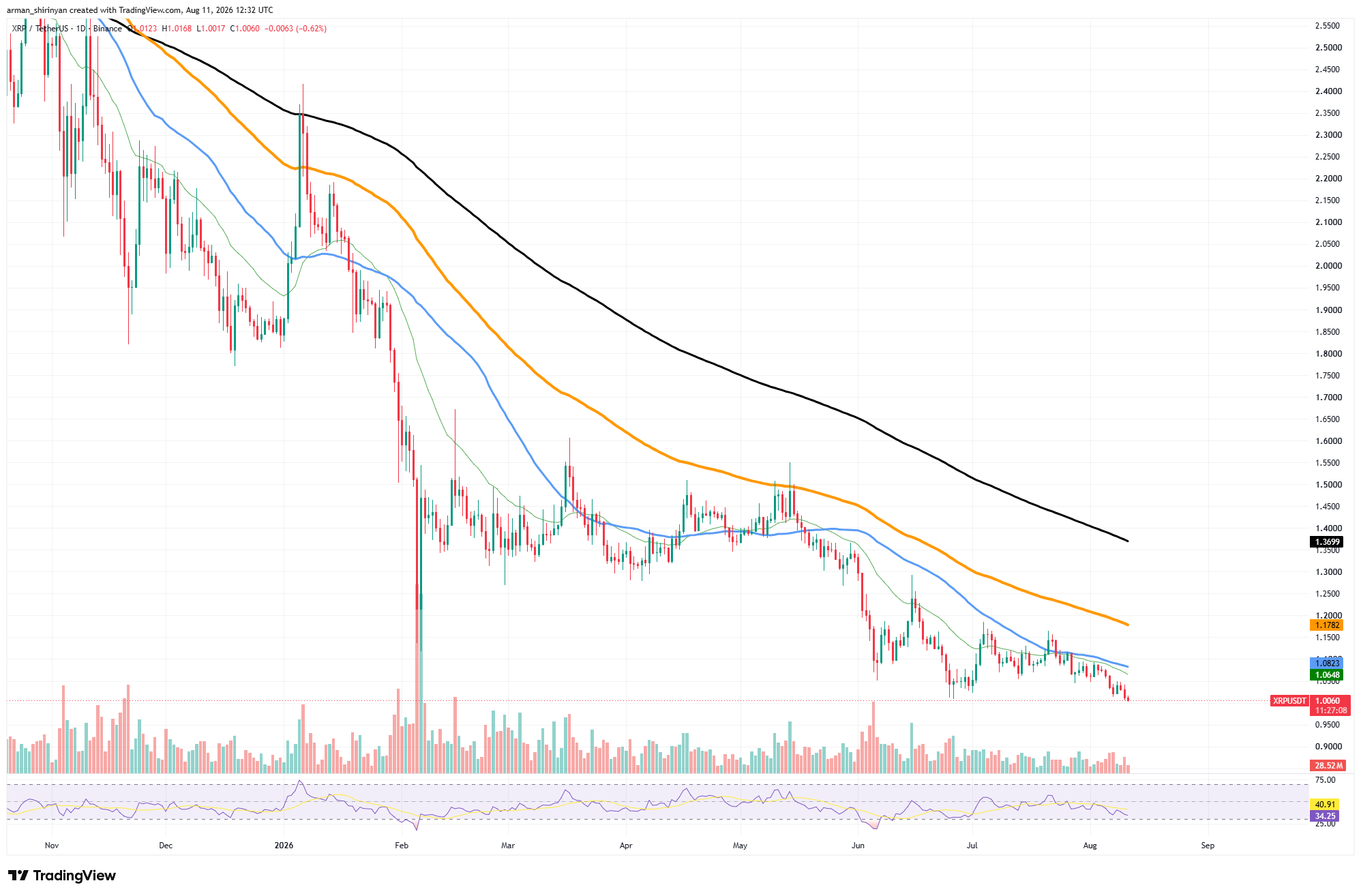
    $XRP‘s price is currently just above the psychological $1 mark, effectively invalidating one of its most significant support structures of 2025. The decline is particularly noteworthy because it occurs while $XRP Ledger activity is still comparatively high. After dropping below the $1.05-$1.07 range that had consistently offered support during the most recent consolidation, $XRP is currently trading at about $1.006.

    Short-term picture isn’t yet clear

    The short-term moving average, which is currently close to $1.065, strengthened this region. Rather than recovering it, $XRP has kept generating lower highs and lower lows. The obvious next issue is that $1 is now the first line of defense. A persistent break below $1 would be more significant than another typical daily decline.

    $XRP/USDT Chart by TradingView

    There isn’t much obvious support for $XRP below the current price. If selling picks up speed, the next possible demand area is around $0.95, followed by roughly $0.90. Moving averages support the negative framework. While the larger averages sit significantly higher at roughly $1.178 and $1.370, $XRP stays below the averages near $1.065 and $1.082.

    Since they are all positioned above the market, any attempt at a recovery will face several levels of resistance. Additionally, momentum is declining. The daily RSI has dropped to about 34.2, which is close to oversold territory but not quite at the traditional 30 threshold. This allows for more declines before $XRP becomes technically stretched.

    Network remains active

    It’s interesting to note that the weakness does not seem to be caused by declining network participation. According to $XRP Ledger data, there were roughly 207,028 active users on August 10. In general, activity has increased from about 100,000–120,000 users in the middle of July to about 200,000 or more recently.

    As a result, there is an obvious discrepancy between market performance and network usage. Spot demand has not increased enough to stop $XRP‘s decline despite more active users. Although network activity can bolster a longer-term fundamental argument, it does not ensure that the token will appreciate right away.

    For $XRP, the first significant indication that the most recent breakdown is being contested would be the recovery of $1.065–$1.082. Until then, the technical structure remains very bearish, with $1 being much more significant now that the previous support zone has failed.