Category: Business

  • Trikon Taps IBVM to Bring Bitcoin Security to AI-Driven Web3

    Trikon Taps IBVM to Bring Bitcoin Security to AI-Driven Web3

    Trikon, a renowned Web3 infrastructure entity, has partnered with IBVM, the earliest Bitcoin-based zero-knowledge layer 2 ecosystem. The partnership is set to combine AI-led consumer experience infrastructure and blockchain-powered security. As per Trikon’s official announcement, the development attempts to merge a modular blockchain framework with crypto capital within an inclusive Web3 tech framework. Additionally, Trikon will pay significant attention to its AI-driven operating network to deliver chainless, agent-led, and gasless interactions for dApps.

    We’re excited to partner with @IBVMCHAIN, Bitcoin’s native ZK Layer 2, bringing the most battle-tested capital in crypto into the modular Web3 stack.

    Trikon’s AI-native OS handles the UX layer chainless, gasless, agent-driven. IBVM handles the trust layer: ZK-verified,… pic.twitter.com/x29k2GKmTf

    — Trikon (@0xTrikon) August 8, 2026

    Trikon and IBVM Partnership Combines Bitcoin Security with AI-Driven UX

    In partnership with IBVM, Trikon is poised to assist builders in developing streamlined dApps without any compromise on the security properties linked with Bitcoin. In this respect, the AI-native OS of Trikon focuses on streamlining the way consumers interact with diverse blockchain apps by decreasing technical complications that are normally linked to wallets, individual networks, and gas fees. Additionally, the platform’s agent-powered architecture is set to allow automated interactions, letting AI-native agents handle specific blockchain activities on behalf of consumers.

    Apart from that, IBVM will advance this client-facing infrastructure by serving as a verification and security layer. In the form of a Bitcoin-native ZK L2, the platform leverages zero-knowledge technology for the verification of computations and transfers while using Bitcoin as the security foundation thereof. The approach attempts to support more scalability while also retaining a complete link to the established security architecture of Bitcoin.

    Simultaneously, the joint effort underscores the wider shift toward modular chain architectures, where diverse protocols and ecosystems specialize in particular functions instead of attempting to deliver each component within one chain. In line with the proposed framework, Trikon can focus on AI-led interactions and application usability, whereas IBVM addresses verification, security, and settlement requirements.

    Driving Web3 Trust and Usability for Scalable Web3 Infrastructure

    According to Trikon, the collaboration also signifies the rising role played by AI agents within the Web3 infrastructure. Amid the growing complexity of dApps, AI-led interfaces could increase the accessibility of blockchain functionality by abstracting technical procedures from users. Overall, by merging a Bitcoin-secured ZK model with the AI-led interaction layer, both entities endeavour to deal with trust and usability amid scaling dApps.

  • Cardano up 19% after Dijkstra launch – Can ADA stay above $0.20?

    Cardano up 19% after Dijkstra launch – Can ADA stay above $0.20?

    Cardano [$ADA] is among the top blockchains across the globe and recently hit a new peak in the Nakamoto coefficient of 16. This put Cardano as one of the most decentralized chains as prices slowly rebound.

    The altcoin has surged by more than 19% this week with daily gains averaging more than 6%. These gains resulted from Cardano transitioning to the Dijkstra development era. Can the price keep surging?

    Dijkstra launch fuels Cardano’s weekly gains

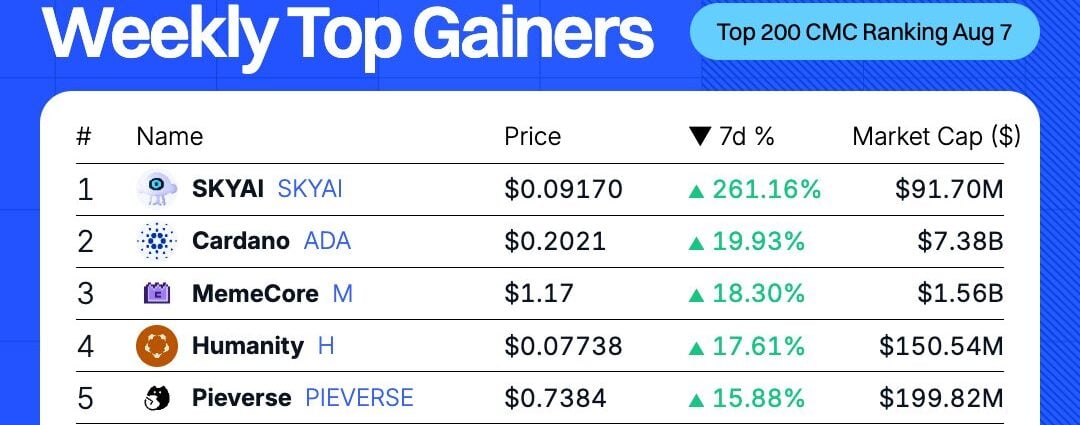
    According to CoinMarketCap, Cardano came a distant second among the largest weekly gainers. SKYAI recorded 261% with MemeCore [M], Humanity Protocol [H], and Pieverse [PIEVERSE] wrapping up the top 5 list for this week.

    Source: CoinMarketCap

    Cardano’s transition to the Dijkstra development era drove these weekly gains. This was a newly approved roadmap that made it the first chain to fund core development directly from its treasury.

    Additionally, the ecosystem was expanding to other blockchains. For instance, the chain connected with Injective [$INJ] via The Inter-Blockchain Communication Protocol (IBC), which was on testnet. Both $INJ and $ADA will be usable across the two ecosystems.

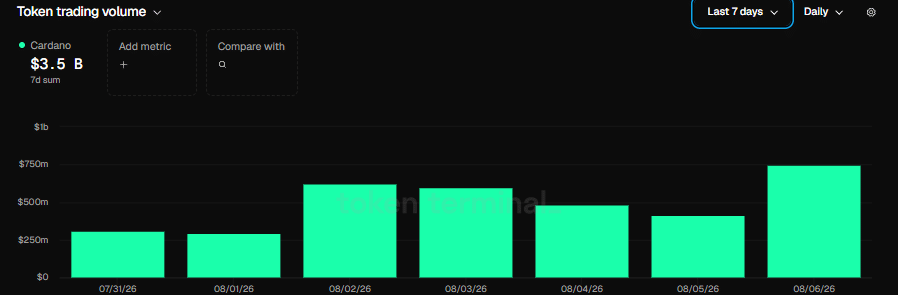
    As a result, the daily trading volume has also jumped by more than 78%, recording about $747 million. It jumped from $412.8 million to A 7-day sum of $3.50 billion.

    Source: Token Terminal

    Furthermore, the Total Value Locked (TVL) rose by around 3%, reaching $88 million. The chain’s weekly DEX volume also increased by 17%, reaching $13 million.

    Moreover, such developments prompted the big players to position themselves. According to Santiment data, whales have accumulated over 240 million $ADA in the past few days.

    Can $ADA stay above $0.20?

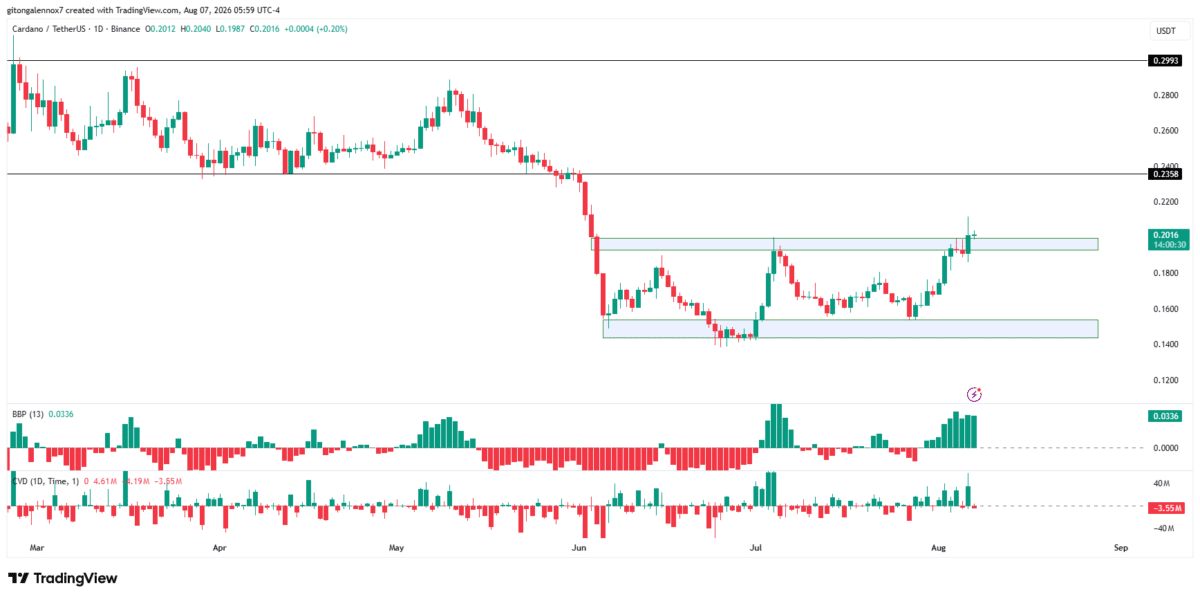
    Meanwhile, Cardano’s price broke above the $0.20 resistance level, but there was some lag at this zone. The altcoin price has been ranging between $0.14 and $0.20 since July, aligning with whale positioning. The range followed a 41% sharp drop from $0.24 to $0.14.

    In support of this trend was the Bull/Bear Power indicator, which turned green. The CVD showed that traders on Binance’s spot market bought more than 40 million $ADA tokens.

    With the token clearing the $0.20 resistance that capped every recovery attempt this year, it exposed $0.24 and $0.30 as the next target areas. But failing to hold above $0.20, the altcoin may revert back to the range.

    Source: $ADA/USDT on TradingView

    Therefore, Cardano’s native $ADA may rally higher if the chain developments continue.

    Final Summary

    • Cardano surged by more than 19% this week after transitioning to the Dijkstra era, funding its development directly from its community treasury.
    • $ADA price broke above a resistance level at $0.20, which has capped every recovery attempt this year.
  • Coldcard Exploit Confirmed at 1,719 BTC Stolen as Galaxy Research Warns Losses May Top $130 Million

    Coldcard Exploit Confirmed at 1,719 BTC Stolen as Galaxy Research Warns Losses May Top $130 Million

    The scale of the Coldcard hardware wallet exploit is becoming sharply clear. Galaxy Research has now confirmed with high confidence that at least 1,719 $BTC have been stolen across multiple user accounts, valuing the compromise at roughly $111 million at recent prices. But that number may not be the ceiling. Total losses, according to the research team’s latest assessment cited in the original report, are likely to surpass $130 million once all outstanding cases are verified.

    More than 25 distinct attack patterns have been identified, and investigators now believe that multiple threat actors are actively exploiting the vulnerability. The number of victims is piling up; Galaxy confirmed it has received reports from over 250 individuals. If every case is ultimately confirmed, the total haul could climb past 2,300 $BTC. For now, the only hardware known to be affected are Coldcard Mk3, Mk4, Mk5, and the Q model. There is no evidence that the bug has spread to other signing devices or wallets, and Galaxy has not indicated that any affiliated software or firmware outside of Coldcard’s ecosystem is compromised.

    A self-custody nightmare

    This incident hits at the very foundation of self-custody culture. Coldcard is widely considered one of the most secure Bitcoin hardware wallets, specifically designed for air-gapped, paranoid-grade storage. The fact that it has been cracked at this scale, with what appears to be a long-running exploitation window, will rattle confidence among users who have staked their entire net worth on it. It also complicates the already tense legislative conversation around self-custody protections in Washington. Just days before a crucial Senate vote on landmark crypto legislation—discussed in our coverage of how banks are attempting to reshape the bill—an exploit of this magnitude gives opponents of liberal self-custody rules a powerful new data point.

    Hardware wallets have been sold as the ultimate defense against hacks, yet they remain vulnerable to supply chain attacks, firmware tampering, and physical side-channel exploits. In this case, the exact entry vector has not been publicly detailed by Coinkite or Galaxy, but the existence of so many distinct patterns suggests it was not a single bug. A misconfigured random number generator, a compromised supply chain component, or a flaw in the device’s communication protocols could all be at play. For users who lost funds, there is the added bitterness that Bitcoin’s immutability makes fund recovery virtually impossible.

    What’s next for victims and the market

    With over 250 victims already identified, legal and reputational consequences are mounting for Coinkite, the manufacturer of Coldcard. The firm has yet to release a detailed technical postmortem, and the market is waiting to see whether a patch is even feasible for existing hardware or if replacements are necessary. So far, only Coldcard’s own line appears infected, but the discovery of multiple independent attackers suggests the vulnerability may have been widely known in certain circles before it became public. That raises the uncomfortable possibility that the exploit was first discovered and traded privately, only becoming a headline after losses spiraled.

    From an institutional perspective, this event will push funds and large holders toward scrutinizing their device choices more intensely. Multi-sig setups and custodian-based cold storage solutions may see renewed interest. The insurance question also re-emerges: most self-custody users carry zero coverage, while regulated custodians bundle insurance into their service. The $130 million-plus figure, though small compared to total Bitcoin market cap, is large enough to attract regulatory attention at a time when lawmakers are weighing how to classify and supervise wallet providers.

    Uncertainty looms

    Several unanswered questions make this a story that will develop further. Galaxy’s report does not clarify how the attackers managed to exfiltrate private keys or sign transactions without physical access to the devices. It is possible that the vulnerability allowed an attacker who gained temporary access—perhaps during shipping or through a compromised reseller—to later drain funds without ongoing access. The fact that over 25 patterns exist indicates that multiple techniques were employed, and it cannot be ruled out that some victims unknowingly used malicious firmware updates from unofficial sources.

    The community is left to weigh whether the Coldcard brand can recover its reputation. Hardware wallet security is as much about trust as it is about cryptographic design. Once that trust is broken at a scale of thousands of coins, the road back is long. Meanwhile, other manufacturers will likely use this event to market their own devices as superior, and the broader lesson for the industry is clear: self-custody demands constant vigilance, and no single device should be treated as a magic shield.

  • XRP Flirts With Sub-$1 Territory as Clarity Act Fails in August: Is This the Ultimate Buying Zone?

    XRP Flirts With Sub-$1 Territory as Clarity Act Fails in August: Is This the Ultimate Buying Zone?

    A massive retreat is unfolding in the $XRP market after the main fundamental driver of recent weeks — the U.S. Crypto CLARITY Act — was officially put on hold.

    The U.S. Senate has gone into recess, postponing the final vote until September 2026. The reaction from capital was immediate, and $XRP led the decline among market leaders, settling at $1.02.

    While retail traders are getting rid of the asset, the emerging Washington deadlock is weighing on the price, forcing major players to assess whether an inevitable drop below $1 would be a catastrophe or an ideal buying opportunity.

    Bollinger Bands narrow the room

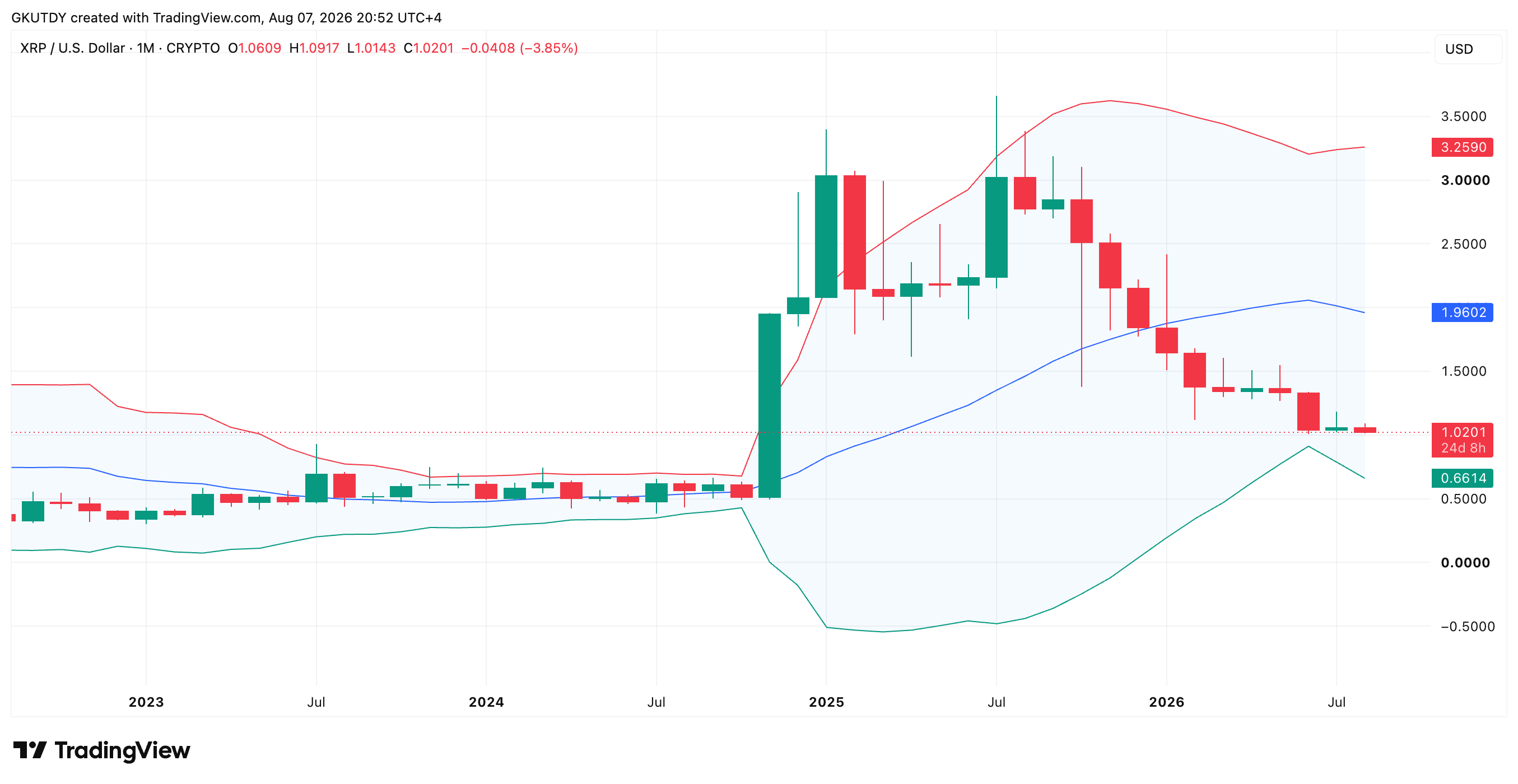
    TradingView chart data clearly maps out sellers’ targets as $XRP attacks the $1 boundary. Right now, the decline has temporarily stalled exactly at the lower daily Bollinger Band — $1.0240.

    The indicator’s bands have converged into an extremely narrow corridor, which historically signals that the market is preparing for a powerful price move. Due to local oversold conditions, a short technical rebound toward the middle band at $1.0831 or the upper band at $1.1423 is possible, but this would not reverse the broader downtrend.

    $XRP price action on a monthly time frame within Bollinger Bands, Source: TradingView

    If sellers finally push through the psychological $1.00 level, the next stop will be a test of the lower weekly band at $0.9572. In the worst-case scenario and a full-scale market capitulation, the true lower support boundary on the monthly timeframe would be around $0.6625.

    Risks and opportunities for $XRP investors

    The token’s next move depends on two key factors that are currently shaping the behavior of major players:

    • Bearish pressure: The freezing of U.S. institutional capital until mid-September and the loss of the key monthly middle line at $1.9605 open the door for a drop below the psychological $1.00 level.
    • Bullish potential: Buyers’ firm defense of the daily support at $1.0240, the potential for a strong technical rebound due to the compression of the bands, and continued demand across the global payments network are preventing the asset from an immediate collapse.

    In such an environment, short-term speculative capital will most likely continue avoiding $XRP in the coming weeks.

    However, for large strategic investors, a price decline into the $0.90–$0.95 zone, or in the event of a panic sell-off toward the monthly target of $0.6625, may be seen not as the collapse of the project but as a rare window of opportunity to build a long-term position at a deep discount.

  • Bitcoin, Ether ETFs Add $220 Million as Blackrock Leads Again

    Bitcoin, Ether ETFs Add $220 Million as Blackrock Leads Again

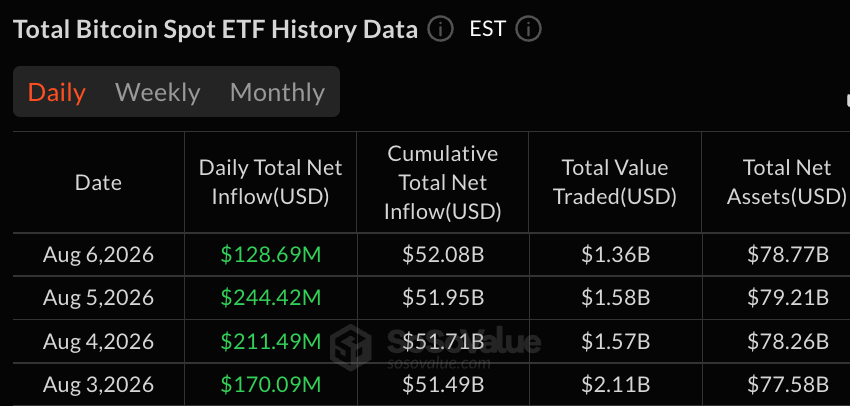
    Bitcoin Streak Hits 4 Days With $128.69M Inflow

    Capital continued to flow into the largest crypto ETFs as the week progressed. Bitcoin funds added another nine-figure haul, ether demand strengthened sharply, and several altcoin products found fresh buyers.

    The broad tone remained constructive across the market, although solana ETFs slipped into a modest outflow.

    Blackrock Leads Another Strong Bitcoin Session

    Bitcoin ETFs recorded $128.69 million in net inflows across six funds. Blackrock’s IBIT once again carried most of the load, attracting $128.33 million. Morgan Stanley’s MSBT added $14.94 million, while Fidelity’s FBTC brought in $11.20 million.

    Grayscale’s GBTC and Bitcoin Mini Trust contributed $7.48 million and $6.83 million, respectively. Bitwise’s BITB added another $1.75 million. Withdrawals from two funds partially reduced those gains. Vaneck’s HODL lost $32.77 million, while Valkyrie’s BRRR recorded a $9.07 million outflow.

    Four days of inflows for bitcoin ETFs worth $755 million. Source: Sosovalue.

    Total bitcoin ETF trading value reached $1.36 billion. Combined net assets closed at $78.77 billion. The latest inflow extended Bitcoin’s streak to four sessions.

    Austrian economist and investment manager Lawrence Lepard highlighted the durability of ETF ownership during the broader market decline. He noted that while bitcoin ETF values have fallen sharply from their peak, total shares outstanding have declined by far less, suggesting limited net selling among holders.

    Ether Builds Momentum as $HYPE Recovery Continues

    Ether ETFs produced one of the day’s strongest results, drawing $92.15 million across five funds.

    Blackrock’s ETHA dominated with an $81.14 million inflow. Grayscale’s Ether Mini Trust and ETHE added $4.55 million and $3.07 million, respectively. Blackrock’s ETHB received $1.96 million, while Fidelity’s FETH added $1.42 million. No Ether ETF posted an outflow.

    Total ether ETF trading value reached $435.46 million, with net assets closing at $10.64 billion.

    $XRP ETFs also returned to positive territory with $3.45 million in inflows. Bitwise’s $XRP fund attracted $2.89 million, while Franklin Templeton’s XRPZ added about $562,000. Net assets ended at $964.21 million.

    $HYPE ETFs extended their recovery with a $2.84 million inflow into Bitwise’s BHYP. Trading value reached $5.10 million, while net assets closed at $265.04 million.

    Solana ETFs moved the other way. Fidelity’s FSOL recorded an $859,450 outflow, leaving combined net assets at $857.24 million.

    Thursday’s flows reinforced the week’s strongest theme: institutional demand remains concentrated in bitcoin and ether, with Blackrock continuing to capture the largest share of new capital.

  • Bitcoin Faces a Major Holder Shift as Small Wallets Sell and Large Players Accumulate

    Bitcoin Faces a Major Holder Shift as Small Wallets Sell and Large Players Accumulate

    • Addresses with balances between 10 and 10,000 $BTC added over 20,000 Bitcoin units while the price fluctuated between $63,000 and $65,000.
    • Micro-holder wallets recorded the fastest liquidation rate registered since December 2024.
    • Network activity reached a three-month peak with 712,000 active addresses in seven days and 61,800 transactions over $100,000.

    During the first week of August, large Bitcoin holders steadily increased their positions, absorbing available supply while the price hovered between $63,000 and $65,000. At the same time, retail investors reduced their holdings at the fastest pace observed in over a year. According to the report by Santiment, this divergence coincides with the uncertainty triggered by a security flaw in Coldcard hardware wallets.

    🔗 Live Chart: https://t.co/Otqzjq6H6S

    🐳 Updating our previous report, Bitcoin whales & sharks are adding more and more to their wallets at this $63K – $65K level.

    🦐 Meanwhile, micro holders are showing their sharpest plummet in holdings since December, 2024.

    🕵️ This is… https://t.co/kAS8pneuBI pic.twitter.com/6bpE0cv8xM

    — Santiment Intelligence (@SantimentData) August 6, 2026

    The digital asset market is undergoing a reconfiguration in coin distribution. Smaller participants are choosing to offload their funds in a rushed manner.

    According to analysts at Santiment, the flaw in the random number generator of the Coldcard firmware sparked concern among network users. This situation prompted thousands of addresses to move their assets or reorganize their wallets as a precautionary measure.

    Data presented by CoinMetrics indicates that centralized exchanges logged a temporary increase in stored Bitcoin balances. Data from Santiment suggests that massive transfers to reorganize funds drove on-chain activity metrics to peak levels not seen in several months.

    Wallet Restructuring and Regulatory Impact

    During the last seven days evaluated by Santiment, weekly active addresses on the network rose to 712,000 units. Over that same timeframe, transactions exceeding $100,000 reached 61,800 operations.

    According to the Santiment report, the high volume of large transactions reflects both the preventive redistribution of funds and direct buying by institutional entities. The firm notes that investors holding between 10 and 10,000 $BTC took advantage of the retail pullbacks to accumulate value.

    The regulatory environment has also influenced the behavior of smaller-scale wallets. Uncertainty surrounding the passage of the CLARITY Act in the U.S. Senate has prompted caution across the sector.

    As Santiment researchers explained, the lack of resolution regarding applicable legislation for digital assets slowed enthusiasm among small traders. Prolonged lateral price consolidation ultimately discouraged retail participants, intensifying sell pressure from small addresses.

    Despite the selling pressure from the retail segment, on-chain data suggests a shift in trend probability. Sustained accumulation by large wallets at support zones typically strengthens the overall market structure.

    Projections by Santiment suggest that the likelihood of Bitcoin‘s price breaking above the $70,000 mark presents a more viable scenario compared to a drop below the $60,000 support level. Analytics firms expect supply absorption by well-capitalized players to limit the impact of short-term retail selling.

    The next milestone to watch in network dynamics will be the start of the U.S. Senate recess, the deadline when progress on the CLARITY regulatory bill and its implications for cryptocurrency markets will be assessed.

  • BNB Chain Hits New All-Time High as RWA Adoption Surpasses 300,000 Holders

    BNB Chain Hits New All-Time High as RWA Adoption Surpasses 300,000 Holders

    • The $BNB Chain network surpassed 300,000 unique addresses holding real-world assets (RWA) in its ecosystem.
    • DeFiLlama ranks $BNB Chain’s total value locked (TVL) in RWA at $5.64 billion.
    • The price of the $BNB token holds above key support at $584, trading near $591.67.

    Through a post on X, it was reported this Friday that the number of addresses with real-world asset tokens on $BNB Chain has surpassed 300,000 holders, a new all-time high for the Binance-driven blockchain network. With this milestone, it cements its status as a leading protocol in tokenized asset adoption within the DeFi ecosystem.

    RWA holders on $BNB Chain surpassed 300K!

    A new ATH for holders!https://t.co/JVN5TsniSc pic.twitter.com/rCzvkZnMab

    — $BNB Chain (@BNBCHAIN) August 6, 2026

    Mass Adoption and Position in the DeFi Market

    The continuous growth in the number of wallets interacting with RWA tokens on $BNB Chain reflects increased operational activity on the network. The Ethereum Virtual Machine (EVM)-compatible infrastructure has allowed users to process transactions at low cost and high speed.

    According to DeFiLlama metrics, $BNB Chain ranks second in total value locked in the RWA category, registering $5.64 billion. The global ranking places Ethereum in first position with $16.52 billion in RWA TVL, while Stellar, Solana, and Avalanche hold third, fourth, and fifth places, accumulating $2.50 billion, $2.21 billion, and $1.33 billion, respectively.

    The influx of institutional capital and the expansion of tokenized funds have shifted part of the market share toward $BNB Chain. This movement suggests a diversification of capital into networks that combine scalability for Web3 applications with competitive transaction fees.

    $BNB Technical Price Action and Catalysts

    In the spot market, the asset trades around $591.67, representing a 1.2% gain over the past week and 2.1% on the monthly timeframe. Despite widespread crypto market volatility, buying pressure has managed to hold the price above the key support zone set at $584.

    According to the report’s analysis, consolidation above current support levels could pave the way for a technical breakout attempt in the short term. The report’s projections indicate that volume accumulation around this technical zone sets a recovery target toward the $615 to $620 range.

    The growth in network fundamentals, driven by tokenized funds from institutional clients, stands out as one of the main factors supporting the asset’s price structure.

    Protocol monitoring will focus on upcoming weekly closes and the network’s ability to maintain capitalization volume across its core DeFi protocols.

  • Is Justin Sun mixing HTX’s reserves with Poloniex?

    Is Justin Sun mixing HTX’s reserves with Poloniex?

    $HTX has been hit with sanctions from the European Union and the United Kingdom’s Foreign Commonwealth & Development Office.

    In the wake of these measures, TRM Labs highlighted that $HTX had started rapidly rotating through addresses on-chain, making it harder to identify its holdings.

    This problem was compounded by $HTX choosing to change its proof-of-reserves, obscuring the location of its reserves in a new “ThirdParty” category that’s supposed to describe funds held at third-party custodians.

    $HTX claims that users can still verify the funds by reaching out to the custodians in question, but $HTX has failed to respond to our requests for the identity of that custodian.

    TRM claims $HTX is rotating wallets to ‘stay ahead of screening’

    Before these transitions, $HTX published a proof-of-reserves that contained a variety of addresses.

    Protos has attempted to track the stETH in one of those addresses to its final destination and believes that this path may revealing something about how $HTX has been functioning.

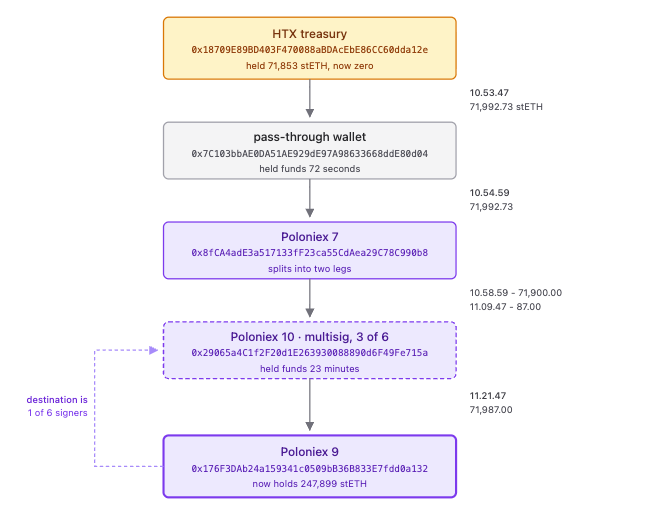
    Let’s start with the May 1 proof of reserves, which noted there were 71,853.22 stETH, at today’s price worth about $135 million, in the address 0x18709e89bd403f470088abdacebe86cc60dda12e.

    On May 30, shortly before $HTX was due to generate its June proof-of-reserves where funds were moved to “ThirdParty,” these funds were moved to 0x7C103bbAE0DA51AE929dE97A98633668ddE80d04.

    Moments later, they were transferred to 0x8fCA4adE3a517133fF23ca55CdAea29C78C990b8, an address labeled on Etherscan as Poloniex 7.

    Shortly after, they were transferred again to 0x29065a4C1f2F20d1E263930088890d6F49Fe715a, an address that Etherscan labels as Poloniex 10.

    Finally, moments later, they were transferred to 0x176F3DAb24a159341c0509bB36B833E7fdd0a132, an address labeled on Etherscan as Poloniex 9.

    This address, 0x176F3DAb24a159341c0509bB36B833E7fdd0a132, used to be labeled as “Justin Sun 4” on Etherscan before being listed as a Poloniex address.

    This pattern of transactions shows a large quantity of funds moving from $HTX to a Poloniex address where they have been commingled with the Poloniex reserves.

    The convoluted journey taken by $HTX’s stETH.

    The wrapped $BTC wrinkle

    This isn’t the first time that $HTX has relied heavily on Poloniex to hold certain assets.

    Often, more than half the $BTC held at $HTX has been in a tokenized form, specifically a tokenized form that seemed to be held by Poloniex.

    This often represented hundreds of millions of dollars worth of value.

    Poloniex was unwilling to disclose the addresses where it presumably (hopefully) holds that $BTC to Protos.

  • Trump Media Abandons Crypto Treasury, Prediction Market Ventures

    Trump Media Abandons Crypto Treasury, Prediction Market Ventures

    In brief

    • Trump Media has ended plans for a Crypto.com-backed CRO treasury company.
    • The companies also scrapped a broader digital asset deal and scaled back prediction market plans.
    • Existing Truth Social Funds ETFs will continue unchanged.

    President Donald Trump’s Trump Media & Technology Group has scrapped plans to launch a Crypto.com-backed CRO treasury company and abandoned a broader digital asset deal with the company.

    According to a report by Axios, Trump Media, Crypto.com, and special purpose acquisition company Yorkville Acquisition Corp. have mutually agreed to terminate the proposed Trump Media Group CRO Strategy, a previously announced services agreement, and related digital asset products.

    The companies cited “prevailing market conditions” and “shifting business and stakeholder priorities” for the decision.

    The venture would have licensed the Trump Media name for a company built around Crypto.com’s Cronos blockchain and the Cronos token, which trades as CRO. When announced last year, the partners said it would become the first and largest publicly traded CRO treasury company by accumulating the token and generating additional returns from those holdings. The CRO token currently trades for $0.05, falling sharply following the news, at around a $2.4 billion market capitalization.

    Interim CEO Kevin McGurn told Axios the company is narrowing its focus after the market for digital asset treasury companies became increasingly crowded over the past year. He added that staking has become less important to Crypto.com, making it the right time for the companies to go their separate ways.

    The Truth Social parent company is also abandoning plans to integrate prediction markets directly into Truth Social. Instead, the companies will pursue a marketing deal that promotes Crypto.com’s prediction market products to Truth Social users.

    McGurn said the prediction market business has become crowded, making it a less compelling area for investment. Rather than operating prediction markets itself, Trump Media now sees greater value in acting as a distribution and data partner.

    Trump Media’s relationship with Crypto.com had expanded over the past year.

    In October 2025, Trump Media announced plans to launch Truth Predict, a Crypto.com-powered prediction market integrated with Truth Social. In December, the companies unveiled plans for a publicly traded CRO treasury company with Yorkville Acquisition Corp., which was expected to hold billions of CRO tokens. In February, Crypto.com disclosed donating $35 million over the previous year to the pro-Trump super PAC MAGA Inc. The same month, the Office of the Comptroller of the Currency conditionally approved the exchange’s application for a national trust bank charter.

    Democrats have repeatedly criticized Trump’s expanding crypto ventures.

    Earlier this week, Sen. Elizabeth Warren (D-Mass.) and Sen. Richard Blumenthal (D-Conn.) urged the SEC to investigate President Donald Trump’s meme coin, arguing the agency should determine whether it facilitated fraud or unjust enrichment. The request is the latest sign of growing Democratic scrutiny of Trump’s business dealings, specifically in crypto, ahead of November’s midterm elections.

    Daily Debrief Newsletter

    Start every day with the top news stories right now, plus original features, a podcast, videos and more.

  • Solana Perp DEX Flash Trade to Wind Down Unless It Finds a Buyer

    Solana Perp DEX Flash Trade to Wind Down Unless It Finds a Buyer

    Flash Trade said on Friday it will wind down operations unless it finds a party to acquire the Solana perpetuals exchange, and that the decision was not driven by money.

    “This decision is not calculated based on monetary reasons,” the team wrote on X, citing “direction, shrinking market participants, and our own honest read on the crypto market as a whole and where it is heading.”

    The exchange said it is now pursuing a sale of its tech stack, brand and intellectual property, and that whatever the sale brings will be distributed to FAF token holders pro rata. The team “will not take a percentage,” and team tokens will not participate in the distribution, according to the post.

    Flash Trade has not set dates. “We haven’t fixed the exact timeline yet, and we’d rather say that than publish dates we might have to move,” the team wrote, committing only that withdrawals stay open and that it will give “clear notice well ahead of any change to them.”

    The operational specifics — when new positions are disabled, how open positions get settled, what liquidity providers need to do, and the dates for each — will be worked through on a call with token holders on Monday, with a write-up published immediately afterwards, the exchange said. The founders will hold an AMA on X on Monday, Aug. 10, at 16:00 UTC, or noon ET.

    Explored Freezing AMM

    Before settling on a sale, the team said it explored freezing its automated market maker with MetaDAO so that funds sitting in the AMM could be returned to holders pro rata. “That turned out not to be possible,” according to the post.

    Flash Trade also removed the three-month delay on token staking, so holders who want to unstake can do so immediately.

    Alongside its read on the market, the team described a conflict over what its users wanted. “Ethically we are misaligned with the current direction of the crypto ecosystem,” it wrote, adding that its own order flow showed “traders want to push further out on the risk curve” and that “we never found a way to serve that demand while sitting comfortably.”

    The exchange said it never raised outside capital, funding itself from the start, and has paid out roughly $520,000 in USDC of revenue share to FAF holders to date.

    Perpetuals venues have been closing even as the sector’s largest platforms grow. Dango said in July that it would wind down and halt trading on July 29.