Category: Business

  • The AI-Generated Pattern Hides You From Surveillance Cameras—Including Flock

    The AI-Generated Pattern Hides You From Surveillance Cameras—Including Flock

    In brief

    • Bill Swearingen’s noRecognition project generates patterns that stop camera software from classifying what it covers—people, faces, or cars.
    • The patterns defeated all 11 open-source detection algorithms he tested, including the software behind Flock license plate readers, Axon body cameras, and Clearview AI.
    • The first public test came Friday at Def Con in Las Vegas: a 2009 Toyota Yaris wrapped in the pattern, driven past a Flock camera.

    Bill Swearingen spent the past year running one experiment over and over from his home in Kansas City, where he co-founded the SecKC security meetup. About 31 million tests later, he says he can produce patterns on demand that hide whatever they cover from the detection software wired into Flock cameras—the controversial surveillance system being rolled out across America.

    He showed it in public for the first time Friday at Def Con, working with the YouTube channel Donut Media to cover a 2009 Toyota Yaris in one of his newest patterns and roll it past a Flock camera.
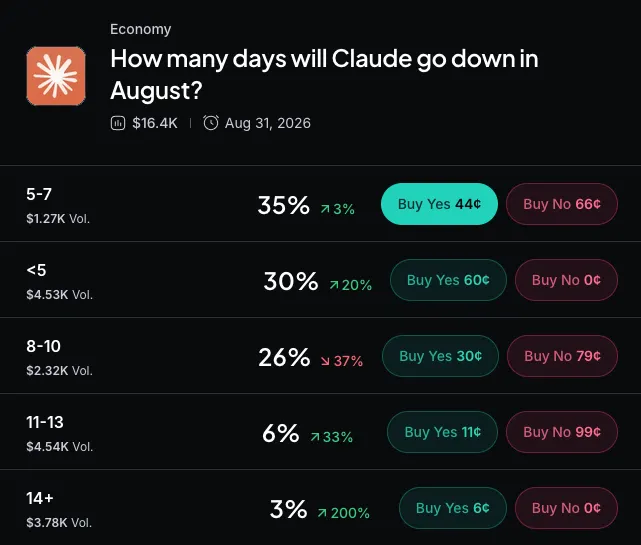
    Myriad: How many days will Claude go down in August? Click to make your prediction.
    Myriad: How many days will Claude go down in August? Click to make your prediction.

    “We proved it was effective,” Swearingen told TechCrunch, though he said the wheels were a challenge. Donut Media said video of the demo lands in the next few weeks.

    The pattern doesn’t blind the camera. Footage still records normally, and a human watching the screen sees a car. What breaks is the layer on top—the object-detection model that decides “that’s a vehicle, that’s a plate, log it.”

    So basically, feed an AI detector with enough visual noise engineered against its own math and it logs nothing. The car goes back to being a needle in a haystack.
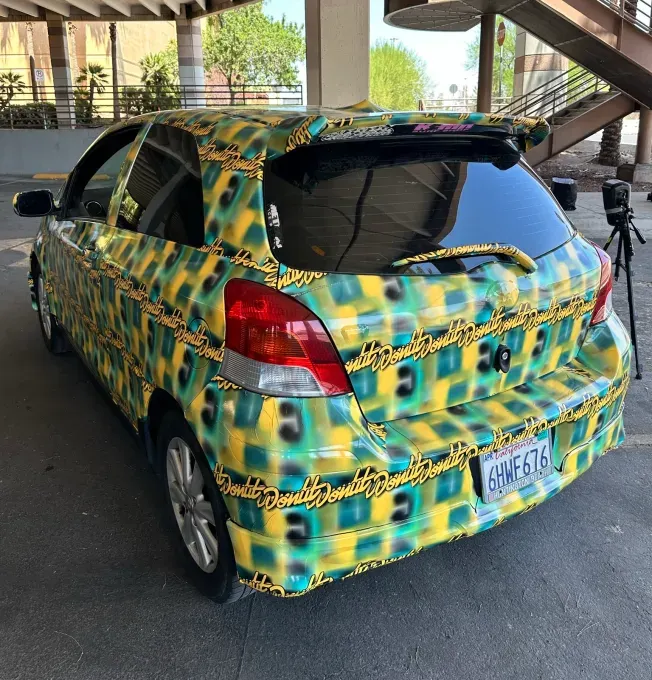
    Image credit: Donut Media

    That’s adversarial machine learning, and it works because computer vision doesn’t see what you see. A wrap that reads as loud graphic design to a person can read as nothing at all to a classifier.

    Swearingen built it with a reinforcement learning model that grades its own homework. Pattern gets detected, model adjusts, tries again—what he described as teaching the model “how to paint.” It now spits out fresh patterns every minute, and he’s keeping the strongest ones offline so camera vendors can’t train against them.

    “Privacy is a fundamental right,” he said, calling the patterns a way for people to “opt out of being tracked.” He said the idea took hold last year when he wanted to attend a protest and worried about the cameras logging everyone who showed up.

    The long tail of hiding from machines

    People have been improvising against detection systems for years, usually with hardware store solutions. San Francisco activists put traffic cones on the hoods of Waymo and Cruise robotaxis to freeze them in place, an exploit that needed no code at all.

    During last year’s Los Angeles immigration raids, protesters went further and torched several Waymos. Masks, hoods, and brimmed caps remain the default on protest lines. Adversarial clothing labels have been selling face-confusing prints for years, and anti-recognition eyeglasses have arrived with thin evidence they do much.

    What separates Swearingen’s project, which he calls noRecognition, is the target list. Swearingen tested against the specific stacks in wide deployment, and Flock is the one drawing heat. The company is facing a growing backlash on Capitol Hill, and internal documents show it pitched a plan to turn 350,000 Uber and Lyft dashcams into a rolling plate-scanning fleet.

    Automated readers have already pulled over innocent drivers at gunpoint over bad matches, and immigrants and protesters keep getting swept into ICE’s AI dragnet. Lawmakers are pressing Meta over facial recognition in its smart glasses on a parallel track, so any legal measure to fight against automatic detection technology is being studied by privacy enthusiasts.

    Swearingen’s noRecognition project is running a crowdfunding campaign to fund early merchandise—T-shirts and hoodies now, vehicle skins later. Swearingen said the goal is resolution high enough to work at a distance and design good enough that people will actually wear it.

    Driving a wrapped car on public roads is its own legal question, and plate obstruction statutes vary by state. The patterns cover bodywork, not plates.

    “Every failure improves my model, and so [the patterns] keep getting better and better,” Swearingen said.

    Daily Debrief Newsletter

    Start every day with the top news stories right now, plus original features, a podcast, videos and more.

  • SushiSwap-Backed Pools.fun Announces Protocol Token Launch with Buyback and Airdrop Plans

    SushiSwap-Backed Pools.fun Announces Protocol Token Launch with Buyback and Airdrop Plans

    Pools.fun, the token issuance platform developed jointly by decentralized exchange SushiSwap and automated trading agent Bankr, is preparing to launch its own protocol token. Bankr founder 0xDeployer revealed the plans on X, outlining a structure that includes token buybacks, burns, an airdrop, and a points program.

    Tokenomics and Fee Allocation

    According to 0xDeployer, 30% of protocol fees generated by Pools.fun will be allocated to token buybacks and burns. This mechanism is designed to reduce circulating supply over time, potentially benefiting long-term holders. The founder also confirmed that fees intended for buybacks are already being accumulated ahead of the token’s official launch.

    The announcement detailed a points program that rewards user activity. Trading volume on the platform and the trading volume of tokens issued by users will both factor into the points system. While the exact conversion rate between points and token allocations has not been disclosed, the program is expected to play a role in the upcoming airdrop.

    Context and Platform Background

    Pools.fun emerged from a collaboration between SushiSwap, one of the oldest decentralized exchanges in the DeFi space, and Bankr, an automated trading agent focused on on-chain strategies. The platform aims to simplify token issuance, allowing users to create and trade tokens with built-in liquidity mechanisms. Its positioning draws comparisons to other issuance platforms like pump.fun, but with a distinct emphasis on automated trading integration.

    The decision to launch a protocol token follows a broader trend in DeFi where platforms introduce native tokens to incentivize usage and align stakeholder interests. However, such launches also carry risks, including regulatory scrutiny and market volatility.

    Implications for Users and the DeFi Ecosystem

    For active users of Pools.fun, the points program and airdrop could provide tangible rewards for early participation. The buyback-and-burn mechanism may also create a deflationary pressure on the token’s supply, which some investors view positively. Yet, the success of such initiatives depends on sustained platform activity and market conditions.

    Industry observers note that token launches of this nature often generate short-term speculation. Long-term value will hinge on the platform’s ability to attract and retain users beyond initial incentives. The integration with Bankr’s automated trading tools could offer a unique utility, potentially distinguishing Pools.fun from competitors.

    Conclusion

    Pools.fun’s protocol token launch represents a significant step for the SushiSwap-Bankr collaboration. With a clear fee allocation strategy and user-centric incentives, the platform is positioning itself to reward early adopters. However, as with any emerging DeFi project, potential participants should conduct thorough research and remain mindful of market risks.

  • GSR raises Solana to 43.6%, cuts Bitcoin to 16.9%

    GSR raises Solana to 43.6%, cuts Bitcoin to 16.9%

    GSR shifted its Core3 model toward Solana on Aug. 12, raising $SOL to 43.6% of the portfolio and making it the model’s largest allocation.

    Ether fell to 39.5%, while Bitcoin dropped to 16.9%, the smallest weight among the three assets.The firm said the change reflected a move in its relative alpha signals toward Solana as $SOL showed stronger near term price momentum. GSR’s written commentary lists the Solana weight at 43.7%, while the accompanying allocation table shows 43.6%. This article uses the table figure.

    Solana allocation jumps 7.1 points in one week

    The latest allocation marks a sharp reversal from the prior week. On Aug. 5, GSR assigned 36.5% to Solana, 44.1% to Ether and 19.3% to Bitcoin. Solana therefore gained 7.1 percentage points in the model within seven days, while Ether lost 4.6 points and Bitcoin lost 2.4 points.

    As crypto.news previously reported, the prior weekly allocation tilted toward Bitcoin as trading activity weakened and volatility eased. The Aug. 12 update reversed part of that move. GSR said its latest positioning reflected proprietary relative signals rather than a simple ranking of recent returns.

    The distinction matters because Core3 is not presented as a live investment recommendation. GSR says the weekly publication is a model framework intended for professional investors and does not constitute advice or a recommendation to allocate to the three assets.

    Solana leads weekly returns while Ether leads the month

    Solana delivered the strongest seven day return in GSR’s latest table, gaining 2.98%. Bitcoin declined 1.02% over the same period, while Ether slipped 0.20%. Over 30 days, however, Ether remained ahead with a 7.88% gain, compared with 3.19% for Bitcoin and 2.44% for Solana.

    The Core3 model itself returned 0.85% over one week and 5.30% over one month, ahead of the equal weight basket at 0.59% and 4.68%, respectively. Longer periods remain weaker. Core3 was down 35.58% year to date and 70.28% over one year, compared with losses of 32.22% and 63.44% for the equal weight basket.

    Volatility also remained relatively subdued. GSR put 30 day volatility at 26.82% for Bitcoin, 39.75% for Ether and 35.26% for Solana. The firm said Solana trading volume had softened over both seven and 30 day periods, meaning its larger model weight did not coincide with stronger volume across those windows.

    U.S. Solana access expands as GSR favors $SOL

    The model shift comes as U.S. investors gain more exchange traded routes to Solana exposure. Morgan Stanley Investment Management announced on July 28 that it had launched the Morgan Stanley Solana Trust, MSOL, on NYSE Arca alongside an Ether product. The release said MSOL carries a 0.14% expense ratio and seeks to track $SOL while staking a portion of its holdings.

    Morgan Stanley expanded its crypto ETP lineup after launching a Bitcoin product earlier in 2026. An SEC prospectus says the Solana trust may stake up to 100% of its $SOL under normal market circumstances, subject to liquidity needs and legal or regulatory considerations. The filing also details risks tied to staking, custody and concentration in one digital asset.

    Competition among U.S. products has also increased. A 21Shares filing dated July 27 said the issuer would waive TSOL’s 0.21% sponsor fee for one year beginning July 28. The company said the product can capture staking rewards, while warning that rewards can fluctuate and staking creates operational and liquidity risks.

    Those product developments do not prove that U.S. investors share GSR’s preference for Solana. They do show that regulated U.S. exchange traded access to $SOL has broadened and become more competitive while the Core3 model has shifted exposure away from Bitcoin and Ether.

    What traders will watch next

    GSR publishes the Core3 model weekly, making the next allocation an immediate test of whether the Solana overweight persists or reverses. Recent updates show how quickly the weights can move. Bitcoin rose from 9.2% on July 15 to 19.3% on Aug. 5 before falling back to 16.9% in the Aug. 12 model.

    Volume, relative momentum and volatility will therefore remain useful measures to watch alongside the next model update. GSR has already cautioned that its opinions and estimates can change without notice as market conditions change.

    The firm also warns against treating Core3 results as returns available from a live strategy. Its published figures are hypothetical, gross of transaction and management fees and exclude staking rewards. GSR further states that it may trade the assets for its own account and may hold positions that differ from the views expressed in its commentary.

  • Metaplanet CEO shuts down Bitcoin sale speculation after $322M transfer

    Metaplanet CEO Simon Gerovich has shut down speculation that the Japanese Bitcoin treasury company was selling its holdings.

    “This was a routine custody operation. No bitcoin was sold, and our holdings remain 43,000 $BTC,” Gerovich said Thursday.

    The company transferred 5,014 $BTC ($322 million) over a 24-hour span starting Wednesday. Gerovich said the network fees to move the trove cost Metaplanet about $8.

    Metaplanet is the third-largest publicly traded Bitcoin treasury company and the largest in Asia. According to Arkham data, it is sitting on an unrealized loss of about $1.4 billion.

    Metaplanet has continued to expand its Bitcoin strategy beyond accumulation. In March, the company established Metaplanet Ventures, pledging 4 billion yen ($25 million) over two to three years to invest in Bitcoin and crypto infrastructure in Japan.

    The company is targeting holdings of 100,000 $BTC by the end of 2026 and 210,000 $BTC by the end of 2027.

  • Harmony’s ONE Sinks 37% After Attacker Mints 4 Billion Tokens

    Harmony’s ONE Sinks 37% After Attacker Mints 4 Billion Tokens

    In brief

    • Harmony confirmed an exploit after an analyst reported that an attacker minted about 4 billion ONE, roughly 26% of the supply.
    • Around 97% of those tokens have already reached exchanges, on-chain analyst Juiceberg said.
    • ONE was trading at about $0.00077, down 37% on the day, after Harmony shipped a patch to stop further minting.

    Layer-1 blockchain Harmony has confirmed it was exploited after an attacker minted roughly 4 billion ONE tokens without authorisation, sending the token down 37% to about $0.00077, per CoinGecko data.

    On-chain analyst Juiceberg flagged the mint early Wednesday, putting it at close to 4 billion tokens, or about 26% of the supply, and saying the tokens had been created through empty blocks. Around 2.8 billion were funnelled onto exchanges as the price fell.

    In a follow-up tweet, the analyst said the attacker had roughly 115 million ONE left to sell on-chain, about 2.9% of the total minted. “The overwhelming majority (~97%) is already on exchanges,” Juiceberg wrote, and had either been sold or was sitting in deposit wallets.

    Harmony responded in a tweet that it was “working with our team and appropriate exchanges to stop and freeze the funds,” adding that it was preparing a patch and weighing rollback options. In a second post it named four wallets, each listed in both Harmony and hex formats, and asked exchanges to block anything traced to them.

    Just over two hours after that first statement it paused its bridge, then released a patch a minute later, telling validators to upgrade to a build it said prevents any further minting. Dealing with the tokens already created would take another update, it said. Five hours had passed since Juiceberg’s first post.

    The project has not disclosed the vulnerability, confirmed how many tokens were created, or said how much reached exchanges. One oddity Juiceberg noted is that Harmony’s totalSupply endpoint did not reflect the new tokens, and price trackers still list circulating supply at about 14.87 billion.

    Rolling back the chain

    A rollback would return the network to a state before the exploit and continue from there, erasing what followed from the accepted history. That cuts both ways, since transactions made by ordinary users after the attack would go with it.

    Harmony has been here before, with hackers draining about $100 million from its Horizon cross-chain bridge in June 2022, in an attack the FBI later attributed to North Korea’s Lazarus Group.

    The project’s first proposal to the 2022 hack was to reimburse victims in ONE, which would have meant minting billions of new tokens on top of the circulating supply and hard-forking the chain to allow it. The plan drew enough criticism that the team replaced it with one funded from its treasury. Four years on, an attacker has minted a comparable amount without asking.

    ONE now carries a market capitalisation of about $11.5 million, ranking it outside the top 1,000 tokens. It last traded near its October 2021 record of $0.38 more than four years ago, and is down more than 99% from that level.

    Daily Debrief Newsletter

    Start every day with the top news stories right now, plus original features, a podcast, videos and more.
  • Bank of England to test stablecoin, digital currency use in cross-border finance

    Bank of England to test stablecoin, digital currency use in cross-border finance

    “If these processes can become faster and more efficient, U.K. businesses could unlock working capital sooner and make it easier to finance international trade,” Jacobsson said in an interview over LinkedIn.

    The BOE named NOBO Finance, Dun & Bradstreet, a global provider of business decisioning data, analytics, and credit-rating services, and Polygon Labs, a software and blockchain company, as participants in its Digital Pound Lab.

    The project will be the first time the Digital Pound Lab tests how public stablecoins and central-bank money work in a single payment flow alongside a portable credit identity for small businesses. The lab uses no real customers or money and does not signal any decision to issue a digital pound.

    NOBO, a U.K.-based fintech building digital trade finance infrastructure that helps small and medium-sized enterprises (SMEs) become visible, verifiable, and bankable, was already involved in Phase 1. During the first phase, NOBO helped demonstrate conditional business-to-business escrow payments relevant to trade finance workflows.

    A first workstream will build an SME “bankable profile.” NOBO, Dun & Bradstreet and Polygon plan to combine wallet transaction data, open-finance information and business intelligence to create a reusable credit assessment. Polygon will provide smart contracts intended to record the verified outcome and manage consent.

  • Alameda Research, a Cryptocurrency Company, Makes a Notable Move in Solana Staking! Is a Sell-Off Coming? Here Are the Details

    Alameda Research, a Cryptocurrency Company, Makes a Notable Move in Solana Staking! Is a Sell-Off Coming? Here Are the Details

    Alameda Research, the cryptocurrency arm of the bankrupt FTX, has moved a significant amount of Solana ($SOL) holdings again after nearly five years. According to information reported by the on-chain data platform Onchain Lens, Alameda unlocked 201,740 $SOL, removing it from its staking position, and then transferred a total of 201,780 $SOL to a BitGo-owned custodial wallet.

    The transfer has reinforced expectations that Alameda is preparing to divest its long-dormant $SOL holdings. On-chain data suggests the transaction may have been conducted for over-the-counter (OTC) sale via BitGo, rather than a direct sale of the tokens on exchanges.

    OTC transactions stand out as a preferred method, especially for selling large amounts of crypto assets. Since conducting large-scale transactions directly in open markets can create sudden selling pressure on prices, institutional investors and large portfolio owners often utilize OTC markets.

    Alameda’s release of $SOL assets that had been staked for approximately five years also increases the significance of the transfer. Releasing assets locked in staking transactions allows their owners to reuse or sell them.

    While it’s stated that the transfer doesn’t necessarily mean a sale, the movement to BitGo’s custodial wallet is being closely watched in the crypto market. The liquidation of assets in the Alameda and FTX bankruptcy proceedings continues to be a significant topic in the crypto market in recent years.

    Large $SOL transfers, in particular, can be interpreted by market participants as an indicator of potential selling pressure. Whether Alameda will actually sell these assets via OTC is yet to be confirmed.

    *This is not investment advice.

  • Bitcoin holds near $64,000 as U.S. inflation data looms, Harmony exploit rattles altcoins

    Crypto markets were steady on Wednesday as traders absorbed a protocol exploit while waiting for a U.S. inflation report that often sets the tone for risk assets.

    Harmony, a layer-1 blockchain network for DeFi protocols and marketplaces. confirmed it had been hit by an exploit early in the Asian day. An attacker minted some 4 billion ONE tokens through empty blocks, representing about 26% of the token’s circulating supply.

    Around 2.8 billion of the tokens were quickly funneled to exchanges, pushing ONE down as much as 40% to a record low.

    Broader markets were also little changed before the July U.S. CPI print, due at 12:30 UTC. Brent crude is near $90 a barrel after more Houthi attacks on shipping in the Bab el-Mandeb Strait and a U.S. strike on a vessel in the Gulf of Oman renewed supply concerns overnight.

    Bitcoin $BTC$64,051.34 absorbed all of this quietly, adding 0.23% since midnight UTC to around $63,900. The Fear and Greed index is at 38.

    Derivatives positioning

    • Futures market stasis masks a bearish shift in taker sentiment: While the aggregate crypto futures market appears to be in stasis, with negligible changes in total volume and open interest, underlying positioning is shifting. The long-short ratio for takers, or those executing market orders that remove liquidity from the book, has flipped bearish, with shorts now accounting for 51.36% of activity. This is a 180-degree reversal from the bullish bias observed earlier in the week.
    • Avalanche shows signs of aggressive shorting as open interest climbs: The AVAX token has emerged as one of the largest laggards among the top 100 coins over the past 24 hours, even as open interest (OI) grew 6%. A combination of falling prices and rising OI validates the current weakness in the spot price. Confirming this trend is the 24-hour cumulative volume delta (CVD), which is the most negative among major assets, suggesting that bears are aggressively shorting via market orders rather than utilizing passive limit orders.
    • Dogecoin leverage builds toward a potential volatility breakout: Open interest in DOGE futures continues to climb, surpassing 17.2 billion tokens, the most since October. This significant growth from the June low of 12 billion tokens occurred while the price remained pinned near the 7-cent mark. The buildup of leverage amid sideways price action suggests that the market may be coiled for a significant volatility event in the near term.
    • Major assets see light positioning: Market participation in the two largest cryptocurrencies remains subdued, with bitcoin’s open interest hovering below 750,000 $BTC. This lack of momentum has persisted for several weeks, and a similar trend is visible in ether ETH$1,909.79, indicating that institutional and retail traders alike are currently sidelined in the majors.
    • Selling pressure dominates the altcoin market according to CVD trends: Most of the 25 largest cryptocurrencies are exhibiting negative 24-hour cumulative volume deltas. This widespread selling pressure indicates a general bearish tilt across the sector, with Chainlink LINK$8.7971, Cronos CRO$0.04701, and Tron TRX$0.3369 being the only notable exceptions.
    • Implied volatility remains depressed ahead of key U.S. inflation data: Bitcoin’s 30-day implied volatility index, BVIV, is back under pressure, receding to 37.5% from Monday’s high of 38.66%. Short-dated one-week implied volatilities also remain at low levels, signaling that options traders are not anticipating significant changes following the U.S. CPI release. This suggests the market may be underpricing the actual event risk.
    • Options traders eye the $70,000 level while hedging for volatility: In the Deribit bitcoin options market, the $70,000 call remains the most actively traded contract for the second consecutive day. Simultaneously, there is a growing preference for $BTC strangles, a strategy involving the simultaneous purchase of puts and calls, indicating that some participants are positioning to profit from a sharp move in either direction.

    Token talk

    • CRV is the week’s standout performer, up roughly 35% over seven days and trading around 28 cents. The move coincides with a 15% annual emissions reduction that is set to trigger imminently. It has risen by more than 3% since midnight UTC.
    • Uniswap (UNI) has tumbled by more than 10% over the past 24 hours with no clear catalyst for the slide, suggesting the altcoin market remains vulnerable to price swings due to limited liquidity and market depth.
    • Monero (XMR) is up by 5.8% since midnight and has now retraced Tuesday’s entire shift to the downside.
    • AI tokens NEAR, FET and TAO are all also in the black, up by between 1.3% and 2.3% respectively as AI-themed optimism slowly returns to the market after months of waning sentiment.
  • Another OpenAI Exec Quits in Leadership Shake-Up as AI Giant Eyes IPO

    Another OpenAI Exec Quits in Leadership Shake-Up as AI Giant Eyes IPO

    In brief

    • Brad Lightcap is leaving OpenAI after eight years.
    • His departure follows several recent exits across the company’s leadership, ethics, and safety teams.
    • OpenAI confidentially filed for a potential IPO in June but has not committed to going public.

    Longtime OpenAI executive Brad Lightcap announced Tuesday that he is leaving the AI developer after eight years to start a new venture. It’s the latest among a string of departures at the AI behemoth, leaving observers to wonder what to make of the moves as OpenAI preps for an IPO.

    In a post on X, Lightcap said starting something new was “bittersweet,” calling his years building the company the honor of his life.

    “Through it all, I’m proud of how we’ve maintained our focus on people,” he wrote. “It always amazes me how quickly the world has adopted our tools and rallied behind our mission. I hope we will continue to earn their trust.”

    Lightcap joined OpenAI in 2018 and spent four years as its chief operating officer. He helped build the company’s finance, legal, personnel, corporate security, government relations, and partnership teams as it grew from a research lab into a major AI developer.

    “Sitting here today, mission success feels within sight,” Lightcap wrote. “It has been the honor of my life to help bring us to this point.”

    Lightcap’s exit follows several leadership changes at OpenAI in 2026.

    Bill Peebles, Kevin Weil, and Srinivas Narayanan announced their departures in April, followed by product and business chief Fidji Simo, who stepped down in July to focus on recovering from a chronic illness.

    AI ethics lead Chloé Bakalar also left in July and reportedly has not been replaced. Bakalar’s departure followed those of safety systems chief Johannes Heidecke and chief futurist Joshua Achiam that same month.

    The news comes as OpenAI prepares to enter the public markets.

    In June, OpenAI confidentially filed for a potential IPO but has not said when or if it plans to proceed. On Myriad, a prediction market developed by Decrypt’s parent company Dastan, the market currently believes it’s more likely rival company Anthropic IPOs before OpenAI at nearly 85% odds.

    Nevertheless, the expected public offering for Sam Altman’s OpenAI has made its recent executive turnover a focus of speculation on social media.

    “It is just not that typical to have so many executives depart before their long awaited IPO,” Partner at asset management firm ParaFi Jeff Park wrote on X. “Unless…”

    Whatever the reason, Lightcap expressed gratitude to his colleagues and said he would remain available to support them after his departure.

    “I am deeply grateful to have had the opportunity to work with all of you, and to so many of you for the support through the years,” he wrote. “The old OpenAI meme that “the real AGI is the friends you made along the way” really rings true for me.”

    Daily Debrief Newsletter

    Start every day with the top news stories right now, plus original features, a podcast, videos and more.

  • Connecticut Judge Says Kalshi Sports Contracts Were Never Swaps

    Connecticut Judge Says Kalshi Sports Contracts Were Never Swaps

    Not Swaps, and Not Preempted Even If They Were

    U.S. District Judge Vernon D. Oliver’s ruling rests on a threshold point rather than preemption: for the CFTC’s exclusive jurisdiction to attach, a contract must be a swap traded on a designated contract market. Oliver held it is the judiciary’s role, not the agency’s, to decide what counts as a swap, rejecting Kalshi’s argument that any such challenge must be brought against the CFTC itself.

    On the statute, Oliver read “the occurrence, nonoccurrence, or the extent of the occurrence of an event” to concern whether an event happens and to what degree, not its outcomes. He adopted the reasoning of the District of Nevada in a case brought by a Crypto.com-owned exchange – which found that dictionaries treat “event” as meaning “outcome” only in an archaic sense. A boxing match can occur, not occur, or run three rounds; who wins is an outcome of the event, not a separate event. Oliver expressly declined to decide whether contracts on whether a game reaches overtime or a series reaches a seventh game would fare differently, since neither was in the record.

    His second ground was the requirement that the event be associated with a potential financial, economic, or commercial consequence. That connection must be embedded in the event itself, Oliver held, not created by endorsement contracts, bonus provisions, side wagers, or other downstream arrangements made by independent actors. A sporting event has consequences built in through ticket sales, broadcast rights, and advertising; who wins it does not. He also noted Kalshi’s own concession in earlier litigation before the D.C. Circuit that contracts on games are unlikely to serve any commercial or hedging interest.

    Between 80% and 90% of the contracts listed on Kalshi’s exchange were sports-event contracts, responsible for a similar portion of company revenue. The CFTC has not subjected a single one to review under the special rule, let alone prohibited any. Kalshi was valued at roughly $11 billion at February’s hearing and has about 24,000 Connecticut users.

    Oliver reached preemption anyway and rejected it on both theories. The special rule at § 7a-2(c)(5)(C), which lets the CFTC bar contracts involving gaming or activity unlawful under state law, reflects an intent to preserve state authority rather than displace it. Federal impartial-access rules bar discriminatory access criteria; they do not require a DCM to offer contracts nationwide. And he was unwilling to read Dodd-Frank as handing exclusive authority over sports betting to a financial regulator with no history in the field, noting that Congress has never appropriated funds to the CFTC for that purpose.

    Kalshi also lost on irreparable harm. Its asserted injuries were largely monetary, and to a significant extent self-inflicted, given that it kept listing the contracts through repeated regulatory warnings and adverse rulings. Because Kalshi is already building geofencing for other states, Oliver found Connecticut compliance unlikely to add much cost. He noted Kalshi has issued no warnings to users while advertising itself as the first app for legal sports betting in all 50 states.

    The crypto exposure runs through a separate five-page order. Coinbase Financial Markets began offering Kalshi’s contracts through its platform in January 2026 as a futures commission merchant rather than a DCM, and Connecticut never directed any enforcement at it. Oliver denied the motion “largely in line with” the Kalshi order and attached that opinion as an exhibit. Connecticut’s December sweep had also named Robinhood Derivatives and Crypto.com: DCP announced all three orders on Dec. 3, with Gaming Director Kris Gilman saying a prediction market wager is not an investment, and Commissioner Bryan T. Cafferelli saying the platforms would violate other state laws even if licensed, including by taking wagers from people under 21.

    Oliver’s order counted 14 suits Kalshi has filed against states, with federal courts split and every state court to rule so far ruling against it. He cited KalshiEX LLC v. Cox, decided in Utah on Aug. 4, and went further than Minnesota’s judge, who blocked that state’s ban while treating a World Cup winner contract as likely a swap. Massachusetts, Nevada, and Michigan state courts have all ordered geofencing; Kalshi pledged to implement it in Nevada by Aug. 12 and faces the same date in Michigan.

    A Kalshi spokesperson told Sports Betting Dime (a Sportradar subsidiary) the company respectfully disagrees with the decision and is considering all legal options. Oliver ordered the parties to file their Rule 26(f) report by Aug. 24, with Connecticut’s response to the complaint due Aug. 31.