Category: Business

  • Ethereum Undervalued, Bitcoin & XRP Remain Neutral Amid Recent Bullish Reversal

    • MVRV shows $ETH is mildly undervalued, while $BTC, $XRP, and Chainlink remain neutral.

    • The crypto market is now witnessing an upward trend reversal despite recent bearish trends.

    • Buyers show renewed interest in crypto following Nvidia earnings report.

    Based on the 30-day Market Value to Realized Value (MVRV) Ratio, Ethereum ($ETH) is mildly undervalued at -5.5%. Bitcoin ($BTC), $XRP ($XRP), and Chainlink ($LINK) remain neutral at -1.4%, -0.1%, and +3.3%, respectively. By contrast, Cardano (ADA) is mildly overvalued, with an MVRV ratio of +6.8%.

    Source: Santiment

    Bitcoin and the wider crypto market showcase a bullish trend reversal

    The past day has seen an upward trend reversal in the broader cryptocurrency ecosystem, despite recent bearish momentum and sentiment.

    Data shows that the average Moving Average Convergence Divergence (MACD) indicator has slightly surpassed its 9-day average, indicating a weak bullish momentum reversal.

    $BTC was up 7.78% in the past day to trade at $69,050 as $ETH gained 13.31% to reclaim its $2,000 psychological level. Meanwhile, $XRP and $LINK gained +9.37% and 16.07%, respectively. Uniquely, Cardano has experienced a striking 20.07% upsurge to trade at $0.3115.

    Source: CoinMarketCap

    Events leading up to the recent crypto rally

    Tech company Nvidia recently reported record-breaking earnings driven by demand in artificial intelligence (AI). Due to the strong correlation (98%) of crypto with the S&P 500, the news fueled renewed risk appetite in investors of both stocks and crypto.

    Capital rotation from $BTC to altcoins has contributed to their recent rallies as investors seek higher returns from riskier assets. Bitcoin dominance is now at 58-60%, while the Altcoin Season Index reads 34/100, indicating a mixed market for Bitcoin and Altcoins.

    This week, Bitcoin ETFs saw $257.7M in net inflows, effectively ending a five-week outflow streak.

    Near-term market outlook

    At press time, the overall crypto market cap totaled $2.38 trillion, having gained 7.50% in the last 24hours.

    Should the current rally hold, the crypto market could test the $2.59T (50% Fibonacci) level. Falling below $2.35T (78.6% Fib) would indicate a loss in momentum, validating a weak bullish theory.

  • Bitcoin, Ethereum and Solana Shorts Get Rekt as BTC Price Rebounds Near $69K

    Bitcoin, Ethereum and Solana Shorts Get Rekt as BTC Price Rebounds Near $69K

    Traders betting against the prices of major cryptocurrencies are feeling the pain Wednesday as Bitcoin, Ethereum, and other top assets are well in the green, leading to hundreds of millions of dollars’ worth of short position liquidations.

    Bitcoin (BTC) has rebounded to nearly $69,000 for the first time in more than a week, recently trading for $69,869 after falling below the $63,000 mark on Tuesday. While up more than 7% on the day, the price of the leading cryptocurrency remains down more than 21% over the last 30 days.

    Altcoins Ethereum (ETH) and Solana (SOL) are the biggest gainers among the top 10 coins by market cap, with Ethereum rising 12% on the day to a recent price of $2,075 while Solana has jumped almost 14% to just shy of $89. Both coins had shown substantial losses in recent weeks, but are swinging back the other direction on Wednesday.

    Overall, the crypto market has climbed by about 6.6% over the last 24 hours, per data from CoinGecko. Other major gainers with double-digit rises during that span include Polkadot (DOT), Filecoin (FIL), Uniswap (UNI), Aptos (APT), Avalanche (AVAX), and Chainlink (LINK).

    More than $400 million worth of short positions have been liquidated in the last 24 hours, per data from CoinGlass, making up the vast majority of the $463 million worth of total liquidations during that span.

    Bitcoin currently leads the list with about $200 million worth of liquidations, with Ethereum next up with $153 million worth and Solana well behind in third with about $22 million.

    Prominent crypto stocks are skyrocketing Wednesday as the risk-on appetite grows in equities, with USDC stablecoin issuer Circle showing a 29% spike to $79 per share after reporting earnings, while blockchain lender Figure is up 15% to $34 per share and Ethereum treasury leader BitMine Immersion Technologies has swung up almost 14% to $22.

    Other notable crypto stock gainers today include Coinbase with a 13% swing to $183, Bitcoin treasury giant Strategy rising nearly 9% to above $135 per share, and Bitcoin miner MARA Holdings with a 7% rise to $8.66.

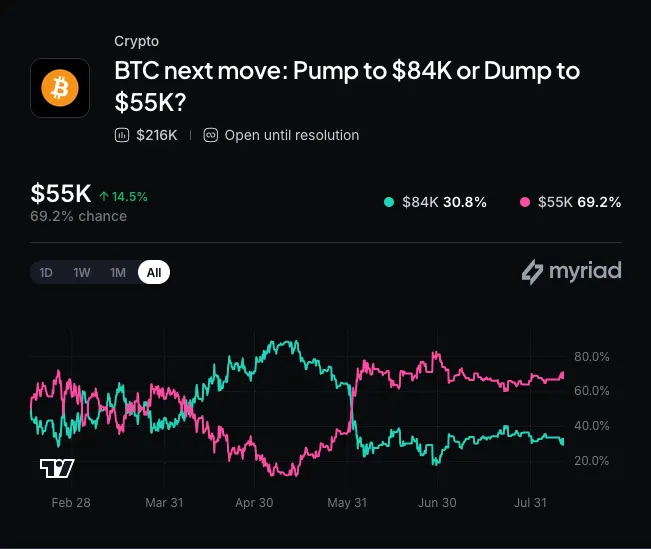
    While still bearish overall, users on Myriad—a prediction markets platform operated by Decrypt‘s parent company, Dastan—are gaining more confidence that Bitcoin will continue rising. They currently pencil in a 43% chance that Bitcoin will next rise to $84,000 rather than fall to $55,000, with odds rising about 14% in the last day.

    Daily Debrief Newsletter

    Start every day with the top news stories right now, plus original features, a podcast, videos and more.

  • Ethereum Price Rally Hits Wall at $2,150 After Explosive 15% Move

    Ethereum Price Rally Hits Wall at $2,150 After Explosive 15% Move

    Ethereum price started a major rally above the $2,000 resistance. $ETH is now correcting gains from $2,150 and might decline to $2,000.

    • Ethereum started a fresh upward move above the $1,950 zone.
    • The price is trading above $2,000 and the 100-hourly Simple Moving Average.
    • There was a break above a bearish trend line with resistance at $1,920 on the hourly chart of $ETH/USD (data feed via Kraken).
    • The pair could start a fresh decline if it stays below the $2,120 zone.

    Ethereum Price Rallies Over 15%

    Ethereum price managed to form a base and traded above the $1,920 resistance, like Bitcoin. $ETH price rallied above the $2,000 and $2,020 resistance levels.

    There was a break above a bearish trend line with resistance at $1,920 on the hourly chart of $ETH/USD. The bulls even pumped the price above $2,100. A high was formed at $2,158 before there was a sharp downside correction. The price dipped below the 23.6% Fib retracement level of the upward move from the $1,792 swing low to the $2,158 high.

    Ethereum price is now trading above $2,000 and the 100-hourly Simple Moving Average. If the bulls remain in action above $2,000, the price could attempt another increase. Immediate resistance is seen near the $2,080 level.

    The first key resistance is near the $2,120 level. The next major resistance is near the $2,150 level. A clear move above the $2,150 resistance might send the price toward the $2,200 resistance. An upside break above the $2,200 region might call for more gains in the coming days. In the stated case, Ether could rise toward the $2,250 resistance zone or even $2,320 in the near term.

    Another Drop In $ETH?

    If Ethereum fails to clear the $2,120 resistance, it could start a fresh decline. Initial support on the downside is near the $2,000 level. The first major support sits near the $1,975 zone or the 50% Fib retracement level of the upward move from the $1,792 swing low to the $2,158 high.

    A clear move below the $1,975 support might push the price toward the $1,930 support. Any more losses might send the price toward the $1,900 region. The main support could be $1,880.

    Technical Indicators

    Hourly MACDThe MACD for $ETH/USD is losing momentum in the bullish zone.

    Hourly RSIThe RSI for $ETH/USD is now above the 50 zone.

    Major Support Level – $1,975

    Major Resistance Level – $2,150

  • IMF: US Inflation Won’t Hit Fed Target Until 2027, Delaying Rate Cuts

    IMF: US Inflation Won’t Hit Fed Target Until 2027, Delaying Rate Cuts

    The International Monetary Fund said Wednesday that US inflation will not return to the Federal Reserve’s 2% target until early 2027.

    The assessment, part of the IMF’s first Article IV review of the Trump administration, signals that meaningful rate relief remains distant despite the president’s optimism.

    IMF Flags Fiscal Risks

    IMF Managing Director Kristalina Georgieva told reporters the US current account deficit is “too big.” The Fund estimates it at 3.5% to 4% of GDP in the near term.

    But the IMF’s prescription clashes with the administration’s approach. Nigel Chalk, the Fund’s Western Hemisphere Director, said fiscal consolidation — not tariffs — is the best path to narrowing the deficit. The recommendation comes after the Supreme Court struck down Trump’s broad emergency tariffs as illegal, forcing the administration to invoke Section 122 of the Trade Act of 1974 for replacement levies.

    The fiscal picture is stark. The IMF projects US federal deficits will remain between 7% and 8% of GDP in the coming years. That is more than double the levels targeted by Treasury Secretary Scott Bessent. Consolidated government debt is on track to reach 140% of GDP by 2031.

    “The upward path for the public debt-GDP ratio and increasing levels of short-term debt-GDP represent a growing stability risk to the US and global economy,” the Fund warned.

    Trump’s Rate Optimism vs. Structural Reality

    The IMF review landed one day after Trump’s State of the Union address, where the president painted a rosy picture on borrowing costs. He claimed mortgage rates had hit four-year lows and that annual mortgage costs had dropped nearly $5,000 since he took office. He framed lower rates as the solution to what he called the “Biden-created housing problem.”

    Yet the IMF’s numbers tell a different story. With inflation not reaching the Fed’s target until 2027 and fiscal deficits running at twice the administration’s own goals, the structural case for higher-for-longer rates is strengthening. The Fund pegged 2026 US growth at a resilient 2.4%, leaving the Fed little urgency to ease.

    What It Means for Crypto

    The implications for risk assets are clear. Sticky inflation and an expanding fiscal deficit reduce the probability of aggressive rate cuts this year. For crypto markets, which rallied on rate-cut expectations through late 2025, the IMF’s assessment reinforces caution.

    The deeper irony is that the administration’s own fiscal expansion — including what the IMF notes are historically large tax cuts — is the primary driver of the deficit that keeps rates elevated. Trump wants lower rates but is pursuing policies that structurally prevent them.

    The IMF stopped short of predicting a crisis, noting that “the risk of sovereign stress in the US is low.” But the trajectory it describes — rising debt, persistent deficits, delayed disinflation — points to an environment where rate relief comes slowly, if at all.

    The post IMF: US Inflation Won’t Hit Fed Target Until 2027, Delaying Rate Cuts appeared first on BeInCrypto.

  • Bitcoin Price Explodes Higher, $70K Level Faces Fresh Bullish Assault

    Bitcoin Price Explodes Higher, $70K Level Faces Fresh Bullish Assault

    Bitcoin price started a major increase above $68,000. $BTC is now struggling to clear the $70,000 resistance and might correct some gains.

    • Bitcoin started a fresh increase after it settled above the $67,000 support.
    • The price is trading above $67,500 and the 100 hourly simple moving average.
    • There was a break above a bearish trend line with resistance at $66,500 on the hourly chart of the $BTC/USD pair (data feed from Kraken).
    • The pair might dip again if it trades below the $67,500 and $67,200 levels.

    Bitcoin Price Rallies 10%

    Bitcoin price managed to form a base above the $66,000 zone. $BTC started a fresh increase and was able to surpass the $67,000 resistance zone.

    The price even rallied above the $68,000 resistance. Finally, the bears appeared near $70,000. A high was formed at $70,000, and the price is now correcting gains below the 23.6% Fib retracement level of the upward move from the $62,500 swing low to the $70,000 high.

    Bitcoin is now trading above $67,500 and the 100 hourly simple moving average. If the price remains stable above $67,500, it could attempt a fresh increase. Immediate resistance is near the $68,500 level.

    The first key resistance is near the $69,200 level. A close above the $69,200 resistance might send the price further higher. In the stated case, the price could rise and test the $70,000 resistance. Any more gains might send the price toward the $71,200 level. The next barrier for the bulls could be $72,200 and $72,500.

    Another Decline In $BTC?

    If Bitcoin fails to rise above the $68,500 resistance zone, it could start another decline. Immediate support is near the $67,500 level. The first major support is near the $67,200 level or the 50% Fib retracement level of the upward move from the $62,500 swing low to the $70,000 high.

    The next support is now near the $66,250 zone. Any more losses might send the price toward the $66,000 support in the near term. The main support now sits at $65,500, below which $BTC might struggle to recover in the near term.

    Technical indicators:

    Hourly MACD – The MACD is now losing pace in the bullish zone.

    Hourly RSI (Relative Strength Index) – The RSI for $BTC/USD is now above the 50 level.

    Major Support Levels – $67,500, followed by $67,200.

    Major Resistance Levels – $68,500 and $69,200.

  • UK Selects Firms for Stablecoin Regulatory Sandbox, Including Revolut

    UK Selects Firms for Stablecoin Regulatory Sandbox, Including Revolut

    In brief

    • The Financial Conduct Authority has selected four firms for a stablecoin regulatory sandbox.
    • The program will help shape final UK stablecoin rules due later this year.
    • The sandbox will let the companies test stablecoin issuance in real-world conditions without regulatory penalties.

    The UK’s top financial regulator announced Wednesday that it has selected four crypto firms to participate in a risk-free regulatory sandbox that will inform how the agency shapes stablecoin rules later this year.

    The Financial Conduct Authority (FCA) chose neobank startup Revolut to participate in the sandbox, along with three other companies: Monee Financial Technologies, ReStabilise, and VVTX. All of the companies have existing stablecoin-related projects.

    Decrypt reported last year that Revolut is mulling launching its own stablecoin, though the company has not yet made any announcements on the subject. Users on Myriad Markets—a prediction market operated by Decrypt’s parent company, Dastan—currently estimate that odds stand at 34% that Revolut will announce such a token before July.

    The FCA’s stablecoin sandbox will allow the company, along with the three others, to trial stablecoin-related products in real-world conditions without fear of regulatory repercussions. The testing will focus primarily on stablecoin issuance, the FCA said.

    The UK is currently developing its own rules regarding stablecoins, which are set to be finalized later this year. The results of the stablecoin sandbox program will directly impact the shape of those rules.

    The four selected firms’ proposals represent a range of stablecoin use cases, including payments, wholesale settlement and crypto trading,” the FCA said Wednesday. “Each firm will receive feedback from FCA specialists while helping to shape the UK’s regulatory approach.”

    The companies were chosen from a pool of 20 applications, the FCA noted.

    The United States passed its own stablecoin regulatory regime, the GENIUS Act, last summer. UK banking leaders have emphasized the importance, in recent months, of not falling behind America’s pace of establishing crypto regulations.

    In September, both countries announced a joint crypto regulatory task force, chaired by officials from both the U.S. Treasury Department and His Majesty’s Treasury. The aim of the task force is to increase links between the American and British capital markets and reduce barriers between both nation’s crypto sectors.

    The group, dubbed the Transatlantic Taskforce for Markets of the Future, is expected to release a report on its findings this summer.

    Daily Debrief Newsletter

    Start every day with the top news stories right now, plus original features, a podcast, videos and more.

  • Bitcoin Giant Strategy, Coinbase Among Most-Shorted Stocks: Goldman Sachs

    In brief

    • Shares of Strategy (MSTR) and Coinbase (COIN) are two of the most shorted stocks on the market, according to data compiled by Goldman Sachs.
    • Strategy has been a popular short target for use in arbitrage trades, Bitwise CIO Matt Hougan told Decrypt.
    • The firm’s stocks have both fallen heavily amid crypto’s decline, dropping 60% and 40% respectively in the last six months.

    Big money is betting against crypto equities like Bitcoin treasury firm Strategy (MSTR) and American crypto exchange Coinbase (COIN), new data compiled by Goldman Sachs Research shows. 

    The firms find themselves ranked first and fourth in short interest as a percentage of market cap at 14% and 10%, respectively, among companies valued at $25 billion or greater. 

    “Crypto is like cilantro: Some people love it and some people hate it,” Bitwise CIO Matt Hougan told Decrypt. “It’s not surprising to see it at the top of the short interest list,” he said of MSTR and COIN’s ranking.

    While the data, gathered from reported hedge fund holdings at the end of 2025, shows no notable change in hedge fund ownership for the two firms from Q3 to Q4, the pair have been some of the weakest performers among top shorted stocks. 

    While up about 9% on Wednesday to a recent price of $135, shares of MSTR have plunged around 60% in the last six months as Bitcoin has fallen precipitously from its October all-time high of $126,080. The top crypto asset, and the bedrock of Strategy’s business, is now changing hands at $68,614—over 45% below that all-time high mark. 

    That extended decline has led to mounting losses for Michael Saylor’s firm, formerly known as MicroStrategy, which now finds itself facing unrealized or paper losses of around $5.3 billion.

    Skeptics have previously noted that if MSTR shares fall far enough, it could force the firm to sell some of its Bitcoin holdings to repay debts, creating a cascading event within the market as its biggest player liquidates its BTC. The company established a cash reserve in December to cover stockholder dividends, but didn’t rule out potential Bitcoin sales in the future.

    Users on Myriad, a prediction market platform operated by Decrypt‘s parent company Dastan, currently pencil in a less than 15% chance that Strategy sells Bitcoin by the end of 2026. That mark has fallen from a peak above 35% earlier this month.

    “Shorting MSTR has been a popular trade for the past couple of years,” said Hougan, noting that some have been running arbitrage trades like “long Bitcoin and then shorting MSTR,” or “long the convertible bonds and short the stock.” 

    While those trades are “reasonable” in Hougan’s eyes, he said some traders shorting the firm are misinterpreting its business model.

    “Some people don’t understand MSTR’s balance sheet, and think the company is at some kind of threat of going bankrupt if the value of Bitcoin falls below their purchase price,” he added. 

    “This is, of course, wrong, and anyone shorting for this reason will learn they are wrong the hard way.”

    Saylor recently defended the firm amid similar concerns, noting that Strategy would be fine even if Bitcoin dropped all the way down to $8,000

    Despite its business not being centered on only Bitcoin, shares in Coinbase too have taken a dive amid falling crypto prices over the last six months, dropping around 40% during that time. The firm recently missed expectations for its fourth quarter earnings, but with shares trading around $167 at the time, analysts from Bernstein indicated the stock was “too ‘cheap’ to sell.” 

    COIN shares are trading higher today, above $184 amid a 14% boost on Wednesday, but sit well off its 52-week high of $444.

    Other firms with crypto ties on the most shorted list include CoreWeave (CRWV), Robinhood (HOOD), and PayPal (PYPL). 

    Daily Debrief Newsletter

    Start every day with the top news stories right now, plus original features, a podcast, videos and more.

  • Bitcoin Rebounds Toward $70,000, But Is It a Momentary Relief or Slow Bull Run Signal?

    Bitcoin Rebounds Toward $70,000, But Is It a Momentary Relief or Slow Bull Run Signal?

    Bitcoin surged sharply this week, briefly nearing $70,000 before pulling back. The move sparked debate across the market: has Bitcoin finally bottomed, or is this just another relief rally inside a broader bear phase?

    Multiple on-chain, derivatives, and institutional indicators show early signs of stabilization. However, key signals still point to a fragile recovery rather than a confirmed bullish reversal.

    Bitcoin Surges Nearly 7%. Source: CoinGecko

    Options Market Shows Fragile Conditions, Not Strong Support

    Bitcoin’s options positioning recently shifted into what traders call a negative gamma regime, according to Glassnode’s GEX heatmap.

    In simple terms, gamma measures how options market makers hedge risk. When Bitcoin sits in a negative gamma zone, dealer hedging tends to amplify price moves.

    That means rallies can accelerate quickly—but so can selloffs.

    Bitcoin GEX Strike Heatmap. Source: Glassnode

    The heatmap also shows fewer strong resistance “gamma walls” above current prices. This creates less friction for upward moves, which helps explain Bitcoin’s sudden surge.

    However, it also means the market lacks structural stability.

    Without strong hedging support, price moves remain fragile and prone to reversal.

    Bitcoin Spot Demand Is Improving for the First Time in Months

    CryptoQuant data shows Bitcoin’s apparent demand, which measures net accumulation versus new supply, has turned positive for the first time since November.

    This is an important early signal. When demand exceeds supply, it suggests buyers are stepping in and absorbing coins from sellers.

    Bitcoin spot demand is growing for the first time since late November. pic.twitter.com/ZnbiWDnB0C

    — Julio Moreno (@jjcmoreno) February 25, 2026

    However, one positive shift does not confirm a full reversal. During past bear markets, temporary demand increases often occurred before further consolidation.

    A sustained trend of rising demand over several weeks would provide stronger confirmation.

    Short-Term Holders Are Still Selling at Losses

    Another key indicator comes from CryptoQuant’s short-term holder profit and loss data, which tracks whether newer investors are selling at gains or losses.

    The data shows short-term holders have been selling at losses consistently since late January. Several major loss spikes occurred in early February and again recently.

    Bitcoin Short-Term Holders Data. Source: CryptoQuant

    This pattern is known as capitulation, where weaker investors exit the market. Capitulation is common near market bottoms, because stronger buyers absorb those losses.

    However, the signal has not fully reversed.

    Until short-term holders begin selling at profits again, analysts warn that rallies can become “exit liquidity,” where trapped investors sell into strength rather than holding.

    Technical and Historical Data Suggest Selling Pressure Is Easing

    Bitcoin’s relative strength index (RSI), a momentum indicator, recently recovered after reaching extremely oversold levels in early February. This suggests selling pressure has weakened.

    Historically, such RSI recoveries often lead to short-term rebounds.

    Bitcoin RSI Recovers After Hitting Extreme Oversold Levels on February 5. Source: TradingView

    Quarterly performance data also shows Bitcoin rarely experiences multiple consecutive quarters of heavy losses.

    While this pattern does not guarantee a bottom, it supports the view that the market may be entering a stabilization phase.

    Institutional Flows Still Show Weakness

    Institutional positioning remains a key concern. Earlier data showed Bitcoin ETFs experienced sustained outflows, and SEC filings revealed large investment advisors and hedge funds reduced exposure significantly in late 2025.

    This suggests institutional demand has not fully returned. Strong bull markets typically require consistent inflows from large investors.

    What did 13F filers do with the Bitcoin ETFs in Q4??

    In what should not be much of a surprise — they were sellers. Advisors and Hedge Funds (the two largest holder categories) were the biggest sellers. Overall 13F Filers sold ETF shares equivalent to ~25,000 Bitcoin in 4Q 2025. pic.twitter.com/0MEbzXVDb1

    — James Seyffart (@JSeyff) February 24, 2026

    Early Bottoming Signs, But Bull Market Not Confirmed

    Bitcoin is showing several early bottoming signals. Spot demand is improving, capitulation appears to be getting absorbed, and technical indicators suggest selling pressure is fading.

    However, key confirmation signals are still missing.

    Short-term holders remain in loss territory, institutional flows remain weak, and options market structure shows fragile conditions.

    For now, Bitcoin’s rally appears more consistent with a relief bounce than a confirmed bull reversal.

    A sustained recovery will likely require stronger demand, renewed institutional inflows, and price stability above key resistance levels.

    The post Bitcoin Rebounds Toward $70,000, But Is It a Momentary Relief or Slow Bull Run Signal? appeared first on BeInCrypto.

  • Aave Delegate Slams Aave Labs’ Track Record as Governance Dispute Continues

    Aave Delegate Slams Aave Labs’ Track Record as Governance Dispute Continues

    The dispute between Aave Labs and the Aave DAO appears to be escalating, with DAO delegates ramping up their hostility after Labs’ “Aave Will Win” proposal requested another $51 million in development funding from the DAO.

    On Feb 20, delegate BGD Labs announced its intent to halt its work with the DAO due to Labs’ focus on Aave V4 rather than “a very mature and successful V3.” The decision came after Aave Labs co-founder Stani Kulechov stated in the proposal that “Once V4 is mature, V3 parameters should be gradually adjusted to encourage migration, following the same approach used in past version transitions.”

    Marc Zeller, the founder of Aave-Chan Initiative (ACI), another service provider to the Aave DAO, called BGD’s impending departure from the DAO a major change and sold a portion of his $AAVE holdings.

    Today, the feud between the DAO and Labs was cranked up a notch after Zeller published a full audit of Labs’ performance in the Aave governance forum, bashing Aave Labs’ product delivery, profitability, and business development (BD).

    Zeller referred to Labs’ standalone products, including Lens Protocol, $GHO v1, and Horizon, as “The Product Graveyard,” citing “zero successes.” He went on to point out that even its more successful launches, such as Horizon, which has commanded over $500 million in total value locked (TVL), still resulted in a negative 96% return on investment (ROI), and that Aave’s stablecoin, $GHO v1, depegged and had to be rebuilt by BGD and TokenLogic.

    Source: Aave Governance

    The report went on to criticize Aave Labs’ BD department, noting that Labs was set to work with prominent entities in DeFi and traditional finance like Coinbase’s Layer 2 Base, World Liberty Financial, Apollo, and Mantle.

    Morpho emerged as the most notable competitor in these relationships and now serves as the backend of Coinbase’s decentralized lending product, and recently announced a partnership with $800 billion asset manager Apollo Global Management.

    While the relationship between the DAO and Labs continues to crack, Aave remains DeFi’s leading protocol by TVL, accounting for more than 28% of the DeFi market with $27.5 billion across all chains.

    Meanwhile, Morpho is the second largest lending protocol and sixth largest in DeFi with $5.8 billion.

    Despite Aave’s leading position in terms of TVL and brand recognition, its native $AAVE token is trading near multi-year lows at just $122, or a $1.9 billion fully diluted valuation, after reaching as high as $380 in December 2024 and $660 in 2021.

    $AAVE Chart – CoinGecko

    Aave Labs did not respond to The Defiant’s request for comment.