Category: Business

  • Suspects Arrested After South Korean Police Mishandle $1.4 Million in Bitcoin: Report

    Suspects Arrested After South Korean Police Mishandle $1.4 Million in Bitcoin: Report

    In brief

    • Police in South Korea’s capital lost access to 22 Bitcoin, or around $1.4 million worth at today’s prices.
    • Officers from the Gangnam Police Station were supposed to take custody of seized BTC in their own cold wallets, but instead allowed a third-party to manage them.
    • Years later, the Bitcoin was identified as stolen, and two suspects were arrested for their alleged role in the incident.

    Police officers from the Gangnam Police Station in Seoul, South Korea didn’t adhere to crypto custody guidelines, leading to the loss of more than $1.4 million in Bitcoin at today’s prices, per a new report from local media outlet Dong-A Ilbo. Now two suspects have been arrested in relation to the swiped Bitcoin.

    After confiscating 22 Bitcoin from a company that was hacked in 2021, police were supposed to securely custody the crypto in an offline or cold wallet that they controlled. Instead, they allowed the funds to sit in a wallet managed by a third-party and didn’t even have the seed phrase to access the funds, the report said.

    “When seizing virtual assets, it is appropriate to transfer them to the investigative agency’s hard wallet and store them in a separately installed safe,” the seized asset guidelines from the National Police Agency recommended, according to the report.

    Without control of the wallet, the police lost the funds in 2022 when the firm with the seed phrase borrowed Bitcoin from an individual identified as “Jeong,” who was also given the wallet’s secret phrase.

    The funds were only discovered to be missing this year after a review by the Gwangju District Prosecutors’ Office found a different case of 320 Bitcoin that were missing—around $21 million worth.

    Now in connection to the 22 BTC missing from the Gangnam Police Station, two individuals have been arrested by the Gyeonggi Northern Provincial Police Agency, which is conducting an investigation. 

    “We are currently investigating the specific circumstances, including how the Bitcoin was leaked out,” a police official said, according to Chosun Daily.

    While the investigation is ongoing, it is known that a member of the original hacking investigation team was “indicted on bribery charges” last year, and the third-party firm in question “reportedly offered bribes in exchange for ensuring the investigation proceeded in their favor,” Dong-A Ilbo’s report says. 

    The ordeal follows increased scrutiny on South Korean financial regulators after they failed to find an internal system flaw which led to $43 billion in erroneous Bitcoin distributions on crypto exchange Bithumb earlier this month.  

    Instead of sending 2,000 South Korean won (around $1.40) to users as part of a promotion, the exchange accidentally sent as much as 2,000 BTC—about $135 million at today’s prices—to hundreds of users.

    Daily Debrief Newsletter

    Start every day with the top news stories right now, plus original features, a podcast, videos and more.

  • Meta’s AI Floods Child Abuse Investigators With ‘Junk’ Tips, Law Enforcement Officials Claim

    Meta’s AI Floods Child Abuse Investigators With ‘Junk’ Tips, Law Enforcement Officials Claim

    In brief

    • ICAC officers say Meta’s AI tips overwhelm investigators with unusable reports.
    • It comes amid allegations via a New Mexico state lawsuit alleging Meta’s AI complicates child exploitation investigations.
    • Meta pushed back stating it cooperates quickly with law enforcement and reviews reports before submission.

    Meta’s use of artificial intelligence to police its platforms is generating large volumes of low-quality reports that are draining resources and slowing child abuse investigations, according to a report by The Guardian.

    The news comes as New Mexico law enforcement officials testified last week that AI-generated reports are overwhelming investigators and slowing child exploitation cases.

    Officers with the Internet Crimes Against Children Task Force program specifically cited Meta’s automated systems, saying they generate thousands of unusable tips each month that are forwarded to law enforcement.

    “We get a lot of tips from Meta that are just kind of junk,” Benjamin Zwiebel, a special agent with the ICAC taskforce in New Mexico, testified during the state’s trial against the company.

    Another ICAC officer, speaking anonymously, told The Guardian the department’s cybertips doubled from 2024 to 2025. 

    “It’s pretty overwhelming because we’re getting so many reports, but the quality of the reports is really lacking in terms of our ability to take serious action,” they said.

    In a statement shared with Decrypt, a Meta spokesperson said the company has long cooperated with law enforcement and noted that the Department of Justice and the National Center for Missing & Exploited Children have praised its reporting process. 

    “In 2024, we received over 9,000 emergency requests from U.S. authorities and resolved them within an average of 67 minutes and even more quickly for cases involving child safety and suicide,” the spokesperson said. 

    “Consistent with applicable law, we also report apparent child sexual exploitation imagery to NCMEC and support them to prioritize reports, from helping build their case management tool to labeling cybertips so they know which are urgent,” they added.

    ICAC officers, however, said some of the reports sent by Meta are not criminal in nature, while others lack credible evidence needed to pursue a case.

    The increase follows the Report Act, which was signed into law in May 2024 and expanded reporting requirements to include planned or imminent abuse, child sex trafficking, and related exploitation, while requiring companies to preserve evidence longer. 

    By the numbers

    Meta remains the largest source of reports to NCMEC’s CyberTipline, accounting for about two-thirds of the 20.5 million tips received in 2024, down from 36.2 million in 2023. The decline has been attributed in part to changes in Meta’s reporting practices.

    In its August 2025 integrity report, Meta said Facebook, Instagram, and Threads sent more than 2 million CyberTip reports to NCMEC in the second quarter of 2025. Of those, more than 528,000 involved inappropriate interactions with children, while more than 1.5 million involved the sharing or re-sharing of child sexual abuse material.

    Despite those figures, JB Branch, a policy advocate at Public Citizen, said the increased reliance on AI has made the Report Act less efficient for investigators reviewing cases, arguing that while algorithms have long helped reduce moderators’ workload, human reviewers were the most effective filter.

    “Part of the problem here is that a lot of these tech companies have laid off content moderators and replaced them with AI security features,” Branch told Decrypt. “As a result, there is an overabundance of false positives being selected out of an overabundance of caution.” 

    In the past, Branch said, there were typically more human reviewers in the review chain who could identify and remove content that did not warrant escalation.

    “Because these companies have removed human content moderators or reviewers from the chain, way more things are getting passed off because they want to err on the side of caution,” he said. “They’re basically dragging a broader net and capturing things that don’t even qualify, and they’re relying heavily on AI tools to do that.”

    Investigators say the impact of faulty AI-generated tips is now being felt inside the task forces reviewing them.

    “It is killing morale. We are drowning in tips, and we want to get out there and do this work,” an ICAC officer reportedly said. “We don’t have the personnel to sustain that. There’s no way that we can keep up with the flood that’s coming in.”

    Daily Debrief Newsletter

    Start every day with the top news stories right now, plus original features, a podcast, videos and more.

  • New Day, New Ethereum Price Warning — But Why Is $1 Billion Still Betting Higher?

    New Day, New Ethereum Price Warning — But Why Is $1 Billion Still Betting Higher?

    Ethereum price is down about 1.4% over the past 24 hours, extending its broader weakness. At first glance, this looks like a routine pullback inside a consolidation phase. But this decline did not appear randomly. It came right after a warning signal flashed on the daily chart, suggesting the recent recovery may already be losing steam.

    What makes this moment unusual is the reaction from traders. Instead of reducing risk, leveraged long positions have surged past $1 billion. This creates a dangerous contradiction. The same conditions that are warning of a deeper drop are also attracting aggressive bullish bets. This disconnect could now decide Ethereum’s next major move.

    Bearish Divergence And Supply Cluster Are Now Pointing To The Same Risk

    The first warning sign appeared through a hidden bearish divergence on the daily chart. Between January 21 and February 25, the Ethereum price formed a lower high. This means the recent recovery was weaker than the previous rally, confirming the broader downtrend remains intact.

    At the same time, the Relative Strength Index (RSI), which measures momentum strength, formed a higher high. This creates a hidden bearish divergence. This pattern usually appears during downtrends and signals that the recovery is only temporary, with the larger decline likely to continue.

    Hidden Bearish Divergence

    Hidden Bearish Divergence: TradingView

    Want more token insights like this? Sign up for Editor Harsh Notariya’s Daily Crypto Newsletter here.

    This signal becomes more important because Ethereum is already down about 32% over the past 30 days. That confirms the broader structure remains bearish. Now, on-chain data shows where this pullback could accelerate.

    The Ethereum cost basis heatmap reveals a major support cluster between $1,870 and $1,890. Around 1.40 million $ETH was accumulated in this range. This level is important because it represents the average buying zone for a large group of holders.

    These holders are still in profit at current prices. But if Ethereum falls into this zone while fear increases, many may sell to protect their gains. This could weaken support and allow the pullback to deepen.

    Cost Basis Cluster: Glassnode

    This makes the divergence warning more dangerous as a key support lies nearby.

    Whale Selling And $1 Billion Long Exposure Create A Dangerous Conflict

    At the same time, large holders are starting to show caution.

    Ethereum supply held by whales has dropped slightly from 113.41 million $ETH on February 25 to 113.39 million $ETH now. This is not a large drop, somewhere in the $40 million range, but it confirms that whales are no longer aggressively accumulating.

    This matters because whale activity often signals future price direction. When whales stop buying or begin selling, it weakens market confidence. But derivatives traders are reacting in the opposite way.

    <span class=$ETH Whales”>

    $ETH Whales: Santiment

    Binance liquidation data shows cumulative long leverage has crossed $1 billion. Short leverage, in comparison, sits near $382 million. This means long exposure is nearly three times higher. Even more importantly, nearly $697 million of long leverage is concentrated near $1,870. Per the map, the risk starts developing if the $ETH price drops under $2,015.

    Liquidation Map

    Liquidation Map: Coinglass

    This level aligns almost perfectly with the cost basis cluster starting near $1,870. This creates a high-risk situation.

    If Ethereum falls into this zone, holders may begin selling while leveraged long positions are forced to close. These forced liquidations would push the price even lower and accelerate the correction. That risk could be the reason why whales have stepped back, for now.

    But despite these risks, traders are still betting on a breakout. The reason becomes clear in Ethereum’s price structure itself.

    Ethereum Price Structure Explains Both The $2,600 Hope And The Breakdown Risk

    Ethereum’s recent price structure is creating the optimism that derivatives traders are betting on. On the 8-hour chart, Ethereum is forming a cup and handle pattern. This is a bullish structure that often appears before upward breakouts.

    The handle is forming now as a consolidation phase, something that the traders might be considering as a lull before the breakout.

    The neckline of this pattern is sloping upward. An upward-sloping neckline strengthens breakout expectations, provided the price can break past key resistance levels. The critical ones are now revealed by the technical projections.

    <span class=$ETH Price Structure”>

    $ETH Price Structure: TradingView

    If Ethereum breaks above $2,140, the pattern breakout hopes rise. While the neckline will still be at a distance, the hopes of a 17% rally toward $2,600 would surface. This upside potential possibly explains why traders continue opening long positions despite growing warning signs.

    But this optimism depends entirely on Ethereum holding its support levels. If Ethereum falls below $1,990, weakness begins increasing, although the pattern still survives.

    A drop below $1,890 would become much more serious. This level sits directly at the top of the cost basis cluster between $1,870 and $1,890. Losing this zone would weaken holder confidence and expose Ethereum to a deeper decline.

    Below $1,820, the bullish structure would begin failing. If Ethereum falls below $1,790, the cup and handle pattern would be invalidated completely. This would remove the bullish setup and could trigger large-scale long liquidations.

    Ethereum Price Analysis

    Ethereum Price Analysis: TradingView

    That is why the same price structure attracting $1 billion in bullish bets is also sitting directly above the most dangerous breakdown zone. Recovery is still possible. But Ethereum must break above $2,140 first. Until then, Ethereum remains stuck between breakout hope and breakdown risk.

    The post New Day, New Ethereum Price Warning — But Why Is $1 Billion Still Betting Higher? appeared first on BeInCrypto.

  • US Judge Rejects Binance’s Arbitration Request in Case Involving 7 Altcoins! Here Are the Details

    US Judge Rejects Binance’s Arbitration Request in Case Involving 7 Altcoins! Here Are the Details

    Binance received bad news from the US. A US judge rejected Binance’s arbitration request.

    District Judge Andrew Carter of the Southern District of New York ruled that Binance does not have the authority to compel U.S. users to arbitrate for damages arising from cryptocurrency purchases made on its platform before February 20, 2019.

    However, the judge ruled that the ongoing class action lawsuit would be heard publicly in federal court.

    Therefore, customers who accuse Binance of selling unregistered tokens will be able to pursue damages claims arising before February 20, 2019, in court.

    The judge, in his review, found that Binance unilaterally updated its Terms of Use in 2019, amending the terms to include a waiver of the right to arbitration and the right to class action, without notifying customers of this change.

    The ruling also stated that there was no evidence that Binance had announced the arbitration order or explained to customers where this order could be found in its terms of use.

    According to the judge, since the terms of use in 2017 did not include arbitration or class action waiver provisions, the changes made in 2019 cannot be applied retroactively to claims relating to periods prior to that date.

    The class-action lawsuit known as Williams v. Binance was filed by five US investors from California, Nevada, and Texas, alleging that Binance and its founder, CZ, illegally sold unregistered securities and failed to register as brokerage firms. The lawsuit was dismissed in 2022, but in 2024 the US Second Circuit Court of Appeals remanded it back to the lower court.

    In the retrial, Judge Carter rejected Binance’s request for arbitration, while Binance stated that the plaintiffs had voluntarily withdrawn claims arising after February 20, 2019, and that the company would continue to defend against the remaining claims.

    This decision allows users to file lawsuits for damages incurred before February 20, 2019, and for the case to be heard publicly. Altcoins named in the lawsuit include ELF, EOS, FUN, ICX, OMG, QSP, and TRX.

    *This is not investment advice.

  • There’s a New DeFi Bill in Congress—What Does That Mean for Crypto Market Structure?

    There’s a New DeFi Bill in Congress—What Does That Mean for Crypto Market Structure?

    In brief

    • A bipartisan group of lawmakers introduced a bill to protect non-custodial crypto developers from criminal prosecution.
    • The bill would amend a criminal code used to convict multiple crypto developers last year.
    • While similar protections may appear in a broader crypto market structure bill, the bill may not pass this year.

    A bipartisan group of lawmakers introduced a bill Thursday that would exempt certain decentralized software developers from criminal liability.

    With crypto’s stalled market structure bill poised to contain similar language, what does the bill’s introduction mean for the state of privacy-focused crypto legislation in Washington?

    The new bill goes further than similar language currently being debated in market structure legislation—but should not be seen as an indication that the market structure bill’s language on developer protections is too weak, nor that the market structure bill itself is doomed, a source familiar with the thinking behind the new bill told Decrypt.

    The new bill, dubbed the Promoting Innovation in Blockchain Development Act, would formally amend the language of a U.S. criminal statute that has been successfully used—by both the Joe Biden administration and the current Donald Trump administration—to prosecute crypto software developers.

    The statue, U.S. code 1960, defines an illegal money transmitting business. Today’s legislation would amend the code to ensure it applies only to individuals who “exercise control over currency.” It was introduced in the House today by Reps. Scott Fitzgerald (R-WI), Ben Cline (R-VA), and Zoe Lofgren (D-CA).

    Last year, an Ethereum software developer was found guilty by a Manhattan jury of violating code 1960 for developing a crypto privacy tool called Tornado Cash. The developer argued that because the software was decentralized, and he did not take custody of user funds, he should not be considered the operator of an illegal money transmitting business.

    Some months later, the Trump Department of Justice secured guilty pleas under code 1960 from two Bitcoin software developers who created a similar platform called Samourai Wallet. The developers are both currently serving sentences in federal prison.

    “This bill is critically important for engineers,” the DeFi Education Fund, an industry advocacy group, said today of the Promoting Innovation in Blockchain Development Act.

    “It makes it clear that software developers who do not take custody of or control other people’s money can build neutral technology, here at home, without worrying about being criminally prosecuted as if they are a financial intermediary,” the group said.

    The crypto market structure bill is likely to include language addressing code 1960—but not language that actually rewrites the statute itself. The language would, instead, order that “non-controlling developer[s]” not be treated as engaged in money transmitting under code 1960. 

    Language in the bill surrounding decentralized finance, or DeFi, is currently in relative flux, however, as lawmakers and industry stakeholders attempt to salvage the legislation after months of delays. DeFi refers to the collection of financial applications that exist natively on blockchain networks, circumventing the need for third-party intermediaries such as banks.

    DeFi language in the bill, though, while not finalized, is unlikely to be the hill the bill dies on, sources familiar with the matter told Decrypt. Industry leaders and the banking lobby are currently locked in another disagreement regarding stablecoin rewards, while Senate Democrats and the White House remain at an impasse on language regarding conflicts of interest and President Trump’s numerous crypto ventures.

    Lawmakers have urged that the bill needs to see significant progress in the coming weeks, or it risks falling by the wayside as Congress grinds to a halt in the spring ahead of November’s midterms.

    Daily Debrief Newsletter

    Start every day with the top news stories right now, plus original features, a podcast, videos and more.

  • Block Stock Pops as Jack Dorsey’s Bitcoin, Payments Company Dumps 4,000 Jobs

    Block Stock Pops as Jack Dorsey’s Bitcoin, Payments Company Dumps 4,000 Jobs

    In brief

    • Block expects most restructuring charges to land in the first quarter, driven by severance and share-based compensation costs.
    • The company employed just over 10,200 workers at the end of 2025, highlighting the scale of the workforce reduction.
    • Block’s business spans consumer and merchant payments through Cash App and Square, alongside a growing Bitcoin operation tied to trading and payments.

    Jack Dorsey’s Block Inc said it will cut more than 4,000 jobs, over 40% of its workforce, as part of a broad restructuring unveiled alongside its fourth-quarter and full-year 2025 earnings.

    Shares of the New York Stock Exchange-listed payments company jumped more than 23% in after-hours trading, Yahoo Finance data shows.

    The scale of the layoffs places Block among the companies carrying out the largest workforce reductions in the fintech sector so far this year, as payments and financial technology firms grapple with slower growth, tighter capital conditions, and increased scrutiny of operating costs.

    In a 8-K filing with the Securities and Exchange Commission on Thursday, Block said the workforce reduction is intended to better align its organizational structure with its “operating model and strategic priorities.”

    Block said it expects to record between $450 million and $500 million in restructuring charges, largely related to severance, notice-period pay, employee benefits, and other cash costs, as well as non-cash expenses tied to the vesting of share-based awards. 

    Most of the charges are expected to be recognized in the first quarter of fiscal 2026, with the restructuring largely completed by the end of the second quarter.

    The company cautioned that the estimates are based on assumptions and that actual costs could differ materially.

    As of the end of 2025, Block employed just over 10,200 full-time workers globally, according to its 10-K annual filing with the regulator, underscoring the scale of the cuts.

    Cash App had 59 million monthly transacting users in the U.S. at year-end, bringing in $316 billion of customer inflows during 2025.

    Block’s core business spans consumer and merchant payments through Cash App and Square, alongside a long-running push into Bitcoin products, including trading, self-custody, and merchant payments.

    Block now reports its business across three revenue categories: commerce enablement, financial services, and its Bitcoin ecosystem, which together generated $10.4 billion in gross profit in 2025, per its annual filing.

    Block said it would hold an earnings conference call and webcast later Thursday to discuss its results for the quarter and year ended December 31, 2025.

    Daily Debrief Newsletter

    Start every day with the top news stories right now, plus original features, a podcast, videos and more.

  • LinkedIn Founder Reid Hoffman’s Cryptocurrency Portfolio Revealed – How Much Does He Hold of Each Asset?

    LinkedIn Founder Reid Hoffman’s Cryptocurrency Portfolio Revealed – How Much Does He Hold of Each Asset?

    LinkedIn founder Reid Hoffman’s cryptocurrency portfolio is back in the spotlight. According to data from the on-chain data platform Arkham, Hoffman holds approximately 3,078 Ethereum ($ETH) in known addresses.

    Considering that Ethereum is priced at $2,028.89, the total value of these assets is approximately $6.25 million.

    Hoffman’s portfolio includes not only $ETH but also a CryptoPunk NFT that he purchased for 150 $ETH late last year.

    Hoffman’s former PayPal colleague, Elon Musk, prefers Bitcoin. Tesla, Inc., where Musk is CEO, and SpaceX have approximately $1.3 billion worth of $BTC on their balance sheets.

    According to the data, SpaceX holds 8,285 $BTC, with a current value of approximately $558 million. Tesla, on the other hand, holds 11,509 $BTC, a position worth around $775 million.

    Assuming Bitcoin is trading at $67,352, the two companies’ total $BTC holdings exceed $1.33 billion.

    *This is not investment advice.

  • SBI Holdings, Startale Group to issue first trust-based yen stablecoin JPYSC under Japan’s framework

    SBI Holdings, Startale Group to issue first trust-based yen stablecoin JPYSC under Japan’s framework

    Startale Group, a Tokyo-based blockchain infrastructure firm behind Japan’s largest public network Astar, and SBI Holdings, one of the country’s leading financial conglomerates, have unveiled JPYSC, a trust bank-backed Japanese yen stablecoin designed for institutional and cross-border applications, according to a Friday announcement.

    The JPYSC stablecoin will be issued by SBI Shinsei Trust Bank under Japan’s regulatory framework, making it the first trust bank-backed yen stablecoin in the market. SBI VC Trade will handle distribution while Startale oversees technical development.

    The partners are targeting a second-quarter launch, pending final regulatory clearances.

    Discussing the launch, Yoshitaka Kitao, Representative Director, Chairman, and President of SBI Holdings, said it is intended to support the expansion of digital financial services and strengthen the link between traditional finance and emerging digital infrastructure.

    “The transition to a ‘Token Economy’ where all real-world assets are tokenized and tokens permeate society as a means of settlement is now an irreversible societal trend,” Kitao stated.

    Sota Watanabe, CEO of Startale Group, said the company aims to bring more of the global economy onchain, positioning its yen-denominated stablecoin as a key component of the future digital infrastructure.

    “Our yen-denominated stablecoin is not just a means of everyday payment,” Watanabe added. “It will play a central role in a fully onchain world. In particular, we see enormous potential in enabling payments between AI agents and powering distributions for tokenized assets, both of which will soon become reality.”

    The move reinforces Japan’s position in regulated digital currency infrastructure as global stablecoin competition accelerates.

    As one of the few major jurisdictions with a clear legal pathway for stablecoin issuance, Japan is enabling domestic financial institutions to develop compliant digital assets.

    The project aims to challenge the dominance of dollar-pegged tokens by offering a regulated yen alternative suited for treasury operations, corporate payments, and international settlement.

    Startale operates Astar Network and jointly develops the Soneium blockchain through a partnership with Sony Group Corporation.

  • OCC Lays Out Framework for Regulated Stablecoins Under GENIUS Act

    OCC Lays Out Framework for Regulated Stablecoins Under GENIUS Act

    In brief

    • The OCC opened a 60-day comment period on draft rules implementing the GENIUS Act.
    • The proposal prohibits anyone other than a “permitted payment stablecoin issuer” from issuing a payment stablecoin in the U.S.
    • AML and sanctions rules will follow separately, with the Act taking effect the earlier of 18 months after enactment or 120 days after final regulations.

    The Office of the Comptroller of the Currency on Wednesday proposed rules to implement the GENIUS Act, laying out how payment stablecoins would be issued and supervised under the agency’s jurisdiction.

    In a notice of proposed rulemaking issued Wednesday, the OCC said it is launching a 60-day public comment period to determine how payment stablecoins are issued, backed, supervised, and potentially shut down under federal oversight.

    Wednesday’s move aims to operationalize the Guiding and Establishing National Innovation for U.S. Stablecoins (GENIUS) Act, the first federally established stablecoin framework that passed into law last July.

    The law generally prohibits anyone other than a “permitted payment stablecoin issuer” from issuing a payment stablecoin in the U.S. and bars digital asset service providers from offering non-compliant stablecoins to U.S. users.

    “The regulations effectively bring the industry into the traditional finance world with significant oversight and connectivity with the banking industry,”  Musheer Ahmed, founder and managing director of Finstep Asia, told Decrypt.

    The U.S. market is expected to see a host of “regulated stablecoins from non-banks, payments, and crypto institutions” for “tokenized TradFi use cases.” 

    The OCC’s draft covers reserve asset standards, mandatory redemption at par, liquidity and risk management controls, audits, supervisory examinations, custody requirements, and application pathways for new issuers. 

    It also introduces a “capital and operational backstop” and amends existing capital adequacy and enforcement rules.

    The agency said it “will have regulatory or enforcement authority over certain permitted payment stablecoin issuers,” including subsidiaries of national banks and federal savings associations, Federal qualified payment stablecoin issuers, and certain State qualified issuers. 

    “In addition, the OCC will have regulatory authority over foreign payment stablecoin issuers,” the proposal says, an expansion that could pull offshore issuers seeking U.S. access into federal oversight.

    Notably absent are Bank Secrecy Act and sanctions rules, which the OCC said will be addressed separately with the Treasury Department.

    The new stablecoin regime is expected to kick in no later than January 2027, but could begin as soon as 120 days after regulators finalize implementing rules, shortening the transition window if rulemaking moves faster than the statutory 18-month deadline.

    Last August, the banking groups wrote to Congress demanding closure of “several loopholes” in the GENIUS Act, warning that third-party yield offerings on stablecoins could still trigger major deposit flight.

    OCC Chief Jonathan Gould has previously dismissed fears of a sudden deposit crisis, telling ABA conference attendees in October that any material deposit flight “would not happen in unnoticed fashion” and “would not happen overnight.”

    To that end, Ahmed said regulated stablecoins could be “potentially safer than traditional banks” in stress events, noting banks operate on 10–20% capital ratios while stablecoin issuers are mandated to hold 100% reserves for 1:1 redemptions, making them “fairly solvent” if rules are maintained.

    In an extreme market scenario, Ahmed said, “one could say that the lender of the last resort will be the U.S. Fed,” not by directly backstopping issuers, but by “supporting the underlying assets that form stablecoin reserves — largely US treasuries and cash equivalents.”

    Daily Debrief Newsletter

    Start every day with the top news stories right now, plus original features, a podcast, videos and more.

  • ‘Need a Bigger Orange Bag’: Saylor Hints at Bitcoin Buying Spree Amid $67,000 Stability

    ‘Need a Bigger Orange Bag’: Saylor Hints at Bitcoin Buying Spree Amid $67,000 Stability

    As Bitcoin tries to stabilize at $67,000, Michael Saylor, Chairman of Strategy, continues to demonstrate his trademark optimism on social media. In a new post on X, Saylor not only depicted himself carrying a large orange bag covered with Bitcoin logos but also added an intriguing caption suggesting he might need a “bigger” one.

    The message to the market is clear: Saylor & Co. are prepared to keep absorbing supply and buying more Bitcoin.

    Why Michael Saylor сalling for “bigger bag” amid MSTR stock turbulence

    At present, Strategy holds 718,722 $BTC, equivalent to approximately $48 billion in value. However, given an average purchase price near $76,000, Saylor and the company are sitting on an unrealized loss of about 12% on their position. Despite this, the company’s mNAV ratio remains around 1, while its adjusted enterprise value multiple is even higher: 1.256.

    In other Strategy-related developments, this week, the company hosted Strategy World 2026, where Saylor reiterated his thesis that Bitcoin represents digital capital. According to him, Bitcoin’s core value is not in abstract portability narratives but in the practical reality that one billion dollars in $BTC can be transferred anywhere in the world, whereas moving a billion dollars in traditional assets is far more complex.

    Need a bigger orange bag. pic.twitter.com/DoVuklGMFr

    — Michael Saylor (@saylor) February 26, 2026

    At the same time, he acknowledged that Bitcoin’s primary challenge is price volatility, arguing that large-scale capital inflows are held back mainly by fluctuations, not by any structural flaw in the network itself. From Saylor’s perspective, corrections are a normal part of the model. His message remains consistent: if you invest in $BTC, be prepared to hold it for 7-10 years.

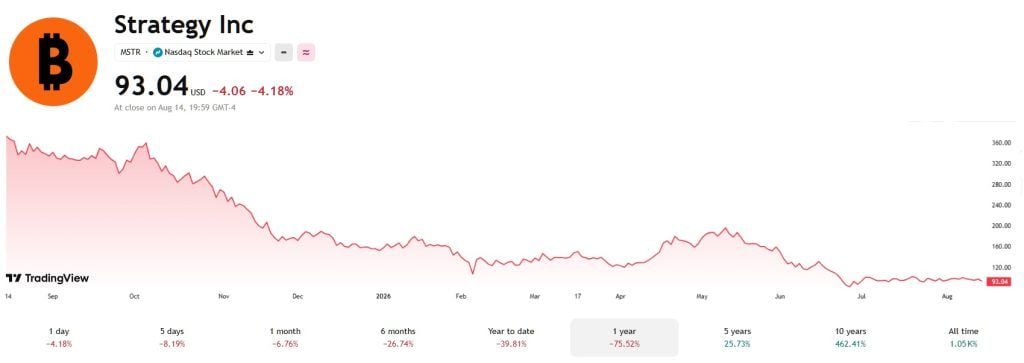
    All of this comes as Strategy’s stock, MSTR, is reportedly the most shorted stock in the market, according to Goldman Sachs. The shares are currently trading at $132.8, down 12.6% year-to-date in 2026. Compared to the all-time high of $542, the stock is off by 75.8%.

    How much Saylor needs an even bigger orange bag may become clearer next week, as Strategy continues to report its Bitcoin activity on a weekly basis when transactions occur. One thing is certain: Saylor remains openly optimistic, even amid the current turbulence on the crypto market.