Category: Business

  • Crypto community fear of Iran choking oil supply and crashing markets may be overblown

    Crypto community fear of Iran choking oil supply and crashing markets may be overblown

    As tensions flare once again between Iran, Israel, and the U.S., social media, especially on crypto social media X (or Crypto Twitter), fears that Tehran could shut down the Strait of Hormuz, a vital oil chokepoint. Such a move, many worry, could send oil prices and global inflation soaring and roil financial markets, including bitcoin.

    However, those concerns may be exaggerated, according to some observers.

    Early Saturday, Israel and the U.S. launched airstrikes on Iran, aiming to dismantle the nation’s nuclear facilities and missile capabilities after failed negotiations. Iran retaliated by firing ballistic missiles at Israel and the U.S. bases in the region, escalating fears of a full-blown military conflict.

    This sparked jitters in the crypto market, the only venue open for investors to express fear and risk, while traditional markets stay closed over the weekend.

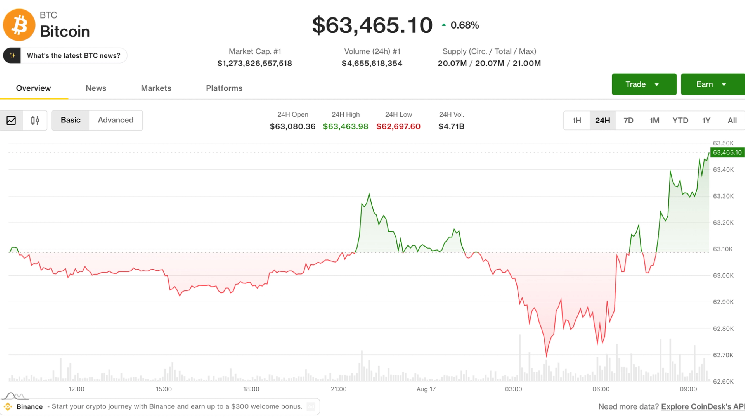
    Bitcoin BTC$64,892.86, the leading cryptocurrency by market value, dropped to $63,000 from around $65,600 before rebounding to $65,000. Oil-linked futures on Hyperliquid surged more than 5%.

    Hormuz fears

    The Strait of Hormuz is a chokepoint (21 miles wide at its narrowest point) between Iran to the north and Oman to the south, and facilitated about 20 million barrels of oil shipments each day in 2024, according to the U.S. Energy Information Administration (EIA).

    Naturally, amid simmering tensions, crypto accounts on X are worried that Iran may close the Strait of Hormuz, choking off oil supplies.

    “If a direct conflict between the United States and Iran has begun, this isn’t just geopolitics. It’s a global economic event. If the Strait of Hormuz is threatened, oil could spike toward $120–$150,” an X handle called @Crypto_Diet said.

    This could lead to an inflation shock, market sell-offs, a dollar surge, and depreciation in emerging-market currencies, the post added.

    Several more accounts have posted similar views, with some savvy geopolitical experts sharing these concerns.

    “Oil prices had already climbed to six-month highs ahead of the strikes. Iran is a founding OPEC member and the Strait of Hormuz, through which roughly 20% of global oil passes, is now directly implicated,” Geopolitical Strategist Velina Tchakarova said.

    On top of that, some news outlets are already reporting that several oil majors, including trading houses, have suspended oil and fuel shipments through the strait.

    Outright closure unlikely

    Some observers, however, argued that an outright closure of the strait is not in Iran’s best interests and may be geographically impossible.

    According to Daniel Lacalle, a PhD economist, fund manager, and chief economist at Tressis, Iran currently produces 3.3 million barrels per day of oil, but exports just half of that, which almost entirely goes to its ally China.

    “It would shoot itself in the foot,” Lacalle said, downplaying fears of an eventual Iranian shutdown of the strait.

    He added that OPEC members could quickly offset any potential disruption to oil supplies from Iran, while stressing that the United States, by itself, is the world’s largest oil producer.

    In other words, any spike in oil prices could be measured and temporary.

    The other aspect to consider is Geography. While the strait is split roughly in the middle between Iran and Oman, the shipping lanes are predominantly in Omani waters. It’s because water on the Iranian side is said to be shallower, while on the Omani side, it is deeper and better suited for the movement of large oil tankers.

    So, technically, ships could pass through Oman’s yard, which means Iran’s closure of its territory may not have a big impact on supplies.

    “Most waterways are in Oman, not Iran,” Energy Market Expert Dr. Anas Alhajji said on X.

    “Hormuz strait has never been blocked despite all wars – It cannot be blocked. Too wide. Well protected,” he added.

    All things considered, the odds of Iran shutting the strait and choking off oil supplies are low. That said, an all-out war can still trigger widespread risk aversion, potentially driving bitcoin below the widely watched $60,000 support level.

    Meanwhile, bitcoin’s price chart also signals a potential for deepening of the bear market ahead amid the Middle East crisis.

  • Bullish Sign? Bitcoin Nears Milestone as 100+ BTC Wallets Approach 20K

    Bullish Sign? Bitcoin Nears Milestone as 100+ BTC Wallets Approach 20K

    Bitcoin’s bullish setup is strengthening as wallets holding 100 $BTC or more approach record levels, according to Santiment, which says this trend can be considered a bullish sign when it rises during or after price declines.

    Bitcoin Flashes Possible Bullish Sign as Large Holders Climb Toward 20,000 Threshold

    Crypto analytics platform Santiment shared on social media platform X on Feb. 26 that bitcoin’s growing number of wallets holding 100 $BTC or more is approaching 20,000 addresses and may signal accumulation behavior, according to the firm. Santiment stated:

    “ Bitcoin is about to hit a milestone, surpassing 20,000 wallets with at least 100 $BTC. When this number rises during or after price declines (like it has been), it can be considered a bullish sign.”

    “If the number of 100+ $BTC wallets is growing, that suggests distribution across more large holders rather than a small group controlling everything,” Santiment noted. The platform emphasized that historically, rising whale wallet counts have occasionally been observed during accumulation stages that later supported price rebounds. This pattern has at times been associated with medium- to long-term upward price movements, particularly when larger entities absorb supply from retail traders during weaker market conditions, according to Santiment.

    Amount of wallets with 100+ bitcoin. Source: Santiment.

    At the same time, Santiment clarified that supply concentration among key stakeholders has not yet significantly expanded, which may explain why bitcoin prices remain subdued despite the increase in large wallets. The firm detailed:

    “The growth in wallet numbers just needs to match the growth in overall supply held, with retail slowly selling off their coins to the larger wallets.”

    Based on historical cycles, such redistribution phases have, in some instances, formed market bottoms before broader recoveries emerge, Santiment’s data suggests. While the data does not guarantee immediate upside, the predictive signal from expanding whale participation may indicate a strengthening accumulation structure that could support future price appreciation if sustained.

    FAQ 🧭

    • Why does the rise in 100 $BTC wallets matter for investors?
      Growing large-wallet counts are viewed by Santiment as signaling accumulation phases that have historically preceded price rebounds.
    • Does more whale participation guarantee a bitcoin rally?
      No, but sustained accumulation has at times aligned with medium- to long-term upward trends.
    • What does distribution across more large holders indicate?
      It suggests supply is spreading among whales rather than concentrating in a few hands, supporting structural stability.
    • Why are bitcoin prices still subdued despite wallet growth?
      Overall supply held by large wallets has not yet expanded enough to confirm a full accumulation-driven breakout.
  • Venus Flux Surpasses $119 Million In Total Market Size A Day After Launch, Indicating Renewed DeFi Interest

    Venus Flux Surpasses $119 Million In Total Market Size A Day After Launch, Indicating Renewed DeFi Interest

    Venus Flux, a liquidity layer launched yesterday on the BNBChain, continues to experience significant market performance, according to a revelation disclosed today by Venus Protocol, a decentralized lending protocol that allows users to earn interest by supplying crypto or borrow against their assets.

    Yesterday, on Thursday, February 26, 2026, Venus Protocol and a liquidity infrastructure project, popularly called Fluid, announced a strategic collaboration that enabled them to launch a unified liquidity layer, dubbed Venus Flux, on the BNBChain.

    As per the announcement, Venus Flux functions as a liquidity layer that aims to enhance capital efficiency, streamline yield generation, and make assets more productive across DeFi networks supported by the BNBChain blockchain.

    🚀 Venus Flux 24H Update

    Over the past 24 hours, Venus Flux continues expanding its unified liquidity layer — driving more efficient capital movement across @BNBCHAIN.

    📊 Total Market Size: $119,087,766
    📈 The number keeps growing
    Liquidity is accelerating. Momentum is… pic.twitter.com/13b7eGlxb9

    — Venus Protocol (@VenusProtocol) February 27, 2026

    Venus Flux On-Chain Activity and Usage Focus

    Today, Venus Protocol shared market updates that revealed that Venus Flux has recorded a massive $119,087,766 in total market size (market capitalization) following its debut on the BNBChain yesterday. This surge showcases increasing investor confidence in the Venus Flux platform, which is designed to integrate lending, trading, and other DeFi applications into a unified liquidity infrastructure.

    The liquidity platform aims to allow users and traders to engage in both lending and liquidity markets, thereby decreasing the need for manual token transfers between different chains. Following the launch, Venus Flux introduced smart collateral and debt mechanisms that facilitate both collateral and borrowed funds to constantly operate as positions in DEX liquidity pools, aiming to enhance capital efficiency.

    On-chain indicators show rising user engagement and governance participation on Venus Flux. According to the latest data from Dune Analytics, a total of $17,895,795 in capital has been borrowed from the liquidity platform since the beginning of its official network operation yesterday.

    Venus Flux Traction In DeFi Growing

    Data from Dune Analytics indicates that Venus Flux has achieved a significant milestone in DeFi, recording $17.89 million in cumulative lending volume after its launch yesterday, driven by the continued expansion of institutional participation and RWA integration in decentralized finance.

    The accomplishment showcases Venus Flux’s position as a rapidly emerging on-chain liquidity infrastructure. The record is an indicator that Venus Flux is on the journey towards becoming a major and efficient liquidity network globally, reducing costs and enhancing liquidity across financial markets.

  • Ban on Crypto Privacy Tools Would Be Counterproductive: UK Think Tank

    Ban on Crypto Privacy Tools Would Be Counterproductive: UK Think Tank

    In brief

    • A RUSI paper based on a public-private roundtable discussion has called for greater collaboration between privacy tool developers and law enforcement.
    • Participants at the roundtable repeatedly stressed that banning privacy solutions, such as privacy pools and ZK-proofs, would simply make illicit activity harder to detect.
    • The paper highlights several legitimate uses for privacy solutions, including company confidentiality and protection for potential wrench attacks.

    A report from the world’s oldest defense and security think tank has warned against banning blockchain-based privacy tools, arguing that blanket prohibition would merely result in bad actors using noncompliant services.

    In a paper titled, ‘Privacy-Enhancing Technologies in the Crypto Industry,’ the London-based Royal United Services Institute (RUSI) highlighted a “need to balance compliance objectives” with the growing role of privacy-related protocols and platforms in the cryptocurrency sector.

    It observed that growing demand for privacy solutions currently derives from four legitimate sources. They include individuals and entities wanting to avoid targeting by hackers, privacy concerns in the face of AI-related data mining by companies; privacy concerns of cryptocurrency businesses; and reducing the risk that high-net-worth and/or prominent individuals will be targeted by criminals or authoritarian governments.

    Based on roundtable discussions convened by the UK Home Office and National Economic Crime Centre in July 2025, the report highlights several blockchain-based privacy technologies, including zero-knowledge proofs, confidential stablecoins and privacy pools.

    While acknowledging that illicit actors are naturally attracted to privacy tools and “succeed by taking advantage of innovation,” the paper reports that roundtable participants—which included industry players as well as regulators and enforcement agencies—made the point “several times” that there was a “need to not ban” privacy solutions.

    “The participants highlighted that banning the technology would result in illicit actors using unregulated services,” the report reads. “As a result, law enforcement would have fewer entities to reach out to and request information from, subsequently limiting options for further investigations.”

    Instead, the roundtable participants agreed on the value of expanding collaboration between officials and providers, and of using privacy-enhancing technologies to aid law enforcement practices and “improve detection of illicit activity.”

    Crypto privacy and compliance

    The report’s author, RUSI Associate Fellow Allison Owen, told Decrypt that it’s important for policymakers and enforcement agencies to work together with developers to ensure that privacy solutions integrate compliance features.

    “From the roundtable, it is clear that the participating companies that integrate PETs and compliance features are willing to engage with the public sector,” she said.

    While accepting that there will always be individuals with bad intentions, Owen emphasized that this shouldn’t “cloud the possibility of responsible actors using the technology to benefit society.”

    Indeed, the report focuses almost exclusively on the legitimate uses of privacy solutions, highlighting their utility in the context of increasingly frequent “$5 wrench attacks,” which in 2025 claimed record losses of $41 million.

    It also discusses other drivers of usage, such as cryptocurrency firms wanting to keep crypto-based salaries confidential, as well as wanting to keep their business practices and fund flows private from competitors.

    Based on such practices, the roundtable’s participants generally believed that privacy-enhancing mechanisms “will continue to grow,” with zero-knowledge proofs in particular being integrated increasingly into business practices by the end of this year.

    However, despite this optimism Owen herself told Decrypt that “extensive” collaboration between developers and the public sector needs to happen before trust in crypto-related privacy solutions reaches a critical mass.

    “Building trust through the integration of compliance features will ultimately expand the use of the technology,” she said. “The roundtable reflects a step forward in driving these discussions around how to balance compliance and user privacy.”

    Daily Debrief Newsletter

    Start every day with the top news stories right now, plus original features, a podcast, videos and more.

  • Ethereum Outlines 2026 Glamsterdam Hardfork, ETH Still Below $2K

    Ethereum Outlines 2026 Glamsterdam Hardfork, ETH Still Below $2K

    • Vitalik Buterin has outlined Ethereum upgrades linked to its upcoming Glamsterdam hardfork.

    • The developments generally aim to increase scalability, security and user experience on the blockchain.

    • ETH has fallen below $2K following wider market events.

    Ethereum creator and co-founder Vitalik Buterin has outlined 8 Ethereum Improvement Proposals (EIPs) that comprise the upcoming Glamsterdam hardfork scheduled for the first half of 2026.

    Ethereum: 2026 Glamsterdam hardfork

    The proposals follow Ethereum’s three-track roadmap enshrined in its 2025 “predictable engineering delivery model” and comprising:

    • Scalability.
    • Improved user experience.
    • Heightened security, censorship-resistance, and quantum-resistance.

    More specifically, block building will now take place directly on Ethereum rather than external relays. This increases decentralization and transaction verification time for validators.

    Additionally, the upgrade will pave the way for parallel block verification, effectively increasing the network’s transaction processing speed. Users will also enjoy a 78.6% reduction in gas fees for both simple and complex smart contracts, and the ability to run nodes at a lower bandwidth.

    Developers, on the other hand, would be financially incentivized to write leaner code on the network’s database, aka “The State.” They would also experience fewer memory-related errors during code compilation and fewer smart contract security risks.

    Source: CoinMarketCap

  • Sen Warren leads Democrat probe into Binance in latest scrutiny of Trump crypto ties

    A group of Senators have written a letter to Attorney General Pam Bondi and Treasury Secretary Scott Bessent requesting that Binance’s compliance to its 2023 settlement be reviewed.

    The lawmakers are requesting for proof that an impartial investigation will be carried out given Binance’s ties to the Trump family and the Trump administration’s pro-crypto attitude.

    Will Binance be investigated?

    A group of 11 Democratic senators, led by Senator Elizabeth Warren sent a formal letter to Attorney General Pam Bondi and Treasury Secretary Scott Bessent, demanding a “thorough and impartial” investigation into Binance.

    The senators’ major concern is whether or not Binance is sticking to the rules of its massive 2023 settlement.

    Back then, the exchange paid over $4 billion and admitted to failing to stop money laundering. As part of that deal, Binance agreed to let U.S. officials watch over its operations.

    However, the senators now say that new reports suggest the exchange has resumed its old ways. They also claim that as much as $1.7 billion in digital assets moved through Binance to Iranian entities, including groups linked to terrorism like the Houthis and the Islamic Revolutionary Guard Corps.

    CEO Richard Teng and the company’s legal representatives at Withers Bergman denied a recent Wall Street Journal (WSJ) article that alleged that the exchange fired staff for flagging $1 billion in Iranian-linked transactions, calling it “defamatory” and “categorically false.”

    See also South Korea approves $23.3B extra budget to counter US tariff risks

    The company’s lawyers also argued in a letter to the WSJ editorial board that the newspaper ignored detailed corrections provided by the company before the story was published.

    Binance stated that between January 2024 and January 2026, it reduced its direct exposure to major Iranian cryptocurrency exchanges by more than 97.3%.

    The company noted that while anyone can try to send money to an address on public blockchains, their job is to monitor and stop those funds. They claim they are doing this better than any of their global peers.

    Binance also stated that it has invested hundreds of millions of dollars into its compliance systems. Its compliance team now includes over 1,500 people, which is roughly 25% of its entire global workforce.

    Senator Richard Blumenthal also opened an inquiry into Binance through the Senate’s Permanent Subcommittee on Investigations. He is specifically looking for records regarding two Hong Kong-based entities that were reportedly used to funnel money toward Iran.

    Why are lawmakers worried about Trump’s ties to Binance?

    Democratic lawmakers are worried that the Trump administration might not be tough enough on Binance for several reasons.

    First, is the pardon of Changpeng Zhao, the founder of Binance. In October 2025, President Trump granted a “full and unconditional pardon” to Zhao, who had served four months in prison for failing to stop money laundering. Trump described the prosecution of Zhao as a “war on cryptocurrency” by the previous administration.

    See also Breaking: Signature Bank kicks crypto clients to the curb

    His decision was criticized by Senator Warren, who argued that the pardon sends a message that crypto executives can break the law if they have the right political connections.

    Second, reports indicate that Binance has been a key supporter of “World Liberty Financial,” a crypto venture backed by President Trump and his sons. The exchange has also reportedly encouraged its 275 million users to use the $USD1 stablecoin.

    There are even reports that an Emirati fund used $USD1 to make a $2 billion investment in Binance itself, an arrangement that could earn the Trump family millions in interest every year.

    Because of these close ties, the senators are asking Attorney General Bondi and Secretary Bessent to prove that any investigation will be fair. They have given the DOJ and Treasury until March 13, 2026, to explain what steps they are taking to review Binance’s conduct.

  • Amazon, Nvidia Flood OpenAI With Cash as ChatGPT Maker’s Valuation Hits $730 Billion

    Amazon, Nvidia Flood OpenAI With Cash as ChatGPT Maker’s Valuation Hits $730 Billion

    In brief

    • OpenAI announced $110 million in new investment at a $730 billion pre-money valuation.
    • Amazon, Nvidia, and SoftBank invested in the firm, with Amazon and Nvidia also agreeing to strategic partnerships.
    • Microsoft and OpenAI said the addition of new investors and partnerships doesn’t change their deal at all.

    OpenAI has announced $110 billion in new investment at a $730 billion pre-money valuation, securing $30 billion each from Nvidia and SoftBank, with Amazon adding $50 billion to the pot. The ChatGPT maker has also revealed broader strategic alliances with Amazon and Nvidia.

    ChatGPT now has over 900 million weekly active users and 50 million consumer subscribers, OpenAI said in a Friday blog post. The firm added that its Codex AI coding tool has seen its weekly user base more than triple to 1.6 million since the start of the year, suggesting a strong growth area as more people use AI for coding purposes.

    The Amazon partnership focuses on accelerating AI adoption for enterprises and startups, while the expanded Nvidia collaboration includes dedicated inference and training capacity on next-gen hardware systems.

    “We’re pushing the frontier across infrastructure, research, and products to make AI more capable, reliable, and broadly useful,” said OpenAI CEO Sam Altman, in a statement.

    “SoftBank, Nvidia, and Amazon are long-term partners who share our ambition to turn real scientific progress into systems that deliver meaningful benefits for people at global scale,” he added. “Building AI that works for everyone will require deep collaboration across the stack, and we’re excited to do this together.”

    OpenAI said that additional investors are expected in the round, with only the three backers and $110 million investment announced so far on Friday. The raise also boosts the OpenAI Foundation’s stake in the company to over $180 billion, expanding its philanthropic capacity in areas like health and AI resilience.

    “Artificial intelligence is the most consequential technology of our time, and OpenAI is at the forefront,” said Nvidia founder and CEO Jensen Huang, in a statement. “We have been privileged to partner with OpenAI since its earliest days, as it delivered one breakthrough after another. Together, we will continue to push the frontier—building the infrastructure for the age of AI and scaling its benefits to serve industries and societies worldwide.”

    In a separate joint statement, OpenAI and Microsoft said that the addition of new investors doesn’t impact their existing relationship.

    “Microsoft and OpenAI continue to work closely across research, engineering, and product development, building on years of deep collaboration and shared success,” they wrote. “Microsoft maintains its exclusive license and access to intellectual property across OpenAI models and products. Collaborations like the partnership between OpenAI and Amazon were always contemplated under our agreements and Microsoft is excited to see what they build together.”

    Daily Debrief Newsletter

    Start every day with the top news stories right now, plus original features, a podcast, videos and more.

  • Minnesota Weighs Total Ban on Bitcoin and Crypto ATMs

    Minnesota Weighs Total Ban on Bitcoin and Crypto ATMs

    In brief

    • Lawmakers in Minnesota are considering a total ban on crypto ATMs.
    • The state passed a regulatory framework for the machines in 2024.
    • Countries like New Zealand have recently imposed sweeping bans.

    Lawmakers in Minnesota are considering a total ban on crypto ATMs, with legislation introduced earlier this week in response to a growing number of scams against the elderly.

    Introduced on Monday by Rep. Erin Koegel, who serves as co-chair of the state’s House Finance and Policy Committee, HF 3642 would effectively ban all physical machines in Minnesota that allow users to purchase cryptocurrencies using cash.

    The legislation marks renewed efforts to address risks associated with crypto ATMs, following a state framework passed in 2024 that imposed a $2,000 daily transaction limit for new customers, refund requirements, and a licensing framework for operators.

    Although several states have implemented pauses or strict local bans on crypto ATMs, the measure in Minnesota would likely be the first of its kind in the nation. It would mirror sweeping bans taken up in multiple countries, such as one last year in New Zealand.

    Law enforcement officials testified during a hearing on Thursday that older Minnesotans are continuing to lose tens of thousands dollars from scammers, who direct victims to send them crypto under false pretenses, often while impersonating the government or tech support.

    At the hearing, a local detective recalled how one resident feared she would become homeless after sending Bitcoin to a scammer 10 times within six months. The official said she was losing 50% of her monthly income until she was found at a gas station appearing confused one day, and she required government assistance “due to her dire circumstances.”

    There are around 430 crypto ATMs in Minnesota, which are clustered mostly around the state’s most populous city, Minneapolis, according to Coin ATM Radar. Across the country last year, victims reported $333 million in losses tied to crypto ATMs, according to the FBI.

    CoinFlip General Counsel Larry Lipka said at the hearing that the ATM operator is aware of the prevalence of scams using its machine, but scammers have multiple tools at their disposal.

    In a letter submitted to the committee, the police chief of one city in Minnesota wrote that “law enforcement has an extremely limited ability to recover funds once transferred,” representing one of several challenges from a public safety perspective.

    Rep. Keith Allen noted during the hearing that millions of dollars have likely been siphoned from rural communities that “could have been doing a lot of good.”

    As lawmakers in Minnesota weigh a total ban on crypto ATMs, state prosecutors in other areas are advocating for restrictions against associated companies, including Bitcoin Depot.

    Earlier this week, the largest operator of Bitcoin ATMs in North America signaled that it would begin requiring customers to provide personal identification each time they make a transaction. The move presented a voluntary effort to refine its compliance procedures.

    That decision followed a lawsuit brought by Massachusetts Attorney General Andrea Campbell earlier this month, which alleged that Bitcoin Depot knowingly facilitated crypto scams while “removing safeguards against fraud and misleading investors in order to line their own pockets.”

    Bitcoin Depot has pushed back against the assertion, according to ICIJ, with a spokesperson asserting recently that the firm is built around compliance and consumer protection. The company continues to work with law enforcement to combat illicit activity, they added.

    Daily Debrief Newsletter

    Start every day with the top news stories right now, plus original features, a podcast, videos and more.

  • DCTRL Vancouver: Iconic Bitcoin Hackerspace Closes Downtown Location After 12 Years Due to Zoning Changes

    DCTRL Vancouver: Iconic Bitcoin Hackerspace Closes Downtown Location After 12 Years Due to Zoning Changes

    DCTRL Vancouver: Iconic Bitcoin Hackerspace Closes Downtown Location After 12 Years Due to Zoning Changes

    DCTRL, a Bitcoin hub and hacker space out of Vancouver, the fair-weather Canadian city, has announced the sunset of its downtown basement location, iconic among early adopters for its tinkerer mindset and hardware hacker culture. The community will be migrating to a new location in the coming weeks, and updates to the vision of the hub. The Vancouver Bitcoin community is renowned for having set up the first Bitcoin ATM in History, with DCTRL specifically having hosted a variety of renowned characters that, over the years, gave this industry much of its cultural and innovative flair.

    Visited by some of the most influential people in the Bitcoin and broader Crypto industry in its 12 year run, DCTRL is far from done being a hub of the Canadian Bitcoin and Crypto scene. Preparing to move due to a change in zoning laws, plans to relaunch in a new location are in the works, as active members consolidate the historical moments, relationships, and lessons learnt during perhaps the longest-running Bitcoin hackspace experiment in the young industry’s history.

    It all started at Waves cafe on Howe Street, in Vancouver. The Bitcoiniacs, a group of four OGs that operated a Bitcoin brokerage at the time — still active to this day — decided it was time to get the robots involved. So they rigged up an ATM to sell bitcoin to the public, rallied the local Vancouver tech, finance, and burgeoning crypto scene, and hosted a historical launch party.

    “The first Bitcoin ATM in the world was a massive event,” said Freddie Heartline, a Bitcoin enthusiast and co-founding member of the DCTRL hacker space. In an exclusive interview with Bitcoin Magazine, Heartline went on to recall the event, saying, “Oh man, the vibes were incredible. It literally felt like a really good rave. But it was smarter. Way smarter. That’s how it all came about, actually.” referring to the founding of DCTRL.

    The timing for the Bitcoin ATM event was perfect, it was October 2013 and bitcoin had just gone from a few dollars to almost 150, consolidated for a few weeks around 100 and was getting ready to take a shot at 1,000 a coin. The energy across the Bitcoin community as electric, this was the end of the longest bear market in Bitcoin history, in a way this rise in price was proof that Bitcoin was here to stay.

    The launch of the first Bitcoin ATM, as a result, made national and international news. The idea of a Bitcoin ATM being operational was considered a historical milestone in the adoption of Bitcoin as money.

    Tens of thousands of Canadian dollars worth of bitcoin were sold that day and over the coming weeks, likely creating a few millionaires over the years, spawning copycat ATM projects and even a handful of Bitcoin ATM manufacturing companies to boot. It also inspired the creation of the DCTRL hacker space, called “Decentral Vancouver” at the time.

    Cameron Gray, another Bitcoin enthusiast who was volunteering with the Bitcoiniacs event and a friend of Heartline, was the one who had the idea. “Cam was absolutely an essential part of founding Decentral.” Heartline recalled “He literally turned to me one day – as he was operating the bitcoin ATM at Waves – after I complained about the lighting at the coffee shop – and said ‘we should open a space.’ And that was it.”

    Soon, they had secured a basement location in downtown Vancouver, grimy, humid, but cozy. Over the years, this spot became a hub for Bitcoin engineers, founders, crypto enthusiasts, and eventually legends. The decor got better, the leaks patched, and the walls decorated with Bitcoin art. The empty spaces filled up with hardware of all kinds, modified to operate or somehow interact with the orange coin.

    Heartline and Gray were starting a lifestyle project of sorts, and while Bitcoin may have been doing well at over $1,000, it would soon correct back to $300, another bear market, which had important consequences for the industry. During that time, the bills for DCTRL’s rent had to be paid somehow, and so Heartline moved in. Not into the basement, but onto the rooftop. In order to keep the lights on during that bear market, he literally set up a tent. Not a bad setup either if you have a look.

    DCTRL started hosting meetups, the Vancouver Startup Weekend community got wind of it, and a gentleman known as Greg began to visit the hub. Soon enough, the Startup Weekend events were taking place at DCTRL as well, pulling in the local tech startup scene. Before long, even Vitalik Buterin, founder of Ethereum and former writer for Bitcoin Magazine, showed up.

    Greg had another important contribution to DCTRL; he made a donation that created a symbol for the local community. He donated $500 to the space with one condition: “It has to be used for something creative …” Heartline recalled, “so I found a Pepsi machine on Craigslist. Greg even helped us move the thing in a pickup. Him, me, Cam, and Mike Olaff moved that fucking insanely heavy and awkward thing down the stairs – lol almost killing Cam.” The Pepsi machine would soon get backwards engineered, hacked, and rebranded to the Bepsi, for obvious Bitcoin reasons.

    In the above video, you can see Greg making an on-chain transaction to the pop machine, milliseconds later dropping a soda for him on Q. The satisfying sound of Bitcoin being used as money for the small pleasures of life became a staple of DCTRL. A digital version of the Bepsi was eventually made, which fans from all over the world used to make donations. Many iterations of the underlying software took place over time, rig-wired into the Cold War era pop machine with a Raspberry Pi and some hacker ingenuity. A decade later, even the Mayor of Vancouver Ken Sim, dropped by to pay homage to this staple of Vancouver hacker culture, this time buying a soda from Bepsi with a lightning payment.

    Vancouver Mayor @KenSimCity using the Bepsi machine with @lightning at DCTRL 🙌🏼 pic.twitter.com/bTE2VNiiFK

    — DCTRL (@dctrlvan) November 7, 2025

    Today, the Bepsi supports practically every Bitcoin protocol, a testing ground for the cutting edge of Bitcoin technology, including protocols like Taproot Assets, Spark, and Arcade OS. “We even issued our own Bepsi token. One Bepsi equals one soda from the Bepsi machine… it’s like a stable coin… pegged to the price of the pop can.” said Heartline. The Bepsi, which in a way was inspired by the Bitcoin ATM, also inspired copycats, such as the 21up vending machine hosted in a nearby Blockchain lab known as MintGreen. To this day, funds collected by the Bepsi machine have gone to support the operation of the hacker space and cover costs, serving as a cornerstone of the community. Control over the Bepsi’s underlying wallets and tech stack in a way setting rank among the most active members and hosts.

    Visited by Legends

    Throughout the years, big names within the industry visited or engaged with DCTRL in one way or another. Vitalik Buterin personally visited the space and hung out there in the very early days of Ethereum, as demonstrated by this photograph hung on their wall, featuring Gray, Heartline, Vitalik, and another active member referred to as Kyle.

    The founders of CaVirtex, the first Canadian Bitcoin exchange, were also photographed there. This brand is little known now as they were bought out by Kraken years later, but they had a deep influence on the Canadian Bitcoin scene, selling the coin to Canadians since before the first bull run, which peaked at $30 per coin. Without this exchange, many of the big Canadian Bitcoiners may not have gotten in.

    Virtually, Bitcoin celebrities also attended DCTRL events throughout the years, answering questions from the local crowd, such as Roger Ver, before the fork wars, Andreas Antonopoulos, and Willy Woo. Erik Vorhees, who came to fame in Bitcoin for creating the first major instant swap, crypto-to-crypto exchange called ShapeShift, is seen in this video doing a fireside chat at DCTRL during a local meetup.

    Even one famous scammer attended the hub, a man who was a regular in the Canadian Bitcoin scene in the 2014 era, and who to this day remains one of the unsolved mysteries of crypto-related crime, Gerald Cotten of QuadrigaCX. Cotten, whom I personally met multiple times in Toronto at the time, was a charming and smooth-talking entrepreneur in the scene at the time, before his turbulent professional history was revealed and the exchange went down in bankruptcy, leaving millions of dollars of user funds unpaid. Cotten allegedly died suddenly and mysteriously in India just before the exchange went bankrupt, taking the crypto keys with him, but many who were personally affected by this centralized exchange collapse are skeptical of that story.

    Further evidence of DCTRL as a microcosm of the industry as a whole was seen years later during the fork wars, as Gray, the other primary co-founder of the hub, took the ‘big block’ side of the debate, resulting in intense debates and ultimately a falling out with the local community and broader Bitcoin scene. Gray, nevertheless, is highly respected and appreciated by the active members of DCTRL for his contributions to the DCTRL social scene, which would inevitably suffer from the same forks and tensions that the Bitcoin protocol went through at the time.

    During those difficult times, DCTRL served as a forum and debate space for these topics, even hosting Peter Rizun of the alternative implementation Bitcoin Unlimited — a big blocker — who debated Taylor, seen on the right in the photo below.

    Overall, DCTRL enjoyed more than 12 years of continuous operation, boasts hundreds of events hosted, over 1500 registered community members, and 69 recorded talks published on YouTube, which touched many elements of the Bitcoin and crypto industry. Throughout this whole time, the hub was operated entirely by volunteers and sustained through public donations and, of course, the Bepsi.

    As the location of DCTRL gets rezoned by the city government, and a new building will be going up in its place, the active members and hosts of DCTRL, have begun organizing a transition to a new location, alongside an update to the brand and

    According to DJ, one of the active members who prefers to stay pseudonymous, the hub has had record attendance in recent months. And while the location will change, its future is brighter than ever. Those who would like to be a part of the future of DCTRL can learn more at www.DCTRL.wtf.

    This post DCTRL Vancouver: Iconic Bitcoin Hackerspace Closes Downtown Location After 12 Years Due to Zoning Changes first appeared on Bitcoin Magazine and is written by Juan Galt.