In July 2023, Disney CEO Bob Iger sat down with CNBC’s David Faber at the Allen & Co. conference in Sun Valley, Idaho. The Writers Guild of America had been on strike for two months, and SAG-AFTRA would join them that later that day. It was all quite baffling.
“There’s a level of expectation that they have that’s just not realistic, and they are adding to a set of challenges that this business is already facing that is quite frankly very disruptive and dangerous,” he said.
That afternoon, SAG-AFTRA President Fran Drescher issued a blistering response, calling Hollywood’s CEOs “tone deaf” and “greedy.” “Shame on them!” she shouted. The first double-strike since 1960 was underway.
But why?
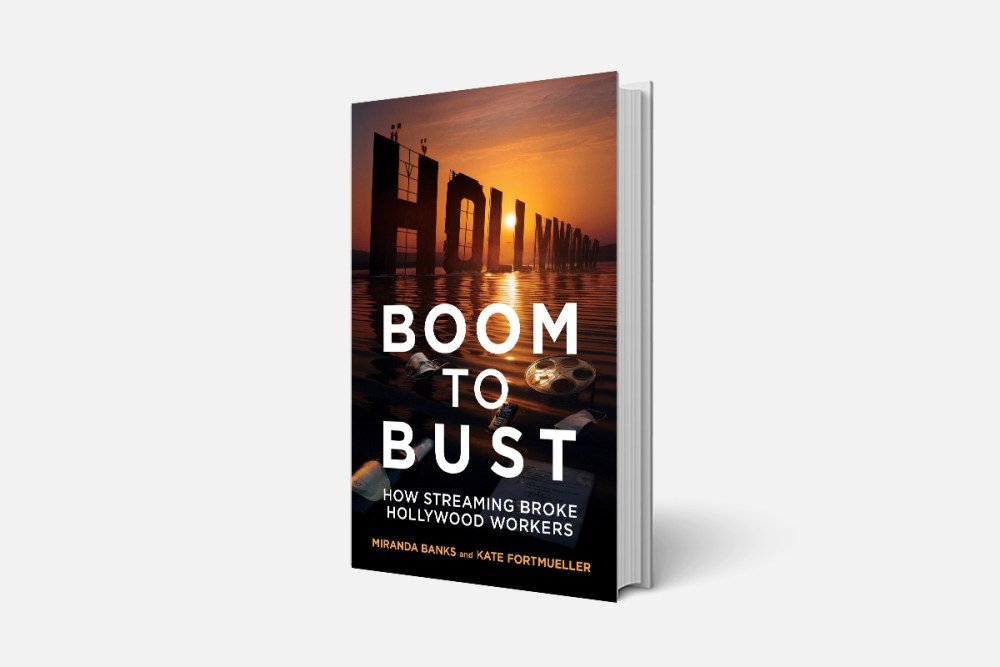
Miranda Banks and Kate Fortmueller, professors of film and TV at Loyola Marymount University and Georgia State University, respectively, have published a book, “Boom to Bust: How Streaming Broke Hollywood Workers” that seeks to answer that question by putting the six-month work stoppage in its social and cultural context.
From the vantage point of 2026 — post-Peak TV, with industry jobs down 40% — the story looks gloomier than it did then. The book’s cover depicts a hazy sunset over a Hollywood sign that is drowning in floodwaters. Of necessity, the strikes looked backwards at the unprecedented rise of streaming TV and sought to address the disruptions that came with it. But they came just as that phase was ending and the wide-open opportunities of that era were already starting to close.
“At the time, 2023 looked like a victory for Hollywood labor,” the authors write, “but the damage to the industry was so vast that a return to business as usual was already impossible before the strikes, let alone after.”
In an interview last week, Banks and Fortmueller discussed the causes and consequences of the strikes, and how they appear with the benefit of hindsight. Were they a necessary corrective that meaningfully altered the industry’s balance of power? Or were they merely a valiant protest against the implacable forces of capitalism and technology?
The week the book was published, WGA members were voting to ratify a new contract that includes a bailout of the union’s ailing health fund and significant increases in health insurance costs. The union’s own staffers were on strike for better wages and working conditions, and this year it was the WGA’s turn to call them unrealistic, as the memory of 2023’s “hot labor summer” mood recedes into history.
What were you trying to achieve with the book?
Kate Fortmueller: When the strikes happened, we were having a lot of conversations with journalists. Some of the questions we got were like, “Was this surprising?” I think we really were like, “It’s not surprising.” But when did this start? So we really wanted to work back and think about how Hollywood had changed, how work had changed. People are talking about all these working conditions that were really radically different.
Miranda Banks: Often it’s this perfect storm of technological change, industry shifts — also the cultural moment, the political moment — that all coalesce into a moment of crisis. Generally, if there’s only one issue, it doesn’t go to a strike. But it’s this combination. It took a little bit of time for Kate and I to try to periodize it and to try to understand what were those factors and how did each of them lead to a moment where workers said, “Wait a second. There is no other choice.” What we hit on as the inciting incident was when streamers started doing original programming. The streamers became studios.
And then all the studios decided they had to become streamers as well.
Banks: Yes, exactly.
Fortmueller: A lot of who we’re teaching are people who want to enter the industry. Miranda’s in L.A., I’m in Georgia, and those are both production hubs. So you get a lot of young people aspiring to go into the industry. Some of this also comes from wanting to be able to explain and talk to students about what the industry was — like, “What is this moment?”
One of the themes that you talked about is this clash between assumptions and reality — like, the assumption that Hollywood cares about your voice, or that things are going to be more fair in the future than they are today. And if you run into the fact that Hollywood is an insular place that’s run on relationships almost exclusively, that’s a very potent collision.
Fortmueller: Teaching young people, we hear those assumptions from them. We’re seeing people coming into the industry with these ideas that this is a place where my voice and my creativity and my unique perspective is the thing that matters. They really hear that and embrace that.
Banks: It was a moment when new voices really were appreciated in ways they hadn’t been. People hadn’t had the same opportunities to tell more niche stories. The assumption was that this would continue — or that this was the way that the industry worked — as opposed to a trend for the moment. Like, the idea of writing an original pilot, because it helps hear the individual person’s voice. The reality is in most TV jobs, you have to write in somebody else’s voice. But for this period of time, there were assumptions that were getting made that were not foolhardy, completely. But they led people to assume things about the long-term sustainability of these things. And then another thing was advancement, right? You had so many opportunities on different shows, and that leads to a real amount of knowledge. But you may have only been around for maybe 12 episodes of something. It’s just not the same as 22. You don’t get that experience that allows you to step up in your next job to a higher rank.
Fortmueller: These things also really dovetail with entrenched notions of the American dream — like “plucked out of obscurity.” The way that it has recently manifested is maybe particular to this generation, to streaming’s own objectives. Your voice did matter. They wanted to distinguish themselves. Netflix is trying to distinguish itself and its programming. Having all these different shows is useful for them.
That gets to one of the core paradoxes of the strike. Was the streaming era — from 2012 to 2022 — good or bad?
Banks: Yes.
Since the invention of the television, there have never been more shows on television than there were in 2022. And yet, the next year, they go on strike. So what is that about? It’s not that there’s not enough work.
Fortmueller: There’s not a lot of quality work.
There’s more shows. They might only last eight episodes. It’s not that everybody is working on “Cheers” with guaranteed lifetime income coming along with that. But if it was 30 years ago, most of those writers probably wouldn’t have a job at all. It was a much smaller industry, right?
Banks: The thing is — it was unsustainable. Streaming itself as a technology isn’t evil. There’s amazing opportunities with streaming. We talked to a lot of creatives who said streaming gave them whole new ways of telling stories. It freed them in all sorts of ways. The problem was that it was a mad dash to make so much to hold onto subscribers. And it wasn’t about meeting the marketplace. So this overproduction led to a lot of overwork and exhaustion. There was no sanity to it. It’s not streaming’s fault, per se, but streaming also really screwed up the financial model. It wasn’t thoughtfully paced. It was designed for a land grab. It’s the greed that really screwed people over. It’s not so much the technology.
Fortmueller: The cost of living in Los Angeles and in major cities across the country has really gone up. I think that there’s also that frustration that you get your show on the air, or you get in a writer’s room, and this is the thing you’ve been working for, and you’re not getting paid very well, and it’s not very many episodes. And also you still have to scramble to pay your rent because you live in one of the most expensive cities in the country.
Banks: Both of us are historians, by training, and you know the old guard of Hollywood moguls were not great guys. They were not benevolent leaders. They were terrible people. But what was different is they could only make money if they made good and better movies or TV shows. So they would always reinvest in the industry, right? Now we’re at a point with a lot of these conglomerates that can also make money by selling diapers or by selling computers or by having people just go to a theme park. And their focus or interest in the sustainability of stories and entertainment, whatever form they’re in — film or television or streaming — is just not top of the list.
In terms of identifying the cause — as you said, there’s a perfect storm. The streaming piece is one piece of it. But there are a lot of other issues as well — writing staff sizes and film writers doing free work — so it becomes harder to say what this is about. So three years later, what do you think it was about?
Fortmueller: That’s a great question.
Banks: It’s always about money.
Fortmueller: Like, existentially, what was it about?
Yeah.
Fortmueller: I think it’s about money. Maybe it is actually really about unfulfilled promises.
Reading your book — particularly the passage about the assumptions versus reality — the phrase “revolution of rising expectations” occurred to me. Like — things are getting better, but not as fast as we thought they would. And that’s the moment where it’s most volatile. Not the moment like now. We’re in the midst of a depression, basically. And there’s no strike. There’s no threat of a strike.
Fortmueller: You have to feel like you have leverage. Like, there was obviously going to be no strike during COVID.
Banks: That was actually the time that it made a lot more sense. That would have been the time to strike.
Fortmueller: I also don’t think that AI was really what the strike was about.
That’s interesting. Your book talks about how that was more of a symbol.
Fortmueller: The thing with AI is that, if the reality is not meeting expectations, and you feel like you should be feeling this sense accomplishment and progress and you’re not, and then all of a sudden you’re being threatened with being completely replaced by AI — it’s not about AI, but that becomes a thing that really pushes you over the edge. It’s a business and most things you’re not going to necessarily get validation for or feel valued. But I think the attitude that everyone’s replaceable can really exacerbate some ill will.
Banks: That’s been there in Hollywood for a long time, since runaway production — like, you are not necessarily important to this company. But what’s shockingly different is it’s not that the job is in Georgia or in Croatia or whatever it is. The job is with the technology. The human isn’t even in there.
Do you think the strike was successful — either on its own terms or just in general?
Fortmueller: I think — yes. On the terms of what they were negotiating, they were successful. They got movement on all the things they wanted to. These are all smart people, they’re people who recognize their own self interest. They were not wrong in the things that they were asking for. The thing that is hard — as someone who lives in Georgia — is that the unions have never really been successful with runaway productions. The thing that maybe was not being addressed was the issue of runaway production. But I don’t think that they could have done it, because I don’t think anyone’s ever been able to do it. Peak TV brought in way more people into the industry than this industry could ever support. It’s not an infinite growth business, in part because we do not have infinite time to watch TV.
That is the limiting factor.
It’s a hard thing to say because I don’t work in the business and these are people’s lives and livelihoods. But I don’t think the industry could ever sustain the amount of people that were working in it. So one of the really unfortunate outcomes of this is that it will contract. It has contracted. I think the crisis is spread out across the country. I’m having conversations with neighbors who can’t find work in the industry.
Yeah. It didn’t run away. It just went away. It didn’t go anywhere necessarily.
Or it went out of the country. But that wasn’t really a piece of what was ever being negotiated. So I think that the members who voted to authorize the strike and the members who walked those picket lines — I think those efforts were important — the terms to try to make this a job that you can actually make a living at and continue to do long term — I think all of that was important. They made good progress. Some of the problems that we’re seeing now were outside of the control of things, and I think some of this, unfortunately, is a natural contraction. It’s supply and demand issues. We had an oversupply and there’s just not enough demand for some of these things.
Banks: I appreciate that term — “success for what they were asking for.” And that doesn’t mean that the strike was great. It was not great for Hollywood. But given the demands that workers had and the negotiation that they had, the contract was successful in providing what people were asking for. The problem is that the strike accelerated something that was already happening. The strike wasn’t the cause of this downturn. It accelerated the downturn, and that acceleration has been painful. There’s just a desperation to get back to work and that is very clear from the workers.
I went back to look at the Fran Drescher speech. She talks about how you can’t change the business model as much as it’s been changed, and not change the contract too. And they did. They did get access to viewership data and then payment partially based on it, with a very tight limit on how much you can actually benefit. It feels like they got something that at least gestures in the direction of the way things used to work, but is never going to replace the dollars.
Banks: Yeah, especially not for the average worker, right?
Fortmueller: What these unions are trying to do is make this a livable industry. The Fran speech is great, and when she said you have to change the contract, she’s right. But those are fundamental changes and that stuff’s hard.
This interview has been edited and condensed for clarity.
Leave a Reply