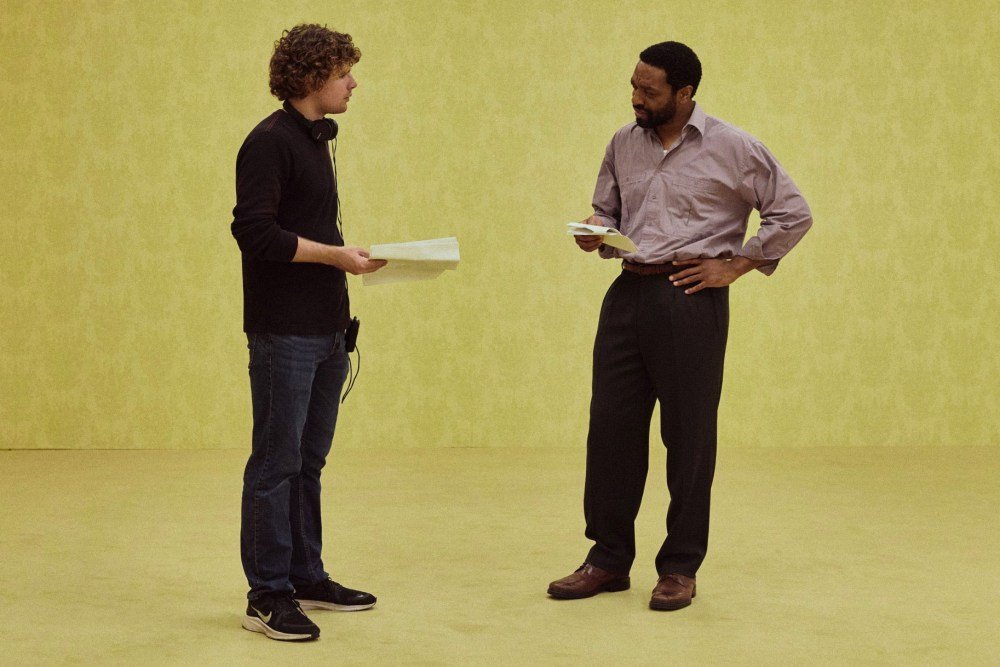
“Backrooms” is one of the most unique cinematic events of the year. The film, which opens in theaters Friday via A24, was directed by 20-year-old Kane Parsons, who previously developed the web series of the same name. Already tallying huge box office numbers from Thursday preview screenings, it is projected to be one of A24’s biggest hits ever.
The surreal plot involves Clark (Chiwetel Ejiofor), a furniture store owner who finds a secret doorway that leads him to a seemingly endless series of nondescript rooms. Once he goes missing in them, his therapist, Dr. Mary Kline (Renate Reinsve), enters these Backrooms to find him, even as her reality starts bending.
Parsons spoke with Variety in the weeks leading up to the film’s release about getting approached to make the film when he was 16 years old, why he thinks future chapters might end up on YouTube and why liminal spaces freak people out so much.
There’s been so much hype around the movie. How have you been holding up with this press cycle?
It’s been a very strange time. I’ve never done any of these things before, so it’s a lot of new experiences … consistently, frequently, every day of every week. I’m just excited for it to hit the internet, and on May 29th, I’ll probably just be staying in and just monitoring the fallout, so to speak.
What was the original genesis of doing a feature version of “Backrooms”?
I’d been doing “The Backrooms” as a series online for really only a month when this conversation started. I put out that first short at the beginning of 2022. I had immediately recognized and connected it to this other abstract story with some broader thematic ideas that I wanted to touch on, kind of like an itch or an engine of a story. I combined those and it became the series that people know. I designed it to work where I knew the ending when I started it. I’ve grown up where a lot of my favorite IPs are all serialized, so, yes, I love film, but I think I’m biased to enjoy stories that are more than just one singular piece of material and pace themselves out over a period of years or time, and that feverish audience who’s waiting for more and trying to put something together. That informed the desire to have a meticulously crafted story, as best as I could.
That’s the standard I would like to appeal to, and so I started working on that series, the science fiction project, and always knew it was going to go in a direction that hopefully would go beyond where I was. I was hoping it would always increase in scope and quality, and part of that would mean leaving behind the found footage convention in some ways, sometimes. Not abandoning it, but what’s been done on YouTube was very much in conversation with the direct concept of the Backrooms, and the more analytical science fiction aspects. I think it was a major hole in terms of what you could get away with in my budget level, which is basically zero at the time.
I was doing the found footage stuff because Blender [an open-source 3D modeling and animation design program] is free, and I know how to use Blender. I can put the character behind the camera, so I don’t have to deal with character animations, and when I do have to deal with characters, they don’t have to look uncanny, because they’re in hazmat suits. So I played to what I could, and but the hope would always be to approach the Backrooms concept from a more intimate, human-driven perspective, where rather than doing things that change the way the Backrooms presents itself, or the way the mythology works, or the history of that narrative, it would be just allowing the interior lives of these characters to more specificity dictate and imply a deeper meaning to the space. The humanity of the characters and the intimacy of it ends up coloring the space a little bit more than you can do alone, when it’s just purely observing the space from an analytical perspective.
So people reached out within the first month. Lots of companies were emailing me. I had no reference of the industry prior to that point. I was 16 at the time, and I was very skeptical and assuming that it would fall apart in some way, shape, or form, just because … What the fuck? It wasn’t that it was too good to be true, I think it was just that I’ve grown up seeing so many properties get butchered by suits and whatnot, that I assumed that there would be some kind of catch here, something’s gotta give. I didn’t want to end up with nothing, and I didn’t want to end up not being able to work on this series, and letting the series fall apart in some way. I was just very careful of that, and eventually, I got managers, I got a lawyer and we found a way to safely go into a handshake deal, initially with Atomic Monster and 21 Laps. We just developed a version of the film that would work for new audiences and fans of the series. It wasn’t the version we ended up making, exactly. It was an iterative process, but we pitched that to A24, along with a few other studios, and we’ve made a deal with them, and it was a deal that I felt good about, and still maintain that I do. I think it ended up getting to a place where the fears that I had all subsided.
How did you protect yourself and your vision once others got involved? Were you willing to walk away if things didn’t make sense, or did you have guardrails for yourself to maintain your creative voice?
A lot of it was a gamble. I feel as though, in the early days, when I had the ability to walk away, I would have walked away with the IP. If it was up to me, I would hold on to that thing and not abandon it, because I want to work on it. I make it because I want to make it, not because it’s just a job for me to do. The specifics of it matter to me, and I don’t think anyone else in the entire production of the thing really even has a handle on a lot of the engine of it, so I do think I’m still invaluable to that. I like to think unless they’re training a fucking Grok model on my brain or something without me knowing … I think I was just, at a certain point, either we’re making the movie or we’re not making the movie, and if I stand in the way of too many pivotal moments with my personal asks, which are maybe not maintained or felt by all the other parties involved, who are going to be spending this kind of money and time on this project, I feel like I had to kind of find the right balance of letting it move forward, even if it wasn’t 100% where I wanted. It was knowing that I would have a chance, if I really worked hard, to get in there within a limited window, and fix the things that I wasn’t liking.
If I didn’t touch anything, it would drift continuously, and it would continue getting made, but it would just take extra added effort on top of the normal production that goes into a film to continually adjust it to my liking. It was an obsession for me for most of the production. It was not uncommon to have 20-hour, 21-hour work days sometimes, just really cramming to get everything that needed to be done, done. So I think that’s kind of the honest answer: It was a gamble. We wanted to make this film, and we wanted to make sure that we could get there, and I found great creative partners with [producer] Chris Ferguson up in Vancouver, who understood exactly where I was coming from, and he got it. And [“Longlegs” director] Oz Perkins was a really good defender, and he played great creative defense on this, and he’s just fun.
If someone is uninitiated with liminal spaces, or going into this as their first “Backrooms” experience, what feelings or emotions does the world evoke in you?
I feel as though liminal space, that whole world, is very much connecting with people on the level that it’s referencing uncurated little fragments of memories that are lacking context. Moments in your life where the primate mind has learned its environment, and has a specific relationship with the way it memorizes its environment. You’ve got little abstract flickers of a location you went to when you were a kid that you have no idea where it was, or when it happened, or what happened there exactly. You just have information that floats around in the brain sometimes, and a lot of these little space photos evoke the feeling of people who had childhoods in the early 2000s and ’90s, and I think that’s partially just due to the medium of a lot of the stuff being digicam.
I would say it’s largely that you don’t feel the authorship behind those photos, you don’t feel the person behind the camera, because they’re not framing to tell a story. Oftentimes, these are incidental images taken from property listings and from random home photo libraries. Stuff just gets out there, and it floats around, and I think people are able to really project themselves onto these spaces and feel as though they feel seen, or have some kind of attachment, nostalgia of the texture of an archway in your grandparents’ home when you’re a kid. The popcorn ceiling, some little element in the environment that doesn’t feel worthwhile to mention ever in your whole life, because why would it? It’s one of billions and billions of little architectural details or memory fragments, but then seeing something that feels like it’s speaking exactly on that wavelength brought onto a computer screen, and then seeing a whole thread of that to pull, I think really is compelling for people.
With “Backrooms,” I take it in the science fiction direction, but it’s a tangible version of that idea and exploration in the form of this place that is either exploiting or using, probably not consciously, but I think people find it and come into contact with it, and they find that most of the horrors to be found are them projecting their own interior world onto it, like a person in sensory deprivation, grasping at random noises, using what’s in their own mind subconsciously to try to make sense of it. I think it’s a phenomenon used to break down the conscious experience of an individual person, and highlights the systems that we put up as a species that push us to that breaking point, but also highlight how arbitrary it all is in the first place. It’s cosmic horror. It all goes in that direction.
When you were developing the film, were you thinking at all about the relationship it would have with the audience, given that they are so obsessive with analyzing the work and coming up with their own theories?
One million percent. I’ve grown up as a part of a feverish audience. I am waiting every day for the “Half-Life 3” announcement to come. I am a very eager consumer of the things I enjoy. I’m a fan of things, and I like to make things for people who like to be fans of things. I don’t like to do it in such a way that is isolating to people. I think you can easily create lore bloat with a project, where you go way too far in terms of overemphasizing the wrong puzzle-building details of a narrative, and you lose sight of the actual engine that engages people emotionally and intellectually. And some indie IPs get that wrong, especially when going to film adaptation and whatnot. I won’t name names. [Fakes a throat-clear and cheekily names an example].
Part of the goal has been … I am very specifically trying to maintain this level of detail in every creative choice we make in the film, in the same way I’ve been doing with the YouTube series. Obviously, we are on a stricter timeline with this film. But when I think about this stuff, I think about it from the perspective of me being part of the audience, and knowing there’s gonna be a billion theory videos about all of these choices. I want it to hold up. I want that to be part of the experience. It’s not an afterthought for me; it’s very much part of the curated point, as much as I think any other part of the viewing experience is. There’s stuff for people to find, and I think there are levels to the material where I just keep pulling, you get to the place where you just obsess over the exact sound files and the samples from different soundtracks. You rip apart what is there, and so I like there to be a lot of interesting things to find inside the actual project itself, beyond the narrative. On all levels, really.

Renate Reinsve in “Backrooms.”
Courtesy Everett Collection
What were some of the inspirations for the outdoor shots? They were just as eerie as much of the liminal spaces.
The outside world stuff, some of the inspirations we talked about were “One Hour Photo,” “Better Call Saul,” “Breaking Bad” — that look. When we were doing sky replacements, we used some “Pluribus” references, a little more California, a little more South. We are actually shooting up in Vancouver, so slightly different clouds and whatnot. We did a lot of sky replacements, and it was very deliberate to get that — I won’t outright say that feeling of unreality, because I don’t want to imply anything narrative — it’s more of an artistic choice of tone. But I would say there’s also the painterly feeling of “The Truman Show” skybox. I grew up in Petaluma, California, which is right by the Windows XP Bliss wallpaper, where that photo was taken. It doesn’t quite look like that anymore in that exact spot, but the hills and that environment are the same as San Jose, the same sort of hillscape.
Those rolling green hills were a crucial part of the feeling in my mind, and it’s that whole environment of the California suburbs surrounded by these looming green mounds, with a blue sky. It’s focusing on the filtered childlike qualities of things I remember from my own childhood growing up in that area. You’ll hear the mourning doves and the wind chimes are obviously a piece of audio. I tried to blend in a lot of things that I recognized from my own childhood, and go a little oversaturated with it in some ways. We had fun referencing a whole bunch of miscellaneous liminal space photography collections, stuff that is maybe hard to pin down off the top of my head, but it’s a lot of one-offs that we can’t even identify who made. They’re just random JPEGs from Reddit and whatnot that people have come to expect when discussing liminal spaces. We wanted to pay homage.
This film ends with plenty of questions left. How do you want to continue telling this story? Are you just focused on film now?
I don’t want to leave YouTube behind. I immensely enjoy the work I’ve done there, and I feel creatively fulfilled by it in a way that’s proportional to what I’ve done with this film. I personally think there’s merits, because there’s a lot of projects that I just could never do outside of YouTube, or outside of a more free-form internet multimedia container. So I wouldn’t limit myself just to one spot, but I do think it’s a way of saying that I’ve got a bit of a good thing going right now that I want to utilize with the energy and positivity around this film. Without a doubt, “Backrooms” has always been planned to be more of a series that goes outside the confines of this film. If anything, I would say this is a bit of a foot in the door that would lead to more of a progression towards the true root of the narrative, which has been set up online for years. But a version that maintains accessibility and lets this be the way in. For people who are into it, I’ve got a contract, and I got a hold at my end, and that means I am definitely not done with “Backrooms.” I’ve got very specific things that I’m working on, things are in the works right now that I am eager to be able to talk about, but, currently, it’s still in a secret mystery world.
Watch the “Backrooms” trailer below.
Leave a Reply