Author: rb809rb

  • XRP Hits New Milestone of 13M Total Agentic Payments

    XRP Hits New Milestone of 13M Total Agentic Payments

    With the total now above 13 million, he believes the network could reach 100 million payments sooner than many people in the $XRP community expect.

    $XRP Soars From 1M to 13M Agentic Payments

    XRPL recorded its first 1 million agentic transactions on July 8, 2026. By July 22, 2026, the total had reached 1.4 million, marking a 127% increase. The growth came as more AI agents began using the ledger to pay for real-world digital services and support automated tasks.

    Around that time, Akinyele predicted that XRPL would soon surpass 10 million agentic transactions. He highlighted the growing number of AI agents and improvements in blockchain infrastructure as the main reasons behind the increase. The ledger has since surpassed this mark.

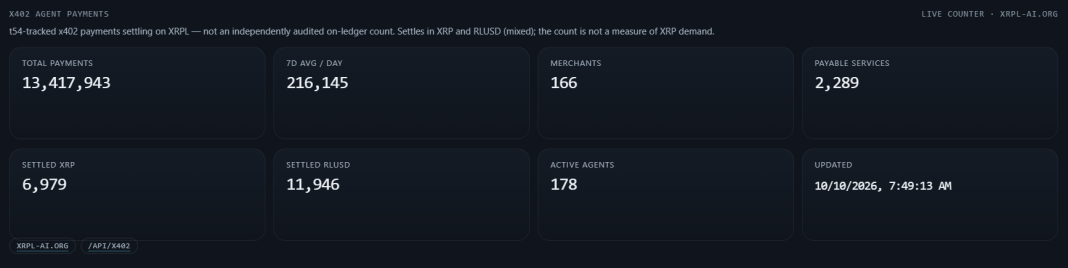
    XRPL now averages 216,145 agentic transactions per day over the past seven days. According to Akinyele, these payments account for about 25% of all activity on the network. Essentially, AI-driven payments are becoming an important part of daily XRPL activity.

    On-chain data sourced by t54 puts the total at exactly 13,417,943 payments at press time. The network currently has 178 active agents operating across 166 x402 merchants and 2,289 payable services.

    $XRP Ledger crosses the 13 million agentic payments milestone

    In addition to this, the data also records 6,979 transactions in $XRP and 11,946 transactions in Ripple USD ($RLUSD), showing that both assets have continued to support payments within the ecosystem.

    Call for Developers to Build on XRPL

    Akinyele also urged developers to take advantage of the growing activity on XRPL by building new applications. He noted that AI agents already create demand for application programming interfaces (APIs), data and computing resources.

    Developers can meet this demand by creating products that allow AI agents to access and pay for digital services automatically.

    He mentioned low transaction fees, fast settlement, and a growing set of AI development tools as major advantages for developers working on XRPL. These features could help them create products that handle automated payments without relying on traditional payment methods for every transaction.

    Ripple has also taken steps to make it easier for developers to build AI payment applications. In June 2026, the company launched the XRPL AI Starter Kit, which provides tools, documentation, and integrations for developers creating agentic payment solutions on the ledger.

    The kit supports the x402 protocol and payments in both $XRP and $RLUSD. This allows AI agents to pay for API calls, model inference, and computing resources without the extra steps involved in traditional account-based payment systems.

    How x402 Supports Agentic Payments

    The x402 protocol provides the payment standard behind XRPL’s growing agentic activity. For context, the protocol is an open, internet-native payment standard built around HTTP, which allows online services to request payments through familiar internet infrastructure.

    This supports automated payments between AI agents and service providers, including payments for data, software tools, and computing resources.

    Coinbase originally developed the x402 protocol, while the x402 Foundation, hosted by the Linux Foundation, now oversees its governance. Ripple has also joined the foundation as a Premier Member, showing its involvement in the development and adoption of the standard.

  • Brad Bird on Why He Took ‘Ray Gunn’ to Skydance Instead of Pixar: Making Animated Films for Teens and Adults ‘Shouldn’t Be a Controversial Decision’

    Brad Bird on Why He Took ‘Ray Gunn’ to Skydance Instead of Pixar: Making Animated Films for Teens and Adults ‘Shouldn’t Be a Controversial Decision’

    On a balmy April afternoon at Abbey Road Studios in London, a 74-piece orchestra comprised of violinists, cellists, flautists and even an organ-payer, is packed into Studio One. The iconic room, which has hosted musical legends from Edward Elgar to Harry Styles, is painted “Toy Story” blue, a fitting color given the reason everyone is here today is to record the score for “Ray Gunn,” a new feature animation from Pixar legend Brad Bird, the brains behind “Ratatouille” and “The Incredibles.”

    The film, which has been gestating inside Bird’s mind for three decades, is not a Pixar or Disney project, however (more on which later), but a Skydance Animation production which will hit Netflix on Dec. 18 (it premieres at the BFI London Film Festival on Oct. 10).

    Directing the orchestra at Abbey Road is Bird’s longtime collaborator, composer Michael Giacchino. “Ray Gunn” is the duo’s sixth project together since first teaming up for “The Incredibles” in 2004 and it’s one Giacchino (who won an Oscar for Pixar’s “Up” in 2010) has had more than two decades to prepare for. “We talked about this movie during ‘The Incredibles,’” the composer reveals, when we speak a few months later. “I’ve known about this for a very long time.”

    Fittingly, given the key role of music in the film, Bird first conceived the idea for “Ray Gunn” – a noir detective caper set in a “Jetsons”-style retro future – after hearing The B-52s’ song “Planet Claire.” To Bird, the tune sounded like a mash-up between the theme song to 1960s detective series “Peter Gunn” and “a ’50s monster sci-fi movie,” Bird says in an interview a day before the film’s premiere. “I went, ‘This is not “Peter Gunn.” What is this?’ And then I went, ‘It’s Ray-Gun.’ And then I went, ‘Ray Gunn: It’s a guy’s name. He’s a detective, but it’s in the future.’”

    Michael Giacchino and Brad Bird (courtesy of Netflix)

    Courtesy of Netflix

    But the idea got shelved as other projects got in the way: there was his sophomore Pixar project “Ratatouille” followed by “The Incredibles 2” and, in between, live action fare “Mission: Impossible – Ghost Protocol” and “Tomorrowland” as well as an abandoned attempt to adapt Will Eisner’s comic “The Spirit.” Bird, who describes his mind as a “big shop floor,” would come back and “tinker” with “Ray Gunn” every now and again, biding his time until he could bring it to life (the film fell through at other studios including Warner Bros.)

    It was “Mission: Impossible” that finally paved the way for what had effectively become Bird’s real-life mission: impossible. “It was [Skydance’s] second film and everybody was happy with how it turned out,” Bird says of his turn at the helm of the Tom Cruise franchise. So when the opportunity arose to pitch the studio on another idea, “Ray Gunn” was the obvious choice. (The move also reunited Bird with Pixar co-founder John Lasseter, now the head of Skydance Animation.)

    “I never pitched it at Pixar because I felt like it wasn’t in Pixar’s wheelhouse exactly,” Bird explains, referring to the studio’s reputation for catering to younger audiences than the one he’s aiming at with “Ray Gunn.” “If you put a Pixar label on it people would go, ‘Oh well, it’s meant for the same audience that these other films were meant for,’ and inevitably some of them would go, ‘Well, my little Jimmy would be unhappy at this.’”

    Bird expands on the theme, pointing out there are “10 billion animated films” for children and far fewer for teenagers and adults, despite them comprising the majority of the movie-going audience. Making animated films for them “shouldn’t be a controversial decision,” Bird says, “and yet it was always treated that way by the ministers of resource allocation [at Pixar].” (He is returning to Pixar for his next project, a third “Incredibles” movie.)

    Skydance had a different take. “My thought when [they] got involved was that that they’ll go with me on this slightly different audience tangent,” Bird says. “And here it is.” Skydance CEO David Ellison is a producer on “Ray Gunn”: was that in name only or was he fairly hands-on? “Well, he was more involved in the earlier days,” Bird says. “But he got — you know, his plate became very full.” The director is obliquely referring to Ellison’s recent battle to acquire Warner Bros. Discovery. Bird won’t be drawn on whether he thinks Ellison will stick to his promise, made as part of his bid, that Skydance will produce at least 30 theatrical films a year. “All that stuff is beyond my pay grade,” he says, sidestepping the question.

    While Skydance may have become the latest lightning rod in an increasingly polarised and under pressure Hollywood, Bird is a pragmatist. Later in our conversation, he notes that after making “The Iron Giant” he took his nascent idea for “The Incredibles” to Pixar. “The crew from ‘Iron Giant,’ a lot of them were mad at me initially because they felt like I was leaving hand-drawn [animation] and going to the sexy new CG,” Bird recalls. “And I said I don’t really care about the technology part. I’m going up to Pixar because they protect storytelling.”

    “Ray Gunn”

    Netflix

    As it happens, protecting — versus exploiting — art is one of the themes of “Ray Gunn,” which follows the eponymous private detective (voiced by Sam Rockwell) as he uncovers a dastardly plot involving Venus Nova (Scarlett Johansson), a superstar singer with a huge secret.

    For Giacchino, the trick to scoring a film filled with so much intrigue is keeping the viewer guessing. “Probably the second toughest thing was just making sure everything was always in alignment thematically, so that I didn’t give the audience something that they shouldn’t be thinking about,” he notes. (The actual toughest, he says, was an intimate scene between Gunn and Nova when they’re first opening up to each other. “It needed to really hit every single emotional beat in this perfect way,” he explains.)

    Bird may have written “Ray Gunn” almost three decades ago but it’s themes of art, technology and corporate greed resonate now as much as they did in the late 1990s. He says the screenplay changed “less than you’d think” between that first draft and the finished movie.

    “A lot of the things that people are saying that [the film] is dealing with that are contemporary right now in the headlines were in there 30 years ago,” Bird notes. “People are people and greed is greed and the flaws of people make good subject material for films. If that’s what’s driving the story, then the story’s not going to age because it’s about eternal things rather than things that were in the news last week.”

  • Stealing $1.5B in crypto is easy, cashing out is the trap

    Stealing $1.5B in crypto is easy, cashing out is the trap

    He eventually obtained information that helped him trace more than $12 million in Bybit-linked funds and, according to his account, contributed to Tether freezing 442,000 $USDT.

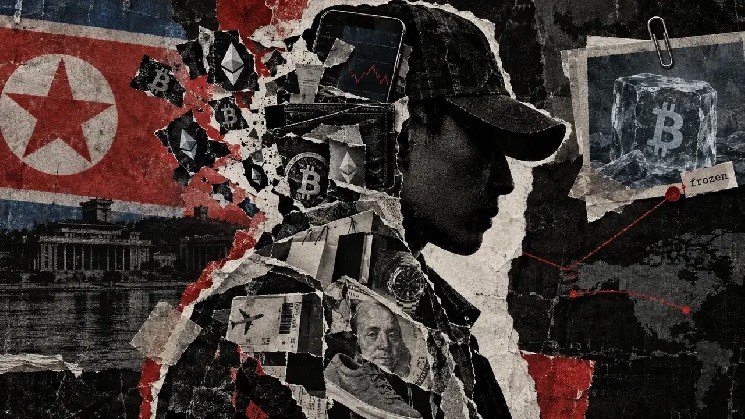
    His investigation led him to a network he believes laundered more than $1 billion from crypto thefts linked to the North Korean Lazarus Group, including proceeds from the Bybit attack.

    The implications of his investigations extend to a much larger market for criminal financial services that American authorities have spent the past two years trying to disrupt.

    In September, the US Treasury sanctioned Xinbi Guarantee, a marketplace it said has processed more than $24 billion in digital assets and fiat currency through its platforms since 2022, and explicitly identified North Korean hackers among the illicit actors reported to have used its services.

    Treasury also acknowledged that criminals tried to preserve their operations by moving from Huione to Xinbi after it was sanctioned, showing how removing one marketplace doesn’t eliminate the relationships and demand that supported it in the first place.

    Believe it or not, hacking an exchange and stealing funds is actually the easiest part of this crime. Converting stolen crypto into fiat or another form of real purchasing power is where it gets difficult.

    To do that, hackers rely on payment services and other shady relationships that let investigators and regulators intervene.

    The $349,700 customer

    The FBI attributed the Bybit theft to North Korean hackers on Feb. 26, 2025, identifying the activity as TraderTraitor and warning that stolen assets were being converted into Bitcoin and other cryptocurrencies before being distributed across thousands of blockchain addresses.

    While it took no time to identify the hackers, identifying the intermediaries handling the stolen money required much more investigative work.

    According to ZachXBT, he began that work when he saw more than 15 accounts in public Telegram and Discord groups seeking help with transactions tied to the stolen Bybit funds, suggesting that at least part of the subsequent laundering process involved intermediaries openly soliciting or arranging services.

    He contacted several of those accounts and eventually developed a relationship with someone using the Telegram alias Jimmy Green, who presented himself as someone who needed help moving cryptocurrency between networks.

    On March 6, 2025, ZachXBT says he funded a new Ethereum address with 349,700 $USDC and began exchanging the dollar-linked token for $USDT on Tron through the contact, accepting unfavorable exchange terms while trying to establish himself as a credible customer.

    The 349,700 $USDC represented capital committed to the transactions rather than a disclosed net investigative loss, while the 5% he says he lost on each order is the cost he was prepared to accept for access to information that ordinary blockchain analysis could not provide.

    The arrangement also carried the risk that the intermediary could just disappear with the funds.

    Hackers depend on intermediaries who might steal from them in turn, and without enforceable commercial protections, reputation and personal familiarity become especially important to keeping those relationships working.

    That gave ZachXBT a way into the operation, since a customer willing to conduct repeated transactions became more valuable to the person providing the service.

    The relationship eventually produced information beyond wallet addresses, including discussions of planned fund movements before the transactions occurred, allowing ZachXBT to compare statements made privately with activity subsequently recorded on public blockchains.

    In one instance, the intermediary discussed moving funds to Solana before the corresponding movement took place, while other exchanges and wallet connections allegedly helped identify a larger cluster of assets linked to the Bybit theft.

    This was a major turning point in his investigation, because on-chain data can’t identify the person behind the transaction or its intent. Private conversations about a transaction provided the key evidence about who controlled it and what they used it for.

    Even though ZachXBT’s investigation still doesn’t completely match the FBI’s official record, it’s still one of the most significant investigative efforts we’ve seen in a while. It showed that personal and commercial relationships can provide evidence blockchain alone can’t, and that similar tactics could help investigate and eventually resolve other thefts.

    Tracing $12 million differs from recovering it

    ZachXBT said information from his relationship with Jimmy Green helped identify a cluster with more than $12 million in Bybit-linked funds, including transactions across several networks.

    He also reported that Tether later froze 442,000 $USDT linked to the North Korean hack. This showed that quickly identifying stolen assets, while they remain accessible through issuer-controlled tokens like $USDT or $USDC, can be crucial to recovering the funds.

    The two amounts should not be confused: tracing more than $12 million does not mean the entire amount was frozen, and freezing 442,000 $USDT does not mean the tokens were seized or returned to Bybit.

    The specific 442,000 $USDT figure and its connection to ZachXBT’s investigation come from his account, although Tether has separately disclosed larger freezes tied to the Bybit theft.

    There’s a considerable distance between observing stolen cryptocurrency, identifying the people handling it, and obtaining legal or technical control over the proceeds.

    Public blockchains don’t prevent the assets from moving again, especially when they pass through services that refuse to cooperate with investigators or operate beyond the reach of relevant authorities.

    Centrally issued stablecoins create a potential intervention point because their issuers can retain the administrative ability to restrict transfers from designated addresses.

    Native Bitcoin has no equivalent issuer-controlled restriction, although authorities can still restrain assets held by custodians or seize the keys controlling them when they obtain the necessary access and legal authority.

    That leaves investigators dependent on more than tracing accuracy, since an identified balance must also remain within reach of someone who has the technical ability and authority to act.

    During Bybit’s recovery effort, court orders and cooperation from financial intermediaries could restrict assets long after the initial theft, without guaranteeing full recovery.

    The problem is that stolen cryptocurrency can become increasingly fragmented as it moves between wallets, chains, custodians, and trading counterparties, with each additional service potentially requiring another source of evidence or another legal process before the pursuit can continue.

    That’s why investigators can see where the funds traveled but have no way to stop the next transaction or recover the funds.

    $4 billion in crypto laundering

    The use of outside intermediaries isn’t limited to the Bybit theft, and American enforcement records show a longer history of attempts to identify businesses that convert stolen crypto into assets criminals can use.

    In March 2020, the Justice Department charged two Chinese nationals, Tian Yinyin and Li Jiadong, with laundering more than $100 million worth of crypto, primarily through activity connected to exchange hacks.

    These charges show how individuals who don’t carry out the hack can still play an essential role in the crime.

    The Treasury’s sanctions announcement also revealed that Tian converted nearly $1.4 million in Bitcoin into prepaid Apple iTunes gift cards, showing how laundering can eventually involve ordinary retail instruments rather than the more elaborate financial services usually associated with international cybercrime.

    The same economic requirement operates on a much larger scale through marketplaces that connect criminals with merchants offering settlement, exchange, payment and other services.

    In May 2025, the Treasury’s Financial Crimes Enforcement Network identified Cambodia-based Huione Group as a financial institution of primary money laundering concern, finding that its operations had laundered at least $4 billion in illicit proceeds between August 2021 and January 2025.

    Of that amount, FinCEN identified at least $37 million in crypto stemming from North Korean cyber thefts, along with other proceeds from investment fraud and cyber scams.

    The $4 billion figure reflects illicit activity across several crime categories, and the $37 million represents the minimum North Korean-linked component identified in the agency’s findings.

    Related Reading

    ZachXBT infiltrates $1B crypto syndicate to expose Lazarus Group

    FinCEN’s assessment also identified serious deficiencies in anti-money-laundering and customer-verification controls across the group, including an acknowledgment that inadequate checks had allowed one component to indirectly receive funds connected to a North Korean heist.

    The significance of those findings extends beyond any individual transaction because an intermediary that offers repeated access to payment services can become infrastructure for multiple criminal customers, reducing the need for each organization to build its own arrangements for converting stolen assets.

    That concentrates activity around businesses that can become targets for sanctions, seizures, restrictions on banking relationships and other enforcement measures.

    Huione’s marketplace handled a substantial volume of transactions and illicit services, and operators tried to keep operating after Telegram disrupted access to parts of the network.

    Those marketplace transaction figures and FinCEN’s narrower estimates of identified illicit proceeds measure different categories of activity, making it key not to treat all funds moving through a platform as proven criminal proceeds.

    The customers moved

    The difficulty is that a criminal marketplace can lose infrastructure without losing the demand that made its services profitable, particularly when users can still contact alternative providers.

    In June 2026, the Justice Department announced the seizure of a cloud computing account that hosted backend infrastructure used by Huione Group subsidiaries allegedly involved in moving proceeds from fraud, cyber scams and other criminal activity.

    The action followed earlier US restrictions on the group and targeted technology that supports the transfer and concealment of illicit funds.

    Removing that infrastructure doesn’t automatically eliminate relationships between customers and the intermediaries willing to serve them.

    The Treasury made that limitation particularly explicit on Sept. 9, when it sanctioned Xinbi Guarantee, describing an illicit marketplace that connected criminal organizations with merchants providing financial services, technology, and other resources needed to support their operations.

    According to Treasury, Xinbi had processed the equivalent of more than $24 billion in digital assets and fiat currency since approximately 2022, with its services primarily supporting transactions involving Southeast Asian markets.

    The scale makes the platform relevant to enforcement efforts against the broader financial infrastructure that serves criminal organizations.

    Treasury also said cybercriminals had attempted to preserve their operations by migrating activities from Huione-related services to Xinbi following FinCEN’s earlier action, with the new marketplace offering substantially similar services to an overlapping group of customers.

    The agencies described a commercial market where participants could seek another provider when enforcement made their previous arrangements less reliable.

    During the Huione crackdown, Telegram removed thousands of channels associated with Huione Guarantee as merchants moved to alternative marketplaces.

    This is why a crackdown’s success cannot be measured solely by the number of websites, accounts, or servers taken offline, since customers who still need an illicit financial service can try to rebuild access through providers that remain operational.

    The disruption still imposes costs, particularly when balances are frozen, settlements fail, or established counterparties become unavailable, but the economic incentive to move stolen funds continues as long as the underlying crime remains profitable.

    The problem for enforcement agencies is making those services increasingly expensive and unreliable across the network of potential replacements.

    Tether’s freezes push crypto laundering networks toward other payment options

    The enforcement action against Xinbi shows how financial restrictions can disrupt criminal operations while prompting the businesses involved to change their payment arrangements.

    A series of Tether freezes restricted over $45 million in $USDT across at least 22 wallets associated with Xinbi’s operations.

    The marketplace responded by telling users it would move toward USDD, a stablecoin structure that doesn’t offer the same issuer-controlled address-freezing mechanism as $USDT.

    That was an important shift because the ability to freeze a token can be valuable to investigators when suspected proceeds remain within the issuer’s administrative reach, while customers attempting to avoid those restrictions have an incentive to move toward instruments with different controls.

    The move shows how restrictions on one part of the payment system can redirect transactions toward another, requiring investigators to follow both the assets and the businesses that provide access to them.

    During the September crackdown, authorities also targeted Xinbi-linked infrastructure and restrained over $52 million in cryptocurrency, while withdrawals accelerated and competing marketplaces reportedly began restricting laundering-related merchants.

    Those developments differ from the 442,000 $USDT freeze ZachXBT attributes to North Korean hackers, since public reporting does not establish that the same addresses, participants, or funds were involved.

    Both cases show that criminal operations depend on financial intermediaries whose services can create opportunities for intervention even after the original theft is complete.

    Where a token issuer can freeze assets, the relevant exposure may be the balance held in an identifiable address. Where a marketplace serves multiple criminal groups, its vulnerability may extend to the infrastructure, merchant relationships, and settlement arrangements supporting those customers.

    Both routes can reduce the ability to move and use stolen money without additional cost or risk.

    People behind the transfers are harder to replace

    ZachXBT’s investigation made an impact because he described how a paid relationship produced information about the people arranging the transactions.

    Criminal intermediaries who repeatedly handle stolen cryptocurrency develop a commercial reputation, establish preferred counterparties, and learn which services can complete transactions without interfering with the proceeds.

    Those relationships can make an operation more effective over time, especially when customers need to move large amounts of money without revealing their identities or risking that a counterparty will keep the assets.

    However, they also create dependencies that are hard to replicate quickly when an established provider disappears, especially if alternatives charge higher fees, reject suspicious funds, or prove less reliable.

    Those dependencies also provide investigators with another source of evidence because a service provider can reveal what it knows about future transactions, other participants, and the payment infrastructure required to complete an order.

    Investigators still need to test the information against observable activity and other records, and the fact that an address receives funds connected to a theft does not establish the recipient’s intent or knowledge.

    But comparing private communications with subsequent blockchain movements can narrow that uncertainty in ways tracing transactions alone cannot.

    The broader enforcement record points out that making criminal financial services less attractive requires more than periodically taking down their websites, because the customers and commercial incentives supporting those services can outlast the equipment used to deliver them.

    Seizing assets, restricting financial access, prosecuting service providers, and identifying the people who control settlement arrangements can change that calculation, though the point at which those costs outweigh revenue from serving illicit customers will differ across businesses.

    This is also why the dollar value of a cryptocurrency theft cannot automatically be treated as money successfully converted into spendable revenue for the responsible government, much less as a verified amount used for any particular military or state expenditure.

    The original theft, the amount moved through intermediary addresses, the value successfully converted into other forms of purchasing power, and the amount ultimately recovered by authorities are separate measures that require separate evidence.

    For North Korean hackers, relying on laundering services adds risk after the initial intrusion succeeds, since gaining control of stolen assets doesn’t eliminate the need for others to accept, exchange, and ultimately spend them.

    ZachXBT’s reported infiltration shows how that requirement can turn a customer relationship into an investigative opening, while the US actions against Huione and Xinbi demonstrate how the surrounding businesses can become enforcement targets even when criminal customers attempt to migrate elsewhere.

    The essential weakness is that stealing cryptocurrency and using it in practice are different, and the second still depends on commercial arrangements whose participants have assets, reputations, and financial interests to protect.

    North Korean hackers’ efforts to make that money spendable can still pull them back into relationships that require trust, and the people providing it have something to lose.

  • Does This $32M Whale Know Where Bitcoin’s Price Goes After $82.5K

    Does This $32M Whale Know Where Bitcoin’s Price Goes After $82.5K

    The Date Matters Here

    On Oct. 10, 2025, crypto suffered its largest liquidation event on record, with many calling it bigger than LUNA, COVID and FTX. One market tracker tallied that bitcoin’s market cap has fallen from $2.43 trillion then to about $1.72 trillion now.

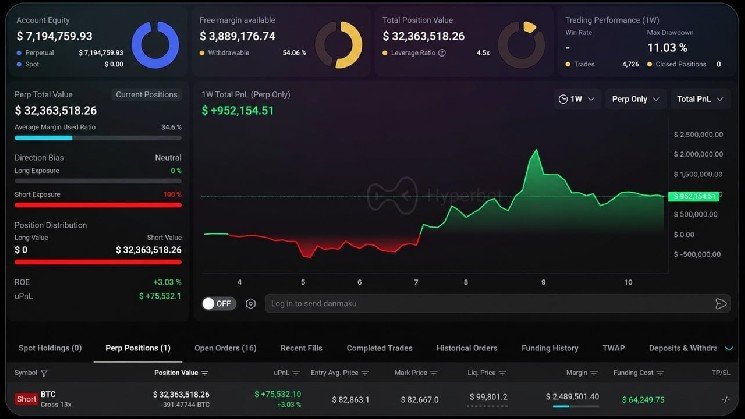
    Bitcoin’s price tells the same story as the asset is currently changing hands near $82,754, about 34% below its $126,080 all-time high. The past week has been rough as Bitcoin.com News reported that $BTC’s price dropped below $81K on Oct. 8 as liquidations topped $1.1 billion, before it bounced back to $83K a day later.

    Lastly, earlier this week, Bitcoin.com News flagged two linked wallets carrying $1,58 billion in shorts, and the analysts tracking them noted the bets could offset positions held elsewhere. In any case, Hyperliquid’s $BTC market carries about 38,040 $BTC in open interest, so this whale controls roughly 1% of it. That is meaningful, but will not move the market alone.

    The Crowd on the Other Side

    A Coinglass liquidation map shared by Bitcoin Archive late Friday showed roughly $3.3 billion in shorts stacked between the current price and $85,000. If bitcoin rallies through that zone, forced buybacks could add fuel, which is exactly what bears do not want on a weekend with thin liquidity.

    Bettors are not leaning bullish either, as Polymarket’s year-end price market gives bitcoin a 27.5% chance of touching $100,000 by Dec. 31. Institutional flows are mixed, with spot bitcoin exchange-traded funds (ETFs) taking in a modest $21.13 million on Oct. 9, led by Blackrock’s IBIT, after nearly $1 billion left over the prior two sessions.

  • Rising fuel costs slashed Delta’s profit outlook despite strong demand

    Rising fuel costs slashed Delta’s profit outlook despite strong demand

    Rising fuel prices push Delta’s annual fuel expenses up by $6bn, affecting its profit outlook for 2026.

    Delta Air Lines cut its profit forecast despite heightened demand as fuel costs surge across the air travel sector.

    The Atlanta-based air carrier said in its third-quarter earnings report released on Friday that it expects its annual fuel costs to jump by $6bn, as ongoing tensions between the United States and Iran have sent fuel prices surging across the global aviation sector.

    Recommended Stories

    list of 3 itemsend of list

    Overall, US airlines spent nearly $43bn on fuel in the first eight months of the year, a $13.2bn increase from the same period a year earlier.

    On Wall Street, Delta cut its earnings outlook for the year to adjusted earnings per share of $5.10 to $5.60, down from its July forecast of $6.50 to $7.50. The midpoint of the new range is below analysts’ average estimate of $5.46, according to LSEG data.

    Delta’s stock tumbled in midday trading as the trading week came to a close. It was down 1.1 percent from Friday’s opening price. While the stock has fallen 4.4 percent over the past five days, it has performed well in 2026, gaining nearly 18 percent since the beginning of the year.

    CEO Ed Bastian said the airline had raised prices by roughly 20 percent this year and said those prices could be sustained even if fuel prices decline.

    Delta Air Lines is the first of the major US airlines to report earnings and is generally more protected from price fluctuations than its competitors because it owns a refinery in Pennsylvania, which it acquired in 2012.

    Despite higher prices, demand remains elevated, with 60 percent of flights in the fourth quarter already booked. Delta also announced several new international routes, including Seattle–Tokyo, Japan and Boston–Venice, Italy, as well as Austin-Paris, France, all beginning next year.

    Bastian told the Wall Street Journal that holiday bookings also remain strong and that premium travel is growing, with premium seat revenue jumping 18 percent for the quarter compared with the same period last year.

    Broadly speaking, premium flights can be a boon for major airlines, and prices in the segment are rising. Average ticket prices for premium seats across major airlines were up 11 percent compared with the same period last year, according to the Airline Reporting Corporation’s monthly report, which tracks airline ticket transactions.

    But lower-income consumers are pulling back. US consumer sentiment is slumping, according to the University of Michigan’s Surveys of Consumers, which released its Consumer Sentiment Index on Friday.

    “Overall, sentiment for lower-income consumers and those with smaller stock portfolios dropped steeply this month, groups that have fewer resources to weather increases in prices,” Joanne Hsu, director of the Surveys of Consumers, said in the release.

    Delta’s report comes as the US summer travel season draws to a close, following reports that lower-income travellers would pull back amid rising prices. In May, 51 percent of Americans earning less than $100,000 annually said travel would be one of the first expenses they would cut, according to a report from consulting firm Deloitte.

    United Airlines is the next major carrier expected to report earnings, with results slated for after the market close on October 20. Like Delta, United’s stock was down on Wall Street, falling 0.8 percent from Friday’s opening price.

  • US surpasses 4,000 measles cases with infections confirmed in 45 states: CDC

    Measles cases in the United States have surpassed 4,000 this year, according to data updated Friday from the Centers for Disease Control and Prevention (CDC).

    A total of 4,080 cases have been confirmed, with most reported by 45 states and Washington, D.C. Eighteen of this year’s total have been among international visitors to the U.S., according to the CDC.

    Five measles-associated deaths have been confirmed so far in 2026, all of them in Pennsylvania, according to health officials in the state.

    The CDC has only recognized two deaths so far this year, with the agency saying that “number is subject to change.”

    The majority of measles cases in 2026 have been confirmed among children and teenagers aged 19 and younger, according to the CDC. About one in 10 children under age 5 have been hospitalized, CDC data shows.

    Signs point the way to measles testing in the parking lot of the Seminole Hospital District across from Wigwam Stadium on February 27, 2025 in Seminole, Texas.

    Jan Sonnenmair/Getty Images

    About 95% of cases are among people who are unvaccinated or whose vaccination status is unknown, according to agency data.

    Meanwhile, 2% of cases are among those who have received just one dose of the measles, mumps, rubella (MMR) vaccine and 2% of cases are among those who received the recommended two doses, according to the CDC.

    “It’s very telling,” Dr. Peter Chin-Hong, an infectious diseases specialist and associate dean for regional campuses at the University of California, San Francisco, told ABC News of the breakdown in cases by vaccination status. “It’s not a surprise, but it’s chilling in many ways.”

    According to Chin-Hong, the official total of confirmed cases likely does not reflect the full picture of measles in the U.S. He said it’s probable that there are many families with measles cases who never got tested.

    “The story’s not been fully told yet,” he said. “In other words, the official numbers are only part of the picture and the reason why I think so is because the number of deaths and hospitalizations suggests that there are many more people who are infected but unaccounted.”

    The CDC currently recommends that people receive two doses of the MMR vaccine, the first at ages 12 to 15 months and the second between 4 and 6 years old. One dose is 93% effective, and two doses are 97% effective against measles, the CDC says.

    However, CDC data shows vaccination rates have been lagging in recent years. During the 2025-26 school year, 92.4% of kindergartners received the MMR vaccine, according to data. This is lower than the 95.2% seen in the 2019-20 school year, prior to the COVID-19 pandemic.

    “Unlike many of the healthcare issues or diseases that affect so much of the population … we have the tool,” John Brownstein, an epidemiologist and chief innovation officer at Boston Children’s Hospital and an ABC News contributor, said. “It’s a vaccine that is incredibly effective and the goal is to close vaccination gaps.”

    He noted that authorities have a responsibility to offer straightforward advice to the public.

    “We need federal leadership that is really clear on the need for vaccination. We need local communities that are providing clear guidance and education and support to make decisions,” Brownstein said. “I think we need to have a very aligned view on … the impact of measles when communities are under-vaccinated.”

    Instructions for a Measles vaccination is seen outside of the Lubbock Public Health facility on April 09, 2025 in Lubbock, Texas.

    Brandon Bell/Getty Images

    Some public health specialists previously told ABC News they believe the U.S. is on track to lose the elimination status it earned in 2000.

    The specialists said there are several reasons for the U.S. breaking measles case records for the second year in a row, including declining vaccination rates, people not fearing the measles virus, a loss of trust in public health institutions and a perceived lack of clear guidance and communication from the nation’s top public health officials.

    “I think there’s a very strong chance that we would lose our elimination status because we’re seeing the signs that measles is becoming continuously established here in the U.S.” Brownstein said. “For a country with resources and an ability to provide protection, it’s really unfortunate that we’re seeing these tides turn on this very preventable disease.”

  • Katie Zacharia selected to be next White House press secretary

    Katie Zacharia selected to be next White House press secretary

    The role has been vacant since former White House press secretary Karoline Leavitt left in August.

    Conservative commentator Katie Zacharia has been selected as US President Donald Trump’s next press secretary.

    Trump confirmed Zacharia’s selection in a social media post on Friday, calling the California native a “devoted fan and member of MAGA”.

    Recommended Stories

    list of 3 itemsend of list

    “I am confident that Katie will deliver strong results for our Country as the next White House Press Secretary, as she has the respect of, and will work fantastically with, the Media, the American People, and my Administration,” Trump posted on his Truth Social account.

    In a post praising Trump for selecting her, Zacharia said it was the “honor of a lifetime” to be named to the role.

    “The work ahead is to continue delivering strong results for our Country and communicating to the American people the major wins that this Administration is making every single day”, she wrote on X. “I look forward to working with the White House press corps, and with reporters across the country, to get that record out.”

    Zacharia’s selection comes as Trump has launched an unprecedented effort to restrict US media outlets’ access to his administration and the White House.

    A US federal judge on Thursday temporarily extended his block on Trump’s order last month that barred CNN, MS NOW and Politico from the White House. The judge said the decision would be revisited next week.

    Zacharia, according to her LinkedIn profile, is a senior communications adviser to Trump Media and Technology Group, which operates the president’s social media platform Truth Social. Her profile also states she was previously employed as a commentator for conservative US media outlets, including Newsmax and Fox News, before joining the Trump administration in February 2026 as an official at the US Department of Homeland Security.

    Zachariah first came to Washington in 2006, when she held intern roles at the Republican National Committee and in the White House under former US President George W Bush, the profile says.

    Earlier on Friday, a White House source told Al Jazeera the position had “been offered” to Zacharia.

    The White House press secretary role has been vacant since August, when its previous holder, Karoline Leavitt, resigned to spend more time with her family.

  • How to Watch Chicago White Sox vs. Cleveland Guardians MLB Division Series Game 5 (Even for Free)

    How to Watch Chicago White Sox vs. Cleveland Guardians MLB Division Series Game 5 (Even for Free)

    As summer comes to a close and the air turns crisp, you know what’s coming: the MLB Playoffs. The NFL season is already underway, and if you’re also a baseball lover, this next month is essential viewing. The MLB has been through a number of changes in recent years. From the universal DH and the pitch clock to video replay and an automated strike zone, baseball may look very different if you haven’t been paying attention.

    This week, Division Series matchups come to a close. The Dodgers, Rays, and Brewers have announced to the next round, while the Braves, Yankees, and Padres have been eliminated. The White Sox and Guardians are the only teams in action today. Don’t want to miss a minute of the action? Here’s how you can watch live.


    What Time Is White Sox vs. Guardians Game 5?

    Today’s game between the Chicago White Sox and Cleveland Guardians will take place on Saturday, October 10 at 8 p.m. ET.


    How to Watch White Sox vs. Guardians Game 5?

    American League Division Series games will be broadcast on TBS, while National League games will be on Fox and FS1. You can also watch them with a live TV or sports streaming subscription from DirecTV, Fox One, Fubo, HBO Max, Hulu, Sling, Sportsnet+ (if you’re in Canada), or YouTube TV.


    How to Watch the Games For Free

    If you don’t want to subscribe to any of the above platforms, you may be able to sign up for a few free trials to gain access to this weekend’s games. Fox One and Hulu offer three-day trials, DirecTV and Fubo offer five days, and YouTube TV gives you 10 days for free.

    Unlock Your Streaming Service’s Full Catalog

    PCMag Logo

    Unlock Your Streaming Service’s Full Catalog


    2026 MLB Playoffs Game Schedule

    MLB’s expanded postseason means more teams on the playoff schedule. Things started off with the best-of-three Wild Card Series, where the Braves, Padres, White Sox, and Yankees advanced. Now, the best-of-five Division Series puts them up against the Los Angeles Dodgers, Milwaukee Brewers, Cleveland Guardians, and Tampa Bay Rays, respectively.

    The best-of-seven Championship Series starts October 11 to determine the best team in each league. The winner from each league will then advance to a best-of-seven World Series to begin on October 23. Who will make it all the way?

    Chicago White Sox vs. Cleveland Guardians – CWS lead 2-1

    Los Angeles Dodgers vs. Milwaukee Brewers

    • Game 1 on October 11 @ TBD – Fox/FS1

    • Game 2 on October 12 @ TBD – Fox/FS1

    • Game 3 on October 14 @ TBD – Fox/FS1

    • Game 4 on October 15 @ TBD – Fox/FS1

    • Game 5 on October 16 @ TBD – Fox/FS1

    • Game 6 on October 18 @ TBD – Fox/FS1

    • Game 7 on October 19 @ TBD – Fox/FS1

    TBD vs. Tampa Bay Rays

    • Game 1 on October 12 @ TBD – TBS/HBO Max

    • Game 2 on October 13 @ TBD – TBS/HBO Max

    • Game 3 on October 15 @ TBD – TBS/HBO Max

    • Game 4 on October 16 @ TBD – TBS/HBO Max

    • Game 5 on October 17 @ TBD – TBS/HBO Max

    • Game 6 on October 19 @ TBD – TBS/HBO Max

    • Game 7 on October 20 @ TBD – TBS/HBO Max

    2026 MLB postseason brackets

    (Credit: MLB)


    How to Stream the 2026 MLB Playoffs

    This year’s MLB postseason is stretched across multiple networks and streaming services. All Wild Card Series games for the American League and National League were broadcast on NBC, NBCSN, and Peacock. Additional rounds will be on other networks. ALDS and ALCS games are on TBS/TruTV and HBO Max, while NLDS and NLCS games are on Fox/FS1. For the World Series, all games will be broadcast on Fox and the Fox One streaming service.

    • DirecTV: DirecTV’s MySports base pack costs $45 per month for the first six months to see every game on Fox, FS1, NBC, and TBS/TruTV.

    • Fox One: Fox’s own streaming app lets you watch the NLDS, NLCS, and World Series on Fox and FS1 for $20 per month.

    • Fubo: Fubo’s Sports plan costs $45.99 for the first month to watch the Wild Card Series, NLDS, NLCS, and World Series on Fox, FS1, and NBC/NBCSN.

    • HBO Max: If you pay for the $18.49-per-month HBO Max Standard, you’ll be able to watch the ALDS and ALCS games on TBS/TruTV.

    • Hulu: For $90 per month, you can watch every game on Fox, FS1, NBC, TBS, and TruTV.

    • Peacock: Instead of a live TV service, you’d need to pay $10.99 per month for Peacock Premium to see the Wild Card Series games.

    • Sling: The $60.99-per-month Sling Orange & Blue bundle will let you watch the ALDS and ALCS on TBS/TruTV and the NLDS and NLCS on FS1. Day Passes are also available for Sling Orange, allowing you to watch games on TBS for up to seven days.

    • Sportsnet+ (Canada only): The $30-per-month Standard tier lets you watch every postseason game.

    • YouTube TV: Though the standard plan for YouTube TV costs $83 per month, you can actually now pay for the cheaper $65 Sports package to see all games on Fox, FS1, NBC/NBCSN, and TBS/TruTV.

    Can I Watch Postseason Games on MLB.TV?

    Are you already an MLB.TV subscriber? You can watch the Division Series, Championship Series, and World Series games through MLB’s own streaming service—but there’s a catch. To watch on MLB.TV, you’ll first need to authenticate through a participating pay TV provider. It’s such a sticking point that it makes the entire question moot. If you already have a TV provider, then you wouldn’t need to use a streaming service. If you don’t already have an MLB.TV subscription, don’t pay for one now.

    Recommended by Our Editors

    How can I listen to the 2026 postseason?

    You can also listen to the games via ESPN Radio.


    Which Teams Are In the Playoffs?

    Since MLB expanded its postseason picture in 2022, a total of 12 teams make the playoffs each year. That includes six teams per league, including the three division winners and three Wild Card teams.

    • American League Division Winners: Tampa Bay Rays (1), Cleveland Guardians (2), Houston Astros (3)

    • American League Wild Card: New York Yankees (4), Boston Red Sox (5), Chicago White Sox (6)

    • National League Division Winners: Milwaukee Brewers (1), Los Angeles Dodgers (2), Atlanta Braves (3)

    • National League Wild Card: Chicago Cubs (4), Philadelphia Phillies (5), San Diego Padres (6)


    Upgrade Your Streaming Experience

    If you decide to watch the MLB postseason, there’s still time to get a big-screen television for viewing this beautiful game. Pro tip: Turn on your TV’s motion-smoothing option for the best picture while watching sports. Just remember to turn it off before watching other TV shows and movies to avoid the awful “soap opera” effect.

    About Our Expert

  • European states, Canada, Japan and UN back ICC against US sanctions

    European states, Canada, Japan and UN back ICC against US sanctions

    The United States has imposed a new set of sanctions against the International Criminal Court (ICC), prompting several countries – including US allies – to condemn the move and reiterate their support for the world’s war crimes tribunal.

    On Friday, US Secretary of State Marco Rubio announced that Washington would be banning transactions with the “rogue court, cutting off their resources and crippling its ability to operate”, adding that President Donald Trump would “never allow” the Hague to prosecute Americans.

    Recommended Stories

    list of 3 itemsend of list

    The ICC was created in 2002 to prosecute individuals accused of genocide, war crimes and crimes against humanity when national authorities are unable or unwilling to do so.

    The US Treasury Department announced the penalties with a six-month initial grace period and other exemptions that would allow some transactions for telecommunications, software, pension payments and transactions related to detainees.

    Rubio said the sanctions would give the court and its member states an opportunity to address US concerns and would be adjusted if they did not meet those demands.

    The Trump administration says the court has exceeded its authority by pursuing officials from countries that are not ICC members, such as Israel. The United States and Israel have never joined the court.

    In response to the sanctions, the ICC said that the move was an “assault on the rule of law and on the very foundations of the international legal order”. It called on its 125 member states to defend the institution.

    “The Court cannot stand alone. Its fate now rests also in the hands of the states that created it,” the ICC said in a statement. “This is not just about defending a single institution, but about safeguarding the international order grounded upon the rule of law. History will judge this moment.”

    The Trump administration sanctioned more than a dozen judges and prosecutors before issuing sanctions on the court itself Friday.

    Allies ‘regret and disagree’ with US move

    Soon after the US announcement, top United Nations officials condemned the move.

    UN Secretary-General Antonio Guterres was “deeply alarmed” by the expected impact of the sanctions on the court as a whole, particularly its ability to carry out its mandate, a statement from his spokesperson Stephane Dujarric said.

    “Today’s decision marks a serious blow to our collective pursuit of international criminal justice, of which the ICC is a key pillar,” the statement added.

    UN Human Rights chief Volker Turk called for immediate measures to protect the ICC. “These sanctions – the latest in a series of retaliatory steps against the ICC and its personnel for the work they do every day to advance accountability for the very worst violations of human rights – are unacceptable,” he said.

    ICC member states that are US allies also expressed dismay at the decision.

    Dutch Foreign Minister Tom Berendsen, whose country hosts the ICC, said the US’s decision was “deeply regrettable”.

    “We will stand firm in defence of the court. At the same time, it’s important to note that the sanctions will not take effect immediately and that service providers can continue to work for the ICC. The six-month period before the sanctions take effect creates scope for dialogue,” he said.

    In a joint statement, the foreign ministers of Britain, Denmark, France, Germany, Italy, the Netherlands, Canada and Japan said they “regret and strongly disagree” with the sanctions.

    “If put into effect, these sanctions will have a significant impact on the Court’s work, its dedicated staff and their families … We remain both united in our support for the ICC and committed to engaging in constructive and inclusive dialogue with non-States Parties,” they said.

    Belgian Foreign Minister Maxime Prevot also said Brussels would discuss support for the ICC with European Union foreign affairs colleagues on Monday and at the upcoming European Council.

    “We will press for concrete protection. The court’s independence cannot depend on whom it investigates. Europe must act. Belgium is calling for the activation of the EU Blocking Statute to protect the court,” Prevot said.

    US aims to ‘ultimately destroy’ ICC

    Similarly, organisations and rights groups sounded the alarm over the implications of the US decision.

    Philippe Bolopion, executive director of US-based Human Rights Watch, said the Trump administration had made clear its aim to “destroy” the ICC and “shield US and Israeli officials from facing charges before the court”.

    “The ICC was created to ensure that no one, no matter how powerful, is above the law. Governments that value human rights and accountability should condemn this outrageous move and take swift action to protect the ICC, its staff, and all those who cooperate with it, starting with the European Union using its laws to mitigate the sanctions’ impact in the region,” he said.

    The Executive Director of the Open Society Justice Initiative, James Goldston, said the sanctions were a “calculated attack on the rule of law and the principles of judicial independence and equality that underpin it.”

    “This is the latest move in a campaign of coercion intended to destroy the system of international justice,” he said.

    Amnesty International called on countries to “resist”. Trump’s “sanctions are designed to isolate and ultimately destroy the International Criminal Court”, Erika Guevara Rosas, Amnesty’s senior director for research, policy, advocacy and campaigns, said in a statement. “This existential attack must fail. States must take concrete action to resist the imposition of these measures.”

    Amid widespread criticism, Israel commended the US move.

    Prime Minister Benjamin Netanyahu hailed the sanctions and praised Trump and Rubio for taking this “critical decision”.

    “The ICC is not a court. It is a political body that poses a mortal threat to law-abiding democracies worldwide and to the very idea of national sovereignty,” Netanyahu wrote on X.

    In 2024 the ICC issued an arrest warrant for Netanyahu on war crimes and crimes against humanity charges for the war on Gaza.

  • Trump announces Russian diesel deal amid soaring US fuel prices

    Trump announces Russian diesel deal amid soaring US fuel prices

    Russia to supply 300,000 tonnes of diesel immediately, followed by 1.5 million more, as prices soar amid the Iran war.

    United States President Donald Trump said that Russia has agreed to supply 300,000 tonnes of diesel fuel to global markets amid discussions with Russian President Vladimir Putin.

    “I have just concluded a highly successful discussion with President Vladimir Putin, of Russia, wherein it was agreed that Russia will immediately supply over 300,000 tons of diesel fuel to the American and global marketplace, another 500,000 tons during the month of November, and 1,000,000 tons immediately thereafter,” Trump said in a post on his Truth Social platform.

    Recommended Stories

    list of 4 itemsend of list

    The president added that Russia would deliver an additional 3 million tonnes of fuel “within a short period of time”. He said that the country would supply 500,000 tonnes in November.

    An envoy for Russian President Vladimir Putin, Kirill Dmitriev, praised cooperation between Russia and the United States on diesel and energy in a post on X shortly after.

    “Russia-US cooperation on diesel and energy will benefit the world,” Dmitriev wrote on X.

    Putin-Trump call

    The Kremlin said Putin told Trump in a phone call on Friday that Russia was ready “to supply oil” to the US and world markets.

    “The Russian side reaffirmed its readiness to supply oil and oil products to the American and world markets,” the Kremlin said regarding the talks.

    The Kremlin said the call between Putin and Trump, which lasted an hour and half, covered large-scale economic initiatives, including Russian fuel supplies.

    The read-out from Moscow said Trump welcomed Russia’s involvement in efforts to settle the war with Iran.

    Earlier this week, Putin met Iranian President Masoud Pezeshkian in Turkmenistan and told him Russia would “do everything” to help end the war, Russian news agencies reported.

    In a call on Wednesday, Putin told Pezeshkian that Moscow was prepared to mediate, according to Iran’s IRNA news agency.

    Putin told Trump that Russia would consider when to resume peace talks, the Kremlin said. It added that both leaders were interested in taking part in the Asia-Pacific Economic Cooperation (APEC) summit in China in November.

    Kremlin aide Yuri Ushakov said Trump warmly congratulated Putin on his birthday during the call and wished him success and wellbeing.

    Petrol price pressures

    The deal comes despite Ukrainian air strikes, which have taken more than half of the country’s oil refining capacity offline, according to claims made by Ukraine’s Ministry of Defence on Sunday.

    The latest announcement comes a week after the G7 countries agreed to release 100 million barrels amid pressure from the White House.

    The move also comes as prices of diesel, used in agriculture, heating homes and trucking goods, are near record highs ahead of the November 3 congressional elections that will determine control of Congress.

    Diesel prices have been elevated in recent months but have started to decline. The average price for a gallon is $6.27 ($1.66 per litre), according to the American Automobile Association (AAA), which tracks daily petrol prices. That’s down $0.10 from this time last week, but up $5.94 from this time one month ago.

    Diesel prices, which can drive inflation, are up 70 percent since the US and Israel’s war on Iran began this year, despite two high-profile recent moves by Trump to boost supplies of the fuel: pressuring allies ‌‌to release emergency reserves and expanding access to tax-exempt red-dyed diesel, which is normally used for farm equipment.

    The wars in Iran and Ukraine have triggered an unprecedented global fuel supply crunch.