Author: rb809rb

  • DOJ Launches Investigation Of Networks For Suspending TV Pool Amid Trump’s Ban On CNN

    DOJ Launches Investigation Of Networks For Suspending TV Pool Amid Trump’s Ban On CNN

    The Justice Department has launched an investigation into whether the five major networks violated antitrust laws when they suspended participation in the White House TV pool in protest of Donald Trump‘s ban on CNN.

    Emily Covington, a spokesperson for the Justice Department, said in a statement, “Members of the television press pool have boycotted covering White House events. Group boycotts among commercial competitors can violate the Sherman Act. The Antitrust Division is simply investigating to determine whether these news organizations have violated the antitrust laws.” The New York Times first reported on the investigation.

    After Trump announced his ban on CNN, Politico and MS NOW from the White House grounds on Sept. 18, CNN also was restricted from the TV pool. As part of a long-running arrangement, CNN, CBS News, ABC News, NBC News and Fox News rotate pool duty providing technical, video and reporting coverage of the president, with feeds then distributed to other networks and news organizations. The pool is necessary because of the space limitations of areas of the White House, like the Oval Office, or on Air Force One.

    After the CNN freeze out, the other members of the TV pool jointly announced on Sept. 21 that they would refrain from their rotation turn, a move made to protest the White House effort to block the news network.

    “The public has a vital interest in receiving accurate, independent information about its government. No administration should restrict a news organization because it objects to its reporting,” the five networks said in a statement at the time.

    The suspension lasted for about four days, but it came during the White House visit of Chinese President Xi Jinping. The suspension of the TV pool meant that there was much less video coverage of major ceremonies and other events surrounding his visit. Trump later complained that CNN and MS NOW did not cover Xi’s visit, without mentioning his efforts to ban the two outlets from the White House grounds.

    ABC confirmed that it has not received any notification of the investigation but it expects to. A CNN spokesperson declined to comment. Other networks in the pool did not immediately respond to a request for comment.

    The White House has continued to restrict CNN from certain assignments, including flying on Air Force One on presidential trip.

    After Trump’s ban on CNN, Politico and MS NOW from White House grounds, those three media outlets sued, claiming violations of their First Amendment and due process rights. A federal judge imposed a temporary restraining order, which last until Tuesday, that has forced the White House to renew access to dozens of reporters. The judge, Timothy Kelly, is expected to rule by then on whether to grant the news outlets a preliminary injunction, something that would prevent the White House from denying access on a longer term.

    The issue of access to the White House grounds is separate, yet related, to the issue of whether the administration can also freeze out members of the pool because the president does not approve of their editorial decisions. A different case, involving the Associated Press, is on appeal in the D.C. Circuit. The AP was barred from the White House pool because its style guidance did not adhere to Trump’s renaming of the Gulf of Mexico to the Gulf of America.

    Bruce Brown, president of the Reporters Committee for the Freedom of the Press, said in a statement that the investigation “appears to be a pretext for seeking records from the networks about how they are covering daily White House events during a media ban the president himself put in place. The decisions news organizations make about coverage are protected by the First Amendment, and summoning antitrust authority, on top of the retaliatory actions the White House has already taken to bar certain outlets, is another and even more brazen attempt to try to intimidate journalists.”

    The administration has been rebuffed in the federal courts in another effort to seek materials from media organizations as part of an antitrust investigation. Last year, a federal judge barred the Federal Trade Commission from issuing a civil investigative demand to Media Matters for America, the progressive watchdog group, as part of an antitrust investigation of an advertiser boycott of Elon Musk’s X.

    Media Matters later said that a settlement with the FTC required that the agency forgo issuing such a civil investigation demand. They also said that the “agreement — and the decisions Media Matters won in the district court and the court of appeals — offers a roadmap for other newsgathering and nonprofit organizations facing, or at risk of, government retaliation.” Three advertising holding companies, WPP, Dentsu and Publicis, also reached a settlement with the FTC.

  • Did Denzel Washington say he’s ‘never met anyone braver, smarter’ than Trump?

    Did Denzel Washington say he’s ‘never met anyone braver, smarter’ than Trump?

    Claim:

    Oscar-winning actor Denzel Washington said, “I’ve worked with a lot of people in my life, and I’ve never met anyone braver, smarter, or who cares more about America than Donald Trump. He’s a great friend and an even better president. I’m proud to be a steadfast supporter, and I’ll never apologize for it. God Bless America and our president.”

    Rating:

    Incorrect Attribution

    For at least several months, people have attributed a quote to Oscar-winning actor Denzel Washington in which he allegedly praised and pledged support for U.S. President Donald Trump.

    Snopes received website searches from readers looking for more information about the quote, which read as follows:

    I’ve worked with a lot of people in my life, and I’ve never met anyone braver, smarter, or who cares more about America than Donald Trump. He’s a great friend and an even better president. I’m proud to be a steadfast supporter, and I’ll never apologize for it. God Bless America and our president.

    Searches for Washington and Trump located users posting the rumor in quote memes, for example on Facebook, Threads (archived) and X (archived).

    (Redline News via Facebook)

    Some users’ comments indicated they believed Washington truly spoke out in favor of Trump, while others expressed skepticism that the actor would say such a thing.

    In sum, an extensive search for credible evidence turned up nothing at all, indicating Washington never said this. Also, we previously reported as similarly untrue that fellow Oscar winner Matthew McConaughey and musician Mick Jagger uttered the words after people reposted memes attributing the exact same quote to them.

    As such, we rate this claim as an incorrect attribution.

    Snopes emailed a representative for Washington for confirmation and will update this article if we receive further information.

    Digging into the rumor

    We performed an initial search for Washington and Trump on Bing, DuckDuckGo, Google and Yahoo. Those searches failed to locate any credible sources reporting that Washington praised Trump, either in the words displayed in the meme or in any similar manner.

    Likewise, searches of the news media outlets ABC News, CBS News, CNN, Fox News, MS NOW, NBC News, Newsmax and NewsNation found no reporting that Washington spoke favorably of Trump.

    If any actor of Washington’s prominence who had never publicly expressed such support in the past were to say the words attributed to them in the meme, national and international outlets covering entertainment and politics would have widely reported it. We found no such reporting.

    We reported in 2016 that, despite another rumor, Washington did not publicly announce his support for Trump. We also fact-checked a false rumor alleging the actor said that electing Trump saved the U.S. from becoming an “Orwellian police state.”

    People who create and repost misinformation often exploit the names of actors known for portraying tough, “he tells it like it is” leading men in movies, for example Clint Eastwood, Tom Selleck, Sam Elliott, Washington and others, to boost the credibility of their fabricated claims.

  • ‘Ray Gunn’ Review: Brad Bird’s Latest Animated Feature Is a Giddy Retro-Futurist Noir With More Energy Than Charm

    ‘Ray Gunn’ Review: Brad Bird’s Latest Animated Feature Is a Giddy Retro-Futurist Noir With More Energy Than Charm

    “Welcome to the future,” we hear several times in “Ray Gunn” — not that the brave new world it presents is all that welcoming. Or, for that matter, particularly brave or new. The good news is we finally have flying cars and superpowered jetpacks; in other respects, though, we haven’t come a long way at all. Co-existence with extraterrestrials has seen humans revert to old habits of prejudice and apartheid; crime and corruption are rampant as ever; pop-up ads now irksomely manifest as holograms in your personal space. Still, at least the future looks good. The fifth animated feature from Brad Bird is a handsome return to the retro-futurism he previously practiced in “The Incredibles” and his live-action oddity “Tomorrowland”: in this case, a vision of an impossible 21st-century metropolis as might have been dreamed in 1939.

    The world-building — indeed, even just the building-building — is the principal ongoing thrill of “Ray Gun,” as it zips restlessly between gorgeous Art Deco skyscrapers, smokily lit Old Hollywood nightclubs and vividly kitsch rent-a-rooms, all rendered in chic, clashing scarlets and lilacs and burgundies, in vehicles that may be futuristically engineered, but have the luxurious, elongated curves of pre-WWII automobiles. Like “Blade Runner,” Bird’s film sits in the genre-melding realm of sci-fi noir; unlike “Blade Runner,” with its seamy, rain-sodden transformation of Los Angeles, this lighter, brighter detective story is not willing to sacrifice much gleam.

    And fair enough: “Ray Gunn” is a caper first and foremost, with all its gumshoe antics safely in the PG-rated zone, though one suspects many of today’s kids may be entirely bewildered by it. (After all, Robert Zemeckis’ peerless “Who Framed Roger Rabbit?” — the original and best repurposing of noir tropes for family entertainment, and a clear creative touchstone here — is now very nearly as old as the 1940s classics it was spoofing.) Bird’s mystery zigs and zags breathlessly as it probes multiple murders connected to a femme fatale-styled starlet in the imaginary city of Metropia; it’s consistently nifty, even when it feels less than original.

    But it it’s never quite as funny as it should be, while its characters — in particular the eponymous hero, a smooth-talking P.I. voiced by Sam Rockwell — want for texture and soul. Audiences should happily speed along with them on their adventures, but after a fairly long two hours in their company, we don’t feel terribly attached to them. These aren’t fatal shortfalls: There are more than enough visual and sonic delights here to compensate. But they are surprising ones from Bird, whose animated work has been marked by zingy, non-snarky but adult-favoring wit and carefully seeded personal stakes.

    In “Ray Gunn,” the titular pun — the protagonist’s name, but also his preferred weapon — is typical of the script’s quippery, getting more nods and smiles than outright giggles. The only character dynamic worth a damn, meanwhile, is that between Ray and his weary partner Eye-Ra (Tom Waits, the film’s most inspired casting coup, yielding its most affecting voice performance), who run a down-at-heel “discreet investigations” business from a creaky office being gradually stripped bare by repo men. Business is bad for Ray, in part because Eye-Ra is an alien cyclops, and human-alien collaboration is frowned upon in this world. (We never learn how the two species came to occupy the same planet, but the law regarding their separation is entrenched: Eye-Ra is barred from human hospitals, while aliens can only enter certain clubs as serving staff.)

    It’s a heavy racial allegory to throw into an otherwise breezy enterprise, and the tone hiccups here and there as a result. With more than a nod to the identity politics that underpinned last year’s “KPop Demon Hunters,” however, it does eventually figure into the principal storyline — which, after a couple too many introductory false starts, kicks off when Ray is hired by Arnold (Bobby Cannavale), the lunkhead fourth husband of tempestuous pop megastar Venus Nova (Scarlett Johansson) — to spy on her, though his motivations, of course, aren’t entirely what they seem. When people start showing up inconveniently dead and she’s thrust into scandal on the eve of her new album launch, Ray finds himself effectively babysitting her whilst carrying out his own snooping. But she’s a hard woman to pin down, in multiple senses; the more he knows about her, the less he knows about her, and naturally something sparks between them.

    It’s an odd, perhaps youth-pandering detail that Venus, with her wasp-waisted silhouette and Veronica Lake hairdo, isn’t a Hollywood siren but a Dua Lipa-style electropop artist. (Her original songs are in fact written by Grammy winner Kimbra, of “Somebody That I Used to Know” fame, and they aren’t much in dialogue with Michael Giacchino’s wonderfully busy, brassy score, which makes no secret of its preferred era.) Nova’s particular brand of celebrity doesn’t really fit the film’s 2039-by-way-of-1939 mission statement, though it does allow Johansson a standout torch number in a more anti-period-appropriate vein — when Venus shows her true colors. Turns out she, like Bird, wants everything old to be new again, or everything new to be old again, or whatever the case may be.

    She has a suitable partner on that front in the analog-inclined, trenchcoat-sporting Ray, but his image, too, doesn’t entirely add up: Rockwell voices him with jaded slyness, but he has the unlined face and swooshy hair of a Disney prince, rather than any stubbly Bogart gruffness. It’s just one reason why we can’t altogether warm to him — and why he doesn’t light up the center of Bird’s beautifully rendered dark-pastel dystopia. Rather like the man himself, “Ray Gunn” has slick, boundless energy and resourcefulness to spare, but that doesn’t quite amount to charm.

  • Toby Carvery responds after staff filmed weighing meat portions on Sunday roast

    Toby Carvery responds after staff filmed weighing meat portions on Sunday roast

    Toby Carvery has hit back at claims that its generous portions of meat are a thing of the past.

    Longtime customers were left outraged after footage of a chef weighing the plates of punters began circulating online earlier this week.

    The bloke who filmed a chef putting his meal on the scales at a UK branch said he was informed that this is being rolled out at a number of their restaurants across the country, but Toby Carvery has said otherwise.

    Messing with a famed British pastime such as a carvery is something that could easily spark a riot, given how passionately us lot feel about this dining style.

    Toby Carvery, which dubs itself the ‘home of the Sunday roast’, is notorious for it’s hefty servings and guests regularly pile their plates high with all the grub on offer.

    Toby Carvery insists it is not being stingy with portion sizes, despite online rumours (Nathan Stirk/Getty Images)

    Toby Carvery insists it is not being stingy with portion sizes, despite online rumours (Nathan Stirk/Getty Images)

    You can enjoy a ‘minimum of three roasted meats’ served by the staff behind the carving deck, while you then help yourself to vegetables, Yorkshire puddings, roast potatoes and other trimmings.

    The restaurants promise a ‘proper roast dinner’ which is ‘great value’ for money – but one customer called this into question due to what he witnessed at a branch in Poole, Dorset, this week.

    Content creator Tee Gee shared footage on Facebook of him heading up for his meal, showing how he was left flabbergasted by a new bit of kit that the chef was using.

    The staff member was seen placing the bloke’s plate onto a set of weighing scales before he began dishing up his meat.

    In the video, the Toby Carvery employee can be heard explaining that this supposed new rule was implemented ‘about three weeks ago’ at the Poole branch, as well as ‘a couple of others’ across the UK.

    Take a look at the clip here:

    He then informed Tee that those who opt for a king-size plate are allowed 216g, while those who chose a standard size can have 160g.

    Sharing his shock in the caption of his social media post, Tee wrote: “Toby Carvery…tiny Yorkshire puddings AND they’re weighing the meat now! Good job I went King Size. Next they’ll be counting the peas!”

    His video has since been viewed hundreds of times and plenty of people had something to say about Toby Carvery allegedly putting a cap on their portion sizes.

    One person commented: “I’m boycotting Toby Carvery until they revert back to you can have as much meat as you like.”

    Another fumed: “If they weigh the meat in every Toby I won’t be going anymore.”

    A third added: “Ridiculous weighting the meat…keep it, I’d sooner cook my own.”

    Customers take what they like from the carvery, but chefs dish up the meat (Instagram/@tobycarvery)

    Customers take what they like from the carvery, but chefs dish up the meat (Instagram/@tobycarvery)

    Others remarked that it appeared as though Tee was served up ‘enough meat’ on his plate anyway, while some suggested the scales were used to ‘teach new staff the portion control’.

    And it turns out that these lot were right, as Toby Carvery has explained in a statement shared with LADbible.

    The firm reassured carvery fans that they are still getting a generous helping of its grub, saying ‘nothing has changed’ when it comes to its portion sizes.

    A spokesperson for Toby Carvery said: “Don’t worry Toby fans, nothing has changed with our portion sizes. Our chefs are highly trained and generally carve portions using their experience.

    “Sometimes, we use scales to help to train new team members, or to reassure existing chefs that their portion servings are on point, ensuring accuracy and quality for our guests.”

    So, put down your pitchforks carvery lovers, as the restaurant chain says you will still be leaving with a full belly.

  • Six-Armed, Two-Legged Spider Princess Tale ‘Migali’ Unpacked by Its Director Ahead of MipJunior World Premiere

    Six-Armed, Two-Legged Spider Princess Tale ‘Migali’ Unpacked by Its Director Ahead of MipJunior World Premiere

    At MIPJunior, it’s not often that a little creeper gets put out on center-stage. But on Oct. 10, as “Migali” makes its world premiere in front of buyers from all across the globe, a tiny spider princess seems to be set on weaving webs of laughter and fun at the unmissable Cannes children’s TV market.

    Produced by Adelaïde Terme (Easy Peasy Entertainment, the production/licensing arm of French Auzou Publishing Group) along with Bardaf! Productions in co-production with RTBF, Ketnet, RTS and TF1, “Migali” is a 52x11minute series centered on six-year-old Migali, a spider princess determined to become queen.

    Credits Easy Peasy Entertainment, Bardaf! Productions, TF1, RTBF, VRT, RTS

    As she heads to the Royal Academy, where princes and princesses of all kingdoms learn to control their abilities, Migali brings her boundless energy and extraodinary web-weaving skills to the school, meeting a gallery of other quirky characters from all size and shapes. Facing (and, more often than not, provoking) chaos in her daily life, Migali stays happy, merry and positive, meeting each challenge as a new, fun adventure.

    An adaptation of the eponymous comic book series by Alexandre Arlène and Fabien Ockö Lambert, “Migali” is directed by Cédric Frémeaux (“50/50 Heroes”). Ahead of the premiere, Frémeaux spoke with Variety about the smooth journey that has been bringing this loveable, quirky spider princess from page to screen.

    “I’ve always loved animated series,” recalls the storyboard artist-turned director. “As a kid, I woke every morning eager to discover ‘Dexter’s Laboratory,’ ‘Dragonball,’ and many others. I was captivated by these worlds. Growing up, it quickly became clear to me that I wanted to work in that industry someday.”

    During high school, Frémeaux found his way as an intern at Ankama, the French multimedia giant behind videogame hit “Dofus,” subsequent animated series “Wakfu” and manga hit “Radiant.” After studying animation at LISAA in Paris, he started his career as a storyboard artist, dabbling with editing and directing on trailers and teasers. “Migali” is his second series, a match made possible by Terme, who reached out to Frémeaux for this adaptation.

    “She presented me Auzou’s line-up, and I immediately connected with ‘Migali,’ which turned out to be her own pick for our collaboration. What struck me with this character is how radiant and fun she was, as a heroin. With our target audience [kids 5-8], it’s very important to connect with a protagonist. And with Migali, they definitely can as she faces the sames challenges that they do.”

    Migali, who Frémeaux frames as “Spiderman’s young cousin living in a world of unicorns, dragons and potions,” was brought to screen in close connection with the author duo and Terme, who saw the potential for an animated series even before the first comic was published.

    Since then, Migali’s books have sold more than 150,000 copies in France, and boasts nine volumes already. This success fueled Frémeaux’s enthusiasm even more, as he prepared himself for the challenge of bringing this character to the screen.

    “What I also love about ‘Migali’ is its humor, which doesn’t shy away from deeper topics that really connect with kids. Children from this age are much smart than we think, and if you’re lazy in your writing, they will see it instantly. Today, they have access to so much content. They know these narratives, and they know how it works. Instead of fighting for their attention span with fast-paced, frantic content, we chose to craft something that both takes them seriously and makes them laugh. And I think that’s key to succeeding in retaining kids’ attention today.”

    Credits Easy Peasy Entertainment, Bardaf! Productions, TF1, RTBF, VRT, RTS

    Yet, as Frémeaux continued, the challenge of producing 52 episodes of 11 minutes (or as he put it, a nine-hour movie) was a huge undertaking. “Once storyboard was locked, we had to deliver a full episode’s animatic every week. And to do that, there’s only way I know: surrounding yourself with talented people who understand the project.”

    Frémeaux goes even further: “My role as a director is to find people who are better than me at they own field of expertise. Once I managed to achieve that, every piece fell right into place, and the production was very smooth.” A production that was split between Caribara studios in Annecy, Paris, and Caribara Belgian subsidiary Waoooh.

    “The key is these large European co-productions is to communicate constantly, and maintain overall cohesiveness throughout the whole pipeline. Animation is, at its heart, a collaborative art, and I strongly believe ‘Migali’ benefits from this collective effort. It would be a far less interesting product if I had created it alone with AI tools.”

    “Migali” is AI-free, as the teams received strict instructions during this creative process. While aknowledging its uses, Frémeaux views AI technology as a tool that can’t be part of creating something. “Technology has always been part of the animation industry, which faced similar issues with the introduction of 3D, and other tools that revolutionized the medium over and over. But creativity has to remain at the center of this process, and tools can’t replace artists. Our show is made by people who asked themselves a lot of questions, who made choices in framing, staging, and poured their craft and soul in this series. And that is something that AI can’t do.”

    Credits Easy Peasy Entertainment, Bardaf! Productions, TF1, RTBF, VRT, RTS

    As “Migali” premieres this afternoon, Frémeaux is eager to present this colorful, quirky character to the world. “Much like in our show, Migali is about to discover a whole new world, and I can’t wait to introduce her to global audiences. The series has a lot of potential, and we’ve only scratched the surface of Migali’s universe. There are many more paths and characters we can explore, to build beyond the Royal Academy and introduce children to this loveable IP.”

    “Migali” premieres today at MipJunior, subsequently airing on TF1 and other partner broadcasters in the following months. The series is distributed internationally by Moon-Keys International Content.

  • New York AG Secures Up to $35M and Industry Ban From Ex-Celsius CEO Alex Mashinsky

    In brief

    • New York Attorney General Letitia James has permanently barred former Celsius CEO Alex Mashinsky from the securities, commodities and crypto industries.
    • The settlement secures up to $35 million, payable only if Mashinsky fails to forfeit $10 million more or does not serve his full prison sentence.
    • Mashinsky is serving 12 years in federal prison after pleading guilty to fraud, and has asked a court to vacate the sentence.

    New York Attorney General Letitia James has permanently barred former Celsius Network CEO Alex Mashinsky from the securities, commodities and crypto industries, and secured up to $35 million from him, her office announced Friday.

    The payments are conditional, with Mashinsky required to pay New York $25 million if he fails to forfeit a further $10 million in ill-gotten gains to the federal government under his plea agreement, and $10 million if he does not serve his full prison sentence.

    Mashinsky has asked a court to vacate his 12-year sentence.

    James sued Mashinsky in 2023, accusing him of defrauding hundreds of thousands of investors, including more than 26,000 in New York, by misleading them about the safety of the crypto lending platform, which collapsed in 2022.

    Her office’s investigation found that Mashinsky repeatedly claimed Celsius was safer than a bank, while customers’ assets were used in high-risk strategies whose losses he concealed.

    One New York resident mortgaged two properties to invest with Celsius, and a disabled veteran lost $36,000 that had taken him nearly a decade to save, according to the attorney general’s office.

    “Alex Mashinsky promised New Yorkers that his company was a secure place to invest their hard-earned savings, only to leave them penniless when his risky investments collapsed,” James said.

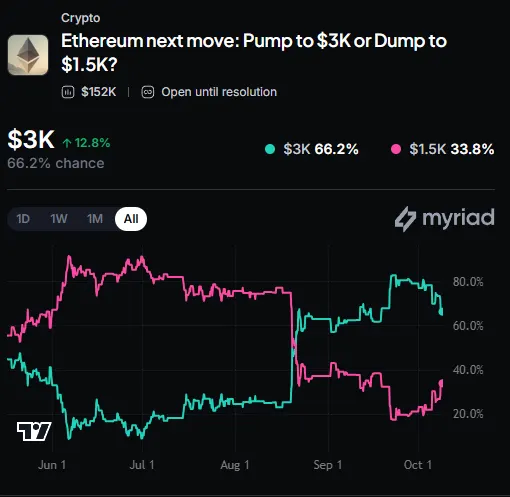
    Myriad: Where does Ethereum go next? Click to make your prediction.
    Myriad: Where does Ethereum go next? Click to make your prediction.

    Mashinsky’s other penalties

    Mashinsky was sentenced to 12 years in federal prison in May 2025 after pleading guilty to fraud charges. Prosecutors had sought 20 years. He was also ordered to forfeit more than $48 million.

    He was arrested in July 2023 and released on $40 million bail ahead of trial.

    The CFTC has permanently banned Mashinsky from trading, and he agreed to a $10 million settlement with the FTC that bars him from the crypto industry.

    Celsius creditors had received more than $3.4 billion through the company’s bankruptcy as of August 2026, according to the attorney general’s office. Mashinsky forfeited all of his claims to the bankruptcy proceeds.

    Daily Debrief Newsletter

    Start every day with the top news stories right now, plus original features, a podcast, videos and more.

  • XRP Hits New Milestone of 13M Total Agentic Payments

    XRP Hits New Milestone of 13M Total Agentic Payments

    With the total now above 13 million, he believes the network could reach 100 million payments sooner than many people in the $XRP community expect.

    $XRP Soars From 1M to 13M Agentic Payments

    XRPL recorded its first 1 million agentic transactions on July 8, 2026. By July 22, 2026, the total had reached 1.4 million, marking a 127% increase. The growth came as more AI agents began using the ledger to pay for real-world digital services and support automated tasks.

    Around that time, Akinyele predicted that XRPL would soon surpass 10 million agentic transactions. He highlighted the growing number of AI agents and improvements in blockchain infrastructure as the main reasons behind the increase. The ledger has since surpassed this mark.

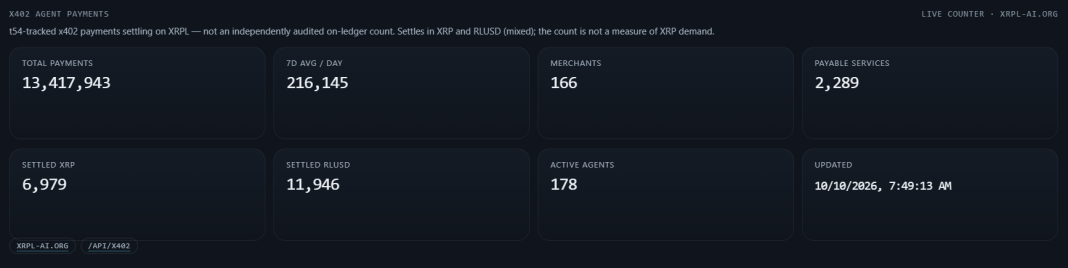
    XRPL now averages 216,145 agentic transactions per day over the past seven days. According to Akinyele, these payments account for about 25% of all activity on the network. Essentially, AI-driven payments are becoming an important part of daily XRPL activity.

    On-chain data sourced by t54 puts the total at exactly 13,417,943 payments at press time. The network currently has 178 active agents operating across 166 x402 merchants and 2,289 payable services.

    $XRP Ledger crosses the 13 million agentic payments milestone

    In addition to this, the data also records 6,979 transactions in $XRP and 11,946 transactions in Ripple USD ($RLUSD), showing that both assets have continued to support payments within the ecosystem.

    Call for Developers to Build on XRPL

    Akinyele also urged developers to take advantage of the growing activity on XRPL by building new applications. He noted that AI agents already create demand for application programming interfaces (APIs), data and computing resources.

    Developers can meet this demand by creating products that allow AI agents to access and pay for digital services automatically.

    He mentioned low transaction fees, fast settlement, and a growing set of AI development tools as major advantages for developers working on XRPL. These features could help them create products that handle automated payments without relying on traditional payment methods for every transaction.

    Ripple has also taken steps to make it easier for developers to build AI payment applications. In June 2026, the company launched the XRPL AI Starter Kit, which provides tools, documentation, and integrations for developers creating agentic payment solutions on the ledger.

    The kit supports the x402 protocol and payments in both $XRP and $RLUSD. This allows AI agents to pay for API calls, model inference, and computing resources without the extra steps involved in traditional account-based payment systems.

    How x402 Supports Agentic Payments

    The x402 protocol provides the payment standard behind XRPL’s growing agentic activity. For context, the protocol is an open, internet-native payment standard built around HTTP, which allows online services to request payments through familiar internet infrastructure.

    This supports automated payments between AI agents and service providers, including payments for data, software tools, and computing resources.

    Coinbase originally developed the x402 protocol, while the x402 Foundation, hosted by the Linux Foundation, now oversees its governance. Ripple has also joined the foundation as a Premier Member, showing its involvement in the development and adoption of the standard.

  • Brad Bird on Why He Took ‘Ray Gunn’ to Skydance Instead of Pixar: Making Animated Films for Teens and Adults ‘Shouldn’t Be a Controversial Decision’

    Brad Bird on Why He Took ‘Ray Gunn’ to Skydance Instead of Pixar: Making Animated Films for Teens and Adults ‘Shouldn’t Be a Controversial Decision’

    On a balmy April afternoon at Abbey Road Studios in London, a 74-piece orchestra comprised of violinists, cellists, flautists and even an organ-payer, is packed into Studio One. The iconic room, which has hosted musical legends from Edward Elgar to Harry Styles, is painted “Toy Story” blue, a fitting color given the reason everyone is here today is to record the score for “Ray Gunn,” a new feature animation from Pixar legend Brad Bird, the brains behind “Ratatouille” and “The Incredibles.”

    The film, which has been gestating inside Bird’s mind for three decades, is not a Pixar or Disney project, however (more on which later), but a Skydance Animation production which will hit Netflix on Dec. 18 (it premieres at the BFI London Film Festival on Oct. 10).

    Directing the orchestra at Abbey Road is Bird’s longtime collaborator, composer Michael Giacchino. “Ray Gunn” is the duo’s sixth project together since first teaming up for “The Incredibles” in 2004 and it’s one Giacchino (who won an Oscar for Pixar’s “Up” in 2010) has had more than two decades to prepare for. “We talked about this movie during ‘The Incredibles,’” the composer reveals, when we speak a few months later. “I’ve known about this for a very long time.”

    Fittingly, given the key role of music in the film, Bird first conceived the idea for “Ray Gunn” – a noir detective caper set in a “Jetsons”-style retro future – after hearing The B-52s’ song “Planet Claire.” To Bird, the tune sounded like a mash-up between the theme song to 1960s detective series “Peter Gunn” and “a ’50s monster sci-fi movie,” Bird says in an interview a day before the film’s premiere. “I went, ‘This is not “Peter Gunn.” What is this?’ And then I went, ‘It’s Ray-Gun.’ And then I went, ‘Ray Gunn: It’s a guy’s name. He’s a detective, but it’s in the future.’”

    Michael Giacchino and Brad Bird (courtesy of Netflix)

    Courtesy of Netflix

    But the idea got shelved as other projects got in the way: there was his sophomore Pixar project “Ratatouille” followed by “The Incredibles 2” and, in between, live action fare “Mission: Impossible – Ghost Protocol” and “Tomorrowland” as well as an abandoned attempt to adapt Will Eisner’s comic “The Spirit.” Bird, who describes his mind as a “big shop floor,” would come back and “tinker” with “Ray Gunn” every now and again, biding his time until he could bring it to life (the film fell through at other studios including Warner Bros.)

    It was “Mission: Impossible” that finally paved the way for what had effectively become Bird’s real-life mission: impossible. “It was [Skydance’s] second film and everybody was happy with how it turned out,” Bird says of his turn at the helm of the Tom Cruise franchise. So when the opportunity arose to pitch the studio on another idea, “Ray Gunn” was the obvious choice. (The move also reunited Bird with Pixar co-founder John Lasseter, now the head of Skydance Animation.)

    “I never pitched it at Pixar because I felt like it wasn’t in Pixar’s wheelhouse exactly,” Bird explains, referring to the studio’s reputation for catering to younger audiences than the one he’s aiming at with “Ray Gunn.” “If you put a Pixar label on it people would go, ‘Oh well, it’s meant for the same audience that these other films were meant for,’ and inevitably some of them would go, ‘Well, my little Jimmy would be unhappy at this.’”

    Bird expands on the theme, pointing out there are “10 billion animated films” for children and far fewer for teenagers and adults, despite them comprising the majority of the movie-going audience. Making animated films for them “shouldn’t be a controversial decision,” Bird says, “and yet it was always treated that way by the ministers of resource allocation [at Pixar].” (He is returning to Pixar for his next project, a third “Incredibles” movie.)

    Skydance had a different take. “My thought when [they] got involved was that that they’ll go with me on this slightly different audience tangent,” Bird says. “And here it is.” Skydance CEO David Ellison is a producer on “Ray Gunn”: was that in name only or was he fairly hands-on? “Well, he was more involved in the earlier days,” Bird says. “But he got — you know, his plate became very full.” The director is obliquely referring to Ellison’s recent battle to acquire Warner Bros. Discovery. Bird won’t be drawn on whether he thinks Ellison will stick to his promise, made as part of his bid, that Skydance will produce at least 30 theatrical films a year. “All that stuff is beyond my pay grade,” he says, sidestepping the question.

    While Skydance may have become the latest lightning rod in an increasingly polarised and under pressure Hollywood, Bird is a pragmatist. Later in our conversation, he notes that after making “The Iron Giant” he took his nascent idea for “The Incredibles” to Pixar. “The crew from ‘Iron Giant,’ a lot of them were mad at me initially because they felt like I was leaving hand-drawn [animation] and going to the sexy new CG,” Bird recalls. “And I said I don’t really care about the technology part. I’m going up to Pixar because they protect storytelling.”

    “Ray Gunn”

    Netflix

    As it happens, protecting — versus exploiting — art is one of the themes of “Ray Gunn,” which follows the eponymous private detective (voiced by Sam Rockwell) as he uncovers a dastardly plot involving Venus Nova (Scarlett Johansson), a superstar singer with a huge secret.

    For Giacchino, the trick to scoring a film filled with so much intrigue is keeping the viewer guessing. “Probably the second toughest thing was just making sure everything was always in alignment thematically, so that I didn’t give the audience something that they shouldn’t be thinking about,” he notes. (The actual toughest, he says, was an intimate scene between Gunn and Nova when they’re first opening up to each other. “It needed to really hit every single emotional beat in this perfect way,” he explains.)

    Bird may have written “Ray Gunn” almost three decades ago but it’s themes of art, technology and corporate greed resonate now as much as they did in the late 1990s. He says the screenplay changed “less than you’d think” between that first draft and the finished movie.

    “A lot of the things that people are saying that [the film] is dealing with that are contemporary right now in the headlines were in there 30 years ago,” Bird notes. “People are people and greed is greed and the flaws of people make good subject material for films. If that’s what’s driving the story, then the story’s not going to age because it’s about eternal things rather than things that were in the news last week.”

  • Stealing $1.5B in crypto is easy, cashing out is the trap

    Stealing $1.5B in crypto is easy, cashing out is the trap

    He eventually obtained information that helped him trace more than $12 million in Bybit-linked funds and, according to his account, contributed to Tether freezing 442,000 $USDT.

    His investigation led him to a network he believes laundered more than $1 billion from crypto thefts linked to the North Korean Lazarus Group, including proceeds from the Bybit attack.

    The implications of his investigations extend to a much larger market for criminal financial services that American authorities have spent the past two years trying to disrupt.

    In September, the US Treasury sanctioned Xinbi Guarantee, a marketplace it said has processed more than $24 billion in digital assets and fiat currency through its platforms since 2022, and explicitly identified North Korean hackers among the illicit actors reported to have used its services.

    Treasury also acknowledged that criminals tried to preserve their operations by moving from Huione to Xinbi after it was sanctioned, showing how removing one marketplace doesn’t eliminate the relationships and demand that supported it in the first place.

    Believe it or not, hacking an exchange and stealing funds is actually the easiest part of this crime. Converting stolen crypto into fiat or another form of real purchasing power is where it gets difficult.

    To do that, hackers rely on payment services and other shady relationships that let investigators and regulators intervene.

    The $349,700 customer

    The FBI attributed the Bybit theft to North Korean hackers on Feb. 26, 2025, identifying the activity as TraderTraitor and warning that stolen assets were being converted into Bitcoin and other cryptocurrencies before being distributed across thousands of blockchain addresses.

    While it took no time to identify the hackers, identifying the intermediaries handling the stolen money required much more investigative work.

    According to ZachXBT, he began that work when he saw more than 15 accounts in public Telegram and Discord groups seeking help with transactions tied to the stolen Bybit funds, suggesting that at least part of the subsequent laundering process involved intermediaries openly soliciting or arranging services.

    He contacted several of those accounts and eventually developed a relationship with someone using the Telegram alias Jimmy Green, who presented himself as someone who needed help moving cryptocurrency between networks.

    On March 6, 2025, ZachXBT says he funded a new Ethereum address with 349,700 $USDC and began exchanging the dollar-linked token for $USDT on Tron through the contact, accepting unfavorable exchange terms while trying to establish himself as a credible customer.

    The 349,700 $USDC represented capital committed to the transactions rather than a disclosed net investigative loss, while the 5% he says he lost on each order is the cost he was prepared to accept for access to information that ordinary blockchain analysis could not provide.

    The arrangement also carried the risk that the intermediary could just disappear with the funds.

    Hackers depend on intermediaries who might steal from them in turn, and without enforceable commercial protections, reputation and personal familiarity become especially important to keeping those relationships working.

    That gave ZachXBT a way into the operation, since a customer willing to conduct repeated transactions became more valuable to the person providing the service.

    The relationship eventually produced information beyond wallet addresses, including discussions of planned fund movements before the transactions occurred, allowing ZachXBT to compare statements made privately with activity subsequently recorded on public blockchains.

    In one instance, the intermediary discussed moving funds to Solana before the corresponding movement took place, while other exchanges and wallet connections allegedly helped identify a larger cluster of assets linked to the Bybit theft.

    This was a major turning point in his investigation, because on-chain data can’t identify the person behind the transaction or its intent. Private conversations about a transaction provided the key evidence about who controlled it and what they used it for.

    Even though ZachXBT’s investigation still doesn’t completely match the FBI’s official record, it’s still one of the most significant investigative efforts we’ve seen in a while. It showed that personal and commercial relationships can provide evidence blockchain alone can’t, and that similar tactics could help investigate and eventually resolve other thefts.

    Tracing $12 million differs from recovering it

    ZachXBT said information from his relationship with Jimmy Green helped identify a cluster with more than $12 million in Bybit-linked funds, including transactions across several networks.

    He also reported that Tether later froze 442,000 $USDT linked to the North Korean hack. This showed that quickly identifying stolen assets, while they remain accessible through issuer-controlled tokens like $USDT or $USDC, can be crucial to recovering the funds.

    The two amounts should not be confused: tracing more than $12 million does not mean the entire amount was frozen, and freezing 442,000 $USDT does not mean the tokens were seized or returned to Bybit.

    The specific 442,000 $USDT figure and its connection to ZachXBT’s investigation come from his account, although Tether has separately disclosed larger freezes tied to the Bybit theft.

    There’s a considerable distance between observing stolen cryptocurrency, identifying the people handling it, and obtaining legal or technical control over the proceeds.

    Public blockchains don’t prevent the assets from moving again, especially when they pass through services that refuse to cooperate with investigators or operate beyond the reach of relevant authorities.

    Centrally issued stablecoins create a potential intervention point because their issuers can retain the administrative ability to restrict transfers from designated addresses.

    Native Bitcoin has no equivalent issuer-controlled restriction, although authorities can still restrain assets held by custodians or seize the keys controlling them when they obtain the necessary access and legal authority.

    That leaves investigators dependent on more than tracing accuracy, since an identified balance must also remain within reach of someone who has the technical ability and authority to act.

    During Bybit’s recovery effort, court orders and cooperation from financial intermediaries could restrict assets long after the initial theft, without guaranteeing full recovery.

    The problem is that stolen cryptocurrency can become increasingly fragmented as it moves between wallets, chains, custodians, and trading counterparties, with each additional service potentially requiring another source of evidence or another legal process before the pursuit can continue.

    That’s why investigators can see where the funds traveled but have no way to stop the next transaction or recover the funds.

    $4 billion in crypto laundering

    The use of outside intermediaries isn’t limited to the Bybit theft, and American enforcement records show a longer history of attempts to identify businesses that convert stolen crypto into assets criminals can use.

    In March 2020, the Justice Department charged two Chinese nationals, Tian Yinyin and Li Jiadong, with laundering more than $100 million worth of crypto, primarily through activity connected to exchange hacks.

    These charges show how individuals who don’t carry out the hack can still play an essential role in the crime.

    The Treasury’s sanctions announcement also revealed that Tian converted nearly $1.4 million in Bitcoin into prepaid Apple iTunes gift cards, showing how laundering can eventually involve ordinary retail instruments rather than the more elaborate financial services usually associated with international cybercrime.

    The same economic requirement operates on a much larger scale through marketplaces that connect criminals with merchants offering settlement, exchange, payment and other services.

    In May 2025, the Treasury’s Financial Crimes Enforcement Network identified Cambodia-based Huione Group as a financial institution of primary money laundering concern, finding that its operations had laundered at least $4 billion in illicit proceeds between August 2021 and January 2025.

    Of that amount, FinCEN identified at least $37 million in crypto stemming from North Korean cyber thefts, along with other proceeds from investment fraud and cyber scams.

    The $4 billion figure reflects illicit activity across several crime categories, and the $37 million represents the minimum North Korean-linked component identified in the agency’s findings.

    Related Reading

    ZachXBT infiltrates $1B crypto syndicate to expose Lazarus Group

    FinCEN’s assessment also identified serious deficiencies in anti-money-laundering and customer-verification controls across the group, including an acknowledgment that inadequate checks had allowed one component to indirectly receive funds connected to a North Korean heist.

    The significance of those findings extends beyond any individual transaction because an intermediary that offers repeated access to payment services can become infrastructure for multiple criminal customers, reducing the need for each organization to build its own arrangements for converting stolen assets.

    That concentrates activity around businesses that can become targets for sanctions, seizures, restrictions on banking relationships and other enforcement measures.

    Huione’s marketplace handled a substantial volume of transactions and illicit services, and operators tried to keep operating after Telegram disrupted access to parts of the network.

    Those marketplace transaction figures and FinCEN’s narrower estimates of identified illicit proceeds measure different categories of activity, making it key not to treat all funds moving through a platform as proven criminal proceeds.

    The customers moved

    The difficulty is that a criminal marketplace can lose infrastructure without losing the demand that made its services profitable, particularly when users can still contact alternative providers.

    In June 2026, the Justice Department announced the seizure of a cloud computing account that hosted backend infrastructure used by Huione Group subsidiaries allegedly involved in moving proceeds from fraud, cyber scams and other criminal activity.

    The action followed earlier US restrictions on the group and targeted technology that supports the transfer and concealment of illicit funds.

    Removing that infrastructure doesn’t automatically eliminate relationships between customers and the intermediaries willing to serve them.

    The Treasury made that limitation particularly explicit on Sept. 9, when it sanctioned Xinbi Guarantee, describing an illicit marketplace that connected criminal organizations with merchants providing financial services, technology, and other resources needed to support their operations.

    According to Treasury, Xinbi had processed the equivalent of more than $24 billion in digital assets and fiat currency since approximately 2022, with its services primarily supporting transactions involving Southeast Asian markets.

    The scale makes the platform relevant to enforcement efforts against the broader financial infrastructure that serves criminal organizations.

    Treasury also said cybercriminals had attempted to preserve their operations by migrating activities from Huione-related services to Xinbi following FinCEN’s earlier action, with the new marketplace offering substantially similar services to an overlapping group of customers.

    The agencies described a commercial market where participants could seek another provider when enforcement made their previous arrangements less reliable.

    During the Huione crackdown, Telegram removed thousands of channels associated with Huione Guarantee as merchants moved to alternative marketplaces.

    This is why a crackdown’s success cannot be measured solely by the number of websites, accounts, or servers taken offline, since customers who still need an illicit financial service can try to rebuild access through providers that remain operational.

    The disruption still imposes costs, particularly when balances are frozen, settlements fail, or established counterparties become unavailable, but the economic incentive to move stolen funds continues as long as the underlying crime remains profitable.

    The problem for enforcement agencies is making those services increasingly expensive and unreliable across the network of potential replacements.

    Tether’s freezes push crypto laundering networks toward other payment options

    The enforcement action against Xinbi shows how financial restrictions can disrupt criminal operations while prompting the businesses involved to change their payment arrangements.

    A series of Tether freezes restricted over $45 million in $USDT across at least 22 wallets associated with Xinbi’s operations.

    The marketplace responded by telling users it would move toward USDD, a stablecoin structure that doesn’t offer the same issuer-controlled address-freezing mechanism as $USDT.

    That was an important shift because the ability to freeze a token can be valuable to investigators when suspected proceeds remain within the issuer’s administrative reach, while customers attempting to avoid those restrictions have an incentive to move toward instruments with different controls.

    The move shows how restrictions on one part of the payment system can redirect transactions toward another, requiring investigators to follow both the assets and the businesses that provide access to them.

    During the September crackdown, authorities also targeted Xinbi-linked infrastructure and restrained over $52 million in cryptocurrency, while withdrawals accelerated and competing marketplaces reportedly began restricting laundering-related merchants.

    Those developments differ from the 442,000 $USDT freeze ZachXBT attributes to North Korean hackers, since public reporting does not establish that the same addresses, participants, or funds were involved.

    Both cases show that criminal operations depend on financial intermediaries whose services can create opportunities for intervention even after the original theft is complete.

    Where a token issuer can freeze assets, the relevant exposure may be the balance held in an identifiable address. Where a marketplace serves multiple criminal groups, its vulnerability may extend to the infrastructure, merchant relationships, and settlement arrangements supporting those customers.

    Both routes can reduce the ability to move and use stolen money without additional cost or risk.

    People behind the transfers are harder to replace

    ZachXBT’s investigation made an impact because he described how a paid relationship produced information about the people arranging the transactions.

    Criminal intermediaries who repeatedly handle stolen cryptocurrency develop a commercial reputation, establish preferred counterparties, and learn which services can complete transactions without interfering with the proceeds.

    Those relationships can make an operation more effective over time, especially when customers need to move large amounts of money without revealing their identities or risking that a counterparty will keep the assets.

    However, they also create dependencies that are hard to replicate quickly when an established provider disappears, especially if alternatives charge higher fees, reject suspicious funds, or prove less reliable.

    Those dependencies also provide investigators with another source of evidence because a service provider can reveal what it knows about future transactions, other participants, and the payment infrastructure required to complete an order.

    Investigators still need to test the information against observable activity and other records, and the fact that an address receives funds connected to a theft does not establish the recipient’s intent or knowledge.

    But comparing private communications with subsequent blockchain movements can narrow that uncertainty in ways tracing transactions alone cannot.

    The broader enforcement record points out that making criminal financial services less attractive requires more than periodically taking down their websites, because the customers and commercial incentives supporting those services can outlast the equipment used to deliver them.

    Seizing assets, restricting financial access, prosecuting service providers, and identifying the people who control settlement arrangements can change that calculation, though the point at which those costs outweigh revenue from serving illicit customers will differ across businesses.

    This is also why the dollar value of a cryptocurrency theft cannot automatically be treated as money successfully converted into spendable revenue for the responsible government, much less as a verified amount used for any particular military or state expenditure.

    The original theft, the amount moved through intermediary addresses, the value successfully converted into other forms of purchasing power, and the amount ultimately recovered by authorities are separate measures that require separate evidence.

    For North Korean hackers, relying on laundering services adds risk after the initial intrusion succeeds, since gaining control of stolen assets doesn’t eliminate the need for others to accept, exchange, and ultimately spend them.

    ZachXBT’s reported infiltration shows how that requirement can turn a customer relationship into an investigative opening, while the US actions against Huione and Xinbi demonstrate how the surrounding businesses can become enforcement targets even when criminal customers attempt to migrate elsewhere.

    The essential weakness is that stealing cryptocurrency and using it in practice are different, and the second still depends on commercial arrangements whose participants have assets, reputations, and financial interests to protect.

    North Korean hackers’ efforts to make that money spendable can still pull them back into relationships that require trust, and the people providing it have something to lose.


  • Does This $32M Whale Know Where Bitcoin’s Price Goes After $82.5K

    Does This $32M Whale Know Where Bitcoin’s Price Goes After $82.5K

    The Date Matters Here

    On Oct. 10, 2025, crypto suffered its largest liquidation event on record, with many calling it bigger than LUNA, COVID and FTX. One market tracker tallied that bitcoin’s market cap has fallen from $2.43 trillion then to about $1.72 trillion now.

    Bitcoin’s price tells the same story as the asset is currently changing hands near $82,754, about 34% below its $126,080 all-time high. The past week has been rough as Bitcoin.com News reported that $BTC’s price dropped below $81K on Oct. 8 as liquidations topped $1.1 billion, before it bounced back to $83K a day later.

    Lastly, earlier this week, Bitcoin.com News flagged two linked wallets carrying $1,58 billion in shorts, and the analysts tracking them noted the bets could offset positions held elsewhere. In any case, Hyperliquid’s $BTC market carries about 38,040 $BTC in open interest, so this whale controls roughly 1% of it. That is meaningful, but will not move the market alone.

    The Crowd on the Other Side

    A Coinglass liquidation map shared by Bitcoin Archive late Friday showed roughly $3.3 billion in shorts stacked between the current price and $85,000. If bitcoin rallies through that zone, forced buybacks could add fuel, which is exactly what bears do not want on a weekend with thin liquidity.

    Bettors are not leaning bullish either, as Polymarket’s year-end price market gives bitcoin a 27.5% chance of touching $100,000 by Dec. 31. Institutional flows are mixed, with spot bitcoin exchange-traded funds (ETFs) taking in a modest $21.13 million on Oct. 9, led by Blackrock’s IBIT, after nearly $1 billion left over the prior two sessions.