Author: rb809rb

  • Shailene Woodley Was Crushed When She Found Out Her Scenes in ‘Amazing Spider-Man 2’ Were Cut: The Role of Mary Jane Was ‘My Dream’

    Shailene Woodley Was Crushed When She Found Out Her Scenes in ‘Amazing Spider-Man 2’ Were Cut: The Role of Mary Jane Was ‘My Dream’

    More than 12 years later, Shailene Woodley has opened up about her disappointment in finding out that her part in “The Amazing Spider-Man 2” opposite Andrew Garfield didn’t make the final cut.

    Woodley, in a recent interview as part of the “SAG-AFTRA Foundation Conversations” series with actors about their craft, revealed that she found out a year after filming for “The Amazing Spider-Man 2” that she would not appear in the movie, which was released in theaters in May 2014.

    “That was a fun phone call,” Woodley recalled.

    She said that being cast as Mary Jane Watson in the movie by director Marc Webb “was my dream because I really, oh my god, Spider-Man’s my favorite superhero. Mary Jane was my favorite character growing up. So, when I got it, I was like, ‘This is so exciting.’”

    Woodley said she filmed “like three scenes together, me and Andrew Garfield. And then like a year later, they were like, ‘So, you’re not in the movie anymore.’ And I was like, ‘What? What do you mean?’ And they were like, ‘We’ve introduced a lot of new characters in this last one, and we’re going to wait for… whatever happens between [Emma Stone’s character, Gwen Stacy, who is Peter Parker’s girlfriend in the film] and Andrew.” (Spoiler: Gwen Stacy dies in “The Amazing Spider-Man 2.”)

    Woodley said she was also told, “’Let’s wait for [Gwen Stacy] to die and then we’ll introduce Mary Jane.’ Which made sense. But then they didn’t make that film.”

    Apparently, the filmmakers decided to axe Mary Jane from the movie because they thought it was confusing to have the character as another love interest to Peter Parker. “Well, that’s what I was told, you know,” Woodley said. “But again, who knows what the truth is. I could have been terrible and they’re like, ‘We can’t do this.’”

    In 2014, at the New York premiere of “The Amazing Spider-Man 2” (which featured a Mary Jane-themed cocktail), producer Matt Tolmach told Variety this about the deletion of Woodley’s scenes: “We bit off more story than we could tell. We had a 148-page script. We were in the middle of that, and we realized this story [with Mary Jane] is not going to be in this movie.”

    In Sam Raimi’s Spider-Man movie trilogy, the role of Mary Jane was played by Kirsten Dunst opposite Tobey Maguire.

    In Woodley’s nearly 90-minute “SAG-AFTRA Foundation Conversations” interview, she also spoke about her performances in “Divergent,” “Dumb Money,” “The Descendants,” “The Fault in Our Stars,” HBO’s “Big Little Lies” and Season 2 of Hulu’s “Paradise.”

    You can watch the full interview here:

  • New York Warns of Fake Crypto and AI as Scam Losses Hit $8 Billion

    New York Warns of Fake Crypto and AI as Scam Losses Hit $8 Billion

    Investment Scam Losses Rise 38%

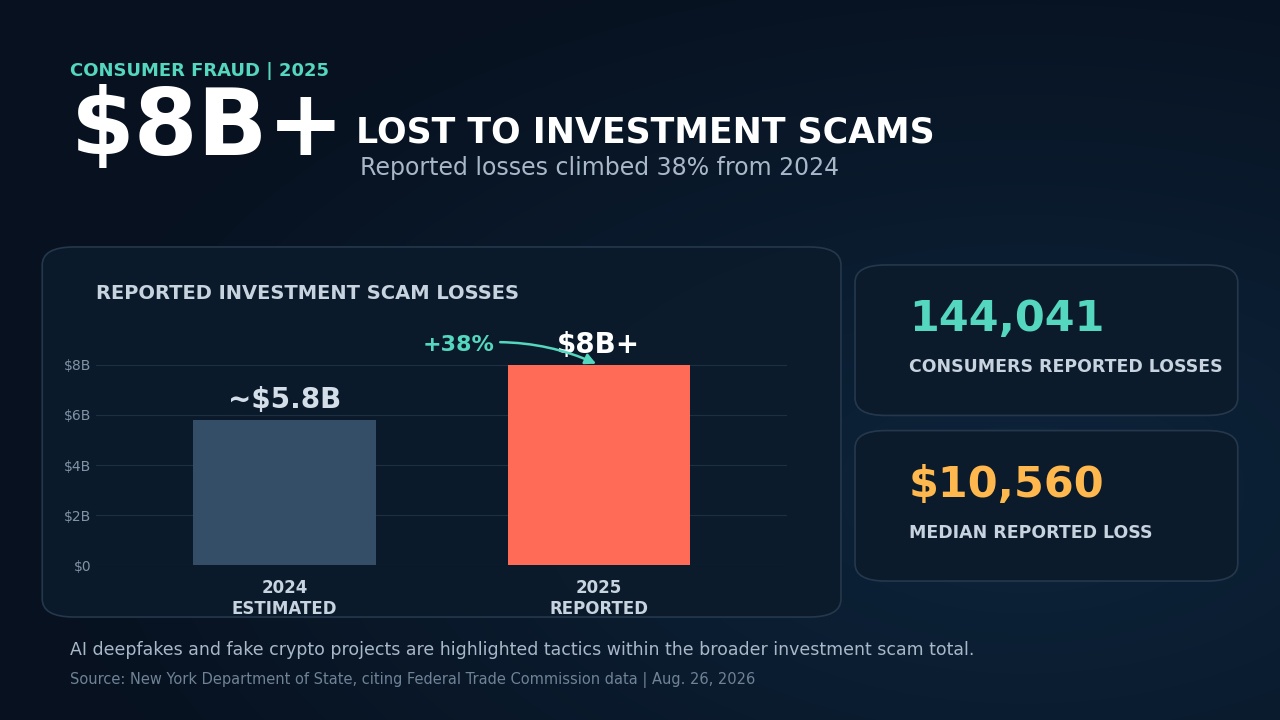
    Investment scams became the costliest fraud category tracked by the Federal Trade Commission in 2025, according to New York officials. The state’s Division of Consumer Protection issued an AI investment scam warning on Aug. 26 after 144,041 consumers reported losing more than $8 billion, a 38% increase from 2024. The median reported loss reached $10,560.

    The schemes can begin through social media, dating apps, text messages, emails, online advertisements, or apparently friendly conversations. The FTC’s own April consumer alert put the same 2025 total at more than $7.9 billion, with a median individual loss above $10,000. That agency listed cryptocurrency alongside stocks and forex among the investments scammers pitch through fake coaching offers.

    Secretary of State Walter T. Mosley cautioned:

    “New Yorkers need to be vigilant against scammers, who may be able to create increasingly sophisticated and realistic messaging using AI technology or other means to steal your hard-earned money. If it seems too good to be true, it probably is.”

    Reported investment scam losses exceeded $8 billion in 2025, up 38% from 2024, while the median reported loss reached $10,560. Chart generated by Bitcoin.com News using New York Department of State figures citing Federal Trade Commission data.

    AI Deepfakes Promote Fake Crypto Investments

    Artificial intelligence allows fraudsters to clone voices, fabricate videos, impersonate financial figures, and produce polished social media advertisements. An April warning from New York Attorney General Letitia James described schemes involving deepfake celebrity endorsements, fraudulent cryptocurrencies, pump-and-dump operations, and fake trading platforms promoted across Facebook, Instagram, and Whatsapp.

    Victims may encounter professional-looking applications that display fabricated balances, returns, and trading activity. Some operators permit small initial withdrawals to establish credibility before pressing targets to deposit larger amounts. Similar tactics have appeared internationally, with Australian regulators recently dismantling 3,106 fraudulent cryptocurrency investment platforms during the 2026 financial year as AI-generated endorsements became increasingly difficult to distinguish from authentic promotions.

    Fake Platforms Build Trust Before Demanding Fees

    A separate Australian case showed how organized groups build an entire fake internet around a crypto investment that does not exist. Investigators detailed counterfeit trading platforms, fabricated news articles, and chatbots posing as support staff, deployed before a woman lost nearly $74,690. Operators may then ask for additional fees before releasing funds, which New York’s alert tells consumers never to pay.

    New York officials advised consumers to confirm the identity of any promoter, verify the company and investment, and establish where their money will go before transferring funds. Common crypto scam warning signs include guaranteed high returns, unsolicited investment offers, high-pressure sales tactics, and projects lacking clear documentation. Anyone who suspects fraud should stop sending money immediately and report it to the FTC, the FBI’s Internet Crime Complaint Center, the SEC, or the New York Attorney General.

  • What’s in the US-Venezuela ‘biggest oil deal in world history?’

    What’s in the US-Venezuela ‘biggest oil deal in world history?’

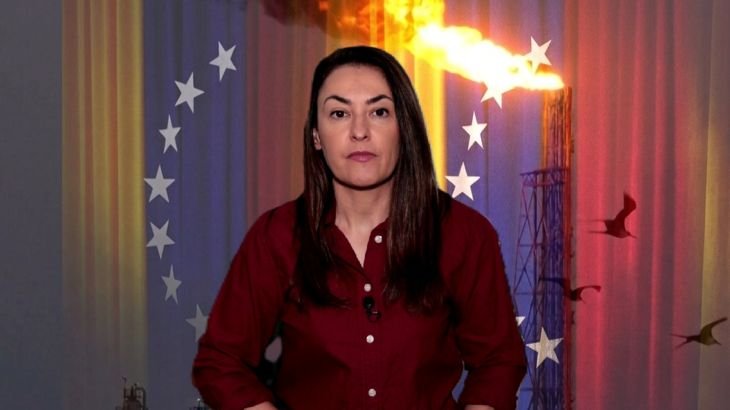
    US President Donald Trump has claimed the US and Venezuela have reached the ‘biggest oil deal in world history’, which will give the US control over 65 billion barrels of Venezuelan oil. Critics say it’s predatory. Soraya Lennie explains what we know.

  • Hyperliquid’s $249B volume lead – Can HYPE survive the crowd it created?

    Hyperliquid’s $249B volume lead – Can HYPE survive the crowd it created?

    Hyperliquid [$HYPE] is unstoppable, but markets rarely stay that simple. Behind the strong exterior, things are looking shaky.

    Here’s why.

    Hyperliquid is now in a league of its own

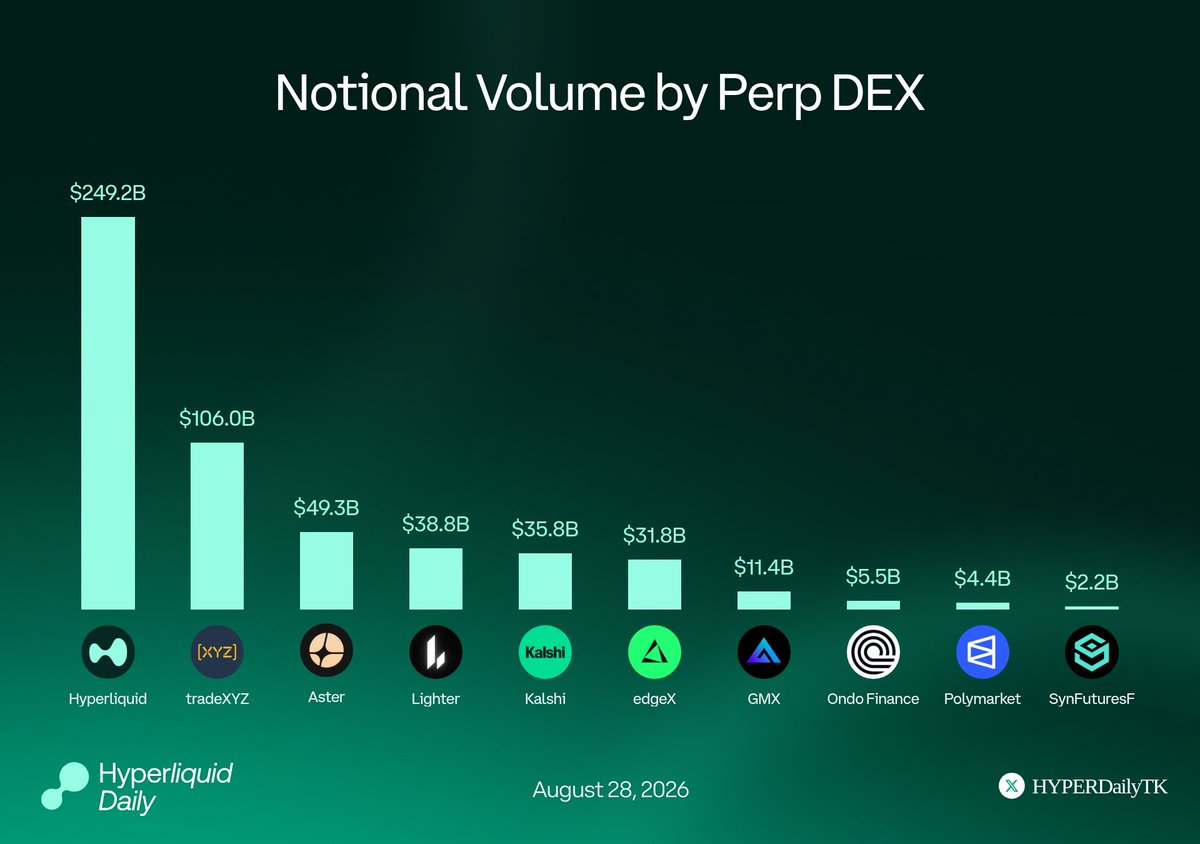
    Hyperliquid’s notional volume is at $249.2 billion. That’s more than double the $106 billion recorded by its nearest competitor, TradeXYZ.

    The gap only gets wider from there.

    Source: X

    Aster was at $49.3 billion, while Lighter, Kalshi and edgeX are all below $40 billion.

    LIquidity tends to attract even more liquidity, and that becomes self-reinforcing real quick. More volume brings deeper markets, and in turn, more traders.

    Hyperliquid Strategies turned $HYPE into a big balance sheet bet

    It’s not just the traders who believe.

    Nasdaq-listed Hyperliquid Strategies more than doubled its $HYPE treasury to 29.3 million tokens. They were worth $1.9 billion at the end of the fiscal year on June 30.

    The company raised $647 million through equity financing. Since then, it has deployed another $773.4 million to buy 16.5 million $HYPE tokens.

    That is a sizeable commitment to a single ecosystem. Most of those tokens are also being staked, so those assets are being put to work for more yield.

    Too many traders on one side?

    Now, it’s not all sunshine and rainbows. We have too many traders leaning the same way.

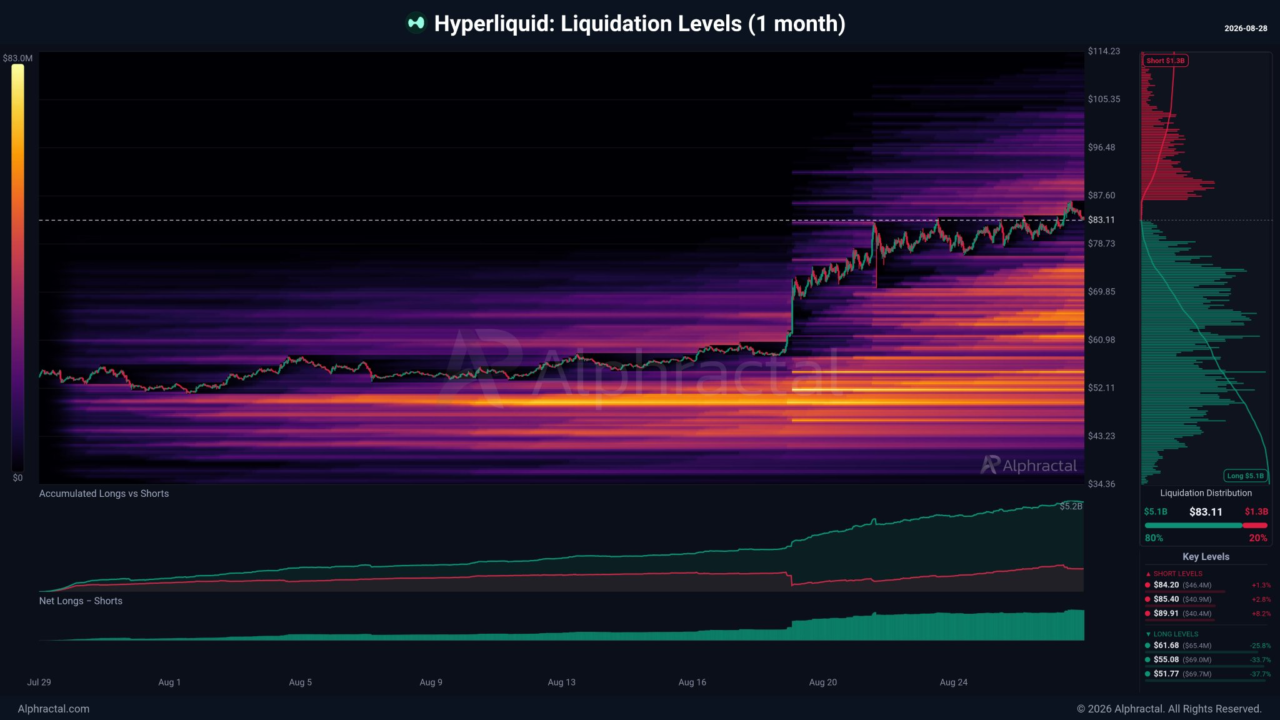
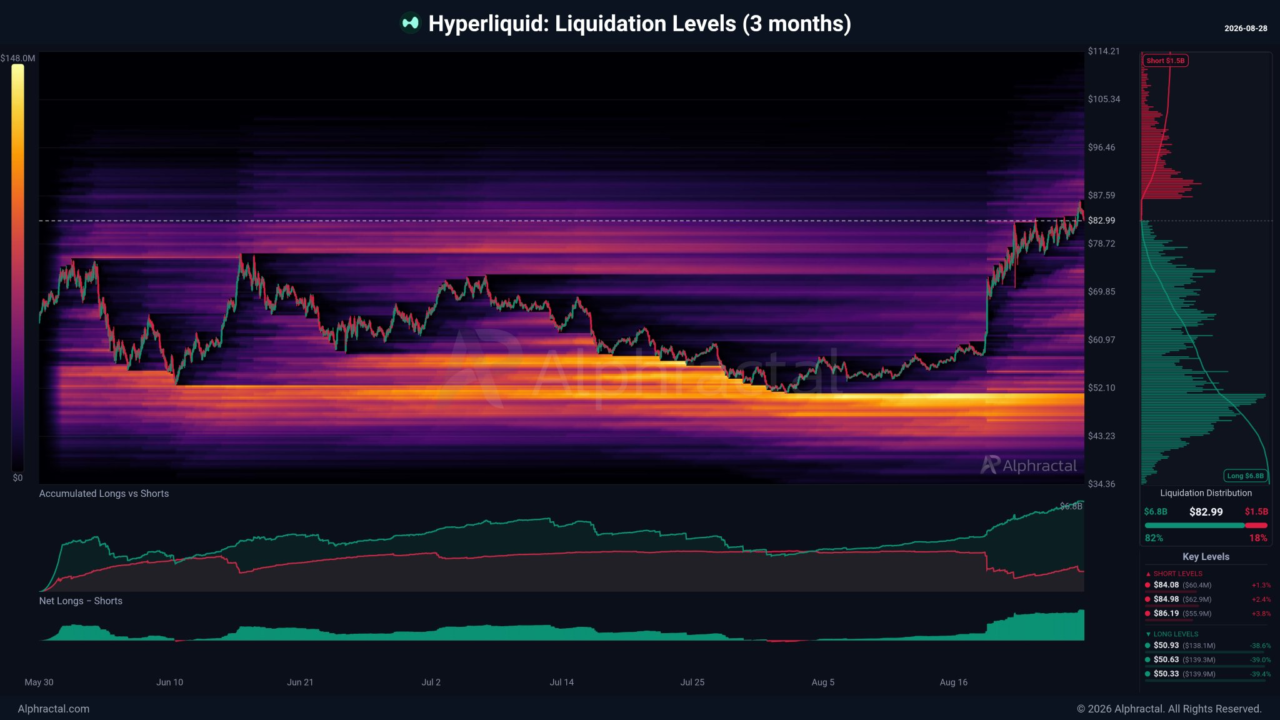
    Over the one-month liquidation window, about 80% of liquidation exposure is on the long side, versus 20% on shorts.

    Source: Alphractal

    It’s a lot more stretched at three months: 82% longs and 18% shorts.

    Source: Alphractal

    According to Joao Wedson, CEO of Alphractal, that imbalance may be dangerous.

    A price decline appears to be the more likely scenario.

    The concern is that $HYPE’s success pulled too much bullish positioning into the market. The short-term structure is going to punish late buyers.

    Will we survive a shakeout?

    The next move may matter less than it first appears.

    If $HYPE holds this level, it could be strong enough for another move higher. If too many long positions start closing, price could fall to the lower liquidity levels.

    A yellow fork in the road that’s worth watching.

    Final Summary

    • Hyperliquid leads perp DEX volume; Hyperliquid Strategies holds about $1.9B in $HYPE.
    • If bullish positioning unwinds, things could go south quick.
  • Bernie Sanders, AOC join marchers in Washington to ‘defend the vote’

    Bernie Sanders, AOC join marchers in Washington to ‘defend the vote’

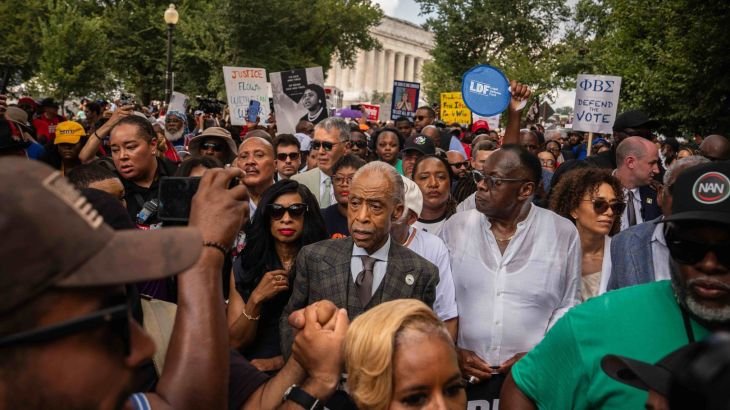
    Thousands of people marched on Washington DC, invoking Martin Luther King Jr.’s legacy on the 63rd anniversary of his ‘I have a dream’ speech, warning that voting rights and other civil liberties are under threat.

  • Jelly Roll Clarifies Political Views, Regrets Not Taking “Opportunity to Speak Up” at Grammys

    Jelly Roll Clarifies Political Views, Regrets Not Taking “Opportunity to Speak Up” at Grammys

    Jelly Roll is ready to speak out about his political beliefs.

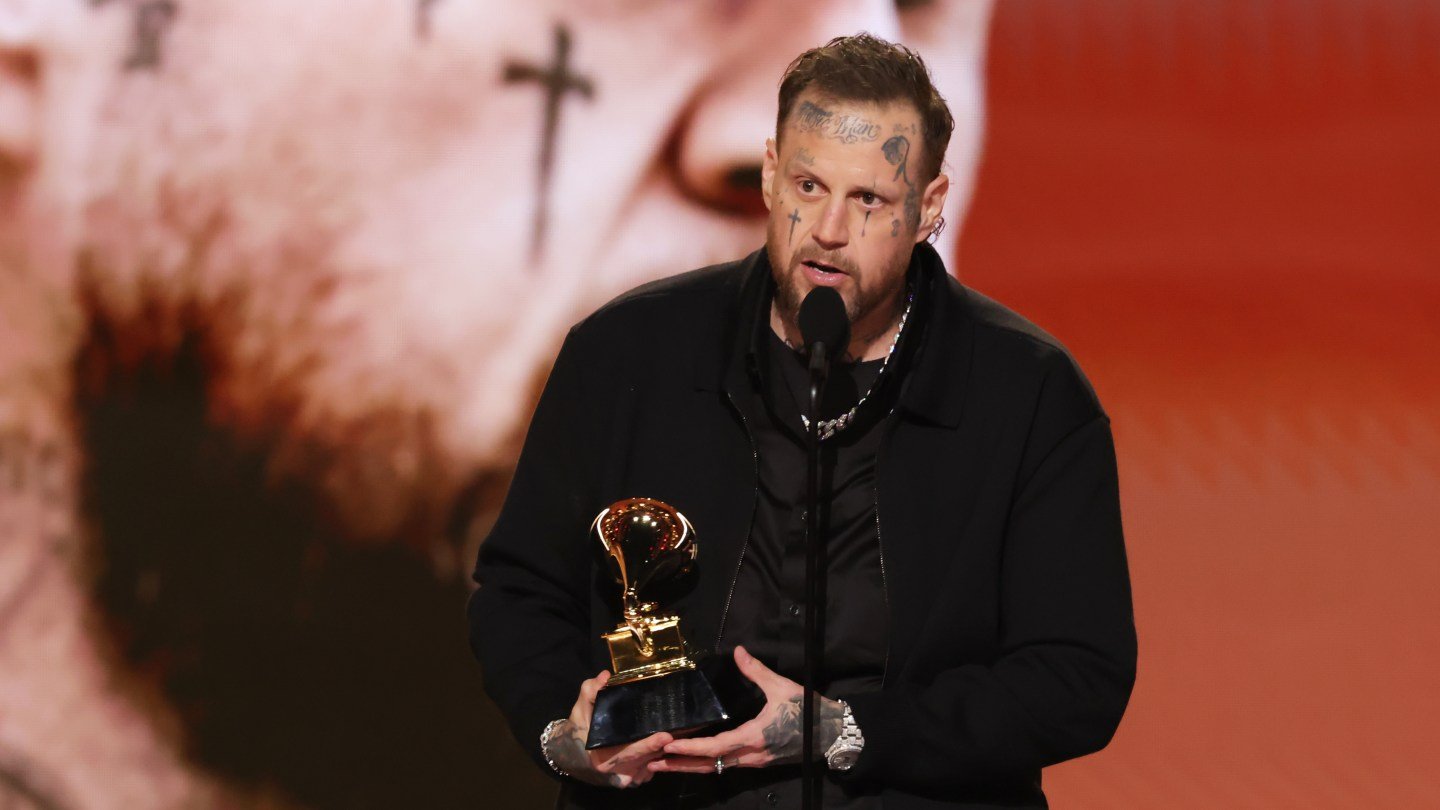
    Months after he declined to get political at the 2026 Grammys, the singer-songwriter opened up about his views on Thursday’s Jimmy Kimmel Live!, which he’s been guest hosting this week while Kimmel’s been on his summer hiatus.

    Earlier in the week, he made a number of jokes about Donald Trump in his monologue, which sparked backlash from some conservatives.

    Thursday night, he shed more light on his political views.

    “It is funny that before this week everybody thought I was MAGA. And now they think I’m some sort of liberal snowflake,” he said. “Hosting Jimmy Kimmel’s show doesn’t mean I have all of Jimmy Kimmel’s politics. Sure, I lean left on some things, but like most folks I’m pretty down the middle.”

    He added, “I am a Christian. I am a country music singer. I’m a farmer. I’m a bow hunter. And most of the things I eat, I prefer to get with a stick and a string. That’s the truth.”

    He went on to say that his beliefs are “simple” and that he wants those who are struggling — including a “recovering addict,” a “felon who is trying to change his life” and a “single mama working a double hard for her family”— to feel seen.

    And he expressed regret for not sharing more about his ideology when he won three Grammys earlier this year.

    “That night at the Grammys, I had an opportunity to speak up for people who were scared, hurting and felt like nobody was speaking for them. I had a microphone and I didn’t use it the right way,” he said. “So I am going to try to do the right thing right now because human dignity isn’t Republican nor Democrat. Compassion isn’t left wing and mercy isn’t right wing. Pain and healing know no partisanship. Hurting hearts are more important than poll numbers. And there are no boundaries or borders for broken families.”

    During his acceptance speech for best contemporary country album, Jelly spoke passionately about his faith and urged people to find Jesus.

    “There was a time in my life, y’all, when I was broken. That’s why I wrote this album. I didn’t think I had a chance y’all,” he said in part. “I was a horrible human.” He reflected on how music and his faith helped him find his way out of the darkness: “I believed that music had the power to change my life and God had the power to change my life.”

    In closing, he added, “Jesus is for everybody. Jesus is not owned by any one political party. Jesus is Jesus. Anybody can have a relationship with him. I love you Lord.”

    But backstage he refused to open up about his political beliefs, despite numerous artists condemning ICE onstage that night.

    “People shouldn’t care to hear my opinion. I’m a dumb redneck,” he said at the time. But he vowed that he would open up about his beliefs eventually.

    “I have a lot to say about it … and everybody’s going to hear exactly what I have to say about it the most loud and clear way I’ve ever spoken in my life,” he added.

    Thursday night he called his Grammy wins the “greatest honor” and the fulfillment of a childhood dream.

    “And immediately after, I was asked to make what I felt at the time was a political stance,” he said. “I was afraid that anything I was going to say was going to be immediately taken as a political statement. And, ironically, by trying so hard not to make a political statement, I became one.”

    He added, “For the last six months, I’ve watched people decide who I am, what I am, what I believe, what I support and what I don’t support. And I felt that even more this week, just because I told a couple of jokes.”

    Instead, Jelly said, he should’ve said, “[Jesus] gave us two commandments. ‘Love God with all your heart and love your neighbor as yourself.’ … There wasn’t a political party exemption. It did not require us to know what country you were born in. There wasn’t a sentence afterward that said, ‘Unless you’re afraid of them.’ It just said, ‘Love your neighbor.’”

    The former convicted felon, who was pardoned in December, said that now that he’s had his right to vote restored, he plans to make his voice heard in the midterm elections this year.

    He said he “would never be so afraid of being called political again”

    And he urged people to come together: “We may disagree. We may argue. We may vote completely. But let’s try not to let the couple of things we disagree about forget the hundreds and hundreds of things we have in common.”

  • California Tries Offering Hollywood New Perks to Make Up for Catch in $750 Million Incentive Program

    California Tries Offering Hollywood New Perks to Make Up for Catch in $750 Million Incentive Program

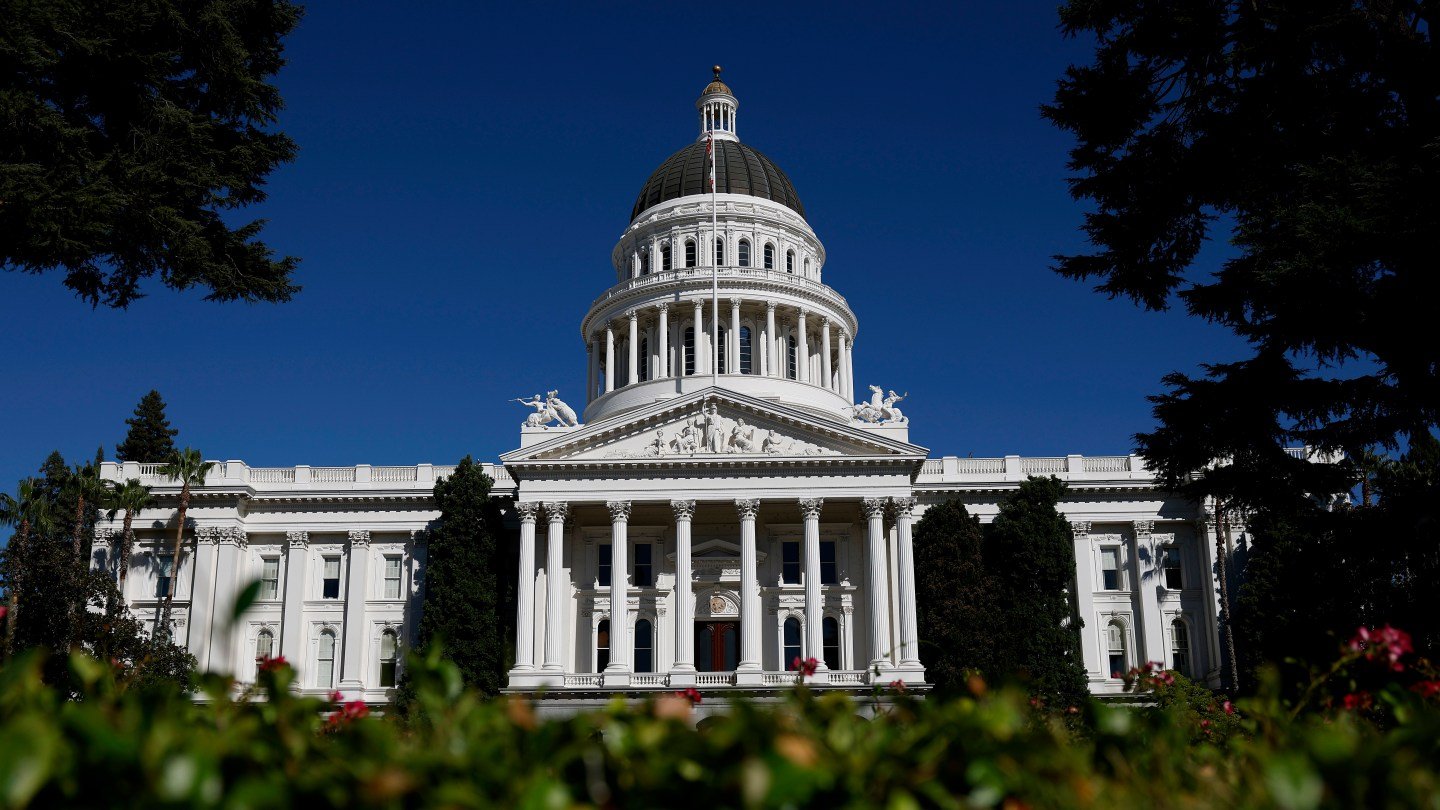
    After failing to secure an exemption for the entertainment industry, stakeholders have made a last-minute proposal to mitigate the impact of California‘s new business tax credit regulations on Hollywood.

    State Assemblymember Rick Chavez Zbur and Senator Ben Allen on Friday introduced AB/SB 186, which if passed would exempt indie projects from the state‘s new business tax credit caps and allow all productions with state tax credits to monetize more of their refunds, faster.

    “Last year, we took action to get families back to work and jumpstart the State’s film and television industry,” Senator Allen said in a statement. “However, we’re at risk of losing this momentum, and all the jobs we’ve created over the last year, if we don’t act by the end of the month. I’m grateful for the support from Governor Newsom, Assemblymember Zbur and the legislative leadership to help us find a path forward that will retain California’s status as the global hub of entertainment.”

    Stakeholders say a state budget bill that was signed into law on June 29 has jeopardized the celebrated increase to California‘s film and television tax credit increase to $750 million in 2025. That 2025 boost to the program, the result of some serious lobbying from Hollywood, more than doubled the amount of funding that could be allocated to giving productions tax relief.

    But budget bill SB 122 threatened its viability by extending previously temporary caps on the use of business tax credits over $5 million a year. The budget bill also made the ceiling on using credits over $5 million a year, or 70 percent of a taxpayer’s liability, whichever is greater, permanent starting in 2030.

    The new trailer bill wouldn‘t give major productions a pass from these caps, but it would enhance the perks for productions that choose to monetize a portion of their tax credits rather than put them towards their tax liability. (The ability to monetize a portion of the tax credits is relatively new, having been signed into law in 2025). The bill allows production to monetize 95 percent of their refund, as opposed to the previous 90 percent, and speeds up the collection period from five to two years.

    The bill additionally would push back the expiration date for credits earned before 2025‘s changes to the program for productions actively shooting in California. Productions recently awarded California tax credits would have 15 years to use them, rather than the previous nine.

    The trade organization for major studios and streamers, the Motion Picture Association, supports the bill alongside the Entertainment Union Coalition and the Producers Guild of America.

    The introduction of AB/SB 186 follows a major lobbying campaign from unions and the MPA, as well as a letter-writing campaign from union members, to oppose the inclusion of the entertainment industry in the business tax credit caps. As of August 14, some 350,000 letters had been sent to legislators airing industry members‘ concerns about what the state budget bill could mean for production in the state.

    While Zbur and Allen‘s bill addresses concerns over productions realizing the full value of their credits, it may not do much to restore trust in policymakers‘ approach to the state‘s film incentives program. Stakeholders have expressed concern that the sudden change to the program implemented this year could scare companies seeking stability and certainty as they make long-term production plans.

    Now, legislators will have to scramble to pass the bill before the legislative session adjourns on August 31.

    “I’m pleased that we have identified a path forward that would help protect the progress we’ve made to strengthen California’s film and television industry,” Assemblymember Zbur said in a statement. He added of the bill, “It does not address every challenge facing this highly competitive and mobile industry, and there is more work to do in the coming months, but this is an important step toward ensuring film and television remain a cornerstone of California’s economy.”

  • California Lawmakers Settle on Partial Film Carveout From Tax Credit Cap

    California Lawmakers Settle on Partial Film Carveout From Tax Credit Cap

    California lawmakers have agreed on a partial carveout for the film and TV industry from a state cap on tax credits.

    The bill, AB 186, was unveiled on Friday evening. It addresses concerns raised in June by the Motion Picture Association and a coalition of entertainment unions, who argued that the cap threatened to undermine the state’s $750 million tax incentive program.

    The state budget seeks to stabilize revenues by preventing corporations from claiming more than $5 million a year in tax credits for the next three years. Industry stakeholders argued that the measure had the unintended consequence of hamstringing Hollywood’s recovery by limiting the ability of studios to use state incentives for in-state production.

    The MPA and the Entertainment Union Coalition have signed on to the agreement. As Variety reported on Aug. 18, the deal falls short of their request for a complete exemption for film tax credits from the $5 million cap.

    Instead, the legislation will accelerate the payback period for studios that elect to refund their credits for cash. Under existing law, studios can choose to get cash back instead of claiming the incentives as a credit against tax liability — but at the cost of a 10% discount, with a payback period of five years. The deal will accelerate that period to just two years and reduce the haircut to 5%.

    The agreement also fully exempts credits for independent film — which account for 10% of the $750 million program — from the cap.

    “It meaningfully improves the situation,” said Kathleen Thompson, vice president of tax incentives at Cast & Crew, a production services company. “They threw a bone to both the studios and to independents.”

    The deal also extends the expiration date of non-refundable tax credits issued prior to 2025 by up to five years. That provision is meant to help studios that are still sitting on millions of dollars of old, unused credits, and were at risk of having them expire after nine years.

    The bill is authored by Sen. Ben Allen and Assemblyman Rick Chavez Zbur, who also wrote the bill that increased the incentive program to $750 million last year. In a statement, Zbur said that the fix will provide “greater stability and certainty” for production workers.

    “It does not address every challenge facing this highly competitive and mobile industry, and there is more work to do in the coming months, but this is an important step toward ensuring film and television remain a cornerstone of California’s economy,” Zbur said.

    The deal is almost identical to an earlier version that circulated in Sacramento last week. A fact sheet accompanying that version said that it would “mitigate some of the impacts” of the tax credit cap. The only significant difference that a provision to make it easier to claim credits against sales tax — which had been sought by studios — was dropped.

    The compromise is the result of complex negotiations among industry unions, studios, legislative leaders and the office of Gov. Gavin Newsom. State leaders resisted an industry-specific carveout because it would have led to calls for similar consideration for the tech industry.

    The bill must be approved by both houses by midnight on Monday, and is expected to do so.

  • Zak Starkey and the Who Have Kissed and Made Up, as Rehearsal Reunion Is Revealed

    Zak Starkey and the Who Have Kissed and Made Up, as Rehearsal Reunion Is Revealed

    Apparently the deep and much-talked-about rift between the Who and former (and future?) drummer Zak Starkey was not quite a hell-freezes-over situation after all. Starkey, who was famously revealed to have been unceremoniously handed his walking orders in April 2025, is now back with Roger Daltrey and Pete Townshend … or at least he has rehearsed with them in advance of expected future dates.

    Both Daltrey and Starkey have made public statements announcing and confirming the somewhat surprising musical reconciliation. Representatives for both Starkey and the Who confirmed to Variety that the respective statements are accurate.

    In a solo gig at the Encore Theater in Las Vegas on Wednesday night, Daltrey informed the audience had recently done a rehearsal with Starkey and “it sounded great,” according to a review of the show the next day in the Las Vegas Journal-Review.

    That this was coming direct from Daltrey was especially unexpected, since the singer had been perceived by much of the public as the surviving member who was most aggrieved by Starkey,’s playing or behavior, although Daltrey went on in interviews to suggest that he was being made into a fall guy for a somewhat unpopular decision that was not his alone.

    And then, sure enough, Starkey — who had played with the band for 30 years and made it abundantly clear that he would welcome being invited back — confirmed that what Daltrey had said was true.

    On social media. Starkey, who is the son of Ringo Starr, posted a screenshot of the relevant paragraph from the Las Vegas newspaper review, and then added his caption: “Nice one Rog x. Lookin forward to tearin it up with The Who again..The rehearsal was great.. I don’t think we’ve ever rehearsed as tough as that .. usually we drink tea and talk about what time we’re going home!”

    Then Starkey made a more formal statement, given to Variety, further establishing his zeal for the reunion: “We rehearsed for an afternoon and were absolutely on fire,” the drummer wrote. “I’m so happy to be back playing the music I love with people I love. It’s good to be home.”

    If you’re asking yourself “Didn’t the Who do a farewell tour last year?,” the answer is, that was a U.S. farewell tour the band wrapped up last October, with Starkey having gotten the boot before it started. But that didn’t mean the group wasn’t still prepared to make one last swing around other parts of the world, or even to do one-off concerts in the States.

    “It’s not over by any means,” Daltrey told the Arizona Republic about the Who, while publicizing his solo tour. “It’s just that was the last tour of America for the Who.” The singer mentioned to that interviewer that the group had recently done a rehearsal to make sure they were properly ready to do a farewell tour in Europe, without mentioning at that time that Starkey had taken part in the rehearsal, if indeed it is just one rehearsal that has taken place so far.

    The exact reasons for Starkey’s dismissal have been clouded, with some deciding that it must be due to an on-stage dispute between Daltrey and Starkey over their lack of being in sync during the band’s first-ever performance of “The Song is Over,”, while intimates of the group suggested that the real reasons for a split had to do with other factors. In interview after he was let go, Starkey insisted that he didn’t understand what had happened, even while pointing out that he was still in regular contact with both Daltrey and Townshend.

    In July 2025, Starkey did an interview with Variety in which he cheekily declared, “I’m the most famous drummer on welfare.”

    He said that when he was sacked, he had been asked to say that it was his decision to quit, which was not acceptable for him. ““I’m not a rock star and they are,, but I’m not gonna let people… make me look fucking bad and them look good because they want me to lie,” he told Variety then. “I wouldn’t do it… and then when they did it, I just threw ‘em under the fucking bus because it was bullshit. And then my dad stepped up for me, and that was the greatest thing in the world.”

    He elaborated: “I didn’t really enjoy being treated like that at all, because (Daltrey) is my friend, but he was wrong. And Roger is one of them guys that, once he’s made his mind up, there ain’t going back. And I couldn’t believe the amount of support that happened. And then, how many times do you get fired twice?”

    Of reconciliation prospects, Starkey then said, “I feel like anything could happen, but if it doesn’t, I’m cool with it, man. … The weirdest thing was, the day before I got sacked the last time, I’d done an interview with the Sunday Times and I said, “’t’s a vocation, man, being in the Who — it’s not a job. It’s like being a nun, or a nurse.’ And 12 hours later after that, I was fired. It’s so fucked up. But actually, it’s so funny, isn’t it? That’s what’s great about it. It’s funny as well as fucking insane. … If it doesn’t come back together, then it doesn’t come back together. But wow, what a great 29 years, man. I’d like to make it 30. Whatever it is, it would be great, just because them two guys are in it.”

  • Sara Bareilles Sings About Loss — and It’s Our Gain — in the Beautifully Bittersweet ‘Good Grief’: Album Review

    Sara Bareilles Sings About Loss — and It’s Our Gain — in the Beautifully Bittersweet ‘Good Grief’: Album Review

    Well, just how good can grief be? That’s a question raised by Sara Bareilles‘ “Good Grief,” which, true to its promissory title, deals primarily with loss and death and the kind of tough stuff that folks in a marketing meeting might suggest slightly downplaying when one is releasing one’s first studio album in seven years. If that focus sounds like it could make for a slog, Bareilles — who was prompted to go down this path by the death of her decades-long best friend — is very much into finding ways to celebrate as well as mourn, or at least actively explore how those two polarizing impulses might intersect. But apart from that, there’s the matter of just how awfully spirit-lifting her earth-angel mezzo-soprano tends to be, even when backing herself into dark corners before backing her way back out again. All of which is to say: Music lovers could not ask for a better bereavement counselor.

    Not one to put off dealing with the elephant in the room, she concentrates several of the songs most overtly tied to her friend’s death from cancer in the first third of the album. Counterintuitively, perhaps, this is where some of the most joyful-sounding material is found too. Bareilles starts off with “Home,” which approaches the subject matter from a different angle, paraphrasing bits of a conversation she saw Stephen Colbert and Anderson Cooper share on television about their own experiences with grief, and how for many of us it gets emotionally brushed under the family dinner table: “I was taught to bury with the dead / The presence of my grief / I see it now, but didn’t then / That silence is a thief / It made strangers out of friends / Robbed me of saving graces offered in unlikely places.”

    The second number, “Just Kids,” is where she begins to bring her own experiences with loss in, going in completely on her late BFF, college bestie and former tour manager Chad Joseph, finding some wryness in the details — “You never got to get married and I hate where you’re buried” — yet a weird exultation in writing about him in real time. In a meta moment, she describes herself singing the song she’s writing about him as a voice mail she’s driven to put down as a voice mail, in public: “Out on the street / Singing in the phone / They’re looking at me / There was a time / That I might have cared / But this one’s for my best friend so let ’em stare.” If this were one of her past or future Broadway musicals — say, a sequel to “Waitress” where Jenna has to plan a funeral — it would be the 11 o’clock number.

    By track 3, the Aaron Dessner-co-produced “Still Crying,” she’s hovering over a deathbed: “Pray, pray to someone I used to know / I request a rescue / Tell Him that he moves too slow.” But it’s not arranged as the somber ballad you might expect, but as a waltz-tempo ode to emotional exhaustion that sounds weirdly romantic, almost like an old-fashioned doo-wop tune, but with tearlessness replacing true love as the ideal end game of all this striving. (Bareilles cites Roy Orbison as the reference point in interviews.) At this point it’s pretty clear that “Good Grief” will never be a grind to get through, however tough the stuff it deals with is, and with the album just getting started, and a lot of potential showstoppers scattered throughout in a variety of moods and styles, the clock will not get run out too exhaustingly or early.

    There is a song dealing movingly with IVF struggles Bareilles has been open about, “Ladies in Line.” (Sondheim might appreciate this strange echo of the “Company” line.) She offers two numbers that touch on the grief Americans might feel about current sociopolitical currents: the dramatic, ominously percussive “Hands Off My Body,” first premiered in concert a couple of years back (“No I’m not gonna choke on a thank you / To a god I don’t pray to / Your holiness haunts me”), and “Heartland,” a defiantly hopeful patriotic ballad sung partly from the point of view of the Statue of Liberty. There’s even a devastating breakup ballad, “Say Leave,” although Bareilles is fairly recently (and apparently happily) wed; she’s not above borrowing from friends’ romantic experience to find a bonus way here to break some hearts, just in case the death stuff didn’t get you.

    But fans who follow her on social media, where she’s discussed mental health struggles, will sense she’s writing more out of her own life again with “Nervous Breakdown.” The title sounds like it could be a last, harrowing straw, but it’s actually a track that breaks the noble mood as a purely fun, semi-comical jazz shuffle that delves into high anxiety over the ironic comfort of a cabaret-style stand-up-bass-and-piano combo. “I’m having a nervous breakdown / Just me myself and I / You, you’re not invited!” she warns, through what sure sounds like a smile.

    But of course, “Good Grief” is an invitation, to commiserate and put a dent in the cycles of misery — be they related to death, love or America, even — through the sharing of voices, starting with Bareilles’ sweetly uplifting guide vocal. And all that, as someone once said, baked in a beautiful pie.