Current market conditions indicate that Solana’s performance is being closely watched alongside Bitcoin and Ethereum. Analysts are particularly attentive to how institutional interest may shape trading strategies in the coming weeks. Recent discussions have also highlighted the competitive positioning of Solana in relation to its peers, suggesting potential trends that traders should monitor closely.
Solana is a high-performance blockchain known for its speed and low transaction costs. Its growing popularity is attracting interest from institutional investors, which is crucial for enhancing market credibility. Goldman Sachs has jurisdiction over crypto products, making its involvement in Solana ETFs particularly relevant for market dynamics.
Where Do We Go From Here
Traders should watch for increased activity in Solana’s market as Goldman Sachs’ significant holding could lead to heightened institutional interest. With the potential for new ETF flows, the interplay between Solana, Bitcoin, and Ethereum could define future trading strategies. The evolving dynamics among these assets will likely impact investor sentiment and market stability.
The information provided in this article is for informational purposes only and should not be considered as financial advice.
Move over, Chalamet — there’s a new white boy of the year.
Minnesota Timberwolves player Anthony Edwards has brought back his satirical Believe That Awards, which went viral in 2025 — reaching 150 million cross-platform views — for crowning Timothée Chalamet white boy of the year. In the 2026 edition, that honorific went to Justin Bieber, who beat out fellow nominees Tom Holland, Erling Haaland, Robert Pattinson and Travis Kelce. Bieber made an appearance in the awards special alongside fellow winners Michael B. Jordan, Druski, Coco Gauff, 50 Cent and more.
The Believe That Awards, now live on Edwards’ YouTube channel and social media profiles and presented by PrizePicks, are produced by Edwards through his Three Fifths Media banner alongside Wheelhouse and Portal A. The special is meant to “celebrates standout moments, cultural disruptors and iconic achievements across sports and entertainment, filtered through the unapologetic and uncensored lens of Edwards.”
The second annual Believe That Awards starring Anthony Edwards
“We’re back, and we raised the bar across the board this year,” Edwards said in a statement. “You know me, which means you know we have the same unfiltered, totally unpredictable energy that is always built for and aimed directly at the culture. We brought together the biggest names in the game to chop it up, have fun and celebrate real greatness on our own terms. You’re not getting this vibe anywhere else.”
“From day one, our mission at Three Fifths Media has been to create content that remains fiercely authentic to Anthony and the community that moves with him,” said Justin Holland, who is Edwards’ business manager and co-founder of Three Fifths Media. “The Believe That Awards sits at the true epicenter of sports, entertainment and culture. Year 2 proves that when you give creators and athletes the room to be themselves, audiences show up in a massive way.”
See the full winners list below.
White Boy of the Year – Justin Bieber
Iconic Performance of the Year – Michael B. Jordan
Main Character of the Year – Druski
Creator of the Year – IShowSpeed
Stood on Bidness Award – Jaden McDaniels
Bring Ya Ass Award – LaMelo Ball
Beauty and The Beast Award (Outstanding On/Off Field Performance) – Coco Gauff
Baba Vanga has some chilling predictions for the next few months, including a change in leadership in Russia and fears of World War III.
The infamous psychic has previously been credited with predicting some huge events, including the 9/11 terror attacks and the Covid-19 pandemic.
The Bulgarian grandmother died in August 1996, but before she passed she made a number of predictions, many of which are still to come.
For this year, Baba Vanga’s predictions reportedly included natural disasters, which we’ve sadly seen.
She also warned that this is the year that humans may begin to find themselves replaced by machines, which echoes concerns about job losses some AI experts have issued.
As we hurtle towards the end of the year there are still a few predictions the mystic made that are on the horizon.
Baba Vanga predicted a change in leadership in Russia (Vyacheslav PROKOFYEV / POOL / AFP via Getty Images)
Baba Vanga reportedly predicted that Russia will have a new leader by 2027, ending Vladimir Putin’s 26-year run and potentially ushering in a new era of political turmoil that could see conflicts sparking out between world powers.
And if that isn’t enough to put a damper on your day, then Baba Vanga also predicted that by November the first aliens will arrive on Earth, meaning next month could be lively.
Looking ahead to next year, it seems as though some of us could end with super-human powers.
According to the psychic, in 2027 some folks may end up with ‘superhuman-like traits’ with the prophecy suggesting it could be caused by a mysterious disease or genetic experiment – sounds a bit like the plot of The Boys, doesn’t it?
Of course, these are only predictions and it probably doesn’t make much sense to plan your life around some guesses someone made decades ago.
Alongside that, Baba Vanga never actually wrote her predictions down, instead, they were passed on to those closest to her, including her niece Krasimira Stoyanova.
This means that things can be misinterpreted or misunderstood, especially as more time passes.
And, as you may have noticed, lots of the predictions made by Baba Vanga are pretty vague so they can’t really be pointed to as rock-solid proof of what’s to come.
A scientist once predicted the world would end next month
A scientist pinpointed the exact date he reckons the world will end (Getty stock image)
As well as Baba Vanga’s prediction that aliens might be rocking by the end of next month, back in the 1960s Austrian physicist Heinz von Foerster predicted that the world would end on 13 November 2026.
Yep, that means if von Foerster is correct then we’ve got less than a month left.
Unlike Baba Vanga, who relied on her psychic powers, von Foerster examined 24 estimates of the world’s population spanning a couple of thousand years to see how fast population growth was expanding.
His research showed that where it used to take centuries for the population to double, it had since sped up and each doubling had happened quicker than its predecessor.
The scientist claimed that if things continued in this way, then there would come a point where these doublings would be so rapid we’d run out of space and – as he put it – end up ‘squeezed to death’.
As “The Lowdown” Season 2 opens, citizen journalist (or “truthstorian”) Lee Raybon (Ethan Hawke) is in a completely uncomfortable position: success. He’s about accept a local media award for a piece he wrote about the death of Dale Washberg (as detailed in Season 1 of the series), but isn’t happy about it.
Rather than accept his acclaim, a boozy Lee gets on stage and immediately tears into the crowd for being sellouts. It doesn’t go well. Series creator Sterlin Harjo admits to Variety that Lee’s inability to deal with a bit of acclaim comes directly from his own experience after the launch of his previous FX series, “Reservation Dogs.”
“I was living in a studio loft in downtown Tulsa, and all of a sudden I had a TV show,” he says. “I had been a kind of quiet independent filmmaker hoping to get some attention from anyone in this industry with my films. But then, ‘Reservation Dogs’ Season 1 truly changed my whole life. And I didn’t handle it well at first. You don’t know what to do. All of a sudden, there’s articles, and there’s all this stuff and you’re very exposed. It was fun thinking of that as Lee Raybon, because how does he handle the little recognition that he got? I bet he handles it really wrong, and I bet that there is a knee-jerk reaction to reject it.”
The theme of Season 2, Harjo says, is to figure out how to love yourself — and how that love will extend to everyone else in your life. After that initial shock of his “Reservation Dogs” success, Harjo is getting there. It helps that he has another critically acclaimed series on his hands.
Conceivably, “The Lowdown” could go on forever, given that there’s no shortage of story fodder about the amount of profligacy that exists in the world. After Season 1, “I wasn’t finished telling the story,” he says. “There was more of the corruption that I could tell.”
As Season 2 premieres on Oct. 14 on FX, Lee is soon recruited by public defender Ginger (Betty Gilpin) to investigate a new mystery: the disappearance of her client inside the Oklahoma prison system.
This time out, Harjo says he was inspired by the 1972 Lee Marvin/Gene Hackman film “Prime Cut,” 1981’s “Cutter’s Way” and the 1949 noir “The Third Man” to come up with the underlying concept.
“This idea of a missing man, I was like, how do we amp this up a little bit?” he says. “Well, it’s really hard to go missing in prison. There’s a sign-in sheet. How do you go missing from prison? That was such an intriguing question.”
Harjo says he, fellow exec producer Duffy Boudreau and Hawke began brainstorming the idea while doing their press tour for Season 1 of “The Lowdown.”
“That’s when we came up with kind of the bones of the plot,” he says. “Through lots of influences, and also just Oklahoma.”
Harjo says they also got to know Hawke’s cousin, a public defender in Ft. Worth, who shared stories about her experiences. “And I grew up in a town with a prison, and I saw how that affects a town,” he adds. “You really saw this shift in the town, and not a positive one. Because you have drugs, you have trafficking, you have drug trafficking of guards and prisoners.”
For inspiration, Harjo also remembers visiting his uncle as a kid in a McAlester, Oklahoma, prison, where he was doing time for repeat alcohol offenses. “The Lowdown” wound up shooting in that very same institution this season.
But that’s just one half of Season 2. The show’s other bombshell comes at the end of the opening episode: Tommy Lee Jones shows up as Lee’s estranged father.
“We talked a lot about being a father in Season 1. What’s it like being a son? And how do you forgive your father or a parent?” Harjo says. But just as Lee Sr. neglected his son growing up, Lee Jr. continues to mess things up with his own daughter, Francis (Ryan Kiera Armstrong).
“He’s trying to not make bad decisions [like his father],” Harjo says. “And at the same time, he’s neglecting his daughter, which is a bad decision. And then, his father, who was a bad father, is connecting with his granddaughter.”
“The more complicated you can make all that stuff, the better, because you’ve got to fight your way out of it as a writer,” Harjo says. “It was a very painful writing experience, more painful than anything, because I had written myself into so many corners. There was stuff that I was writing, there was episodes being written deep into production. I hope I never have to do that again!”
After writing the first episode of Season 2, Harjo immediately thought of Jones for the part as Lee’s father. Both he and Jones are both represented by CAA — and once Jones read it, the actor wanted in. Jones had already watched Season 1 — and told Harjo that he specifically loved the bookstore security guards Waylon (Cody Lightning) and Cousin Henry (Jude Barnett), who provide some comic relief.
“He wanted to be with them, which that told me everything I needed to know,” Harjo says. “If you love the security guards, you love me and the show and the vibe. Because those characters wouldn’t necessarily be on a lot of shows. You would cut that. After the premiere the other day, [Jones] says, ‘Thanks for paying attention to the character Waylon, because most people wouldn’t. It’s characters and storylines like that I think make the show what it is.’”
Harjo also excitedly notes that Jones started watching “Reservation Dogs” while shooting “The Lowdown.”
“There was something amazing about every day coming to work and having Tommy Lee Jones describe an episode of the show that I created,” he says. “He’d be talking to Ethan or me about it, and it was nice that he appreciated it so much. ‘Reservation Dogs’ is the type of show that you might think someone like Tommy Lee Jones could miss and not get it, but he’s a sophisticated, really smart artist and he loved it. It was amazing every day.”
As for the character of Ginger, she’s clearly a love interest for Lee — a tough character who can go toe-to-toe with him, but has a humor to her as well. Once Gilpin came on board, Harjo says she helped redefine who Ginger could be.
“Lee can be a bit wild, and I needed someone to match that energy,” Harjo says. “Betty can do anything, and I already knew that she was great. And then she came, and it was like another level. All of a sudden she’s doing things in the first scene that I’m filming with her, and there’s things happening that I did not write. From that day forward, I’m trying to write toward her voice and what she’s bringing to that character.”
Harjo says he aimed to make Season 2 “go harder and faster with everything that we have established. It’s kind of like ‘Reservation Dog’ Season 2 as well. I’ve established the world. I feel like people that like the show will come with me. I have a meter of what feels real and what doesn’t, so I always sort of adhere to that. Let’s make ‘Empire Strikes Back,’ where it’s great and it stands on its own, but you also want more by the end. Gods of TV willing, we’ll be making a Season 3 of this show.”
The first two episodes of “The Lowdown” Season 2 premiere on FX and Hulu on Oct. 14 at 9 p.m. ET, with remaining episodes airing weekly on Wednesdays
U.S. consumer prices rose 3.7% year over year in September, above the 3.6% forecast, as gasoline jumped 9.1% in a single month.
Odds of an October Fed rate hike roughly doubled from 22% after the report, and the 10-year Treasury yield climbed to about 5.3%.
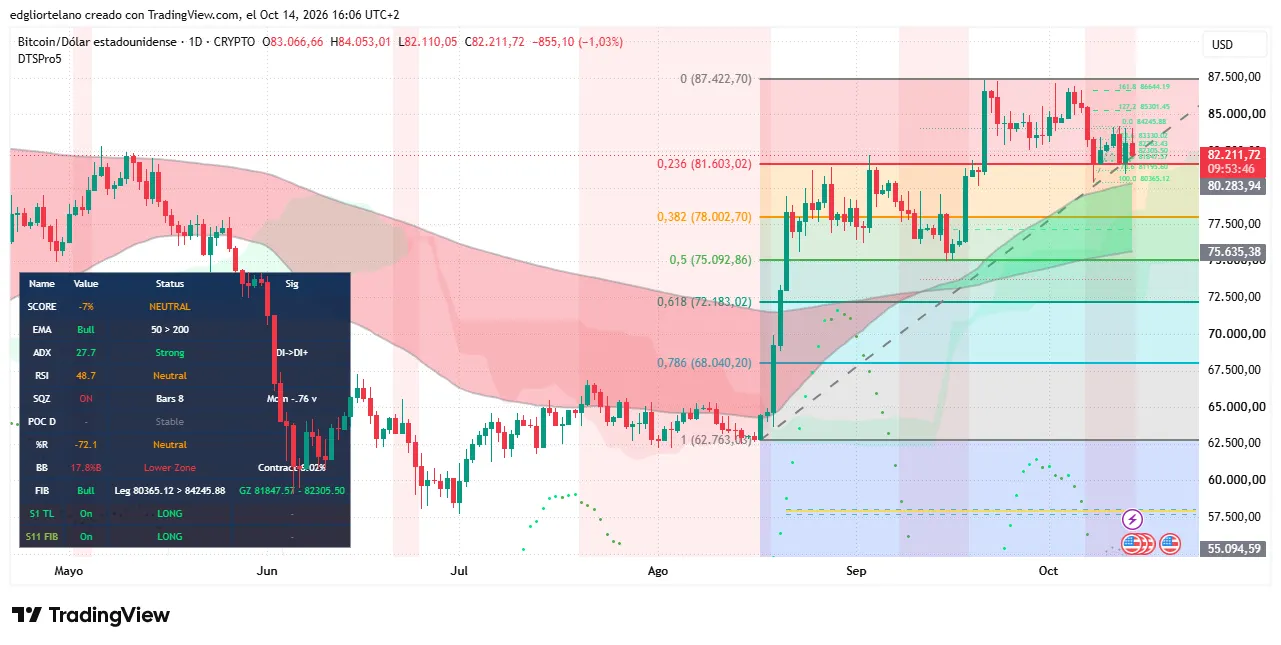
Bitcoin fell 1.5% to $82,142 and is holding the $81,847 to $82,305 Fibonacci golden zone, with $81,603 as the next support.
Bitcoin fell 1.5% to $82,142 on Wednesday after U.S. inflation came in hotter than expected, dragging most of the crypto market down with it. Ethereum dropped 2.8% to $2,440, Solana lost 1.9% and XRP slid 1.3%, while total crypto market cap shed 0.7% to $2.8 trillion.
The Consumer Price Index rose 0.6% in September and 3.7% over the past year, up from 3.4% in August, per the Bureau of Labor Statistics. Economists expected 3.6%. Gasoline prices jumped 9.1% in a single month and accounted for more than half of the increase.
Core CPI, which strips out volatile food and energy prices, rose 2.6% annually against a 2.5% forecast. That is the reading the Federal Reserve watches most closely, since it shows whether price pressure is spreading into rent, airfares, and services.
Expensive gasoline starts with expensive oil, which has traded above $90 a barrel for most of the past two months amid the war between the U.S. and Iran. Pricier fuel raises the cost of shipping and producing almost everything.
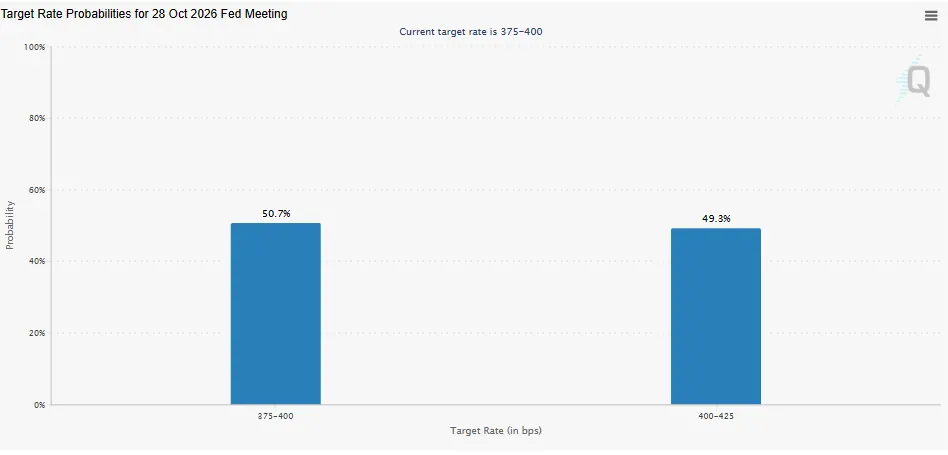
When inflation runs hot, the Fed raises interest rates to cool spending. It already hiked in September to a 3.75%-4.00% range, and traders now see roughly 44% to 49% odds of another hike at its October 27-28 meeting, up from 22% before the report, according to CME FedWatch.
The 2-year Treasury yield, which closely tracks Fed rate expectations, jumped about 10 basis points to roughly 4.9%, while the 10-year climbed to about 5.3%, near 24-year highs.
Higher yields hit crypto directly. A government bond paying 5.3% with almost no risk competes with Bitcoin, which pays nothing. Rising rates also make borrowing more expensive and tend to strengthen the dollar, draining the cheap money speculative assets feed on, which is why the S&P 500 fell 0.6% and the Nasdaq 0.8% on the same news.
Crypto also swings harder than stocks because many traders borrow to bet on rising prices, and when the price drops past a set level, exchanges automatically close those positions, a process called liquidation, and that forced selling can push prices lower and trigger more liquidations in a chain.
BitcoinBTC · USD
$81,686−1.71%
Oct 8Oct 9Oct 11Oct 13Oct 15
$84.2k$83.1k$81.9k$80.7k
24h HighHigh$84,025
24h LowLow$81,376
VolVol$1.5B
Market projectionsOdds by Myriad
→
At the moment, more than $281 million in crypto derivatives positions have been liquidated in the past 24 hours, with most of it coming in just the last four hours—and the majority of that coming from Bitcoin long positions (the bulls betting the price would go up, and now paying the price when it dropped).
Bitcoin price: The macro picture is punching hard
On the daily chart, Bitcoin opened at $83,066 and now trades near $82,211, sitting inside the Fibonacci “golden zone” it reclaimed on Tuesday. That zone marks an area where pullbacks within uptrends often attract buyers.
The average price of the last 50 days remains above the 200-day average, a setup traders read as an intact long-term uptrend. The Average Directional Index, which gauges trend strength on a 0-to-100 scale where readings above 25 confirm a trend, sits at 27.7 with buyers still ahead, down from 29.9 on Tuesday, meaning traders are bullish, just not as much as they used to be.
The Relative Strength Index, a momentum gauge from 0 to 100, slipped to 48.7, just under the 50 line that separates bullish from bearish momentum. The Squeeze Momentum Indicator has been on for eight sessions, meaning volatility is compressed and a big move is building, and its -0.76 reading leans bearish by a small margin.
A daily close below $81,603 would break the golden zone and bring the $80,365 swing low into play, with the trend band near $80,284 right under it; losing that would expose $78,003. On the upside, bulls need to reclaim $84,245 before targeting $85,301, $86,644 and the October high of $87,422.
The next test arrives Thursday with the Producer Price Index, which tracks what businesses pay for goods and services, and the Fed announces its rate decision on October 28.
Disclaimer
The views and opinions expressed by the author are for informational purposes only and do not constitute financial, investment, or other advice.
Daily Debrief Newsletter
Start every day with the top news stories right now, plus original features, a podcast, videos and more.
Academy CEO Bill Kramer is set to make his first trip to Asia later this month. He will collect a leadership award at the Tokyo International Film Festival and also sit down with Toho president and CEO Matsuoka Hiro for a public conversation.
The festival’s 39th edition runs Oct. 26–Nov. 4 and has built a program titled Academy in Tokyo around the visit. Two colleagues will join Kramer in the Japanese capital: Academy president Lynette Howell Taylor and Meredith Shea, the organization’s chief membership, impact and industry officer.
The three executives will share a stage on Oct. 28 at Tokyo Midtown Hibiya Hall for a 90-minute panel moderated by TIFF festival director Hisamatsu Takeo. They will take the audience behind the curtain of the Oscars and outline the Academy’s international initiatives and membership programs. The conversation will also turn to how the organization views international cinema today and where it is heading.
Once the panel wraps, Kramer will receive TIFF’s Global Cinema Leadership Special Award. The festival said the honor recognizes his contribution to the growth of the worldwide film business and to film culture. Later that day, the Academy will hold a private reception for its members from across the globe.
Kramer returns to the same venue on Oct. 29 to sit down with Matsuoka. Their session will look at the state of the global film landscape and the outlook for theatrical and streaming distribution, along with ways to deepen cross-border partnerships. Both public events are free, though advance reservations are required. Booking details have yet to be released.
Kramer took the Academy’s top job in 2022. Before that, he ran the Academy Museum of Motion Pictures as its director and president. The museum opened its doors in September 2021. As CEO, Kramer has pushed to broaden the Academy’s 11,000-strong membership and give it a more international makeup. He runs the organization’s global operations, from the Oscars and the Academy Foundation to the $500 million Academy100 campaign.
Howell Taylor is in her second term as president. She is an Oscar-nominated producer whose credits include “A Star Is Born,” “The Accountant,” “Captain Fantastic” and “Blue Valentine.” She joined the Academy’s Producers Branch in 2014. She also co-produced the 92nd Oscars telecast in 2020, which earned her an Emmy nomination.
Shea is the first person to hold her post. Her remit covers membership, awards administration and talent development. It also includes the Academy’s outreach to film festivals and international territories.
Matsuoka has steered Toho’s expansion overseas, including its acquisitions of Gkids and Anime Limited. He also oversaw the production of Oscar winner “Godzilla Minus One.” In 2025, Toho posted its best-ever results at the Japanese box office. Matsuoka also sits on the board of trustees of the Academy Museum.
TIFFCOM, the content market that runs alongside the festival, takes place Oct. 28–30.
Bitcoin hash rate has stabilized pic.twitter.com/9uIXjuTcdL
— Zach Pandl (@LowBeta) October 14, 2026
Operational factors behind the mining contraction
The loss of installed capacity was primarily driven by margin compression following the price pullback from its October 2025 highs. An industry source stated in September 2026 that computing power retreated from 1,160 exahashes per second (EH/s) to 850 EH/s in the first week of February 2026. This shift represented a 26.72% drop over the analyzed period.
The report attributes this hardware disconnection to three concurrent variables: depressed spot prices, elevated algorithmic difficulty levels, and low transaction fee volume on the base layer.
Direct revenue per processing unit suffered severe deterioration by mid-year. Industry data places the hashprice at a monthly average of $27.70 per petahash per second per day (PH/s/day) during June 2026.
Industry specialists note that this revenue level failed to cover operational costs in mining farms running older-generation ASIC hardware.
Compounding these market factors were direct pressures on energy tariffs. In major mining hubs such as Texas, operators faced seasonal electricity price hikes and winter weather disruptions. Market reports indicate that several facilities powered down portions of their operations to curtail load back to the grid or migrated capacity toward AI infrastructure data centers.
The recovery toward levels near 1 ZH/s suggests that companies with efficient hardware and fixed-price power purchase agreements are capturing the market share left behind by less profitable competitors.
Monitoring desks are now looking ahead to the upcoming Bitcoin network difficulty adjustment, scheduled to conclude within the next 150 blocks of the two-week cycle, an event that will formally recalibrate the production cost of each block.
Andrea Chrysanthou says it’s been almost impossible to limit her 13-year-old son Nathaniel’s screen time.
“My son understands that he’s addicted,” said Chrysanthou, the Toronto-based board chair of the advocacy group Children First Canada. She says he’s asked her for help to stop using his digital device so much, but the minute she turns her back, he’s reaching for it again.
Her son is like millions of other kids around the world whose physical and mental well-being are at risk because of excess screen time, according to a new series of research papers published Sunday by medical journal The Lancet.
It’s a broad review of international studies that allowed researchers to distill the potential harms and benefits of digital technology, and offers a sense of “what needs to happen to protect children’s health,” said co-author Jay Shaw, an assistant professor in the University of Toronto’s Department of Physical Therapy.
Despite the breadth of their analysis, Shaw and his colleagues say the true severity of the issue can’t be fully understood or addressed without access to tech companies’ own user data — something those companies are currently under no obligation to share.
WATCH | Social media consumption is public health issue, study says:
Study calls for public health action on kids’ screen time
Excessive screen time is taking a toll on young people’s health, according to a major new study. Researchers warn it’s linked to anxiety, depression and poor sleep. They’re urging governments to intervene.
But they say their research makes the case that screen addiction among young people is a public health issue that requires governments to intervene.
Parents can’t be the only line of defence, Chrysanthou told CBC News.
“We want the companies and the platforms to take responsibility, to make their platforms safe.”
LISTEN | How do we determine the quality of screen time at school:
The Current23:13Has screen time at school gone too far?
A ‘clear’ picture
Shaw and his fellow researchers reviewed data from 2,790 studies comprised of more than nine million participants.
Among the youngest users of digital devices, age 10 and under, too much screen time was linked to sleeping less and affected cognitive, emotional and social development.
There was a wider range of implications for young people between the ages of 10 and 24, from mental health problems and reduced physical activity to substance abuse, self-harm and suicidal ideation.
“I think we’re in a moment globally right now, where the harms associated with digital media use, especially for young people, have become quite clear,” Shaw told CBC News.
Dr. Rachel Mitchell, a psychiatrist at Toronto’s Sunnybrook Health Sciences Centre, says this research confirms that tech and social media companies need to share responsibility.
She says most digital platforms and applications weren’t designed for young people, noting that kids five and under and adolescents are at a time in their lives when their brains are still developing and they are more vulnerable.
Mitchell says they’re being bombarded with digital distractions from various applications, games and platforms that often aim to capture constant attention by employing features like autoplay, push notifications and elements of gamification, along with daily rewards for online activity.
“Adults, at least, have fully developed frontal lobes with which to regulate, and they can’t even do it themselves,” she said, referring to the ability to limit screen use.
“So, why we’re expecting children to do it is beyond me.”
WATCH | Why educational experts blame overuse of AI, excess screen time for dropping grades:
Experts blame AI, screens for slipping Canadian student test scores
While Canadian students still perform well globally in math, science and reading, scores have dipped significantly in recent years. Some educational experts blame the rising overuse of AI and too much screen time.
Tech’s ‘big tobacco’ moment?
Shaw says there’s a long history of public health interventions when it comes to health-related concerns about certain habits, such as smoking. He says the addictive nature of social media and other digital platforms should be no different.
And society, he says, may be at its “so-called big tobacco moment” with technology.
“If we don’t get out in front of it, then digital technologies will end up being more harmful than beneficial for public health.”
But Mitchell says addressing excess screen use, especially for young people, is a different scenario than smoking.
She says there are no real benefits to smoking, while digital devices and media serve many purposes in our daily lives.
A cigarette, she adds, won’t help you find your way around the city — but a phone will.
In fact, Mitchell points out, the data review in The Lancet highlights the positive benefits of digital media for young people when it’s used in moderation, as well as when it’s used for education and extracurricular learning.
But, she says in order to leverage the benefits, the risks of these technologies need to be managed.
Seven-year-old Tonah plays on a tablet at his home in Lewes in southern England on March 27. Data analyzed for Shaw’s research showed that too much screen time children 10 years and younger was linked to sleeping less and affected cognitive, emotional and social development. (Carlo Jasso/AFP/Getty Images)
Mitchell says this new research series demonstrates that the risks are so high and affect such a wide population that it’s no longer ethically or morally possible for people to manage without intervention from the government or the tech companies themselves.
Some social media and tech companies have implemented tools aimed at helping parents reduce the amount of time their children spend scrolling.
Meta, the parent company of social media platforms Facebook and Instagram, agreed to implement age limits in the U.S. when it settled a multi-state class-action lawsuit for $18 billion US in August. It was described as the largest state consumer protection settlement in history outside of the Big Tobacco settlements of the 1990s.
TikTok has a default setting that limits usage to one hour for users between the ages of 13 to 17, but this setting can be changed or turned off.
The head of Snapchat’s parent company, Snap Inc., recently told BBC News the company is open to time restrictions for teens.
Steps like these, Mitchell says, are “absolutely necessary” and “should have been there from day one.”
WATCH | Some Canadians like possible social media ban, but what companies held accountable:
Parents, experts warm on proposed social media ban but want details
Ottawa’s proposed social media ban for kids under 16 has seen a generally warm response so far, but some parents and experts are concerned over a lack of details on how the government would hold social media companies accountable.
Push for tech company transparency
Shaw and his fellow researchers hope the review can help governments shape public health policy to address the potential harms that the overuse of digital media has on young people.
But he says without access to user data from big tech companies, it will be difficult to get a true picture of how much young people are interacting with digital devices and of the true toll it takes on their physical and mental well-being.
Their series of papers notes that tech giants like Meta, TikTok and Google aren’t obligated to share such data or details about how their algorithms fuel prolonged use, especially among young people.
“It’s very hard to reconcile morally, ethically, how that data cannot be available to researchers,” Mitchell said.
Digital safety legislation like the federal government’s proposed Safe Social Media Act (Bill C-34) would, if passed, compel tech platforms to be transparent and provide accredited researchers with access to electronic data related to online safety.
Bill C-34 would also force social media companies to restrict accounts for children under 16 unless the platforms can implement adequate safeguards to protect them.
But neither Mitchell nor Shaw and his colleagues are making the case to ban children from using social media — even Children First Canada’s Chrysanthou isn’t sure it would work.
She says that in places like Australia, where age limits on social media were put in place earlier this year, many kids remain online, having found a way around restrictions or because the tech companies haven’t employed effective checks.
“Beyond some kind of regulations around screen time,” Chrysanthou said, “we want the companies and the platforms to take responsibility, to make their platforms safe.”
WATCH | How more school assignments on screens, not textbooks, may affect children:
Parents push back against screen time in schools
A growing number of Canadian parents are pushing back against the amount of screen time their kids are having in school, as textbooks and assignments migrate from page to screen.
New York Democrats are fining unvaccinated Amish children $2,000 per day, as social media posts claimed in October 2026.
Rating:
What’s True
In 2022, New York fined three Amish schools for not complying with a law mandating schools only accept students with updated vaccines, following the 2019 removal of a religious exemption from that law. The small schools were fined $2,000 for every student without updated vaccines every day, for a total of $118,000 before the schools sued the state.
What’s False
New York fined the schools, not the children.
What’s Undetermined
The New York Department of Health did not clarify to Snopes whether it had fined any other schools or whether it had continued to fine the three schools since 2022.
In early October, some social media posts claimed the state of New York had “declared war on the Amish” with vaccine requirements enforced by fines. Many Amish communities have lower childhood vaccination rates than the rest of the U.S. population, although vaccination is not universally rejected in these communities.
For example, one Facebook post (archived) claimed the state was fining each unvaccinated Amish child $2,000 per day. The post asserted that New York Democrats took away the religious exemption often used by Amish families to opt out of childhood vaccine requirements.
Users shared similar posts claiming New York Democrats were fining unvaccinated Amish children $2,000 each day on Instagram (archived) and X (archived). Snopes readers emailed us asking whether the rumor was true.
It’s true that New York fined at least three Amish schools $2,000 for each unvaccinated child it allowed to attend the school each day. New York did not fine the children themselves, and it’s unclear whether the state is still actively imposing fines on these schools or any other over their vaccination policies. Therefore, we’ve rated this claim a mixture of true and false information.
According to the case, in 2019 New York repealed the religious exemption to its school immunization law — which applies to all public, private and religious schools in the state — after a measles outbreak in 2018 and 2019 centered around communities with clusters of unvaccinated people (PDF Page 3).
Democrats were the majority in both the state Senate and state Assembly in 2019. The governor at the time was Andrew Cuomo, a Democrat.
The immunization lawprohibits schools from allowing children who do not have their scheduled vaccinations to attend the school until those vaccination requirements are met. New York audited three Amish schools’ compliance with the law in 2021, and in 2022 it fined the schools for allowing children to attend who did not meet the vaccine requirements (PDF Page 7).
A school is fined $2,000 for each violation of the law every day (PDF pages 7-8). Every attending student who does not meet vaccine requirements is considered a violation, which means the school is fined for each noncompliant student every day. Prior to imposing the fines, the state sent a letter to school administrators warning it would impose the fines.
New York applied the fines under the assumption that two schools failed to comply for one day and acted as if there were only one noncompliant student attending for 10 days at the third school. That resulted in fines of $52,000 for 26 students at one school, $46,000 for 23 students at another school and $20,000 for one student at the third school, for a total of $118,000.
Notably, this amount was the total of the fines fines placed on the schools at the time the lawsuit was filed on June 2, 2023, the total fine referenced in the latest court decision on June 30 and the total fine referenced in social media posts as of this writing. A legal organization representing the Amish schools said they racked up $118,000 in total fines when announcing it would appeal the latest ruling to the U.S. Supreme Court on Oct. 2.
Snopes reached out to the New York State Department of Health to ask whether the schools were still racking up fines or whether there have been other schools fined since the beginning of the lawsuit. The department did not elaborate on the fines. A spokesperson told Snopes via email:
The state’s responsibility is to protect public health, keep New Yorkers and their families safe and enforce the law fairly and equitably. While we cannot comment on pending litigation, the Department is committed to eliminating serious illness and unnecessary deaths caused by vaccine preventable diseases. The Department continues to provide community outreach and education on the safety of immunizations. New York’s school immunization requirements are based in science and protect the health and well-being of all New Yorkers.
The lawsuit challenging this law, which does so on religious freedom grounds, has traveled up and down the court system. In 2025, the 2nd U.S. Circuit Court of Appeals upheld a lower court’s decision to side with New York over the plaintiffs (PDF Page 5), but the U.S. Supreme Court vacated that decision and told the 2nd Circuit to reconsider the case in light of a different case the Supreme Court recently ruled on.
After considering this other case, the 2nd Circuit did not change its decision in Miller v. McDonald. That was the June 30 decision that representatives for the Amish schools are appealing to the Supreme Court once again.
An image authentically shows a protester wearing a shirt that read “Release the Epstein Files” at a Trump rally in Youngstown, Ohio, on Oct. 12.
Rating:
Context
Though this particular image was fake, law enforcement officials did remove an apparent protester wearing a shirt that read “Release the Epstein Files” from the crowd at a Youngstown, Ohio, rally for Republican candidates running in the midterm elections on Oct. 12.
In October 2026, an image (archived) circulated online that social media users claimed authentically showed a protester wearing a shirt that read “Release the Epstein Files” at a Trump rally in Youngstown, Ohio, on Oct. 12.
Newsfootage from the rally showed what appeared to be Republican supporters grappling with a person wearing a black shirt that read “Release the Epstein Files” until law enforcement officers stepped in to remove the apparent protester. Livestreamed footage from the rally showed Trump reacting to the incident, claiming that the person was a paid protester and commenting on their weight.
The image that circulated online shows a crowd of angry people wearing red hats emblazoned with the words “Trump” and “USA” confronting a person wearing a black shirt that reads “Release the Epstein Files.” One Threads user who shared the image wrote:
At Ohio Trump rally, I saw a brave woman surrounded by male violence. One bastard punched her, pulled her hair, and dragged her to the ground. When police officers arrived, I thought they would help her and arrest the attacker. I was wrong. She was led away while Trump cheered on the thugs. As a German, this is unbelievable to me. A brave woman among raptors. Trump’s followers are chilling and disgusting—just like the man himself. She is my hero today.
(@two_and_a_half_dachshunds, accessed via Threads)
The image also spread onX (archived, archived). Snopes readers contacted us to ask if the image was real.
The image was fake. A SynthID detector, which looks for invisible watermarks in AI-generated media, concluded Google’s AI tools created the image. In a follow-up post, the Threads user above also confirmed the image was AI-generated and suggested they created it.
“I intentionally chose a symbolic graphic over sharing the horrific, raw footage of a woman being dragged and beaten by men at that rally,” the user wrote.
A Google reverse image search identified the Threads post as the earliest version of the image. We contacted the Threads user for confirmation they created it and await a reply.
Though this particular image was fake, the incident it was based on did take place on Oct. 12 during a rally for Republican candidates in Youngstown, Ohio.
Footage from the rally showed a scuffle in the audience, with at least four people grappling with and grabbing at one person as they appeared to attempt to pull the person to the ground. Law enforcement officials who appeared to be from the Mahoning County Sheriff’s Office arrived at the scene and separated the apparent protester, who was wearing a shirt that read “Release the Epstein Files,” from the crowd.
As officers pulled the apparent protester from the crowd, Trump said, “He’s a paid protester, they’re all paid. They get paid by the lefties in order to destroy our country. They’re scum.”
The President then appeared to comment on the protester’s weight, adding, “Oh, he’s got to go on a diet. He’s a fat guy. Wow.”
Though Trump repeatedly identified the apparent protester as a man, news outlets including The Hill and Fox News reported that the person in question was a woman. Snopes has not independently verified the identity or gender of the person, nor what started the incident at the Youngstown rally.
Trump’s claim that the person in question was a paid protester remained unproven as of this writing.
The apparent protester’s shirt that read “Release the Epstein Files” was likely intended as criticism of the Trump administration.
Democratic lawmakers have criticized the Trump administration for failing to release all of the documents pertaining to the investigation into late convicted sex offender Jeffrey Epstein, while United Nations experts condemned “serious compliance failures and botched redactions that exposed sensitive victim information” as part of the documents the administration did release.
Youngstown Mayor Derrick McDowell said on Facebook (archived) that Youngstown Police Department officers were not involved in the incident at the rally. Snopes contacted the U.S. Secret Service and the Mahoning County Sheriff’s Office to ask if either agency carried out arrests at the rally.
The Mahoning County Sheriff’s Office had not returned our request for information at the time of this writing. The U.S. Secret Service referred our request to the sheriff’s office.
Beitsch, Rebecca, and Sudiksha Kochi. ‘Lawmakers Hammer DOJ over Epstein Files Release’. The Hill, 22 Dec. 2025, https://thehill.com/homenews/house/5660099-lawmakers-doj-epstein-files-release/.
Davis, Sarah. ‘Trump Mocks Heckler Punched at Ohio Rally’. The Hill, 13 Oct. 2026, https://thehill.com/homenews/campaign/6144766-donald-trump-ohio-rally-heckler/.
‘Flawed “Epstein Files” Disclosures Undermine Accountability for Grave Crimes against Women and Girls: UN Experts’. United Nations Human Rights Office of the High Commissioner, 16 Feb. 2026, https://www.ohchr.org/en/press-releases/2026/02/flawed-epstein-files-disclosures-undermine-accountability-grave-crimes.
Mion, Landon. ‘Protester Punched in Face by Trump Supporter, Mocked by President at Ohio Rally: “Gotta Go on a Diet”‘. Text.Article. Fox News, Fox News, 13 Oct. 2026, https://www.foxnews.com/politics/protester-punched-face-trump-supporter-mocked-president-ohio-rally-gotta-go-diet.
‘Protester Attacked by Multiple Attendees at Trump Rally in Ohio’. ABC7 New York, 13 Oct. 2026, https://abc7ny.com/post/protester-attacked-multiple-attendees-donald-trump-rally-ohio/19934104/.