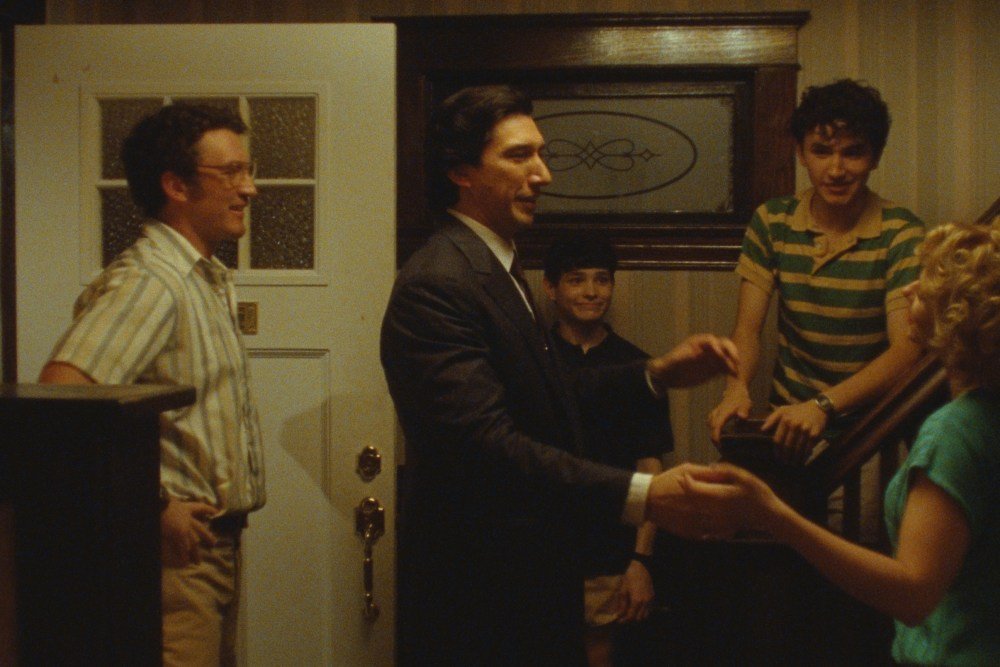
Adam Driver gamely walked the red carpet at the Cannes Film Festival premiere of “Paper Tiger” on Saturday, posing for pictures alongside his co-star Miles Teller and the film’s writer and director James Gray. But as soon as the Lumière Theatre darkened and the film began to play, Driver slipped out of his seat.
“I can’t stand to watch myself,” Driver says. “I have a whole system where I wait until everything is starting and I go through these mazes into a room that overlooks all these boats. And then I sneak back in and try not to be noisy so I can be there as the lights come up.”
It’s a routine that Driver has perfected over several Cannes Film Festival appearances — though he did sit through the 2024 premiere of “Megalopolis” to support its director Francis Ford Coppola. “[His wife] Eleanor had just passed away,” Driver explains.
“Paper Tiger,” in which he plays a former cop turned smooth-talking businessman, who struts around in designer suits like he owns the city, marks his eighth film to debut at the festival. And though Driver seems at ease on screen in his latest, the experience of being observed as you’re observing yourself on screen, hasn’t gotten easier.
“I used to have a couple drinks, just to calm down, but I can’t go overboard because sometimes you come back and you don’t match the mood of a movie,” he admits. “Sometimes people are crying, and you’re like, ‘Hey everybody!’”
It’s the day after “Paper Tiger’s” opening night and the reviews have bordered on the ecstatic with one critic calling it Driver’s “career-best performance” and others praising Gray’s blend of a gritty crime thriller and family drama. Both men are sitting in a small room in the Carlton Hotel, gushing over each other’s talents.
“I love Adam Driver!” Gray declares, admonishing the actor to “close your ears.”
“I wrote this part for him,” Gray continues. “It’s very uncommon to find an actor who can convey vulnerability and danger. These are the two most valuable commodities for a director. I can only think of one performance in the history of movies where there’s no danger, and it’s great. And that’s Jeff Bridges as the Dude in ‘Big Lebowski.’ Everything else has kind of an undercurrent of menace.”
Driver was eager to work with Gray, having binged his New York-set stories on the Criterion Channel, a collection of urban masterworks that includes “We Own the Night,” “Two Lovers” and “The Yards.”
“He tells these really intimate stories where there’s always an amazing cinematic sequence,” Driver says. “But it’s always grounded in character.”
In the lead up to production, the two met frequently at Driver’s house in New York to hone the script.
“If I don’t understand a part, then it’s hard to play it,” Driver says. “And the biggest enemy on a film is time. We had official rehearsals, but whatever you can do in advance to drill down into the characters is so important, so then you don’t waste time on set having debates about everything.”
Many of Gray’s stories are drawn from his outer boroughs childhood. He grew up in Queens. His father was an electronics contractor, his mother was a teacher. While he was studying film at USC, his mother was struggling with the brain cancer that would kill her and his father was charged with bribing a MTA employee to get a contract — he’d ultimately pay a fine after pleading guilty. “Paper Tiger” isn’t a facsimile of those experiences, but it is heavily autobiographical. In the film, Teller and Driver are brothers Irwin and Gary Pearl, whose plan to profit from the redevelopment of the Gowanus Canal goes off the rails when they run afoul of the Russian mob. Scarlett Johansson is Hester, Irwin’s wife, whose terrible headaches and blurred vision result in a devastating medical diagnosis.
“It’s embarrassing to talk about the parallels,” Gray says. “The time frame was different. It was probably about a year and two months, but in cinema you have to contract so everything happens in a few weeks. But in my own experience, I had a brother and a mother and a father, and within a short period I moved to Los Angeles, my father’s legal troubles began where he faced prison time, and my mother died of brain cancer. That familial unit was shattered very quickly, and that sense of loss has stayed with me.”
In the film, Irwin makes the disastrous decision to revisit the Gowanus at night with his teenage sons, where they see something they shouldn’t. That’s when the boys are held at knifepoint in the back of a car by two menacing Russian hoods. Is that something, I ask, that happened to Gray?
“Pretty much,” he says, slowly nodding. “And I live with that every day.”
“Paper Tiger” has the weight of a Greek tragedy (it begins with a quote by Aeschylus, after all), but despite its classical influences, Gray tries to keep things light and loose on set. He shoots rehearsals and encourages the stars to find their way into a scene instead of storyboarding something to death.
“He reveres actors,” Driver says.
He’s certainly studied them. About midway through our interview, Gray launches into a long discusion about how Maximilian Schell, the star of Gray’s first film “Little Odessa,” shared a dirty little secret about Spencer Tracy’s approach on the set of “Judgment at Nuremberg.”
“He said, ‘the mark would go down for the actor, and then I would watch Spencer Tracy, and he’d” — at the point, Gray gets out of his chair, starts shuffling Tracy-like while looking at his feet, stops and then looks up as if staring into the barrel of a camera. “And then he’d say his line.”
“He absolutely fucked up Spencer Tracy for me!” Gray thunders. “I can’t watch him now!”
For Driver, “Paper Tiger” was another chance to operate in the indie realm after an extended stint going over to the dark side playing Kylo Ren in the most recent “Star Wars” trilogy.
“I like the scale of those bigger movies, and I like the reach of them,” Driver says. “I more naturally gravitate towards smaller films. The rhythm is completely different. It’s a little faster. I don’t mind having to do something technical. And I feel like that was the only debate that we would have on set was James apologizing in advance for something complicated. And I’m like, ‘I understand there is an artificiality here. I’m aware that all of this is not real.’”
“Paper Tiger,” like many of Gray’s films, is about how various systems — political, judicial, criminal — can eat up and spit out an individual. The American Dream is a myth that claims that great ambition and hard-work will be rewarded, but the American Experience isn’t one in which virtue prevails. I wonder how Gray, an artist and an auteur who must navigate the business of Hollywood, has avoided being crushed by a different kind of corporate system.
“I have to shut it out because I think it is very damaging to creativity,” Gray says. “I hate it when people call me up and say things like, ‘This is what’s selling right now, this is what’s hot.’ If I tried to retrofit something so it would sell, it would be very artificial. Steven Spielberg is someone who people hold up as a commercial director. But Steven Spielberg is actually a very sincere director. There’s no cynicism there. He’s not trying to cash in.”
Now Gray is rolling, growing more animated and excited as he talks about his desire to make his stories, his way in a business that wants filmmakers to tailor their creativity to fit the latest fashion.
“Just focus on the work, focus on the work,” he says. “It’s not easy. The system is designed to humiliate you. To keep you in line. Don’t step out of line, don’t fight. If you fight, you’re going to lose, you can be humiliated, and won’t that be awful? Look at the house I got, look at the car I got. I have a new deal at this studio. Do you have one? I got this prize. Did you win one? These are all weapons that are used to humiliate the artist. It can be fatal, if you let it.”
Leave a Reply