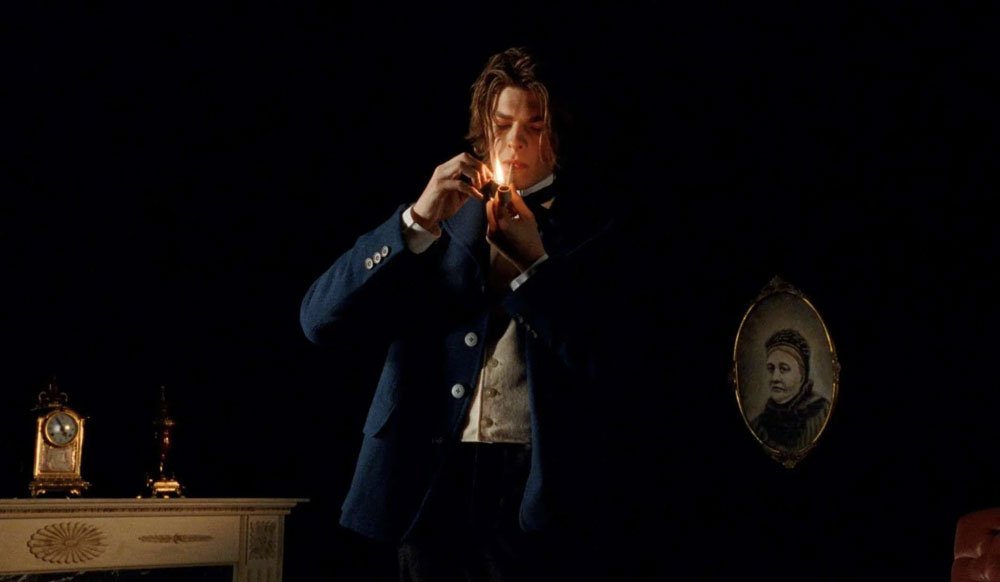
Six decades ago, David Lean ventured to the sprawling sandstone mountains of Wadi Rum to film the world’s most interesting canvas: the human face. This credo is not dissimilar from that of Winnipeg-shot “A. Rimbaud,” the latest micro-budget feature from American indie virtuoso Patrick Wang (“A Bread Factory”), whose contained, stripped-bare, three-hour biopic of French poet Arthur Rimbaud plays like a black box “Lawrence of Arabia.” It’s wonderful and fascinating.
Wang’s Peter O’Toole is a young man by the name of Blake Draper, who you probably haven’t heard of, but who delivers a towering performance spanning several decades. The director’s Alec Guiness and Omar Sharif, however, are musical instruments, for “A. Rimbaud” is also a remarkably esoteric one-man show rendered in impossibly cinematic hues, yielding an appropriately sui generis rollout (a months-long engagement of only one weekly showing at New York’s Roxy Cinema).
Mere minutes into its gargantuan runtime, Draper’s Rimbaud adjusts the camera to make himself look diminutive, in order to recall a story from when he was a child. It’s about the only time the fourth wall is broken so brazenly, but it speaks to Wang’s postmodern approach to the big screen — which is notably anti-Lean, who believed tools should be invisible — and to the manner in which “A. Rimbaud” embodies the spontaneous mischief of the French surrealist’s work.
Set throughout the late 19th century, the movie follows Rimbaud’s burgeoning youth through one-sided dialogue which, although it accommodates invisible responses (à la Han Solo responding to Chewbacca) can only do so much to overcome this self-imposed restraint. Yet it’s utterly captivating to watch, in no small part because Draper balances theatrical expressiveness with nuance for the movie camera. He makes each scant, minimalist set feel fully alive, with an ambitious glimmer in his eye. However, this gradually fades as Rimbaud goes from an adventurous youth in London and Paris to a forward-thinking colonial envoy in Algeria decades later — a passage of time marked by theatrical lighting cues — and Draper’s performance turns inward, becoming meaningfully introspective.
Where most conversations are half-silent, important figures in Rimbaud’s life are embodied by musical instruments, ranging from overbearing tubas to melodic strings, depending on who’s speaking and their place in the story. However, each of their shapes, conjured like the adults around Charlie Brown, is completely distinct. It’s an oddity that, at on the surface, gels with Wang’s bare-bones approach born of financial necessity — shooting in a confined room with stage flats is a lot less expensive than hiring a thousand of extras — but this formal inventiveness proves apt, and eventually, necessary to tell this particular story. Wang digs into Rimbaud as a deeply lonely figure, and ensures that the isolation of this stage-like setting becomes a palpable formal boundary.
There are always people in Rimbaud’s vicinity (chairs move independently of him, and objects are passed his way through sleight-of-hand) but rarely is he able to fully connect with them. The other side of this coin, however, is that Wang and cinematographer Frank Barrera tether us so closely to Rimbaud that we have no choice but to empathize with the brash ingenu — even though, in his constant desire to escape and explore, he always seems to leave loved ones behind, setting himself up for inevitable regret.
Draper, who speaks in a pronounced English accent (except for French words and names), brings an appropriately poetic mood to the verbose dialogue, ensuring that the words written by Wang seldom feel different from those penned by Rimbaud himself. Many of his poems are spoken at length, practically turning “A. Rimbaud” into a bizarre version of a modern, estate-controlled music biopic about a pop star, where half the reason one might buy a ticket is to see earworm hits recreated from the ground up.
However, even for the Rimbaud-faithful in the crowd, Wang never seems satisfied with rote presentation, and warps the confines of his form with magnificent imagination. Some of the poet’s most hallucinatory imagery seeps through the corners of the screen. Poems like “The Drunken Boat” become as much about the words themselves as they do Rimbaud’s impassioned telling, which conjures sounds and even natural elements from outside the frame, as the camera remains transfixed by Draper’s impassioned delivery. Few filmmakers have so understood that poetry is as much performance as it is writing.
Other works, like “Vowels,” see Rimbaud’s synesthetic framework adapted to the texture of film itself, as a medium that can freely rotate about a visual axis, if its director so chooses. In effect, “A. Rimbaud” starts out as the kind of movie Rimbaud himself might have made, had the technology been invented; Wang even blends the boundaries between other visual mediums by turning motion blur into painterly brush strokes. It’s quite a joy to look at.
Granted, at nearly three hours in length, the film is also incredibly demanding — especially its initial half, which, by its nature, becomes a recursive cycle of directionless youth that Rimbaud struggles to break. Intentionally or not, it’s a challenge to sit through, but it also has a secondary effect. By the time it slows down, and becomes more tonally and formally serious during Rimbaud’s travels as an adult (when he also speaks fluent Arabic), the film pulls a remarkable switch. Not only does it gradually accustom viewers to its aural idiosyncrasies — we become entirely used to dialogue manifesting as music and silence — but it also takes a distinct turn towards a more traditional, more classical visual staging, in a way that ought not to be possible for a film like this one. This happens by way of Draper’s closeups, which are so unyielding, so tactile and so thoughtfully layered by Barrera’s conscientious lighting and warm, visceral 35mm photography, that they’re indecipherable from closeups in a traditional studio picture — not to mention, just as effective, as though Wang had found some secret avenue to the soul.
“Any language can be yours,” Rimbaud advises his younger sister at one point, referencing the rigorous study that led him to become both a polyglot and a well-liked diplomat. However, this message feels initiated by Wang himself, as though he were spelling out a filmic manifesto on his uncanny wielding of cinematic form. The maddening emotional impact of “A. Rimbaud,” in its final act, is no different from that of even the most lavish Hollywood epics, but its most intimate transmissions are born of the kind of maverick indie spirit that demands a complete re-orientation of audiovisual language in a way few modern experimentalists would attempt with traditional technology. It’s a look back at the old, established forms of storytelling that breaks them open from within, practically forcing the box of cinema to take new shape as Wang transmutes what’s expected, and what’s possible, with a camera, an actor and imagination.
Leave a Reply