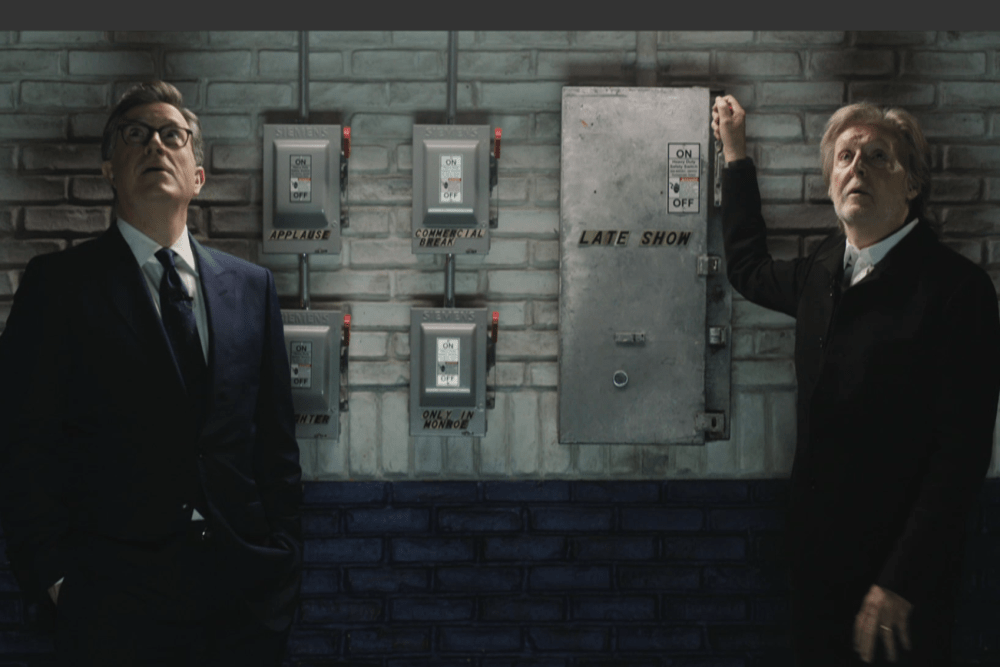
Paul McCartney, a surprise guest on the final episode of “The Late Show With Stephen Colbert,” provided a poignant capper to the series by being given the ceremonial honor of turning out the lights in the Ed Sullivan Theater, a location with which he has plenty of history.
The final number had McCartney and Colbert singing the Beatles‘ classic “Hello Goodbye,” accompanied by Elvis Costello and Jon Batiste. and joined on stage by a parade of staffers dancing as the house band turned the ’60s tune into something with a New Orleans-style coda.
Then Colbert was seen in a filmed bit taking McCartney backstage to the electrical breakers, where the legendary rocker was seen flipping a switch that not only turned the lights out but sent the Sullivan Theater into a green interdimensional portal introduced earlier in the show by Neil deGrasse Tyson.
The symbolic gesture followed McCartney’s stint as the show’s final interviewee as well as last musical performer, in which the host asked him to share stories about his first visit to the theater 62 years ago.
“Hello Goodbye” was not the only musical number toward the end of the extended final telecast. In another filmed segment, Colbert was joined by Costello and Batiste for a seated rendering of a song that was surely unfamiliar to 99% of the viewing audience: “Jump Up,” a bluesy song Costello wrote in the mid-1970s that was not released until decades later, as a demo included as a bonus track on a “My Aim Is True” deluxe edition.
The Beatles’ appearance on “The Ed Sullivan Show” on Feb. 9, 1964 is often credited as being the turning point that helped push the already fast-rising group over the top toward ultimately becoming the most successful group in music history. This crux point for Beatlemania was viewed by a reported 73 million viewers, or about half of the U.S. population at the time.
Colbert asked McCartney for recollections about the Beatles’ visit to the theater. “We’d never been to America; we come here and people said this is the biggest show,” the musician recalled. “To tell the truth, we’d never heard of it. You know, England,” he added, to explain their ignorance of the top-rated U.S. variety show. “It was fantastic… You had to go a few floors down to get makeup… We went down there and the girls put makeup on us and it was, like, bright orange.”
“That’s very popular in certain circles these days,” responded Colbert, in one of the few references to Donald Trump in an episode that otherwise skewed surprisingly non-political. “Now we know where it started. Thanks a lot, Paul McCartney,” he quipped.
Colbert asked McCartney whether he and his fellow Beatles were nervous coming onto the Sullivan show. “We were a little bit nervous, but we’re young kids and we’re sort of full of ourselves,” McCartney responded, suggesting they were more cocky than anxious. “It was very exciting. America’s where all the music we loved came from — rock ‘n’ roll, the blues and the whole thing, even going back to Fred Astaire.” He suddenly waxed patriotic. “The land of the free; the greatest democracy.” Although the audience may have been expecting the host to jump in with a joke, he respectfully refrained. Added McCartney: “That was what it was, and still is, hopefully.”
No musical guest had been announced in advance for Colbert’s final show, although rumors ran rampant it would be McCartney, whose new album, “The Boys of Dungeon Lane,” comes out May 29. McCartney appeared on “Saturday Night Live” last weekend to perform the single “Days We Left Behind,” along with post-Beatles golden oldies “Band on the Run” and “Coming Up.”
McCartney had occasionally revisited the Ed Sullivan Theater in the 62 years since the Beatles’ history-making performance there. On July 15, 2009, he and his band played atop the marquee for an episode of David Letterman’s show. After Colbert took over the show from the retiring Letterman, McCartney came by for an interview to promote his children’s book in 2019.
McCartney’s history with Colbert outside of the CBS show dates back to when he did an hour-long interview and performance with the host for his Comedy Central series “The Colbert Show” in 2013.
CBS has announced earlier in the week that the “Late Show” finale would go overtime and not be confined to its usual one-hour time slot. There was precedent for that, with David Letterman’s farewell to the show in 2015 going 17 minutes overtime. Thursday night’s “Late Show” finale went just slightly over that, ending at 12:54 p.m. ET.
Whether the Ed Sullivan Theater will remain dark for long or indefinitely is unknown, with CBS not having announced any future plans for the venue, but no longer having a late-night franchise that requires one. Its historical landmark designation requires it remain in use as a theater, although that could mean continued tapings or a transition back to a legit house.
It opened as Hammerstein’s Theatre in 1927 and operated as a Broadway house for nine years. It was subsequently renamed the Manhattan Theatre, and then Billy Rose’s Music Hall. In 1936 it became a CBS Radio soundstage, transitioning into use as a TV studio in 1948. After hosting Arthur Godfrey’s and Jackie Gleason’s shows, it became the home of Ed Sullivan in 1953, though it was known as Studio 50 until it was officially renamed the Ed Sullivan Theater in 1967. The venue was often dark after he left the air in 1971, but received intermittent filming use before and after it was landmarked in 1988. Letterman moved in and the theater began getting daily use again in 1993, at which point CBS bought the house it had long rented.
Leave a Reply