At the Cannes premiere of “Propeller One-Way Night Coach,” the first movie written and directed by John Travolta (it’s only an hour long, and drops on Apple on May 29), Travolta was introduced with a 10-minute montage of his film work — the sort of thing that sounds very standard, though this had to be one of the greatest movie-star montages I’ve ever seen. It had the benefit of amazing music (“Stayin’ Alive,” “You’re the One That I Want”), but watching Travolta in his ’70s heyday, and in his ’90s second heyday, you realized, quite simply, that he’s one of the most electric stars of the last half century. The montage cued you to a dozen movies you were suddenly dying to see again.
Travolta then came out on stage, wearing a beret and a trim geometric beard (a look that seemed like a beatnik nod to Samuel L. Jackson), and the audience was rapturous in its appreciation. When the movie started, all that good feeling carried over to it. In this case, however, the “We love you, John!” emotional spillover seemed notably appropriate, since “Propeller One-Way Night Coach,” while little more than a slim and winning facsimile of a movie, is rooted in the power of affection.
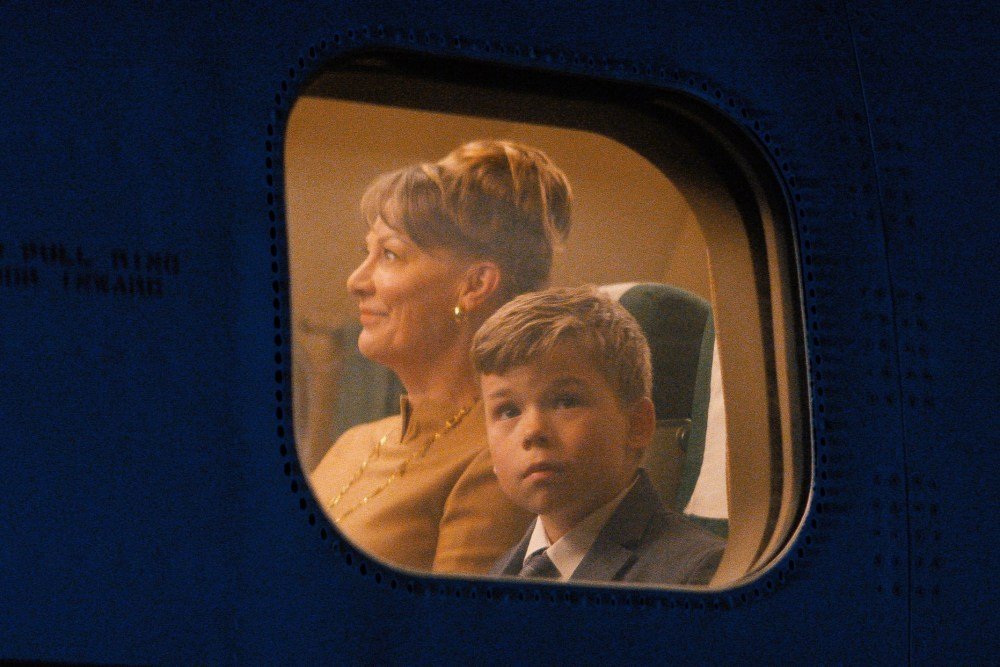
Based on Travolta’s 1997 children’s novel of the same name, the movie is his fictionalized childhood memoir, the slightly tall tale of an 8-year-old boy named Jeff who, in 1962, takes his first plane trip. It’s a TWA flight from the East Coast to California that stops in more cities than an Amtrak trek. (Did planes really used to do this? I guess so.) Our young hero loves the adventure of being on an airplane for the first time. But what he loves just as much — and what the movie, in a way, is about — is the trappings of the “Mad Men”/space-age era, which it views as a lost paradise.
Travolta, basically reading his book out loud, narrates the entire film, and considering its anecdotal style (there’s no pretense of a story; it’s just the kid’s diary of his trip), and what an all-American tyke Jeff is, you may be reminded of the movie version of “A Christmas Story,” which was also a heavily narrated memoir rooted in nostalgia for Americana. But that movie was full of snark and broad cartoon hijinks. (That’s why I’ve never cared for it.) “Propeller One-Way Night Coach” is sometimes funny in a light way, but it’s mostly sincere. Travolta wants to share how much he loved being on that plane: the wide-eyed wonder of it all — and, underneath that, the feeling that he was protected. (That’s the feeling 1962 could give you.)
Jeff (Clark Shotwell), an innocent full of curiosity, and his mother, Helen (Kelly Eviston-Quinnett), a part-time professional actress and full-time tippling narcissist, are flying to California because Helen, who has done stage work, has decided she wants to make it in Hollywood. She’s a 49-year-old flirt in a librarian’s beehive who will beam adoringly at any unattached middle-aged man who has a decent job; between that and her Manhattans, she doesn’t have too much attention to give to Jeff. Yet she’s viewed, like everything else in the movie, with an adoration that is nearly transcendental. This, Travolta is saying, is what his mother (or some version of her) was, and he accepts it. He celebrates it.
Travolta selected the film’s music, which ranges from bossa nova to “Rhapsody in Blue.” He sets the mood for this space-age tone poem with Stéphane Grappelli’s gently jaunty “Ballade,” even though it came out in 1974, because it really does have that post-1950s Proustian Woody Allen vibe of mellow adventure. At Idlewild Airport, which had yet to be christened JFK, the film revels in the modernist trappings of the TWA terminal; in the comfort of the plane; even in the slight yuckiness of the airplane food — which is always chicken cordon bleu, a dish that makes Jeff go: I like fried chicken, I like cheese, but I don’t necessarily want them together. Jeff meets the people on the plane, like the 10-foot-tall man, and the pilots (back then you could knock on the door and hang out with them), and, finally, the film’s version of an 8-year-old’s love object: a stewardess named Doris, played by Ella Bleu Travolta (the director’s daughter), who might just be a star.
Jeff and Helen end up in first class, and on a real jet that flies at 33,000 feet and at 600 miles per hour. “Propeller One-Way Night Coach” always feels like a children’s tale — Travolta’s narration lends it a storybook innocence — but it’s one that a lot of adults will likely consider checking out. It’s kind of like a home movie with better sets, and the fact that we know it’s Travolta telling his own story is part of its appeal. If “Propeller One-Way Night Coach” lets you know anything genuine, it’s that Travolta, at an early age, looked around at his life and thought it was magical. That, in its way, is a gift, one that in movie after movie he has reflected back to his fans.
Leave a Reply