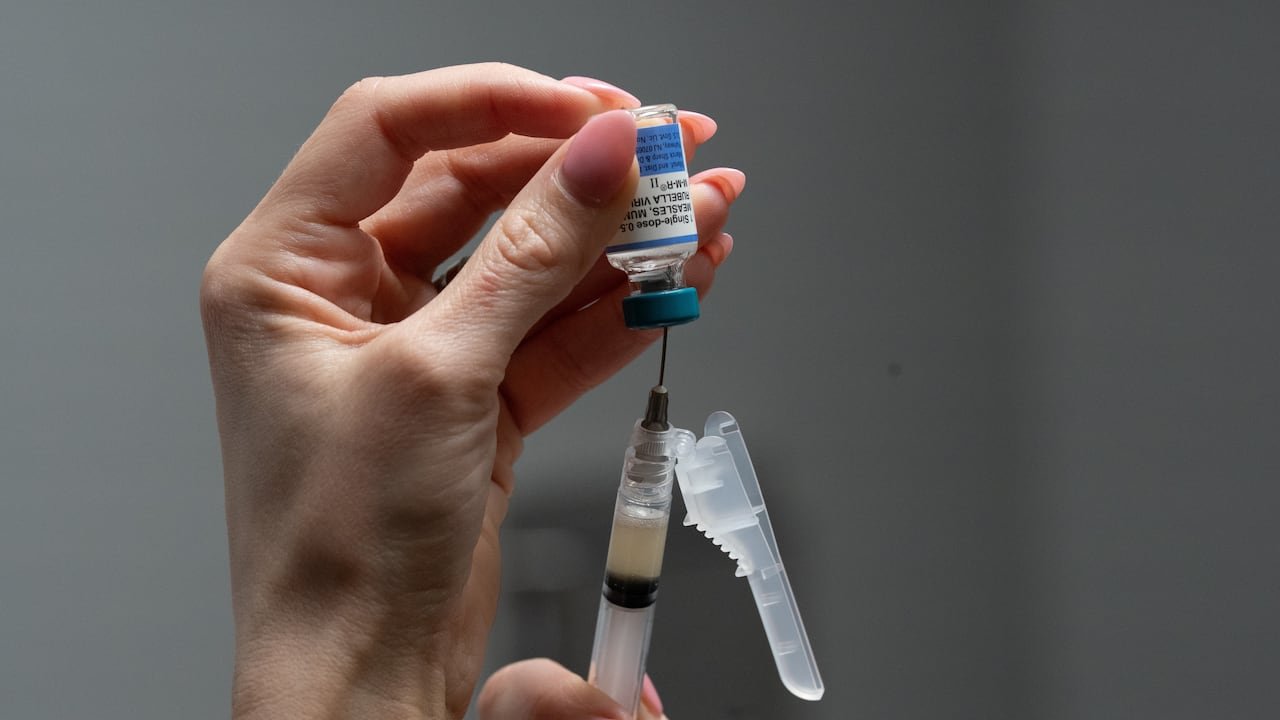
The U.S. has officially lost its measles elimination status, more than a quarter of a century after it first achieved the distinction, marking a striking backslide in public health progress.
The Pan American Health Organization (PAHO), an arm of the World Health Organization, announced the update in a media briefing on Tuesday, following the deadliest year for measles in the U.S. since 1991. Ten measles-associated deaths have been reported in the U.S. so far this year, and the U.S. Centers for Disease Control and Prevention have confirmed more than 5,400 cases.
Mexico also lost its measles-elimination status amid a massive measles outbreak that has been ongoing since the start of 2025. Bolivia lost its status as well.
It’s another domino down for measles prevention in the Americas, the region that originally led the charge for elimination. The news comes a year after Canada lost its measles elimination status, a distinction it had held for 28 years.
“The decision to strip the United States of its measles elimination status is sadly not a surprise,” said Jennifer Nuzzo, a professor of epidemiology and director of the Pandemic Center at the Brown University School of Public Health.
“The fact that we’ve now lost our status means we’re going backwards. It’s a loss of standing. It’s the loss of stature in the world. And it’s a loss for public health, because measles is a terrible disease.”
The reversal of a public health victory first achieved decades ago comes in the midst of a U.S. political climate in which U.S. federal leaders have enabled anti-vaccine myths and slashed scientific funding.

The U.S. has officially lost its measles elimination status, more than a quarter of a century after it first achieved the distinction. Tuesday’s announcement by a branch of WHO follows the deadliest year for measles in the U.S. since 1991. Ten measles-associated deaths have been reported in the U.S. so far this year, and the U.S. Centers for Disease Control and Prevention have confirmed more than 5,400 cases.
Measles can cause flu-like symptoms and rash but it can also lead to hospitalization and serious complications, including pneumonia, encephalitis, blindness and death, along with the risk of long-term health effects like neurological issues.
“It puts about 10 per cent of the people who get it in the hospital,” Nuzzo said. “Every thousand people who get it, about … one to three will die.”
Falling vaccination rates
Measles is highly contagious, but also very preventable with the measles, mumps and rubella (MMR) vaccine, first introduced in the 1970s and delivered in two doses during early childhood.
Elimination status signifies that a region has prevented endemic measles transmission for at least a year — which is straightforward to achieve when communities maintain a 95 per cent or higher vaccine uptake.
But in the wake of the COVID-19 pandemic, vaccine intake began to drop, and the transmission of measles began to rise in the U.S. and Canada.

A CBC News analysis shows childhood vaccination rates appear to be declining in B.C. The trend comes as a measles outbreak makes its way through northern B.C. The CBC’s Jon Hernandez takes a closer look at the numbers.
According to the U.S. CDC, only one fifth of American states are currently meeting the recommended MMR vaccine rate, while more than a third saw vaccination rates below 90 per cent in 2025-2026 among kindergarteners.
The gulf can be vast between individual states: In West Virginia, the MMR vaccination uptake is 98 per cent, but that falls to 75 per cent in Idaho.
In Canada, only 85 per cent of two-year-olds were adequately vaccinated against measles as of December 2025.
Some health advocacy groups point to U.S. political leaders, who have given a helping hand to anti-vaccine sentiment in recent years.

Health and Human Services Secretary Robert F. Kennedy Jr., who has no formal medical training, has long espoused anti-vaccine views. (Mark Schiefelbein/The Associated Press)
“No one bears more blame for this preventable and deadly health crisis than Donald Trump and RFK Jr.,” Kayla Hancock, director of a public health project at the advocacy group Protect Our Care, said of Tuesday’s announcement.
U.S. Health Secretary Robert F. Kennedy Jr., who has no formal medical training, was a leading voice in the anti-vaccine movement before Trump appointed him to oversee federal health agencies. Under his leadership, the CDC’s website was updated to state that a link between autism and vaccines could not be ruled out — boosting a false claim that has been debunked for decades, and that Kennedy has long been a proponent of.
Kennedy and other federal leaders have downplayed climbing measles rates, with Kennedy stating in April that the U.S. had “done better under my leadership than any country in the world in limiting [measles].” In January, a CDC leader told reporters that the loss of the nation’s elimination status would be the “cost of doing business” globally.

U.S. President Donald Trump signed an executive order calling for fewer childhood vaccinations by limiting the inoculation schedule from 18 to 11 immunizations. The order also recommended splitting the childhood measles, mumps and rubella vaccine into three shots and delivering the shots at separate medical visits. Public health experts say the current U.S. schedule reflects decades of evidence and that fewer recommended shots will leave more children exposed to preventable diseases.
Trump also signed an executive order in August to limit childhood vaccinations, which included a recommendation to split the MMR shot into three shots, a directive health experts warned could lead to delayed immunizations.
The American Academy of Pediatrics said in a statement Tuesday that the loss of measles-free status marked “a preventable failure to protect children,” calling on the government to step up and “consistently support vaccines.”
The steps forward
In many regions of Canada, it’s not solely misinformation that is stopping vaccine uptake, but access.
Alon Vaisman, infection control physician at the University Health Network, told CBC News that measles tends to spread in pockets of Canada where communities may have less access to health care, often in rural, religious communities.
Mennonite and Amish communities tend to be undervaccinated in rural areas in Ontario, New Brunswick and Alberta, he said.
“Specific dedicated resources really have to go in to educate those groups of people, to provide the support in a non-condescending, non-judgmental way,” Vaisman said. “When it comes to measles … the vaccine works very, very well. It’s a matter of educating and allowing people access to the vaccine.”
Vaisman pointed out that while the U.S. government’s apparent “anti-science” stance makes its roadblocks to fighting measles more obvious, Canada also lost its measles eliminations status.
“It may be more obvious that Americans have this problem with the current administration, but no less is the problem here.”
Canada’s outbreak declared over
The U.S. CDC said Tuesday that it is committed to regaining the country’s measles elimination status, stating that they’ve invested $100 million US in state and local health departments to reach communities that require vaccination.
Bolivian and Mexican health authorities reported progress on Tuesday, with Mexican authorities stating that vaccine coverage had reached 90 per cent.

Explosive measles outbreaks in Mexico and parts of the southern United States have prompted Health Canada to warn travellers to check their vaccination status first.
In October, Canada marked an “important milestone,” Dr. Jarbas Barbosa, director of PAHO, said in Tuesday’s briefing: two months without new cases connected to the massive outbreak that started in 2024 and cost the nation its measles-free status in 2025.
The outbreak was first sparked after an international traveller attended a wedding in New Brunswick in 2024, causing cases to crop up all across the country and eventually leading to two deaths in 2025.

Canada has lost its measles elimination status after a sustained outbreak of the disease that’s lasted more than a year, leading to more than 5,000 infections and the death of two babies.
Since the start of that outbreak, more than 6,400 cases of measles have been reported, including more than a thousand in 2026.
The Public Health Agency of Canada announced the outbreak’s end in October, but Canada’s elimination status won’t be re-established until the country has gone a year without endemic transmission.
The U.S. losing its measles elimination status is a reminder of how serious the threat of measles is, said Dr. Sarah Wilson, deputy chief of Communicable Disease Control at Public Health Ontario.
But she says Canada has “learned many lessons from the measles outbreak,” and is firmly on the right path.
“I’m very optimistic that Canada will regain its measles elimination status,” she said.
Leave a Reply