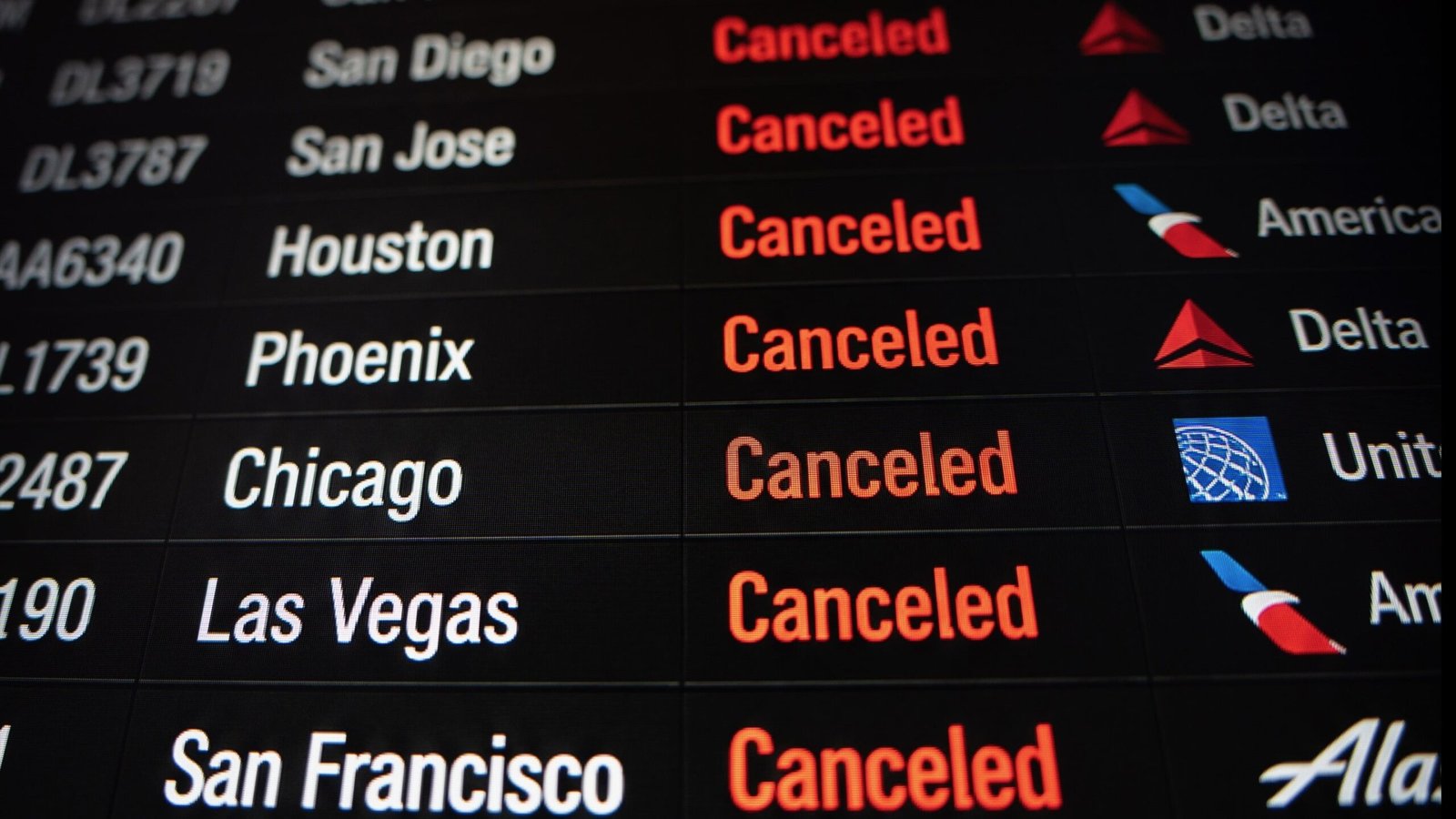
To avoid a repeat of last Friday’s ground stop at US airports, the Federal Aviation Administration has temporarily suspended its effort to install new routers from Hewlett Packard Enterprise’s (HPE) Juniper Networks.
The agency confirmed the suspension, first to The Wall Street Journal and then in an updated FAQ about the incident. “As a precaution, we disabled the same functionality on more than 60 other Juniper routers in the system, and we have paused installing them,” the FAA wrote.
On the same day, Democratic lawmakers sent a letter to US Transportation Secretary Sean Duffy, requesting the “immediate pause on the deployment of additional Juniper devices.”
Friday’s outage prompted the FAA to issue a rare nationwide ground stop that lasted nearly five hours at US airports and led to 12,462 flight cancellations. The agency blames the disruption on the contractor L3Harris, which is installing a new Juniper router at an FAA site in El Dorado, Arkansas, that is scheduled to switch from old-school copper lines to high-speed fiber.
The router misconfiguration caused data to flood the agency’s telecommunications infrastructure, “at a rate of 1,000 connection attempts every 4 to 5 seconds. This disrupted the system and created instability with aircraft communications and radar feeds,” the FAA’s FAQ says. “We began experiencing instability at 17 of our 22 Air Route Traffic Control Centers, and it spread into several Terminal Radar Approach Controls.”
On Tuesday, Duffy also noted that, “This was the 69th installation of that router. Sixty-eight times it worked well. This one, the router started to broadcast into our network, and it started to overload the network.”
The Juniper routers are replacing older Cisco routers at the FAA. L3Harris is now examining the Juniper router with help from Cisco, HPE, the FAA, and the FBI. Duffy reiterated that the US has so far uncovered no evidence of a cyberattack. “We’ve been able to recreate what happened in El Dorado. But [as to] the root cause of what happened, we don’t have clarity yet,” he said.
Recommended by Our Editors
“If we were subject to a hack, we will share that to you as well. But all of my intelligence partners are telling me that wasn’t the case,” Duffy added.
As part of the copper-to-fiber upgrade, L3Harris has been preparing to convert 3,648 routers to Juniper devices, according to Democrats on the Senate Committee on Commerce, Science and Transportation. “To date, it is our understanding that 400 devices have been installed, and 69 are operational,” the lawmakers wrote to Duffy. “With thousands of conversions remaining, FAA must address outstanding safety and reliability concerns before expanding installation.”
However, Duffy has defended his approach to migrating the FAA to modern IT systems. “We are moving at the right pace. But I’ll tell you, the longer we stay on a rickety network, the less safe it becomes,” he said, alluding to how some FAA systems still rely on tech from the 1980s. He’s now pressing Congress for another $50.1 billion to complete an overhaul of the air traffic control system, despite receiving $12.5 billion from Trump’s One Big Beautiful Bill.
About Our Expert

Michael Kan
Principal Reporter
Experience
I’ve been a journalist for over 15 years. I got my start as a schools and cities reporter in Kansas City and joined PCMag in 2017, where I cover satellite internet services, cybersecurity, PC hardware, and more. I’m currently based in San Francisco, but previously spent over five years in China, covering the country’s technology sector.
Since 2020, I’ve covered the launch and explosive growth of SpaceX’s Starlink satellite internet service, writing 600+ stories on availability and feature launches, but also the regulatory battles over the expansion of satellite constellations, fights with rival providers like AST SpaceMobile and Amazon, and the effort to expand into satellite-based mobile service. I’ve combed through FCC filings for the latest news and driven to remote corners of California to test Starlink’s cellular service.
I also cover cyber threats, from ransomware gangs to the emergence of AI-based malware. In 2024 and 2025, the FTC forced Avast to pay consumers $16.5 million for secretly harvesting and selling their personal information to third-party clients, as revealed in my joint investigation with Motherboard.
I also cover the PC graphics card market. Pandemic-era shortages led me to camp out in front of a Best Buy to get an RTX 3000. I’m now following how the AI-driven memory shortage is impacting the entire consumer electronics market. I’m always eager to learn more, so please jump in the comments with feedback and send me tips.
Leave a Reply