Andy Warhol famously said that in the future, everyone will have 15 minutes of fame. “Trust Me, I’m A Doctor” expands that tally to an hour and 51 minutes for Sandeep Kapoor, the physician who treated Playboy Playmate Anna Nicole Smith and was implicated in her death from a prescription drug overdose in 2007. That’s too long.
Though it’s difficult to chronicle any element of Smith’s life without injecting at least a hint of tabloid sensationalism, writer-director Thane Economou (“The Wedding Party”) takes an aggressively cheeky approach to the saga of Kapoor’s involvement, in the process undercutting what he clearly intends to be an empathetic portrait of both the doctor and his patient. Taking the lead in a rare film focused on a prominent Indian American, Kal Penn struggles to wrangle this flamboyant biopic into a serious acting challenge, but he delivers impressive work in its final scenes even if they fail to elevate what came before them.
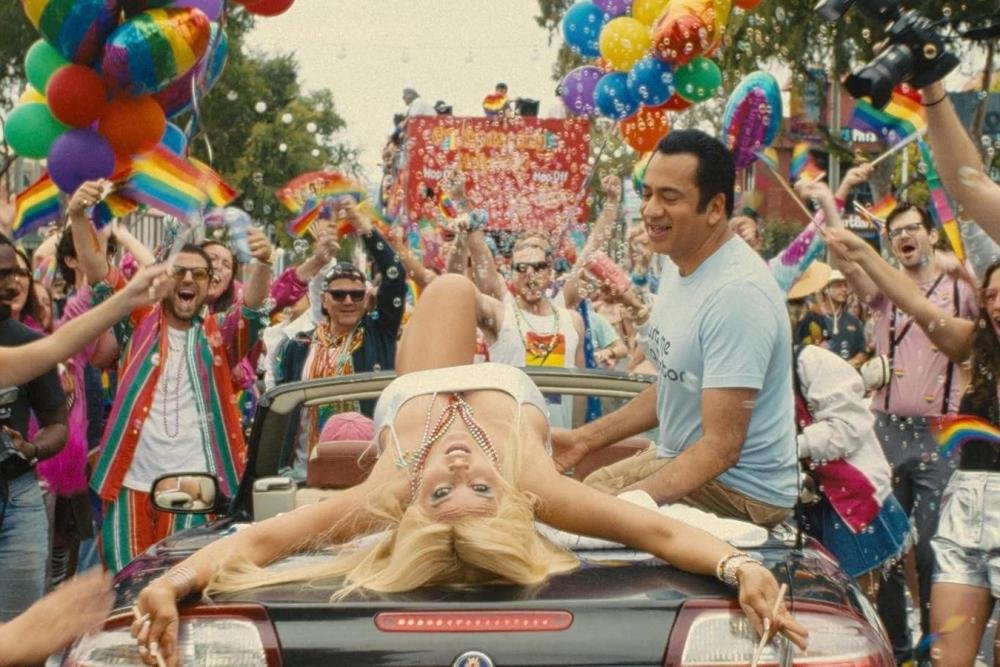
Penn plays Kapoor, a closeted physician who takes over a retiring colleague’s practice, in the process inheriting Anna Nicole Smith (Abbie Cornish) as a patient. Like his predecessor, Sandeep agrees to treat Smith under a pseudonym, but she quickly beguiles him with her childlike charm; despite his attempts to maintain a professional distance, he soon becomes a part of her inner circle. Shortly after she invites him to ride in a Los Angeles Pride parade where he participates in a self-described “orgy,” Anna announces that she’s pregnant — with whose baby, he does not know. Even so, he determines that failing to prescribe methadone to curb her festering drug addiction could harm her pregnancy, so he reluctantly writes a big order for her to take with her on a weeks-long trip to the Bahamas.
She eventually gives birth to a daughter, Dannielynn, and just three days later, loses her son Daniel (Jordan Kronis) to an overdose. A few months later, Sandeep learns from news reports that Anna herself has overdosed; he rushes to his office to confiscate her and Daniel’s medical files to protect them from being stolen or leaked, but the media has already staked out his practice. At the urging of a devoted patient, Margie (Jocelyne Zucco), he retains no-nonsense attorney Ellen Garofalo (Linda Hamilton) and mounts a PR campaign to present himself as the upstanding medical professional he claims to be. But when federal investigators discover Anna’s medical records in his underwear drawer, he becomes an official suspect in her death.
Eventually, the attorney general working at the direction of gubernatorial hopeful Jerry Brown charges Sandeep, along with Smith’s lawyer Howard K. Stern (David Julian Hirsh) and her psychiatrist Khristine Eroshevich (Virginia Cowan), of criminal conspiracy, with him as the lead plaintiff. As he fights to clear his name, Sandeep unexpectedly discovers that his best ally to win the case may be Harvey Levin (Elon Gold), the TMZ journalist whose photos first incriminated him, even as he reckons with the cost of his relationship with Smith on his family, his practice and his future.
According to this film, Sandeep Kapoor was kind of a nitwit regarding his time in the spotlight, but he ultimately occupied only a marginal place in Anna Nicole Smith’s story. His famous patient passes away 25 minutes into the film; the remaining 86 minutes focus on Garofalo’s legal maneuverings and his own incredulity at virtually every part of the process of being put through the public wringer.
Given Smith’s celebrity status and the sensational ups and downs of her life, it’s easy for an audience unfamiliar with Kapoor’s memoir, which inspired the film, to assume that he was a sycophant and enabler of this troubled woman. Economou seems to want to do justice to both his and his patient’s lives, but his script obfuscates Kapoor’s involvement in her death more than necessary by jumping back and forth in time, peppering what was already intriguing subject matter with fourth-wall-breaking monologues, montages that meld real and staged footage and at least one sidebar about a character who, though objectively interesting, is more or less totally irrelevant to this story.
Events such as his interview with Levin — as Garofalo’s legal strategy or his personal leap into the belly of the media beast — are especially fascinating when we see actual footage of their conversation over the closing credits. But they are unfortunately sandwiched between reams of expository commentary about each participant’s real and imagined motivations, political undertones of the lawsuit brought against him, and Kapoor’s only semi-convincing protestations of his innocence.
Understandably, Penn struggles to hold these disparate points of focus together with a performance that vacillates between disarmingly dopey and almost willfully ignorant of the realities of the 2000s media landscape. It does not help that, outside of Hamilton as his tough-as-nails defense lawyer, the rest of the performances are delivered at an almost parodic pitch, led by Cornish with a rendition of Smith that seems pitched more to “Saturday Night Live” than a real film for the big screen.
All of which is to say “Trust Me, I’m A Doctor” probably would have worked better as a documentary than as a narrative feature. Even taking Kapoor at his word that he never wanted and was happy to recede afterward from the public eye, Economou clearly possesses an impressive enough archive of material to tell this story with or without his participation, with the same multimedia flair that he deploys here. If nothing else, moviegoers wouldn’t have had to watch Cornish play Smith, an admittedly unenviable acting tightrope that she navigates clumsily at best. Kapoor, meanwhile, seems much more self-possessed in the real footage, making him precisely as sympathetic as the filmmaker intended.
Following a handful of genuinely powerful scenes by Penn that sadly come too late to offset the circus-like tone established earlier, the film concludes with a montage detailing what happened to everyone involved after the verdict was handed down in Kapoor’s case. The overarching message of that sequence is that something about celebrity worship seems to drive people crazy, imagining anything connected to it as more significant than it actually is. With respect to Kapoor, Economou should have paid more attention to the epiphanies of his own film; the rollercoaster of Smith’s life will always be a curio, but that doesn’t mean that every passenger on it has a story worth telling.
Leave a Reply