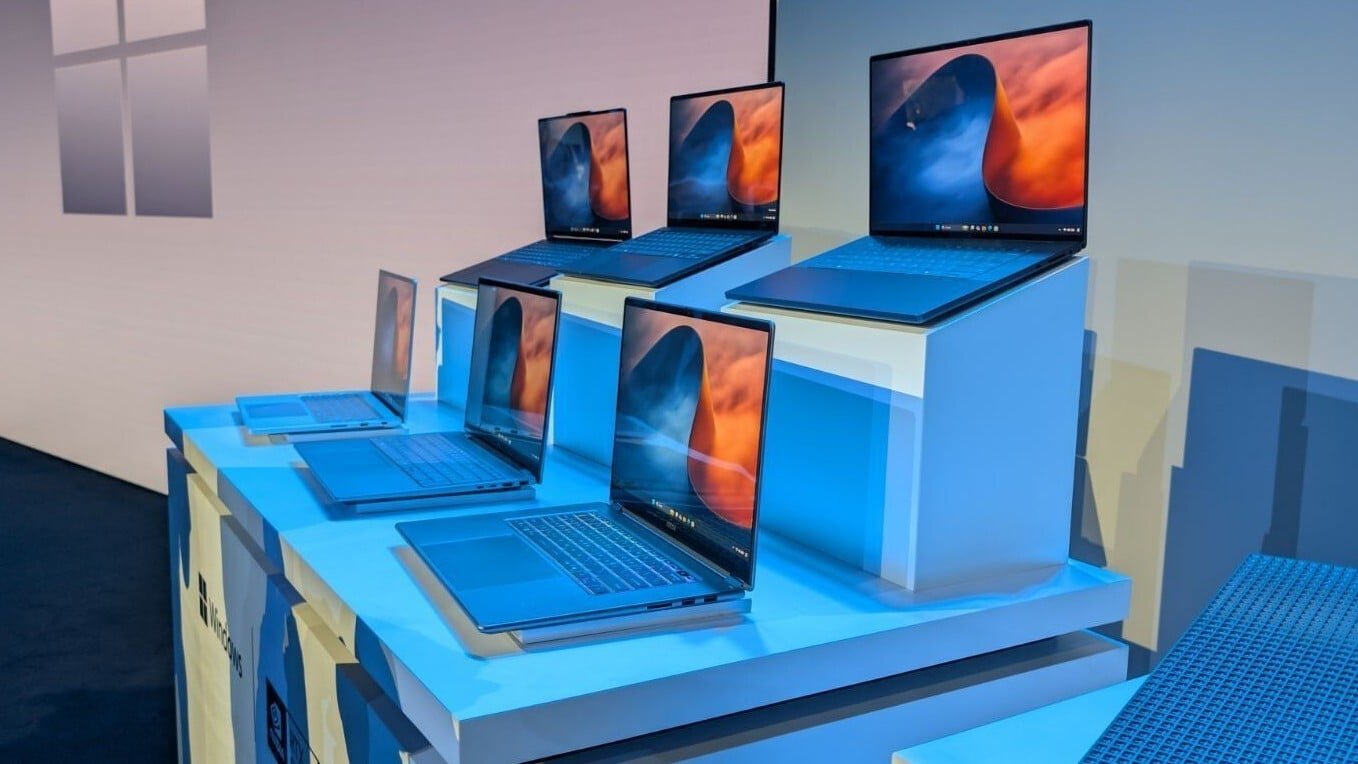
The Microsoft Surface event of Oct. 7 was, indeed, a rare spotting: Microsoft CEO Satya Nadella and Nvidia CEO Jensen Huang sharing the stage to unveil a joint vision for personal computing. Seeing the leaders of Microsoft and Nvidia together in one keynote is a singular event in itself, but what followed was even more notable: a commitment to tight co-engineering across hardware and software, spanning multiple brands and manufacturers, of a kind the PC industry hasn’t seen in years.
This event wasn’t just about a single laptop or an incremental operating system update. (That said, we did get info on the Oct. 16 availability, and pricing, of the first RTX Spark PCs.) It was a dual showcase split across two deeply intertwined pillars: Nvidia’s new RTX Spark hardware platform, and Microsoft’s re-engineered Windows features built for local AI models and autonomous agentic tools.
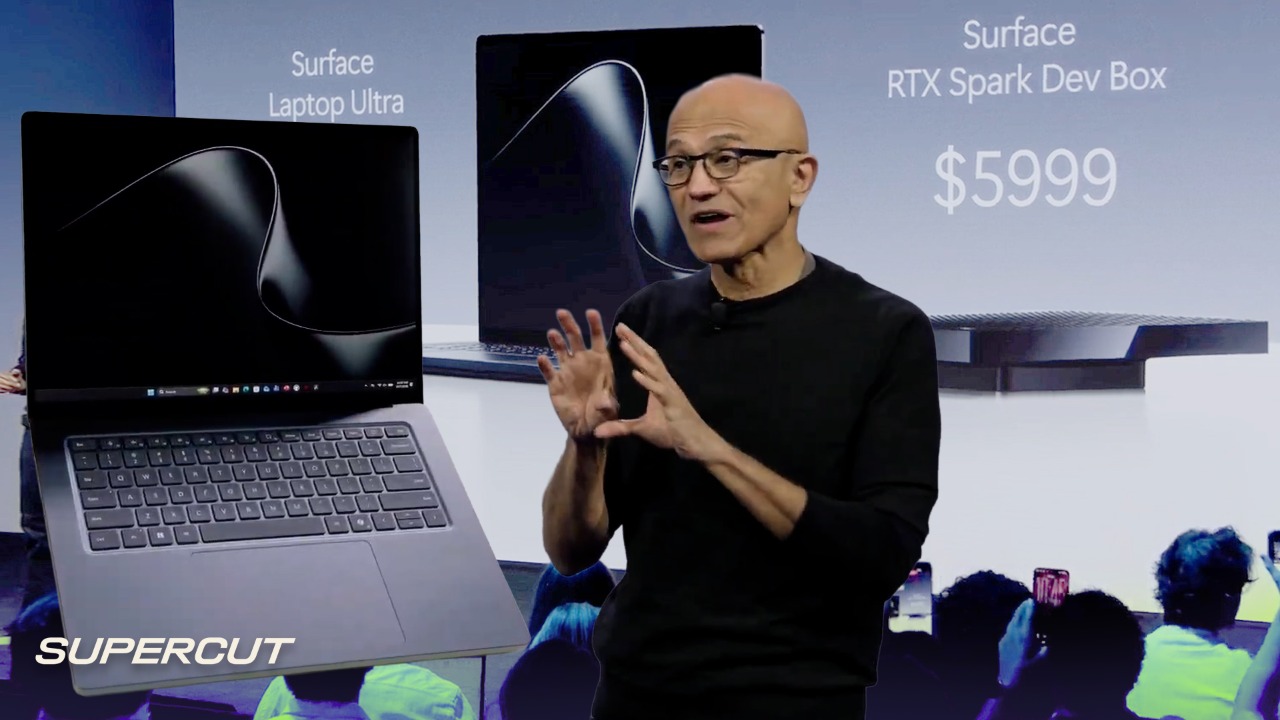

Windows, Surface and Nvidia Event Highlights: Everything Announced in 16 Minutes
The two go hand in hand. While Nvidia’s silicon provides the raw compute and unified memory needed to run heavy AI models on-device, Microsoft is providing the OS-level sandboxing, identity attribution, and security required to make those tools safe and manageable. Together, they are setting the stage for a long-term shift toward a future where personal computing and personal AI agents are inseparable.
30 Years in the Making: The Origins of Surface Laptop Ultra and RTX Spark
During the keynote, Nadella and Huang sat down to discuss the history of PCs and how it led us to this moment—tracing a direct line from Windows 3.1 influencing the creation of Nvidia in the early 1990s, to Nvidia developing DirectX 8 programmable shaders with Microsoft, to CUDA, and ultimately setting the stage for today’s AI revolution.

(Credit: Brian Westover)
That historical context is important because, as Huang noted, this is the start of a new era of computing. That might sound like marketing fluff, but he is genuinely right.
AI tools empower users to do things that previously required entire teams and sophisticated software suites. Now, a single local model can accomplish vastly more, and specialized tools can be stitched together in platforms like ComfyUI to build complex workflows that handle heavy multitasking automatically.
While AI agents haven’t hit the mainstream yet—remaining mostly confined to enthusiasts and developers—this event marks an important step toward bringing those capabilities to the broader market.
NPUs vs. GPUs vs. RTX Spark: The Three Tiers of AI Hardware Defined
To understand where RTX Spark fits, it helps to draw a sharp distinction between what we’ve been calling a standard “AI PC” with an NPU and the heavy-duty hardware being introduced today. The market is effectively splitting into three distinct hardware tiers:
Consumer AI PCs: Designed around PCs with 40-to-50-TOPS NPUs and 16GB to 32GB of system RAM. These provide just enough muscle for lightweight tasks—summarization, noise cancellation, webcam framing, and basic app-level content generation. However, the main system memory ceiling on these PCs imposes a hard limit on the size of models they can execute.
Traditional Workstations and Gaming Laptops: These bring dedicated GPUs into the mix, leveraging parallel-processing horsepower to crunch heavier AI workloads. However, they remain constrained by dedicated VRAM pools (typically 12GB to 24GB, or occasionally 32GB on ultra-high-end mobile GPUs), limiting how large a model or context window can be loaded directly onto the card.

(Credit: Brian Westover)
Big-Memory Local AI Systems (“Builder PCs”): A growing tier consisting of workstation dev boxes, Apple M-series Macs, and now RTX Spark PCs. By using large, high-bandwidth pools of unified memory (up to 128GB on the Surface Laptop Ultra, and some other RTX Spark models), these machines bypass traditional VRAM bottlenecks. This unified memory allows multi-billion-parameter models and massive context windows to run locally, eliminating the need to send data to a cloud data center.
Apple built an early lead in this third category by centering its Mac lineup around unified-memory-backed SoCs before the generative AI boom arrived, finding widespread adoption among developers eager to run local LLMs and coding agents. But RTX Spark brings that exact unified-memory capability into a mobile Windows form factor. It scales down server-grade architecture just enough to fit a portable laptop chassis at price points developers and enthusiasts can swallow. That’s a big deal today, to be sure. But it also serves as a vision of the future—one in which these capabilities trickle down to more typical consumer systems.
RTX Spark ‘Builder PCs’: Curing Token Burn With Unified Memory
Over a year and a half ago, after Nvidia first announced the DGX Spark developer desktop, I wrote:
“Using AI may be a rarified niche now, but it won’t stay that way. Today’s cutting edge becomes tomorrow’s baseline, and as powerful AI works its way into more devices and apps, the hardware that drives it all will go from niche to mainstream.”
Get ready for that prediction to come true. RTX Spark—Nvidia’s Windows-friendly silicon that combines the company’s “Blackwell” GPU architecture with high-performance CPU cores—is bringing server-class AI power to a new class of laptops. In my own writing, I previously dubbed this concept the “personal supercomputer,” but Microsoft is settling on a slightly less hyperbolic name: the “Builder PC.”

(Credit: Brian Westover)
Where traditional workstation laptops are built around raw graphics power and ISV-certified software compatibility, this new breed of system is engineered specifically for AI and the large, shared pools of unified memory needed to run local models. Microsoft outlined these as “high-performance PCs that bring local and cloud together.”
That is the crux of today’s announcement: a new tier of compute that allows local AI models to run entirely on-device, alleviating the “token anxiety” felt by companies getting walloped by out-of-control API bills.
Agents in particular burn dramatically more tokens than a simple back-and-forth chatbot conversation. A single task can require multiple reasoning steps, tool calls, and self-reflection loops as the model plans, executes, and checks its progress against parameters. Companies going all-in on agentic frameworks like OpenClaw have seen token usage explode—a concerning trend when you or your company is bound to a per-token pricing model.
The RTX Spark hardware launch aims to address this directly. With up to 128GB of unified memory and 1 petaflop of compute, these machines promise the ability to run local LLMs, chatbots, and image generation entirely on-device. While local performance might not quite match top-tier cloud models from OpenAI or Anthropic yet, it’s workable. Indeed, when an agent can run in the background or overnight at zero marginal cost, speed and parameter count take a back seat to token burn.
Windows 11 and Surface Laptop Ultra: Keeping Autonomous AI Agents on a Leash
Then there’s the question of trust and accessibility. As headlines warn of agents deleting codebases, making unauthorized purchases, or falling victim to prompt injections, user concern over unsupervised AI is valid. Microsoft is addressing these risks directly with new OS-level features built around containment, transparency, and attribution.
First among these is containment, as Microsoft adds built-in sandboxing specifically to keep agents on the leash, away from data and systems that need to be safeguarded. Coming to Windows 11, Microsoft Execution Containers (MXC) provide lightweight, runtime sandboxing that gives developers control over which local directories, network endpoints, or tools an agent can access. Windows will enforce these boundaries at the OS level.

(Credit: Brian Westover)
Next is OS-level agent attribution. As humans use agents to carry out specific tasks, it gets pretty blurry who is responsible for what if an operation goes off the rails. After all, an agent running on someone’s laptop looks a whole lot like a human user, even when things start to go wrong, whether due to user error, AI hallucinations, or a malicious prompt injection by a third party. To help parse these events in the future, Microsoft is creating separate human and agent identities, which makes it possible to isolate, restrict, or block an agent without blocking the human user or disrupting their work.
Beyond security, what users are waiting for is the “killer app” that brings agents into the mainstream. Frameworks like OpenClaw created the template, but setting them up remains complex—the average PC user doesn’t know a GitHub distribution from a Markdown file.
To bridge that gap, Microsoft introduced a new streamlined agent-onboarding experience in Windows, offering one-click setups and simplified management right out of the box. As these tools evolve, background execution and agent management will become as simple to toggle as any standard desktop application.
Can RTX Spark Power Big AI Workloads Without Tanking Battery Life?
The first wave of PCs that promise to power this revolution is, collectively, the RTX Spark platform, powered by Nvidia’s new N1X SoC and coming from all the usual OEM suspects, including Asus, Dell, HP, and Lenovo. The machine in the vanguard is the Surface Laptop Ultra, Microsoft’s flagship Spark laptop, first shown at Computex 2026. (See our initial hands-on.)
One of the boldest claims made for the Surface Laptop Ultra is that it can maintain more than 99% of its total performance while running on battery power. That is an audacious statement for a portable PC built to run heavy local AI models and continuous background agents.
Local AI execution is notoriously power-hungry. Achieving unthrottled output off the plug requires a delicate balance of silicon efficiency, aggressive thermal management, and smart fan design. (Indeed, Microsoft claims a 2.5x increase in thermal capacity for the Laptop Ultra chassis; our hands-on time illustrated a bit about the cooling scheme.) How that translates to real-world battery drain, fan noise, and surface temperatures under sustained agentic workloads remains to be seen—and it’s something we will be testing thoroughly in PC Labs once review units land.
Sparked: The Next Paradigm Shift in Personal Computing
All of this—the RTX Spark hardware, the Windows AI enhancements, and the increased control and visibility for agents—signals a fundamental shift in personal computing that I’ve been tracking for years. Once AI models and autonomous agents become accessible to non-technical users on everyday hardware, personal computing will look vastly different.
Much like the smartphone enabled app stores to flourish, and how high-speed mobile data created entirely new product categories (such as streaming and podcasts), agentic AI will shift how we interact with technology: evolving from a tool we use to do things, into a tool that acts on our behalf.
We are still in the early stages of that transition, but things are moving very fast. A primary reason Microsoft and Nvidia are pushing these tools so aggressively is to seed the developer ecosystem for what comes next. Armed with local agentic hardware, developers will build intuitive, task-focused tools with simpler implementations for everyday users. The systems sold today as “Builder PCs” for developers and creators are paving the way for increasingly accessible consumer devices—setting off hardware upgrade cycles for years to come.
About Our Expert

Brian Westover
Principal Writer, Hardware
Experience
From the laptops on your desk to satellites in space and AI that seems to be everywhere, I cover many topics at PCMag. I’ve covered PCs and technology products for over 15 years at PCMag and other publications, among them Tom’s Guide, Laptop Mag, and TWICE. As a hardware reviewer, I’ve handled dozens of MacBooks, 2-in-1 laptops, Chromebooks, and the latest AI PCs. As the resident Starlink expert, I’ve done years of hands-on testing with the satellite service. I also explore the most valuable ways to use the latest AI tools and features in our Try AI column.
Leave a Reply