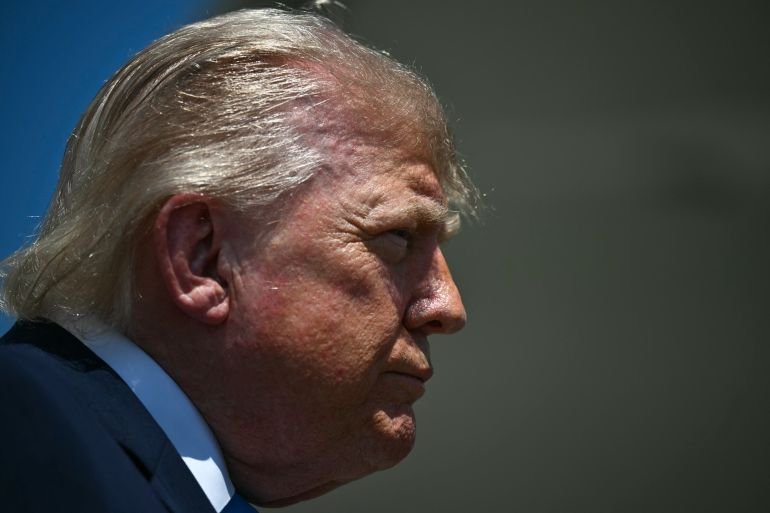
The United States Department of Justice has introduced an “anti-weaponisation fund” that will be used to financially compensate people who claim they have been unfairly targeted by the federal government.
The fund, announced on Monday, is part of a settlement arising from a lawsuit that President Donald Trump filed against the Internal Revenue Service (IRS) this year, blaming it for a leak of his tax information.
How did the ‘anti-weaponisation fund’ come about?
Between 2018 and 2020, Trump’s tax information was leaked to The New York Times. In 2023, Charles Edward Littlejohn, a former contractor at the IRS, was accused of providing those tax returns, according to a statement from the US Justice Department. The Times, citing the returns, reported in 2020 that Trump, a billionaire, had paid little or no federal income taxes over 15 years.
The IRS is the US government’s revenue service responsible for collecting federal taxes and enforcing tax laws.
Littlejohn pleaded guilty to disclosing the returns and in 2024 was sentenced to five years in prison.
In January, Trump sued the IRS and Department of the Treasury, which are part of his own government, for $10bn, accusing the agencies of failing to prevent the leak of his tax information.
On Tuesday, the office of the attorney general in Washington DC, announced the establishment of the “anti-weaponisation fund” as part of a settlement agreement between the two sides.
“The machinery of government should never be weaponized against any American, and it is this Department’s intention to make right the wrongs that were previously done while ensuring this never happens again,” Acting Attorney General Todd Blanche, who was appointed by Trump, was quoted as saying in a Justice Department news release published on Monday.
“As part of this settlement, we are setting up a lawful process for victims of lawfare and weaponization to be heard and seek redress.”
How will the fund work?
The fund will receive just under $1.8bn, which will come from a separate “judgement fund”, a standing government account from which the US government pays legal settlements and court judgements without requiring an act of Congress each time.
People who believe they have been harmed by unfair legal action by the federal government may seek compensation from the new fund by filing a claim.
Every three months, the fund is supposed to issue a report to the attorney general that is to include details about who has received payments or relief and whether that is in a cash payment, debt relief or some other form of compensation.
The fund is to be overseen by a team of five people appointed by the attorney general. One member of that panel will be appointed in consultation with congressional leaders.
The fund is to operate until December 1, 2028, after which it is to stop accepting new claims.
Because the fund was established as part of a Justice Department settlement and has already been approved by a federal judge, it does not require any further approvals to become operational. However, critics are calling for Congress to intervene.
Why is the fund controversial?
Some Democrats are objecting to the creation of this fund, and several legal experts have argued that using a legal settlement to create such a large compensation scheme pushes the limits of executive authority.
They said they believe the fund will ultimately be used to pay off Trump supporters who rioted at the US Capitol on January 6, 2021, but have since been pardoned by Trump himself.
On January 6, 2021, thousands of rioters, fuelled by false claims that the 2020 presidential election had been rigged against Trump, stormed the Capitol to try to stop the certification of Democrat Joe Biden’s victory.
More than 2,000 people broke into the seat of the US Congress, vandalised offices and fought with police. Five people were killed and others injured.
About 1,270 people were convicted of federal crimes linked to the riot, and their prison sentences ranged from a few years to more than two decades for leaders of far-right groups.
On the day he was inaugurated for his second presidential term in January last year, Trump pardoned or commuted the sentences of 1,500 people who had been convicted or indicted in relation to the riots, calling their treatment “outrageous”.
More than 90 Democrats in the House of Representatives filed a legal document to try to block the new fund, according to a news release published on Monday by the office of one of these Democrats, Congressman Seth Moulton.
“This taxpayer-funded pool is intended to compensate individuals who claim they were ‘persecuted’ by the previous administration – specifically targeting payouts for January 6th convicts and participants in the ‘fake electors’ conspiracy.”
Massachusetts Senator Elizabeth Warren, a Democrat, described the fund in an X post as a “$1.7 BILLION slush fund for Trump’s hand-picked stooges to hand money to January 6th insurrectionists and his political allies”.
Warren called the fund an “insane level of corruption – even for Trump”.
The size of the fund has also sparked controversy. At $1.8bn, the fund is comparable to a midsized US city’s annual policing or school budget. It far exceeds the usual amount associated with a single lawsuit.
Why are critics calling this a ‘slush fund’?
Oregon Senator Ron Wyden wrote in an X post on Monday: “Trump deserves no credit for dropping this lawsuit. He’s doing it to set up a $1.7 billion slush fund for right-wing political violence. If Trump follows through, it will be the most brazen theft of taxpayer dollars by any president in history.”
A slush fund is an unregulated fund used for covert or even illegal purposes.
The Cato Institute, a Washington, DC-based think tank, published an analysis on Wednesday titled “Trump’s Anti-Weaponization Fund Is a (Another) Slush Fund.”
It said the creation of a new spending programme without congressional authorisation fits the Trump administration’s well-established pattern of improvising ways for Trump to bypass Congress.
How is the Trump administration defending this?
The acting attorney general argued that the fund is similar to one set up during former Democratic President Barack Obama’s administration. “This was done during the Obama administration, something almost identical in structure,” Blanche told a Senate appropriations subcommittee on Tuesday, adding: “It is true that this is unusual. That is true, but it is not unprecedented.”
Blanche was referring to the 2011 Keepseagle v Vilsack settlement, which provided compensation for Native American farmers and ranchers. Adjusted for inflation, the roughly $680m Keepseagle compensation fund from 2011 would be worth about $1bn today.
In that settlement, after the funding was used to pay approved claims, hundreds of millions of dollars in leftover money was distributed to nonprofits and NGOs that had not filed claims.
This week, the Justice Department has stated that if money is left over in the new fund after December 1, 2028, it would be redirected back to the federal government.
“The analogy that has been drawn to that case is grossly inaccurate,” PBS News quoted Joseph Sellers, the lead attorney who represented the Native American plaintiffs in the case, as saying.
He said this is because Trump v IRS was not a class-action lawsuit.
Legal experts also argued that, unlike the Keepseagle settlement, the new fund will operate largely without any judicial oversight.
Leave a Reply