Tag: News – Al Jazeera

  • How the US-Iran talks in Islamabad unfolded

    How the US-Iran talks in Islamabad unfolded

    Islamabad, Pakistan – The capital woke up on Saturday to lockdown: Roads were sealed, checkpoints appeared, and more than 10,000 security personnel were deployed ahead of  ceasefire talks between the United States and Iran.

    The Iranian delegation arrived late on Friday night, their movement swift and largely unseen. We followed the flight en route to Islamabad via Balochistan. A Pakistani air force plane quickly switched off its call sign inside Pakistani airspace. By the following afternoon, the Americans landed at Nur Khan Air Base, which India claimed to have damaged during the brief war last year.

    Recommended Stories

    list of 3 itemsend of list

    On the tarmac, three extraordinary tail fins stood out. One American, two Iranian. It was a small detail, but in a region defined by symbolism, not insignificant.

    From the base, the motorcades moved along pre-cleared routes to the Serena Hotel, the venue of the talks. The property, which had been attacked by armed groups in the past, was vacated days earlier. Guests were asked to check out, floors secured, staff vetted. What remained was not a hotel, but a controlled diplomatic environment.

    The stage was set for the first direct, high-level engagement between post-revolution Iran and the United States… on Pakistani soil.

    ‘To talk or not to talk’ was the question

    Inside the negotiation room was expectedly a collision of two fundamentally different worldviews – an American “peace through strength” versus the Iranian “resistance with dignity.”

    “This is a make-or-break moment for lasting peace,” Pakistani prime minister Shahbaz Sharif said the night before.

    Nothing, it seemed, had been guaranteed. Ahead of the arrival, Iran’s chief negotiator, Mohammad Bagher Ghalibaf, had publicly set conditions – no talks without movement on a ceasefire in Lebanon, and no progress without the unfreezing of Iranian assets abroad.

    Iran wants the ceasefire to include the Lebanon front, where Israel has continued a brutal campaign, killing more than 2,000 people. Tehran is also seeking the unlocking of its frozen assets due to years of US sanctions, which have crippled its economy.

    The message was clear: diplomacy, not dictation. Negotiations which could not be detached from the realities of the conflict.

    Yet, within hours of both delegations landing, separate, bilateral engagements began. For Pakistani officials involved in the process, this was the breakthrough thaw.

    This was not an unfamiliar setting, and the failures of the recent past lingered. Talks between Washington and Tehran have happened before – in Muscat, Vienna, Geneva and Abu Dhabi. But each round carried with it a familiar undertone: mistrust, layered over years of confrontation and broken commitments. But never before were they face-to-face and at this level – negotiators including the US vice president JD Vance and the speaker of the Iranian parliament Ghalibaf.

    It was within this context that Islamabad’s role became significant. It was happening amid deepened mistrust. Iranian officials pointed to the killings of its officials, including security chief Ali Larijani, while negotiations were ongoing.

    Pakistan managed what others couldn’t with geography, religion and regional relations. It has close ties with Gulf states, including Saudi Arabia and Qatar. It shares a long and sensitive border with Iran. Its ports sit close to one of the world’s most critical energy chokepoints – the Strait of Hormuz. And its relationship with China adds another layer of strategic relevance. Unlike several other mediators in the region, it does not host US military bases. Yet its powerful army chief Asim Munir is Donald Trump’s “favourite field marshal”

    Taken together, these factors placed Islamabad in a position few others could claim – able to speak to all sides, without formally belonging to any.

    The long night

    Once the talks began, they did not pause for long. Officials described the 21 hours of talks as “continuous, but uneven”.

    The first session lasted under two hours. It was followed by a pause, which was partly procedural, partly cultural. Dinner was served, but conversations continued, albeit without structure.

    What followed after that was more intense: Multiple rounds, drafts exchanged, and positions restated. Behind the scenes, there had already been dozens of calls between leaders, red lines redrawn and tremendous pressure from capitals – Washington and Tehran.

    Those familiar with the discussions say progress came in fragments – small areas of convergence, followed by immediate pushback elsewhere. At times, there were indications that a framework might be within reach. At others, the gaps appeared to widen.

    “It was a cycle,” one person close to the process said.

    Throughout, communication lines with capitals remained active. The American delegation was in repeated contact with Washington, including with President Donald Trump. Iranian negotiators, too, were reportedly relaying developments back home.

    For Pakistan’s leadership – prime minister Sharif, foreign minister Ishaq Dar, and army chief Asim Munir – the days leading up to the talks had already been consumed by preparation. Officials say sleep had been scarce, and coordination was non-stop. The objective, they insist, was modest: not a final agreement, but the outline of one which prevents escalation.

    Then it all stalled

    By the time the final stretch began, expectations had shifted. There had been discussion of extending the talks into a second day. Iranian officials indicated they were willing to stay. But the American side chose to conclude – from the outside, it felt abrupt and shocking.

    When JD Vance emerged, his assessment was direct. “We have been at it now for 21 hours,” he said. “The good news is that we’ve had substantive discussions. The bad news is that we have not reached an agreement.”

    He framed the outcome in strategic terms. The United States, he said, had made its position clear – particularly on Iran’s nuclear programme.

    “We need to see an affirmative commitment that they will not seek a nuclear weapon… not just now, but for the long term. We haven’t seen that yet”. He added that Washington had presented what he described as its “final and best offer”. Washington’s message was: We were flexible, they refused.

    Iranian officials did not contest the duration or the intensity of the talks. But their interpretation differed sharply. Iran’s ambassador in Islamabad described the negotiations as “not an event, but a process” – one that had, in his words, “laid the foundation” for future engagement.

    Among the issues cited were demands linked to the Strait of Hormuz, nuclear material and broader regional influence. And behind that measured language, the messaging hardened. State-affiliated outlets, including Fars and Tasnim, characterised the US position as excessive, arguing that Washington had sought concessions it had failed to secure through military pressure.

    A spokesperson for Iran’s foreign ministry framed the talks in more ideological terms.“For us, diplomacy is a continuation of struggle,” he said, referencing what he described as past “transgressions” by the United States. At the same time, he left space for continuation – stating that progress would depend on “seriousness and good faith” from the other side.

    The US had joined Israel in attacking Iran’s nuclear facilities last year.

    For Pakistan, the public posture remained cautious. “We thank both sides for participating,” finance minister Dar said. “We hope they maintain a positive spirit. Pakistan will continue to facilitate”.

    No victory claim, no reference to any failure – just continuity.

    Privately, officials acknowledge the constraints. There are competing pressures – from within Iran, from within the US, and from regional actors with their own stakes in the outcome. One government source described these as “detractors on all sides,” capable of influencing both pace and direction.

    Among those frequently mentioned, though not publicly, is Israel and its prime minister Benjamin Netanyahu. Some point to a “Zionist” broader strategic calculus in a prolonged regional confrontation. Views which reflect the wider geopolitical layering around the talks.

    “There are detractors in Tehran. Detractors in Washington. But the biggest impediment to peace is Israel — which benefits from perpetual conflict,” a senior source told us.

    The day after

    By the following day, Islamabad had not fully returned to normal. As security remained in place, traffic diversions continued and the Serena Hotel stayed under tight control. There were indications – unconfirmed, but repeated – that lower-level contacts had not entirely stopped.

    At the Convention Centre, where journalists had been gathered during the talks, the atmosphere had been markedly different. Large screens, stable connections, free-flowing chai, coffee and food – but little in the way of substantive information. In a country where unofficial comments often find their way into headlines, the absence of leaks was notable. “It was unusually disciplined,” one reporter said.

    As the aircraft departed, carrying the delegations out of Islamabad, the outcome remains unchanged.

    But in a conflict defined by distrust, ending with no agreement, no framework, but also – no breakdown; is considered positive diplomatic progress.

    The door closed for now, but it is not locked.

  • US military threatens to blockade all Iranian ports starting on Monday

    US military threatens to blockade all Iranian ports starting on Monday

    Vessels will still be able to transit Strait of Hormuz to and from non-Iranian ports, says CENTCOM; Iran warns any approaching military vessels will be breaching ceasefire.

    The United States military has announced it will begin blockading all Iranian ports on Monday, its latest move to exert pressure on Tehran after marathon peace talks in Pakistan concluded without a deal.

    In a statement on Sunday evening, US Central Command (CENTCOM) said the blockade would apply to “all maritime traffic entering and exiting Iranian ports” from 10am Eastern Time (14:00 GMT) on April 13. That includes “vessels of all nations entering or departing Iranian ports and coastal areas”, including those on the Gulf and the Gulf of Oman.

    Recommended Stories

    list of 3 itemsend of list

    However, US forces “will not impede freedom of ⁠navigation for vessels transiting the Strait ⁠of Hormuz to and ⁠from non-Iranian ports,” CENTCOM said, in an apparent scaling back from President Donald Trump’s earlier threat to blockade the entire strait and pursue ships paying tolls to Iran.

    “There are a lot of questions here,” said Al Jazeera’s Heidi Zhou-Castro from Washington, DC, pointing to “conflicting information” coming out of the US side.

    “Trump said the blockade would target any and all ships trying to enter or leave the Strait of Hormuz. But CENTCOM is saying this would only target ships going to or from Iranian ports.”

    The price of US crude oil jumped 8 percent to $104.24 a barrel after the US blockade threat. Brent crude oil, the international standard, increased 7 percent to $102.29.

    Iran has essentially taken control over the Strait of Hormuz, a vital chokepoint for the global energy market, since the US and Israel launched a war against the country on February 28. Traffic through the waterway has since slowed to a trickle, nearly paralysing about one-fifth of the world’s oil and liquefied natural gas shipments.

    Iran has continued to move its own vessels through the strait, while allowing limited passage of ships from other countries. Iranian officials have discussed setting up a toll system after the fighting ends.

    In a statement responding to Trump’s blockade threat, Iran’s Islamic Revolutionary Guard Corps said any approaching military vessels would be in breach of a US-Iran ceasefire – meant to be in effect until April 22 – and “will be dealt with severely”.

    The US-declared blockade appears to be triggered by the failure of the talks in Pakistan’s capital, Islamabad, raising fears of renewed fighting.

    Iranian officials blamed the US side for failing to reach a deal, with Minister of Foreign Affairs Abbas Araghchi saying US negotiators shifted the “goalposts” and obstructed efforts when a memorandum of understanding was “just inches away”.

    Zohreh Kharazmi, an associate professor at the University of Tehran, said the US “is not in a position to dictate” to Iranians how to behave, or “to choose which vessels may pass”.

    “If this blockade becomes a contest between the resilience of the Islamic Republic and the resilience of global markets, it will not take long to see who is losing,” she said, adding that Iran “is ready for a prolonged war”.

    “Technically, they [the US] cannot control the situation. With Hollywood-style strategies, they cannot prevail in this battleground.”

  • Machete-wielding man killed by police in New York’s Grand Central station

    Machete-wielding man killed by police in New York’s Grand Central station

    Three elderly victims were wounded at the transit hub, and the alleged attacker is in critical condition, police said.

    A man wielding a machete was fatally shot by police in New York City’s Grand Central station, after allegedly wounding three elderly individuals, according to the local police department.

    Police responded to a call about a man with a knife at the iconic transit hub at 9:40am United States Eastern time (13:40 GMT) on Saturday.

    Recommended Stories

    list of 3 itemsend of list

    One police officer opened fire, striking the man, who was taken to a local hospital in critical condition.

    Three individuals — an 84-year-old man, a 70-year-old woman and a 65-year-old man — were wounded before police arrived at the scene, according to a New York Police Department (NYPD) spokesperson.

    All three victims were hospitalised in stable condition. Further details of the incident were not immediately available.

    In a statement, New York City Mayor Zohran Mamdani said the attacker later died from the wound.

    He said police had opened fire when the man “did not drop the machete”.

    “I’m grateful to the NYPD for their quick response and for preventing additional violence,” he said.

    “The NYPD is conducting an internal investigation and will release body-worn camera footage, as it does in all incidents involving the discharge of an officer’s firearm.”

    The suspect’s identity and what motivated the attack were not immediately known.

    Grand Central station is one of the best known and travelled transit hubs in the United States.

    Located in Midtown, Manhattan, it is a nexus of several New York City subway lines, as well as the regional Metro-North Railroad system.

    Known for its Beaux-Arts architecture, the terminal is also one of the most visited tourist attractions in the world, with an average of 750,000 travellers and visitors a day.

  • Trump says Strait of Hormuz to reopen ‘soon’ as US, Iran head to talks

    Trump says Strait of Hormuz to reopen ‘soon’ as US, Iran head to talks

    Trump says Washington will not accept Iran’s imposition of a de facto toll booth system in the critical waterway.

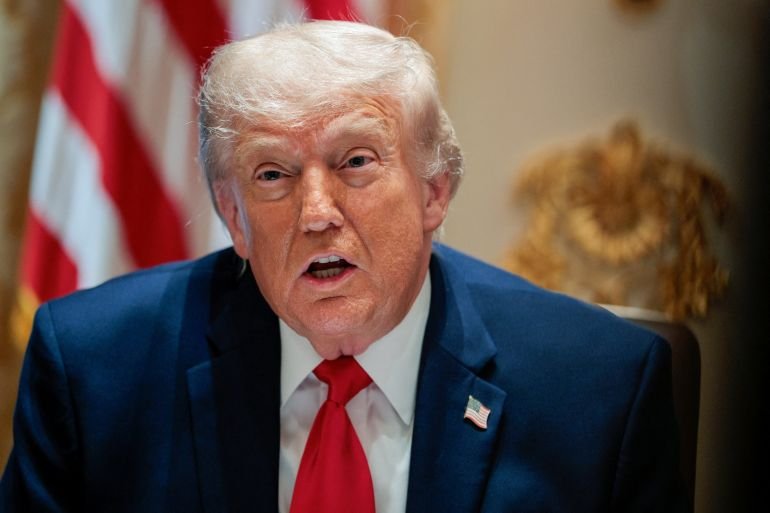
    United States President Donald Trump has said the Strait of Hormuz will reopen “fairly soon” with or without Iran’s assistance, as Tehran’s effective blockade of the waterway continues to roil global energy supplies.

    Speaking to reporters on Friday in advance of peace talks between US and Iranian officials in Pakistan, Trump said the US would “open up the Gulf” and that other countries were ready to “help out”.

    Recommended Stories

    list of 4 itemsend of list

    “It won’t be easy,” Trump said.

    “I would say this: We will have that open fairly soon,” he added.

    Trump, who did not elaborate on how Washington would unblock the critical maritime chokepoint, also said he would not accept Iran’s imposition of a de facto toll booth system in the strait.

    Tehran has indicated that it intends to charge vessels fees for safe passage even in the event that a deal is reached with the US to end the war.

    “If they are doing that, we’re not going to let that happen,” Trump told reporters before boarding Air Force One at Joint Base Andrews in Camp Springs, Maryland.

    Trump said ensuring Iran does not possess nuclear weapons is the priority in any agreement, and the strait would open “automatically”.

    “No nuclear weapons, that’s 99 percent of it,” Trump said.

    “The strait will open up,” he added. “If we just left … otherwise they make no money.”

    Despite the announcement of a two-week ceasefire between the US and Iran on Tuesday, shipping in the strait remains at an effective standstill, disrupting approximately one-fifth of global oil and natural gas flows.

    Only two vessels passed through the strait on Friday, down from five the previous day, according to S&P Global Market Intelligence.

    Since the start of the ceasefire, just 22 ships with their automatic identification system turned on have exited the strait, according to the market intelligence provider, compared with about 135 daily transits before the war.

    More than 600 vessels, including 325 tankers, are still stranded in the Gulf due to the blockage of the strait, according to Lloyd’s List Intelligence.

    US Vice President JD Vance and Iranian parliamentary speaker Mohammad Bagher Ghalibaf are on Saturday set to lead negotiations in Islamabad aimed at securing a permanent end to the war.

    The US and Iran have offered conflicting messages on the agreed-upon terms for the negotiations, including the contents of a 10-point plan put forward by Tehran.

  • Brazil announces US partnership to intercept weapons, drug trafficking

    Brazil announces US partnership to intercept weapons, drug trafficking

    The Brazilian government has announced a new security partnership with the United States to combat criminal networks, as well as the illicit traffic of drugs and weapons.

    In a social media post on Friday, Brazil’s President Luiz Inacio Lula da Silva called the deal a breakthrough.

    Recommended Stories

    list of 3 itemsend of list

    “Brazil and the United States today established unprecedented cooperation between the Brazilian Federal Revenue Service and US Customs,” he wrote on social media.

    “We will intensify the fight against international arms and drug trafficking through concrete actions.”

    Some of those “concrete actions”, he said, will include “real-time data sharing, rigorous cargo tracking and joint operations to intercept illicit shipments”.

    Separately, a statement from the Brazilian Revenue Service said the deal would result in the “continuous flow of information from US authorities to their Brazilian counterparts”.

    The operation, according to Lula’s government, will be called the DESARMA programme.

    Brazil’s Finance Minister Dario Durigan hailed the collaboration with US Customs and Border Protection (CBP) as an “important step in strengthening international cooperation” against crime.

    “This initiative will integrate intelligence and joint operations to intercept arms and narcotics trafficking, thereby reinforcing security and coordinated action between the two countries,” he said on social media.

    Friday’s deal is the latest collaboration inked between the administration of US President Donald Trump and a government in Latin America.

    Trump has been on a campaign to crack down on criminal networks throughout the Western Hemisphere, and he has reached out to regional right-wing governments to join his “Shield of the Americas” coalition.

    But left-wing leaders like Lula were absent from a March summit kicking off the “Shield of the Americas”.

    Still, the Trump administration has pressured governments like Lula’s to take more “aggressive” action towards crime, including through military deployments.

    For his part, Lula has sought to limit the illicit flow of US weapons across its borders.

    In announcing the DESARMA initiative, the Brazilian government revealed that, in the last 12 months alone, it had seized 1,168 illegally imported arms and weapons parts, mainly sent from the US state of Florida.

    Those weapons largely end up in the hands of criminal networks, according to the government.

    Differing approaches

    But Trump and Lula have been at loggerheads in recent months over how best to address crime in the Americas.

    Since returning to office in January 2025, Trump has taken a hardline approach, labelling multiple Latin American gangs and cartels as “foreign terrorist organisations”, a designation that had traditionally been reserved for armed groups with political aims, like al-Qaeda.

    He has used such labels as justification to carry out deadly attacks in the name of national security.

    Since September 2, the US has conducted at least 47 lethal strikes on maritime vessels travelling in the Caribbean Sea and eastern Pacific Ocean, in what legal experts condemn as extrajudicial killings.

    At least 147 people have died, their identities never publicly confirmed.

    The Trump administration has also carried out what it described as a “joint military and law enforcement raid” in Venezuela on January 3, in the name of confronting drug trafficking.

    The operation culminated in dozens of deaths, all either Cuban or Venezuelan, as well as the abduction of Venezuelan President Nicolas Maduro and his wife Cilia Flores. They currently await trial in New York on drug-trafficking and weapons possession charges.

    The Trump administration has reportedly argued that it is in “armed conflict” with Latin American criminal networks, whom it considers “unlawful combatants”.

    While Lula’s government has taken action against such networks within Brazil, it has called on the Trump administration not to use the “foreign terrorist” label for entities within its borders.

    In recent months, for instance, reports have emerged that Trump is considering designating two Brazilian criminal networks: the Primeiro Comando da Capital (PCC) and the Comando Vermelho (CV).

    But in an interview on March 25 with the Brazilian news organisation G1, Brazil’s Foreign Minister Mauro Vieira said he conveyed his opposition directly to US Secretary of State Marco Rubio.

    “I spoke on the phone with Secretary Marco Rubio and told him that the Brazilian government is against this classification,” Vieira said.

    Lula himself has repeatedly called on the Trump administration to respect the sovereignty of Latin American countries, including his own.

    “Brazil is a sovereign nation with independent institutions and will not accept any form of tutelage,” Lula posted last year after Trump threatened the country with steep tariffs, in protest against the prosecution of former right-wing leader Jair Bolsonaro.

    Lula is expected to travel to Washington, DC, in the coming months to visit Trump.

  • US federal court hears new case against Trump tariffs

    US federal court hears new case against Trump tariffs

    The case is to overturn the temporary tariffs that Trump imposed after the Supreme Court struck down his earlier ones.

    The centrepiece of United States President Donald Trump’s economic policy — sweeping taxes on global imports — is under legal assault again.

    A three-judge panel of the US Court of International Trade, a specialised court in New York, is hearing oral arguments on Friday in an attempt to overturn the temporary tariffs Trump turned to after the Supreme Court in February struck down his preferred choice — even bigger, even more sweeping tariffs.

    Recommended Stories

    list of 4 itemsend of list

    Several US states and small businesses have said the 10 percent global import tax that Trump imposed in February sidesteps the Supreme Court ruling that invalidated most of his previous tariffs.

    A group of 24 mostly Democratic-led states and two small businesses sued the Trump administration to stop the new tariffs, which went into effect on February 24.

    Oregon’s lawyer Brian Marshall told the judges they should block the 10 percent tariffs rather than let them expire on the normal 150-day timeline, to keep Trump from invoking a variety of laws to keep them indefinitely.

    “[If] we have a successive series where there’s always tariffs in place, that’s a problem,” Marshall said.

    Marshall also said the tariffs were based on archaic authority that was meant to protect the US dollar from sudden depreciation in the 1970s, when dollars could be exchanged for gold reserves held in Fort Knox.

    He said that authority was meant to resolve significant “balance-of-payments deficits”, and Trump cannot repurpose it to address routine trade deficits.

    Tariffs, a central pillar

    Trump has made tariffs a central pillar of his foreign policy in his second term, claiming sweeping authority to issue tariffs without input from Congress.

    The administration has said that global tariffs are a legal and appropriate response to a persistent trade deficit caused by the fact that the US imports more goods than it exports.

    “President Trump is lawfully using the executive powers granted to him by Congress to address our country’s balance of payments crisis,” White House spokesperson Kush Desai said.

    Trump imposed the new tariffs under Section 122 of the Trade Act of 1974, which authorises duties of up to 15 percent for up to 150 days on imports during “large and serious United States balance-of-payments deficits” or to prevent imminent depreciation of the dollar.

    The states and small businesses argue that the Trade Act’s tariff authority is meant only to address short-term monetary emergencies, and routine trade deficits do not match the economic definition of “balance-of-payments deficits.”

    Trump announced the new tariffs on February 20, the same day the Supreme Court handed him a stinging defeat when ⁠it struck down a broad swath of tariffs he had imposed under the International Emergency Economic Powers Act (IEEPA), ruling that the law did not give him the power he claimed.

    No US president before Trump had used the IEEPA or Section 122 to impose tariffs. The two lawsuits do not challenge other Trump tariffs made under more traditional legal authority, such as recent tariffs on steel, aluminium, and copper imports.

  • Is the US-Iran ceasefire already doomed?

    Is the US-Iran ceasefire already doomed?

    Expectations for the upcoming talks between the United States and Iran in Pakistan are understandably modest. There is even a risk that the meeting won’t take place at all.

    Yet, paradoxically, the failure of the talks may still shift the situation in a positive direction. Indeed, the true measure of the ceasefire’s success may not be whether it yields a lasting accord with Iran. It may lie instead in what it forestalls: Even in the absence of a durable deal, Washington may have found a way to avoid going back into a futile war.

    Tehran’s reaction to the talks has been ambivalent. The government has cast the ceasefire as a victory, projecting strength at home and abroad. But many voices close to the security establishment are less sanguine, warning that Iran may have sacrificed momentum and weakened its deterrent posture by settling for anything short of a complete and immediate end to hostilities.

    Still, whatever the internal debate, there is little dispute about one point: The ceasefire, as it stands, reflects Iran’s terms more than America’s.

    Let us consider what the ceasefire entails. The negotiations will proceed on the basis of Tehran’s 10-point proposal, not US President Donald Trump’s 15-point plan for Iranian capitulation. As part of this, Iran will retain control of the Strait of Hormuz during the truce – continuing to collect transit fees from passing vessels.

    Washington appears to have conceded two critical points: That it tacitly acknowledges Iran’s authority over the strait, and that Tehran holds the upper hand in setting the terms of the talks. Trump himself seemed to signal as much, describing the Iranian proposal on social media as a “workable” foundation.

    Unsurprisingly, this has raised eyebrows in Washington, given the scope of Iran’s demands. They range from recognition of Iran’s continued control over the strait and acceptance of uranium enrichment, to the lifting of all US primary and secondary sanctions – as well as United Nations sanctions – to a withdrawal of US combat forces from the region, and a comprehensive ceasefire that would extend to Israel’s operations in Lebanon and Gaza.

    It is difficult to imagine Washington agreeing to such terms in full. Just as uncertain is how far Iran is willing to bend – whether it would pare back its demands or hold firm on a maximalist position.

    The geopolitical consequences would be profound if the final outcome reflects these demands. Yet it is equally important to recognise that Tehran is unlikely to wield control of the Strait of Hormuz as a blunt instrument of coercion. Rather, it is more likely to use that leverage to rebuild economic ties with Asian and European partners – countries that once traded extensively with Iran but were pushed out of its market over the past 15 years by US sanctions. Even so, this would be a bitter pill for Iran’s regional rivals.

    Trump, however, has already hinted he may be prepared to accept such an arrangement, noting that the US itself is not dependent on the oil that flows through the strait. The burden, in other words, would fall far more heavily on Asia and Europe.

    Tehran’s insistence that the ceasefire extend to Israel may prove the most difficult obstacle, given that the latter is not party to the talks and has long resisted being bound by agreements it did not help shape.

    For Iran, this demand is rooted in three considerations. First, solidarity with the peoples of Gaza and Lebanon is not merely rhetorical; it is central to Tehran’s regional posture. Having been widely perceived as abandoning these constituencies in 2024, Iran can ill afford another rupture that would further weaken the so-called “axis of resistance”.

    Second, continued Israeli bombardment risks reigniting confrontation between Israel and Iran – a cycle that has already flared twice since October 7, 2023. The linkage between these arenas is not only real but widely acknowledged, including in Western rhetoric that casts Iran as the hub of resistance to Israeli and US policies, expressed through its network of allied groups in Lebanon, Palestine, Iraq and Yemen. From Tehran’s vantage point, a durable halt to its own conflict with Israel cannot be separated from ending Israel’s wars in Gaza and Lebanon. As such, it is not an aspirational add-on but a necessary condition.

    Perhaps more consequentially, tying Israel to the ceasefire is a test of Washington’s willingness – and ability – to restrain its closest regional ally. If Trump cannot, or would not, do so, the value of any ceasefire with Washington comes into question. An agreement that leaves Israel free to reignite hostilities – and the US unable to keep itself from being drawn back in – offers little assurance of stability. Under such conditions, the utility of a ceasefire with the Trump administration diminishes sharply.

    Whatever the outcome of the talks in Islamabad, the strategic landscape has already been altered. Trump’s failed war has weakened the credibility of US military threats. Washington can still brandish force, but after a costly and futile conflict, such warnings no longer carry the same weight.

    A new reality now shapes US-Iran diplomacy: Washington can no longer dictate terms. Any agreement would require genuine compromise – patient, disciplined diplomacy that tolerates ambiguity, qualities rarely associated with Trump. It may also necessitate the involvement of other major powers, particularly China, to help stabilise the process and reduce the risk of a relapse into conflict.

    All of this argues for tempered expectations. Yet even if the talks collapse – and even if Israel resumes attacks on Iran – it does not automatically follow that the US would be drawn back into war. There is little reason to believe a second round would end differently, or that it would not again leave Iran positioned to disrupt the global economy. No wonder Tehran feels confident that its deterrence has been restored.

    The more plausible outcome is a new, non-negotiated status quo – one not codified through formal agreement but sustained by mutual constraint. The US would stay out of the war; Iran would continue to exert control over traffic through the Strait of Hormuz; Israel and Iran would continue a low-level conflict. A full-scale US-Iran war would be, for the moment, averted.

    Such an equilibrium would reflect not enough political will to reach a comprehensive settlement, but sufficient shared interest to avoid a wider conflagration – and a degree of tolerance for an arrangement in which both sides could claim partial victory.

    Iran could plausibly claim it weathered the combined might of Israel and the US while emerging with its geopolitical position intact – if not strengthened. Trump, for his part, could argue that he avoided another forever war, steadied energy markets, and secured tactical gains by degrading Iran’s military capabilities.

    So long as both sides cling to a narrative of victory, a fragile equilibrium – absent full-scale war – may yet endure.

    The views expressed in this article are the author’s own and do not necessarily reflect Al Jazeera’s editorial stance.

  • JD Vance expects ‘positive’ US-Iran war talks as he departs for Pakistan

    JD Vance expects ‘positive’ US-Iran war talks as he departs for Pakistan

    United States Vice President JD Vance has departed for Pakistan to engage in talks on ending the US-Israeli war with Iran, saying he expects “positive” results.

    Vance spoke briefly to reporters on Friday as he boarded a plane bound for Islamabad, where talks with Iran were set to be held the following day.

    Recommended Stories

    list of 3 itemsend of list

    “We’re looking forward to the negotiation. I think it’s going to be positive. We’ll, of course, see,” he said.

    Vance added that President Donald Trump had given him “pretty clear guidelines” for the meeting.

    “If the Iranians are willing to negotiate in good faith, we are certainly willing to extend an open hand, that’s one thing,” he said.

    “If they’re going to try to play us, they’re going to find that the negotiating team is not that receptive.”

    Some observers have seen the last-minute move to have Vance lead the US delegation as a sign of Iran’s wariness with US Special Envoy Steve Witkoff and Trump’s son-in-law Jared Kushner.

    Witkoff and Kushner, who will still attend Saturday’s talks, had twice led indirect negotiations about Iran’s nuclear programme.

    Those talks were ongoing when Israel initiated a 12-day war on Iran in June 2025, which ended with the US striking three of Iran’s key nuclear sites, and when the US and Israel launched the latest war on February 28.

    While deeply loyal to Trump, Vance is also viewed as less hawkish than many of the president’s other top officials.

    A former member of the US Marine Corps during the 2003 Iraq war, Vance has become representative of the anti-interventionist wing of Trump’s “Make America Great Again” (MAGA) movement.

    “It’s interesting that JD Vance has been singled out to head this delegation. He hasn’t played much of a role to date,” Al Jazeera correspondent Mike Hanna reported from Washington, DC.

    “One of the reasons, possibly, is because the Iranians had expressed their preference for dealing with Vance, rather than the other envoys who they have been dealing with.”

    Iranian Parliament Speaker Mohammad Bagher Ghalibaf and Foreign Minister Abbas Araghchi are expected to lead the Iranian delegation, although it is not clear if any representative from Iran’s Islamic Revolutionary Guard Corps (IRGC) would attend.

    The format of negotiations, and whether the US and Iranian officials would speak face to face or through intermediaries, was not revealed as of Friday.

    From threat to ‘destroy civilisation’ to talks

    The talks on Saturday will cap an extraordinary week in the war, which saw Trump threaten strikes on Iran’s civilian infrastructure, including power plants and bridges, if Tehran did not agree to his terms.

    International law experts have said such strikes would likely constitute war crimes.

    On Tuesday, just hours before the temporary ceasefire was announced, Trump went further, pledging that a “whole civilization will die tonight” if a deal was not reached.

    While the pause in fighting has generally held, both sides have offered conflicting messages on the agreed-upon terms.

    The Trump administration said it agreed to a 10-point plan put forward by Iran, but maintained the points are different from an earlier 10-point proposal it previously rejected.

    No clarity has emerged on key issues, including control over the Strait of Hormuz, the future of Iran’s nuclear programme, and whether Israel’s invasion of Lebanon is subject to the ceasefire.

    Both the US and Israel have maintained that pausing the fighting in Lebanon was not part of the initial ceasefire agreement, contradicting claims from Iran and Pakistan.

    However, on Thursday, in a phone interview with an Israeli journalist, Trump said he told Israeli Prime Minister Benjamin Netanyahu to make the operations in Lebanon more “low key”, so as not to derail the talks in Pakistan.

    In a phone interview with the New York Post on Friday, Trump re-upped his threat, saying the US was “loading up the ships with the best ammunition, the best weapons ever made” in the event the talks fall through.

    Ghalibaf, meanwhile, cast doubt on whether the negotiations would move forward.

    In a post on X on Friday, he maintained two conditions of the initial agreement had not yet been fulfilled. They included the “ceasefire in Lebanon and the release of Iran’s blocked assets prior to the commencement of negotiations”.

    “These two matters must be fulfilled before negotiations begin,” Ghalibaf wrote.

    Lack of trust

    Iran’s Deputy Foreign Minister for Political Affairs Majid Takht Ravanchi, meanwhile, told a meeting of foreign ambassadors on Friday that Iran welcomed the Pakistan dialogue.

    But Ravanchi added he remained wary that it could be used as a deception, to cover for renewed escalation in the fighting. He said Iran seeks an agreement with guarantees that it will not be attacked again.

    Before the negotiations, the two sides appear to be “miles apart, and there’s tremendous amounts of mistrust” before the meeting, according to Ali Vaez, the Iran project manager at the International Crisis Group.

    “In fact, I would argue that they’re beginning from a negative starting point now, because of their recent experience of the Trump administration bombing them twice in the middle of negotiations in the past year,” Vaez explained.

    “However, the reality is that every option possible has been tried: Sanctions, economic coercion, military coercion, and both sides ended up in a lose-lose scenario towards the end of this conflict.

    “And if they are practical, they’ll realise it is so much better and less costly … to do concessions at the negotiating table,” he added. “But that is much easier said than done.”

    Reporting from Islamabad, Al Jazeera correspondent Osama Bin Javaid cited multiple sources as saying some “ground progress is already being made” before the arrival of the marquee negotiators.

    But he noted it remains to be seen whether the US and Iran resume their negotiations from February, when talks about Iran’s nuclear programme were unfolding in Oman and Switzerland.

    “Now the question is: Where does that framework begin? Is it going to be where they left off in Oman and in Geneva?” Bin Javaid said. “Or after the evolution of the last six weeks, it is going to start from scratch?

    “What are the modalities that they will have to agree upon?”

  • Inflation rises in US amid Iran war, Hormuz blockade

    Inflation rises in US amid Iran war, Hormuz blockade

    Government report shows gasoline going up by 21.2 percent in March as petrol remains above $4 per gallon despite a truce.

    Consumer prices in the United States have risen by nearly 1 percent in March – one of the highest short-term inflation rates in years – largely due to the disruption of the energy markets amid the war on Iran.

    A report by the US Bureau of Labor Statistics, released on Friday, showed that inflation in March rose by 0.9 percent, compared with 0.3 percent in February. It was the largest uptick since May 2022, which took place at the height of the cost-of-living crisis prompted by the COVID-19 pandemic.

    Recommended Stories

    list of 4 itemsend of list

    The March increase was driven by energy prices, with gasoline going up by 21.2 percent and fuel oil increasing by more than 30 percent.

    “The index for energy increased 10.9 percent in March, the largest monthly increase in the index since September 2005,” the government report said.

    After the US and Israel launched an all-out war on Iran on February 28, killing the country’s Supreme Leader Ali Khamenei, Tehran closed the Strait of Hormuz, sending oil and gas prices across the world soaring.

    The price for a barrel of oil reached $120 during the war, up from about $70 on February 27.

    In the US, the price of one gallon (3.8 litres) exceeded $4.1. It was less than $3 before the fighting began.

    Late on Tuesday, the US and Iran agreed to a two-week ceasefire that would see Iran lift its blockade on Hormuz.

    But marine traffic in the strategic waterway that connects the Gulf to the Indian Ocean remains at a fraction of its pre-war levels.

    On Wednesday, Iran’s Fars News Agency said “oil tankers have been suspended from passing through the Strait of Hormuz” in response to the Israeli assault on Lebanon, which killed more than 300 people.

    US President Donald Trump has warned Iran against blocking the strait or charging vessels for safe passage.

    About 20 percent of the world’s oil passed through the Strait of Hormuz before the war.

    While the ceasefire has brought relative relief to the global energy market, bringing down the price of oil to less than $100, US consumers are still paying $4.15 on average at the petrol pump, according to the American Automobile Association (AAA). Experts say it will be many months before prices stabilise.

    Friday’s inflation report came as many politicians in the US are focusing on the cost of living and affordability, before the November midterm elections that will determine control of Congress for the rest of Trump’s presidency.

    Trump’s Democratic rivals have been rebuking him for launching the war without congressional approval, highlighting increased economic costs for Americans.

    But the White House has argued that the uptick in petrol prices represents “short-term pain” that will be offset by the supposed benefits of defeating Iran.

    A US delegation, led by Vice President JD Vance, is en route to Pakistan to meet with Iranian officials for talks to finalise a long-term ceasefire deal.

  • Potholes and progress: Mamdani reflects on 100 days as New York’s mayor

    New York – It has been almost 100 days since thousands of supporters braved the blistering cold at City Hall Park to witness the public inauguration of Zohran Mamdani.

    As the first Muslim mayor of the world’s wealthiest city, the young Democratic socialist’s win was historically significant. For many, it was a test of whether a campaign platform built on affordability could actually govern a financial capital.

    Recommended Stories

    list of 4 itemsend of list

    Mamdani had become a symbol of change for his supporters as he ran for office amid polarised politics, with a message of unity and campaign promises of lower living costs that bolstered his support.

    “The only real majority in this country and in this city is that of the working class,” Mamdani told Al Jazeera in an interview at City Hall. “And too many working-class New Yorkers, working-class Americans, do not see themselves and their struggles at the heart of our politics.”

    It was his messaging about the struggles of the working class that motivated many of his supporters to the polls last year. New Yorkers faced record rents, higher grocery prices and expensive childcare.

    Despite his popularity running on these issues, not everyone was a fan. Mamdani faced fierce criticism from not only his opponents in the race and Republicans nationwide who accused him of being a communist, but also those within his own party.

    Democratic Congresswoman Laura Gillen called him too “extreme”, while Democratic leaders like Chuck Schumer and Hakeem Jeffries refused to endorse him despite his growing popularity with voters.

    Childcare and potholes

    However, his first 100 days have been marked by some major victories, including delivering on one of his signature promises: universal childcare.

    Now he’s rolling out a plan to add 2,000 seats in daycare centres, starting in lower-income neighbourhoods, with the promise of taking the burden of expensive childcare off New Yorkers’ shoulders.

    The win on childcare was for both the mayor and Governor Kathy Hochul, as they shared a priority that didn’t require tax increases. Together, the two secured $1.2bn to fund the venture from the state’s existing revenue streams allocated in the 2026 fiscal-year budget.

    In June, New Yorkers will be able to sign up for spots for two-year-olds and offers for spots will be announced by August.

    “These are the things that New Yorkers need, because we’re talking about a city of immense wealth, the wealthiest city in the wealthiest country in the history of the world, where one in four New Yorkers are also living in poverty,” Mamdani said. “And after housing, it’s childcare costs that are pushing New Yorkers out of the city.”

    The mayor also found popular success with a drive to fix the city’s potholes. By early April, the city had filled 100,000 potholes, a milestone reached Monday.

    “One of the reasons we focus so much on filling 100,000 potholes across the city is that it’s symptomatic of a city government that can actually take care of even the smallest tasks in New Yorkers’ lives, to prove that we can be trusted to take on the biggest problems in their lives as well,” Mamdani said.

    But the mayor has also faced scrutiny over the city’s response to brutal snowstorms and the limited progress in ongoing state budget negotiations.

    “Well, I think every crisis is an opportunity to not only learn about the tools that the city has, but also learn about the tools the city should have,” he said of the massive snowstorms that hit the city in January and then February. “In the first snowstorm, it became clear that the city did not have a preexisting plan of how to address, whether it be the lack of tagging geometrically, of bus stops, of sidewalks, of crosswalks.”

    The city launched a new tool to measure the cost of living in New York, factoring in essentials like food, transportation, taxes and housing. It found that 62 percent of New Yorkers don’t earn enough to cover these costs. On average, families fall nearly $40,000 short. The burden is highest for communities of colour – 77 percent of Hispanic and 65 percent of Black New Yorkers cannot meet the cost of living.

    “That’s about five million New Yorkers. This is the most expensive city in the United States of America,” he told Al Jazeera. “And we have to take every single tool that we have to make it more affordable.”

    But not everyone agrees that raising taxes is the way to cut costs.

    EJ Mahon, an adjunct fellow at the Manhattan Institute, a conservative think tank, pointed out that millionaires in New York already face the highest tax burden in decades.

    “If there’s one slogan that has risen to the level of obsession among Mayor Mamdani and other New York progressives, it’s ‘tax the rich’. But here’s the thing: We already tax the rich,” Mahon said in a video post on the conservative think tank’s website last month. “We already impose the highest rates on millionaire earners in more than 40 years, as written in state and city law.”

    New Yorker Aria Singer said he worries that billionaires will flee the city if taxes are too high.

    “He wants to tax the rich. He doesn’t realize the rich people hire people. They employ people. They employ the masses. When you attack the rich, they move out of the state, they move out of the city, so this whole concept that we are going to help the masses is a little bit foolish,” Singer told Al Jazeera.

    Mamdani’s rise was driven by sharply increasing rents – up roughly 25 percent on average since 2019 – and political turmoil under former Mayor Eric Adams, who was indicted in September 2024 on bribery and campaign finance charges.

    Many of Mamdani’s other plans, however, depend on raising taxes, creating tension between the mayor and the governor. That strain extends beyond Mamdani’s relationship with the governor, reflecting a long history of friction between the two offices.

    The city has limited control over setting its own tax rates. With the exception of property taxes, the mayor is at the governor’s mercy, who would ultimately greenlight it.

    And using his political capital with the state assembly, which he was previously a member of, will drive much of his agenda, including his free bus proposal. The city’s bus system falls under the jurisdiction of the Metropolitan Transit Authority (MTA), a state agency, not a city agency.

    But because of tax-driven decisions, his success or failure will depend on his ability to put political pressure on the governor, according to Adin Lenchner, a political strategist at Carroll Street Campaigns.

    “If he can continue to build that [grassroots support], there will be more and more public pressure to actually execute on those priorities,” said Lenchner of the New York-based political consultancy. “It’s going to be an uphill challenge, but I think he’s uniquely positioned to be able to take off.”

    He stressed, though, that it is not a given and requires consistent mobilisation of supporters. Lenchner said that does not always work. For example, Barack Obama was unable to maintain his grassroots support that would have otherwise put pressure on lawmakers standing in the way of his political priorities.

    “It’s possible this falls on its face,” Lenchner said.

    Locally, Mamdani is focused on housing. The agency that would freeze rents, one of his signature campaign promises, is considering his proposal. His plan, however, would regulate rents for only about half of rental apartments. To alleviate pressure on the rest, his administration is aggressively building more housing across the city, arguing that this will create more competition and drive down prices.

    Mamdani’s first 100 days come ahead of the midterms, with candidates like him running across the country on policy or approach. Some primaries are already underway, and a track record is already on the books in New York City. Over the next six to eight months, candidates will be in a position to point to the city as a solid example of what to do, or something they will actively avoid.

    “He’s made these issues accessible to New Yorkers and, frankly, to a larger audience across the country, which is why you are now seeing candidates and elected officials across the country use similar approaches,” Democratic strategist Nomiki Konst said.

    “What Mayor Mamdani has been able to do is use this platform and these strategies to elevate the everyday functions of the largest administration in the country and make it accessible.”

    Republicans have pushed back on the affordability agenda that Mamdani ran on. In December, US President Donald Trump called affordability a “hoax” created by Democrats, and only a month later, he changed his tone, pushing his own affordability plan.

    Identity tests

    A wave of xenophobic attacks disproportionately targeting the city’s Jewish and Muslim communities took place shortly after he became mayor.

    In late January, a car rammed into a Jewish community centre in Brooklyn. In early March, Mamdani was the subject of brazen Islamophobic remarks from a talk radio host who called him a “radical Islam cockroach”.

    Only days later, a far-right activist led a rally for far-right, anti-Muslim demonstrators outside the mayor’s residence, called Gracie Mansion.

    In response, the New York City Police Department (NYPD) said that counterprotesters identified as Emir Balat and Ibrahim Kayumi threw an “improvised explosive device”. The Department of Justice referred to the incident as an “ISIS-inspired act of terrorism”.

    “Violence at a protest is never acceptable,” Mamdani said in response to the chaos that unfolded outside his residence. “The attempt to use an explosive device and hurt others is not only criminal, but it is also reprehensible and the antithesis of who we are.”

    As the city moves past the 100-day milestone, the blistering cold of his inauguration has been replaced by the heat of governing a city demanding results.

    Mamdani appears to know that his time as mayor will not be measured solely by the number of potholes filled, but by whether his vision for a more affordable New York can withstand the friction of its own politics.

    However, the mayor said, filling potholes is a good start.

    “I think if you want someone to believe in the promise of a transformative vision of universal childcare, of fast and free buses, you have to first deliver on the thing that diminishes their faith on a daily basis,” he said.

    “It may not seem like much, but if you are driving your car or you’re riding your bike and you hit the same pothole every single day, why would you trust city government in its ability to deliver something that you have never seen at that scale, when it can’t even do this?”