Cuba’s Diaz-Canel vows to resist US pressure to resign as Trump escalates threats, tightens oil blockade on the island.
Published On 10 Apr 202610 Apr 2026
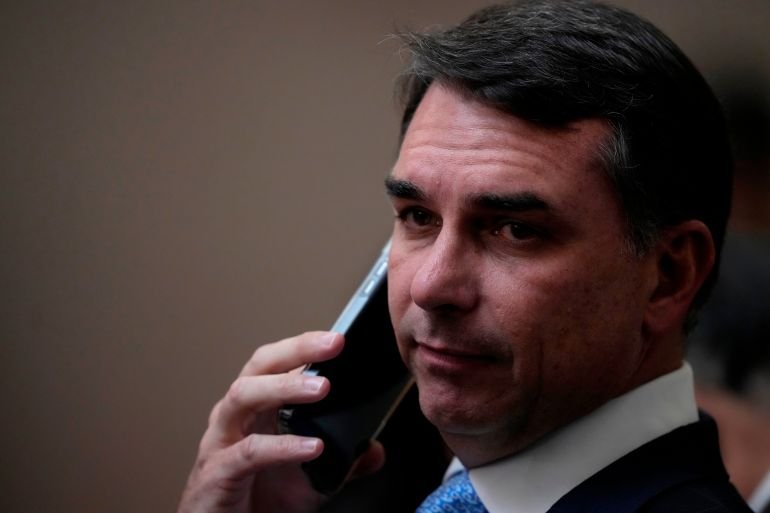
Cuban President Miguel Diaz-Canel says he will not bow to pressure by the United States to resign.
“Stepping down is not part of our vocabulary,” he said in an interview with US broadcaster NBC News on Thursday.
Recommended Stories
list of 4 itemsend of list
The president described communist-ruled Cuba as a “free sovereign state” with the right to “self-determination,” adding that the island is not “subject to the designs of the United States”.
“In Cuba, the people who are in leadership positions are not elected by the US government,” he said.
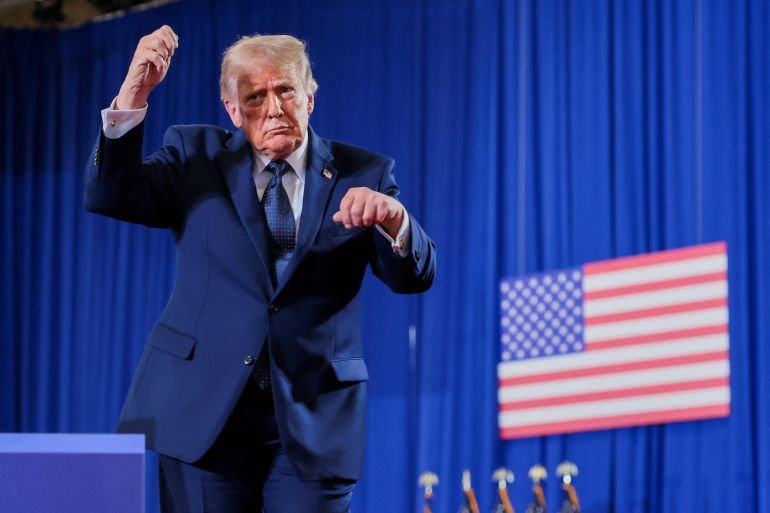
The president since 2018 faces increasing pressure and demands for regime change from President Donald Trump’s administration.
Trump has hinted that Cuba could face the same fate as Venezuela and Iran.
“I built this great military. I said, ‘You’ll never have to use it.’ But sometimes you have to use it. And Cuba is next,” the US president said last month.
Cuba’s main oil supply was cut off after Trump ousted Venezuelan leader Nicolas Maduro in January. The US has since imposed an oil blockade on the island and threatened tariffs on any country that sells oil to Cuba.
‘Hostile policy’
Diaz-Canel condemned the US “hostile policy” that has left Cuba reeling from widespread power blackouts, fuel shortages and disruptions to water and food distribution.
He also said the Trump administration has “deprived the American people from a normal relationship with Cuba.”
Since returning to office last year, Trump has labelled Cuba an “unusual and extraordinary threat” to US national security and threatened a “takeover” of the island.
Current tensions stretch back to the Cold War, when the US took an adversarial stance against left-wing governments across the Americas.
The Cuban Revolution in the 1950s led to the overthrow of a US-backed military government. By the early 1960s, Washington had imposed a comprehensive trade embargo aimed at weakening revolutionary leader Fidel Castro.
‘We cannot betray Cuba’
Despite US pressure, Russia has remained a close ally of Cuba.
“We cannot betray Cuba. That is out of the question. We cannot leave it on its own,” Russia’s Deputy Foreign Minister Sergei Ryabkov said at a news conference in Havana on Friday.
Last month, a Russia-flagged tanker carrying 730,000 barrels of oil docked in Cuba – the first to reach the island in three months.
Donald Trump’s disdain for NATO allies dates back to even before he became United States president the first time. From anger over their relatively low defence spending to — more recently — threats to take over Greenland, the territory of fellow NATO member Denmark, the American leader has long left the alliance on edge.
But the decision of NATO allies not to join Trump’s war on Iran has deepened the fracture to unseen levels, say analysts. This week, Trump called their lack of support a stain on the alliance “that will never disappear”. Chancellor Friedrich Merz of Germany put it even more bluntly, hours later: The conflict “has become a trans-Atlantic stress test”.
Recommended Stories
list of 3 itemsend of list
That back and forth underscores a central question exposed by the Middle East crisis that experts say NATO can no longer put off: can the transatlantic alliance survive, especially if the US pulls out?
“There will be no return to business as usual in NATO, during neither this US administration nor the next one,” said Jim Townsend, adjunct senior fellow at the Center for a New American Security. “We are closer to a break than we have ever been.”
Trump can’t pull the US out of the alliance on a whim.
To formally do so, he needs a two-thirds majority in the US Senate or an act of Congress — scenarios that are unlikely to come to pass any time soon, with NATO still enjoying broad support among many legislators in both major American parties.
But there are other things Trump can do. The US has no obligation to come to the aid of allies should they come under attack. The treaty’s Article 5 states members’ collective‑defence obligation, but it does not automatically force a military response — and there is scepticism among allies over whether Washington would ever come to help.
The US can also move the about 84,000 American troops spread across Europe out of the continent. The Wall Street Journal reported on Wednesday that Trump was considering moving some US bases from countries deemed unhelpful during the Iran war and transferring them to more supportive countries. He could close down US military bases and cease military coordination with allies.
Since US security guarantees to Europe have undergirded NATO since its founding, such disengagement would do enough damage.
“He doesn’t need to leave NATO to undermine it; by just saying he might, he has already eroded its credibility as an effective alliance,” said Stefano Stefanini, former Italian ambassador to NATO from 2007 to 2010 and former senior adviser to the Italian Presidency.
Still, allies are not helpless. Russia’s invasion of Ukraine revealed the weakened state of European defence industries and their deep reliance on the US. That, coupled with the numerous diplomatic crises in the US-NATO partnership – including Trump’s threat to take control of Greenland – has pushed European allies to invest more in defence capabilities. Between 2020 and 2025, member states’ defence expenditure increased by more than 62 percent.
However, areas where Europe suffers from overdependence on the US include the ability to strike deep into enemy territory, intelligence, surveillance and reconnaissance, space-based capabilities such as satellite intelligence, logistics and integrated air and missile defence, according to a report by the International Institute for Security Studies (IISS).
These challenges remain considerable. It will take the next decade or more to fill them and about $1 trillion to replace key elements of the US conventional military capabilities. Europe’s defence industries are struggling to ramp up production quickly, and many European armies can’t hit their recruitment and retention targets, the IISS report said.
Still, some experts believe a European NATO is possible. Minna Alander, an analyst at the Stockholm Centre for Eastern European Studies of the Swedish Institute of International Affairs, says NATO has, over the years, become a structure for military cooperation between European countries.
“NATO can therefore survive the Iran war — and even a US withdrawal — as European members have an incentive to maintain it, even if in a radically different form,” Alander said.
For some, the deadline is 2029. That is when Russia may have reconstituted its forces sufficiently to attack NATO territory, according to estimates by Germany’s chief of defence, General Carsten Breuer. “But they can start testing us much sooner,” Breuer said in May last year, ordering the German military to be fully equipped with weapons and other material by then. Others estimate that Moscow could pose that threat as early as 2027.
And what about the US — would it do better without NATO?
According to Stefanini, the former ambassador, the debate about NATO is often “twisted” to portray the alliance’s raison d’être as solely in function of protecting Europe from Russia, as a US favour to the continent.
NATO was a network of alliances born at the onset of the Cold War against the Soviet Union. For decades, the US fought to attract into the alliance as many countries as possible, treating those that refused as friends of the enemy.
Following the September 11, 2001, attacks on the US, NATO invoked for the first and only time Article 5 to rally behind Washington and sent troops to fight in Afghanistan. Thousands of servicemen died there, including nearly 500 from the United Kingdom, and dozens from France, Denmark, Italy and other countries.
And during the war in Iran, European bases were beneficial staging sites for the US military — even if many countries publicly distanced themselves from the conflict.
“NATO served US interests and Trump comfortably overlooks these aspects,” said Stefanini. “Europe has its own responsibility by not investing in defence and creating strong dependence, but thinking that NATO serves only European strategic interests is simply not true.”
Israel has launched more than 50 strikes across Lebanon in the past 24 hours, raising fears that the escalating violence could unravel the fragile ceasefire between the United States and Iran, reigniting a broader regional conflict.
Lebanon’s National News Agency said an Israeli air strike on the southern town of Hanawya killed one person and wounded another on Friday. The agency also reported that Israeli forces destroyed residential areas in Aita al-Shaab, with additional strikes on al-Majadel in the Tyre district.
Recommended Stories
list of 3 itemsend of list
Al Jazeera’s team on the ground reported that Israeli forces blew up homes in the town of Haneen in southern Lebanon.
The Lebanese group Hezbollah responded by firing rockets towards settlements in northern Israel, including Kiryat Shmona, Metula and Misgav Am. In a statement posted on Telegram, fighters said “these attacks would continue until the Israeli-American aggression against the country and the people stopped”.
Despite the escalation in the south, Al Jazeera’s Zeina Khodr reported a relative lull in Beirut, following Israel’s large-scale assault on Wednesday. It killed at least 300 people and wounded about 1,000 others.
“What we’ve noticed in the past 24 hours or so is that the tempo of Israeli strikes has been reduced, at least in the Beirut area,” Khodr said.
“Yes, there’s still military activity in the south of Lebanon but really a marked reduction in strikes in Beirut – whether or not this is intentional or not. But the Israeli media is making it clear, and quoting Israeli officials, that there is US pressure on the Israeli government to de-escalate this conflict in Lebanon,” she added.
The pressure to end the conflict comes amid food security warnings from the United Nations World Food Programme.
“What we’re witnessing is not just a displacement crisis, it is rapidly becoming a food security crisis,” said WFP’s Lebanon country director Allison Oman, speaking via video link from Beirut on Friday.
She warned that food is becoming increasingly unaffordable due to rising prices and higher demand from displaced families, and as the Iran war disrupts supply routes.
Stalled diplomatic efforts
Israeli Prime Minister Benjamin Netanyahu said on Thursday that he ordered direct negotiations with Lebanon “as soon as possible”. Diplomatic efforts appear limited, however.
A senior Lebanese official told the Reuters news agency on Friday that Lebanon intends to join a meeting next week in Washington with US and Israeli representatives to discuss and announce a ceasefire. Beirut considers it a precondition to further talks to reach a broader deal with Israel.
But a senior Lebanese source told the Anadolu news agency that the planned talks in Washington will be preliminary.
“The meeting at the US State Department next week is preparatory, not a negotiation,” the source said.
The latest violence began days after Israel and the US launched their war on Iran on February 28. An attack by Hezbollah struck Israel on March 2, after which Israel launched an air campaign and ground operations in southern Lebanon.
The humanitarian toll continues to rise. The UN’s children agency, UNICEF, warned that escalating attacks are having “a devastating and inhumane toll on children”.
“As news of a regional ceasefire agreement briefly ignited hope across the country, deadly Israeli airstrikes struck across Lebanon, reportedly killing 33 children and injuring 153,” the agency said on Thursday.
“The latest bloodshed adds to a staggering 600 children either killed or injured in Lebanon since 2 March,” adding that it has received reports of children missing, separated from their families and being pulled from under the rubble.
Nearly 390,000 children are among more than one million people displaced, UNICEF said.
Human Rights Watch said Israeli strikes have crippled important infrastructure in the south, including bridges over the Litani River.
“Between March 12 and April 8, Israeli forces systematically destroyed or severely damaged all main bridges connecting areas south of the Litani River to the rest of the country,” the group said, adding that only one main crossing remains operational.
The US Justice Department is investigating the NFL amid concerns about broadcast sales to streamers.
By Reuters and The Associated Press
Published On 9 Apr 20269 Apr 2026
The United States Department of Justice has opened an investigation into whether the National Football League (NFL) has engaged in anticompetitive tactics that harm consumers, according to a source familiar with the matter.
Major broadcast station owners, US regulators and senators have raised concerns in the past over the difficulties consumers face in watching sports games and the growing trend of selling broadcast rights to streamers.
Recommended Stories
list of 4 itemsend of list
The nature and full scope of the investigation could not be immediately ascertained.
However, the NFL said in a statement on Thursday that more than 87 percent of its games are aired on free broadcast TV and that all games are aired on free broadcast television in markets of participating teams.
The Justice Department did not immediately respond to Reuters’ requests for comment. The Wall Street Journal first reported the news, while The Associated Press identifies their source as a “government official”.
In February, the Federal Communications Commission opened a review into the growing shift of live sport away from broadcast networks to pay TV and subscription services, seeking comment on actions the agency “could take to ensure continued access by viewers to live sports through free over-the-air broadcast TV.”
In response, major broadcast station owners last month urged the regulator to address the trend of Big Tech companies acquiring the rights to broadcast football, baseball and other sporting events, saying it could weaken local TV news.
The FCC has said many sporting events previously available through free broadcast or traditional cable TV packages are now available only through standalone subscription streaming, which has frustrated many sports fans.
Last year, NFL games aired on 10 different services, the FCC said, citing estimates that it could cost a consumer more than $1,500 to watch all games.
In March, US Senator Mike Lee submitted a letter to the Justice Department and the Federal Trade Commission requesting a review of antitrust exemptions for the NFL’s dealings with streaming platforms.
A 1961 law exempts major sports leagues from antitrust laws and allows them to pool their individual teams’ television rights and sell those rights as a package.
Washington, DC – Preliminary data from the Organisation for Economic Co-operation and Development (OECD) has found that international development aid from its members dropped by about 23 percent from 2024 to 2025.
Much of that decline was attributed to a major shortfall in funding from the United States.
Recommended Stories
list of 3 itemsend of list
The forum, which includes many of the the largest economies across Europe and the Americas, said on Thursday that the US saw a nearly 57 percent drop in foreign aid in 2025.
The OECD’s four other top contributors — Germany, the United Kingdom, Japan and France — also saw declines in their foreign aid assistance.
The report marked the first time foreign development assistance from all five of the OECD’s top donors simultaneously declined. The total assistance for 2025 totaled only $174.3bn, down from $214.6bn the year before, representing the largest annual drop since the OECD began recording the data.
OECD officials warned the dramatic decrease comes at a time when global economic and food security has been cast into doubt amid the stresses of the US-Israeli war with Iran.
“It’s deeply concerning to see this huge drop in [development funding] in 2025, due to dramatic cuts among the very top donors,” OECD official Carsten Staur said in a statement.
Thursday’s preliminary data shows that only eight member countries met or exceeded their funding from 2024.
“We are in a time of increasing humanitarian needs,” Staur added, citing growing global uncertainty and extreme poverty. “I can only plead that DAC donors reverse this negative trend and start to increase their [assistance].”
The data covers the 34 members of the OECD’s Development Assistance Committee (DAC), which provide the vast majority of global foreign assistance.
But the numbers offer an incomplete picture of global development aid, as it fails to include influential non-DAC members including Turkiye, the United Arab Emirates, Qatar and China.
The data tracked by the OECD distinguishes official development assistance from other forms of aid, including military funds.
US drives ‘three-quarters of the decline’
In its preliminary assessment, the OECD noted that the US “alone drove three-quarters of the decline” in 2025, the first year of President Donald Trump’s second term.
Trump has overseen widespread cuts to the US’s aid infrastructure, including dissolving the US Agency for International Development (USAID) as part of a wider effort to shrink government spending.
The US contributed about $63bn in official development assistance in 2024, which was cleaved to just short of $29bn in 2025, according to OECD.
Research this year from the University of Sydney has suggested that cuts to US funding over the past year have corresponded with an increase in armed conflict in Africa, as state resources grow more scarce.
Other experts have noted that the slashed assistance is likely to prompt upticks in cases of HIV-AIDS, malaria and polio.
Analysts at the Center for Global Development have projected that the US cuts were linked to between 500,000 and 1,000,000 deaths globally in 2025 alone. A recent article published in the medical journal The Lancet found that a “continuation of current downward trends” in development funding could lead to over 9.4 million new deaths by 2030.
The Trump administration, meanwhile, has maintained it is transforming, not eschewing, the US aid model.
In recent months, it has struck a handful of bilateral assistance agreements with African countries that it says are in line with its “America First” agenda.
But while the details of such deals have not been made public, critics note that some negotiations appear to have involved requests for African countries to share mineral access or health data.
‘Turning their backs’
Oxfam, a confederation of several non-governmental aid organisations, was among those calling on wealthy countries to change course following Thursday’s report.
“Wealthy governments are turning their backs on the lives of millions of women, men and children in the Global South with these severe aid cuts,” Oxfam’s Development Finance Lead Didier Jacobs said in a statement.
Jacobs added that governments are “cutting life-saving aid budgets while financing conflict and militarisation”.
As an example, he pointed to the US, where the Trump administration is expected to request between $80bn and $200bn for the US-Israeli war with Iran, which has currently been paused amid a tenuous ceasefire.
The administration has separately requested a historic $1.5 trillion for the US military for fiscal year 2027.
“Governments must restore their aid budgets and shore up the global humanitarian system that faces its most serious crisis in decades,” Jacobs said.
The United States fertility rate has now been in decline for two decades, dropping nearly 23 percent since 2007.
Published On 9 Apr 20269 Apr 2026
The fertility rate in the United States has dropped to an all-time low, continuing a trend that has seen births in the country drop by nearly 23 percent since 2007.
Data released by the US Centers for Disease Control and Prevention (CDC) on Thursday shows that the fertility rate for 2025 was 53.1 births per 1,000 women aged 15 to 44, a one percent drop compared to the year before.
Recommended Stories
list of 3 itemsend of list
Experts attribute the change to a variety of factors, from changing priorities among younger women to socioeconomic factors such as anxiety over the cost of living and the affordability of housing and childcare.
According to the Economic Policy Institute, a progressive think tank focused on economic issues, the average cost of childcare in the state of California was nearly $22,000 per year. In states with a lower cost of living such as Alabama, it was nearly $8,000.
Even though Alabama’s costs were lower, the institute noted that $8,000 is the equivalent of 27 weeks of full-time work for a labourer making the minimum wage in the state.
For California, it would take a minimum-wage worker 33 weeks to earn enough for childcare costs alone.
Phillip Levine, an economics professor at Wellesley College, told the news agency Reuters that factors such as “greater and more demanding job market opportunities, expanded leisure options, [and] increased intensity of parenting” have made “the option to have children less desirable”.
Falling birth rates have also grabbed the attention of policymakers, with some seeking to roll out tools to incentivise young couples to have children.
The administration of United States President Donald Trump promised to embrace pro-birth policies, sometimes referred to as pro-natalist policies. Last year, the administration touted new guidance to increase access to IVF treatments as evidence that the Republican Party was the “party of parents”.
After unveiling his recent budget request for fiscal year 2027, Trump justified the need to slash social spending, while defending his $1.5 trillion request for military spending.
He has suggested that existing federal programmes be offloaded onto states, which have varying resources.
“The United States can’t take care of daycare. That has to be up to a state. We can’t take care of daycare. We’re a big country,” Trump said last week.
“Medicaid, Medicare, all these individual things, they can do it on a state basis. You can’t do it on a federal [basis]. We’ve got to take care of one thing: military protection. We have to guard the country. But all these little things, all these little scams that have taken place, you have to let states take care of them.”
Far-right politicians have also become fixated on falling birth rates in Western countries, using them to promote a narrative that white majorities could be “replaced” by migrants from non-Western countries.
The number of babies born in the US in 2025 also saw a slight drop of about one percent, down to 3.6 million.
Confusion over competing United States and Iranian proposals to end the war is deepening uncertainty about the fragile two-week ceasefire between the longtime foes, with officials presenting sometimes differing accounts of what has been agreed.
At the centre of the dispute is an Iranian 10-point plan, which is the basis for the upcoming negotiations with the US in the Pakistani capital, Islamabad, this weekend. President Donald Trump has called the plan “workable”, despite initially handing Iran a 15-point plan that Tehran dismissed as “maximalist”.
Recommended Stories
list of 4 itemsend of list
However, hours after the ceasefire, US officials, including Trump, offered mixed responses to Iran’s proposal and what Washington understood the key points of the document to be.
Vice President JD Vance dismissed the publicised version as little more than a “random yahoo in Iran submitting it to public access television”.
Adding to the confusion, the Persian version of the plan notably diverges from the English one on a key sticking point between Washington and Tehran – Iran’s right to enrich uranium.
What was the US’s 15-point plan, and what was Iran’s response?
The Trump administration presented Iran with what officials described as a 15-point framework aimed at ending the war, and potentially achieving a permanent end to hostilities between the longtime foes.
While the full details have not been publicly released, reports by US media outlets and others included the following elements:
Iran commits to never developing nuclear weapons.
Iran must also no longer enrich uranium within the country, and hand over its stockpile of already enriched uranium to the International Atomic Energy Agency (IAEA).
Tehran would also commit to allowing the IAEA to monitor all elements of the country’s remaining nuclear infrastructure.
Reopening of the Strait of Hormuz.
Ending Iran’s support for regional proxies such as Hezbollah in Lebanon and the Houthis in Yemen.
A removal of all sanctions imposed on Iran, alongside the ending of the United Nations mechanism that allows sanctions to be reimposed.
Limits on the range and number of Iran’s missiles.
Donald Trump on Wednesday said that “many of the 15 points” in the proposal had been agreed upon, signalling optimism about a broader deal.
“We are, and will be, talking tariff and sanctions relief with Iran,” the US president added.
However, Iran rejected the US framework, with its Ministry of Foreign Affairs spokesperson Esmaeil Baghaei confirming that Tehran had received messages from the US via intermediaries. He dismissed Washington’s demands as “maximalist” and “illogical”.
Tehran advanced its own positions in a 10-point counterproposal, which included demands of compensation for damages suffered by Iran during the war, a commitment to non-aggression by the US, Iran retaining its leverage over the Strait of Hormuz, and acceptance of Iran’s nuclear enrichment.
How has the US reacted to the 10-point proposal?
Trump on Wednesday said the US has received a 10-point proposal from Iran, which he called a “workable basis on which to negotiate”.
However, later in the day, confusion over what the official US position was started to become apparent.
Trump turned to his Truth Social platform to attack those he accused of spreading inaccurate accounts of supposed agreements.
“There is only one group of meaningful ‘POINTS’ that are acceptable to the United States, and we will be discussing them behind closed doors during these Negotiations,” Trump said, without providing details. “These are the POINTS that are the basis on which we agreed to a CEASEFIRE.”
The US president, in a separate post, said there will be “no enrichment of Uranium, and the United States will, working with Iran, dig up and remove all of the deeply buried (B-2 Bombers) Nuclear ‘Dust’”.
White House press secretary Karoline Leavitt downplayed certain reports about the Iranian proposal and said that Trump would reject any uranium enrichment by Tehran.
“The president’s red lines, namely the end of Iranian enrichment in Iran, have not changed,” Leavitt told reporters. While Iran says it is not seeking nuclear weapons, it insists on enriching its own uranium as a national right.
Moreover, Leavitt said Iran’s initial 10-point proposal was “literally thrown in the garbage” by Trump’s team, but Tehran later put forward a revised “more reasonable and entirely different” plan, one which could be aligned with Trump’s own 15-point proposal.
“The idea that President Trump would ever accept an Iranian wish list as a deal is completely absurd,” she said.
Trump’s second-in-command, Vance, dismissed the publicised version as little more than a “random yahoo in Iran submitting it to public access television”.
“We don’t really concern ourselves with what they claim they have the right to do; we concern ourselves with what they actually do,” he added in remarks made to reporters in Budapest.
He said he had seen at least three different drafts of the proposals. “The first 10-point proposal was something that was submitted, and we think, frankly, was probably written by ChatGPT,” Vance said.
Are there different versions of Iran’s 10-point plan?
In short, yes. At least two different versions of that same plan appear to exist, one in English and the other in Persian.
In the Persian version, made public by Iran’s Supreme National Security Council, it said the “US has, in principle, committed to” a series of demands, most notably the “acceptance of enrichment”, signalling that any deal must recognise Iran’s right to continue enriching uranium.
However, this phrase was allegedly omitted from the English-language version.
Iran has consistently framed uranium enrichment as a sovereign right, while the Trump administration and its ally Israel call the demand a non-starter and a red line.
For years, Tehran has maintained that its nuclear activities are strictly civilian and that it has no plans to build nuclear weapons.
In 2015, it reached an agreement with the US to curb its nuclear programme in return for relief from sanctions. In 2018, however, Trump pulled Washington out of that landmark accord and reimposed sanctions on Iran.
Just hours after the United States and Iran announced a ceasefire in the war that has dominated news headlines around the world and pushed oil prices to new heights, Israel bombarded Lebanon on Wednesday, killing hundreds, injuring thousands and prompting Iran to reimpose its blockade of the Strait of Hormuz.
The bone of contention: whether or not Israel’s relentless strikes on Lebanon were included in the ceasefire at all. Pakistan, which brokered the agreement, said they were. Israel said they weren’t.
Recommended Stories
list of 4 itemsend of list
Later on Wednesday, the US sided with Israel, with President Donald Trump calling the violence in Lebanon “a separate skirmish” even though Hezbollah had entered the war in defence of Iran.
In Israel, Prime Minister Benjamin Netanyahu has come under intense political pressure since the US and Iran signed the ceasefire, which had little or no active involvement from Israel.
None of Israel’s war aims, which Netanyahu had assured his country were the basis for what he framed as an existential battle with Iran, had been achieved, angering those who supported the war.
Furthermore, under the terms of the truce published yesterday, a 10-point peace plan put forward by Iran has been accepted as a starting point for negotiations due to begin this weekend in Islamabad.
Under early descriptions of the Iranian plan, Iran would retain its nuclear stock and could benefit financially from levies charged on shipping traffic through the Strait of Hormuz and from tariffs and sanctions relief promised by Israel’s ally, US President Donald Trump, on his Truth Social account.
This is far from the 15-point list of demands the US previously put forward to Iran, which would have seen the strait completely reopened without conditions, and Iran giving up its enriched uranium stocks, ending its ballistic missiles programme and promising to stop arming proxy groups in the region, such as the Houthis in Yemen, Hezbollah in Lebanon and a flurry of armed groups in Iraq.
Arguing that Lebanon is exempt from the ceasefire agreement, Israel launched the most extensive bombardment on its neighbour in recent months on Wednesday. In the space of about 10 minutes, the Israeli military carried out more than 100 strikes on what it claimed were Hezbollah targets, hitting Beirut, southern Lebanon and the eastern Bekaa Valley, killing at least 254 people, 91 of them in the capital, Beirut, alone.
The attacks have been condemned by numerous nations and international organisations, including Spain, France, the United Kingdom, the United Nations and Pakistan, which brokered the ceasefire deal and stated explicitly that Lebanon was included.
Responding to the strikes, Iranian state media announced that its government was now considering walking away from the truce and has already announced that restrictions on the economically vital Strait of Hormuz will be reimposed.
For its part, Israel says it is not trying to kill the ceasefire by launching strikes on Lebanon. Charles Freilich, Israel’s former deputy national security adviser, told Al Jazeera that the motivation for the strikes arose solely from the “opportunity to hit numerous mid to high-level Hezbollah fighters, not spoil the ceasefire, which both the US and Israel maintain does not include Lebanon”.
‘Provocateurs-in-chief’
Some analysts are sceptical, however.
“Israeli officials will no doubt claim that this was a super sophisticated operation against necessary security targets, perhaps embellishing those arguments with claims of deep intel and technological penetration and sophistication, and you will probably have the usual mainstream Western media outlets slavishly parroting the Israeli line,” former Israeli government adviser Daniel Levy told Al Jazeera, before explaining that such operations typically combine two principal features.
“The first is, sadly, an Israeli devotion to death and destruction, largely for its own sake, to spread terror and upend state capacity in various places in the region, and to upend civilian life,” he said. “And, secondly, a very transparent attempt to prolong the broader war against Iran, to collapse any ceasefire prospects, and to act as provocateurs-in-chief.”
Politically, support within Israel for the war may have weakened, however. Many of those who initially supported the war on Iran have been unsparing in their criticism of a potential pause in the conflict negotiated by the other two parties at Israel’s apparent expense.
Posting on X, opposition leader Yair Lapid claimed that Prime Minister “Netanyahu has turned us into a protectorate state that receives instructions over the phone on matters pertaining to the core of our national security”.
Democrats leader Yair Golan was equally scathing. “Netanyahu lied,” he wrote on X. “He promised a ‘historic victory’ and security for generations, and in practice, we got one of the most severe strategic failures Israel has ever known.”
Israeli opposition leader Yair Lapid has been unsparing in his criticism of Prime Minister Benjamin Netanyahu following a ceasefire he claims Israel was excluded from [Evelyn Hockstein/Pool via AP]
“Netanyahu is in real trouble, and he thinks he has to wreck the ceasefire to get out of it, just as he did previously in Gaza,” Member of the Knesset Aida Touma Sliman of the left-wing Hadash party, which has opposed the war from the start, told Al Jazeera. “The ceasefire has lost him a lot of support, even among those who backed the war. None of his war aims have been achieved and it looks like he is losing control to the Trump administration,” she said.
“Don’t forget, we’re heading towards elections,” she added, referring to the vote currently slated for October, “and Netanyahu’s dropping in the polls. He needs something he can claim is a victory.
“And that’s why he did what he did,” she said, of Wednesday’s barrage on busy Lebanese neighbourhoods that killed hundreds, including women, children and medical workers, according to emergency workers on the ground. “He conducted a massacre in Lebanon.”
As the small East African coastal nation of Djibouti prepares for presidential elections on Friday, longtime leader President Ismail Omar Guelleh is expected to win the polls with little to no challenge.
Djibouti, a country of just about one million people that neighbours Eritrea, Ethiopia and Somalia, is politically relevant in the Horn of Africa region. It is also internationally important due to its strategic location right at the Bab al-Mandeb Strait, which provides access to the Red Sea from the Gulf of Aden and through which a large portion of global trade between Asia and the West passes.
Recommended Stories
list of 3 itemsend of list
Djibouti hosts important military bases for the United States, France, China and other powers, earning it the tag of the country with the most foreign military bases. It is also an important port hub for bigger inland landlocked countries like Ethiopia.
Incumbent candidate Guelleh is running for his sixth term as president. Though originally ineligible due to term limits and age, lawmakers removed age limits last year, paving the way for another term in office.
Formerly named French Somaliland under colonialism, the country continued to maintain large numbers of French troops following independence in 1977, but it was the September 11, 2001, attacks in the US that saw it garner new attention as Washington sought proximity to armed groups in Somalia and Yemen.
Djibouti was also a strategic military launchpad for naval units during the anti-piracy fights of the mid-2000s when the US, European Union, and other allies sought to battle pirates off the coast of Somalia.
Both French and Arabic are official languages in Djibouti. Somali and Afar are also widely spoken by Somalis, who make up about 60 percent of the population, and people from the Afar group, who comprise about 35 percent.
About 94 percent of people in Djibouti practise Islam. The local currency is the Djiboutian franc.
Here’s what to know about Friday’s election:
Who is eligible to vote?
About a quarter of the population, or 243,471 people, are registered to vote in the polls, according to the International Foundation for Electoral Systems. That’s up from the last presidential election in 2021, when about 215,000 were registered.
Voter turnout on average is about 67 percent.
Polls are expected to open early on April 10 and close in the evening.
Although Djibouti is described by monitors as an “electoral autocracy”, election observers from the Intergovernmental Authority on Development (IGAD), an eight-country regional bloc, arrived there on Tuesday.
IGAD said 17 observers from Ethiopia, Kenya, Somalia, South Sudan and Uganda will be deployed across all regions, and will release a statement after the vote on April 12.
Djibouti’s President Ismail Omar Guelleh casts his ballot during the presidential elections at the Ras-Dika district polling centre in Djibouti, on April 9, 2021 [File: Abdourahim Arteh/Reuters]
Who is running?
Ismail Omar Guelleh: The 78-year-old incumbent, known as “IOG”, is running for his sixth term as president. He was first voted into power in 1999. His party is the ruling People’s Rally for Progress.
Guelleh’s latest bid came after lawmakers in November unanimously amended the constitution to remove a 75-year-old age limit. Back in 2010, parliament had scrapped term limits in a constitutional reform.
Guelleh has been criticised for ruling with an iron fist and holding on to power unconstitutionally. However, he is also credited with maintaining a relatively stable hold in a region that’s usually rife with instability.
Under his rule, Djibouti, which has no natural resources, has signed infrastructure deals with China and lucrative military hosting pacts with Western powers by leveraging its location.
Djibouti Finance Minister Ilyas Dawaleh in 2017 said the country makes $125m a year from hosting US, French, Chinese, Italian and Japanese military bases, with Washington paying almost half of that.
The US base, Camp Lemonnier, is the only permanent US military base in Africa.
Guelleh, donning his party’s leaf-green colours, spoke to hundreds of his supporters during campaign rallies that were held in the capital this month.
In one campaign, he said the elections and the choices available to voters “are consistent with democracy” in the country and promised more “significant success” if elected. His supporters held up banners that read “national unity and social cohesion”.
Mohamed Farah Samatar: Guelleh’s only rival is a former member of the ruling party. He is running under the Unified Democratic Centre party.
Samatar rallied in Tadjourah and Obock regions with his supporters, claiming that “another Djibouti is possible”.
Sonia le Gouriellec, a Horn of Africa expert at Lille Catholic University, told the AFP news agency: “There’s not much at stake [in the election]. It’s just a token competition.”
Omar Ali Ewado, head of the Djibouti League of Human Rights (LDDH), called the vote a “masquerade” and said it is a “foregone conclusion”.
“The person who will challenge President Guelleh is a member of a small party subservient to those in power,” he told AFP.
What are the key issues?
Shrinking democratic freedoms
Guelleh’s critics are increasingly sounding the alarm about the shrinking of civic space in the country.
Elections have been described as merely ritualistic, with Guelleh winning more than 90 percent of votes in the 2021 polls. Since 2016, opposition parties have boycotted elections.
Guelleh’s government is also accused of high levels of corruption and nepotism, with some speculating that his stepson and the secretary-general of the prime minister’s office, Naguib Abdallah Kamil, is being prepared for the top job.
The country is regularly singled out by human rights organisations for its repression of dissenting voices. It is currently ranked 168th out of 180 in the 2025 press freedom index published by Reporters Without Borders (RSF).
One aspiring presidential candidate, Alexis Mohamed, who formerly served as presidential adviser until he resigned in September, told reporters he was “unable” to pursue his candidacy because he had no “security guarantees” if he were to return to the country from his current location abroad.
Mohamed, who served in an official capacity for 10 years, accused Guelleh of “patronage-based management of the state”.
According to the International Federation for Human Rights, elections in Djibouti are “not free”.
Rising debt
Many accuse Guelleh of brandishing shiny infrastructure projects built by China, such as a railway to Ethiopia, but point to the country’s stagnating economy and rising debts to Beijing.
By 2026, the country owed China $1.2bn from loans, as well as several others. The International Monetary Fund said in a report in 2025 that Djibouti’s debt profile is “in distress and unsustainable”.
Some of these costly infrastructure projects have not had an impact on lowering poverty rates. About 73 percent of the country’s young population is unemployed due to a dearth of jobs, for one example.
Meanwhile, a major source of the country’s revenue is under threat: Djibouti’s ports almost entirely handle Addis Ababa’s maritime imports and exports for about $2bn annually.
However, in 2024, Ethiopia is seeking to reduce that independence. The country signed a port deal with autonomous Somaliland, a case that has caused tensions with Djibouti as well as Somalia, which considers Somaliland part of its own territory.
Following Turkiye-led mediation, Ethiopia and Somalia reached a preliminary understanding in late 2024 to resolve their dispute. Ethiopia has agreed to pivot to “reliable and sustainable” sea access with Somalia rather than with Somaliland.
The Strait of Hormuz, which links the Gulf to the Gulf of Oman, has held global attention since Israel and the US began their war on Iran in February.
Until fighting began, the narrow channel, through which 20 per cent of the world’s oil and liquefied natural gas (LNG) supplies are shipped from Gulf producers in peacetime, remained toll-free and safe for vessels. The strait is shared by Iran and Oman and does not fall into the category of international waters.
Recommended Stories
list of 4 itemsend of list
After the US and Israel began strikes, Iran retaliated by attacking “enemy” merchant ships in the strait, effectively halting passage for all, stranding shipping, and creating one of the worst-ever global energy distribution crises.
Tehran continued to refuse to re-open the strait to all traffic at the start of this week, despite US President Donald Trump’s threats to bomb Iran’s power plants and bridges if it did not relent. Trump backed away from his threat on Tuesday night when a two-week ceasefire, brokered by Pakistan, was declared.
That followed a 10-point peace proposal from Iran that Trump described as a “workable” basis on which to negotiate a permanent end to hostilities.
As part of the truce, Tehran has now issued official terms it says will guide its control of the Strait going forward. The US has not directly acknowledged the terms ahead of talks set to begin in Islamabad on Friday. However, analysts say Tehran’s continued control will be unpopular with Washington, as well as other countries.
During the crisis, only a few ships from specific countries deemed friendly to Iran and those which pay a toll have been granted safe passage. At least two tolls for ships are believed to have been paid in Chinese yuan, in what appears to be a strategy to weaken the US dollar, but also to avoid US sanctions. China, which buys 80 percent of Iran’s oil, already pays Tehran in yuan.
Here’s what we know about how shipments will work from now on:
(Al Jazeera)
Who is controlling the strait now?
On Tuesday, Iran’s Foreign Minister Abbas Aragchi said Iran would grant safe passage through the strait during the ceasefire in “coordination with Iran’s Armed Forces and with due consideration of technical limitations”.
On Wednesday, the Islamic Revolutionary Guard Corps (IRGC) released a map of the strait showing a safe route for ships to follow. The map appears to direct ships further north towards the Iranian coast and away from the traditional route closer to the coast of Oman.
In a statement, the IRGC said all vessels must use the new map for navigation due to “the likelihood of the presence of various types of anti-ship mines in the main traffic zone”.
Alternative routes through the Strait of Hormuz have been announced by Iran’s Islamic Revolutionary Guard Corps (IRGC), providing new entry and exit pathways for maritime traffic [Screen grab/ Al Jazeera]
It is unclear whether Iran is collecting toll fees during the ceasefire period.
However, Trump said on Tuesday the US would be “helping with the traffic buildup” in the strait and that the US army would be “hanging around” as the negotiations go on.
The Strait will be “OPEN & SAFE” he posted on his Truth Social media site on Thursday, adding that US troops would not leave the area, and threatening to resume attacks if the talks don’t go well.
It’s not known to what extent US troops are directing what happens in the strait now.
Delhi-based maritime analyst C Uday Bhaskar told Al Jazeera that there is a lot of “uncertainty” about who can sail through the strait, and that only between three and five ships have transited since the war was paused.
How does Iran’s 10-point plan affect the Strait?
Among Tehran’s main demands listed on its 10-point plan are that the US and Israel permanently cease all attacks on Iran and its allies – particularly Lebanon – lift all sanctions, and allow Iran to retain control over Hormuz. The plan has not been fully published but is understood to be a starting point for talks.
Iranian media say Iran is considering a plan to charge up to $2m per vessel to be shared with Oman on the opposite side of the strait. Other reports suggest Iran could charge $1 per barrel of oil being shipped.
Revenues raised would be used to rebuild military and civilian infrastructure damaged by US-Israeli strikes, Tehran said.
Oman has rejected the idea. Transport minister Said Al-Maawali said on Wednesday that the Omanis previously “signed all international maritime transport agreements” which bar taking fees.
What does international law say about tolls on shipping?
Critics of Iran’s plan to charge tolls say it violates international law guiding safe maritime passage, and should not be part of a final ceasefire agreement.
The United Nations Convention on the Law of the Sea (UNCLOS) says levies cannot be charged on ships sailing through international straits or territorial seas.
The law allows coastal states to collect fees for services rendered, such as navigation assistance or port use, but not for passage itself.
Neither the US nor Iran has ratified that particular convention, however.
Even if they had, there could be ways to get around this law anyway. Analyst Bhaskar told Al Jazeera that if Iran instead charged fees to de-mine the strait and make it safe for passage again, that could be allowable under maritime laws.
There is no precedent in recent history of countries officially taxing passage through international straits or waterways.
In October 2024, a United Nations Security Council report alleged that the Iran-backed Houthis in Yemen were collecting “illegal fees” from shipping companies to allow vessels to pass through the Red Sea and the Bab-el-Mandeb strait, where it was targeting ships linked to Israel during the Gaza war.
Last week, a top adviser to Supreme Leader Mojtaba Khamenei suggested the Houthis could shut the Bab al-Mandeb shipping route again in light of the war on Iran.
(Al Jazeera)
How might countries react to a Hormuz toll?
Tolls for passage through the Strait of Hormuz would likely most affect oil and gas-producing countries in the Gulf, but ripple effects will spread to others as well, as the current supply shocks have shown.
Gulf countries, which issued statements calling for the reopening of the passage and praising the ceasefire on Wednesday, would also face a continuing degree of uncertainty, analysts say, as Iran could again disrupt flows in the future.
Before the ceasefire was announced, Bahrain had already proposed a resolution at the UN Security Council calling on member states to coordinate and jointly reopen the passage by “all necessary means”. It was backed by Qatar, the UAE, Saudi Arabia, Kuwait and Jordan. On April 7, 11 of 15 UNSC members voted in favour of that resolution.
But Russia and China vetoed the resolution, saying it was biased against Iran and did not address the initial strikes on Iran by the US and Israel.
Beyond the region, observers say the US is unlikely to accept indefinite toll demands by Iran as part of the negotiations expected to begin on Friday.
A toll to pass through the Strait of Hormuz “is not going to go down well with President Trump and his expectations that the strait should be open for everyone”, Amin Saikal, a professor at the Australian National University, said.
Other major powers have also voiced opposition. Ahead of the ceasefire, Britain had begun discussions with 40 other countries to find a way to reopen the strait.
Practical realities in the strait might see a different scenario play out with ship owners losing millions each day their vessels remain stranded seeking to get them out quickly and undamaged experts say. They are more likely to comply with Iran, at least for now.
“If I were the owner of a VLCC [very large crude carrier] which weighs about 300,000 tonnes, whose value could be a quarter billion dollars…I would believe the Iranians if they said we have laid mines,” Bhaskar said.