US President Donald Trump has announced he plans to withdraw his leadership from the John F Kennedy Center for the Performing Arts, after a federal judge ruled he could no longer have his name on the building.
On Friday, in a 580-word post, Trump blasted Judge Christopher Cooper as reckless. He also painted the performing arts centre as a dilapidated structure only he could restore.
Recommended Stories
list of 3 itemsend of list
“Unfortunately, Judge Cooper and the Radical Left would rather see it DIE than have President Trump transform it into something that everyone could be proud of,” Trump wrote, referring to himself in third person.
But Trump’s interventions at the Kennedy Center, a national performing arts centre in Washington, DC, have been controversial from the start.
Construction on the building began in 1964, shortly after President John F Kennedy was assassinated.
That year, his successor, Lyndon B Johnson, signed into law an act of Congress that established the site as a “living memorial” to the slain leader.
But since starting his second term, Trump has sought to reshape Washington, DC, in his own image, undertaking construction projects and erecting banners with his photograph.
Within weeks of his inauguration, in February 2025, he fired Democratic members of the Kennedy Center’s bipartisan board and replaced them with his picks.
He also terminated the leadership of the centre’s longtime president, Deborah Rutter. The board quickly elected Trump as chair instead.
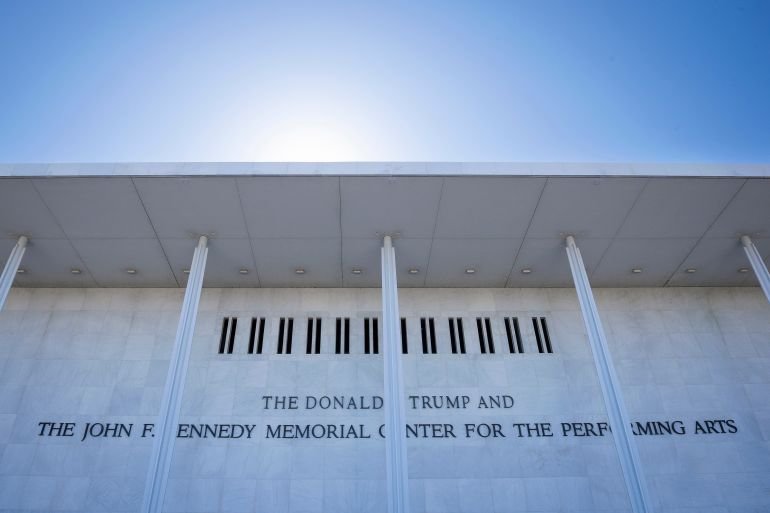
But some of the biggest backlash came in December, when the board went a step further and voted to rename the building “The Donald J Trump and the John F Kennedy Memorial Center for the Performing Arts”.
Within a day, construction crews were seen outside the arts centre, adding Trump’s name to the outside of the edifice.
Critics immediately denounced the effort as a violation of the 1964 law, not to mention a sign of disrespect towards the late Kennedy.
Amid public pressure and a string of cancellations from performers, Trump announced in February he would shutter the arts centre for two years, starting in July. He cited renovations as his rationale for the sudden closure.
US Representative Joyce Beatty, a Kennedy Center trustee, sued to stop the closure from happening. She also sought the removal of Trump’s name.
Friday’s court ruling requires Trump to remove his name from all Kennedy Center signage and materials within 14 days [File: AFP]
Inside the court’s ruling
In Friday’s ruling, Judge Cooper — an appointee of former President Barack Obama — sided with Beatty’s requests.
He ordered that Trump’s name must be removed from the theatre’s facade, as well as any other signage or official materials, within 14 days, citing the 1964 law.
“The Kennedy Center’s organic statute makes crystal clear that the Center is to be named for President Kennedy, and it cannot bear any other formal name or public memorial based on the Board’s unilateral say-so,” Cooper wrote.
“Congress gave the Kennedy Center its name, and only Congress can change it.”
Cooper also overturned the Trump-led board’s decision to strip trustees like Beatty of the right to vote on Kennedy Center matters. Beatty is one of several bipartisan trustees who have a seat on the board by virtue of an act of Congress.
“If trustees presumptively possess the right to vote, what, if anything, authorizes the Board to unilaterally strip certain trustees of voting rights?” Cooper asked in his decision, striking down the Trump-era policy.
“Absent Congressional authorization, the Board may not deprive a duly-appointed Kennedy Center trustee of her right to vote on Board matters on which all other trustees are entitled to vote.”
In the last part of his 94-page decision, Cooper turned his attention to the Kennedy Center’s imminent closure.
He pointed to statements and plans from Trump administration officials touting the use of the performing arts facility before the July closure date, saying they undermined the assertion that the building was somehow hazardous.
“Former Kennedy Center President [Richard] Grenell emphasized that the Center would be one of the ‘premiere spots’ for America’s 250th celebration — quite a concerning idea if the Center is as dangerous as the Defendants now represent,” Cooper wrote, alluding to events scheduled for the coming weeks.
He later added, “Up until February 1, the Center was planning to proceed apace with some form of phased construction and cited no safety concerns about that plan.”
While closing the Kennedy Center is within the board’s powers, Cooper concluded that the board had likely violated its duty to administer the centre “as a prudent person would” under the law.
He therefore issued a temporary injunction against the centre’s closure. “The trustees might have assessed the propriety of closure in a number of prudent ways. This was not one,” he wrote.
Representative Joyce Beatty sued the Trump administration over its planned closure of the arts facility [File: Paul Sancya/AP Photo]
Reactions to the ruling
The ruling prompted an incensed rebuttal from Trump on his Truth Social platform. The president pledged to transfer oversight of the facility to Congress, under whose mandate the centre already operates.
“We are going to be working with Congress to transfer this failing Institution back to them so they can make a determination as to what to do with it,” Trump wrote.
He also blasted Cooper as a partisan actor who had treated him “unfairly”, echoing similar criticisms he had levied against other judges.
“Judge Cooper should be ashamed of himself! I cannot be involved with a situation where danger to the Public is allowed to flourish in plain and open sight,” Trump said.
“Unless I am free to do what I do better than anyone else, bring this Institution back, physically, financially, and artistically, I have no interest in continuing what could only be a hopeless journey into ‘NEVER NEVER LAND.’”
Beatty, meanwhile, applauded the ruling as a victory against unchecked power, unfettered by the law.
“The Kennedy Center is an institution that belongs to the American people, not to Donald Trump,” she wrote.
“He has desecrated this sacred memorial for his own vanity. I am proud to have fought for the rule of law and to protect this sacred institution.”
The administration of United States President Donald Trump wants to increase the percentage of regionally produced content in North American-built vehicles to qualify for preferential treatment under the US-Mexico-Canada Agreement (USMCA) on trade to 82 percent, with 50 percent of that value produced in the US.
The new proposal, which was first reported by the Reuters news agency, citing four unnamed sources familiar with the matter, emerged amid negotiations to revise the USMCA in Mexico City. Canada was not present at the negotiations.
Recommended Stories
list of 4 itemsend of list
The shift, if accepted, would be a major break from the current USMCA, which requires that 40 percent of the “core parts” value of North American passenger vehicles be produced in high-wage jurisdictions, effectively the US or Canada.
That threshold is now 45 percent for pick-up trucks. Overall, vehicles built in North America currently must have 75 percent regional content to qualify for preferential treatment under the USMCA.
Auto sector officials told the outlet that US Trade Representative Jamieson Greer will negotiate with Mexico and present Canada with a take-it-or-leave-it proposition.
Canada’s exclusion from the negotiations for the USMCA, which is up for review in July, comes amid growing tensions between Washington, DC and Ottawa.
The USMCA, which was launched in 2020 to replace the decades-old North American Free Trade Agreement, maintained a duty-free trade zone that underpins nearly $1.6 trillion in annual trilateral trade. But Trump last year imposed 25 percent tariffs on Canadian and Mexican vehicles and components, with 50 percent duties on steel, aluminium and copper from those countries.
Greer has said that he intends to keep some level of tariffs on key Mexican and Canadian goods in the revised trade pact. But the two partners may get some preferential tariff rates. Currently, vehicles from Japan, South Korea, the European Union and the United Kingdom can be imported at lower rates than from Canada or Mexico.
Economic shifts
The Canadian economy contracted in the first quarter compared to last year, marking the second straight quarter of declines amid tariff-driven uncertainty.
Canada’s gross domestic product (GDP) declined, unexpectedly, at an annualised rate of 0.1 percent in the first quarter, Statistics Canada said on Friday, compared with a downwardly revised contraction of 1 percent in the fourth quarter of last year. However, on a quarterly basis, first-quarter GDP was unchanged against a decline in the fourth quarter of last year.
“Our forecast for growth to ramp up in H2 and through 2027 depends on a favourable USMCA renegotiation, an early end to the Middle East war, and resumption of normal commerce through the Strait of Hormuz,” said Tony Stillo, director of Canada economics at Oxford Economics, in a note, adding that “the economy faces a potentially bumpy ride ahead.”
The Canadian economy has been buffeted by, among other things, tariffs from Trump, who has threatened to annex the country and make it the 51st state of the US. Prime Minister Mark Carney was elected on the platform that he would strengthen and diversify the Canadian economy away from the US.
China’s Minister of Foreign Affairs Wang Yi, during a meeting with Canada’s Foreign Minister Anita Anand on Friday, said that Canada could surpass its goal of increasing exports to China by 50 percent by 2030.
Wang is on a three-day visit to Canada, marking the first state visit by a Chinese foreign minister in a decade. He thought Canada’s exports to China could increase by 100 percent, building on the momentum between the countries.
Canada and China struck an initial trade deal in January to slash tariffs on electric vehicles.
“Canada is focused on growing our economy and diversifying our trading relationships,” Anand said during the meeting.
Canada has continued to push for a strong relationship with the US despite the tension.
On Thursday, in a speech at the Economic Club of New York, Carney called for a new partnership with the US as the two countries decide on renewing the agreement.
Carney says there should be a “true partnership” that reimagines cooperation in specific sectors deeply challenged by global competition. He warned, “We live in a world where integration has been weaponised,” and noted that is why Canada is diversifying away from the US and signing trade deals with countries around the world.
“Our core objective across these partnerships is to increase our strategic autonomy. Because we live in a world where integration has been weaponised. Because a country that cannot feed, fuel or defend itself is not truly sovereign,” Carney said.
Deep mistrust remains between Washington and Tehran as Iran’s top negotiator urges action, not words.
Published On 29 May 202629 May 2026
United States President Donald Trump says he is meeting in the Situation Room to make a “final determination” on a possible deal with Iran that could extend the ceasefire and reopen the Strait of Hormuz.
However, deep mistrust remains between the two sides. Iran’s top negotiator, Mohammad Bagher Ghalibaf, said earlier on Friday that Tehran would judge any agreement by actions rather than promises as talks continue.
Recommended Stories
list of 3 itemsend of list
In his latest post on the Truth Social platform, Trump on Friday set out numerous conditions for Tehran to accept, including: never having a nuclear weapon or bomb, the Strait of Hormuz being open in both directions and without tolls, the removal of any remaining mines left in the Strait, and the US unearthing and destroying Iran’s enriched uranium that is buried.
“Ships caught in the Strait due to our amazing and unprecedented Naval Blockade, which will now be lifted, may start the process of ‘heading home!’” Trump wrote.
“No money will be exchanged until further notice. Other items, of far less importance, have been agreed to. I will be meeting now, in the Situation Room, to make a final determination,” he added.
Reporting from the White House, Al Jazeera’s Patty Culhane said that in the past, the Trump administration has indicated that a deal has been reached, only to find out it has not.
“If this was in fact a deal, it would be the entire wishlist of what the US was demanding and none of the concessions that Iranian were asking for,” she explained.
Uncertainty about the details of a memorandum of understanding (MOU) has grown over the past week amid ongoing distrust between the two sides as they seek to end the three-month-long war.
On Thursday, White House sources told Al Jazeera that the US and Iran had reached a tentative agreement to extend the ceasefire by 60 days to allow for formal negotiations, but Trump has yet to sign off.
Moreover, earlier on Friday, Iran’s top negotiator Ghalibaf said that Tehran did not trust “guarantees and words, only actions are the criterion”.
“No action will be taken before the other side acts,” he said in a social media post, without elaborating.
“The winner of any agreement is the one who is better prepared for war the day after,” the Iranian official added.
Still, Iranian state news outlet Fars, citing sources, reported on Friday that the agreement with the US was in its final stages of ratification, but no final decision has been made yet.
The sources stressed that there were no provisions about destroying Iran’s nuclear materials in the MOU and added that arrangements for the reopening of the Strait of Hormuz could include the monitoring and inspection of ships.
The fund stemmed after a recent IRS settlement with US President Donald Trump over his leaked tax records.
Published On 29 May 202629 May 2026
A United States federal judge temporarily blocked the administration of President Donald Trump’s nearly $1.8bn “anti-weaponisation fund” to compensate victims of what Trump has called government “weaponisation”.
On Friday, US District Judge Leonie Brinkema of the Eastern District of Virginia blocked the Trump administration from “taking any further action” to set up or operate the fund while the judge hears additional legal arguments.
Recommended Stories
list of 4 itemsend of list
The judge, who was nominated to the bench by President Bill Clinton, scheduled a June 12 hearing for arguments about whether to extend the order blocking payouts.
The Department of Justice announced the fund last week as part of an agreement to settle a lawsuit brought on behalf of Donald Trump, in his personal capacity, against the Internal Revenue Service (IRS) stemming from allegations that Charles Edward Littlejohn, a former contractor, leaked Trump’s tax records to journalists.
The fund was set up to be overseen by a five-member commission which would release money for those who can show that they were victims of “lawfare” and “weaponisation”, terms Trump and his allies have used to describe investigations and criminal cases against them.
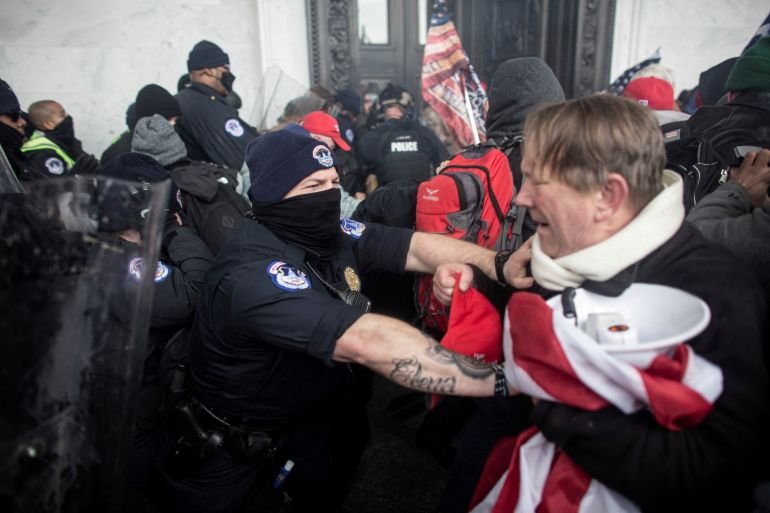
Friday’s ruling came in a lawsuit filed by a group led by a prosecutor of the January 6 riots, Andrew Floyd. The suit claimed that the fund would be partisan to fund Trump supporters and not those who are the president’s political opponents.
The Justice Department has yet to form the commission that will decide on payout criteria, so there has been no money paid out yet or claims accepted.
The fund spurred a backlash, even from some lawmakers in Trump’s Republican Party, who expressed anger that some people who attacked the US Capitol on January 6, 2021, would receive taxpayer-funded payouts.
During a congressional hearing earlier this month, acting Attorney General Todd Blanche would not rule out the possibility that rioters who assaulted police on January 6 could be eligible.
Nearly 1,600 people were charged with Capitol riot-related federal crimes. More than 1,200 were convicted and sentenced before Trump handed out mass pardons, commuted prison sentences, and ordered the dismissal of every pending January 6 criminal case last year.
Comments mark a shift in Berlin’s stance towards one of its key allies, of which it has long been a strong supporter.
Published On 29 May 202629 May 2026
The German government has expressed concern over Israeli plans to extend its military control of Gaza.
A spokesperson for the German Foreign Office said on Friday that Berlin opposes any permanent division of Gaza. The comment came in response to Prime Minister Benjamin Netanyahu’s order to the Israeli military to increase control in the enclave to 70 percent.
Recommended Stories
list of 3 itemsend of list
The expansion of Israeli occupation raises questions over the durability of the nominal “ceasefire” brokered by the United States and regional countries, including Qatar and Turkiye, in October.
That deal required the Israeli military to pull back so it controlled about half of Gaza. However, it has steadily expanded control as it continues to fight Hamas, and fears are growing of a return to full-scale war.
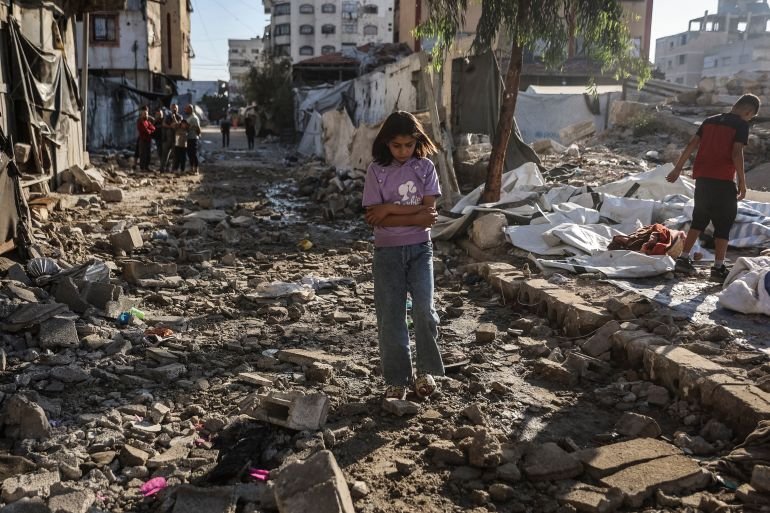
An expansion of Israeli control would also worsen conditions for Gaza’s 2.3 million people already squeezed into about 35 percent of the small enclave.
Germany is one of Israel’s closest allies and its second-largest weapons supplier after the US.
However, in recent months Berlin has begun criticising some Israeli actions, including its annexation of more territory in the occupied West Bank, and the implementation of the death penalty solely for Palestinians.
Fears of annexation
Speaking on Thursday, Netanyahu suggested Israel might even seize more than 70 percent of Gaza.
“We were at fifty, we moved to sixty,” Netanyahu said as he explained that he has now ordered the military to increase control to 70 percent.
Let’s start with that,” he added. “We’re pressing them [Hamas] from all sides. We’ll deal with the remnants.”
Israel agreed to withdraw its troops to behind the ‘Yellow Line’ artificial border as the ceasefire came into effect in October, leaving it occupying about 53 percent of Gaza.
The steady expansion of Israeli control since, in violation of the terms of the ceasefire, has raised Palestinian fears that Israel aims to permanently annex large parts of the enclave. Some Israeli officials have suggested they hope to permanently expel Palestinians.
Earlier this week, Defence Minister Israel Katz said efforts were underway to encourage “voluntary emigration”.
Critics argue that the term “voluntary” is a euphemism, following nearly three years of genocide when most of Gaza’s infrastructure has been destroyed, leaving the territory uninhabitable.
Gareth Dale from Brunel University told Al Jazeera that Netanyahu’s plans to seize more of Gaza are “an egregious breach of the terms of the ceasefire”, but are driven by his political concerns ahead of parliamentary elections in October.
“For the women, men and children of Gaza, already subjected to deliberately inflicted hunger, thirst and disease, on top of continued bombing by the IDF, it represents a renewed round of suffering,” he added.
In a report published last month, both the United Nations and European Union said Israel’s war on Gaza has had a “catastrophic impact on human development”. The report estimated that more than $70bn was needed over the next decade for recovery and reconstruction.
More than 50 percent of hospitals in the territory are non-functional, while nearly all schools have been destroyed or damaged.
On Friday, Israel said it had killed senior Hamas commander Imad Hassan Hussein Aslim and a colleague in a strike in Gaza earlier in the week. Hamas has not commented.
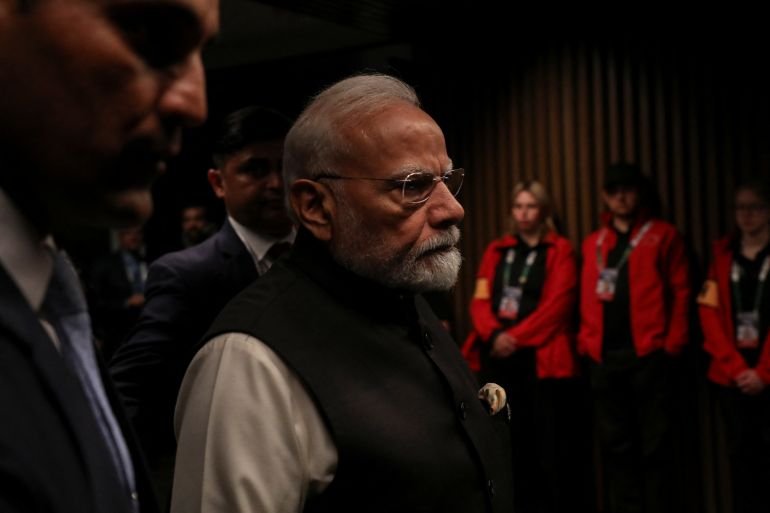
Doha, Qatar – Thumping his fist on a lectern, Indian Prime Minister Narendra Modi issued a direct challenge to the leaders of Pakistan.
“India has been successful in isolating you, and we will intensify those efforts,” he said, addressing a large rally of supporters in the southern Indian state of Kerala, as dusk set in. “We will make sure that you are isolated around the world.”
Recommended Stories
list of 4 itemsend of list
It was September 2016, and Modi was responding to an attack by armed fighters in Indian-administered Kashmir days earlier, in which 18 Indian soldiers had been killed. “The leaders of Pakistan should listen: The sacrifice of our 18 soldiers will not go in vain,” the Indian leader said.
Yet a decade later, Pakistan stands far from isolated: It is a close strategic ally of China, where the Pakistani prime minister, Shehbaz Sharif, visited this week, and has reemerged as a trusted partner of the United States under President Donald Trump.
Pakistan’s army chief Asim Munir and Sharif have both visited Trump at the White House over the past year. Islamabad is the principal mediator between the US and Iran amid their ongoing war. Trump has also frequently praised the Pakistani leadership.
In part, say analysts, that’s a reflection of Pakistan’s success in wooing Trump, and in capitalising on key geopolitical events to make itself an important diplomatic player for superpowers and regional players alike. But equally, say analysts, Pakistan’s growing diplomatic stature underscores missteps by Modi’s administration.
“Certainly, India’s strategy of undercutting and indeed isolating Pakistan, regionally and globally, has backfired in a big way,” Michael Kugelman, a senior fellow on South Asia at the Atlantic Council think tank, told Al Jazeera.
Rubble of buildings in Muridke, Pakistan, hit by Indian missiles in May 2025 [Abid Hussain/Al Jazeera]
The ceasefire and the Nobel nomination
On May 10, 2025, Trump announced that he had secured a ceasefire between nuclear-armed India and Pakistan.
“After a long night of talks mediated by the United States, I am pleased to announce that India and Pakistan have agreed to a FULL AND IMMEDIATE CEASEFIRE,” he posted on his Truth Social platform.
Shortly after, Sharif, the Pakistani PM, thanked Trump’s “leadership and proactive role” in securing the truce that ended four days of intense fighting involving ballistic missiles, fighter jets and drones. It was the worst fighting between India and Pakistan in decades: Dozens of people were killed on both sides of their heavily militarised border.
The conflict erupted after the Indian military carried out attacks on “terror” sites deep inside Pakistani territory, in response to an attack by gunmen who killed 26 tourists in Indian-administered Kashmir.
But unlike Sharif, Modi, who had cultivated a personal rapport with the US president – whom he had met just months earlier in the Oval Office – chose to remain silent, even as India’s foreign secretary confirmed the ceasefire.
Days later, the US president offered to work with the two arch foes to find a solution to the Kashmir issue, which has defined India-Pakistan relations since 1947, the year the two South Asian nations achieved independence from British colonial rule.
For India, Trump’s attempts to portray himself as a peacemaker between New Delhi and Islamabad were troubling: India has long insisted that its disputes with its neighbour were strictly bilateral, for the two countries to resolve among themselves – though US former President Bill Clinton had played a role in ending the 1999 Kargil War.
In June, Modi was visiting Canada when Trump asked him to also fly over to Washington. Modi turned down the offer. He instead told the US president over the phone that New Delhi wouldn’t accept third-party mediation, and that the ceasefire in May was solely the result of bilateral conversations with Pakistan.
Yet that tit-for-tat spiral of claims around the May truce continued. Trump has since insisted on more than 30 occasions that he brokered the ceasefire between India and Pakistan. He has claimed that he averted a nuclear war that could have killed millions. The US president also asserted that Indian fighter jets were shot down on the first day of the conflict, echoing the Pakistani narrative of downing several Indian planes.
New Delhi also failed to convince the international community on Pakistan’s role in the attack that triggered the May 2025 fighting in the first place, analysts say.
“The world did not step back and encourage India to carry out strikes… World capitals noted that India did not provide proof of any Pakistani complicity in the Pahalgam attack,” Kugelman of the Atlantic Council said, referring to the scenic town in Indian-administered Kashmir where tourists were shot. Pakistan, he said, appeared to have won “the global battle of narratives”.
“The fact that Pakistan was able to hold its own in a conflict and shoot down several Indian jets … that’s something that got a lot of attention around the world, including in the White House,” he added.
New Delhi’s silence on the downing of the jets for almost three weeks further gave impetus to that perception. The country’s top general eventually acknowledged that several fighter planes were shot down by Pakistan, though India has never confirmed the number.
Analysts say Modi’s refusal to give credit to the US president for the truce strained US-India ties.
Pakistan, on the other hand, promptly acknowledged Trump’s efforts in achieving the truce and even nominated him for the Nobel Peace Prize – an award the US president has said he deserved.
Trump, who had accused Pakistan of “deceit and lies” during his first term, has since repeatedly praised Pakistani leadership, including army chief Asim Munir who led the war efforts against India.
And to India’s dismay, Trump invited Munir to the White House for lunch – the first time that a Pakistani military chief who was not also president had been hosted by a US president. Trump has described Munir as his “favourite Field Marshal” and an “exceptional human being” – even as New Delhi portrays the Pakistani military chief as an architect of “terrorism” against India.
Pakistan Prime Minister Shehbaz Sharif and army chief Asim Munir hold a meeting with US President Donald Trump at the White House in September 2025 [Handout/White House]
‘Terror and talks cannot go together’
For decades, the Indian government had followed a doctrine of “strategic restraint” with Pakistan.
As India opened its economy in the 1990s, it projected itself as a responsible rising power focused on economic issues. It used diplomacy and its rising economic profile to pressure Pakistan, with India eager to avoid an all-out war between the two nuclear-armed countries.
It was this doctrine that made India, under the Congress party-led government, refrain from attacking Pakistan in response to the 2008 Mumbai attacks. But Modi’s Hindu majoritarian Bharatiya Janata Party (BJP) had, while in opposition, lambasted the Congress for that restraint.
Once in power, though, Modi too initially tried to engage Pakistan, invited then-Prime Minister Nawaz Sharif to his inauguration and visited Lahore for the wedding of Sharif’s granddaughter.
But New Delhi recalibrated its approach after major armed attacks it blamed on Pakistan – starting with the 2016 one that prompted Modi to make the comments on isolating the country.
“Terror and talks cannot go together” became the Modi government’s mantra.
Instead, it lowered the threshold for a military response to attacks by armed groups that it accused Pakistan of backing. After the 2016 attacks, the Indian army carried out a raid inside Pakistan-administered Kashmir against what it claimed were camps used by armed groups to launch attacks against India.
Then, in 2019, Indian fighter jets carried out attacks in Pakistan’s Balakot after 40 Indian soldiers were killed in Indian-administered Kashmir’s Pulwama district – the response going beyond the actions of 2016.
For many years, India’s hardline stance against Pakistan appeared to be working, including during Trump’s first term and under the Joe Biden administration. Modi was frequently in Washington. Trump and Biden both visited India, while neither travelled to Pakistan.
Indian Prime Minister Modi was one of the first world leaders to be invited to the White House after Trump’s inauguration. Modi built a personal rapport with Trump during his first term in office, but Washington-New Delhi ties have soured during Trump’s second term [File: Kevin Lamarque/Reuters]
In the wake of last year’s military conflict, those equations began to change.
More than 20 years of strategic ties between Washington and New Delhi were already strained by Trump’s tariff war, during which India was slapped with the highest levy in the world.
The tariffs have since come down amid trade negotiations. But the tensions linger.
When Secretary of State Marco Rubio visited India this week, he attended an event at the US Embassy to celebrate the US’s 250th Independence Day in New Delhi. Trump called in and said he “loves India, loves Modi”.
But Trump’s administration has continued to pressure India on trade.
On May 23, Rubio posted on X, saying India had committed to buying $500bn in US goods over the next five years, at a time when New Delhi’s foreign reserves have dropped. Moreover, Rubio justified Trump’s tariffs on India, citing their trade imbalance – India sells the US more than it buys from it.
In India, Rubio was also asked questions by journalists about the shadow of US relations with Pakistan over Washington’s ties with New Delhi. Rubio said he did not view US relations with “any country in the world as coming at the expense of our strategic alliance with India”.
India’s attempts to isolate Pakistan, though, have come at the expense of South Asia’s regional integration – even as broader shifts in New Delhi’s foreign and domestic policies have weakened its stature compared with its neighbour.
Setbacks and shifts
As Modi took the oath as prime minister for the first time in May 2014, his audience included leaders from across South Asia. The Indian leader described his foreign policy as one built on the concept of “neighbourhood first”.
But two years later, after the 2016 attack in which Indian soldiers were killed, Modi’s government announced that it would boycott a summit of the South Asian Association for Regional Cooperation (SAARC) because Islamabad was the host.
The summit was cancelled. And South Asia’s premier grouping has not held a meeting of its leaders since then. Instead, India has tried to promote BIMSTEC, a grouping of South Asian and Southeast Asian nations excluding Pakistan, which has struggled to grow into a powerful platform.
“India effectively abandoned SAARC in the pursuit of isolating Pakistan,” Ishtiaq Ahmad, professor emeritus of international relations at Islamabad’s Quaid-i-Azam University, said.
Meanwhile, Pakistan’s diplomatic ties with Bangladesh have improved dramatically following the ouster of Prime Minister Sheikh Hasina, who was seen as close to India.
Pakistan’s ties with China – the two have long been staunch strategic partners – further came to the fore during last year’s conflict. Pakistan used Chinese missile defence systems and jets.
Earlier this week, Chinese President Xi Jinping praised Beijing’s “unbreakable” ties with Pakistan during PM Sharif’s trip.
Chinese President Xi Jinping and Pakistan’s Prime Minister Shehbaz Sharif attend a meeting at the Great Hall of the People in Beijing on May 25, 2026 [Tingshu Wang/Pool/Reuters]
But India under Modi hasn’t only abandoned SAARC: Some analysts say New Delhi has also drifted away from its policy of strategic autonomy – that is, to work with all regional and global powers, while not getting pulled into any nation’s orbit.
Since the early 1960s, India led what came to be known as the Non-Aligned Movement – a grouping of 120 newly decolonised nations that chose not to join either the US- or Soviet Union-led alliances. Whether wars or sanctions, India only backed actions that were approved by the United Nations against other countries.
“In the past decade, India, owing to its economic potential, has become more self-assured and ambitious on the global stage, shifting from a balanced, largely non-aligned foreign policy” to a more “transactional” approach, Praveen Donthi, a senior analyst at the Brussels-based International Crisis Group, told Al Jazeera.
The first signs of a break with that policy emerged under Modi’s predecessor, the Congress Prime Minister Manmohan Singh. In 2013, as the Obama administration pushed countries to stop buying Iranian oil in a bid to pressure Tehran amid nuclear negotiations, India cut down its purchase of crude from Iran.
But after Trump imposed his “maximum pressure” sanctions against Iran in 2018, the Modi government completely stopped buying Iranian oil.
“These sanctions do not just harm India’s economy. They also seek to bend India’s foreign policy to another’s will, and are a blow to its proudly tenets of strategic autonomy,” Suhasini Haider, the diplomatic editor of The Hindu newspaper, one of India’s most respected publications, wrote on April 22.
Indian Prime Minister Indira Gandhi with Andrei Gromyko, the foreign minister of the erstwhile USSR, and Leonid Brezhnev, the general secretary of its Communist Party, in Moscow in July 1966 [Keystrone-France/Gamma-Rapho via Getty Images]
Israel and Islamophobia
India has also shifted its position on the Israel-Palestine issue.
New Delhi was the first non-Arab capital to recognise the Palestine Liberation Organization (PLO) as the representative of the Palestinian people in 1974, and among the first in the world to recognise Palestinian statehood in 1988.
India established diplomatic ties with Israel only in 1992, though it had pursued clandestine cooperation, especially in security and defence, for several years before.
For two decades after the Cold War, it slowly built ties with Israel, but balanced that with firm and vocal support for the Palestinian cause.
Yet under Modi, India has become one of Israel’s closest allies – its largest weapons buyer. New Delhi has increasingly been abstaining from UN resolutions critical of Israel. At a summit of the BRICS grouping last month, it tried to dilute language on the Israel-Palestine conflict, a break from its historical position on the so-called two-state solution. It has not condemned the genocide in Gaza even once.
Just two days before the US and Israel launched their war on Iran in late February, Modi travelled to Israel. This came at a time when Israel is increasingly seen as a regional hegemon in the Middle East. India’s opposition parties called the trip “ill-timed”, as they argued it would show India as a partisan player in the region, which is the main source for its energy imports.
“The Iran war put India in a difficult position due to its growing ties with Israel,” Donthi said.
That public alignment with Israel under Modi, who has called Prime Minister Benjamin Netanyahu his friend, despite an ICC arrest warrant, has complicated its standing with Gulf states, at precisely the moment Pakistan has deepened its security partnerships with the oil-rich Gulf Cooperation Council (GCC).
Amid Israel’s multiple wars – on Gaza and in the occupied West Bank, in Lebanon and on Iran, and its bombing of Qatar and Syria – Gulf nations have increasingly looked beyond their traditional reliance on a US security umbrella.
Last September, Saudi Arabia announced a mutual defence pact with Pakistan – the only Muslim nation with a nuclear weapon. Some reports have suggested that other Gulf nations and Turkiye – one of the most powerful militaries in the region – might also consider joining the Saudi-Pakistan defence agreement.
And last May’s war strengthened Pakistan’s image as a credible security provider: Demands for Pakistani fighter jets have since surged, while Chinese defence equipment has attracted the world’s attention.
Over in India, in the meantime, the Modi government’s increasingly aggressive anti-Muslim policies have amplified tensions with a range of its neighbours, from Bangladesh to the Maldives, and led to occasional rebukes from Gulf nations.
In May 2022, BJP then-spokeswoman Nupur Sharma made derogatory remarks against Prophet Muhammad, prompting outrage across the Gulf region, where Indian envoys were summoned and public condemnations were issued. The BJP sidelined Sharma after the incident to calm anger across the Muslim world.
Pakistan seized on these anti-Muslim attacks to build its case against India. Under former Pakistani Prime Minister Imran Khan, Islamabad highlighted rising anti-Muslim rhetoric globally, including in India, at the UN. It led the campaign in coordination with the Organisation of Islamic Cooperation (OIC) to press the UN to declare March 15 as the International Day to Combat Islamophobia.
People join a protest against the cases of mob lynching of Muslims in Mumbai on July 3, 2017. Dozens of Muslims have been lynched over the suspicion of trading cattle or eating beef since Modi became prime minister in 2014 [Danish Siddiqui/Reuters]
Pakistan woos Trump
Since Trump’s return to power in January 2025, Pakistan has wooed his administration with deals on critical minerals and crypto mining.
Last July, Pakistan signed a deal to supply rare earth elements – critical for emerging technologies but largely controlled by China – to the US. A US firm plans to invest $500m in Pakistani minerals.
In September 2025, army chief Munir, along with Pakistani Prime Minister Sharif, met Trump in the Oval Office. The Pakistani army chief was also invited to Trump’s Mar-a-Lago estate in Miami last December.
Masood Khan, former Pakistani envoy to the UN, said Islamabad has gained enormous ground in Washington in the past year, especially after the May war, because of its “astute diplomacy”.
“This bonhomie [between Trump and Asim Munir] was buttressed by agreements on critical minerals and cryptocurrency,” he told Al Jazeera.
For Pakistan, that “bonhomie” has helped break years of distrust that emerged from accusations in Washington that it played both sides during the so-called “war on terror”. After the September 11 attacks, Pakistan, under then-President Pervez Musharraf, was a key partner of the US in the war on Afghanistan.
But Islamabad was also accused of continuing to shelter and support the Afghan Taliban fighters. Al-Qaeda leader Osama bin Laden was found and killed in Abbottabad, Pakistan, in 2011 – an episode that deepened suspicions in the US about Islamabad.
Through that period, India – spanning multiple governments – accused Pakistan of being behind the armed rebellion against New Delhi’s rule in Indian-administered Kashmir, and tried to portray that uprising as a religious war linked to global “terror” organisations such as al-Qaeda.
For nearly two decades, India built a credible international case against Pakistan. Successive Indian governments tried to corner Pakistan at multilateral forums, including the UN, and pushed for scrutiny of Islamabad’s alleged “terror” funding. India amplified those efforts after the 2008 Mumbai attacks that left at least 165 people dead.
Islamabad faced global scrutiny over its links to armed groups and suffered reputational damage. Pakistan’s own security broke down as it faced blowback from armed groups. Investments dried up, global capitals issued travel warnings and sporting events were cancelled, isolating Pakistan – just as India wanted.
A file picture dated November 27, 2008, showing firefighters trying to douse the fire as smoke rises from the Taj hotel building in Mumbai, India. The attacks, which began on November 26, 2008 and lasted until November 29, killed at least 165 people and wounded at least 308. Ajmal Amir Kasab, the only attacker who was captured alive, claimed that the attackers were members of Lashkar-e-Taiba, the Pakistan-based armed group [EPA]
But “India assumed its post-9/11 narrative on Pakistan had become permanent,” Ahmad, from Quaid-i-Azam University, told Al Jazeera.
Instead, he said, Islamabad quietly began to rebuild its credibility, including by targeting leaders and financing of armed groups.
“It learned painfully from decades of extremist blowback, while increasingly repositioning itself around diplomacy, connectivity and economic integration rather than ideological confrontation,” he said.
Now, he said, Pakistan was “increasingly viewed as a country shaping regional outcomes rather than merely reacting to crises”.
“Pakistan is one of the few countries able to simultaneously engage Washington, Tehran, Riyadh and Beijing with credibility, which makes its current position far more sustainable than the post-9/11 moment,” he said.
Recent signs indicate India appears to be recognising the limitations of its approach: Reports suggest that ex-army generals and retired diplomats from both countries have met twice in the past three months.
A senior leader from the Rashtriya Swayamsevak Sangh, the ideological mothership of Modi’s ruling BJP, has advocated for restarting dialogue with Pakistan – and former Indian army chief Manoj Mukund Naravane has backed that proposal.
Meanwhile, India has been trying to revive its critical relationship with the US, which has sputtered over the past year. Rubio’s visit to India, his first since taking charge as Trump’s top diplomat in January 2025, was a step aimed at that reset.
India-US tensions
But Rubio isn’t the big prize India has been hoping to host. During the same phone call with Trump in June 2025, when Modi insisted that the India-Pakistan ceasefire had been brokered bilaterally, the Indian leader invited the US president to visit New Delhi.
US Secretary of State Marco Rubio (L) and India’s External Affairs Minister Subrahmanyam Jaishankar shake hands after signing a memorandum of understanding at Hyderabad House in New Delhi, on May 26, 2026. Rubio defended the high tariffs imposed on India, citing the imbalance in trade [AFP]
Almost a year later, Trump is yet to visit, even though he travelled to China last week and has said he would be ready to fly to Pakistan to sign a potential peace agreement with Iran.
It wasn’t always this way.
Over a quarter century, four US presidents: George W Bush, Barack Obama, Trump himself, and Joe Biden, oversaw a flourishing relationship with India. Washington saw India, a fast-growing economy of a billion-plus people, as a counterweight to rising China. All four US presidents visited India; Obama came twice. By contrast, no US president since Bush has visited Pakistan.
As a part of their converging interest in balancing China, the leaders of India and the US deepened the strategic partnership between their nations. India, historically dependent on Russia for the bulk of its weapons systems, increasingly started buying jets, missiles and other weapons from the US and its Western allies.
The US and India also joined hands with Japan and Australia to form the Quadrilateral Security Dialogue, or Quad, with the unstated but thinly veiled goal of containing China’s expanding footprint in the Asia Pacific region.
But since Trump’s return to power in his second term, he has focused much less on Asia. Vijay Gokhale, Indian former foreign secretary, wrote in The Times of India newspaper on May 13 that the US was losing interest in the Quad. A summit of the grouping’s leaders, for which Modi had invited Trump, was never held in 2025, and it is unclear when it will be held next – though Rubio attended a meeting of Quad foreign ministers while in New Delhi.
“India, it appears, does not geographically fit into the Trump administration’s evolving Indo-Pacific strategy. It has, likely, concluded that New Delhi is reluctant, and also lacks capacity to bear greater responsibility for security in the western Pacific. It’s readying alternatives,” wrote Gokhale.
Instead of Asia, Trump, in his second term, has invested most of his energy in a tariff war that has rocked global trade; an anti-immigration policy to cater to his MAGA base; and military operations against Venezuela and Iran.
Some experts say Modi’s refusal to give credit to the US president for the truce with Pakistan last year soured ties between them – they had previously twice attended rallies together, once in Houston, Texas, and then in Ahmedabad, India.
Trump has also accused India of protectionism, pressured New Delhi to stop buying cheap Russian crude oil and refused to extend a sanctions waiver for a major Indian port project in Iran. His administration has shut down the H-1B visa programme that disproportionately benefitted Indian IT professionals. And sections of Trump’s MAGA movement have increasingly turned to openly racist commentary against Indians.
US President George W Bush, right, with Indian Prime Minister Manmohan Singh at the White House in Washington, DC on July 18, 2005. Under Singh, India signed the civil nuclear deal with the US in 2008 [Ken Cedeno/Corbis via Getty Images]
‘Not over’
Still, say analysts, there is no guarantee that the current state of US ties with either India or Pakistan will last.
“Whether this diplomatic resurgence can translate into a broader reset in US-Pakistan relations that extends beyond the current administration and marks the beginning of a new chapter in how Pakistan is viewed in Washington is far less certain,” wrote journalist Ailia Zehra in The National Interest publication in early May.
Sreeram Chaulia, dean of the Jindal School of International Affairs, based in Sonipat, north of New Delhi, said India-US ties had suffered a setback but argued they could bounce back.
“The US-India strategic partnership is at its lowest point, but it doesn’t mean the partnership itself is over,” he told Al Jazeera. Bilateral trade, he pointed out, has crossed $200bn. India, he said, had joined Pax Silica, “a major US initiative to counter China’s dominance of semiconductors and critical minerals crucial for defence and AI”.
India announced a critical minerals framework among the Quad countries during Rubio’s recent trip.
From the economy to military exercises to intelligence sharing, the two nations remained close partners, he said.
“So, I would say parts of the US-India strategic partnership are going to continue to flourish, but not the full partnership as long as Trump is in power,” he said.
Chaulia also rejected suggestions that the US had re-hyphenated India and Pakistan – in essence, dealing with each through the lens of the India-Pakistan relationship.
“I don’t think the American system sees Pakistan as a peer equal of India,” Chaulia said, pointing out India is a fast-growing economy as opposed to Pakistan’s economic struggles.
US companies, Chaulia noted, had poured billions of dollars into the Indian economy; by contrast, he argued, US investment in Pakistan was negligible.
US President Joe Biden is received by PM Modi at the G20 summit in 2023. India-US ties were further strengthened under Biden and Modi’s leadership [Kay Nietfeld/dpa via Getty Images]
The way forward
Yet the central thorn in the India-Pakistan relationship, which periodically explodes into armed conflict between the neighbours, remains unresolved.
Mohamad Junaid, an associate professor of anthropology at the Massachusetts College of Liberal Arts, said the future of Kashmir was critical to settling India-Pakistan tensions.
“For Kashmiris, the goal will be to meet demilitarisation, increase in political freedoms, economic freedoms, and avoid being subject to violence and oppressive laws,” he said.
Kashmir is one of the most militarised regions in the world, with more than 750,000 Indian soldiers stationed in the picturesque Himalayan region. More than 60,000 people, most of them Kashmiri civilians, have been killed in the decades-old conflict. Rights groups have accused Indian forces of carrying out rights abuses against Kashmiris.
In 2019, the Modi government scrapped a constitutional provision that had hitherto given Kashmir a semi-autonomous status. Indian-administered Kashmir was split into two, and its statehood was taken away, placing it under the direct control of New Delhi.
“What is India getting from keeping Kashmir under the jackboot?” he asked.
Junaid said dialogue between India and Pakistan alone could resolve the future of Kashmir and the dispute between the two countries. At the moment, he said, “Kashmir is a powder keg.
“The security and prosperity of South Asia lies in mutual cooperation, toning down on hypernationalist rhetoric, deepening democratic culture, and recovering shared cultural and religious pluralism.
“That journey can begin in Kashmir, where a democratic resolution will create permanent peace in the subcontinent,” Junaid, who is of Kashmiri descent, added.
Indian paramilitary soldiers patrol at the main market in Srinagar in Indian-administered Kashmir on December 11, 2023. Kashmir is one of the most militarised zones in the world [Mukhtar Khan/AP Photo]
Achin Vanaik, a political scientist and activist, said India needed to “make a distinction between non-state actors and the official armed forces” of Pakistan. India, he argued, could seek punishment of specific armed groups through international mechanisms, such as the UN. Attacking Pakistan carried the risk of a dangerous escalation in a highly militarised nuclear region, he said.
He urged India and Pakistan to establish a 10km (6-mile) demilitarised zone on both sides of the de facto border (Line of Control), supervised by an international peacekeeping force.
Donthi from the ICG warned that new conflicts between the neighbours are inevitable unless they address their core disputes.
“The India-Pakistan relationship has long been hostage to domestic politics and is arguably at its lowest point,” he said. With China clearly backing Pakistan militarily, India can no longer “afford to view Pakistan only through a bilateral lens”, he added.
There’s only one way to break the cycle of attacks, war, and a diplomatic chill, suggested Donthi.
“India and Pakistan have to establish high-level back channels,” he said, “to begin addressing each other’s concerns and potential triggers of conflict.”
Additional reporting by Abid Hussain from Islamabad.
The incident is the latest setback for Jeff Bezos’s space venture as it seeks to narrow the gap with Elon Musk’s SpaceX.
By AFP, Reuters and The Associated Press
Published On 29 May 202629 May 2026
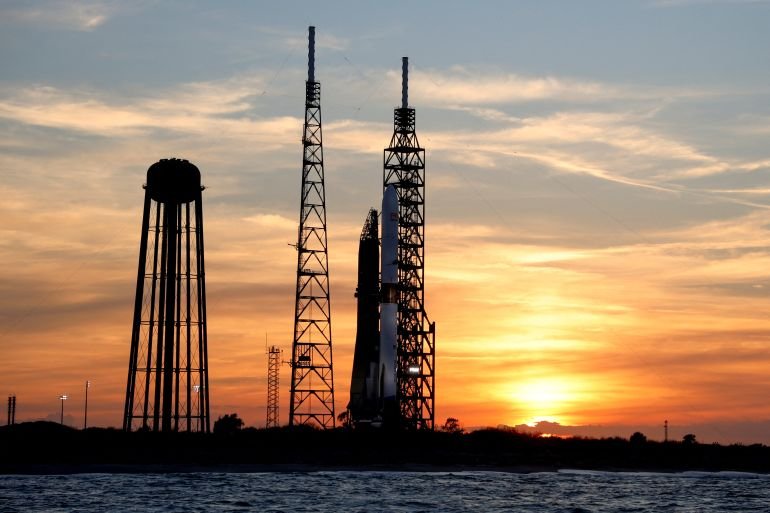
Blue Origin’s New Glenn rocket has exploded on the launchpad during a test in the US state of Florida.
The incident on Thursday evening is the latest setback for Jeff Bezos’s space venture as it seeks to narrow the gap with Elon Musk’s SpaceX.
Recommended Stories
list of 4 itemsend of list
Footage of the incident shows smoke emerging from underneath the rocket before it erupts into a massive fireball that billows skyward, sending a towering plume of flames and smoke into the air.
Emergency crews remained at the scene more than an hour later, but officials said there was no threat from fumes or other potential hazards.
No injuries have been reported.
“We experienced an anomaly during today’s hotfire test,” Blue Origin said in a brief statement posted on X, adding that “all personnel have been accounted for”.
A hot-fire test is where a rocket engine is fired up while anchored to the ground.
In a separate X post, Bezos said it was “too early to know the root cause” of the incident.
“Very rough day, but we’ll rebuild whatever needs rebuilding and get back to flying. It’s worth it,” Bezos added.
US House Representative Mike Haridopolos, whose Florida district includes the launch site at Cape Canaveral, said in a statement on X that he has been in contact with NASA Administrator Jared Isaacman regarding the explosion.
“I am grateful there were no reported injuries and thankful for the first responders, engineers, and launch crews who acted quickly,” Haridopolos said.
Blue Origin is preparing the New Glenn rocket to launch 48 Amazon Leo satellites into low-Earth orbit, part of efforts to build a broadband constellation to rival Musk’s Starlink network.
Musk responded on X to a video of the New Glenn explosion, saying: “Most unfortunate. Rockets are hard.”
Last month, the New Glenn rocket failed a mission to deliver a communications satellite into the correct orbit, prompting an investigation.
President Bernardo Arevalo’s government says it requested security cooperation but did not approve US attacks.
Published On 28 May 202628 May 2026
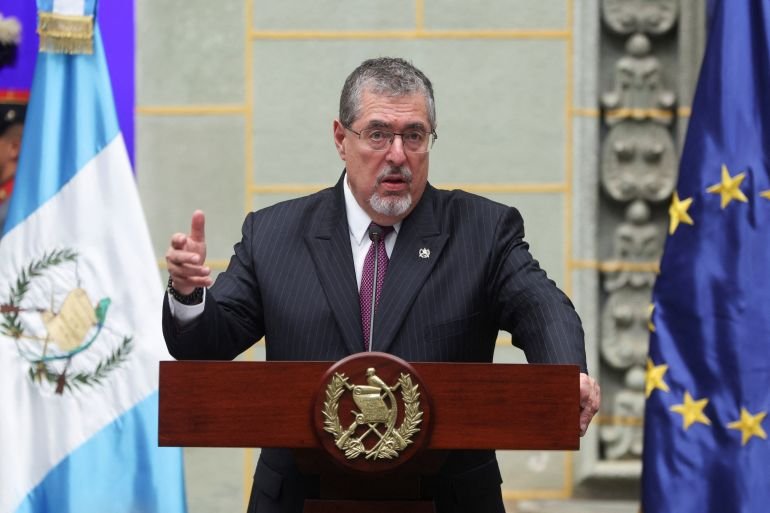
The Guatemalan government has denied reports that it agreed to allow the United States to carry out strikes against drug traffickers in the Central American country, while confirming that it has sought security cooperation with Washington.
“There is no agreement authorising foreign military operations by any country within national territory,” the government of President Bernardo Arevalo said in a statement on Thursday.
Recommended Stories
list of 3 itemsend of list
The denial appears to be in response to a New York Times report published earlier in the day that cited two unidentified sources as saying that Arevalo had agreed to US military action in his country.
The Guatemalan statement was accompanied by a note from a letter by the country’s defence minister, Henry Saenz, to his US counterpart, Pete Hegseth, dated May 28.
The note says that Guatemala “desires to lead, with US assistance, active military operations” against drug groups identified as “designated terrorist organisations” (DTOs) by Washington.
“In accordance with existing bilateral agreements and arrangements, such combined Guatemala-led operations would further bilateral interests in defeating DTOs and advancing regional and hemispheric security,” Saenz wrote.
But the Guatemalan government stressed that the call for assistance from Washington was not an invitation for US attacks in the country.
“This request falls within the framework of existing bilateral agreements on this matter and strictly adheres to the provisions of the Constitution and applicable laws regarding cooperation agreements on civil or military security,” it said.
Under President Donald Trump, the US has shown a willingness to use force in Latin America.
Since last year, the US has been carrying out air strikes against alleged drug boats in the Caribbean Sea and Pacific Ocean, killing at least 194 people, in a campaign that rights advocates have said amounts to extrajudicial killings.
In January, the US also abducted Venezuela’s President Nicolas Maduro, whom it accused of drug trafficking.
Maduro was replaced by his vice president, Delcy Rodriguez, who has improved relations with Washington and allowed greater foreign involvement in the country’s oil sector. The US continues to exert control over Venezuela’s oil exports.
Many countries in Central and South America have struggled to contain gang violence related to the drug trade.
In January, Guatemala’s Arevalo declared a state of emergency after suspected gang members killed at least 10 police officers.
But Latin American leaders have been wary of accepting US military intervention in their countries, while inviting intelligence and security cooperation.
Arevalo was elected in 2023 as an anticorruption campaigner.
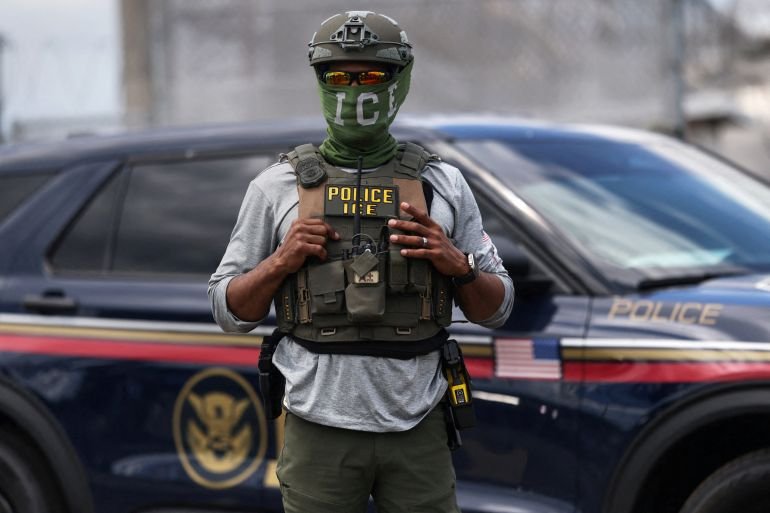
The administration of United States President Donald Trump has filed lawsuits against four Democrat-leaning states for refusing to issue confidential licence plates for vehicles carrying federal immigration agents.
On Thursday, the Department of Justice announced the complaint on its website, accusing Maine, Massachusetts, Oregon and Washington of defying the federal government’s demands.
Recommended Stories
list of 3 itemsend of list
Undercover licence plates, it argued, were necessary for the “operational effectiveness and safety” of agents “who have faced a wave of targeted harassment”.
But officials in the states have pushed back, arguing that agents for Immigration and Customs Enforcement (ICE) should not be allowed to carry out their activities in secret, without proper oversight.
The clash comes as Trump carries out a mass deportation campaign that critics have accused of human rights violations, including unwarranted violence, illegal arrests and denial of due process rights.
Obscuring agents’ identities
The Trump administration, however, has used concerns about ICE safety to crack down on efforts to identify agents.
Over the last year, for instance, the administration has pressured tech companies like Apple and Google to remove apps that tracked ICE agents, citing the risk of violence.
It has also dismissed a list of requested reforms from congressional Democrats, which called on ICE agents to be readily identifiable, stop racial profiling and abide by use-of-force standards.
The question of how to hold ICE accountable remains a politically divisive one. Trump officials have gone so far as to imply ICE could be immune from prosecution.
After an ICE agent shot and killed Minneapolis resident Renee Nicole Good, Vice President JD Vance initially told reporters, “That guy is protected by absolute immunity. He was doing his job,” though he later walked back that statement.
Confidential licence plates are one tactic the federal government uses to shield its agents from public identification.
Licence plate numbers are generally kept in databases accessible by state and federal officials. But a private licence plate obscures the owner of a given vehicle.
Several of the states the Trump administration sued on Thursday have argued that ICE agents are largely pursuing civil infractions, not criminal investigations, and are therefore not entitled to such protections.
Watchdog groups have also largely opposed such identity-masking, arguing that it allows ICE agents to commit violence without accountability.
Massachusetts Governor Maura Healey said the Trump administration is angling for ICE agents to ‘operate in secret’, shielded even from state oversight [File: Brian Fluharty/Imagn Images via Reuters]
States respond
On Thursday morning, in a news conference, Massachusetts Governor Maura Healey addressed the lawsuit by describing incidents where ICE has overstepped its authority, including by arresting US citizens and lawful residents.
“Last night, Donald Trump and the US Department of Justice filed a complaint suing our Registry of Motor Vehicles,” Healey said. “They want us to give ICE confidential licence plates so they can operate in secret in Massachusetts — in secret, even from our law enforcement.”
She then proceeded to draw a line between ICE’s actions and those of other federal law enforcement agencies.
“We support law enforcement doing legitimate law enforcement work. That’s not what we’re seeing from ICE,” Healey continued.
“So we’re not going to help them operate in secret as they take people off our streets without cause. We’re not going to allow them to make our streets and our communities and our neighbourhoods and our state less safe.”
Separately, in Oregon, officials have explained to the Trump administration that the state has temporarily paused all registration for federal vehicles, while a legal evaluation is under way.
“The DMV [Department of Motor Vehicles] pause is not intended to place federal law enforcement officers at risk or undermine ongoing criminal investigations,” Amy Joyce, an official with Oregon’s Department of Transportation, wrote in an open letter.
“The pause is necessary to ensure issuance of vehicle registrations and license plates to federal agencies fully complies with Oregon law.”
Oregon has so-called sanctuary laws that prohibit state agencies from collaborating on federal immigration enforcement, even if indirectly. A judicial warrant is needed for state participation.
In her letter, Joyce added that “the prospect of litigation in this area is real”, pointing to lawsuits the state has faced in the past.
She also underscored that giving federal vehicles undercover plates is discretionary, and that Oregon is not required to distribute them. Federal vehicles can still operate on Oregon roads without a state licence plate.
Acting Attorney General Todd Blanche has argued that federal plates will allow immigration enforcement targets to ‘track and evade’ operations [Win McNamee/Getty Images via AFP]
Federal vs state powers
But in issuing its lawsuits on Thursday, the Trump administration is likely to tee up a legal battle over the division of state and federal powers.
Officials with the Department of Justice have argued that not assigning ICE agents confidential licence plates is not only illegal, but violates the US Constitution’s Supremacy Clause.
That law gives federal law precedence over any state law that might conflict with its mandate.
But it is unclear whether such an argument will ultimately prevail in court. States are generally in charge of their own motor vehicle departments, while the federal government has the power to distribute its own plates for official use.
Acting Attorney General Todd Blanche, however, has argued that, by denying local licence plates, the states in question are illegally restricting the activities of the federal government.
“By denying undercover license plates to DHS [Department of Homeland Security] components, including ICE, while issuing them to their own state agencies, these governors are pursuing discriminatory and obstructionist policies against federal law enforcement,” Blanche said in a statement.
“These actions undermine federal immigration enforcement, allow dangerous criminals to escape justice, and terrorize American communities.”
The lawsuits themselves make the case that federal plates would compromise immigration agents during their undercover operations.
“Such law enforcement operations require federal law enforcement officers to blend into the environment to avoid premature detection that could undermine the mission and place them at risk,” the lawsuit against Massachusetts reads.
“If agents are forced to use a single traceable public plate, enforcement targets may be able to track and evade enforcement.”
But in response to that suit, Governor Healey said the issue ultimately comes down to whether federal agents will “respect the rule of law here in Massachusetts”.
Restoring pre-war stockpiles of critical US munitions will take at least two years, according to CSIS report.
Published On 28 May 202628 May 2026
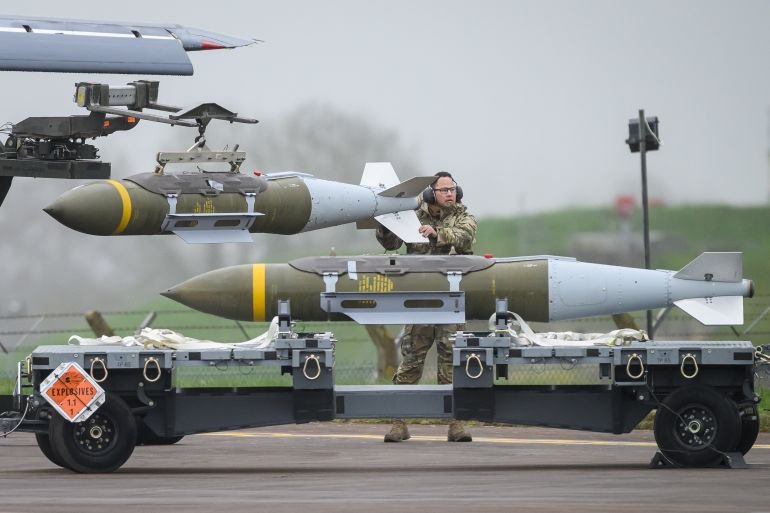
The United States has enough munitions for any plausible scenario in the Iran war, but rebuilding its depleted inventories will “take years”, according to a new report by the Center for Strategic and International Studies (CSIS).
Restoring pre-war stockpiles of four critical munitions heavily used by US forces during nearly 40 days of joint fighting with Israel against Iran would take at least two years – and in some cases more than three – the Washington-based think tank said on Wednesday.
Recommended Stories
list of 4 itemsend of list
While US officials publicly project confidence in weapons stockpiles, analysts have said that dwindling munition supplies may be shaping Washington’s calculations over whether to resume the war on Iran.
“Campaigns against Iran and its proxies – and, for Patriot interceptors, aid to Ukraine – have made the problem more acute,” said the CSIS report.
“Alongside replenishing its own stocks, the United States also has to fulfil orders from allies and partners.”
A finding by the think tank last month said that the four key munitions that had been depleted to more than half their pre-war inventory levels included the Land Attack Missile (TLAM), the Terminal High Altitude Area Defences (THAAD) interceptors, Patriot missiles, and the SM-3 and SM-6 ship-based surface-to-air missiles.
The Joint Air-to-Surface Standoff Missile (JASSM) and Precision Strike Missile (PrSM) will take several months to a year to replace, CSIS said. The pre-war PrSM inventory was low because the system had just begun production, while JASSM, though heavily used in the Iran war, will see large deliveries from recent procurements, it added.
“Decisions on how to allocate new production have already created bilateral friction, and this friction will continue for the next few years as demand outpaces supply,” the report warned.
The main problem is not funding but production time, limited manufacturing capacity and long procurement lead times, with CSIS noting that past procurement levels were relatively low for many systems, slowing replacement efforts despite recent increases in defence spending.
“There will be a window of vulnerability for several years until inventories return to their previous levels and another several years before they get to the levels that war planners desire,” said CSIS.
‘Strategic inventory shock’
US combat experience in recent conflicts may still help preserve deterrence against China during the replenishment period, it added.
Emerging evidence of depleting stockpiles of weapons has surfaced in recent weeks.
The Washington Post revealed earlier this month that the US used more of its advanced missile-defence interceptors to defend Israel than even Israel itself during the 40 days of the Iran war.
The US Navy last week paused $14bn in weapons sales to Taiwan that Congress has approved but President Donald Trump needs to sign off on. The navy’s secretary stating that it needs munitions for the Iran war.
Omar Ashour, a professor of security and military studies at the Doha Institute for Graduate Studies in Qatar, previously told Al Jazeera that while the Iran war did not empty the US arsenal of weapons, it burned through some of the most important and strategically valuable layers of it.
“It’s not tactical exhaustion, it’s just a strategic inventory shock if you wish, because that depletion will affect other theatres [of war],” Ashour said.
CSIS said last month that while the US has enough missiles to continue fighting the Iran war, the risk “which will persist for many years, lies in future wars”.



![Buildings in Muridke, Pakistan, hit by Indian missiles [Abid Hussain/Al Jazeera]](https://www.aljazeera.com/wp-content/uploads/2025/05/WhatsApp-Image-2025-05-07-at-15.45.34-1-1746622293.jpeg?w=770&resize=770%2C579&quality=80)