Tag: News – Al Jazeera

  • Democrat captures Florida House seat in Trump’s Mar-a-Lago district

    Democrat captures Florida House seat in Trump’s Mar-a-Lago district

    Emily Gregory’s victory in the previously GOP-held district is the latest Democratic upset before the November midterms.

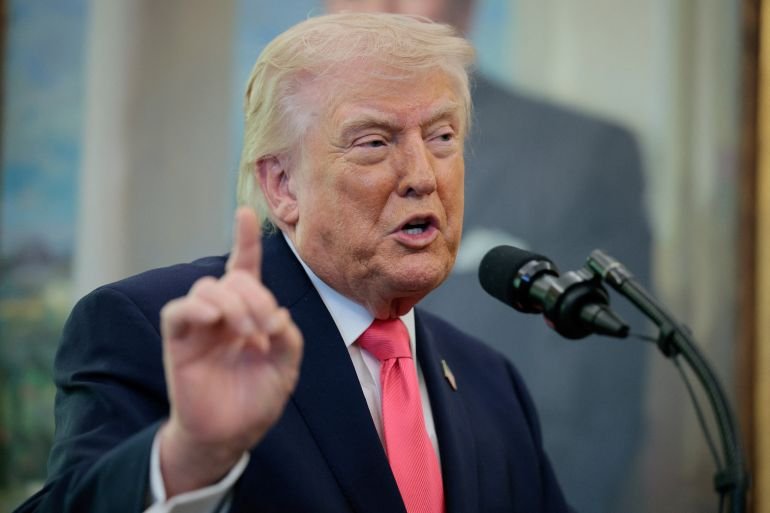
    Democratic candidate Emily Gregory is projected to win a special election for a Florida state House of Representatives seat that includes United States President Donald Trump’s Mar-a-Lago resort, in the latest sign of strain for Trump’s Republican Party.

    With almost all votes counted from the Tuesday election, Gregory led her Trump-endorsed opponent Jon Maples by 2.4 percentage points, reported the AP news agency.

    Recommended Stories

    list of 3 itemsend of list

    Democrats hailed the victory in the previously Republican-controlled House District 87 as a sign voters are turning against Republicans and Trump before November’s midterm elections. Democrats registered electoral gains in the November 2025 gubernatorial and mayoral elections, with the cost of living cited as a major issue on people’s minds.

    The US decision to join Israel in attacking Iran has driven up oil and gas prices, putting further inflationary pressures on Americans.

    “If Mar-a-Lago is vulnerable, imagine what’s possible this November,” said Heather Williams, president of the Democratic Legislative Campaign Committee. She said Tuesday’s race was the 29th seat that Democrats have flipped from Republican control since Trump took office.

    “Gas prices are spiking, grocery costs are up, and families can’t get by – it’s clear voters at the polls are fed up with Republicans,” Williams said.

    Gregory grew up north of Palm Beach in Stuart. She’s the owner of a fitness company that works with pregnant and postpartum women, and she has never run for elected office before.

    Speaking to MSNOW after her victory, she said she was “pretty shocked” and “having a fairly out-of-body experience”.

    Gregory’s victory is the latest in a series of improbable special election outcomes across the country since Trump returned to the White House more than a year ago, including several notable Democratic wins in Republican-controlled Florida.

    In December, Eileen Higgins won the race for Miami mayor, the first time a Democrat had led the city in nearly three decades. She defeated a Trump-endorsed Republican in a campaign that leaned heavily into criticism of the president’s immigration crackdown, a message that resonated with the city’s large Hispanic population.

    Further west in Texas, Democrat Taylor Rehmet flipped a reliably Republican state Senate district in a special election in January.

    Trump immediately distanced himself from the loss in a district he’d won by 17 points in 2024, saying “I’m not involved in that” even though he had endorsed the Republican candidate.

    Trump, who keeps Mar-a-Lago as his official residence, voted by mail in the Tuesday election, and his ballot was counted, Palm Beach County voter records show. He chose a mail ballot despite publicly bashing the voting method as a source of fraud and pushing Congress to curtail the practice.

  • OpenAI pulls AI video app Sora as concerns grow on deepfake videos

    OpenAI pulls AI video app Sora as concerns grow on deepfake videos

    This is first big step by the ChatGPT maker to focus its business on potentially more lucrative areas, such as coding tools.

    OpenAI is shutting down its social media app Sora, which went viral towards the end of last year as a place to share short-form videos generated by artificial intelligence but also raised alarms in Hollywood and elsewhere.

    OpenAI said in a brief social media message on Tuesday that it was “saying goodbye to the Sora app” and that it would share more soon about how to preserve what users had already created on the app.

    Recommended Stories

    list of 4 itemsend of list

    “What you made with Sora mattered, and we know this news is disappointing,” it said.

    The company behind ChatGPT released Sora in September as an attempt to capture the attention, and potentially advertising dollars, that follow short-form videos on TikTok, YouTube or Meta-owned Instagram and Facebook.

    But a growing chorus of advocacy groups, academics and experts expressed concerns about the dangers of letting people create AI videos on just about anything they can type into a prompt, leading to the proliferation of nonconsensual images and realistic deepfakes in a sea of less harmful “AI slop”.

    OpenAI was forced to crack down on AI creations of public figures – among them, Michael Jackson, Martin Luther King Jr and Mister Rogers – doing outlandish things, but only after an outcry from family estates and an actors’ union.

    Disney, which made a deal with OpenAI last year to bring its characters to Sora, said in a statement on Tuesday that it respects “OpenAI’s decision to exit the video generation business and to shift its priorities elsewhere”.

    But Disney did not see the move coming, the Reuters news agency reported.

    On Monday evening, Walt Disney and OpenAI teams were working together on a project linked to Sora. Just 30 minutes after the meeting, the Disney team was blindsided with word that OpenAI was dropping the tool altogether, a person familiar with the matter said.

    OpenAI announced the move publicly on Tuesday.

    “It was a big rug-pull,” according to the person, who requested anonymity to discuss the matter.

    Messy process

    The move is the first big step by the ChatGPT maker to focus its business on potentially more lucrative areas, such as coding tools and corporate customers.

    But the abrupt cancellation of Sora illustrates how messy the streamlining process may become as OpenAI prepares for a stock market debut that could come as early as later this year.

    The Sora decision means the end of a blockbuster $1bn deal between Disney and the ChatGPT maker that was announced a little more than three months ago. As part of the three-year deal, Disney said it would invest $1bn in OpenAI and lend more than 200 of its iconic characters to be used in short, AI-generated videos.

    But the transaction between the companies never closed, two other people familiar with the matter said, and no money changed hands.

  • Trump keeps up claims of talks with ‘the right people’ in Iran

    Trump keeps up claims of talks with ‘the right people’ in Iran

    US reportedly engaged in backchannel efforts, though Israel is apparently not on the same page, and military buildup continues.

    United States President Donald Trump has maintained that negotiations to end the war on Iran are under way, claiming that Tehran wanted to make a deal “so badly” despite its previous denial that talks were happening.

    Speaking at the White House on Tuesday evening, Trump told reporters that the US, which joined Israel in attacking Iran at the end of last month, was talking to “the right people” to reach a deal, alluding to a “very big present” related to “oil and gas” having been gifted by Tehran.

    Recommended Stories

    list of 3 itemsend of list

    But, as fighting continued, including continued Iranian attacks on Israel and a strike near Iran’s Bushehr nuclear plant, uncertainty swirled around Trump’s claims, which had already been dismissed as “fake news” by Iran’s parliament speaker, Mohammad Baqer Ghalibaf, on Monday.

    Trump’s latest claims coincided with media reports that Washington had sent Iran a 15-point plan to end the war. Israel’s Channel 12 cited sources saying the plan would include the end of Iran’s nuclear programme and the reopening of the Strait of Hormuz, which Iran has throttled throughout the conflict.

    Reporting from Washington, DC, Al Jazeera’s Teresa Bo said the plan had apparently been handed over to Iran by Pakistan, noting that Trump was “under pressure” about a costly and unpopular war. A Reuters/Ipsos poll published on Tuesday found that 61 percent of people in the US disapproved of the attacks on Iran, compared with 59 percent last week. Some 35 percent approved them, down from ‌37 percent ‌in a survey conducted last week.

    Behind the scenes, Iran’s Ministry of Foreign Affairs acknowledged that messages had been relayed by “friendly countries” indicating a “US request for negotiations”, according to the AFP news agency.

    ‘Establishing deterrence, economic gains’

    Negar Mortazavi, a senior non-resident fellow at the Center for International Policy, told Al Jazeera Iran would want to end the war imposed on it on its “own terms”.

    “One is to establish enough deterrence to make sure that once this war ends, it doesn’t come back like it did last year,” Mortazavi said. “That they don’t turn into the next Gaza or Lebanon or Syria, or [Benjamin] Netanyahu, potentially with US support, can go in and mow the grass, again and again,” she added, referring to the Israeli prime minister.

    In addition to establishing deterrence, Mortazavi said Iran would also need “some form of economic gain”.

    “This chokehold on the Strait of Hormuz is now giving them ideas. ‘Maybe we can charge passage fees like some other places in the world’ – there are those discussions in Iran”, she said, also citing sanctions relief and reparations to rebuild the country after the heavy damage inflicted by the US and Israeli attacks.

    Though Trump may be seeking a diplomatic off-ramp amid soaring energy prices and a teetering global economy, Israeli military spokesman Effie Defrin said his country’s war plan was “unchanged” and that it would continue “to deepen the damage and remove existential threats”.

    And in the backdrop, the US itself appeared to be readying itself for more war, with media reports suggesting that it was expected to send thousands of soldiers from the army’s elite 82nd Airborne Division to the Middle East, adding to the 50,000 US troops already in the region, and fuelling fears of a longer conflict.

    In Iran, where Trump’s comments provoked a “state of confusion and ambiguity”, according to Al Jazeera’s Mohamed Vall, the atomic energy organisation said a strike on Tuesday evening hit inside the compound of its Bushehr nuclear power plant, but caused no damage.

    In Israel, Iranian attacks on Tuesday wounded seven people, including an infant. Iran has kept up and indeed increased the pace of its launches, sending millions of Israelis into shelters multiple times a day. Recent failed interceptions have caused deaths and injuries.

  • NASA to spend $20bn on moon base, nuclear-powered Mars spacecraft

    NASA to spend $20bn on moon base, nuclear-powered Mars spacecraft

    The agency will increase robotic missions to the moon and launch a spacecraft called Space Reactor 1 Freedom.

    NASA has unveiled a major overhaul of its moon and Mars strategy, scrapping plans for a lunar-orbit space station and instead committing $20bn over the next seven years to build a base on the moon’s surface, while also advancing plans to send a nuclear-powered spacecraft to Mars.

    NASA Administrator Jared Isaacman outlined the changes on Tuesday during a meeting in Washington, DC, with partners, contractors and government officials involved in the Artemis programme, saying the agency will increase robotic missions to the moon and lay the groundwork for nuclear power on the lunar surface.

    Isaacman, appointed by US President Donald Trump and who took charge in December, said the changes form part of a broader overhaul of NASA’s long-term Moon-to-Mars strategy.

    The planned moon base is intended to support long-term human presence on the lunar surface, with robotic missions expected to help prepare the site, test technologies and begin building infrastructure before astronauts return later this decade.

    The agency also disclosed plans to launch a spacecraft called Space Reactor 1 Freedom before the end of 2028, a mission designed to demonstrate nuclear electric propulsion in deep space on the way to Mars.

    The spacecraft will deliver helicopters on the Red Planet, similar to the Ingenuity robotic test helicopter that flew with NASA’s Perseverance rover, a step the agency said would help move nuclear propulsion technology from laboratory testing to operational space missions.

    The Ingenuity helicopter was the first aircraft to achieve powered, controlled flight on another planet. It travelled to Mars attached to NASA’s Perseverance rover and landed in February 2021.

    Pausing the Lunar Gateway station

    The Lunar Gateway station, a planned space station in lunar orbit being developed with contractors including Northrop Grumman and international partners, was meant to serve as a base where astronauts could live and work before heading to the Moon’s surface.

    But NASA now plans to repurpose some Gateway components for use on the surface instead.

    Repurposing Lunar Gateway to create a base on the moon’s surface leaves uncertain the future roles of Japan, Canada and the ‌European Space ⁠Agency in the Artemis programme, three key NASA partners that had agreed to provide components for the orbital station.

    “It should not really surprise anyone that we are pausing Gateway in its current form and focusing on infrastructure that supports sustained operations on the lunar surface,” Isaacman said.

    The changes to NASA’s flagship Artemis programme are reshaping billions of dollars’ worth of contracts and come as the United States faces growing competition from China, which is aiming to land astronauts on the moon by 2030.

    The Artemis programme, begun in 2017 during Trump’s first term as president, envisions regular lunar missions as NASA’s long-awaited follow-up to its first moon missions in the Apollo programme that ended in 1972.

  • Long lines, unpaid TSA workers: Experts say US air travel system in crisis

    Long lines, unpaid TSA workers: Experts say US air travel system in crisis

    For more than a month, employees of the US Transportation Security Administration (TSA), tasked with screening the millions of people who pass through airports across the United States each day, have not been paid.

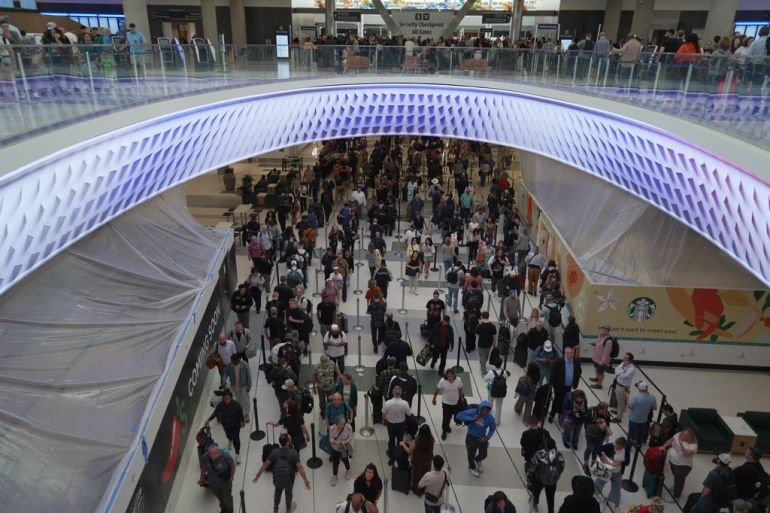
    The result can be seen in videos that have spread across social media, showing frustrated travellers waiting in long lines at some of the country’s busiest airports, where hundreds of TSA employees have quit or declined to show up for work.

    Recommended Stories

    list of 3 itemsend of list

    Hours-long delays have snarled airports, and morale among agency employees has suffered amid the lack of pay, the result of a partial government shutdown affecting the Department of Homeland Security (DHS), which oversees the TSA.

    The administration of US President Donald Trump has deployed federal agents from US Immigration and Customs Enforcement (ICE) to airports across the country to fill gaps. That step that has drawn criticism given their lack of relevant training and a record of aggressive methods.

    The delays also come at a time when the US-Israel war on Iran has resulted in additional complications when it comes to international travel, from cancelled or rerouted flights to heightened energy prices and concerns over security.

    Taken together, analysts warn that the situation has created an image of systemic dysfunction and called into question the safety and reliability of the country’s air travel system.

    “For years we’ve bragged about how the US has the best and safest aviation system in the world,” said William McGee, a researcher and consumer advocate at the American Economic Liberties Project.

    “I’m not sure that’s something we get to say anymore.”

    Exhausted workforce

    More than 450 TSA workers have quit since the partial shutdown began on February 14, according to a CNN report citing Lauren Bis, acting assistant secretary for public affairs at DHS.

    Call-out rates have also risen from an average of about two percent before the shutdown to around 10 percent last week. TSA did not respond to a request for updated figures.

    Frustration among TSA employees has been compounded by the fact that many also went without pay during a previous government shutdown during contentious budget negotiations in October and November, the longest in history.

    Everett Kelley, president of the American Federation of Government Employees (AFGE), a labour union that represents workers from numerous government agencies, including TSA, says the growing exhaustion is a natural response to the professional and financial instability workers experience.

    “Across the country, TSA officers are once again being asked to report to work without a paycheck. They have families, mortgages and bills like everyone else,” Kelley said in a statement emailed to Al Jazeera.

    Statistics on call-outs also don’t capture the full story, with some airports functioning normally while others experience chaotic delays and higher rates. Major airports in cities such as New York, Atlanta, and Houston have seen rates of nearly 30 percent or higher.

    With conditions at each airport variable and hard to predict, McGee likens delays to a game of “Whac-A-Mole” that can occur at one location even as they ease at another.

    “The bottom line is that, if you have to travel right now, you need to be getting to the airport very early,” he said.

    Social media users have shared stories of showing up at the airport with ample time in advance and still missing their flights after waiting in line for several hours.

    A spokesperson for the Port Authority of New York and New Jersey, which oversees operations at major airports such as John F Kennedy International and Newark International, told Al Jazeera in a statement that while the Port Authority does not rely on federal funds to operate, workers for federal agencies such as TSA still do.

    “Over the last several days, we’ve begun to see that translate into long wait times at security checkpoints during certain periods depending on passenger volumes, TSA shift changes and staff breaks, and the number of TSA staff who come to work for each shift,” the statement says.

    Armed federal agents at an airport
    US federal officers patrol around Washington Dulles International Airport, in Chantilly, Virginia, on Tuesday, March 24, 2026 [Manuel Balce/AP Photo]

    Political impasse

    The situation is the result of a political stalemate over continued funding for DHS, which was set aside during the last shutdown for separate negotiations over immigration enforcement agencies such as ICE and US Customs and Border Protection (CBP). The impasse comes amid continued demands from activists and Democratic lawmakers to rein in immigration agencies, fuelled in part by the high-profile killing of US citizens such as Renee Good and Alex Pretti by federal agents during a crackdown in Minnesota in January.

    Widespread public anger over aggressive methods and what rights groups say are routine civil liberties violations during the Trump administration’s mass deportation raids led to calls to rein in agencies and implement reforms.

    But to pass a funding bill to reopen the government in November, both parties agreed to negotiate DHS funding at a later date. That impasse is behind the current partial shutdown, which began when funding lapsed on February 14.

    Several bills put forward by Democrats to fund TSA while a larger deal on DHS is worked out have failed to pass, with both sides blaming the other for chaos at airports across the country.

    “Democrats have offered to pay the salaries — fully fund, no conditions — for TSA,” Democratic Senator Sheldon Whitehouse said in a recent social media post. “It’s Republicans who keep blocking that.”

    “Democrats are holding American travellers hostage and denying federal workers their paychecks for political leverage,” the White House social media account said in a post on Friday, sharing a video of long lines at an airport.

    Media reports on Tuesday stated that the US Senate is moving to advance a bill that would fund much of DHS, including TSA, to address ongoing travel chaos, as an agreement focused on ICE reforms is worked out later.

    McGee says that the situation has created a sense of general dysfunction.

    “The US has launched a war against Iran, and because of that, there are heightened security concerns. That TSA is not being paid in that environment is kind of mind-boggling,” he said.

    “On top of that, you have flight changes, logistical concerns, and rising energy costs,” he added. “It’s all a hot mess right now.”

  • US says they’re talking, Iran says they’re not. Who’s telling the truth?

    US says they’re talking, Iran says they’re not. Who’s telling the truth?

    United States President Donald Trump is insistent that “productive” negotiations have taken place with Iran to end the war he launched with Israel’s Prime Minister Benjamin Netanyahu almost a month ago. The major problem with that narrative is that Iran’s top officials have repeatedly denied it.

    Amid the fog of war and the propaganda being pushed by all sides, it is hard to know who to believe. But an analysis of what each side has to gain from any negotiations – and a potential end to the conflict – could bring more clarity.

    Recommended Stories

    list of 3 itemsend of list

    Trump’s comments that there were “major points of agreement” after “very good” talks with an unnamed “top” Iranian figure came as stock markets opened in the US for the start of the trading week. The five-day deadline he gave for a positive response from Iran also happens to coincide with the end of the trading week.

    Many have cynically noted that timing, especially as it comes after a two-week period in which oil prices have fluctuated in line with events in the Middle East, leading to a high of about $120 a barrel last week.

    Trump’s talk of negotiations may also give time for more US troops to arrive in the Middle East, if Washington decides to conduct some form of ground invasion of Iranian territory.

    Among those questioning Trump’s motives was the man believed by some to be the senior Iranian official Trump was referencing: the Iranian parliamentary speaker, Mohammad Bagher Ghalibaf.

    “No negotiations have been held with the US, and fakenews is used to manipulate the financial and oil markets and escape the quagmire in which the US and Israel are trapped,” Ghalibaf wrote on social media.

    The impact on stock markets and oil prices is not just relevant to the US and Trump, but also to Iran. However, for Tehran, the benefit comes in the damage the war is doing to the US and global economies.

    The Iranian state wants the US to feel economic pain from the war, as a means of deterrence for any future Israeli or US attack on Iran.

    Therefore, as much as it is in the US interest to play up talk of negotiations in order to calm the markets, it is also in Iran’s interest to downplay any talk to do the exact opposite, and not give the Trump administration any breathing space.

    US benefits?

    Consequently, both sides have their own narratives on negotiations, and public comments will do little to inform us as to whether those negotiations are really taking place, or in what form they may be.

    That instead leads us into what each side has to gain from negotiations, and an actual end to the war at the current stage.

    Trump appears to have underestimated the consequences of the conflict that he launched with Netanyahu on February 28, and the ability of the Iranian state to withstand the attacks against it without collapsing.

    “They weren’t supposed to go after all these other countries in the Middle East … Nobody expected that,” he said last week, adding that even “the greatest experts” didn’t believe that.

    Leaving aside that experts – including US intelligence officials – had repeatedly made those warnings, reality has now made Trump aware of the consequences he had previously ignored.

    While some allies and supporters may continue to push him to plough on with the conflict, Trump has previously shown himself amenable to cutting deals to extricate himself from difficult situations, and it is not far-fetched to see the benefits of doing so in this instance.

    The US president has already ordered his government to issue temporary sanctions waivers on some Iranian oil, in an effort to calm oil prices. This is the first time Iran has lifted sanctions on any Iranian oil since 2019, and it will not be lost on Iran that the waivers have come as a result of their policy to expand the conflict to the wider Gulf and the Strait of Hormuz, a key waterway through which a fifth of the world’s oil and liquified natural gas transits.

    The war was already unpopular in the US – and now even more so, as consumers see the impact on petrol prices and potentially other areas of the economy, all in the run-up to congressional elections later this year, in which Trump’s Republicans are likely to do poorly.

    Trump, therefore, has the options of extending this war – and suffering the economic and political cost, or ending it – and facing the criticism that he was unable to finish what he termed as a “short-term excursion”.

    The Iranian perspective

    But whatever Trump wants to do, the decision is not totally in his hands. Iran, attacked for the second time in less than a year, now appears to have less of an incentive to end the war without the establishment of an effective deterrent to another in the future.

    Gone are the days of the telegraphed attacks on US assets and the slow climb up the escalation ladder. From the outset of the current war, it was clear that Iran had changed its tactics and was not as interested in restraint.

    It is now arguably in the Iranian state’s benefit to drag out the conflict and inflict more suffering on the region, if it wants to ensure its survival.

    There may also be a belief that interceptor stocks in Israel are running low, allowing Iran to strike targets more effectively. The thinking – particularly among the hardliners who now appear to be in the ascendancy in Iran – will be that now is not the time to stop, and allow those interceptor stocks to replenish.

    And yet, Iran is suffering. More than 1,500 people have been killed across the country, according to the government. Infrastructure has been heavily damaged, and the power grid could be next. Relations with Gulf neighbours have nosedived, and, after repeated Iranian attacks, are unlikely to return to their previous levels after the conflict.

    More moderate voices in Iran will look at that and think that things could easily get worse. They can argue that some form of deterrence has been achieved, and that the time is now ripe to talk. And if they can get some concessions – such as a promise of no future attacks, or greater authority in the Strait of Hormuz – they may decide that the time is right to make a deal.

  • When are UEFA’s World Cup 2026 playoffs, and which nations are involved?

    When are UEFA’s World Cup 2026 playoffs, and which nations are involved?

    The final qualification spots for the FIFA World Cup 2026 are about to be sealed via UEFA and intercontinental playoffs.

    With the FIFA World Cup 2026 kicking off on June 11, the final spots that are still up for grabs are being fiercely fought by nations in qualifiers around the globe.

    The last governing body to complete their continental playoff route is UEFA, with four European spots still up for grabs at the showpiece event.

    Recommended Stories

    list of 4 itemsend of list

    Thereafter, FIFA’s Play-Off Tournament – an intercontinental competition – will provide the last-chance saloon for two more of the best non-qualified finishers from the other continental processes around the globe.

    Al Jazeera Sport takes a look at UEFA’s final continental playoff path as that draws to a close.

    Which UEFA teams are still in with a chance of World Cup qualification?

    There will be more European teams than from any other continent at the World Cup: 16.

    There are still 16 European teams, meanwhile, vying for the final four of the UEFA qualifying positions for the World Cup:

    • Italy, Northern Ireland, Wales, Bosnia and Herzegovina, Ukraine, Sweden, Poland, Albania, Slovakia, Kosovo, Turkiye, Romania, Denmark, North Macedonia, Czechia and the Republic of Ireland

    Which UEFA teams have already qualified for the World Cup?

    The 12 European teams that have already qualified for the World Cup are:

    • Germany, Switzerland, Scotland, France, Spain, Portugal, the Netherlands, Austria, Norway, Belgium, England, and Croatia

    What is the pathway to the World Cup for the remaining UEFA teams?

    The remaining teams are divided into four paths. Only the winner of each path will qualify:

    Path A:

    • Italy vs Northern Ireland and Wales vs Bosnia and Herzegovina
      The winner of this path joins World Cup Group B (with Canada, Qatar, and Switzerland).

    Path B:

    • Ukraine vs Sweden and Poland vs Albania
      The winner of this path joins World Cup Group F (with the Netherlands, Japan, and Tunisia).

    Path C:

    • Slovakia vs Kosovo and Turkiye vs Romania
      The winner of this path joins World Cup Group D (with USA, Paraguay, and Australia).

    Path D:

    • Denmark vs North Macedonia and Czechia vs Republic of Ireland
      The winner of this path joins World Cup Group A (with Mexico, South Africa, and South Korea).

    When are the first set of UEFA playoffs for World Cup qualification?

    The first round of pathway matches will be played by the 16 remaining teams on March 27, and are single-leg semifinals.

    When are the second set of UEFA playoffs for World Cup qualification?

    The second round of pathway matches will be played on March 31, with the four winners of each pathway final progressing to the FIFA World Cup 2026. These matches will also be played over a single leg.

    How have the UEFA qualifiers reached this stage?

    The four final UEFA qualifying places are being decided by the teams that were the 12 runners-up from the group qualifying stage and four based on performances in the UEFA Nations League.

    How were the home teams decided for the UEFA playoffs?

    The highest-ranked teams are hosting the semifinals. The hosts of the finals were determined by a draw.

    Pressure on Italy as playoff hopefuls eye 2026 World Cup

    There is no doubt that Italy are the biggest name not amongst those nations that have already qualified.

    The four-time champions are seeking to avoid the ignominy of missing out on a World Cup for a third consecutive time.

    The spotlight has been on the Italian domestic league, Serie A, for falling behind the other leagues on the continent with their clubs struggling to compete in European competitions.

    There will be no greater evidence of Italian football’s fall from grace, however, than the failure to reach the finals.

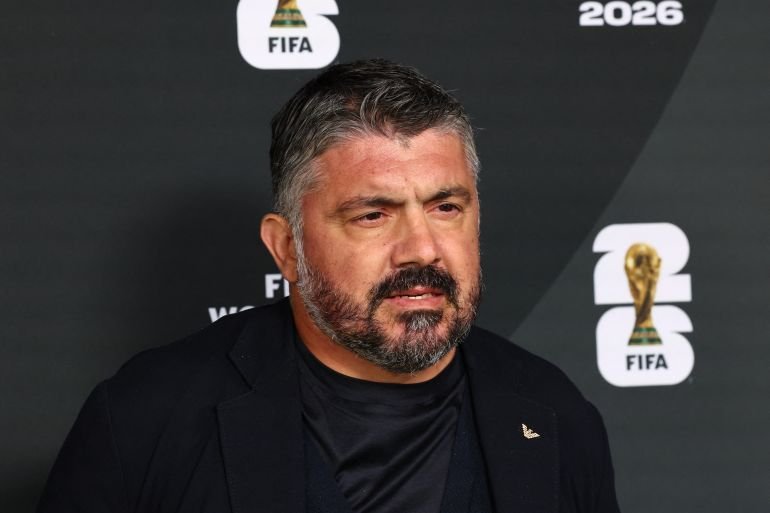
    “It’s undeniable that there’s nervousness,” coach Gennaro Gattuso said. “Only someone without blood running through their veins wouldn’t feel it.”

    Will there be any more qualifiers for the World Cup after UEFA’s?

    Yes. There is a different format for the intercontinental playoffs, which FIFA simply calls the Play-Off Tournament.

    Two teams will advance from a field of six.

    The lineup of teams was comprised of two nations from CONCACAF (Jamaica, Suriname) and one each from Asia (Iraq), Africa (DR Congo), South America (Bolivia) and Oceania (New Caledonia).

  • Afghanistan frees detained US citizen Dennis Coyle as gesture of ‘goodwill’

    US Secretary of State Marco Rubio welcomes Coyle’s release as ‘positive step’ while thanking Qatar and UAE for support.

    Authorities in Afghanistan have released United States citizen Dennis Coyle, who was detained in the country for more than a year, after a plea from his family.

    The country’s Foreign Ministry said on Tuesday that the family of linguist and researcher Coyle had written to the country’s leadership, asking that he be released and pardoned for the Muslim holiday of Eid al-Fitr.

    Recommended Stories

    list of 3 itemsend of list

    “The Supreme Court of the Islamic Emirate deemed his period of detention sufficient and decided on his release,” the ministry said in a statement.

    The announcement comes after a meeting of Afghan Foreign Minister Amir Khan Muttaqi, former US Special Envoy to Afghanistan Zalmay Khalilzad, the United Arab Emirates Ambassador to Kabul Saif Mohammed al-Ketbi, and a member of Coyle’s family.

    The UAE facilitated the release, Afghanistan’s Ministry of Foreign Affairs said, adding that the decision was made on humanitarian grounds and as a gesture of “goodwill”.

    US citizen Dennis Coyle (C) upon his release by the Taliban, poses with US former special envoy to Afghanistan Zalmay Khalilzad (R) and the UAE ambassador to Kabul Saif Mohammed Al-Ketbi (L) at the airport in Kabul on March 24, 2026.
    Coyle, centre, poses with former US special envoy Zalmay Khalilzad, right, and the UAE ambassador to Kabul Saif Mohammed al-Ketbi, left, at the airport in Kabul on March 24, 2026 [AFP]

    US Secretary of State Marco Rubio also thanked the UAE and Qatar on Tuesday “for their support” in securing Coyle’s release.

    “The release is a positive step towards ending the practice of hostage diplomacy,” Rubio wrote in a social media post.

    Earlier this month, Rubio designated Afghanistan’s Taliban government as a “state sponsor of wrongful detention”, warning that the country was not safe for US citizens to visit.

    “The Taliban needs to release Dennis Coyle, Mahmoud Habibi, and all Americans unjustly detained in Afghanistan now and commit to cease the practice of hostage diplomacy forever,” Rubio said in a statement on March 9.

    Coley was detained by the Afghan authorities in January 2025 “while legally working to support Afghan language communities as an academic researcher”, according to the Foley Foundation, a group that advocates for the release of US citizens detained abroad.

    He had been held “in near-solitary conditions, requiring permission even to use the bathroom, and without access to adequate medical care”, the group said.

    Afghanistan’s Foreign Ministry said Coley was held “due to violations of Afghanistan’s applicable laws”, without elaborating.

    “Afghanistan does not detain citizens of any country for political purposes but over violations of its laws,” Tuesday’s statement quoted Taliban Foreign Minister Amir Khan Muttaqi as saying.

    Last year, five other US citizens were released in what the Taliban authorities also said was a “goodwill gesture”.

  • Why has India arrested US, Ukrainian nationals under ‘anti-terror’ laws?

    Why has India arrested US, Ukrainian nationals under ‘anti-terror’ laws?

    India has arrested six Ukrainian nationals and an American citizen for allegedly entering India’s northeast region without permits and crossing to neighbouring Myanmar to train armed groups in drone warfare.

    The foreign nationals were arrested by Indian police on March 13 at three different airports across the country. According to Indian media reports, the US national was detained by the Bureau of Immigration at Kolkata airport, three Ukrainians were detained in Lucknow, and three more in Delhi. It is not clear if they were on their way to Myanmar or returning from the country.

    Recommended Stories

    list of 3 itemsend of list

    India’s National Investigation Agency (NIA) has charged them with violating the country’s “anti-terror” laws, and they will be held in custody until March 27.

    Local police also arrested two more American tourists on Saturday for flying drones near Coast Guard headquarters in the southern city of Kochi – where India is harbouring sailors from an Iranian ship that it hosted in military exercises in February. Another Iranian ship that India had hosted was torpedoed by the US early in the war, embarrassing New Delhi and killing dozens of Iranian sailors.

    Why have these Americans and Ukrainians been arrested? What does this mean for India’s relations with Myanmar, Ukraine and the US?

    Here’s what we know:

    Who has been arrested?

    According to Indian media reports, the seven foreign nationals arrested by the NIA have been identified as Matthew Aaron VanDyke from the US, and Hurba Petro, Slyviak Taras, Ivan Sukmanovskyi, Stefankiv Marian, Honcharuk Maksim and Kaminskyi Viktor, who are all Ukrainian citizens.

    According to VanDyke’s personal website, he participated in the Iraq War and Libya’s civil war. He is the founder of a Washington, DC-based consulting firm called Sons of Liberty International. The organisation’s website says it “provides free security consulting and training services to vulnerable populations to enable them to defend themselves against terrorist and insurgent groups”. The company also ran operations in Ukraine between 2022 and 2023, when it provided training and advice to Ukraine’s military in using non-lethal equipment.

    Not much is known about the Ukrainian citizens who have been arrested.

    The NIA did not specify when the foreign nationals entered India nor when they crossed into Myanmar.

    The two American tourists arrested in Kochi have been identified as 32-year-old Katie Michelle Phelps and 35-year-old Christopher Ross Harvey, both from California.

    Why has India arrested the suspects in the Myanmar case?

    The seven men were initially detained by the NIA for entering India’s northeastern state of Mizoram without valid permits and then illegally crossing into Myanmar.

    This is not the first time foreign nationals have been arrested by India for entering northeastern states bordering the subcontinent’s approximately 1,640km (1,020-mile) border with Myanmar. In April 2025, a Belgian photojournalist was arrested by police in Mizoram for allegedly entering the state without valid travel documents and then crossing into Myanmar.

    On March 16, the NIA told a court in New Delhi that the seven foreign nationals had crossed to Myanmar to train armed groups fighting the military government in drone warfare.

    According to The Indian Express daily newspaper, the NIA said the accused were involved in illegally “importing huge consignments of drones from Europe to Myanmar via India” for the use of “ethnic armed groups”. The agency added that these groups also allegedly supported “Indian insurgent groups” by supplying weapons and training them in “terrorist” activities.

    India’s northeastern states like Mizoram and Manipur, which border Chin state in northern Myanmar, have a troubled history marred with ethnic tensions. Ethnic groups from the states, like Manipur’s Kuki National Army (KNA), also operate in Myanmar and have been actively fighting against the military government.

    India, therefore, requires foreigners to obtain special permits before entering some northeastern states bordering Myanmar, particularly since the 2021 military coup there.

    Angshuman Choudhury, a researcher and writer who specialises in political and security issues in the India-Myanmar borderland, told Al Jazeera that the Indian government views the India-Myanmar border as a major vulnerability, especially because it remains unfenced.

    “Technically, anyone crossing the border without a valid visa or permit under the Free Movement Regime (FMR) is liable for prosecution. The surveillance tends to be higher when it concerns foreign journalists,” he said.

    Foreigners who cross over into Myanmar from India to report on the conflict or support resistance forces there are not, in themselves, viewed as security concerns for India, he explained.

    “These forces have little to do with India and are fighting their own war against the Myanmar military government,” Choudhury noted. “But the Indian state still views their act of using Indian territory to cross into resistance-held territory as a violation of its own sovereignty and a security risk. This threat perception is aggravated by concerns that their support for Myanmar’s resistance forces may indirectly strengthen anti-India insurgents, although evidence for that remains sparse.”

    Why is Ukraine involved in this?

    In recent years, Ukraine has deepened its ties with India but has also been accused by rights groups of supporting Myanmar’s military government. The six Ukrainians, by contrast, have been arrested for allegedly providing support to armed groups resisting the government.

    In September 2021, months after the military coup, Justice For Myanmar, a group focusing on human rights violations in the country, accused Ukraine of supporting Myanmar’s military with arms exports and technology transfers.

    But in a statement on March 19, Ukraine firmly rejected “any insinuations regarding the possible involvement of the Ukrainian State in supporting terrorist activities” and also asked India to release its nationals.

    A statement from Ukraine’s Ministry of Foreign Affairs said: “Ukraine is a state that faces the consequences of Russian terror on a daily basis and, for this very reason, takes a principled and uncompromising stance in combating terrorism in all its forms.

    “We also emphasise that Ukraine has no interest in any activity that could pose a threat to the security of India … Instead, it is Russia, as an aggressor state, that seeks under every circumstance to drive a wedge between friendly countries – Ukraine and India,” the Foreign Ministry added.

    Media reports have suggested that Russia could have been involved in the arrests.

    NIA officials told Germany’s international broadcaster DW News that it was possible that Russian authorities had shared intelligence about the foreign nationals’ movements.

    Choudhury told Al Jazeera that this would be logical, given Russia’s growing ties with the military government in Myanmar.

    “From Moscow’s vantage point, exposing the presence of Ukrainian drone experts in the India-Myanmar borderland also reaffirms the Russian view that Kyiv is contributing to the destabilisation of unstable regions across the world. This may turn global opinion against Ukraine and its Western allies like the US,” he said.

    Russia’s Ministry of Foreign Affairs spokesperson Maria Zakharova accused Ukraine of trying “to conceal the incident and to keep its citizens’ questionable activities, which were clearly designed to destabilise the situation in the region, under wraps”.

    In a statement on March 20, Zakharova said the incident clearly showed that “[Ukrainian President Volodymyr Zelenskyy’s neo-Nazi regime has a core exporter of instability worldwide.”

    Meanwhile, the US has not yet commented on its citizen’s arrest.

    A US ⁠Embassy spokesperson told the Reuters news agency that the country’s embassy in India was aware of the arrest but could not comment on the case “for privacy reasons”.

    Why were the American tourists in Kochi arrested?

    Kochi, in the southern Indian state of Kerala, is home to sensitive Indian Navy and Coast Guard facilities.

    The headquarters near which the American tourists were allegedly flying drones falls within what authorities describe as a red zone: drone activity is strictly forbidden there.

    But the arrests also come at a time when Kochi is hosting more than 180 crew members of the Iranian warship IRIS Lavan, which was given emergency docking permission in early March after the US-Israeli war on Iran began.

    The IRIS Dena, another Iranian warship, was attacked by a US submarine in the Indian Ocean, just off Sri Lanka, at the start of the war while it was returning home from naval exercises hosted by India. IRIS Lavan was also a part of those exercises.

    What do the arrests mean for Indian relations with the US, Ukraine and Myanmar?

    Choudhury said the arrests could serve to strengthen trust between New Delhi and the Myanmar government in Naypyidaw, given the growing military challenge that the latter is facing from resistance forces along the border.

    He said in the short term, the arrests could “adversely affect the India-Ukraine relationship”, however.

    “Although I believe both sides will rely on backdoor channels to manage this issue – especially since Ukraine can’t afford to alienate India at this juncture,” he said.

    Choudhury said the incident would not severely affect relations between India and the US, as Matthew VanDyke’s relationship with the current US administration is not clear.

    “Washington, DC might not consider him an important enough figure to damage its bilateral relationship with New Delhi, which is already strained but appears to be steadily returning to normalcy,” he said.


  • Is the US talking to Iran’s Mohammad Bagher Ghalibaf, and who is he?

    Is the US talking to Iran’s Mohammad Bagher Ghalibaf, and who is he?

    United States President Donald Trump announced on Monday that he is pausing attacks on Iran’s power infrastructure for five days and claimed that Washington and Tehran had held “very good and productive conversations” aimed at ending their war.

    The same day, Trump told reporters that his envoys were talking to a senior Iranian official.

    While Trump did not name the official, multiple news outlets in Israel and the US have reported that special envoy Steve Witkoff and Jared Kushner, Trump’s son-in-law, are talking to the Iranian parliament’s speaker, Mohammad Bagher Ghalibaf.

    Both the Iranian government and Ghalibaf have denied that talks between Washington and Tehran are taking place. And in the Iranian system, any negotiations with the US would need to be approved by new Supreme Leader Mojtaba Khamenei and the Supreme National Security Council for them to have any legitimacy.

    Who is Ghalibaf, and what do we know about these supposed negotiations?

    What do we know about the talks Trump claims to be having?

    On Saturday, Trump issued a 48-hour ultimatum to Iran to reopen the critical shipping route through the Strait of Hormuz or risk US attacks on its power plants. In response, Iran said it would attack energy and water facilities in Israel and the Gulf. Ghalibaf also threatened companies that hold US Treasury bonds.

    Then on Monday, Trump wrote in a Truth Social post that Washington and Tehran had held “very good and productive conversations regarding a complete and total resolution of our hostilities in the Middle East”. He ordered US forces to hold fire against Iranian power plants for five days.

    Iran’s Ministry of Foreign Affairs has rejected Trump’s claims that negotiations were under way. Iranian officials accused Trump of pausing his threatened attacks only in an attempt to calm energy markets.

    News outlets reported on Monday that Trump said his envoys were in contact with a senior Iranian official.

    “We are dealing with a man that I believe is the most respected – not the supreme leader. We have not heard from him,” Trump said told reporters on Monday.

    Trump said he did not want to name the Iranian leader because he did not want to get him killed, but, the US news websites Axios and Politico and multiple Israeli publications have reported that Witkoff and Kushner had been in touch with Ghalibaf.

    However, on Monday, Ghalibaf wrote in an X post: “No negotiations have been held with the US, and fake news is used to manipulate the financial and oil markets and escape the quagmire in which the US and Israel are trapped.”

    Who is Ghalibaf?

    Ghalibaf, 64, is Iran’s parliamentary speaker.

    He served as the commander of the Islamic Revolutionary Guard Corps (IRGC) air force from 1997 to 2000. After this, he served as the country’s police chief. From 2005 to 2017, he was the mayor of Tehran.

    Ghalibaf stood in elections for president in 2005, 2013, 2017 and 2024. He withdrew his bid for president before the election in 2017.

    In May 2020, Ghalibaf became the parliamentary speaker, replacing Ali Larijani, who had been speaker from 2008. Larijani was a close adviser to former Supreme Leader Ali Khamenei, who was killed on the first day of the US-Israeli war on February 28. Larijani, Iran’s top security official, was also killed on March 17 in an Israeli strike.

    What has Ghalibaf said during the war?

    In his posts online, Ghalibaf has been among the fiercest critics of the US and Israel and has repeatedly issued threats to Israel, the US and the Gulf. Those threats have often echoed the IRGC’s warnings – but at times have gone even beyond what the military itself has threatened to do.

    On March 14, he mocked Trump for claiming that the US had defeated Iran. Three days later, he declared that the Strait of Hormuz would not return to its pre-war state. On Sunday, Ghalibaf posted that financial bodies that fund Washington’s military are legitimate targets for Iran: “US treasury bonds are soaked in Iranians’ blood. Purchase them, and you purchase a strike on your HQ and assets.”

    And on Monday, Ghalibaf posted a thread of posts on X, denying that talks with the US were taking place.

    “Iranian people demand complete and remorseful punishment of the aggressors,” he wrote. “All Iranian officials stand firmly behind their supreme leader and people until this goal is achieved.”

    What is the likelihood of any talks right now?

    Experts think negotiations are plausible as pressure is building on Trump to end the war but are cautious about any predictions over whether they might succeed.

    “I would assess the likelihood of talks at 60 percent for several reasons,” Iranian-American economist Nader Habibi told Al Jazeera.

    Habibi explained that the costs of the war were high for all parties. Trump faces pressure to contain the war and prevent attacks on energy infrastructure. He faces pressure from Gulf countries and major economic partners, such as European countries, Japan and South Korea, who have been harmed by the closure of the Strait of Hormuz. He also faces mounting concerns among his fellow Republicans worried about the rising cost of fuel impacting the party’s chances in the midterm elections scheduled for November.

    He added that Iran faces pressure as well. “Iran’s surviving leadership is under considerable stress and is worried about attacks to key energy and power plant infrastructure.”

    Habibi added that several mediating countries, such as Egypt, Saudi Arabia, Pakistan and Turkiye, have been able to establish a communication channel with Iranian officials. This paves the way for negotiations.

    Additionally, China is also using its influence to get Iran to negotiate, Habibi said.

    “Israel and the United States were expecting a short war with a path to regime collapse. Now they are revising their expectations and are aware of the high cost of a prolonged war in which Iran is able to hit targets in Israel.”

    What’s next?

    “It is hard to predict whether any talks that take place in the next few days will be successful,” Habibi said.

    He added that there might be a reduction in violence and some confidence-building measures on both sides during the negotiations but there is no guarantee of a comprehensive deal that could end the war.

    “There might be disagreement between Israel and the US on requirements for ending the war. Similarly, some factions among Iran’s ruling elite might resist the concessions that Iran is expected to offer to meet the demands of the United States,” Habibi said.