Tag: News – Al Jazeera

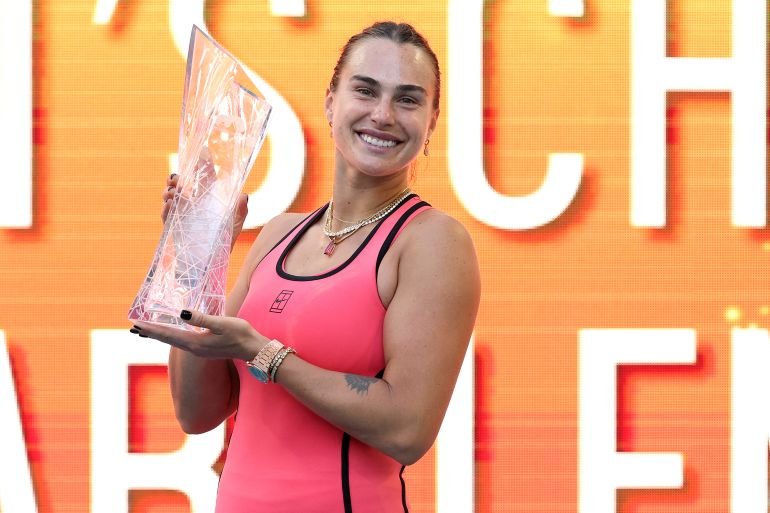
  • Sabalenka defeats Gauff to win second straight Miami Open title

    Sabalenka defeats Gauff to win second straight Miami Open title

    World number one Aryna Sabalenka edges Coco Gauff in a tense three-set final to claim the ‘Sunshine Double’ in Florida.

    Defending champion Aryna Sabalenka beat hometown favourite Coco Gauff 6-2, 4-6, 6-3 in the Miami Open final on Saturday to ⁠join an exclusive club by completing the coveted “Sunshine Double”.

    Top-seeded Sabalenka, who reached the final without dropping a set, won 73 percent of her first-serve points and faced just two break points en ⁠route to victory in a rematch of the 2025 French Open final won by Gauff.

    Recommended Stories

    list of 3 itemsend of list

    Sabalenka is only the fifth woman to win the Indian Wells and Miami titles back-to-back, a feat known as the “Sunshine Double”, given the tournaments’ respective locations in California and Florida.

    “I want to start with [Coco]. You’re a fighter, and you also ‌push me so hard to be a better player, and I like our rivalry,” Sabalenka, who improved to 7-6 all-time versus Gauff, said during the trophy ceremony.

    Aryna Sabalenka in action.
    Sabalenka returns a shot against Gauff in the final [Carmen Mandato/Getty Images via AFP]

    Sabalenka raced out to a 2-0 lead, but Gauff, from nearby Delray Beach and appearing in her first Miami final, got on the board with a love hold and then repelled three break points in her next service game to get within 3-2.

    But Sabalenka did not lose focus and eventually went up a double break ⁠on the world number four before closing out a dominant opening on her ⁠serve.

    There was very little to separate the two players in the middle set, which remained on serve until Gauff broke Sabalenka for the only time in the match to force a third set. Sabalenka broke Gauff to open the decider, held ⁠at love in two consecutive service games to go 5-3 up and then sealed the victory with her fourth break of the match when Gauff ⁠sent a backhand wide.

    Sabalenka is the first player to win back-to-back ⁠Miami titles since Ash Barty in 2019 and 2021. The 2020 edition was cancelled due to the COVID-19 pandemic.

    The Belarusian joins Iga Swiatek (2022), Victoria Azarenka (2016), Kim Clijsters (2005) and Steffi Graf (1994, 1996) as the only women to complete the Sunshine Double.

    She also improved to 23-1 on the ‌year, her only loss coming in the Australian Open final at the hands of Elena Rybakina, whom she went on to beat in the Indian Wells final and Miami semifinals.

    “Aryna, congratulations. We’ve had many ‌battles, ‌many finals and, yeah, I think you push me to be a better player,” said Gauff. “You’re a great fighter, and hopefully we can play many more. I think we will.”

    Aryna Sabalenka and Coco Gauff react.
    Sabalenka and Coco Gauff, right, embrace after the final [Marta Lavandier/AP Photo]
  • Vice President JD Vance tops CPAC’s straw poll to be US president in 2028

    Vice President JD Vance tops CPAC’s straw poll to be US president in 2028

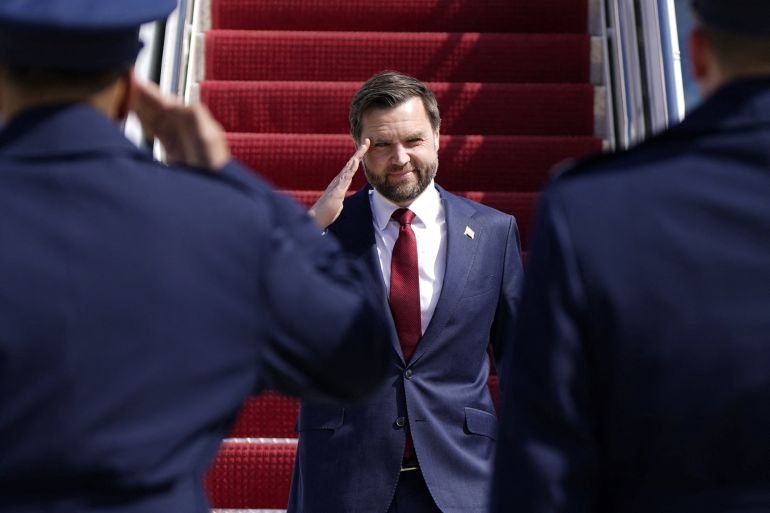
    For the second year in a row, United States Vice President JD Vance has topped the straw poll at the 2026 Conservative Political Action Conference (CPAC), one of the biggest right-wing gatherings in the country.

    The poll is a bellwether – albeit, not necessarily an accurate one – for who might ultimately become the Republican nominee for the next presidential race.

    Recommended Stories

    list of 3 itemsend of list

    During this year’s four-day conference, attendees were asked which candidate they would prefer to lead the Republican Party ticket for the 2028 election.

    The results were revealed on stage Saturday. Vance had swept up 53 percent of the votes cast by nearly 1,600 attendees.

    But rising up the ranks was another senior official under US President Donald Trump: his top diplomat, Secretary of State Marco Rubio. A former senator from Florida, Rubio notched 35 percent of the vote.

    It was a markedly improved standing for Rubio, who tied for fourth place at last year’s CPAC straw poll.

    That poll, taken within weeks of Trump starting his second term, showed Vance with 61 percent support, former Trump adviser Steve Bannon with 12 percent, and Florida Governor Ron DeSantis with 7 percent. Rubio and Representative Elise Stefanik both earned 3 percent.

    US Secretary of State Marco Rubio speaks to the press following a G7 Foreign Ministers' meeting with Partner Countries before his departure at the Bourget airport in Le Bourget, outside Paris, on March 27, 2026.
    US Secretary of State Marco Rubio speaks to the press following a G7 Foreign Ministers’ meeting on March 27, 2026 [AFP]

    Attendance at CPAC, an annual conference, tends to skew away from the political centre and farther to the right.

    Speakers at this year’s conference included Senator Ted Cruz of Texas, Iranian opposition leader Reza Pahlavi, and Eduardo and Flavio Bolsonaro, the sons of Brazil’s former far-right president Jair Bolsonaro, who was imprisoned last September for attempting to subvert his country’s democracy.

    But this year’s straw poll comes at a critical time for the Republican Party.

    Less than eight months remain until November’s midterm elections in the US, and Republicans are hoping to defend their congressional majorities at the ballot box.

    Trump, long the standard-bearer for his party, has seen his approval numbers sink since his return to office in 2025. Earlier this week, a survey from the news agency Reuters and the research firm Ipsos found that only 36 percent of US citizens approved of his job performance, a new low.

    The ongoing war in Iran and economic frustrations, including rising gas prices linked to the conflict, are among the factors contributing to the slump.

    While Trump has teased he may seek a third term, US law prevents modern presidents from serving more than two. His second presidency is set to expire in 2028.

    That leaves an open question as to who may succeed the 79-year-old Republican.

    Vance, a veteran and former single-term senator from Ohio, is seen to represent a more isolationist branch of Trump’s “Make America Great Again” (MAGA) base. He has generally been opposed to US involvement in foreign conflicts, though he has defended Trump’s decision to join Israel in joint strikes on Iran.

    Rubio, meanwhile, has a longer political resume than Vance and is seen to be more hawkish towards regime change, particularly in his family’s ancestral home of Cuba. He served as a senator for Florida from 2011 until his unanimous confirmation as secretary of state in 2025.

    Both men had been critical of Trump before joining his administration. Vance once called Trump “unfit” for office, and Rubio derided Trump as a “con artist” and an “embarrassment” when he was a rival candidate for the 2016 Republican presidential nomination.

    Sen. Ted Cruz, R-Texas, speaks at the Conservative Political Action Conference (CPAC) in Dallas, Saturday, March 28, 2026. (AP Photo/Gabriela Passos)
    Senator Ted Cruz speaks at the Conservative Political Action Conference on March 28 [Gabriela Passos/AP Photo]

    CPAC tends not to survey participants about who should be president when a Republican is already in the Oval Office.

    But the straw polls it held before and after Trump’s first term, from 2017 to 2021, have shown a noticeable realignment in the Republican Party.

    In the decade leading up to the 2016 election – Trump’s first successful campaign for office – moderate Republican Mitt Romney and libertarian Rand Paul consistently won the CPAC straw polls.

    Ever since his first term, however, Trump has trounced the competition.

    Despite his 2020 election defeat, he still garnered the most backing in 2021’s straw poll, with 55 percent support, and his numbers climbed each successive year, through to his re-election in 2024.

    Experts have noted that the Republican Party has largely consolidated around Trump’s politics, with the few remaining moderate and critical voices increasingly marginalised.

    The CPAC straw poll, however, is not always accurate. Ahead of Trump’s victory in 2016, the majority of straw poll participants backed Senator Cruz of Texas to be the next president. Trump came in third place with 15 percent support, trailing Rubio at 30 percent.

  • How the US-Israel war on Iran unfolded in its first four weeks

    How the US-Israel war on Iran unfolded in its first four weeks

    Al Jazeera revisits major military, political and economic developments that took place in first month of the conflict.

    One month into the United States and Israel’s war on Iran, the Middle East is starting to look significantly different — and the effects are being felt across the world.

    Energy prices are soaring, violence is intensifying across the region, and efforts to reach a diplomatic off-ramp are offset by bellicose rhetoric and threats of further escalation by both sides.

    Recommended Stories

    list of 3 itemsend of list

    Experts say the past 28 days have also ushered in new political, security and economic realities. Many top-level leaders in Iran have been killed, and the US has been struggling to rally allies to its aid.

    The death toll in Iran sits at more than 1,937 people, and more have been killed around the Middle East, including US military members.

    Here, Al Jazeera revisits the events of the past four weeks to look at how the war has unfolded so far.

    Week 1

    The war started with enormous US-Israeli strikes against Iran on February 28, which the Pentagon said amounted to twice the firepower of the “shock and awe” campaign that kicked off the 2003 invasion of Iraq.

    Military developments:

    • The opening Israeli strikes killed Iran’s Supreme Leader Ali Khamenei, who served as the country’s de facto head of state as well as the top spiritual authority for millions of Shia Muslims across the world.
    • The initial attack also included the assassination of several top officials, including top general Abdolrahim Mousavi; Mohammad Pakpour, the commander of the Islamic Revolutionary Guard Corps (IRGC); and Ali Shamkhani, an adviser to Khamenei.
    • The Iranian response was quick. Hundreds of missiles and drones were launched against Israel and US assets across the region, as well as civilian and energy targets in the Gulf.
    • Tehran also succeeded in swiftly blocking the Strait of Hormuz, a key waterway for the global oil trade.
    • After the initial onslaught, the US and Israel continued to strike Iran daily, with aides for US President Donald Trump saying that Washington was raining “death and destruction” on the country.
    • The US military announced the first casualties from the war: Six soldiers were killed in an attack on a base in Port Shuaiba, Kuwait.
    • The US military said three US fighter jets were accidentally shot down by friendly fire over Kuwait.
    • Less than 48 hours into the conflict, Hezbollah entered the fray by firing rockets at Israel, which it said was in response to the killing of Khamenei and daily Israeli attacks in Lebanon, in violation of a 2024 ceasefire.
    • Israel started a bombing campaign and a ground invasion in Lebanon.

    Political developments:

    • Gulf states condemned the Iranian attacks as a violation of their sovereignty, stressing that they have been neutral in the war and emphasising their right to respond.
    • Trump said the aim of the military campaign was to bring “freedom” to the Iranian people, but US officials later outlined more narrow goals, including destroying Iran’s military capabilities.
    • Despite the decapitation of its leadership, the Iranian government did not collapse.
    • Iran also did not see any major defections or antigovernment protests.
    • In the US, Trump’s Democratic critics questioned the legality of the strikes, which were launched without congressional approval.
    • Early public opinion polls suggested that only one in four people in the US supported the war.
    • Trump said he would like to be involved in choosing Iran’s next supreme leader, an assertion that was met with ridicule from Iranian officials.
    Two women mourn as they hold a photo.
    People mourn the victims of a strike on a school in Minab, Iran, on the day of their funeral on March 3, 2026 [Amir Hossein Khorgooei/Reuters]

    Civilian cost:

    • By the end of the first week of the war, US and Israeli attacks had killed 1,332 people in Iran.
    • The most jarring attack was the bombing of a girls’ school in the southern city of Minab, which Iranian officials say killed more than 170 people, mostly children.
    • The violence in Lebanon displaced hundreds of thousands of people and killed hundreds.

    Economic impact:

    • By the end of the first week of the war, the price of a barrel of oil had surpassed $90, up from about $70 before the conflict broke out.
    • Civil aviation was scaled back across most of the region, which hosts some of the world’s largest airports.

    Week 2

    By the time the war had entered its second week, it was clear that the Iranian regime had not collapsed and that the conflict was not going to be a brief, one-and-done operation akin to the US abduction of Venezuela’s President Nicolas Maduro in January.

    Military developments:

    • A US military refuelling aircraft fell over Iraq, killing all six crew members. Iran-allied Iraqi groups took responsibility for downing the jet, but the US military said the crash was not “due to hostile fire or friendly fire”.
    • The US and Israel continued to strike Iran, hitting oil storage depots in Tehran for the first time. The attacks caused huge plumes of smoke that produced black rain over the city of nine million people.
    • Hezbollah and Iran launched coordinated rocket attacks against Israel.
    • The Israeli military bombarded Beirut and its southern suburbs, known as Dahiyeh, as it deepened its invasion of southern Lebanon.
    • Several vessels were targeted near the Strait of Hormuz as Iran solidified its control over the strategic waterway.
    • Though Trump pledged escorts for tankers stalled near Hormuz, the US military acknowledged that it was not ready to accompany ships through the strait.
    • Iran intensified its assault across the Gulf with an attack on Saudi Arabia, killing two people.

    Political developments:

    • Iran chose the late Khamenei’s son Mojtaba as its new supreme leader in a show of defiance against US demands, after Trump had rejected the 56-year-old as an option.
    • In a written message, Mojtaba Khamenei said Iran would fight on against the US and Israeli attacks, emphasising the importance of closing the Hormuz Strait.
    • Trump said the war would end “soon”, but Israeli officials stressed that the conflict has no limits.
    • Hezbollah leader Naim Qassem said his group is ready for a “long confrontation” with Israel, describing the war as “existential”.

    Civilian cost:

    • Iran said nearly 10,000 civilian sites were damaged in the US and Israeli attacks.
    • The number of displaced people in Lebanon topped 800,000 as Israel issued forced evacuation orders for large parts of the country.
    • Israeli attacks killed more than 770 people in Lebanon by the end of the second week of the war.

    Economic impact:

    • Oil prices spiked past $110 per barrel on March 8 before dropping to between $90 and $100 later in the week.
    • The International Energy Agency agreed to release a record 400 million barrels of crude oil in response to the disruption to global fuel supplies.
    • Trump suggested the US will benefit from rising oil prices since the country is a major energy producer, despite the increasing consumer costs and a risk of accelerating inflation.

    Week 3

    In its third week, the war saw major escalations beyond the routine air strikes and rocket attacks. Israel carried out major assassinations inside Iran and bombed a gasfield, risking an all-out energy war across the region.

    Military developments:

    • Israel assassinated Iran’s security chief Ali Larijani and the head of the Basij paramilitary force Gholamreza Soleimani.
    • Two heavy missiles from Iran penetrated Israel’s multi-layered air defences, causing widespread damage in the southern cities of Dimona and Arad.
    • Israel struck Iran’s South Pars gasfield in a major escalation that expanded the war to energy infrastructure.
    • Iran responded by attacking energy facilities across the region, including the Ras Laffan liquefied natural gas facility in Qatar and an oil refinery in Israel.
    • The US said it deployed 10,000 interceptor drones to the Middle East to counter Iranian attacks.
    • Iran-allied groups in Iraq struck a US logistics support camp near Baghdad in successive attacks.
    • Hezbollah intensified its rocket fire against Israel, with one launch reaching more than 200km (125 miles) deep into Israeli territory.

    Political developments:

    • Trump distanced himself from the Israeli attack on the Iranian gasfield, saying that he told Israeli Prime Minister Benjamin Netanyahu to stem such strikes.
    • Iran laid out its conditions for ending the war, which included assurances that the attacks would not be renewed, compensation for damages and recognising Iran’s “rights”.
    • Before he was killed, Larijani issued a six-point message to Muslim-majority nations decrying the lack of support for Iran and reasserting that his country is not going to relent in its fight against the US and Israel.
    • Qatar declared the Iranian embassy’s military and security attachés as personae non gratae after the Ras Laffan attack.
    • Joe Kent, the director of the US National Counterterrorism Center, resigned in protest against the war. He argued that Iran posed no imminent threat to the US when the conflict erupted.
    • Saudi Arabia said “the little trust that remained in Iran has been completely shattered”, after its energy infrastructure and military bases came under Iranian attack. Some strikes appeared to be targeted at US assets at the bases.

    Civilian cost:

    • The Iranian Red Crescent said at least 204 children were killed by the war, as the death toll exceeded 1,444 people.
    • In Lebanon, the death toll from Israeli attacks climbed past 1,000, and the number of displaced people rose to more than one million.

    Economic impact:

    • Iranian ⁠attacks knocked out ⁠17 percent of Qatar’s liquefied natural gas export capacity, causing an estimated $20bn in lost annual revenue, QatarEnergy said. The losses threatened repercussions for energy markets in Europe and Asia.
    • The price for one gallon (3.8 litres) of petrol in the US reached more than $3.90, nearly $1 more than before the war started.

    Week four

    The fourth week of the war saw the US claim it had been in diplomatic contact with Iran for the first time since hostilities began. The announcement signalled that Trump might be looking for an off-ramp as the war turns into a protracted conflict.

    Military developments:

    • Trump said he would “obliterate” Iran’s power plants if it fails to fully reopen the Strait of Hormuz within 48 hours, but he later extended the deadline by five days and then for 10 more days.
    • The US moved thousands of troops to the Middle East, raising the prospect of ground operations inside Iran.
    • Israel bombed Iranian steel factories and a nuclear reactor, prompting Iran to threaten industrial sites across the region.
    • Qatar says seven people, including three Turkish service members, died after a military helicopter crashed due to a technical malfunction.
    • Israeli forces attacked the Qasmiyeh Bridge, a key crossing that links Lebanon’s south to the rest of the country.
    • Hezbollah said it hit dozens of Israeli tanks, claiming numerous attacks daily against invading troops.

    Political developments:

    • Trump insisted that Iran is “begging” to reach a ceasefire deal, but Iranian officials denied direct contact with Washington.
    • The US sent a 15-point ceasefire plan to Iran, but Tehran rejected the proposal as maximalist.
    • Qatar called for resolving the conflict through diplomacy, saying that “total annihilation” of rivals in the region “is not an option”.
    • The United Arab Emirates took an increasingly confrontational tone against Iran, with Foreign Minister Abdullah bin Zayed saying that his country will “never be blackmailed by terrorists”.
    • Israel’s Finance Minister Bezalel Smotrich said that “the new Israeli border must be the Litani River”, suggesting that his country would annex about 20 percent of Lebanon’s territory.
    • Yemen’s Houthi group, which has remained on the sidelines, said it is ready to join the war if the Red Sea is used to stage attacks against Iran or if the conflict escalates further.

    Civilian cost:

    • The death toll in Iran approached 2,000, with 25 deaths across the Gulf.
    • In Israel, Iranian and Hezbollah attacks killed 20 people in the first month of the war.
    • Israeli attacks killed at least 121 children in Lebanon as the country’s death toll reached 1,116, according to its Health Ministry.
    • United Nations experts warned that Lebanon, where the Israeli invasion and bombardment have displaced more than 1.2 million people, is facing the risk of a “humanitarian catastrophe”.

    Economic impact:

    • Oil prices surpassed $112 per barrel, the highest since 2022, amid supply fears.
    • The US stock market sank amid economic uncertainty linked to the war, with major indexes, including the S&P 500 and NASDAQ, seeing major losses.
  • France calls IOC sex testing a ‘step backwards’ while Trump praises move

    France calls IOC sex testing a ‘step backwards’ while Trump praises move

    France’s sports minister has called the International Olympic Committee’s decision to introduce genetic testing for women’s ⁠events a “step backwards”, warning it raises major ethical, legal and scientific concerns, while US President Donald Trump praised the IOC’s new policy.

    France “takes note” of the decision to require athletes to undergo testing based on the SRY ⁠gene, but opposes any broad use of genetic screening, Marina Ferrari said in a statement on Friday.

    Recommended Stories

    list of 4 itemsend of list

    “On behalf of the French government, I wish to express our deep concern regarding this decision,” she said. “We oppose a generalisation of genetic testing that raises numerous ethical, ‌legal and medical questions, particularly in light of French bioethics legislation.”

    The IOC said on Thursday that only biological female athletes would be eligible for women’s events from the Los Angeles 2028 Olympics onwards, following a one-time gene test designed to identify male sex development. The move essentially bars transgender athletes from competing in the female category.

    The rule is in line with an executive order by Trump from February 2025 that banned transgender athletes from competing in girls’ and women’s sports.

    “Congratulations to the International Olympic Committee on their decision to ban Men from Women’s Sports,” Trump said late on Thursday on the Truth Social platform.

    “This is only happening because of my powerful Executive Order, standing up for Women and Girls!”

    However, Ferrari said that: “These tests, introduced in 1967, were discontinued in 1999 ⁠due to strong reservations within the scientific community regarding ⁠their relevance. France regrets this step backwards.”

    She added that the policy risked undermining equality by specifically targeting women.

    “This decision raises major concerns, as it specifically targets women by introducing a distinction ⁠that undermines the principle of equality,” she said.

    Ferrari also warned that the approach failed to reflect biological diversity, particularly among intersex ⁠individuals.

    “It defines the female sex without taking into ⁠account the biological specificities of intersex individuals, whose sexual characteristics present natural variations, leading to a reductive and potentially stigmatising approach,” she said.

    New Zealand’s Olympic Committee said on Friday that the IOC policy would bring greater “clarity” and “fairness” to future Games.

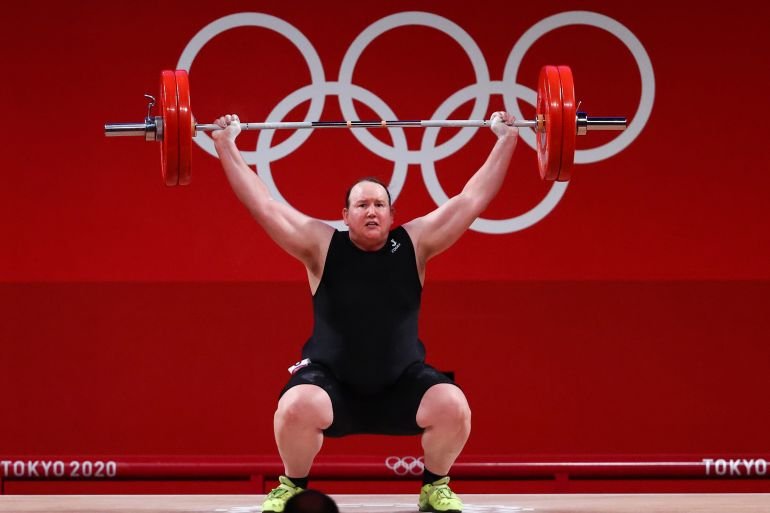
    New Zealand weightlifter Laurel Hubbard became the first openly transgender woman to compete in the Olympics at Tokyo in 2021.

    NZOC chief executive Nicki Nicol said the organisation recognised the “extensive consultation and expert input that has informed this policy”, particularly from athletes.

    She said it would bring “greater clarity, consistency and fairness to eligibility for the female category at the Olympic level”.

    “This is a complex and sensitive area that directly affects people, not just policy,” she added.

    After competing in 2021, Hubbard, who failed in all of her lifting attempts in Tokyo, said she was aware of the controversy surrounding her participation.

    Friday’s NZOC comments did not refer to Hubbard, who has kept a very low profile since her games appearance.

    Also reacting to Thursday’s IOC announcement, Australian Olympic Committee president Ian Chesterman said the IOC had comprehensively investigated what he called a “complex issue”.

    “Without doubt, this is a challenging and complex subject, and at the AOC we approach it with empathy and understanding.”

    He added: “This decision provides clarity for elite female athletes who compete at the highest level and demonstrates a commitment to fairness, safety and integrity in Olympic competition, all of which are fundamental principles of the Olympic Movement.

    “As the IOC has stated, at the highest level of sport, the smallest margins can determine outcomes, and clarity around eligibility is critical for female athletes to continue to compete on a level playing field.”

  • Qatari PM and US officials discuss strategic ties amid Iran war

    Qatari PM and US officials discuss strategic ties amid Iran war

    The meeting held in Washington, DC reviewed the ‘close strategic cooperation’ between Doha and Washington, Qatar’s foreign ministry said.

    Qatar’s prime minister has held talks with senior US officials in Washington, DC, amid the ongoing US-Israeli war on Iran and fallout across the Gulf.

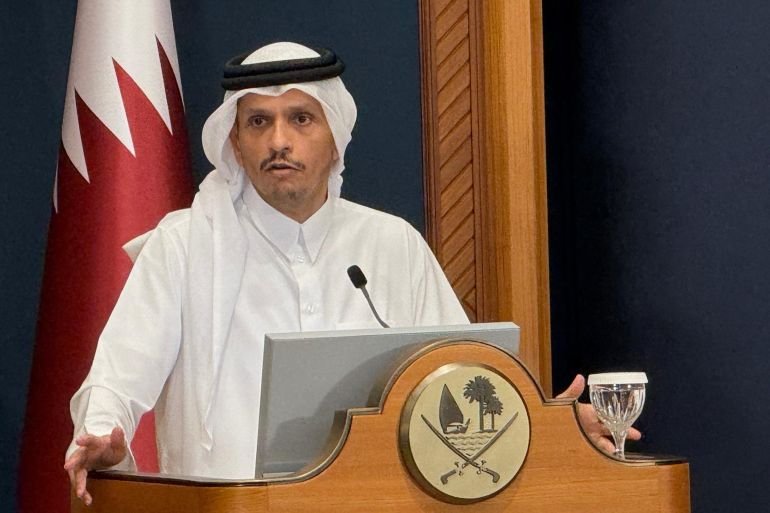
    Sheikh Mohammed bin Abdulrahman bin Jassim Al Thani, who also serves as Qatar’s foreign minister, met US Vice President JD Vance and US Secretary Scott Bessent, Qatar’s Ministry of Foreign Affairs said on Friday.

    Recommended Stories

    list of 4 itemsend of list

    They reviewed ways to strengthen the “close strategic cooperation” between Doha and Washington, “especially the defence partnership in light of the conditions the region is experiencing”, the ministry said.

    Both sides stressed “ensuring the sustainability of energy supplies and maintaining the continued flow of liquefied natural gas from the State of Qatar to global markets”, in a way that “supports global energy security”, it added.

    Vance hailed the “robust strategic partnership”, praising Qatar’s “active role in promoting regional stability and enhancing global energy security”.

    The Gulf has been in a state of heightened tension since February 28, when the US-Israeli war on Iran began, which has killed more than 3,000 people across the region, a vast majority of them in Iran and Lebanon.

    Tehran has since launched drone and missile attacks aimed at Israel, as well as Jordan, Iraq, and Gulf states. Iran insists it is targeting US assets in the Gulf, but the region’s leaders have urged Iran to cease attacks as they endanger civilians.

    Qatar, earlier this month, said Iranian missile attacks on the Ras Laffan Industrial City, the country’s main gas facility, caused “significant damage”.

    The war has created an unprecedented global energy crisis as Iran has effectively closed off the Strait of Hormuz, through which one-fifth of the world’s oil passes.

    Meeting with Hegseth

    On Thursday, Sheikh Mohammed also held a meeting in Washington with US Secretary of Defense Pete Hegseth, the Foreign Ministry said.

    “The meeting took place in Washington on Thursday and focused on ways to support and develop defence and security collaboration amid regional challenges,” it added.

    “Both sides stressed the importance of continued coordination and consultation on regional issues to promote security and stability locally and internationally.”

    On Wednesday, the Qatari Cabinet renewed its condemnation of Iranian attacks on Qatar and its neighbours, calling for an immediate halt.

  • US judge weighs Trump decision to bar Venezuelan funds for Maduro’s defence

    US judge weighs Trump decision to bar Venezuelan funds for Maduro’s defence

    A United States judge has said that he will not dismiss the drug-trafficking and weapons possession charges brought against former Venezuelan President Nicolas Maduro and his wife Cilia Flores.

    But in a Thursday court hearing, Judge Alvin Hellerstein questioned whether the US government has the right to bar Venezuela from funding Maduro’s legal expenses.

    Recommended Stories

    list of 3 itemsend of list

    The hearing was the first for Maduro and his wife since a brief January arraignment, where they pleaded not guilty.

    Maduro and Flores have sought to have the charges against them thrown out. Hellerstein declined to do so, but he pressed the prosecution on some of the issues Maduro’s legal team raised in its petition to dismiss the case.

    Among them was a decision by the administration of US President Donald Trump to prevent the Venezuelan government from financing Maduro’s defence.

    Federal prosecutors argued that national security reasons prevented the US from allowing such payments. They also pointed to ongoing sanctions against the Venezuelan government.

    But Hellerstein pushed back against that argument, noting that Trump had eased sanctions against Venezuela since Maduro’s abduction on January 3. He also questioned how Maduro might pose a security threat while imprisoned in New York.

    “The defendant is here. Flores is here. They present no further national security threat,” said Hellerstein. “I see no abiding interest of national security on the right to defend themselves.”

    Hellerstein emphasised that, in the US, all criminal defendants have the right to a vigorous defence, as part of the US Constitution’s Sixth Amendment.

    “The right that’s implicated, paramount over other rights, is the right to constitutional counsel,” he said.

    Maduro, who led Venezuela from 2013 to 2026, has been charged with four criminal counts, including “narco-terrorism” conspiracy, conspiracy to import cocaine, the possession of machine guns and the conspiracy to possess machine guns and other destructive devices.

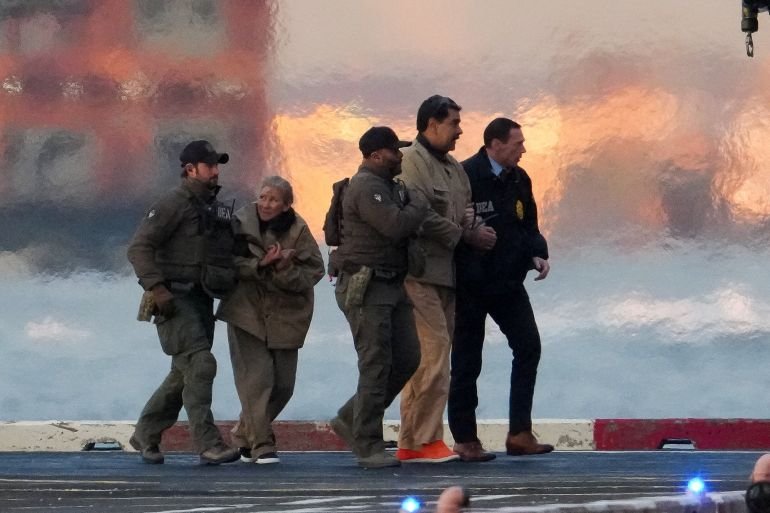
    He and his wife were taken into US custody on January 3, after Trump launched an attack on Venezuela.

    The Trump administration has framed the military operation as a “law enforcement function”, but experts say it was widely considered illegal under international law, which protects local sovereignty.

    Maduro has cited his status as the leader of a foreign country as part of his push to see the case dismissed.

    When he last appeared in court, on January 5, he told the judge, “I’m still the president of my country.”

    In a February hearing, his defence team sought to dismiss the charges on the basis that preventing Venezuela from paying his legal fees was “interfering with Mr Maduro’s ability to retain counsel and, therefore, his right under the Sixth Amendment to counsel of his choice”.

    In an interview with the news agency AFP on Thursday, Maduro’s son, Venezuelan lawmaker Nicolas Maduro Guerra, said that he trusts the US legal system but believes that his father’s trial has been mishandled.

    “This trial has vestiges of illegitimacy from the start, because of the capture, the kidnapping, of an elected president in a military operation,” Maduro Guerra said in Caracas.

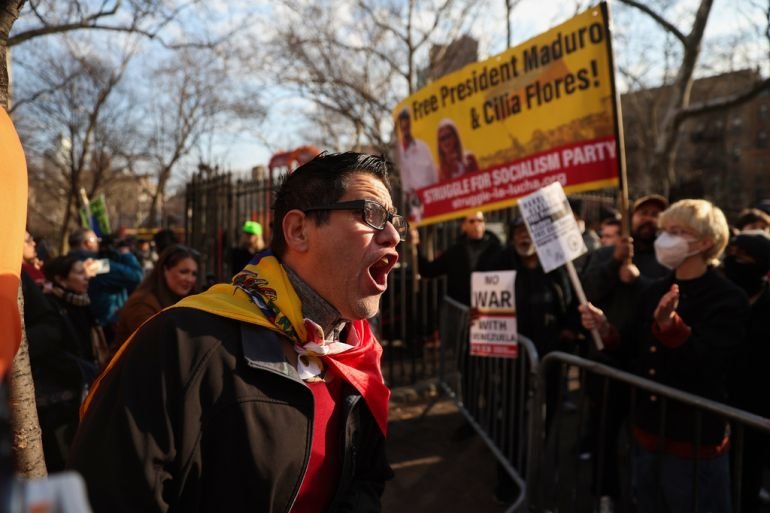
    Protests and counterprotests took place in front of the New York City courthouse on Thursday, with some condemning the US’s actions and others holding signs in support of the trial with slogans like, “Maduro rot in prison.”

    Trump himself weighed in on the proceedings during a Thursday US Cabinet meeting, hinting that further charges could be brought against Maduro.

    “He emptied his prisons in Venezuela, emptied his prisons into our country,” Trump said of Maduro, reiterating an unsubstantiated claim.

    “And I hope that charge will be brought at some point. Because that was a big charge that hasn’t been brought yet. It should be brought.”

    Trump has had an adversarial relationship with Maduro since Trump’s first term in office, when he issued a bounty for the Venezuelan leader’s arrest. He has frequently repeated baseless claims that Maduro intentionally sent immigrants and drugs to the US in a bid to destabilise the country.

    Those claims have served as a pretext for Trump claiming emergency powers in realms such as immigration and national security. On Thursday, Trump emphasised that, while he expected a “fair trial”, he expected more legal action to be taken against Maduro.

    “I would imagine there are other trials coming because they’ve really sued him just at a fraction of the kind of things that he’s done,” Trump said. “Other cases are going to be brought, as you probably know.”

  • Costa Rica to accept 25 deportees per week under Trump deportation effort

    Costa Rica to accept 25 deportees per week under Trump deportation effort

    The Central American nation is the latest to sign a ‘third-country’ deportation agreement as part of Trump’s mass-deportation campaign.

    Costa Rica has announced it will accept 25 migrants deported from the United States per week as part of an agreement to assist with President Donald Trump’s policy of deporting immigrants to “third countries”.

    The Central American nation joins a growing number of countries across Africa and the Americas that have signed contentious, often secretive agreements with the US to accept deportees from other countries.

    Recommended Stories

    list of 3 itemsend of list

    In many cases, critics say migrants who previously hoped to seek asylum in the US are left in a legal “black hole” in foreign countries where they don’t speak the language.

    Countries that have agreed to receive third-party migrants include South Sudan, Honduras, Rwanda, Guyana and several Caribbean islands like Dominica and St Kitts and Nevis.

    “Costa Rica is prepared to see this flow of people,” said Costa Rican Public Security Minister Mario Zamora Cordero in a video statement on Thursday.

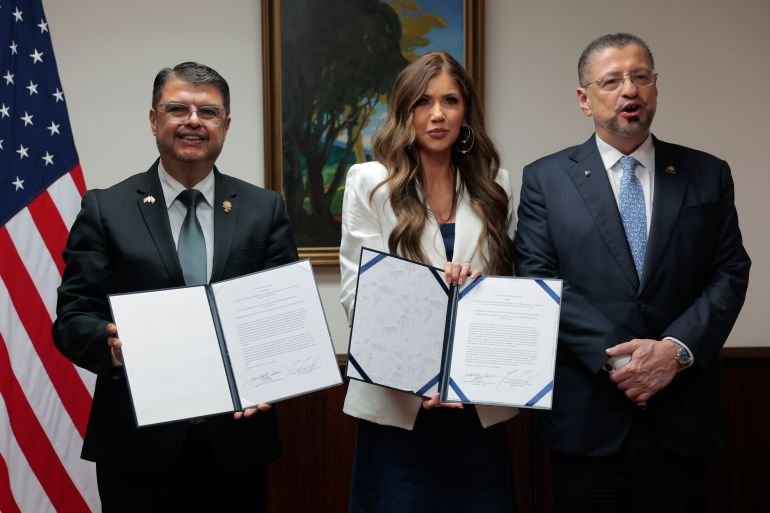
    Costa Rica’s government signed the pact on Monday during a visit from US special envoy Kristi Noem, who was recently named to oversee the so-called “Shield of the Americas”.

    Noem, who was fired earlier this month from her role as secretary of Homeland Security, has been travelling through Latin America, with recent stops in Guyana and Ecuador.

    “We are very proud to have partners like President [Rodrigo Chaves] and Costa Rica, who are working to ensure that people who are in our country illegally have the opportunity to return to their countries of origin,” Noem said on Monday.

    Costa Rica’s government has called the pact a “non-binding migration agreement”.

    It also said the deal allows the Trump administration to transfer foreign nationals – who are not Costa Rican citizens – to the Central American nation.

    The Costa Rican government also reserves the right to accept or reject proposed transfers.

    It said the deportees will be processed under Costa Rica’s migration laws under a special migratory status and that the country will avoid returning people to countries where they might face the risk of persecution.

    Such “third-country” transfers have been sharply criticised for putting vulnerable populations further at risk and, in some cases, sending them to dangerous nations or where they face risk.

    Costa Rica has already faced controversy for its treatment of the 200 deportees from countries like Russia, China, Uzbekistan and Afghanistan it received last year.

    The deportees, almost half of whom were minors, had their passports seized and were locked up for months in a rural detention facility near the Panama border, an incident that fuelled lawsuits and accusations of human rights abuses. The country’s supreme court ordered their release last June.

    Many deportees who said they were too scared to return to their home country were later given temporary permits to stay in Costa Rica. Panama, which locked up hundreds of deportees around the same time, came under similar criticism.

    Zamora on Thursday made assurances that the new round of deportees would be held in better conditions.

    He added that the Costa Rican government would work with the US to return migrants to their countries and with the United Nations International Organization for Migration to house deportees. He didn’t immediately detail where they would be held or for how long.

    “This will ensure they remain in the best possible conditions while in Costa Rica and guarantee their safe return to their countries of origin,” Zamora said.

    At least seven African nations have signed deals with the US to facilitate deportations of third-country nationals, which legal experts said are effectively a way to circumvent laws that forbid countries from sending people to places where their lives would be threatened.

    Many deportees received legal protection from US judges shielding them against being returned to their home countries, their lawyers said.

    The Trump administration has spent at least $40m to deport about 300 migrants to countries other than their own, according to a February report by the Democratic staff of the Senate Foreign Relations Committee.

  • Russian officials meet US counterparts as Moscow denies aiding Iran

    Russian officials meet US counterparts as Moscow denies aiding Iran

    Kremlin spokesperson says talks are part of ‘​necessary dialogue’ with Washington as war in Ukraine continues for a fifth year.

    A delegation of Russian officials has arrived in ‌the United States for meetings with their American counterparts.

    The visit, which began on Thursday, marks the first such trip since ⁠relations strained over Moscow’s war in Ukraine.

    Recommended Stories

    list of 3 itemsend of list

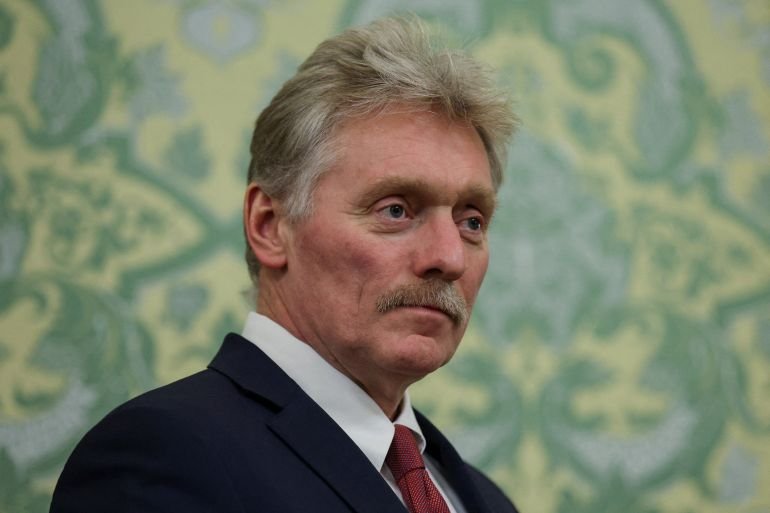
    Kremlin spokesperson Dmitry Peskov said, “We hope that these first tentative steps will, of course, make their contribution to the further revival of our bilateral engagement.”

    He said President Vladimir Putin had set the “main directives” for the trip and would be “thoroughly briefed” on the meeting.

    The visit comes as US-brokered talks seeking a deal to end the war in Ukraine are in effect frozen.

    Several rounds of negotiations since US President Donald Trump returned to the White House last year have failed to break the deadlock, with the Kremlin ruling out compromises to halt its years-long offensive.

    Russia, a close ally of Iran, has also been cited by Western intelligence officials as one of the backers of the Iranian government, as Tehran fights a war launched by the US and Israel.

    A report in the United Kingdom-based Financial Times newspaper on Wednesday alleged that Russia was close to completing a shipment of drones to Iran.

    Responding to questions about the report, Peskov said, “There are so many lies being spread by the media … Do not pay attention to them.”

    Russia this week carried out one of the largest aerial attacks since the start of its war on Ukraine, launching 948 drones in 24 hours as it moved troops and equipment to the front line.

    Ukraine’s President Volodymyr Zelenskyy issued a new appeal for allies to supply Kyiv with air defence munitions, warning that Kyiv, which relies on the US for air defence systems against ballistic missiles, will face a deficit of missiles while Washington is focused on the US-Israeli war on Iran.

    Talks between Ukraine and the US that opened in the US state of Florida on Saturday again failed to produce a security guarantee that Kyiv has long sought from Washington.

  • Venezuela’s Maduro set to again appear in US court: How strong is the case?

    Venezuela’s Maduro set to again appear in US court: How strong is the case?

    Nicolas Maduro, the former leader of Venezuela who was removed by United States forces on January 3, is set to appear in a US court for only the second time.

    In the weeks since he was abducted to the US, Maduro’s defence has offered only a preview of how it will approach the extraordinary case on Thursday. In his first court appearance, in January, Maduro maintained he was not a traditional defendant but a “prisoner of war” and “kidnapped” president.

    Recommended Stories

    list of 3 itemsend of list

    Many questions surrounding Maduro’s prosecution remain unanswered in the run-up to Thursday’s hearing: how Maduro may deploy a carousel of legal arguments to challenge the case; what evidence prosecutors will present to support their claims of “narco-terrorism” and drug trafficking; and ultimately, what would happen in the event federal prosecutors prove unsuccessful.

    While the US has a history of enforcing its domestic law against foreign individuals, the prosecution of sitting and former heads of state has been exceedingly rare.

    The most recent examples include the prosecution of Manuel Antonio Noriega, then the leader of Panama, in 1989, and more recently, the prosecution of former Honduran leader Juan Orlando Hernandez in 2024, explained Renato Stabile, who served as the court-appointed defence lawyer for Orlando Hernandez.

    “We’re in largely uncharted territory,” Stabile told Al Jazeera.

    Will the case get thrown out?

    Legal experts have pointed to a range of challenges Maduro’s team could mount to get the case thrown out before a trial begins. The defence has already argued that the case should be null, pointing to Maduro’s role in Venezuela at the time of his abduction and maintaining that Maduro was taken into custody illegally.

    The US deployed 150 military aircraft in its raid to abduct Maduro, knocking out the country’s air defence as it created a massive power cut across the capital, Caracas. Both an FBI unit and the US Army’s specialised Delta Force were deployed to storm Maduro’s compound. Venezuela has said at least 75 people were killed in the operation.

    The Trump administration has maintained that the goals were purely domestic law enforcement, and unrelated to its explicit calls for regime change or access to Venezuela’s state-controlled oil industry that accompanied a weeks-long military build-up and oil embargo.

    Trump, however, has since pledged to “run” Venezuela with his administration continuing to assert influence over the government of interim-President Delcy Rodriguez.

    The US executive branch has long held the position that the federal government can pursue domestic law enforcement arrests abroad. But according to a panel of federal prosecution experts writing on the LawFare nonprofit website in January, “Maduro will undoubtedly argue that even if such authority exists, it is limited – and that his arrest falls outside the bounds of what’s permitted.”

    Maduro could chart several courses in making the case, including arguing that continuing with the case would make the court itself complicit in the government’s actions, an apparent blatant violation of international law. A form of that argument proved unsuccessful in the Norriega case, the panel noted, although Maduro will likely try to argue the details of the US military operation in Panama in 1989 and the January raid in Venezuela are markedly different.

    Maduro’s team could also argue that the government misused the US military in domestic law enforcement, although experts noted that the government has, for decades, maintained that the military can be used to “protect federal functions”.

    The panel assessed that all options available to Maduro will likely face an “uphill battle”.

    Finally, Maduro’s team could invoke the so-called “head of state” immunity doctrine, arguing he remains the head of state of Venezuela and therefore is protected from prosecution under US common law.

    The US government has, since 2019, maintained that Maduro is not the legitimate head of state of Venezuela, pointing to a string of disputed elections, the most recent in 2024.

    How strong is the indictment?

    If challenges related to Maduro’s position and how he was arrested prove unsuccessful, Orlando Hernandez’s defence lawyer, Stabile, argued the current indictment laid out by federal prosecutors is far from a slam dunk.

    Maduro is charged with one count of conspiracy to commit “narco-terrorism”, with the indictment saying he was involved in drug and arms trafficking in support of the FARC, the ELN and other groups designated “foreign terrorist organisations” by the US.

    But notably, the Department of Justice has largely backed away from a pillar of its initial 2020 indictment against Maduro: claims that he was the leader of the “Cartel de los Soles”, which it, at the time, described as “drug-trafficking organisation” that “prioritised using cocaine as a weapon against America and importing as much cocaine as possible into the United States”.

    The new indictment, unsealed shortly after Maduro’s abduction, instead describes the Cartel de los Soles as a system of “patronage” within Venezuela’s government, and removes any reference to a coordinated effort by the Cartel de Soles to use drugs as a weapon against the US. The original indictment referenced the Cartel de los Soles 33 times, reduced to only two mentions in the new version.

    The second charge focuses on drug trafficking, pointing to various instances where Maduro, his wife and other officials allegedly used their positions and resources – including the use of private planes under diplomatic cover – to directly support and benefit from drug trafficking. The third and fourth charges are largely seen as hinging on the first two: illegal possession and conspiracy to possess automatic machineguns.

    While more evidence could be presented in the weeks, months and possibly years ahead, Stabile said prosecutors appear to be building a case largely built on informants, in what he described as a “snitch indictment”.

    Notably, the indictment details the involvement of former Venezuelan General Hugo Carvajal in several of the alleged crimes. Carvajal has already pleaded guilty to “narcoterrorism”, drug trafficking and weapons charges in the US.

    Last year, in a letter addressed to the “American people”, Carvajal, who has yet to be sentenced, promised to “provide additional details” that would further reveal the Maduro government’s alleged crimes.

    Stabile argued the prosecution will “look very weak” if its case relies on witnesses who have already struck cooperation deals with the US government.

    That feeds the perception that “they’re going to say whatever they need to say to get out of jail.”

    He also pointed to the difficulty prosecutors face in empanelling a jury unaware of the case’s broader political landscape and the contradictory messaging from the Trump administration.

    “Any of the jurors will likely know the story. They will know how the US went in and took him out of Venezuela,” Stabile said.

    “In a typical criminal case, you’re not really able to argue the political aspects of the case. In other words, typically, you can’t argue the motivations of the prosecution team in bringing the charges … [The defence] benefit here.”

    “I could very easily see – if you get the right juror to be a holdout – a hung jury here,” he said, referring to situations where a jury is unable to reach a verdict, and prosecutors are confronted with needing to retry the case, strike a deal or abandon prosecution.

    Long road ahead

    In the short term, the case against Maduro has stalled largely due to the ongoing funding battle.

    In late February, Maduro’s lawyers said the US government was blocking Maduro and his wife, Cilia Flores, from receiving legal funding from the government of Venezuela.

    Maduro’s lawyer, Barry Pollack, argued in court filings that the move deprived Maduro of his “constitutional right to counsel of his choice”.

    Earlier this month, federal prosecutors shot back that “both defendants…surely knew that the US Government did not consider them to hold legitimate positions”, maintaining that the couple were still free to use their personal funds for a lawyer.

    In response, lawyers for Maduro and Flores have called for the case to be thrown out. The issue will likely be addressed at Thursday’s hearing.

    It remains unclear what would happen if the case against Maduro were, in fact, to be thrown out, or if he were eventually acquitted.

    Typically, in those circumstances, an individual would be free. But because Maduro is not a US citizen, he could theoretically be detained by immigration enforcement agents upon his release.

    Argentina has also requested Maduro’s extradition from the US on charges of committing crimes against humanity in his government’s crackdown on protesters and political dissidents. The case was brought by Venezuelans who suffered under the alleged abuses.

    Stabile predicted a long road before clarity emerges on Maduro’s case.

    “We probably have six to nine months of motions … just to resolve the legal issues around his arrest and prosecution. Then there will be discovery,” he said, referencing the period when both sides will gather and exchange evidence.

    “I don’t expect the case to go to trial for at least a couple of years,” he said.
  • Jury finds Meta, YouTube liable for social media addiction: What we know

    A Los Angeles jury has found Alphabet’s Google and Meta liable for damages in a landmark civil trial over youth social media addiction. Campaigners and parents who say social media use has harmed their children, in some cases causing eating disorders, self-harm or deaths by suicide, welcomed the jury’s decision outside the court.

    The jury’s decision on Wednesday came at the end of a case in which the plaintiff’s legal team argued the companies are legally responsible for the addictive design of their platforms.

    Here is more about the jury’s verdict and the trial.

    A 20-year old woman was the plaintiff in this case and was identified by the California Superior Court in Los Angeles County documents only by her initials, KGM. The plaintiff’s lawyers referred to her as Kaley.

    KGM testified in February, saying her early use of social media triggered her addiction to the technology and exacerbated depression and suicidal thoughts. She said she had developed body dysmorphia – a clinical condition diagnosed by doctors – as a result of her social media use.

    Opening statements for the trial started on February 9, and deliberations lasted more than 40 hours.

    Google and Meta, which is the parent company of social media platforms Facebook and Instagram, were the two remaining defendants in the case.

    In late January, TikTok and Snapchat’s parent company, Snap Inc, settled their parts in the case. Details of these settlements are not known.

    Google trial
    Parents who say they have lost their children due to social media hold up a banner with their names and ages outside the court after the jury found Meta and Google liable in a key test case, accusing Meta and Google’s YouTube of harming children’s mental health through addictive social media platforms, in Los Angeles, California, US, on March 25, 2026 [Mike Blake/Reuters]

    What did the plaintiff tell the court?

    In February, KGM told the trial she had started using YouTube at the age of 6 and Instagram at age of 9. By the time she finished elementary school, she had posted 284 videos on YouTube.

    The plaintiff told the court: “I stopped engaging with family because I was spending all my time on social media.” She added that she began to suffer anxiety and depression at the age of 10 – and was later diagnosed with both.

    She said she would also “buy” likes through a platform on which she could “like” other people’s photos and receive a slew of likes in return. “It made me look popular,” she said.

    KGM said several features, which lawyers argued are deliberately designed to be addictive, such as notifications, would give her a “rush”. She said she would sometimes go to the toilet during school just to check her notifications.

    The plaintiff also said she used Instagram filters, which alter cosmetic appearance, on almost all her photos. She said she had not experienced the negative feelings associated with her body dysmorphia diagnosis before she began using social media and filters.

    Victoria Burke, a former therapist the plaintiff worked with in 2019 for six months, also testified in February. Burke said that KGM’s social media and sense of self were intertwined, and what was happening online would influence the plaintiff’s mental health.

    Meta case
    Juliana Arnold, Mary Rodee, and Lori Schott embrace after hearing the jury’s verdict outside the Los Angeles Superior Court during a lawsuit alleging that Meta and YouTube are designed to hook young users and cause them a variety of negative mental health effects and behaviours, including strangling themselves and developing eating disorders, on Wednesday, March 25, 2026 in Los Angeles, US [Kayla Bartkowski/Los Angeles Times via Getty Images]

    While KGM’s lawyers claim she was preyed upon as a vulnerable user, lawyers representing Meta and Google-owned YouTube argued that KGM turned to their platforms as a coping mechanism or a means of escaping her already existing mental health struggles.

    Meta argued that KGM’s challenges began before her social media use.

    In February, Meta’s lawyer Paul Schmidt told the court that the core question in the case was whether the company’s social media platforms were a substantial factor in KGM’s mental health struggles.

    During the trial, Meta lawyer Phyllis Jones showed jurors text exchanges and Instagram posts in which KGM discussed her mental health and her turbulent relationship with her mother, and played videos KGM had recorded of her mother yelling at her. The plaintiff acknowledged that their relationship was difficult. She currently lives with her mother and works as a personal shopper at Walmart.

    What did the jury find?

    The jury found that Meta had been negligent in designing or operating Instagram.

    In the case of Meta, the jury found that the group’s negligence was a “substantial factor” in harm to the plaintiff and said it was liable for failing to adequately warn users about the dangers of using Instagram.

    The jury also found Google had been negligent in designing or operating YouTube and that this negligence was a “substantial factor” in harming the plaintiff. It also found Google liable for failing to adequately warn users about the dangers of using YouTube.

    A majority of jurors agreed to the findings and awarded the plaintiff $3m in compensatory damages.

    Jurors later recommended an additional $3m in punitive damages after deciding the companies acted with malice, oppression or fraud in harming children using their platforms.

    Meta will be liable for 70 percent of the total, while Google will be liable for the remainder.

    The judge will have final say about how much damage is awarded. The judge has yet to enter a final judgement in the case, and it is not yet known when the formal ruling will be made.

    Meta, the parent of Instagram and Facebook, and Google-owned YouTube issued statements disagreeing with the verdict. They said they would explore their legal options, which include making an appeal.

    Google spokesperson Jose Castaneda said the verdict misrepresents YouTube “which is a responsibly built streaming platform, not a social media site”. A Meta spokesperson said teen mental health is “profoundly complex and cannot be linked to a single app”.

    The day before the jury’s decision in the KGM trial, a separate jury in New Mexico determined that Meta had knowingly harmed children’s mental health and concealed what it knew about child sexual exploitation on its social media platforms.

    The lawsuit was the first jury trial to find Meta liable for activities on its platform. It was brought by New Mexico’s attorney general office in December 2023.

    Jurors found there had been thousands of violations carrying a penalty of $5,000, each counting separately towards a penalty of $375m. This was less than one-fifth of what prosecutors were seeking, however.

    More than 40 state attorneys general in the US have filed both federal and state lawsuits in recent years against Meta, claiming the company is contributing to a mental health crisis among young people by deliberately designing Instagram and Facebook features that are addictive.