The upcoming FIFA World Cup will be held at a time of “acute human rights crisis” and will pose significant risks to travelling fans, local communities and those working at the tournament, Amnesty International has said.
The rights group on Monday laid out the threats faced by millions of local and international football fans who will travel to Canada, Mexico and the United States for the six-week tournament.
Recommended Stories
list of 4 itemsend of list
“The US – where three-quarters of World Cup matches will be held – is facing a ‘human rights emergency’ and a recognisable pattern of authoritarian practices,” Amnesty said.
The scathing report was released 10 weeks ahead of the tournament amid immigration crackdowns, protest restrictions and deaths at the hands of US law enforcement officials.
“Armed agents are breaking down doors, detaining children and have deported hundreds of thousands of people,” it said, referring to US immigration policies.
FIFA, host nations urged to take action
Amnesty International said that though FIFA had judged the World Cup to be a “medium risk” tournament, it could become a “stage for repression and a platform for authoritarian practices”.
At least six people have died in the custody of US Immigration and Customs Enforcement (ICE) in 2026, and a seventh person was fatally shot by an off-duty ICE officer. Last year, 32 deaths were reported in ICE custody.
While most of the deaths were due to health complications, some of the late detainees’ families have made accusations of abuse and medical neglect.
The acting director of ICE said last month that the agency will be “a key part of the overall security apparatus for the World Cup”.
The report from London-based Amnesty urges FIFA and World Cup host countries to take urgent action to protect fans, players, journalists, workers and local communities.
FIFA has promised a tournament where everyone “feels safe, included and free to exercise their rights”. But Amnesty said incidents of forced protest shutdowns, gender bias, indiscriminate raids, ethnic profiling, arbitrary arrests, mass detention, cartel violence and unlawful deportations paint a different picture of the host nations.
It accused the US, which will host 78 of the 104 tournament fixtures, of closing civic space while dehumanising and criminalising marginalised people under the administration of President Donald Trump.
“The administration has aggressively advanced an anti-migrant, anti-refugee agenda, subjecting migrants, asylum seekers and refugees to a litany of human rights violations,” the report said.
Amnesty also raised concerns over the Trump administration’s visa ban for nationals of 12 countries, of which four have qualified for the World Cup, saying the “blanket bans target individuals based on their race, religion, nationality and focus on countries with predominantly Black, Brown and Muslim-majority populations, constituting racial discrimination under human rights law”.
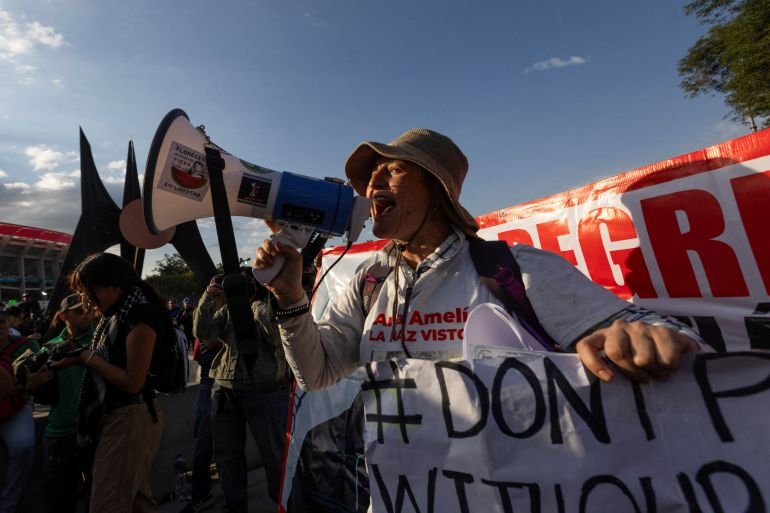
People stand next to a sign on the pavement that reads ‘World Cup of dispossession in Mexico City, Mexico [File: Yuri Cortez/AFP]
Mexico, which will host the opening game of the tournament, is facing its own internal issues following a wave of violence that was triggered in the country on February 23 after the killing of a drug lord who led one of the most powerful Mexican criminal organisations.
Gunmen torched cars and blocked highways in more than half a dozen states in the immediate aftermath of the news of his killing.
Mexican officials thereafter sought to assure FIFA authorities and potential travellers that the tournament would be safe.
In addition to warning of potential violence, Amnesty’s report said a movement of women – mothers seeking truth, justice, and a remedy for the country’s 133,500 disappeared people – is planning a peaceful protest outside the opening match at the Banorte Stadium in Mexico City.
Meanwhile, in Canada, it is feared that people experiencing homelessness will be displaced amid a growing housing crisis. Amnesty’s report also pointed out “violence and harassment” against the LGBTQ community.
Trump administration censured
Amnesty’s report also criticised President Trump, who was awarded the newly created FIFA Peace Prize in December 2025, when FIFA President Gianni Infantino heaped praise on Trump.
Infantino, a close ally of Trump, had made it clear that he thought the US president should have won the Nobel Peace Prize for his efforts to broker a ceasefire in Israel’s genocidal war on Gaza.
“This is your prize, this is your peace prize,” Infantino said at the glitzy, celebrity-studded ceremony.
But Amnesty said the Trump administration has “actively sought to dismantle and defund existing systems of international cooperation, committed an act of aggression in Venezuela, launched air strikes that constitute extrajudicial executions in Latin America and initiated, jointly with Israel, large-scale attacks against Iran – killing civilians as well as putting the country’s participation in the tournament in doubt”.
Amnesty said none of the published US host city plans address how fans or local communities will be protected from ICE operations.
The global football governing body, which has been heavily criticised over its decision to present the award to Trump, stands to earn $11bn from the tournament cycle.
“While FIFA generates record revenues from the 2026 World Cup, fans, communities, players, journalists and workers cannot be made to pay the price,” said Steve Cockburn, Amnesty’s head of economic and social justice.
“It is these people – not governments, sponsors or FIFA – to whom football belongs, and their rights must be at the centre of the tournament.”
The World Cup kicks off on June 11 at the Mexico City Stadium in Mexico, with the final scheduled for July 19 at the MetLife Stadium in New Jersey in the US.
The announcement comes after Madrid refused to let Washington use jointly operated military bases for the US-Israel war on Iran.
Published On 30 Mar 202630 Mar 2026
Spain has closed its airspace to planes of the United States involved in the US-Israel war on Iran, the latest step in the country’s opposition to the conflict.
Defence Minister Margarita Robles confirmed the airspace closure to reporters on Monday after Spain’s El Pais newspaper first reported on it, quoting military sources.
Recommended Stories
list of 3 itemsend of list
“This was made perfectly clear to the American military and forces from the very beginning. Therefore, neither the bases are authorised, nor, of course, is the use of Spanish airspace authorised for any actions related to the war in Iran,” Robles said.
“I think everyone knows Spain’s position; it’s very clear,” the minister added, calling the war on Iran “profoundly illegal and profoundly unjust”.
US President Donald Trump threatened to cut trade with Madrid after the Spanish government denied the US use of the Rota and Moron military bases in southern Spain, forcing 15 US aircraft to relocate.
Under the left-wing government led by Sanchez, Spain has been Europe’s loudest opposing voice against US and Israeli military actions in the Middle East, at a time when the European Union vaguely called for de-escalation and protecting civilians without rejecting the assault on Iran.
Commenting on the war earlier this month, the prime minister said: “This is how humanity’s great disasters start … The world cannot solve its problems with conflicts and bombs.”
Spain has also been a vocal critic of Israel’s genocidal war on Gaza. In October, its parliament approved the enshrinement in law of a total arms embargo on Israel, permanently banning the sale of weapons, dual-use technology and military equipment.
That announcement drew a furious response from Israel, which had already withdrawn its ambassador when Spain recognised a Palestinian state in May 2024.
In November, three activists from Palestine Action Eire crashed a modified van through a barrier at Shannon Airport, drove onto the runway towards a United States military aircraft and sprayed green paint on a parked Boeing 737-700.
The action was in protest against what they saw as Ireland’s complicity in Israel’s genocide against Palestinians in Gaza through the US military’s continued use of Shannon Airport. At the time, Israel’s onslaught had killed more than 69,000 Palestinians.
Recommended Stories
list of 4 itemsend of list
According to data collected by the military plane tracker Shannonwarport, at least 1,300 US military and military-contracted civilian aircraft have flown within 60km (37 miles) of Shannon Airport since January 2024, including at least 45 flights that travelled to or from Israel.
“I took part in the action out of a general frustration with the Irish establishment and society,” activist Conan Kavanagh told Al Jazeera.
After spending two days in Limerick Prison on remand, he paid 10,000 euros ($11,500) in bail money. The three activists awaiting trial have been charged with criminal damage and interfering with the “operation, management or safety of an airport”.
“For a country that prides itself on a shared history of colonialism and resistance, I think we’re incredibly limited in how we express support for the Palestinian people,” Kavanagh said. “A lot of Palestinian activism in Ireland is centred around marches, speeches and rallies, which while good needs to be escalated upon with more actively disruptive protests if we hope to actually force the hands of the state.”
Aine Ni Threinir, another of the activists, believes protesting against the US military’s use of the airport in western Ireland “should be something that we all mobilise strongly around”.
“That hasn’t happened,” she told Al Jazeera. “But there are people, myself included and the 11 others in the past two years who have done actions at Shannon, who are now being criminalised and dragged through the courts by the Irish state. So we [Irish people] absolutely could do more, but it has come at a price for those of us who have taken these actions.”
Ireland’s support for Palestine has historic roots. Among its recent actions are recognising the state of Palestine in May 2024, supporting South Africa in its genocide case against Israel before the International Court of Justice, and welcoming dozens of students and medical evacuees from Gaza.
But critics argued that there are still some areas where it could enact meaningful policy to limit Israeli aggressions – such as the use of its airspace.
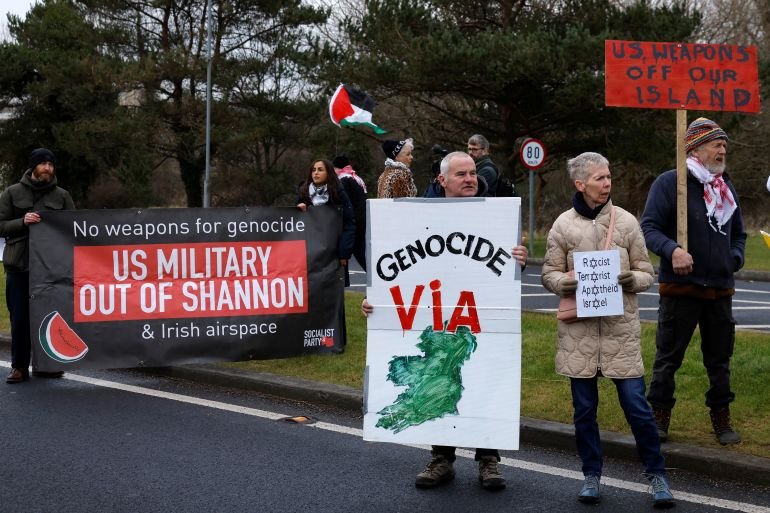
Protesters hold regular demonstrations at Shannon Airport to call on the Irish government to inspect US military and military-contracted planes for weapons destined for Israel.
In a United Nations report published in October, Francesca Albanese, the UN special rapporteur on occupied Palestinian territory, listed Ireland among the countries that permitted weapons transfers through ports and airports, indicating “an intent to facilitate Israeli crimes”. In an interview with the Irish broadcaster RTE, she urged Ireland to stop the transit of weapons.
In 2024, the Department of Transport approved 1,354 applications for civil aircraft or Irish-registered aircraft to carry military weapons or ammunition through Ireland, representing a 14 percent increase over 2023, The Irish Times reported in April. Only two applications were refused in 2024.
During an interview in April with the Irish radio station Newstalk, Alice Mary Higgins, a member of the Irish Seanad, or Senate, said: “While the full records of all the flights are not available, it is known that the largest number of exemptions have been sought by Germany and the United States.”
Data gathered by Shannonwatch, which tracks US military stopovers, confirm that most aircraft passing through are US military and military-contracted with flights by Germany’s Luftwaffe also appearing in its logs.
Officials maintained that they do not routinely inspect foreign military aircraft landing at the airport and no exemptions have been granted for civilian aircraft to carry munitions bound for Israel.
After the US and Israel attacked Iran, Irish Prime Minister Micheal Martin said Shannon was not being used to assist that war. However, he said while there was not “strong evidence” that US military weapons were being transported, it was difficult to “intervene” or “investigate” if there were any “transgressions” of rules.
Ireland ‘looking the other way’
Shannon Airport has been a key US military refuelling and transit point in Europe for more than two decades.
During the Iraq War, more than two million US soldiers passed through the airport in western Ireland, fuelling controversy and allegations that the site facilitated the transport of weapons and detainees, John O’Brennan, director of Maynooth University’s Centre for European and Eurasian Studies, told Al Jazeera.
While most European Union countries facilitate weapon transfers for allies through NATO or EU security frameworks, Ireland’s official policy is to not allow the transit of weapons through its airspace to maintain its traditional military neutrality.
Under Irish law, all civil aircraft carrying weapons or ammunition must apply for exemptions from the Department of Transport before landing at Irish airports or travelling through Irish airspace.
Irish-registered aircraft carrying munitions anywhere in the world must also seek permission. Foreign military aircraft are only authorised to land or fly through Ireland by the Department of Foreign Affairs on the condition they are not carrying weapons.
While Irish authorities said no prisoners during the Iraq War were transported through the airport, human rights groups such as Amnesty International Ireland said the country’s failure to actively inspect planes meant it had violated its human rights obligations.
The full extent of what passed through Shannon was never established “as the government shut down all investigations”, O’Brennan said.
O’Brennan said the government’s strategy of “looking the other way” has resulted in revelations that weapons have transited illegally.
The Irish investigative site The Ditch reported in August 2024 that Israeli-Belgian Challenge Airlines had illegally transited ammunition and military explosives bound for Israel through Irish airspace, based on documents obtained via Freedom of Information requests by the Belgian antiwar NGO Vredesactie.
After this report, the Department of Transport launched a probe that found nine unauthorised flights had carried munitions through Irish airspace destined for Israel since October 2023.
Opposition parties condemned the findings, accusing the government of “turning a blind eye” and failing to uphold international law and Ireland’s policy of military neutrality.
Eoghan McNeill, an editor at The Ditch, told Al Jazeera that these unauthorised flights were operated by a mix of military contractors and commercial carriers, including Israel’s national airline El Al, US carriers FedEx Express and Omni Air International, and Germany’s national airline Lufthansa. It reported that Challenge Airlines alone made 21 flights carrying weapons to Israel through Irish airspace from October 2023 to January 2025.
The Irish government said the Department of Transport is continuing to examine reports of alleged nonexempted flights. It has also pledged to introduce new laws to enable random physical inspections of aircraft and warned the concerned airlines against carrying Israeli munitions through Irish airspace without authorisation.
In October, Ireland granted an exemption for a US military-chartered Omni Air International flight to carry munitions to the Israeli military’s Nevatim Airbase in southern Israel. This marked the first time since 2006 that the Irish government had acknowledged authorising an Israel-bound weapons flight to fly through Shannon Airport, The Ditch reported.
At the time of publication, neither the Irish prime minister’s office nor the Department of Transport had responded to Al Jazeera’s request for comment.
O’Brennan said Ireland is cautious about provoking Washington due to its economic ties with the US, citing the issues around Shannon and a long-debated Occupied Territories Bill, which would ban trade with Israeli settlements, which are illegal under international law. The legislation is yet to pass despite strong parliamentary support.
Last month, Shannon Airport faced renewed criticism after The Guardian reported that several Palestinians arrested in the US were deported to the occupied West Bank on flights chartered by US Immigration and Customs Enforcement that refuelled at the airport.
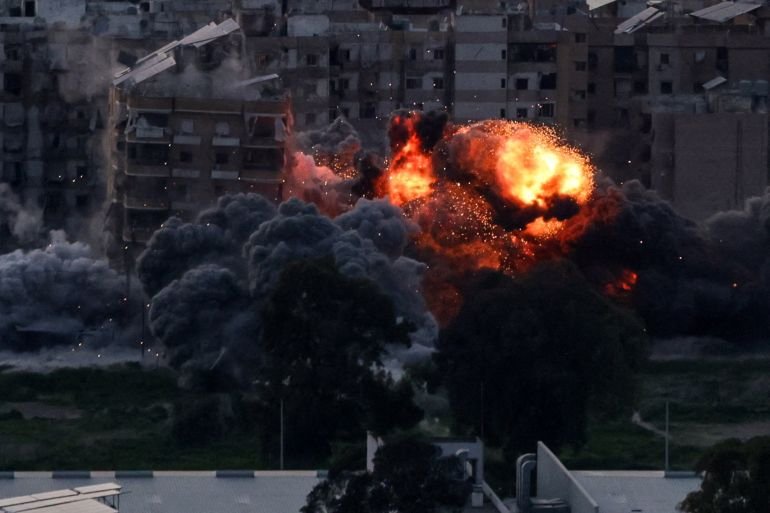
Since launching their military offensive on Iran on February 28, the United States and Israel have carried out thousands of strikes across the Middle East nation of about 90 million people, targeting military as well as civilian infrastructure, including hospitals, schools and residential buildings.
Iran says more than 2,000 people have been killed in US-Israeli strikes on roughly 90,000 civilian sites, including the attack on a school in the city of Minab on the first day of the war, which has spread to Lebanon, where Israel has been accused of extending its “Gaza playbook”. Israeli forces have killed more than 72,000 Palestinians in the Gaza Strip, including hundreds of medics and aid workers, during their genocidal war.
Recommended Stories
list of 3 itemsend of list
Iran has also carried out retaliatory strikes on military, industrial, civilian and energy facilities in Israel, killing at least 19 people and wounding thousands. Tehran has also carried out attacks on Gulf nations that host the US bases, where at least 25 people have been killed. At least 13 US soldiers have also been killed in Iranian attacks.
Israeli and US strikes have expanded to include civilian facilities such as power and water desalination plants, drawing an Iranian response. On Sunday, Iran also targeted a desalination plant in Kuwait, raising concerns in the Gulf nations, which overwhelmingly depend on desalinated water.
We break down some of the key civilian targets the US, Israel and Iran have hit so far:
In this aerial handout picture released by the Iranian Press Center, mourners dig graves during the funeral for children killed in a reported US strike on a primary school in the city of Minab in Hormozgan province on March 3, 2026 [Handout/Iranian Press Center via AFP]
Education
School in Iran
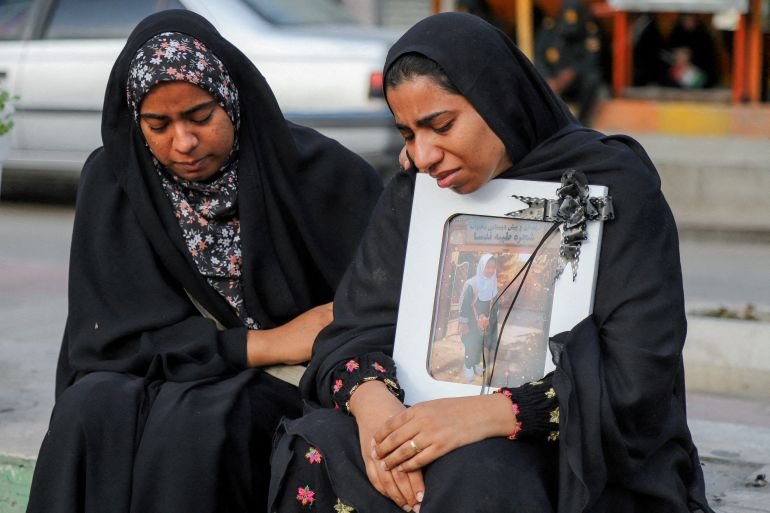
The war on Iran began on February 28 with a strike on an elementary girls’ school, Shajareh Tayyebeh (The Good Tree), in the city of Minab in southern Iran. At least 170 people, most of them girls aged between seven and 12 years, were killed when the missiles struck the school.
President Donald Trump denied that the US had attacked the school.
However, several independent investigations by media organisations, including Al Jazeera, and rights groups, including Amnesty International, have said the attack was likely deliberate and that a US-manufactured Tomahawk missile was likely used in the attack.
In retaliation, on March 1, Iran struck Israel, killing at least nine people in the Israeli town of Beit Shemesh.
Universities in Iran
On March 28, the Iran University of Science and Technology was hit by what Iranian media said were targeted Israeli-US strikes. It remains unclear what the damage and casualties from the strike look like.
A day later, a university in Iran’s central city of Isfahan said it was hit by US-Israeli air strikes for the second time since the war erupted, leaving four university staff members wounded.
After these strikes, according to Iranian state media, the Islamic Revolutionary Guard Corps (IRGC) said it would attack universities tied to the US and Israel across the Middle East in retaliation.
On Sunday, in a post on X, the US Embassy in Baghdad warned that Iran and its proxies “may intend to target US universities in Baghdad, Sulaymaniyah, and Dohuk, as well as other universities perceived as connected to the United States” and advised US citizens to leave Iraq immediately.
Energy facilities
In retaliation for the US and Israel’s strikes, Iran has blocked the Strait of Hormuz, which has led to a disruption in global oil and gas supplies, and many countries have begun tapping into their strategic oil reserves to avoid an economic crisis.
While the world’s focus has been on this strait, and negotiations on how to reopen it are ongoing, attacks on energy infrastructure in Iran and across the Gulf region are also continuing, further upending global energy supply.
Iran
On March 8, Israel hit Iran’s oil facilities for the first time since the war started, killing at least four people. The Aghdasieh oil warehouse in northeast Tehran, Tehran oil refinery in the south, Shahran oil depot in the west of Tehran, and an oil depot in Karaj city were the key facilities targeted. Witnesses said oil from the Shahran depot also leaked into the streets. Reporting from Tehran, Al Jazeera’s Tohid Asadi also described seeing black raindrops on his windows early the next day.
Israel said it had struck “a number of fuel storage facilities in Tehran” that were used “to operate military infrastructure” in the March 8 attack. It provided no proof for its claims. Israel adopted similar tactics in Gaza, targeting schools and hospitals after accusing the facilities of being used by Hamas fighters. Most of their accusations later turned out to be false.
On March 18, Israel struck Iran’s critical South Pars gasfield. South Pars is part of the world’s largest natural gasfield, which spans 9,700sq km (3,745sq miles), and is shared by Iran and Qatar.
Trump has said neither the US nor Qatar had any involvement in or prior knowledge of Israel’s initial strike on the South Pars field.
Iran retaliated by launching missiles and drones at targets across the Middle East, including energy infrastructure in nearby Arab Gulf states.
Qatar
On March 2, Iranian drones struck an energy facility in Ras Laffan belonging to QatarEnergy, the world’s largest liquefied natural gas (LNG) producer.
QatarEnergy immediately announced that it had halted LNG production following the attacks. Qatar’s LNG exports represent 20 percent of the global market.
Iranian officials have, however, publicly denied targeting QatarEnergy.
On March 19, Iranian missiles again struck an LNG facility in Ras Laffan Industrial City in northern Qatar, hours after Israel had struck the South Pars gasfield. Doha reported that the attack caused “extensive damage”.
The attack wiped out about 17 percent of Qatar’s LNG export capacity, causing an estimated $20bn in lost annual revenue, QatarEnergy CEO Saad Sherida al-Kaabi told the Reuters news agency.
Saudi Arabia
On March 2, Saudi Arabia shut down operations at the Ras Tanura plant, its biggest domestic oil refinery operated by Saudi Aramco, after a fire broke out at the facility that officials said was caused by debris from the interception of two drones.
Iranian officials have publicly denied targeting Saudi Aramco.
United Arab Emirates
On March 2, a fire broke out at Mussafah fuel terminal in southwest Abu Dhabi after it was struck by a drone.
A day later, falling debris from a drone interception caused a fire at the Fujairah oil terminal along the eastern coast of the UAE. No injuries were reported.
On March 17, oil loading at the port of Fujairah was halted partly after an Iranian drone attack caused a fire at the export terminal, while operations at the Shah gasfield remained suspended after an earlier attack, officials said. Fujairah, which lies just outside the strait and is typically the outlet for more than 1 million barrels per day of the state company’s Murban crude, is still operating but at reduced capacity, according to Kpler, a data and analytics firm.
Oman
On March 3, multiple Iranian drones struck fuel tanks and a tanker at the port of Duqm, with at least one direct hit on a fuel storage tank, causing an explosion. On the same day, a drone strike was recorded at Salalah port, which handles fuel and industrial minerals.
Kuwait
On March 20, Iranian drones struck Kuwait’s largest oil refinery, Mina al-Ahmadi, for the second time. In the second attack, fires broke out across multiple units at the refinery, which processes about 730,000bpd oil.
Kuwait’s national oil company said several units had been shut down, though there were no casualties.
Israel
The owner of Israel’s Oil Refineries Limited said Iranian missiles struck its Haifa complex on March 19, and essential infrastructure was damaged. Energy Minister Eli Cohen said the Iranian strike had caused damage to a power grid.
Smoke rises from Kuwait international airport after a drone strike on fuel storage in Kuwait City on March 25, 2026 [AP Photo]
Water resources – desalination plants
Iran
On March 7, Iranian Foreign Minister Abbas Araghchi said a desalination plant on Qeshm Island in southern Iran was attacked by the US.
“Water supply in 30 villages has been impacted. Attacking Iran’s infrastructure is a dangerous move with grave consequences. The US set this precedent, not Iran,” he said on X after the attack.
Iran has since targeted desalination plants in the Gulf region.
Bahrain
On March 8, Manama said an Iranian drone attack caused material damage to a water desalination plant.
Water is scarce across the Gulf region, and groundwater, together with desalinated water, accounts for about 90 percent of the region’s water resources, according to a 2020 report by the Gulf Research Center.
The attack exposed the vulnerability of the Gulf countries, which depend on desalination plants for the majority of their water supply.
Kuwait
On March 30, an Iranian attack on a water desalination plant killed one Indian worker and damaged a building at the site, according to Kuwaiti authorities.
“A service building at a power and water desalination plant was attacked as part of the Iranian aggression against the State of Kuwait, resulting in the death of an Indian worker and significant material damage to the building,” Kuwait’s Ministry of Electricity and Water & Renewable Energy said in a statement on Monday.
Iran has yet to comment on the incident.
About 90 percent of Kuwait’s drinking water comes from desalination plants.
Smoke rises after an explosion in the industrial zone, caused by debris after interception of a drone by air defence, according to the Fujairah media office on March 05, 2026, in Fujairah, United Arab Emirates [Christopher Pike/Getty Images]
Power and industries
Power plants in Iran
On March 27, US and Israeli strikes hit the Bushehr Nuclear Power Plant, the Atomic Energy Organization of Iran said, adding that it was the third attack on the facility since the war began. The plant is Iran’s only operational nuclear power facility and plays a vital role in its civilian energy programme.
Power plants in Israel
On March 19, debris from intercepted missiles fell on a power generation station in the northern city of Haifa and caused electricity outages in several areas, according to Israeli media reports. Iranian media reported that Tehran struck the power plant in retaliation for the attack on the South Pars gasfield.
Steel plants in Iran
On March 27, the Israeli air force said it struck two Iranian steel plants linked to the IRGC. It provided no proof linking the plants to the IRGC.
Iran’s Fars news agency reported that the Israeli strikes hit Khuzestan Steel near Ahvaz and Mobarakeh Steel in Isfahan. A day later, according to Iranian media, the Khuzestan Steel Company had to halt production after its steelmaking units were struck.
In a post on X on March 27, Iran’s Foreign Minister Abbas Araghchi declared that Tehran would exact a “HEAVY price”.
Aluminium facilities in Bahrain, UAE
On March 29, the IRGC said it carried out missile and drone attacks on aluminium facilities in Bahrain and the UAE.
Aluminium Bahrain (Alba) said in a statement that two employees were injured in the attack on its facility, while the UAE’s Emirates Global Aluminium (EGA) said one of its sites in Abu Dhabi suffered significant damage, and six people were injured.
Finance and technology companies
Iranian bank hit
On March 11, Iran’s state broadcaster said an Israeli attack overnight had struck a state-owned Bank Sepah branch in Tehran and called it an “illegitimate and unusual act in war”. It reported that several employees were killed in the incident.
The IRGC has since threatened to attack “economic centres and banks” related to US and Israeli entities in the region.
The IRGC-affiliated Tasnim news agency also released a list of offices and infrastructure run by top US companies with Israeli links whose technology has been used for military applications, describing them as “Iran’s new targets”, said Al Jazeera’s Maziar Motamedi, reporting from Tehran.
The companies include Google, Microsoft, Palantir, IBM, Nvidia and Oracle, and the listed offices and infrastructure for cloud-based services are located in multiple Israeli cities, as well as in some Gulf countries, said Motamedi.
Gulf banks threatened
Following Iran’s threats, several banks across the Gulf region have evacuated their offices.
According to a March 11 report by The New York Times, Citibank asked its employees to immediately vacate its regional headquarters in the Dubai International Financial Centre. Standard Chartered told its employees to work from home.
In Qatar, HSBC temporarily shut down all three of its branches.
Data centres in the Gulf
On March 1, an Amazon data centre was struck in an Iranian drone attack on the UAE. On the same day, debris from a drone strike damaged a third Amazon data centre in Bahrain.
On March 24, an apparent Iranian drone attack disrupted Amazon Web Services (AWS) in Bahrain. Amazon did not immediately comment on whether its Bahrain facility was directly hit or if the disruption was due to nearby attacks.
The company said it was helping to migrate customers to alternate AWS regions while it recovers, though it did not provide additional details, such as the extent of the damage or how long it anticipates the disruption to last.
“As this situation evolves and, as we have advised before, we request those with workloads in the affected regions continue to migrate to other locations,” Amazon told Reuters in a statement.
AWS is Amazon’s cloud computing unit and is critical for the operation of many well-known websites and government operations. It is also the company’s main driver of profits.
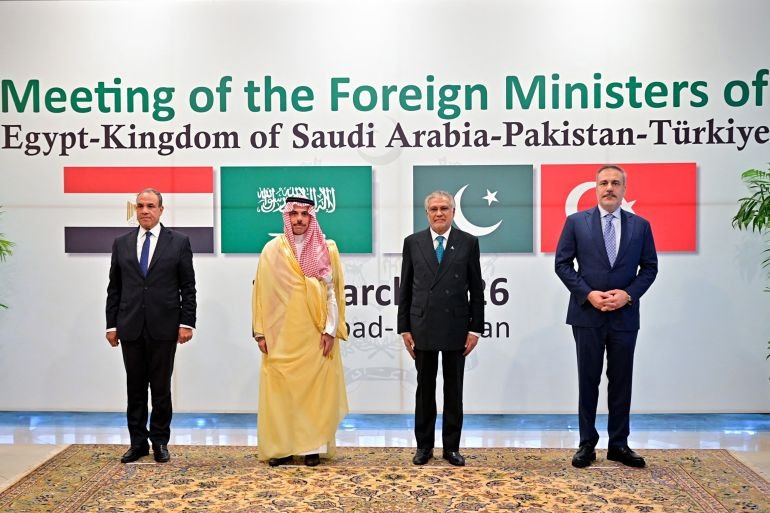
Islamabad, Pakistan – When the foreign ministers of Saudi Arabia, Turkiye and Egypt landed in Islamabad over the weekend, it marked the second meeting in less than two weeks of a diplomatic track working to contain the fallout of the US-Israel war on Iran and Tehran’s retaliatory strikes across the region.
Pakistan’s Deputy Prime Minister and Foreign Minister Ishaq Dar confirmed at the conclusion of Sunday’s consultations that the US and Iran had expressed confidence in Pakistan to facilitate direct talks. Islamabad, he said, was “honoured” to host them “in the coming days, for a comprehensive and lasting settlement of the ongoing conflict”.
Recommended Stories
list of 4 itemsend of list
The four ministers, he added, held “a very detailed and in-depth discussion” on the war, reaffirmed “unity to contain the situation, reduce the risk of military escalations and create conditions for structured negotiations”, and agreed to constitute a Committee of Four senior officials, one from each foreign ministry, to work out the modalities of the process.
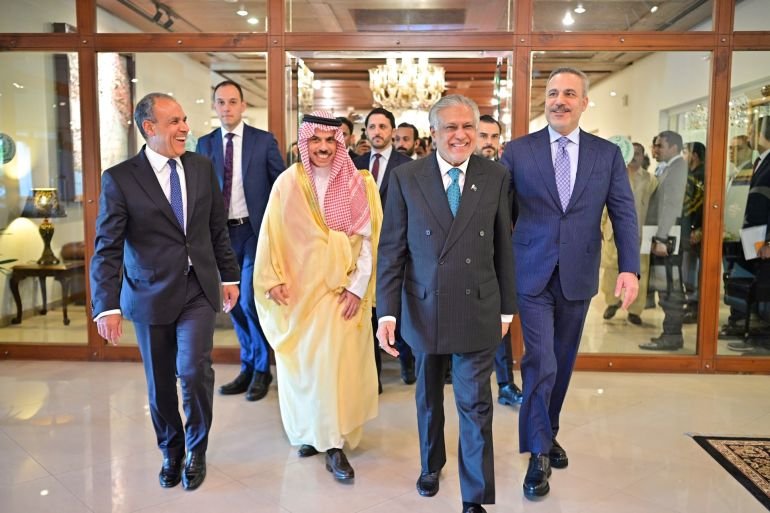
Besides Dar, the meeting was attended by foreign ministers Hakan Fidan of Turkiye, Badr Abdelatty of Egypt and Prince Faisal bin Farhan Al Saud of Saudi Arabia.
The quadrilateral format first came together on the sidelines of the broader Arab and Islamic consultative meeting in Riyadh, Saudi Arabia, on March 19. What began as a wider gathering has hardened into a focused four-country peace push, with Pakistan acting as the primary channel between Washington and Tehran.
Hours later, in an interview with the British newspaper Financial Times, United States President Donald Trump said his “favourite thing is to take the oil in Iran” and did not rule out seizing Kharg Island, the export hub that handles roughly 90 percent of Iran’s crude.
“Maybe we take Kharg Island, maybe we don’t. We have a lot of options,” Trump said. He also confirmed that indirect talks via Pakistani “emissaries” were progressing and reiterated the April 6 deadline he set on Truth Social on March 26 for Iran to accept a deal or face US strikes on its energy sector.
But on board Air Force One on Sunday, Trump said, “I do see a deal in Iran, yeah. Could be soon”, and described negotiations as going “extremely well”.
Those contrasting postures underscored the central tension confronting Pakistan’s diplomatic initiative.
At a moment when Islamabad and its partners are attempting to build a multilateral framework to prevent further escalation, the war appears headed in the opposite direction, with continued Israeli strikes and an expanding US military presence in the region.
‘Baby steps’ amid escalation
Mushahid Hussain Sayed, former Pakistani information minister, senator and foreign policy analyst, said the Islamabad meeting was significant for three reasons.
He described it as the first institutional initiative from the Muslim world aimed at opening a pathway to dialogue.
According to Sayed, Pakistan and Turkiye, both neighbours of Iran, are among the most credible interlocutors available, one a nuclear power and the other a NATO member.
“Both Iran and the US have reposed confidence in Pakistan as a bridge of communication between Tehran and Washington, and most likely the feasible venue for any future peace talks,” he told Al Jazeera.
But he was blunt about the limitations. “These are baby steps for diplomacy in a war scenario that is not only escalating but also becoming more complicated by the day,” Sayed said.
Masood Khan, Pakistan’s former ambassador to the US and the United Nations, said the meeting had “opened a diplomatic corridor, building on earlier shuttle diplomacy, sustained communications and behind-the-scenes efforts to persuade the United States and Iran to engage”.
The Committee of Four, he said, provides a structured backchannel, enabling “a step-by-step, layered, and calibrated process” supported by regional consensus.
Khan outlined four possible stages: trust-building measures, ceasefire negotiations, direct talks on complex issues including the nuclear programme and the Strait of Hormuz, and ultimately an agreement on reciprocal commitments.
However, he cautioned that major obstacles remain. “Tehran’s demands for war reparations and its sovereignty over the Strait of Hormuz are likely to prove the most difficult issues to resolve,” Khan told Al Jazeera.
Before the ministers’ meeting, Pakistan Prime Minister Shehbaz Sharif held a 90-minute call with Iranian President Masoud Pezeshkian, briefing him on Islamabad’s diplomatic outreach to the US, Gulf states and other Islamic countries to “create a conducive environment for peace talks”, according to a statement from the Prime Minister’s Office.
China’s Foreign Minister Wang Yi conveyed Beijing’s full backing for the initiative, while UN Secretary-General Antonio Guterres has also expressed support.
A senior Pakistani diplomat said China was “very supportive” of Pakistan’s efforts, while the Ministry of Foreign Affairs confirmed in a statement on Monday that at Wang’s invitation, Dar will visit China on March 31.
“In this context, the upcoming visit will provide an opportunity for both sides to hold in-depth discussions on regional developments, as well as bilateral and global issues of mutual interest,” the statement from the ministry said.
Dar suffered a hairline fracture in his shoulder after a fall on Sunday while meeting his Egyptian counterpart, according to his son, and the ministry said his upcoming visit, despite medical advice, underscores the importance of the Pakistan-China relationship.
Satellite view of the Strait of Hormuz, a critical chokepoint for global energy supply, connecting the Gulf to the Gulf of Oman [File: Gallo Images/Orbital Horizon/Copernicus Sentinel Data 2025]
Positions remain far apart
The positions formally put forward by both sides remain structurally incompatible, say analysts.
Washington’s 15-point plan, transmitted to Tehran via Pakistan, includes a one-month ceasefire, a handover by Iran of its highly enriched uranium stockpiles, a halt to further enrichment, curbs on Tehran’s ballistic missile programme and an end to support for regional proxies.
Iran’s counterproposal, outlined by state-funded broadcaster Press TV, citing a senior political security official, calls for a halt to aggression and killings, concrete guarantees against recurrence, reparations, an end to hostilities against Iran’s allies and formal recognition of Iranian sovereignty over the Strait of Hormuz.
Trump told reporters on board Air Force One on Sunday that Iran had agreed to “most of” the 15 points.
On Monday, Iran’s Ministry of Foreign Affairs spokesperson Esmaeil Baghaei confirmed that Tehran had received messages via intermediaries, but described the US proposals as “unrealistic, illogical and excessive”.
Baghaei appeared sceptical about the prospects of the Islamabad dialogue yielding a peace deal.
“The meetings that Pakistan has are a framework that they established themselves, and we did not participate in,” he said. “It is good for the countries of the region to be concerned about ending the war, but they should be careful about which side started the war.”
Khan, the former diplomat, said Iran’s scepticism ran deep. “Iran suspects that the diplomatic process could serve as a smokescreen for a ground assault along its coastline, adjacent islands, or the Strait of Hormuz. No magic wand can erase such a deeply entrenched trust deficit overnight,” he said, adding that trust-building “must proceed at a brisk pace given the devastating humanitarian and military costs”.
Javad Heiran-Nia, director of the Persian Gulf Studies Group in Tehran, said any preliminary engagement must ensure neither side feels it has “surrendered”.
“The negotiation framework should be such that each party can participate without feeling it has given in, with a focus on low-cost and fruitful issues in the short term,” he told Al Jazeera.
A realistic first step, he said, would be a US commitment to postpone threats against Iran’s power plants for a sustained period, alongside guarantees from third countries on interim arrangements.
Reza Khanzadeh, an adjunct professor at George Mason University, said the burden of compromise ultimately lies with Washington.
Iran, he said, believes any deal short of its own terms could invite future attacks, making regime survival non-negotiable.
“They may be willing to compromise on the nuclear programme, the ballistic missile programme, and support for regional proxies,” he said. “Tehran will not compromise on its existence. And therefore, Iranians are willing to fight for as long as it takes.”
He also pointed to mounting domestic pressure in the US, noting Trump’s approval rating has fallen to 36 percent in recent polls, driven by rising fuel costs and public concern over the war.
Khan identified the most decisive confidence-building measure as one Washington has yet to deliver.
“A commitment from Washington to ensure that Israel halts its attacks on Iran and Lebanon and withdraws from recently occupied Lebanese territory. That, however, is easier said than done,” he said.
Strait of Hormuz and economic pressure
Iran’s agreement to allow 20 Pakistani-flagged vessels through the Strait of Hormuz, confirmed by Dar over the weekend and acknowledged by Trump, is the most immediate confidence-building measure on the table.
The strait remains effectively closed to normal shipping. The International Energy Agency has described the disruption as the worst oil shock in history, surpassing the crises of 1973 and 1979.
Brent crude rose above $116 per barrel in early Monday trading in Asia, up more than 50 percent since the war began on February 28. The World Trade Organization’s director-general, Ngozi Okonjo-Iweala, has said global trade is experiencing its “worst disruptions in the past 80 years”.
But Sayed, who is also the founding chairman of the Islamabad-based Pakistan China Institute, said Iran’s “closure of the Strait of Hormuz is not the cause but the consequence of the conflict”.
Just as Saudi King Faisal bin Abdulaziz Al Saud weaponised oil exports in October 1973 – cutting off supplies to the US and its allies in retaliation for their support of Israel during the Arab-Israeli war, triggering a global energy crisis – Iran had deployed the strait to counterbalance US-Israeli military firepower with an economic chokehold, he argued.
Khan cautioned against treating the strait as the centrepiece of any settlement.
“The Strait of Hormuz will remain a residual issue and will ultimately need to be addressed by the eight littoral states of the Persian Gulf, with reference to UNCLOS and established legal precedents,” he said, referring to the UN Convention on the Law of the Sea.
The immediate priority, he argued, was a broader halt to hostilities.
“The foremost confidence-building measure would be a pause in hostilities, a truce that provides respite to the warring sides and creates space for peacemakers,” he said.
Heiran-Nia proposed a phased approach.
“First agree on a limited ceasefire and halt to attacks on civilian targets; reduce forces in critical areas and establish confidential channels for information exchange in a second step; and then move to broader ceasefire negotiations,” the Tehran-based analyst said.
Any withdrawals, he added, should be measurable, with mediators acting as a “secret channel” to ensure reciprocity.
The USS Tripoli amphibious assault ship enters the Singapore Strait, as seen from Singapore, March 17, 2026 [Edgar Su/Reuters]
The spoiler problem
Even as diplomatic efforts continue, the military trajectory remains escalatory.
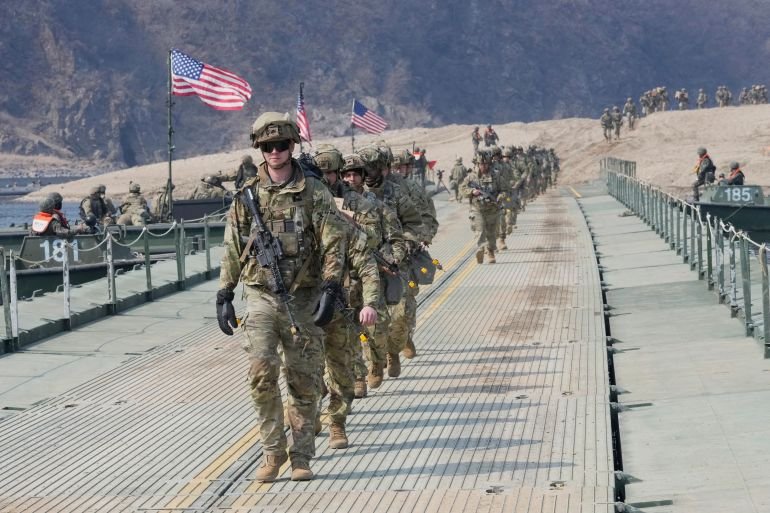
An amphibious task force of about 3,500 Marines and sailors led by the USS Tripoli arrived in the region on Friday, according to the US Central Command (CENTCOM).
Another 2,200 Marines are heading to the Gulf, alongside 2,000 soldiers from the Army’s 82nd Airborne Division.
Trump has made clear that military options remain under consideration. Other reports suggest the Pentagon is preparing for potential ground operations that could last weeks.
Israel, which waged its genocidal war on Gaza in October 2023 and has invaded southern Lebanon for the second time since, struck Tehran again on Sunday.
US and Israeli forces killed Iran’s Supreme Leader Ayatollah Ali Khamenei and other senior leaders in the opening salvo on February 28. They later killed top security official Ali Larijani on March 17.
Iran’s atomic energy organisation said a projectile landed within the compound of the Bushehr Nuclear Power Plant without causing damage, according to state media.
Israel’s Ambassador to the UN Danny Danon said operations would continue until Iran’s nuclear and missile capabilities are eliminated, adding that Israel was not part of any US-Iran talks.
Khan said, despite these pressures, Iran has, for now, “acquiesced to mediation and reposed their trust in Pakistan and Turkiye to move the process forward”.
But he warned of the risks if diplomacy fails.
“The biggest obstacle remains the continuous and unabated attacks on Iran and Lebanon by Israel, which appears to be operating in overdrive. Such escalatory steps risk derailing this seminal yet delicate diplomatic process and could plunge the world into a nuclear-triggered catastrophe, an outcome that must be averted at all costs,” he said.
Sayed agreed, arguing that Iran has “zero trust” in US and Israeli assurances.
“The key question that will determine the outcome is who can suffer more pain in the long run. The US and Israel can inflict pain, but they certainly cannot incur it. It is the classic lesson of asymmetrical warfare: the weaker side wins by not losing,” he said.
Heiran-Nia stressed that any agreement would require robust safeguards.
“Any confidence-building measures must include early warning mechanisms to detect and stop any attempts at sabotage,” he said. “These measures must be short-term, reversible and reciprocal so that any possible disruption does not cause permanent damage.”
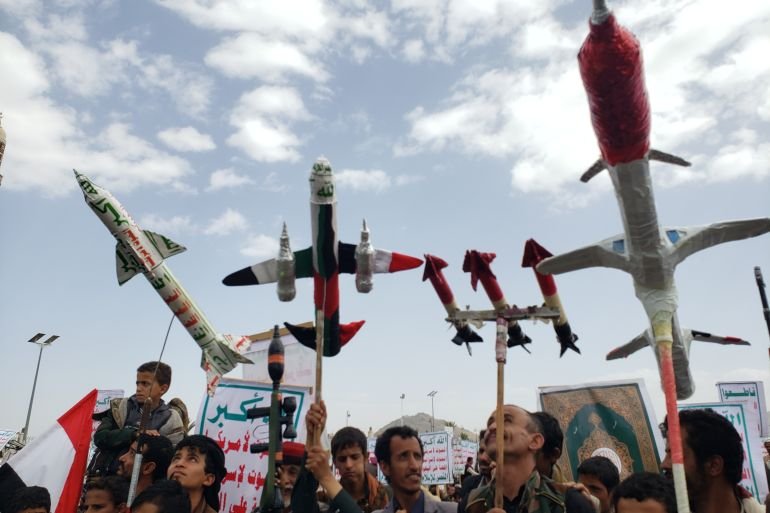
Yemen’s Houthis have entered the Iran war by launching strikes on Israel, and some analysts have warned their arrival could open another front in the conflict – the potential blockade of Bab al-Mandeb, a strait that presents another chokepoint in the global commodities trade.
Brigadier-General Yahya Saree, a military spokesperson for the Houthis, announced on Saturday the Iranian-backed group’s first attack on Israel. On Sunday, he said the Houthis had carried out a “second military operation” against Israel using cruise missiles and drones and said the Houthis would continue carrying out military operations in the coming days until Israel “ceases its attacks and aggression”.
Recommended Stories
list of 3 itemsend of list
Does the Houthis’ warning raise the prospect of a broader regional war, particularly given the group’s ability to block Bab al-Mandeb and strike targets far beyond Yemen?
Here’s what we know:
(Al Jazeera)
Why have the Houthis joined the war?
So far, unlike Lebanon’s Hezbollah and Iraqi armed groups, the Houthis have not made any formal announcement of joining the war.
While Iran champions the Houthis as part of its “axis of resistance”, Houthi religious doctrine does not adhere to Iran’s supreme leader in the same way Hezbollah’s and the Iraqi groups’ do. Iran has built the “axis of resistance” of like-minded factions to oppose Israel and the United States across the region.
Al Jazeera’s Tohid Asadi, reporting from Tehran, said the Houthis joining the war will be welcomed by Iran.
“Speaking of the broader context, we have to keep in mind that over the past months and years, officials in Tehran have said the Houthis in Yemen are close allies. But their decision-making and actions are largely independent,” he said.
“Still, geopolitically, Iran is likely to see this as a significant development,” he added.
Negar Mortazavi, a senior nonresident fellow at the Center for International Policy, told Al Jazeera that the entrance of the Houthis into the fighting is “no surprise”, noting that Iranian actions have been in accordance with their statements.
“Every step has really been what they have telegraphed, what they have threatened even before the war when they went to their Gulf Cooperation Council neighbours and they warned that this [the war] is not going to be inside their borders and they are going to immediately turn it into a regional war,” she told Al Jazeera.
But Nabeel Khoury, a former US diplomat, told Al Jazeera that the missile attacks launched by the Houthis against Israel amounted to “token participation, not full participation”.
“They have fired a couple of missiles as a warning because of all the talk of potential escalation. There are US troops on their way to the region. There’s been talk that if there is no agreement, there might be a full-scale attack on Iran as has not been seen so far,” the former deputy chief of mission in Yemen told Al Jazeera.
“So for all that, the Houthis are saying, ‘We are still here, and if you’re really going to go all-out against Iran, we will then jump in.’ But at this point, they haven’t yet jumped in.”
If they do, Khoury said, their most significant move would be blocking Bab al-Mandeb with boats, mines or missiles.
“All they have to do is fire at a couple of ships coming through, and that would lead to the arrest of all commercial shipping through the Red Sea,” he said. “That would be a red line, and then you would see attacks against Yemen very quickly.”
The passage of oil and gas through the Strait of Hormuz has almost entirely ground to a halt after Iran targeted vessels passing through the waterway. The closure has caused a global energy crisis, adding inflationary pressure to economies across the globe. Several countries have been forced to impose fuel rationing and reduce working hours to conserve energy.
Where is Bab al-Mandeb?
The strait sits between Yemen to its northeast and Djibouti and Eritrea in the Horn of Africa to its southwest. It connects the Red Sea to the Gulf of Aden, which then extends into the Indian Ocean. It is 29km (18 miles) wide at its narrowest point, limiting traffic to two channels for inbound and outbound shipments and is de facto controlled by the Houthis.
It is one of the world’s most important routes for global seaborne commodity shipments, particularly crude oil and other fuel from the Gulf bound for the Mediterranean via the Suez Canal or the Sumed (Suez-Mediterranean) Pipeline on Egypt’s Red Sea coast as well as commodities bound for Asia, including Russian oil.
Reporting from Sanaa, Yemen, Al Jazeera’s Yousef Mawry said the main card in the war for the Houthis is Bab al-Mandeb.
“With the Strait of Hormuz closed off to US and Israeli shipping, if the Houthis also decide to block Bab al-Mandeb, it’s only going to make the situation economically a lot worse for Israel,” Mawry said.
“As of right now, shipping is still available for all vessels, including US- and Israeli-linked vessels. The Yemeni group has not imposed a blockade for the time being. That’s expected in the next phase if Israel decides to target the port of Hodeidah or Yemeni civilian and public infrastructure.”
Can this strait be blocked by the Houthis?
Neither the Houthis nor Iran has commented on whether there is a plan to block one of the world’s busiest maritime routes.
But on Wednesday, an unnamed Iranian military official said Iran could open a new front at Bab al-Mandeb if attacks are carried out on Iranian territory or its islands, the country’s semiofficial Tasnim news agency said.
Then on Saturday, Mohammed Mansour, the Houthis’ deputy information minister, told local media that the group is “conducting this battle in stages, and closing the Bab al-Mandeb strait is among our options”.
Al Jazeera’s Asadi said that so far in the war, Iran has sought leverage through the Strait of Hormuz but now attention is turning to another key chokepoint, likely Bab al-Mandeb.
“If that were to be disrupted, it would provide additional leverage for Iran and its allies amid ongoing air attacks by Israel and the US,” he said.
Elisabeth Kendall, a Middle East specialist and the president of Girton College at Cambridge University, told Al Jazeera that if this strait is blocked, it would create a “nightmare scenario”.
“Because if you have restrictions on the Strait of Hormuz at the same time as restrictions are escalating in the Bab al-Mandeb, then you really will disrupt, if not cripple, trade toward Europe. So this is a knife edge, really, depending on what happens next,” she told Al Jazeera.
“Going to actually strike the Red Sea at the moment when it’s one of the more dependable routes out,and oil is going out via Yanbu from Saudi Arabia on the Red Sea, that would be a bit of a game-changer,” she added, referring to Saudi Arabia’s alternative route to export oil.
Kendall, however, said that while this was a “sweet spot” for the Houthis, she noted that the Yemeni group might not want to “provoke a Saudi or indeed a broader response.”
The Houthis previously carried out attacks in the Red Sea in 2024 when they targeted commercial ships. The Houthis then said they were targeting Israel-linked or Israel-bound vessels in protest against Israel’s genocidal war on Gaza.
Ahmed Nagi, a Yemen senior analyst at the International Crisis Group, told Al Jazeera that the Houthis’ current posture reflects a deliberate calculation rather than restraint born of weakness.
“The Houthis today didn’t attack the Red Sea or speak even about escalation in the Red Sea. They just attacked Israel directly,” Nagi noted.
“That choice matters. The Bab al-Mandeb, linking the Red Sea to the Gulf of Aden, remains one of the most sensitive arteries in the global economy. About 10 percent of global trade and a significant share of oil and gas shipments pass through it,” he said.
For now, Nagi suggested the Houthis are aligning their moves with Tehran’s broader strategy.
“The aim is to support the Iranians in their negotiations, … and they are betting that maybe there will be a way out, so there will not be a need to use Bab al-Mandeb.”
As the United States-Israeli war on Iran entered its 30th day, key regional powers have converged on Pakistan’s capital, Islamabad, in a bid to de-escalate the fighting in the Middle East, which has caused a global energy crisis.
Driven by growing concerns over the fallout of the conflict, Egyptian Foreign Minister Badr Abdelatty, Turkish Foreign Minister Hakan Fidan and Saudi Foreign Minister Faisal bin Farhan Al Saud arrived on Sunday for two days of talks with Pakistani Deputy Prime Minister Ishaq Dar.
Recommended Stories
list of 4 itemsend of list
“Islamabad has now become the hub of all diplomatic activity to try to bring an end to the US-Israel war on Iran,” Al Jazeera’s Osama Bin Javaid reported from the Pakistani capital.
He noted that the meetings are a platform initially discussed in the Saudi capital, Riyadh. Dar, who is also Pakistan’s foreign minister, is now trying to use this foundation to “build a regional bloc of sorts” that could eventually bring together broader powers, including Indonesia and Malaysia.
The diplomatic push follows a Saturday evening phone call between Dar and his Iranian counterpart, Abbas Araghchi. According to a readout posted on Araghchi’s official Telegram channel, Dar briefed him on the four nations’ efforts to achieve an immediate halt to the war. During the call, Araghchi detailed what he described as “heinous crimes” committed by the US and Israel against Iran, accusing them of deliberately targeting schools, hospitals, other public infrastructure and residential areas.
As an initial confidence-building measure after the ministers’ call, Islamabad announced that Tehran had agreed to allow 20 Pakistani-flagged ships to pass through the Strait of Hormuz at a rate of two per day.
Bin Javaid explained that this move is designed to “tell the Americans that they’ve been somewhat successful in opening the Strait of Hormuz”.
The regional efforts come as US President Donald Trump announced a 10-day extension of his deadline for Iran to reopen the strait, through which 20 percent of the world’s oil and gas supplies pass. Tehran’s chokehold on the strait has created the worst energy crisis since the 1973 oil embargo.
Trump has sent a 15-point ceasefire plan to Iran, but Tehran has rejected it and instead presented its own conditions, including the end of US-Israeli aggression, reparations for war damage and security guarantees to prevent future attacks.
Trump and Israeli Prime Minister Benjamin Netanyahu launched the war on February 28 as Washington was holding talks with Tehran on its nuclear programme. Oman, the mediator of those discussions, said the war was launched although a deal had been “within reach”.
‘Very delicate balancing act’
Pakistan will be walking a diplomatic tightrope at the talks. It has close defence ties with Saudi Arabia and shares a 900km (560-mile) border and cultural ties with Iran. Pakistan is also home to the second largest Shia population in the world after Iran.
“It’s a difficult job, given the fact that these foreign ministers will be meeting to see if they are able to bring the Americans and the Iranians back to the negotiating table,” Al Jazeera’s Kamal Hyder said, reporting from Islamabad.
Zahid Hussain, a political analyst from Pakistan, described the country’s role as a “very delicate balancing act”. He pointed out that while Islamabad condemned the recent attacks on Iran and Gulf states, it explicitly named Israel while carefully refraining from naming the US.
Ties between Washington and Islamabad have warmed up since Trump succeeded former US President Joe Biden. Trump has hosted Pakistan army chief Asim Munir twice as the two leaders have developed a personal rapport. Trump has described Munir as “my favourite field marshal”.
“Pakistan is currently playing the role of a messenger rather than a mediator, relaying messages between America and Iran,” Hussain explained, noting that Islamabad lacks the leverage to impose solutions. “If the war ends following this initiative, it will significantly elevate Islamabad’s diplomacy. But if it continues, Pakistan will be one of the countries most harmed.”
‘Islamic alliance’
Analysts said the diplomatic push is a calculated attempt to appeal directly to the US president’s political ambitions.
Mahjoob Zweiri, a Middle East policy expert, told Al Jazeera the Islamabad talks seek to revive Trump’s newly established Board of Peace, which went into a diplomatic “coma” after its recent proposals for Gaza.
“They are appealing to the president’s sensibilities,” Zweiri said. “The message is: ‘You created this board and say you want to achieve peace. Go and make peace in this war.’”
Beyond political manoeuvring, the participating nations are driven by severe economic fears. For Islamabad, the stakes are existential. Pakistan risks a major crisis if energy supplies decline while millions of its citizens could lose their jobs in the Gulf region if the conflict spreads.
Experts also pointed out the enormous economic costs borne by the Gulf countries as their energy exports, a major source of revenue, have dropped drastically due to the closure of the Strait of Hormuz. And near-daily Iranian drone and missile attacks have targeted energy and industrial facilities, forcing petroleum companies in several countries to declare force majeure on supply contracts.
Gulf countries have condemned the Iranian attacks but have so far refrained from undertaking a military response. Iran has carried out attacks on its Gulf neighbours, who have forged close economic and security ties with Washington. Bases in the region where US forces are deployed have repeatedly been attacked by Iran since the war began.
Mahmoud Alloush, a Turkiye-based political analyst, noted that the war has “increasingly deepened the doubts of US-allied countries regarding the American security umbrella”, proving that a reliance on Washington has brought consequences rather than protection.
Alloush argued that the Islamabad gathering serves as a foundational step for an “Islamic alliance” designed to counter the Israeli project in the region, address the resulting geopolitical vacuums and mitigate the uncertainties surrounding future US involvement.
Turkish President Recep Tayyip Erdogan has urged Arab countries not to join the war against Iran. His foreign minister has been travelling to Arab capitals to try to prevent the conflict from spreading.
“Unfortunately, the region is being drawn step by step into a game scripted by Israel,” he said, accusing Israel of sowing a “seed of discord” to divide Muslim countries.
However, the diplomatic push is racing against a highly volatile reality.
On Saturday, Yemen’s Iran-aligned Houthi rebels launched their first attacks on Israel since the start of the conflict, just a day after thousands of additional US soldiers arrived in the Middle East.
US media reports said the Trump administration is planning to launch a ground invasion.
Iran’s parliament speaker, Mohammad Bagher Ghalibaf, on Sunday said Iranian forces are prepared for a potential US ground attack as he accused Washington of signalling talks while planning an escalation of the war.
The Pentagon is preparing for weeks of limited ground operations in Iran, potentially including raids on Kharg Island and coastal sites near the Strait of Hormuz, according to United States officials quoted by The Washington Post newspaper.
The plans, which fall short of a full invasion, could involve raids by special operations and conventional infantry troops, the Post reported on Saturday, exposing US personnel to Iranian drones and missiles, ground fire, and improvised explosives.
Recommended Stories
list of 3 itemsend of list
Whether President Donald Trump would approve any of those plans remains uncertain, according to the report.
“It’s the job of the Pentagon to make preparations in order to give the Commander in Chief maximum optionality. It does not mean the president has made a decision,” White House press secretary Karoline Leavitt said in a statement, responding to questions over the Post report.
The Trump administration has deployed US Marines to the Middle East as the war in Iran stretches into its fifth week, and has also been planning to send thousands of soldiers from the army’s 82nd Airborne to the region.
On Saturday, the US Central Command (CENTCOM) said about 3,500 additional soldiers arrived in the Middle East on board the USS Tripoli.
The sailors and marines are with the 31st Marine Expeditionary Unit and arrived in the region on March 27, along with “transport and strike fighter aircraft, as well as amphibious assault and tactical assets”, according to CENTCOM.
Officials speaking to The Washington Post said discussions within the administration over the past month have touched upon the possible seizure of Kharg Island, a key Iranian oil export hub in the Gulf, and raids into other coastal areas near the Strait of Hormuz to find and destroy weapons that can target commercial and military shipping.
According to the report, one person said the objectives under consideration would probably take “weeks, not months” to complete, while another put the potential timeline at “a couple of months”.
The Pentagon had not responded on Saturday to the Post’s requests for comment. Iran has yet to respond to the report.
The report comes as Pakistan, which shares a 900km-long (559-mile) border with Iran, mediates between Washington and Tehran, hosting two days of talks starting on Sunday with the foreign ministers of Saudi Arabia, Turkiye and Egypt.
Iranian threats
The Iranian parliament speaker, Mohammad Bagher Ghalibaf, said on Sunday the “enemy openly sends messages of negotiation and dialogue and secretly plans a ground attack”.
“Unaware that our men are waiting for the arrival of American soldiers on the ground to set fire to them and punish their regional partners forever. Our firing continues. Our missiles are in place,” the Tasnim news agency reported, quoting Ghalibaf.
“Our determination and faith have increased. We are aware of the enemy’s weaknesses, and we clearly see the effects of fear and terror in the enemy’s army.”
It was not clear whether Ghalibaf was responding to the Post report.
On Wednesday, Ghalibaf had warned that intelligence reports suggested that “Iran’s enemies” were planning to occupy an Iranian island with support from an unnamed country in the region.
He said any such attempt would be met with targeted attacks on the “vital infrastructure” of the regional country – which he did not name – that assists in the operation.
Meanwhile, Iran’s navy chief Shahram Irani said on Sunday that the USS Abraham Lincoln aircraft carrier would be targeted if it comes within range.
“As soon as the USS Abraham Lincoln carrier strike group comes within firing range, we will avenge the blood of the martyrs of the Dena warship by launching various types of sea-to-sea missiles,” Irani was quoted as saying by state TV, referring to an Iranian frigate sunk by the US on March 4.
On Wednesday, Tasnim quoted an unnamed military source as saying that Iran could open a new front at the mouth of the Red Sea if military action takes place on “Iranian islands or anywhere else in our lands”.
The source told Tasnim that Iran can pose a “credible threat” in the Bab al-Mandeb Strait, which lies between Yemen and Djibouti.
Tasnim later quoted an “informed source” claiming that Yemen’s Houthi rebels, backed by Iran, are prepared to play a role “if there is a need to control the Bab al-Mandeb Strait to further punish the enemy”.
South African sprinter Caster Semenya, a two-time Olympic 800-metres champion, says the International Olympic Committee’s (IOC’s) reinstatement of gender verification tests for the 2028 Los Angeles Games is “a disrespect for women”.
The hyperandrogenic athlete on Sunday also expressed her disappointment that the measure was taken under new IOC President Kirsty Coventry of Zimbabwe.
Recommended Stories
list of 3 itemsend of list
“For me personally, for her being a woman coming from Africa, knowing how African women or women in the Global South are affected by that, of course it causes harm,” Semenya said in Cape Town on the sidelines of a sporting competition.
The IOC said on Thursday that only “biological females” will be allowed to compete in women’s events, preventing transgender women from competing.
The IOC had previously used chromosomal sex testing from 1968 to the 1996 Atlanta Olympics before abandoning it in 1999 under pressure from the scientific community, which questioned its effectiveness, and from its own athletes commission.
“It came as a failure, and that’s why it was dropped,” Semenya said.
“It’s like now we need to prove that we are worthy as women to take part in sports. That’s a disrespect for women.”
Semenya has become the symbol of the struggle of hyperandrogenic athletes, a battle on the athletics tracks and then in courtrooms, to assert her rights, which she has waged since her first world title in the 800m in 2009.
In 2025, she won a partial victory at the European Court of Human Rights in her seven-year legal fight against track and field’s sex eligibility rules.
The court’s highest chamber said in a 15-2 ruling that Semenya had some of her rights to a fair hearing violated before Switzerland’s Supreme Court, where she had appealed against a decision by the Court of Arbitration for Sport. It had ruled in favour of track’s international governing body, World Athletics.
The original case between Semenya and Monaco-based World Athletics was about whether female athletes who have specific medical conditions, a typically male chromosome pattern and naturally high testosterone levels, should be allowed to compete freely in women’s sports.
The European court’s ruling did not overturn the World Athletics rules that in effect ended Semenya’s career running the 800m after she had won two Olympic gold medals and three world titles since emerging on the global stage as a teenager in 2009.
IOC’s policy shift removes conflict with Trump
In a major shift of policy, the IOC is abandoning rules it brought in in 2021 that allowed individual federations to decide their own policy and is instead implementing a policy across all Olympic sports.
“Eligibility for any female category event at the Olympic Games or any other IOC event, including individual and team sports, is now limited to biological females, determined on the basis of a one-time SRY gene screening,” the IOC said in a statement.
They will be carried out through a saliva sample, cheek swab or blood sample. It will be done once in an athlete’s lifetime.
“The policy we have announced is based on science and has been led by medical experts,” Coventry said.
“At the Olympic Games, even the smallest margins can be the difference between victory and defeat, so it is absolutely clear that it would not be fair for biological males to compete in the female category. In addition, in some sports it would simply not be safe.”
The new policy removes a potential source of conflict between the IOC and United States President Donald Trump as the 2028 Los Angeles Olympics comes onto the horizon.
Trump issued an executive order banning transgender athletes from women’s sport soon after he returned to office in January 2025.
The US leader took credit for the IOC’s new policy in a post on his Truth Social network on Thursday.
“Congratulations to the International Olympic Committee on their decision to ban Men from Women’s Sports,” Trump wrote. “This is only happening because of my powerful Executive Order, standing up for Women and Girls!”
2024 Olympic gender row
While sports such as swimming, athletics, cycling and rowing have brought in bans, many others have permitted transgender women to compete in the female category if they lowered their testosterone levels, normally through taking a course of drugs.
The IOC is bringing in the new policy after the women’s boxing competition at the 2024 Paris Olympics was rocked by a gender row involving Algerian fighter Imane Khelif and Lin Yu-ting of Taiwan.
Khelif and Lin were excluded from the International Boxing Association’s 2023 world championships after the IBA said they had failed eligibility tests.
However, the IOC allowed them both to compete at the Paris Games, saying they had been victims of “a sudden and arbitrary decision by the IBA”.
Both boxers went on to win gold medals.
Lin has since been cleared to compete in the female category at events run by World Boxing, the body that will oversee the sport at the Los Angeles Summer Games.
We are witnessing a war on humanity. This might sound hyperbolic to some, but it should not. What is unfolding across the globe is not a series of isolated events or crises. It is a coordinated assault waged through brute force against the international systems that sustain humanity. The goal is a world order that doesn’t just quietly practise “might makes right” but proudly proclaims it.
Yet we cannot understand this moment without understanding that Palestine – as both a place and a struggle – has emerged as the epicentre of it.
While the October ceasefire in Gaza offered some relief from the daily carpet bombing, shelling, drone strikes and targeted sniper fire, deadly violence continues to rain on Palestinians from the sky. In violation of the agreement, the Israeli regime also continues to severely restrict the entry of aid and food into the strip.
The Israeli army has divided Gaza in half with the so-called Yellow Line running from north to south and carving out more than 50 percent of Gaza’s pre-genocide territory. Supposedly temporary, this line in reality functions as a mechanism of permanent demographic reorganisation.
This daily violence is not incidental to the post-ceasefire arrangement – it is structural to it. We, therefore, need to be precise about what this arrangement is. It is a new phase of the genocide – one that allows the Israeli regime to pivot while enabling third states to claim progress when the core reality for Palestinians in Gaza remains largely unchanged.
Without a doubt, this moment is the apex of the Israeli regime’s plan to bring into being “Greater Israel” – a biblical project that would see Israel expand to Jordan, Lebanon, Iraq and parts of Saudi Arabia.
The destruction of Gaza, the annexing of large swaths of the West Bank, the invasion of southern Lebanon and now the bombing of Iran all pave the way for the actualisation of that plan. With few consequences and little pushback despite the flagrant trampling of international law, the Israeli regime now realises it has more freedom than it could have possibly ever imagined to act however it wants and take whatever it wants.
None of this, however, can be understood in isolation from what has made it possible – nearly eight decades of unprecedented diplomatic, financial and military cover for the Israeli regime from the United States and European states. This refusal to hold Israel to account continues even as the Israeli government lays waste to the facade of the global rules-based order.
One of the starkest iterations of this dynamic came in November when the United Nations Security Council passed Resolution 2803, endorsing US President Donald Trump’s 20-point plan for Gaza, including the creation of the Board of Peace.
This resolution was pushed through with extraordinary levels of political pressure and coercion. It mandates foreign administrative control over the Palestinian population in Gaza with no reference to the genocide or war crimes nor accountability mechanisms. It is, in effect, a resolution that launders impunity through the mechanisms of multilateralism.
Since then, the Trump administration has made it clear that it intends for the Board of Peace to be a global project – one that attempts to displace the UN and replace multilateral governance with a structure answerable solely to Washington. Clearly for Trump, Gaza is where this project will begin but it is not where it will end.
We have already seen it spread: the illegal attack on Venezuela’s sovereignty and the kidnapping of its president; the intensification of the siege on Cuba and its deliberate starvation; the illegal US-Israeli war on Iran, which is still given diplomatic cover by many Western states; Israel’s assault on Lebanon, aimed at reoccupying parts of its territory.
Simultaneously, we are also seeing the rise of artificial intelligence companies that have been implicated in the genocide in Gaza and whose technology is now deployed by the Immigration and Customs Enforcement (ICE) agency on the streets of US cities. We are seeing the private security sector, the surveillance industry and the military-industrial complex – whose profits peaked during the genocide and are repeaking now during the war on Iran – all expanding through conflict and all finding new markets, new laboratories and new populations to test on.
This is a profound moment, not just for the region, but also for the rest of the world. Trump’s comments about Spain after Spanish Prime Minister Pedro Sanchez’s refusal to allow the US to use its military bases to conduct strikes on Iran demonstrate this par excellence. He said: “Spain actually said we can’t use their bases. And that’s all all right. We could use their base if we want. We could just fly in and use it.” This shouldn’t be dismissed as Trumpian ramblings. It should be a warning to all sovereign nations.
Capitulation or appeasement manifested in agreements to grant access to ports and airspace and defence cooperation treaties won’t shield sovereign nations from danger – in fact, quite the contrary. Such entanglements bind them to the war-making machinery of the US and Israel, rendering sovereignty conditional. It is a pattern many countries know too well.
What is now clear is that what started in Gaza is continuing elsewhere in the world. The genocidal US-Israeli war machine is expanding, and by doing so, it is waging war on humanity itself.
The views expressed in this article are the author’s own and do not necessarily reflect Al Jazeera’s editorial stance.